



Abstract
Recently, the neutrosophic graph has been introduced as an extension of fuzzy graphs and intuitionistic fuzzy graphs, which offers more compatibility and flexibility than these two types in modeling and structuring many actual issues. In this article, using neutrosophic highly strong arc, the new notions of (totally) special irregular, highly special irregular, strongly special irregular, neighborly special irregular and special arc-irregular of neutrosophic graphs are stated. Finally, one of their utilizations relevant to offering a fixed optimization model in decision making in diverse conditions is presented. In fact,we present a decision-making problem in real-world applied example which discusses the factors influencing a companys efficiency. The presented model is, in fact, a factor-based model wherein the impact score of each factor is divided into two types of direct and indirect influences, in which the concept of neutrosophic special dominating set plays a significant role.
Keywords
Introduction
The idea of neutrosophic sets (NSs) was offered by Smarandache [22] as an extension of the fuzzy sets [27], intuitionistic fuzzy sets [8], interval-valued fuzzy sets [26] and interval-valued intuitionistic fuzzy sets [4] theories. The neutrosophic sets are characterized by a truth-membership mapping T, an indeterminacy-membership mapping I and a falsity membership mapping F independently, which are within the absolute standard or nonstandard unit interval ] -0, 1+ [. In some scientific studies, fuzzy sets do not have the necessary yield to display and resolve mental obscurity and Neutrosophic sets show more flexibility and capability in this field. Smarandache [23, 24] defined two principal classes of neutrosophic graphs. In other perusal, Satham Hussain, Jahir Hussain and Smarandache [21] offered the concept of domination in neutrosophic soft graphs. Banitalebi and Borzooei [8, 9] introduced notions of neutrosophic special domination and neutrosophic special n-domination in neutrosophic graphs.
Characteristics of Neutrosophic graphs urged us to examine different meanings regarding their domination sets and in the following, expand the factor-based decision modeling technique Banitalebi et. al. [5–7, 11], this time in Neutrosophic cognitive maps. In this modeling method, optimization and modeling solutions are proposed using the concept of dominating sets, and by reducing the dominating set size, the effective weight of the graph of factors on the control goal increases.
The aim of this article is to introduces the notions of (totally) special irregular, highly special irregular, strongly special irregular, neighborly special irregular and special arc-irregular of neutrosophic graphs. Finally, a fixed optimization model in decision making in diverse conditions will be offered.
This paper is organized as follows: Section 2 contains some of the preliminaries. Section 3 describes T hs -degree, I hs -degree, F hs -degree and etc of nodes and arcs in a neutrosophic graph and Special notions such as special irregular, highly special irregular, strongly special irregular and etc are introduced. Also, we investigate some relevant results in this section. Section 4 is dedicated to applications and it is devoted to providing applications. Finally, we closed this paper by a conclusion.
Preliminaries
(iii) the neutrosophic cardinality of G is interpreted with,
(iv) for any
(iii) A node
(iii) A NSlIS R in G is named a maximal NSlIS if for any node
(i) The neutrosophic special cobondage set (NSpCS) is the set C of additional NHStAs to G, that reduces the neutrosophic special domination number, i.e.
(iii) Minimum neutrosophic arc cardinality amid all minimal NSpCSs of G is named lower neutrosophic special cobondage number of G and indicated with
(iv) Maximum neutrosophic arc cardinality amid all minimal NSpCSs of G is named upper neutrosophic special cobondage number of G and indicated with
(i)
(ii) An
(iii) Minimum neutrosophic node cardinality amid all minimal
(iv) Maximum neutrosophic node cardinality amid all minimal
(v) The neutrosophic special m-domination number of G is indicated with
Special irregular neutrosophic graph
In this part, first, we describe T hs -degree, I hs -degree, F hs -degree, hs-degree and ths-degree of nodes and arcs in a neutrosophic graph. Then we offer the notions of special irregular, highly special irregular, strongly special irregular, neighborly special irregular, totally special irregular and special arc-irregular neutrosophic graphs and we investigate some relevant results.
(i) T
hs
-degree of a node p is indicated with d
T
hs
(p) and interpreted with,
(i) T
hs
-degree of an arc
Proof. Consider G* be a cycle as v1v2v3 . . . v
n
v1 . Then, we investigate the following cases: Case 1. If G does not have any NHStA, then all nodes of G have the hs-degrees equal to zero. Then, the proof is clear. Case 2. If G has a NHStA c, then c is a unique. Presume that c = cjj+1 is an unique NHStA of G. Then, we have
(i) G is named a special irregular neutrosophic graph (SpING) if there exists a node of G that is adjoining to nodes with distinguished hs-degrees.
(ii) G is named a highly SpING if every node of G is adjoining to nodes with distinguished hs-degrees.
(iii) G is named a strongly SpING if every pair of nodes of G have distinguished hs-degrees.
(iv) G is named a neighborly SpING if every pair of adjoining nodes of G have distinguished hs-degrees.
(v) G is called a totally SpING if there exists a node of G that is adjoining to nodes with distinguished ths-degrees.
(vi) G is named a special arc-irregular neutrosophic graph (Sp arc-ING) if there exists an arc of G that is adjoining to arcs with distinguished hs-degrees.

G a NG on G*.
It is clear that, u1u2, u1u5 and u2u3 are NHStAs and
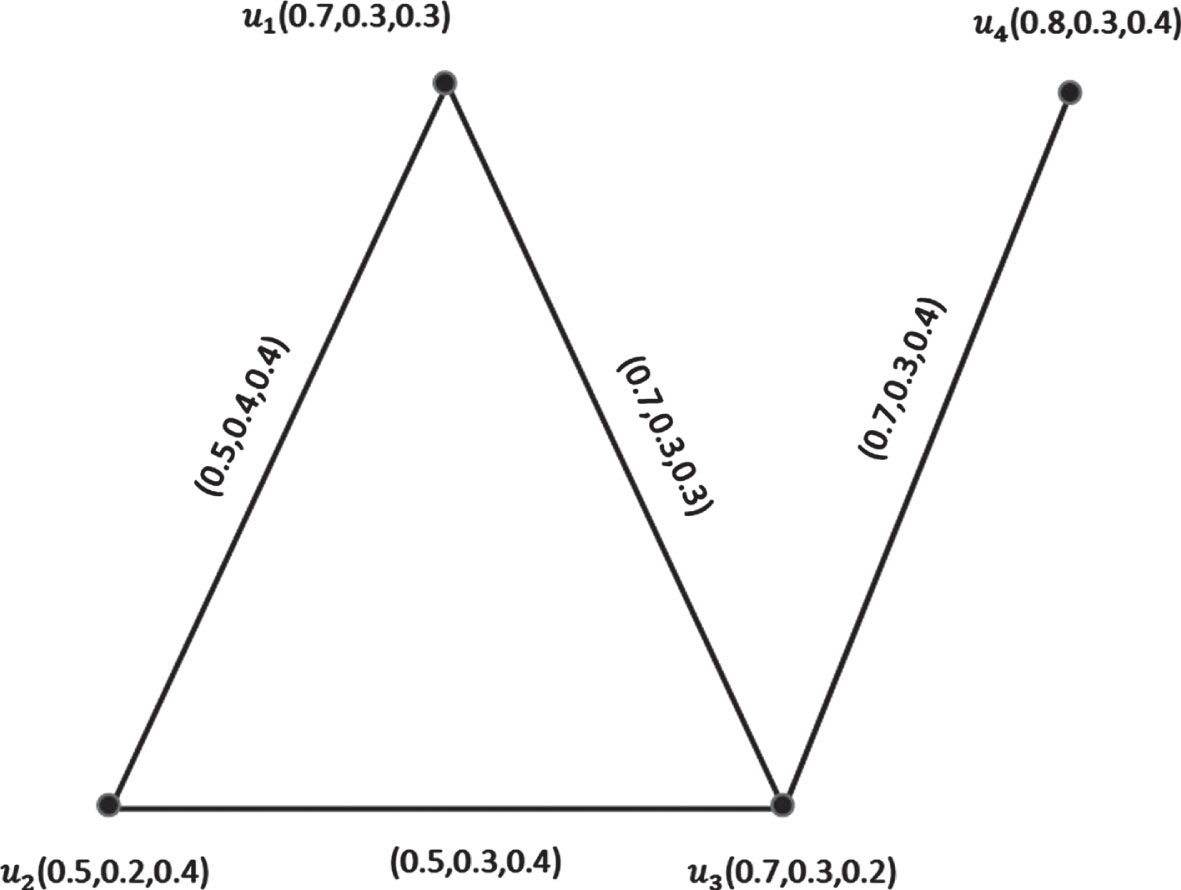
NG G.
Clear that, u1u3 and u3u4 are NHStAs. Obviously,
Proof. Let G be a complete NG on G*. Then for any
Proof. Let that for each
Proof. (⇒) From Theorem 3.8, it is clear. (⇐) Clearly, each arc of G is a NHStA. Let that
Proof. (i ⇔ iii) Set G is a SpING. If G does not have any NHStA, then all nodes of G have the hs-degrees equal to zero. That is a contradiction. Hence, G has a NHStA. Otherhand, if there are
Proof. If G does not have any NHStA, then all arcs and nodes of G have the hs-degrees equal to zero. If G has a NHStA c, then c is a unique NHStA in G. Hence, the proof is clear. □
Proof. Obviously, each arc of G is a NHStA. Assume that alternate arcs take the same membership values. Then,
(i) h (t) = t′ where t adjoining to vertices with distinguished hs-degrees in G1 and t′ adjoining to vertices with distinguished hs-degrees in G2, (ii) for any

SpINGs G1 and G2.
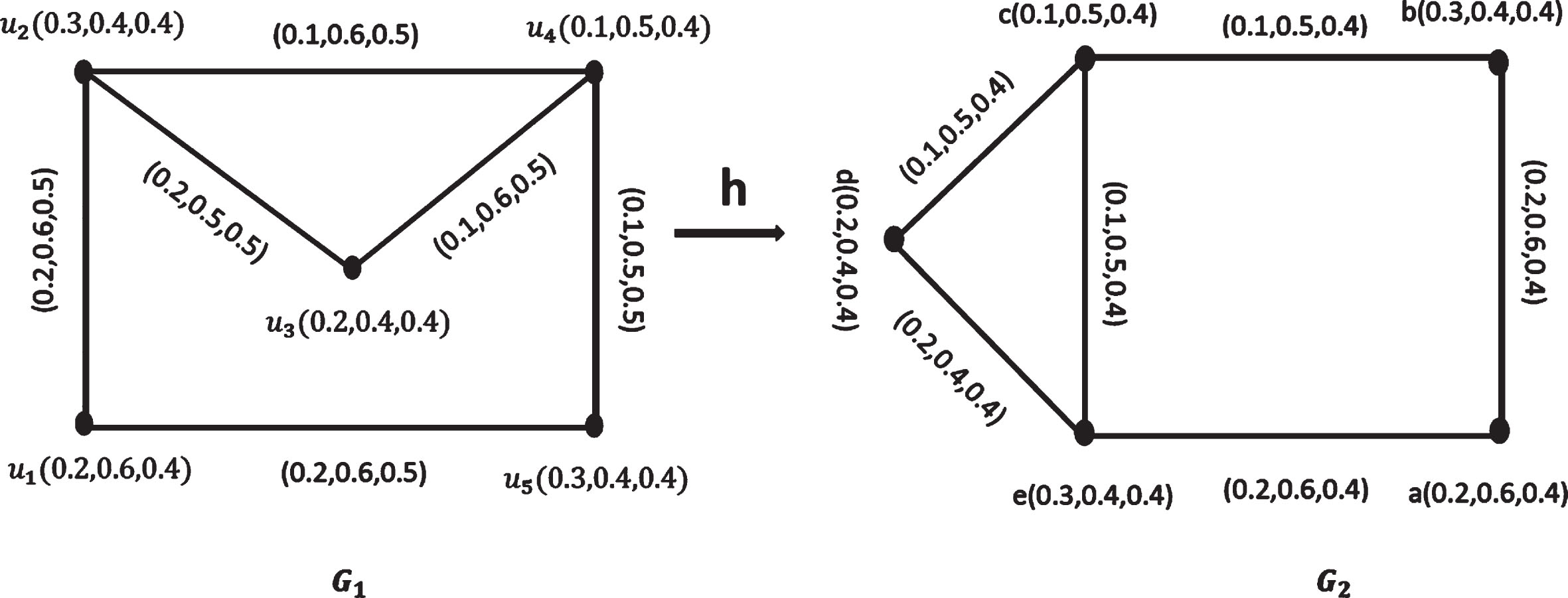
SpINGs G1 and G2.

SpINGs G1 and G2.
(i)
(ii)
Proof. (i) Assume that
(ii) Assume that
(i)
(ii)
Proof. Assume that
Proof. Assume that
Today, NG models are beneficial for modeling many real phenomena in diverse sciences and engineering fields. In this article, we present the idea of special isomorphic images in NG theory. The special isomorphic images of a neutrosophic network can be usages to dissolve many actual issues.
NG models are considered as efficacious, beneficial and widely used models in variant fields because they show more pliability than variant types of fuzzy graph models in dealing with actual issues. Monitoring activities and making decisions at different levels of the company with favorable efficiency criteria and prearranged efficiency ideals in the ashy situations between certitude and incertitude, performs a significant role in elevating the efficiency level and effectuality rate of a company. The set of influencing factors the efficiency of a company in the ashy situations between certitude and incertitude can be considered as NG. We describe the T-strength, I-strength and F-strength values in each node and arc (path) as follows. For any x, y ∈ V and xy ∈ E, we have: T
K
(r): The heaviness of the direct efficacy of factor r on the efficiency of the company in ashy situations. I
K
(r): The heaviness of the inefficacy of factor r on the efficiency of the company in ashy situations. F
K
(r): The heaviness of the indirect efficacy of factor r on the efficiency of the company in ashy situations. T
L
(rs): The heaviness of direct influence rs on the efficiency of the company in ashy situations. I
L
(rs): The heaviness of the inefficacy rs on the efficiency of the company in ashy situations. F
L
(rs): The heaviness of indirect influence rs on the efficiency of the company in ashy situations. Hereon, the next relationships beseem logical:
The relevance between r and s is efficient when the rs is a NHStA. Thus, the NSpDS of this graph contains factors that other factors are specially dominated with at least one of the elements (factors) of this set. Actually, the NSpDS creates a chance for officials and chiefs of the company to concentrate on the factors of the NSpDS and align decisions with these factors in lieu of paying attention and monitoring many influencing factors in ashy situations. This aids company chiefs and officials make the best decisions with the uttermost sureness in the shortest possible time.
As we saw in [8, 9], with strengthening the relevance between the influencing factors the efficiency of the company in the neutrosophic special dominating set or in the inverse neutrosophic special dominating set, the optimal normal heaviness of the factors graph in achieving the favorable efficiency can be elevated, which leads to increased exactitude and certitude in the decision-making process and the diminution of the neutrosophic node cardinality in NSpDS or inverse NSpDS. What is certain is that the heaviness of the impact of each of the influencing factors the efficiency of the company in different political, social, cultural, economic and etc situations varies. Nevertheless, officials and chiefs of a company often look to achieve a constant optimization model in different situations. This possibility seems to have been provided with special isomorphism images.
For example, in Fig. 6, the G neutrosophic graph and co-weak special isomorphisms are examined as factors graphs. It is noteworthy that the number of NStHAs, as well as the number of nodes of NSpDSs, are all constant and only the neutrosophic node cardinality of each node has changed according to political, social, cultural, economic, etc. situations.

NG G and co-weak special isomorphic images of G.
The theory of NGs has many applications in new science and technology. Since neutrosophic models show more accuracy, flexibility and compatibility than fuzzy and vague models, in this paper, special irregular and special arc-irregular neutrosophic graphs and some of their variants are presented and examined. Also discussed, some special situations in which irregularities are matched together are discussed. Finally, by using special isomorphic images of a special irregular neutrosophic graph, a model for optimizing the neutrosophic special domination number parameters were provided. In contrast, unlike models presented, the number of nodes of NSpDS as well as the neutrosophic special cobondage number parameter remains constant.