



Abstract
Many recent studies have shown that Euler’s elastica regularization performs better than the famous total variation (TV) regularization on keeping image features in smooth regions during the process of denoising. In addition, an adaptive weighted matrix combined with total variation is a key technique for well restoring local features of image. Considering these two factors, in this paper, we propose an adaptive Euler’s elastica model for Poisson image restoration so as to well preserve both image features in smooth regions and local features of image. To solve this non-smooth and non-convex model efficiently, we design an alternating direction method of multipliers. Experiments on both natural and synthetic images illustrate the effectiveness and efficiency of the proposed method over the state-of-the-art methods in Poisson restoration and denoising, respectively. In particular, for Poisson restoration, our proposed method improves the TV method up to 2.46 about PSNR for dealing with the Peppers image with Gaussian blur and noise level σ = 1. In addition, the proposed method for Poisson denoising gets higher PSNR and SSIM values than the TAC method, while costing less CPU time.
Keywords
Introduction
Noise and blur are inevitable in the process of image formation, image transmission and image display. It is very necessary to remove them through image restoration technology. Image restoration has received extensive attention in many application fields, such as astronomical and medical imaging, computer science, electronics and engineering [17, 28]. Its goal is to obtain a clear image u from the degraded image f. It is viewed as an inverse problem. Due to the lack of some prior information, this inverse problem is ill-posed. Therefore, many regularization techniques [1] have been widely studied to overcome this disadvantage. The variational regularization problem for image restoration can be constructed as follows:
In numerous practical applications, the obtained images are more vulnerable to Poisson noise. Different from the Gaussian noise, Poisson noise depends on the image intensity, which makes Poisson image restoration very challenging. The restoration models proposed for Gaussian noise are not effective in Poisson noise removal [18].
To remove Poisson noise effectively, the TV-based regularization models were proposed in [23, 45]. Owing to the desirable ability on edge-preserving of TV regularization, it has been widely used in image processing and computer vision [22, 36]. However, the main disadvantage of TV regularization is that it often produces staircase effects in the flat regions of the restored images, especially for piece-wise smooth images. In order to overcome the staircase effects, many improved models were proposed for Poisson image restoration. Specifically, in [14, 43], some HOTV-based regularizations were introduced. Compared with the TV regularization, these ones have better ability to maintain features in smooth regions. However, they usually result in blurring edges of restored images. To preserve edges while suppressing the staircase effects, a Poisson restoration model based on TGV regularization was proposed in [11]. Since the TGV regularization has the ability to construct the piece-wise polynomial function, the proposed model can describe intensity variations in smooth regions more precisely. On this basis, a directional TGV regularization [8] was proposed for Poisson image restoration. In [19], the authors integrated an anisotropic diffusion tensor into the TGV regularization and thus proposed an improved model for Poisson noise removal. This combination yielded a significant quality improvement visually and numerically. But the introduced diffusion tensor increases the computational burden, which needs more CPU time to optimize model. In terms of both preserving edges and overcoming the staircase effects, a non-convex EE model was presented for Gaussian noise removal [31]. This model can faster suppress the high frequency components of images. Thus, it can effectively alleviate the staircase effects and make the denoised images more natural. Due to its non-convexity, non-smoothness and nonlinearity, the solution of the EE model is a highly challenging task. To overcome these problems and reduce computational cost, several fast algorithms have been studied [13, 46]. Inspired by the advantages of EE regularization, we consider it for Poisson image restoration.
Generally, an image contains many different features. For the traditional TV-based models, the two subvariables in the gradient operator use the same weight. In this case, these models cannot effectively couple with local features of the image [12, 26]. Therefore, we hope that the proposed model can diffuse along the tangent direction of local features. To this end, Pang et al. [26] proposed an anisotropic TV (ATV) based on local information, which adds different weight to each component of the gradient operator. It can better describe the local features of image than other TV-based models. Inspired by this model, Wang et al. [33] constructed an anisotropic mean curvature model. This model combined the gradient operator with the adaptive weighted matrix in the mean curvature regularization term, and could describe the local features in image efficiently. In [20], the authors introduced a weighted anisotropic total variation (WATV) model for Gaussian image restoration, where a nonlinear and monotonically increasing function was used as the weight. In some special images, the texture details in images show obvious directionality. Thus, the designed model needs to be able to describe this geometric feature. The directional total variation (DTV) method which rotates the gradient operator by adding a rotation matrix can effectively couple with local structures of image [3, 40]. However, while processing some special images with several dominant directions, the ideal restoration effect will not be achieved by using previous DTV-based models. The reason is that one fixed angle parameter in the rotation matrix cannot simultaneously describe multiple dominant directions [25]. Considering this fact, by combining a rotation matrix, an adaptive weighted matrix and the TV p -quasinorm, the authors proposed an adaptive weighted TV p (AWTV p ) regularization model in [25]. The l p -quasinorm was used to promote the sparsity by setting p ∈ (0, 1). Specifically, the adaptive weighted matrix can enhance the diffusion along the tangential direction of the edge. Combining it with the rotation matrix, the proposed model can handle images with complex structures, which have several dominant directions. Motivated by [25], in our recent work, an adaptive weighted directional TV p (AWDTV p ) regularization was proposed for Poisson image restoration [42].
Different from traditional TV-based models, the adaptive TV-based models can obtain better restoration effect owing to the use of some adaptive weighted matrices. Specifically, they can effectively preserve image details. However, it still exists some problems while restoring smooth images. Considering the superior performance of EE model on overcoming the staircase effects and maintaining the structural information [30, 41], we designed an adaptive Euler’s elastica regularization model for Gaussian denoising [37]. The experimental results demonstrate that the proposed method can obtain the highest PSNR and SSIM values in most cases. In addition, it can improve the image contrast and suppress the staircase effects. Encouraged by the successful application of this regularization, in this paper, we construct a new adaptive Euler’s elastica regularization for Poisson image restoration.
As for tackling the optimization problem, several efficient numerical algorithms have been explored, such as the primal dual algorithm [35], the split Bregman method [29], the nonlinear multigrid method [44] and the alternating direction method of multipliers (ADMM) [7, 34]. In this paper, we adopt the ADMM which has been applied in numerous applications. The main contributions of this paper can be summarized as follows: The models related to Euler’s elastica energy are rarely used in Poisson image restoration. By integrating a new adaptive weighted matrix into the Euler’s elastica regularization, we develop an adaptive Euler’s elastica model with better adaptability and more stronger restoration ability. This combination can effectively overcome the staircase effects and preserve image details, even for some smooth images. Extensive experiments are carried out on natural and synthetic images to show the efficiency of our proposed model and algorithm. For Poisson image restoration, we compare with the TV model and the AWDTV
p
model, while the comparison of the model and the TAC model [46] is conducted for Poisson denoising.
This paper is organized as follows. Section 2 mainly gives a brief introduction of some previous related models. In Section 3, an adaptive Euler’s elastica model for Poisson image restoration is proposed. Section 4 presents an efficient ADMM for solving this model. Section 5 shows some experimental results on natural images and synthetic images for Poisson image restoration and denoising respectively, which demonstrate the effectiveness and efficiency of the proposed method. Finally, we draw some conclusions in Section 6.
In this section, we mainly introduce two previous related models for Poisson image restoration. Experiments on these two models will be carried out and compared with the experimental results of our proposed model.
TV model
As is well-known, the TV regularization was first proposed by Rudin et al. in [27] for removing Gaussian noise, which has been used in many fields such as image restoration, image inpainting, medical image reconstruction and so on. Particularly, the TV-based Poisson restoration model [23, 45] can be described as
In our recent work [42], an adaptive weighted directional TV p regularization was designed for Poisson restoration. The AWDTV p model is formulated as
For handling images which have obvious directionality, it is very useful to add a rotation matrix to rotate the gradient operator. When the image has several dominant directions, it needs to further combine the adaptive weighted matrix with the rotation matrix so as to get better recovery results. Besides, the l p -quasinorm used in model (2.2) is to promote gradient sparsity.
Although the TV-based models can effectively preserve image edges, it fails to restore smooth images. It often causes staircase effects in flat regions. To overcome this problem, some high-order regularization models were proposed, including the popular curvature regularization. Inspired by the successful application of curvature regularization, in this section, we construct a new Poisson restoration model by adding an adaptive weighted matrix to the Euler’s elastica regularization.
In order to obtain restored images with high quality, the following model based on an adaptive Euler’s elastica regularization is proposed for Poisson restoration:
Since the minimization problem (3.1) is non-convex and non-smooth, we will face some numerical difficulties while solving it. To deal with this problem, we design an efficient alternating direction method of multipliers (ADMM), which can decompose a large global problem into a series of smaller local subproblems and then use local solutions to calculate the solution of the original problem [2, 5].
We first introduce three auxiliary variables
To solve the constrained problem (4.1), we introduce three Lagrangian multipliers
ADMM for solving (3.1)
1: Input: a blurred noisy image f
2: Parameters: λ, ι, δ, β, α, nMax, and ɛ ∈ mathdsR
3: Initialize: u0 = f, q0,
4:
5: Assign n by n + 1
6: If ∥u n - un-1 ∥ 2/∥ u n ∥ 2 ≤ ɛ, stop the iteration
7:
8:
In Algorithm 1, the efficiency for solving the optimization problem relies on how to solve the subproblems with high accuracy. The above subproblems all have explicit solutions. Under periodic boundary condition, the equation (4.5) can be solved efficiently by the fast Fourier transform (FFT) in the following way:
In this section, the proposed model for Poisson image restoration called AEEPR is compared with TV model [29] and AWDTV p model [42]. Especially, two types of blur and two noise levels are tested to show the superiority of the proposed model. In addition, we apply the proposed method to Poisson image denoising and compare it with the previous curvature regularization model proposed recently in [46]. All the numerical experiments are conducted via MATLAB on a windows 10 (64bit) desktop computer with 2.90 GHz Intel(R) Core(TM) i7-10700 CPU and 32 GB RAM.
To assess the quality of restored images, two evaluation indexes are utilized, i.e. the peak signal-to-noise ratio (PSNR) and the structural similarity (SSIM). They are defined as follows:
Six test images including natural images (“Peppers” (256 × 256), “Lena” (256 × 256), “Barbara” (512 × 512)) and synthetic images (“Dot” (256 × 256), “Shape” (128 × 128), “Triangle” (254 × 214)) are selected in experiments, as shown in Fig. 1.

Test images.
For Poisson image restoration, there are some parameters in the proposed model and algorithm. For all parameters, we adopted a trial-and-error way to gradually adjust so as to determine the optimal parameter set that yielded the highest PSNR value. During the experiments, we first set several values of λ into a bigger range as [a, b]. Then we find the related λ value through the obtained maximum PSNR value to determine a suitable subset [a1, b1] ⊂ [a, b]. By repeating this strategy many times, we can find a more appropriate parameter value in subset [a i , b i ]. When the difference between successive PSNR values is smaller than 0.01, we set this corresponding parameter value as the selected value of λ. And in turn, we use the same strategy for the choice of other parameters until the PSNR value almost unchanges during the cycle. The same strategy is employed to tune the parameters of the other two methods. During the parameters adjustment, the algorithms are terminated when the stopping criterion is satisfied. It is worth noting that in the process of parameters adjustment, we found that only a few parameters significantly affect the results. Generally, restoration results mainly depend on the regularization parameter λ, which is used to control the balance between the fidelity term and the regularization term. Besides, the main function of ι is to control the local adaptivity, δ is the standard deviation, and the weighted parameter β can enhance the diffusion. The positive parameter α can balance the effect of the curvature term on the length.
We compare the proposed AEEPR with TV and AWDTV
p
for Poisson image restoration. The matlab functions
The optimal values of parameters for different restoration models under different blur kernels and noise levels are listed in Table 1. The number of parameters used in the AEEPR model (3.1) is less than that of AWDTV p model (2.2). In these two models, the optimal values of the same parameters are taken in the same range. Table 2 records the PSNR and SSIM values of three methods for two natural and two synthetic images, and the corresponding CPU time and number of iterations are displayed in Table 3.
Selected parameter sets for different restoration models under different blur kernels and noise levels
Selected parameter sets for different restoration models under different blur kernels and noise levels
PSNR and SSIM obtained by different restoration models
CPU time and number of iterations for different restoration models
From Table 2, we observe that AEEPR and AWDTV p obtain almost the same PSNR and SSIM values, which are much higher than TV. For instance, AEEPR improves the TV up to 2.46 about PSNR for dealing with the Peppers image with Gaussian blur and noise level σ = 1. In addition, Table 3 shows that our AEEPR costs less CPU time than AWDTV p in getting almost the same PSNR and SSIM values, especially in the case of higher noise level with the same blur.
To assess the visual quality of restored images obtained by different methods, we present the restored images and the locally enlarged images for two natural images in Figs. 3, while showing restored images and residual images f - u for two synthetic images in Figs. 5. From these figures, we can see that all methods remove most of the noise and obtain good recovery effects. However, the TV method produces obvious staircase effects in the flat regions, especially for the “Peppers" and “Lena" images. Obviously, the AEEPR and the AWDTV p methods effectively overcome the staircase effects while retaining a lot of image details, such as neat edges and smoother regions. In particular, we observe this from a close-up of the nose and the head regions of “Lena" image. Figures 5 show that AEEPR and AWDTV p remove more blur and noise than TV. On the whole, the AEEPR has better performance on restoring degraded images and costs less CPU time.
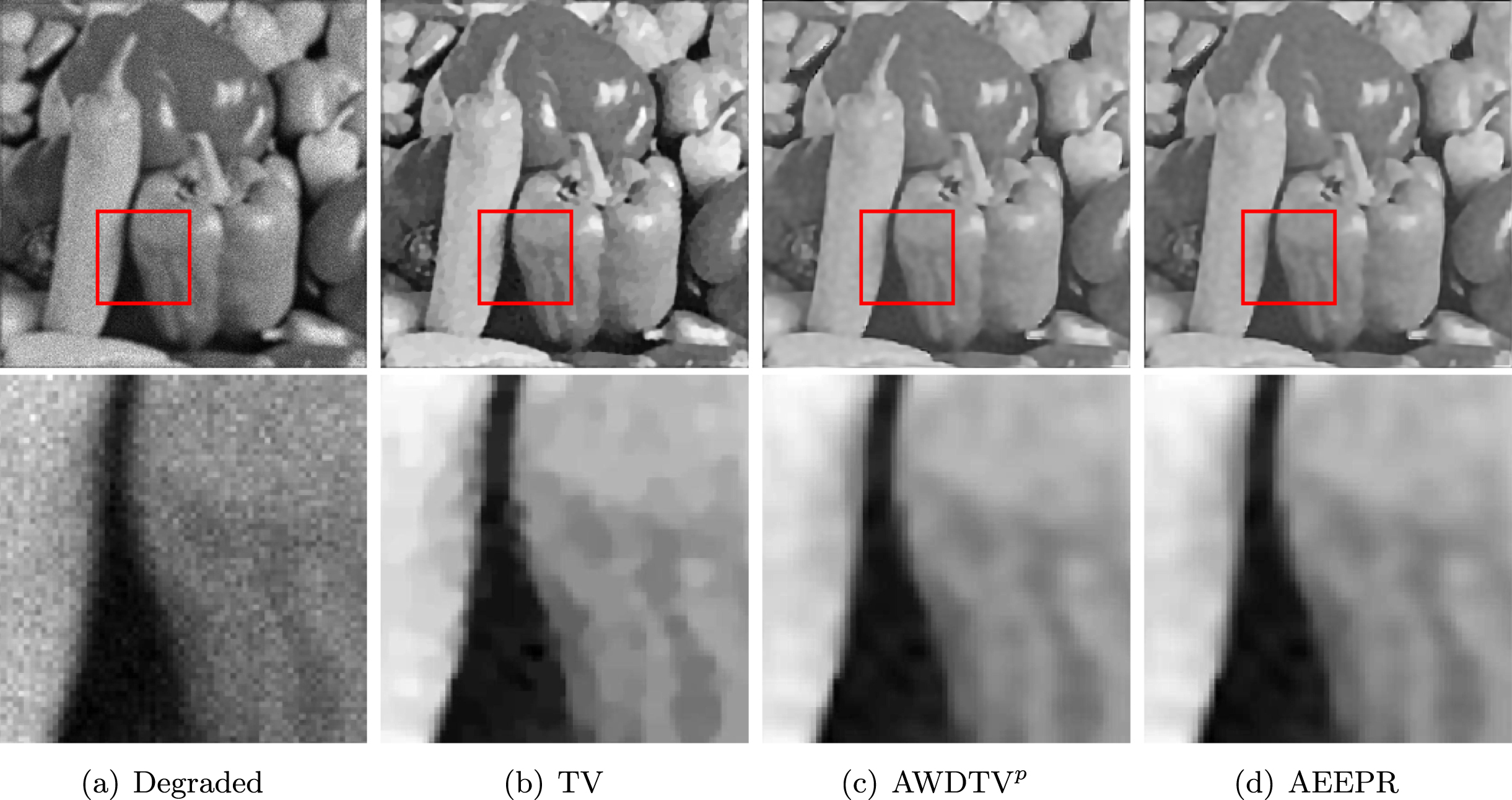
Restored “Peppers” images and locally enlarged images obtained by different restoration models under Gaussian blur and noise level σ = 1.

Restored “Lena” images and locally enlarged images obtained by different restoration models under motion blur and noise level σ = 5.

Restored “Dot” images and their corresponding residual images generated by different restoration models under Gaussian blur and noise level σ = 5.

Restored “Shape” images and their corresponding residual images generated by different restoration models under motion blur and noise level σ = 5.
At last, we empirically demonstrate the convergence of our proposed algorithm. We consider the case of Gaussian blur and noise level σ = 1, and the one of motion blur and noise level σ = 5. Furthermore, all four images are tested by Algorithm 4.1. From Figs. 7, all the plots of PSNR increase rapidly with respect to the CPU time while their plots of energy and relative error decrease accordingly. Thus, we can also draw a conclusion that our AEEPR is convergent.

The plots of PSNR, relative error and energy versus CPU time for our AEEPR model under Gaussian blur and noise level σ = 1.

The plots of PSNR, relative error and energy versus CPU time for our AEEPR model under motion blur and noise level σ = 5.
In this subsection, some Poisson denoising examples are given to further illustrate the advantages of our proposed regularization method. Especially, we compare with the TAC method proposed recently in [46]. The specific implementation is as follows.
Adaptive Euler’s elastica model
When K = I, the AEEPR model (3.1) is reduced to a Poisson denoising model called AEEPD, which can be written as follows:
To solve this minimization problem, we introduce two auxiliary variables
As a comparison, the variational model based on curvature regularization proposed in [46] is described as
Specifically, two auxiliary variables
The
The q-subproblem has a closed form solution, which can be given by
According to the optimality conditions, it is easy to derive the Euler-Lagrange equation of the u-subproblem. Assume periodic boundary condition and then use the fast Fourier transform (FFT) to solve this equation, one can get
In experiments, the “Barbara" and “Triangle" images presented in Fig. 1 are chosen as the test images to show the competitive performance of AEEPD over the TAC method. The testing data are generated by adding Poisson noise with noise level σ = 1 or 5. The related numerical results for Poisson denoising are arranged in Table 4. Specifically, we show the restored “Barbara" images and the corresponding residual images at noise level σ = 1 in Fig. 8. At this moment, the optimal values of parameters used for the TAC method are λ = 38, α = 0.27, μ1 = 0.39, μ2 = 7, while the parameters of our AEEPD are set to be λ = 22, α = 0.24, ι = 0.0019, δ = 0.1, β = 0, γ1 = 0.006, γ2 = 2.7. In addition, the related visual results at noise level σ = 5 for the “Triangle" image are displayed in Fig. 9. Here, we choose λ = 2.5, α = 0.45, μ1 = 0.36, μ2 = 8 for the TAC method and λ = 5.14, α = 0.1, ι = 0.0002, δ = 0.5, β = 0, γ1 = 0.0035, γ2 = 0.1 for AEEPD, respectively.
Numerical results for Poisson denoising
Numerical results for Poisson denoising

(a), (c) Restored “Barbara” images by TAC and AEEPD; (b), (d) their corresponding residual images respectively; (e), (f), (g) the plots of PSNR, relative error and energy versus CPU time (under noise level σ = 1).

(a), (c) Restored “Triangle” images by TAC and AEEPD; (b), (d) their corresponding residual images respectively; (e), (f), (g) the plots of PSNR, relative error and energy versus CPU time (under noise level σ = 5).
From Figs. 9, the restored images obtained by TAC are not as natural as AEEPD, and more noise are removed by AEEPD. This is owing to the use of the adaptive weighted matrix. We observe from Table 4 that our AEEPD method gets higher PSNR and SSIM values than the TAC method, while spending less CPU time. Also, this can be easily seen from the plots of PSNR versus CPU time in Figs. 9. Simultaneously, the plots of relative error and energy versus CPU time show evidences of algorithmic convergence.
In this study, we proposed an adaptive Euler’s elastica Poisson restoration model via an adaptive weighted matrix. The proposed model was solved by an efficient ADMM, where all the subproblems had explicit solutions. Numerical experiments on both natural and synthetic images demonstrated the effectiveness and superior performance of our proposed method by comparing with other state-of-the-art methods.
From the perspective of practical implication, the proposed regularization method can be applied to other problems in image processing and computer vision, such as image segmentation, hyperspectral unmixing and hyperspectral image fusion. A limitation is that a convergence theory for the proposed method is not given, although we conducted a convergence analysis. In the future, we will study the relevant convergence theory.
Data availability
The data used to support the findings of this study are available from the corresponding author upon request.
Competing interests
The authors declare that they have no competing interests.
Conflicts of interest
The authors declare that they have no conflicts of interest.
Funding
This work was partly supported by the Natural Science Foundation of Jiangxi Province (20192BAB211005).