



Abstract
In this paper, we firstly extend C. C. chang’s distance functions from MV-algebras into residuated lattices. But in general, the functions may not be a distance function on residuated lattices. We introduce weak involutory residuated lattices, in which Chang’s function is a pseduo distance function. Moreover we prove that the functions become distance functions on involutory residuated lattices. Secondly by use of the function and a lattice filter, we define F-ball on residuated lattices, and we prove that the set of all F-balls forms a base of a topology τ LF on an involutory residuated lattice. Moreover we show that the topology τ LF on an involutory residuated lattice L makes L to be a topological residuated lattice. At last, we use filters instead of lattice filters to set up filter topologies on an involutory residuated lattice, and study the properties of the filter topologies.
Introduction
In order to have more than two values for evaluation of formulas, a lot of work has been done to generalize the classical algebra for logic. On this way, a special structure, namely residuated lattices, is a very basic and important algebraic structure. Many kinds of non-classical logical algebras, such as MTL-algebra, IMTL-algebra, BL-algebra, Heyting algebra and MV-algebra can be constructed based on residuated lattices. In [6], P. Hájek introduced the notion of BL-algebra as a residuated lattice with two more conditions, namely divisibility and prelinearity.
In [18], the notion of co-annihilators was introduced by Turunen in BL-algebras and some of its properties were studied. In [7], with the help of co-annihilators, M. Haveshki proposed the concept of α-filters in BL-algebras which was inspired by the dual notion of α-ideal from the lattice theory [4].
In 2017, Luan and Yang [9] applied proper lattice filters of an MV-algebra to construct a topology and called it filter topology. They showed that, each filter topology on an MV-algebra making it a topological MV-algebra. Also, using some new types of sequences in MV-algebras, they observed that a 2-divisible MV-algebra is semisimple if and only if it is Hausdorff with respect to any 2-divisible lattice filter. In addtion, there is another way to induce topologies. By two novel norms, topology is induced on neutrosophic soft set, and some topological properties are discussed in [17].
In 2019, Di Nola etc. [5] studied topological spaces of monadic MV-algebras and constructed a covariant functor γ from the category of monadic MV-algebras into the category of Q-distributive lattices, i.e., distributive lattices with quantifier introduced by R. Cignoli. For every monadic MV-algebra, they constructed a dual object named QM-space, and these objects formed a special subcategory of spectral spaces and of Q-spaces developed by R. Cignoli for Q-distributive lattices.
In 2019, Asadzadeh etc. [3] studied some basic facts and some notable examples, including the standard MV-algebra. Then authors showed that every filter topology on a finite MV-chain and also finite simple MV-algebra is discrete. Moreover, they completely described the shape of open sets in the filter topology which generated by a proper filter. This description applies to present basic topological properties of a large class of filter topologies. As an application, they characterized an algebraic property of MV-algebras: an MV-algebra is bipartite if and only if it has a proper filter which generates a filter topology with exactly four open sets.
A (semi)topological residuated lattice is introduced. By means of the inverse limit of an inverse system, completion of a residuated lattice is characterized in [14]. By a lattice ideal and a distance function on an involutive residuated lattice, Wang and Zhao constructed a semitopological residuated lattice in [19]. However in our paper, we use lattice filter and distance function to construct a toplogical residuated lattice, which is more strong than the above result. There is also a close relationship between topology and rough sets. By using a more general topology, authors [1, 2] designed new rough set models with better measurements, and applied the models to disease diagnosis, achieving good diagnostic results.
In this paper, we firstly extend C. C. chang’s distance functions from MV-algebras into residuated lattices. But in general, the functions may not be a distance function on residuated lattices. We introduce weak involutory residuated lattices, in which Chang’s function is a pseduo distance function. Moreover we prove that the functions become distance functions on involutory residuated lattices. Secondly by use of the function and a lattice filter, we define F-ball on residuated lattices, and we prove that the set of all F-balls forms a base of a topology τ LF on an involutory residuated lattice. Moreover we show that the topology τ LF on an involutory residuated lattice L makes L to be a topological residuated lattice. At last, we use filters instead of lattice filters to set up filter topologies on an involutory residuated lattice, and study the properties of the filter topologies.
Preliminaries
In this section, we give some notions and results in residuated lattices, which will be used in the following sections of this paper.
(1) (L, ∧ , ∨ , 0, 1) is a bounded lattice relative to the order ≤;
(2) (L, ⊙ , 1) is a commutative monoid;
(3) x ⊙ y ≤ z if and only if x ≤ y → z, for all x, y, z ∈ L.
In the following, we denote a residuated lattice (L, ∧ , ∨ , ⊙ , → , 0, 1) by L unless specified.
For a ∈ L and a natural number n, we define a n = an-1 ⊙ a for n ≥ 1 and ¬a = a → 0.
1 → x = x, x → 1 =1, x ≤ y if and only if x → y = 1, x ⊙ ¬ x = 0, and x ⊙ y = 0 if and only if x ≤ ¬ y, (x ∨ y) → z = (x → z) ∧ (y → z), x ⊙ (x → y) ≤ y, x ⊙ y ≤ x ∧ y, x ≤ y → x, x → (y → z) = (x ⊙ y) → z = y → (x → z), x ≤ y implies ¬y ≤ ¬ x, ¬0 =1, ¬1 =0, x ≤ ¬¬ x and ¬x = ¬¬ ¬ x, x ∨ (y ⊙ z) ≥ (x ∨ y) ⊙ (x ∨ z), x ⊙ (y ∨ z) = (x ⊙ y) ∨ (x ⊙ z), x ≤ y implies y → z ≤ x → z and z → x ≤ z → y, x ≤ (x → y) → y and y ≤ (x → y) → y, x ≤ y implies x ⊙ z ≤ y ⊙ z.
If for all x ∈ L, ¬¬ x = x, then L is called an involutory residuated lattice.
(1) a Rl-monoid if x ∧ y = x ⊙ (x → y) for any x, y ∈ L,
(2) a Heyting algebra if x ⊙ y = x ∧ y = x ⊙ (x → y) for any x, y ∈ L.
(1) x, y ∈ F implies x ⊙ y ∈ F,
(2) x ∈ F, y ∈ L and x ≤ y implies y ∈ F.
For any nonempty subset X of L, the least filter containing X is called the filter generated by X, which is denoted by 〈X〉. From [13], we get 〈X〉 = {x ∈ L|x ≥ x1 ⊙ x2 ⊙ ·· · ⊙ x n , x i ∈ X, i = 1, 2 ·· · , n}. For any a ∈ L, we call 〈 {a} 〉 the principal filter of L, denoted by 〈a〉. Then 〈a〉 = {x ∈ L|x ≥ a n }.
(a) F is said to be proper if F ≠ L.
(b) A proper filter is said to be prime if for all x, y ∈ L, x ∨ y ∈ F implies x ∈ F or y ∈ F.
(c) A proper filter F of L is said to be maximal if for any other proper filters P of L, F ⊆ P implies F = P.
(d) A prime filter P is called minimal if it is the minimal element in the class of all prime filters.
(e) A filter F is called a Boolean filter, if for all x ∈ L, x ∨ x∗ ∈ F.
(f) A filter F is called a positive implicative filter if (i) 1 ∈ F; (ii) for all x, y, z ∈ L, x → (y → z) ∈ F and x → y ∈ F imply x → z ∈ F.
(g) A filter F is called implicative if 1 ∈ F and x → ((y → z) → y) ∈ F and x ∈ F imply that y ∈ F.
(h) A proper filter F is called obstinate if for all x, y ∉ F, x → y ∈ F and y → x ∈ F.
(i) F is a maximal and Boolean filter(positive implicative filter,implicative filter),
(ii) F is a prime and Boolean filter (positive implicative filter,implicative filter),
(iii) F is an obstinate filter.
(Weak) involutory residuated lattices and distance functions
In this section, weak involutory residuated lattices are introduced. Some properties of weak involutory residuated lattices are given. Especially we introduce a metric function on weak involutory residuated lattices.
In any residuated lattice L, we define binary operations ⊕ and ⊖ by x ⊕ y = ¬ (¬ x ⊙ ¬ y) and x ⊖ y = x ⊙ ¬ y for any x, y ∈ L, respectively.
(1) x ⊕ y ≥ x;
(2) x ⊖ y ≤ x;
(3) x ⊕ 0 = ¬¬ x. If L is involutory, then x ⊕ 0 = x;
(4) x ⊖ 0 = x;
(5) x ⊖ z ≤ (x ⊖ y) ⊕ (y ⊖ z);
(6) (x ⊕ y) ⊖ y ≤ ¬¬ x. If L is involutory, then (x ⊕ y) ⊖ y ≤ x;
(7) x ∗ y ≤ x ⊕ y, for ∗ ∈ {⊙ , ∨ , ∧}.
(2)-(4) Straightforward.
(5) Since y ⊙ ¬ z ⊙ ¬ (y ⊙ ¬ z) =0, then we have ¬z ⊙ ¬ (y ⊙ ¬ z) ≤ ¬ y. Therefore (x ⊖ z) ⊙ (¬ (x ⊖ y) ⊙ ¬ (y ⊖ z)) = (x ⊙ ¬ z) ⊙ (¬ (x ⊙ ¬ y) ⊙ ¬ (y ⊙ ¬ z)) = x ⊙ ¬ (x ⊙ ¬ y) ⊙ ¬ z ⊙ ¬ (y ⊙ ¬ z) ≤ x ⊙ ¬ (x ⊙ ¬ y) ⊙ ¬ y = 0. It follows that x ⊖ z ≤ (¬ (x ⊖ y) ⊙ ¬ (y ⊖ z)) →0 = ¬ (¬ (x ⊖ y) ⊙ ¬ (y ⊖ z)) = (x ⊖ y) ⊕ (y ⊖ z).
(6) Note that ((x ⊕ y) ⊖ y) ⊙ ¬ x = ¬ (¬ x ⊙ ¬ y) ⊙ ¬ y ⊙ ¬ x = 0, we have (x ⊕ y) ⊖ y ≤ ¬¬ x.
(7) Straightforward. □
The following lemma shows the interplay between algebra and order.
(1) x ⊕ z ≤ y ⊕ z;
(2) x ⊖ z ≤ y ⊖ z;
(3) z ⊖ y ≤ z ⊖ x.
(2) Let x ≤ y. Then x ⊖ z = x ⊙ ¬ z ≤ y ⊙ ¬ z = y ⊖ z. Similarly we can prove z ⊖ y ≤ z ⊖ x.
(3) Similarly to (2). □
We can easily find that L is a W-I-residuated lattice, but it is not an involutory residuated lattice since ¬¬ a = 1 ≠ a.
Now we give a example to show that a residuated lattice may not be a W-I-residuated lattice.
(1) ¬¬ (¬ x ⊙ ¬ y) = ¬ x ⊙ ¬ y;
(2) ¬x ⊙ ¬ y = ¬ (x ⊕ y);
(3) x ≤ (x ⊖ y) ⊕ y;
(4) (x ⊕ y) ⊕ z = x ⊕ (y ⊕ z);
(5) x ⊖ (y ⊕ z) = (x ⊖ y) ⊖ z.
(2) By (1), we have ¬ (x ⊕ y) = ¬¬ (¬ x ⊙ ¬ y) = ¬ x ⊙ ¬ y.
(3) Since x ⊙ ¬ y ⊙ ¬ (x ⊙ ¬ y) =0, we have x ≤ (¬ y ⊙ ¬ (x ⊙ ¬ y)) →0, and hence x ≤ ¬ (¬ y ⊙ ¬ (x ⊙ ¬ y)) = ¬ (¬ y ⊙ ¬ (x ⊖ y)) = (x ⊖ y) ⊕ y.
(4) By (1), (x ⊕ y) ⊕ z = ¬ (¬¬ (¬ x ⊙ ¬ y) ⊙ ¬ z) = ¬ ((¬ x ⊙ ¬ y) ⊙ ¬ z) = ¬ (¬ x ⊙ (¬ y ⊙ ¬ z)) = x ⊕ (y ⊕ z).
(5) By (2), we have (x ⊖ y) ⊖ z = (x ⊙ ¬ y) ⊙ ¬ z = x ⊙ (¬ y ⊙ ¬ z) = x ⊙ ¬ (y ⊕ z) = x ⊖ (y ⊕ z). □
(1) ¬y ≤ ¬ x;
(2) ¬¬ x ≤ ¬¬ y;
(3) x ⊖ y = 0;
(4) ¬ (¬ x ⊕ y) =0.
(2) ⇒ (1) Let ¬¬ x ≤ ¬¬ y. By (8) and (9) in Lemma 2.2, we have ¬y ≤ ¬ x.
(2) ⇒ (3) Let ¬¬ x ≤ ¬¬ y. Then ¬y = ¬¬ ¬ y ≤ ¬¬ ¬ x = ¬ x. Moreover x ⊖ y = x ⊙ ¬ y ≤ x ⊙ ¬ x = 0 by Lemma 2.2(3), and hence x ⊖ y = 0. We get (3).
(3) ⇒ (2) Let x ⊖ y = 0. Then x ⊙ ¬ y = 0 and hence x ≤ ¬ y → 0 = ¬¬ y. This shows that ¬y = ¬¬ ¬ y ≤ ¬ x, and hence ¬¬ x ≤ ¬¬ y.
(2)⇒(4) Let ¬¬ x ≤ ¬¬ y. Then ¬y ≤ ¬ x and hence ¬ (¬ x ⊕ y) = ¬¬ x ⊙ ¬ y ≤ ¬¬ x ⊙ ¬ x = 0 by Lemma 2.2(3) and Proposition 3.7(1). So we get ¬ (¬ x ⊕ y) =0.
(4)⇒(2) Let ¬ (¬ x ⊕ y) =0. By Proposition 3.7(1), we have ¬¬ x ⊙ ¬ y = 0 and thus ¬¬ x ≤ ¬¬ y. □
In the following we extend the Chang’s distance function to residuated lattices. Let L be a residuated lattice. Define a binary operation d : L × L → L on L by d (x, y) = (x ⊖ y) ⊕ (y ⊖ x) for all x, y ∈ L.
The following example to show that in general, d may not be a distance function on residuated lattice.
(1) d (x, y) ≤ d (¬ x, ¬ y). If L is involutory, then d (x, y) = d (¬ x, ¬ y);
(2) d (x, y) ≤ d (¬¬ x, ¬¬ y). If L is involutory, then d (x, y) = d (¬¬ x, ¬¬ y);
(3) d (x, x) =0;
(4) d (x, 0) = ¬¬ x. If L is involutory, then d (x, 0) = x;
(5) d (x ⊕ t, t ⊕ y) ≤ d (¬ x, ¬ y). If L is involutory, then d (x ⊕ t, t ⊕ y) ≤ d (x, y).
(2) It follows from (1).
(3) Since x ⊖ x = x ⊙ ¬ x = 0, we have d (x, x) = (x ⊖ x) ⊕ (x ⊖ x) =0 ⊕ 0 = ¬ (¬0 ⊙ ¬0) = ¬ (1 ⊙ 1) =0.
(4) By Lemma 3.1(3), we have d (x, 0) = (x ⊖ 0) ⊕ (0 ⊖ x) = (x ⊙ 1) ⊕0 = ¬¬ x.
(5) It follows from Lemma 3.1(6) and Proposition 3.7(5) that d (x ⊕ t, t ⊕ y) = ((x ⊕ t) ⊖ (t ⊕ y)) ⊕ ((t ⊕ y) ⊖ (x ⊕ t))
= (((x ⊕ t) ⊖ t) ⊖ y) ⊕ (((t ⊕ y) ⊖ t) ⊖ x)
≤ (¬¬ x ⊖ y) ⊕ (¬¬ y ⊖ x)
= (¬¬ x ⊙ ¬ y) ⊕ (¬¬ y ⊙ ¬ x)
= (¬ y ⊖ ¬ x) ⊕ (¬ x ⊖ ¬ y)
= d (¬ x, ¬ y).
If L is involutory, we have d (x ⊕ t, t ⊕ y) ≤ d (x, y) by Proposition 3.11(1). □
(1) d (x, y) ≥0, and d (x, y) =0 if and only if ¬¬ x = ¬¬ y if and only if ¬x = ¬ y;
(2) d (x, y) = d (y, x);
(3) d (x, z) ≤ d (x, y) ⊕ d (y, z).
(4) d (x ⊕ s, y ⊕ t) ≤ d (¬ x, ¬ y) ⊕ d (¬ s, ¬ t). If L is involutory, then d (x ⊕ s, y ⊕ t) ≤ d (x, y) ⊕ d (s, t).
(2) It is clear.
(3) By use of Lemma 3.1(5) and Proposition 3.7(4), we have d (x, y) ⊕ d (y, z) = (x ⊖ y) ⊕ (y ⊖ x) ⊕ (y ⊖ z) ⊕ (z ⊖ y) = (x ⊖ y) ⊕ (y ⊖ z) ⊕ (y ⊖ x) ⊕ (z ⊖ y) ≥ (x ⊖ z) ⊕ (z ⊖ x) = d (x, z).
(4) By Propositions 3.11(5) and 3.12(3), we have
d (x ⊕ s, y ⊕ t)
≤d (x ⊕ s, s ⊕ y) ⊕ d (s ⊕ y, y ⊕ t)
≤d (¬ x, ¬ y) ⊕ d (¬ s, ¬ t).
If L is involutory, it follows from Proposition 3.11(1) that d (x ⊕ s, y ⊕ t) ≤ d (x, y) ⊕ d (s, t). □
(1) d (x, y) ≥0, and d (x, y) =0 if and only if x = y;
(2) d (x, y) = d (y, x);
(3) d (x, z) ≤ d (x, y) ⊕ d (y, z).
Therefore d is a distance function on L.
A non-empty subset F of a poset (P, ≤) is called an order filter if and only if x ∈ F and x ≤ y imply y ∈ F, also we call F is upwards closed with respect to ≤.
(1) If x ⊖ y ∈ F, then x, ¬ y ∈ F;
(2) If x ⊙ y ∈ F, then x, y ∈ F.
(2) Let x ⊙ y ∈ F. Since x ⊙ y ≤ x, y, we have x, y ∈ F. □
Lattice filter topologies on residuated lattices
In this section, by use of lattice filter F and distance function, we define the F-balls which induce a topology τ LF on residuated lattice L. Moreover we study properties of the F-balls and the topology τ LF . Finally we obtain a sufficient and necessary condition for (L, τ LF ) being a topological residuated lattice.
We denote by F (L) and L (L) respectively the set of all proper filters of L and the set of all proper lattice filters of L. Let us note that, from the inequality x ⊙ y ≤ x ∧ y for all x, y ∈ L, we obtain F (L) ⊆ L (L), and the inclusion is proper as the following example shows.
Then we can see that L is a residuated lattice. We can easily get that F = {d, 1} is a lattice filter but it is not a filter since d ⊙ d = c ∉ F.
It follows that r ⊖ d (x, a) ∈ F and thus x ∈ ∪ a,r. Similar arguments imply that x ∈ ∪ b,R. This shows that ∪z0,ɛ ⊆ ∪ a,r ∩ ∪ b,R. Hence the open F-balls form a base of a topology on L. □
Recall that a topological residuated lattice is a residuated lattice and a topological space such that the operations ∧, ∨, ⊙ and → are continuous.
(1) The operation ⊕ is continuous on lattice filter topology τ LF , iff for each r ∈ F there exists s ∈ F such that for any x ∈ L, s ⊖ x ∈ F implies r ⊖ (x ⊕ x) ∈ F.
(2) The operation ¬ is continuous on lattice filter topology τ LF .
(3) The operation ∨ is continuous on lattice filter topology τ LF if for each r ∈ F there exists s ∈ F such that for any x ∈ L, s ⊖ x ∈ F implies r ⊖ (x ⊕ x) ∈ F.
(2) We prove that the operation ¬ is continuous. Let ∪0 be an open F-ball of radius ɛ around ¬x0, where x0 ∈ L and ɛ ∈ F, and let V0 be an open F-ball of radius ɛ around x0. For any x ∈ V0, we have ɛ ⊖ d (x, x0) ∈ F, and thus, by Proposition 3.11(1), we get ɛ ⊖ d (x, x0) = ɛ ⊖ d (¬ x, ¬ x0). Therefore ɛ ⊖ d (¬ x, ¬ x0) ∈ F, and hence ¬x ∈ ∪ 0. It follows that ¬ (V0) ⊆ ∪ 0. Hence we prove that ¬ is continuous.
(3) We prove that the operation ∨ is continuous. Now we prove d (x ∨ y, a ∨ b) ≤ d (x, a) ⊕ d (y, b) for any x, y, a, b ∈ L. By Lemma 2.2(11) and Lemma 3.1(7), we have
d (x ∨ y, a ∨ b)
= ((x ∨ y) ⊖ (a ∨ b)) ⊕ ((a ∨ b) ⊖ (x ∨ y))
= ((x ∨ y) ⊙ ¬ (a ∨ b)) ⊕ ((a ∨ b) ⊙ ¬ (x ∨ y))
= ((x ⊙ ¬ (a ∨ b)) ∨ (y ⊙ ¬ (a ∨ b))) ⊕ ((a ⊙ ¬ (x ∨ y)) ∨ (b ⊙ ¬ (x ∨ y)))
= ((x ⊖ (a ∨ b)) ∨ (y ⊖ (a ∨ b))) ⊕ ((a ⊖ (x ∨ y)) ∨ (b ⊖ (x ∨ y)))
≤ ((x ⊖ a) ∨ (y ⊖ b)) ⊕ ((a ⊖ x) ∨ (b ⊖ y)))
≤ ((x ⊖ a) ⊕ (y ⊖ b)) ⊕ ((a ⊖ x) ⊕ (b ⊖ y)))
= (x ⊖ a) ⊕ (a ⊖ x) ⊕ (y ⊖ b) ⊕ (b ⊖ y)
= d (x, a) ⊕ d (y, b).
The remaining proof is similar to Proposition 4.6(1). □
(1) x ⊙ y = ¬ (¬ x ⊕ ¬ y),
(2) x → y = ¬ x ⊕ y = ¬ (x ⊙ ¬ y),
(3) x ∧ y = ¬ (¬ x ∨ ¬ y).
(2) Note that ¬x ⊕ y = ¬ (¬¬ x ⊙ ¬ y) = ¬ (x ⊙ y). Then (¬ x ⊕ y) ⊙ x ⊙ ¬ y = ¬ (x ⊙ ¬ y) ⊙ x ⊙ ¬ y = 0 and hence ¬ (x ⊙ ¬ y) ⊙ x ≤ ¬ y → 0 = ¬¬ y = y by Definition 2.1(3). Using Definition 2.1(3) again, we get ¬x ⊕ y = ¬ (x ⊙ ¬ y) ≤ x → y. Conversely, note that (x → y) ⊙ (x ⊙ ¬ y) = x ⊙ (x → y) ⊙ ¬ y = (x ∧ y) ⊙ ¬ y ≤ y ⊙ ¬ y = 0, and thus x → y ≤ (x ⊙ ¬ y) →0 = ¬ (x ⊙ ¬ y) = ¬ x ⊕ y. Combining the above arguments we get x → y = ¬ (x ⊙ ¬ y) = ¬ x ⊕ y.
(3) Note that ¬ (¬ x ∨ ¬ y) ≤ ¬¬ x = x and ¬ (¬ x ∨ ¬ y) ≤ ¬¬ y = y. Hence ¬ (¬ x ∨ ¬ y) is a lower bound of x and y. On the other hand, let z ≤ x and z ≤ y. Then ¬x ≤ ¬ z and ¬y ≤ ¬ z, and thus ¬ (¬ x ∨ ¬ y) ≥ ¬ (¬ z ∨ ¬ z) = ¬¬ z = z. It follows that ¬ (¬ x ∨ ¬ y) is the largest lower bound, that is ¬ (¬ x ∨ ¬ y) = x ∧ y. □
The above theorem generalize the result on MV-algebras. The following example shows that it is a proper generalization, that is, an involutory residuated lattice with a ⊙ (b ∧ c) = (a ⊙ b) ∧ (a ⊙ c) may not be an MV-algebra.
Then (L, ∧ , ∨ , ⊙ , → , 0, 1) is an involutory residuated lattice with x ⊙ (y ∧ z) = (x ⊙ y) ∧ (x ⊙ z) for any x, y, z ∈ L. But it is not an MV-algebra since b ⊙ (b → a) ≠ b ∧ a.
(1) F = ∪ 1,1,
(2) ∪¬a,m = ¬ ∪ a,m,
(3) If m ≤ r, then ∪a,m ⊆ ∪ a,r,
(4) If y ∈ ∪ a,m, then y → a, a → y ∈ F.
(2) Note that the following:
z ∈ ∪ ¬a,m
⇔m ⊖ d (z, ¬ a) ∈ F
⇔m ⊖ d (¬ z, a) ∈ F
⇔ ¬ z ∈ ∪ a,m
⇔z ∈ ¬ ∪ a,m.
Therefore ∪¬a,m = ¬ ∪ a,m.
(3) Let m ≤ r and y ∈ ∪ a,m. Then m ⊖ d (y, a) ≤ r ⊖ d (y, a) by Lemma 3.2(2), and hence y ∈ ∪ a,r.
(4) Let y ∈ ∪ a,m. Then m ⊖ d (y, a) ∈ F. By Lemma 3.14(1) and Proposition 4.7(2), ¬d (y, a) = ¬ ((y ⊖ a) ⊕ (a ⊖ y)) = ¬ ((y ⊙ ¬ a) ⊕ (a ⊙ ¬ y)) = (¬ y ⊕ a) ⊙ (¬ a ⊕ y) = (y → a) ⊙ (a → y) ∈ F. By Lemma 3.14(2), we get y → a, a → y ∈ F. □
y ∈ ∪ x0,a
⇔a ⊖ d (y, x0) ∈ F
⇔a ⊖ |y - x0| ≥ a
⇔|y - x0|≤0
⇔|y - x0|=0
⇔y = x0.
Therefore ∪x0,a = {x0}. For any x0 ∈ I and r ∈ ↑ a, we have ∪x0,a ⊆ ∪ x0,r by Proposition 4.10(3). Therefore {∪ x0,a = {x0} : x0 ∈ I} forms a base of topology τ LF , where F = ↑ a, and hence τ LF is discrete. Now we consider the lattice filter F with the form F = (a, 1] for any a ∈ I with a ≠ 1. For x0 ∈ L and m ∈ F, if d (x, x0) ≥ m, then m ⊖ d (x, x0) =0, and thus x ∉ ∪ x0,m. Therefore we have the following:
x ∈ ∪ x0,m
⇔d (x0, x) < m, m ⊖ d (x, x0) ∈ F
⇔m - d (x, x0) > a
⇔m - |x - x0| > a
⇔x0 - (m - a) < x < x0 + (m - a).
It follows that ∪x0,m = (x0 - (m - a) , x0 + (m - a)), and hence τ LF coincides with the usual topology on I.
(2) Consider
In [9], authors propose an open question: How do homomorphisms of MV-algebras behave with respect to the lattice filter topologies? Now we answer the question on the general case and study the interaction between involutory residuated lattices and lattice filter topologies in the following theorem.
(1) If h is onto and G ∈ L (B), then h : (A, τh-1(G)) → (B, τ G ) is continuous and open,
(2) If h is a residuted lattice isomorphism from A to B, and F ∈ L (A), then (A, τ F ) ≅ (B, τh(F)).
z ∈ h-1 (∪ a,m)
⇔m ⊖ d (a, h (z)) ∈ G
⇔h (m∗) ⊖ d (h (a∗) , h (z)) ∈ G
⇔h (m∗ ⊖ d (a∗, z)) ∈ G
⇔m∗ ⊖ d (a∗, z) ∈ h-1 (G)
⇔z ∈ ∪ a∗,m∗.
This shows that h-1 (∪ a,m) = ∪ a∗,m∗ and hence h is continuous. Next we prove that h is open. Let z ∈ h (∪ a,m) for (m, a) ∈ h-1 (G) × A. Then z = h (t) for some t ∈ ∪ a,m. Hence m ⊖ d (a, t) ∈ h-1 (G), which implies h (t) ∈ ∪ h(a),h(m). This shows that h (∪ a,m) ⊆ ∪ h(a),h(m). On the other hand, if z ∈ ∪ h(a),h(m), then h (m) ⊖ d (h (a) , z) ∈ G. Moreover h (m) ⊖ d (h (a) , h (z∗)) ∈ G for some z∗ ∈ A, and thus h (m ⊖ d (a, z∗)) ∈ G. It follows that m ⊖ d (a, z∗) ∈ h-1 (G), and hence z∗ ∈ ∪ a,m. This means z = h (z∗) ∈ h (∪ a,m), and thus ∪h(a),h(m) ⊆ h (∪ a,m). Combining the above arguments we can get ∪h(a),h(m) = h (∪ a,m), and hence h is open.
(2) It follows from Theorem 4.13(1). □
Topologies induced by filters on residuated lattices
Let L be a residuated lattice and F ∈ F (L). Now we discuss the relation between F-ball ∪a,r and equivalent class [a], where a ∈ L, r ∈ F, and [a] = {x ∈ L : x → a, a → x ∈ F}.
By Propositions 4.10 and 5.1, we can get the following corollaries.
(1) L is a Boolean algebra,
(2) L satisfies the distributive law: x ⊙ (y ⊕ z) = (x ⊙ y) ⊕ (x ⊙ z),
(3) F (L) = L (L).
(x ⊙ (y ⊕ z)) ∨ ¬ ((x ⊙ y) ⊕ (x ⊙ z))
= (x ⊙ (y ⊕ z)) ∨ (¬ (x ⊙ y) ⊙ ¬ (x ⊙ z))
≥ (x ∨ ¬ (x ⊙ y)) ⊙ (x ∨ ¬ (x ⊙ z)) ⊙ ((y ⊕ z) ∨ ¬ (x ⊙ y)) ⊙ ((y ⊕ z) ∨ ¬ (x ⊙ z))
≥ (x ∨ ¬ x) ⊙ (x ∨ ¬ x) ⊙ (y ∨ ¬ y) ⊙ (z ∨ ¬ z) =1.
Therefore x ⊙ (y ⊕ z) = (x ⊙ y) ⊕ (x ⊙ z).
(2)⇒(1) Let (2) hold. Then for all x, y ∈ L, ¬ (¬ x ⊕ y) ⊕ y = ¬ ((¬ x ⊕ y) ⊙ ¬ y) = ¬ ((¬ x ⊙ ¬ y) ⊕ (y ⊙ ¬ y)) = ¬ ((¬ x ⊙ ¬ y) ⊕0) = ¬ (¬ x ⊙ ¬ y). Similarly we can prove ¬ (¬ y ⊕ x) ⊕ x = ¬ (¬ x ⊙ ¬ y) and thus ¬ (¬ x ⊕ y) ⊕ y = ¬ (¬ y ⊕ x) ⊕ x. This shows that L is an MV-algebra. By Proposition 4.7(3), we have x ∨ y = ¬ (¬ x ∧ ¬ y) and hence x ∨ ¬ x = ¬ (¬ x ∧ ¬¬ x) = ¬ (¬ x ∧ x) = ¬0 = 1, and thus L becomes a Boolean algebra.
(1)⇒(3) Note that y ≤ x → y for all x, y ∈ L. Let F ∈ L (L) and x, y ∈ F. Then x ∧ y ∈ F. Since L is a Boolean algebra, then x ∧ y = x ⊙ (x → y) ≤ x ⊙ y. Since x ∧ y ∈ F, then x ⊙ y ∈ F. Therefore F ∈ F (L). It follows that F (L) = L (L).
(3)⇒(2) Let F (L) = L (L). For a, b ∈ L, consider F = ↑ (a ∧ b) and then F is a Lattice filter of L. Thus F ∈ F (L). Clearly a, b ∈ F and hence a ⊙ b ∈ F since F ∈ F (L). It follows that a ⊙ b ≥ a ∧ b, and thus a ⊙ b = a ∧ b. In order to prove that a ∨ b = a ⊕ b, we consider F = ↑ (a ⊕ b). Note that
a ⊕ b ∈ F
⇒ ¬ (¬ a ⊙ ¬ b) ∈ F
⇒ ¬ (¬ a ∧ ¬ b) ∈ F
⇒a ∨ b ∈ F,
and so a ⊕ b ≤ a ∨ b. It follows that a ⊕ b = a ∨ b. Since L is distributive, we have x ⊙ (y ⊕ z) = x ∧ (x ∨ z) = (x ∧ y) ∨ (x ∧ z) = (x ⊙ y) ⊕ (x ⊙ z). That is, (2) holds. □
By the above theorem we have the following corollary.
Now we give a notion of involutory filters.
(1) L/F is an involutory residuated lattice,
(2) F is an involutory filter.
(2) ⇒ (1) Let F be an involutory filter. Then x → ¬¬ x = 1 ∈ F and ¬¬ x → x ∈ F for all x ∈ L. Hence [x] = [¬¬ x] = ¬¬ [x] for all x ∈ L, which shows that L/F is an involutory residuated lattice. □
(1) (L, τ) is a topological residuated lattice,
(2) the function F : L × L ↪ L defined by F (x, y) = ¬ x ⊙ y is continuous and ∨ is continuous.
Moreover, by Proposition 4.7(2), we have x → y = ¬ (x ⊙ ¬ y). Since the mapping ¬ (x) = ¬ x of L into L is continuous, the mapping g (x, y) = (¬ x, ¬ y) = (¬ (x) , ¬ (y)) is a continuous map of L × L into L × L. Hence → = ¬ ∘ F ∘ g is continuous. Finally, by Proposition 4.7(3), we have x ∧ y = ¬ (¬ x ∨ ¬ y), and hence ∧ is continuous. □
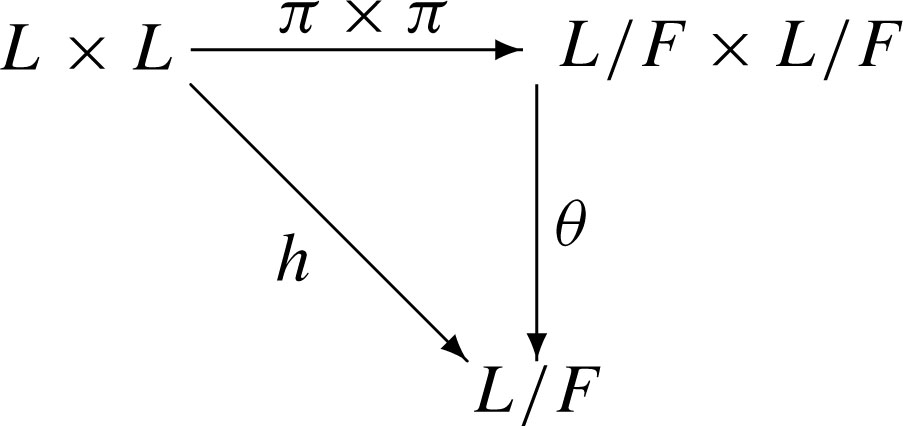
Consequently, we get that θ (x/F, y/F) = (¬ x ⊙ y)/F. Moreover, we can see that
(1) F = {1},
(2) τ F is discrete,
(3) τ F is Hausdorff.
(2)⇒(3) It is straightforward.
(3)⇒(1) Now let τ F be Hausdorff and 1 ≠ x ∈ F. Then there exist a, b ∈ F such that (x, 1) ∈ a/F × b/F and a/F∩ b/F = ∅. Hence, b/F = 1/F and x ∈ b/F, a contradiction. Therefore F = {1}. □
Conclusion
C. C. Chang’s distance function is an important function, which makes MV algebras form a distance space. But they are not distance function on residuated lattices. In this paper, we introduce weak involutory residuated lattices, in which Chang’s function is a pseduo distance function. Moreover we prove that the functions become distance functions on involutory residuated lattices. Note that involutory residuated lattices are not MV-algenras, and so, it is a substantial promotion to extend C. C. chang’s distance functions from MV-algebras into residuated lattices. By use of the function and a lattice filter, we define F-ball on residuated lattices, and we prove that the set of all F-balls forms a base of a topology τ LF on an involutory residuated lattice. Moreover we show that the topology τ LF on an involutory residuated lattice L makes L to be a lattice filter topological residuated lattice. At last, we instead of lattice filters by filters to set up filter topologies on an involutory residuated lattice, and study the properties of the filter topologies. In the future, we study properties of topologies induced by lattice filters and diatance functions, such as separation and connectivity. In addition, we will construct topological residuated lattices by other methods instead of ones in our paper.