



Abstract
Mobile Grid network connects large number of mobile devices like smartphones, tablets, PDAs, wireless digital medical equipment’s etc for the purpose of sharing their resources and performing the task collaboratively and cooperatively. The mobile nodes participating in the mobile grid are autonomous and open in nature making them more vulnerable to data and control attacks made by malicious or selfish nodes. Preventing these malicious or selfish nodes and identifying the trusted nodes to participate in the network is an NP-hard problem. To recognize trusted nodes in the mobile grid system a novel trust management model is proposed in this paper by applying an elitist multi objective optimization algorithm Non-dominated Sorting Genetic Algorithm-II (NSGA-II). The proposed trust management model assesses the trust index of each mobile node in the network using various evaluation factors or attributes and then obtains the non-dominated set of trusted nodes in each front. Comparative analysis of the proposed trust model shows that the proposed model can be a potential candidate for implementing trust management in mobile grid network.
Introduction
Mobile Grid [1] network connects large number of mobile devices like smartphones, tablets, PDAs, wireless digital medical equipment’s etc for the purpose of sharing their resources and performing the task collaboratively and cooperatively. However, these mobile devices are having limited resources like energy and processing capability making them valuable. Also the mobile devices are autonomous in nature due to which the mobile grid network does not have fixed topology and structure. The communication channel and the route between the nodes in the network is also dynamic and open. There is no central control system to monitor the nodes in the network making the environment decentralized. These characteristics of the mobile grid network such as autonomous structure, dynamic participants and open nature make it more vulnerable to attacks from inside and outside the network. There are various mechanisms proposed in literature to handle the attacks in the mobile grid network. These mechanisms are categorized as preventive and reactive mechanisms. Preventive mechanisms avoid the attacks beforehand whereas reactive mechanisms take the corrective actions after the attack happens.
One such preventive mechanism is to allow only trusted nodes and prevent malicious or selfish nodes from participating in the network. Malicious nodes are the nodes that compromise the security of the system by participating selfishly into the network and degrading the performance of the system. Malicious nodes can intentionally drop the data packets and control packets to disrupt the communication between the peers in the network and consuming or blocking their valuable resources. Depending on the strategy, frequency and loss made by the attack, the attacks made by malicious nodes can be categorized as data traffic attack and control traffic attack [2]. Different types of attacks caused by malicious nodes are:
Eavesdropping – Here the malicious node reads the packets while transmission. Jamming – Here the malicious node introduces noise in the network with the intention of DoS. Block hole – Here the malicious node spreads false information and directs the whole traffic towards itself and the then drops the received data packets. Worm hole – Here multiple malicious nodes collaborate to share the confidential information. Gray hole – Here the malicious node misguides the network by sometimes behaving as normal node and sometimes dropping the data packets. Link spoofing – Here the malicious node claims itself to be the neighbor and directs the data packets to itself through a fake link. Rushing – Here the malicious node floods the network by broadcasting received route request (RREQ) packets and behaves like original sender of the packet. Flooding – Here the malicious node floods the network with false routing information with the intent of consuming large resources of the network. Sybil – Here the malicious node misguides the network by showing multiple identities of the target nodes and redirects the data packets to itself. Byzantine attack – Here multiple malicious nodes collaborate together to form loops in the network and affect the QoS by sending the data packets on non-optimal paths.
All the above attacks can be avoided by detection of malicious nodes and preventing them from participating the network. Malicious nodes can be detected by using a robust trust management system that assesses the trustworthiness of the participating nodes in the network. Nodes with low trust values are treated as malicious nodes and are restricted to enter the network.
In this paper we have proposed a novel trust management model for identifying trusted nodes in the mobile grid system by applying an elitist multi-objective optimization algorithm Non-dominated Sorting Genetic Algorithm-II (NSGA-II) [3]. The proposed trust management model assesses the trust index of each mobile node in the network using various evaluation factors or attributes and then obtains the non-dominated set of trusted nodes in each front. The latter part of the paper is composed of following sections: Section 2 discusses various approaches in literature for solving the trust management problem, Section 3 introduces the proposed approach based on NSGA-II, Section 4 evaluates the performance of the proposed approach with the existing fuzzy logic trust model and Section 5 discusses conclusion and future work.
Related work
There exists a vast set of solutions to solve the problem of trust management in mobile grid network. Different approaches for calculation of the trust index of a node in mobile grid network are fuzzy logic based approach, Bayesian networks based approach, approaches based on probability theory and other mathematical methods. However there are some of the trust management models based on genetic algorithms.
A trust management model GenTrust [5] proposed by Ugur Eray Tahta et al. [6] for P2P networks uses GA to calculate the trust index of the peers by extracts the features from past interactions and the recommendations received from other peers. GenTrustprovides securityfromnaive attackers, hypocritical attackers and pseudospoofers.
ChithraSelvaraj et al. [7] proposed a trust model based on peer profiling in which the peer profiles are assimilated with the detected unusual behavior using genetic algorithm. A peer establishes trusted relationship with other peers based on the comparison between the present and past transactions with the other peers. After each transaction, crossover and mutation operations are performed to dynamically update the peer profile. The unusual behavior of the peer is then detected using GA.
A fast and efficient trusted job scheduling algorithm Space-Time Genetic Algorithm (STGA) [8] is based on three security modes. A job is said to be in secure mode if the security of the allocated resource site fulfills the security requirements of a job. A job is said to run in unsafe mode if the job is allocated to any available resource. However, if the risk associated with the allocated resource site is limited to probability f, then the job is said to run in f-risky mode.
In crowdsourcing platform a task publisher is required to select the trustworthy workers for execution of the tasks. Selecting trustworthy worker can be modeled as a nonlinear multiobjective optimization problem. A model proposed by Ye et al. called MOWS_GA [9] solves this NP-hard problem by using NSGA-II. According to the proposed model the trustworthiness of the worker differs based on different task types and number of rewards. The proposed model effectively identifies the honest and dishonest workers based on the rates of Human Intelligence Tasks (HITs) approval.
A wireless sensor network can be efficiently deployed using different techniques like machine learning, neural networks, artificial intelligence, fuzzy logic and genetic algorithms. Such a clustered wireless sensor network consists of a cluster head CH that collects the data from the sensor nodes and forwards the data to one or more sink nodes. A cluster head is a node with the highest trust value. The author Nimbalkar et al. [10] has proposed a cluster head selection technique Trust-based Energy Efficient Clustering using Genetic Algorithm in Wireless Sensor Networks (TEECGA) based on GA. To enhance the security of the communication a set of trusted cluster heads is selected by TEECGA in which one trusted cluster head forwards the data to another nearest trusted CH and so on. The trust value of the CH is calculated using various metrics like outstanding energy, distance etc.
Wang et al. [11] proposed an efficient solution for solving the multi objective problem of node-to-task assignment in a service oriented mobile ad-hoc network (MANET). The proposed solution has three objectives: maximize the reliability, minimize resource consumption variance thereby maximizing workload balance and maximize the QoS. The algorithm is based on the concept of Beta (
Optimal Security with Optimal Overhead Scheduling (OSO2S) [13] is a secure task scheduling algorithm based on NSGA-II having multiple conflicting objectives viz minimize the Security Overhead (SO) and maximize the Security Level (SL).
NSGA-G [14] is an extension of NSGA based on grid partitioning strategy proposed by Le et al. to find the Query Execution Plans (QEPs) in cloud computing as per the user preferences such as minimum budget, low response time etc. The proposed grid partitioning method divides the entire population into small groups by using the nearest grid Min Point and nearest grid Max Point for each group and calculate and compare solutions in one group during each iteration. This reduces the computation time and improves the speed by reducing the size of population.
Propsed trust model
In autonomous systems like mobile grid there is no central point of control for managing the trustworthiness of the peers and nodes are dynamic in nature, which makes the problem NP-hard.
Thus trust management in such a self-organizing network should be efficient enough to determine the malicious behavior of the selfish nodes and allow only genuine nodes to perform the computational or data intensive tasks. In this paper we propose a trust management model using NSGA-II. The dual objectives of the proposed trust management system are to minimize the attacks and maximize the job success rate of the participants in the network. Thus NSGA-II is the most suitable elitist pareto optimal solution for solving multiobjective optimization problems like trust management.
NSGA-II
NSGA-II [3, 4] is an extension of the most popular multiobjective optimization algorithm [15] NSGA (Non dominated Sorting Genetic Algorithm). NSGA-II has two important properties:
Elitism preserving: NSGA-II selects the best set of solutions in the next itteration. Diversity preserving: NSGA-II also supports the diversity in the population.
These two properties differentiates it from other multiobjective optimization algorithms in literature.
The basic procedure of NSGA-II is shown in Fig. 1 [3].
Basic structure of NSGA-II.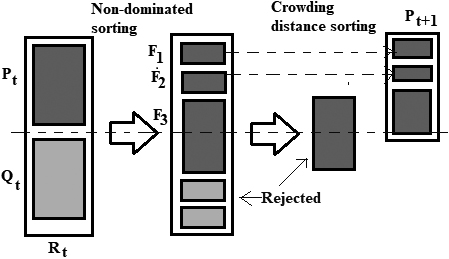
Capability based features
Interaction based features
Recommendation based features
NSGA-II uses two specialized multi-objective operators:
Non-dominated Sorting: When the genetic operators (select, crossover and mutation) are applied to the first population P, with N members, a new offspring population Q is generated with N members. After joining P and Q, and the total population R
The proposed trust model analyze the characteristics of the malicious and genuine nodes by extracting the information of the peers based on their capability to perform the task, past interaction and recommendations. This information forms the feature set for evaluating the trusted nodes in the network using NSGA-II.
The features representing the capability of the peers to perform the task are based on the resources available on the node as per the task requirements. Features based on the capability of the mobile node to perform task are listed in Table 1.
The features based on past interaction are extracted from the experience of each peer while interacting with the other peers in the network. Table 2 contains the list of features based on past interaction.
Whenever a peer need to evaluate the trustworthiness of the other peer in the network, it request its neighbors to share their experience about the requested peer in the form of recommendations. This experience shared by the neighbors provide the bases for recommendation based feature set listed in Table 3.
The proposed trust model is then evolved using these three categories of feature sets by using NSGA-II to find the trusted nodes in the mobile grid.
Fitness function
Trust management in mobile grid network has dual objectives conflicting with each other i.e. minimizing the Number Of Attacks (NOA) and maximizing the Job Success Rate (JSR). The fitness functions determines the success of the proposed solution to solve this multi-objective problems. Equations (1) and (2) represent the fitness functions used by the proposed trust model for calculating the number of attacks and job success rate respectively.
Where NOA
In mobile grid network the node who wishes to evaluate the trust value is called as trustor node. The trustor node needs to identify as set of trusted nodes to execute the submitted task successfully. The proposed trust model helps the trustor node to identify a set fittest nodes in the population based on non-dominated sorting and crowding distance. The fittest nodes in the population are selected as the most trustworthy nodes.
The steps involved in the trust management system using NSGA-II are as follows:
Using YenTopShortestPath algorithm find K-shortest loopless paths from trustor node to all other peers in the network. Initially generate the parent population Generate the offspring population Combine the parent population
Using the feature set described above and applying the non dominated sorting operator classify the population Input parameters for mobile grid environment
Job success rate.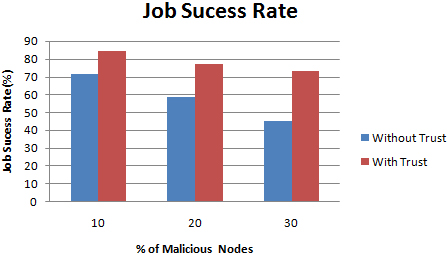
Execution time.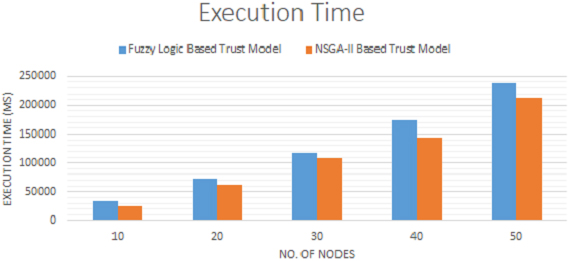
Generate the next population
Select the population in each front beginning from front
If the size of population in front
Crowdsort (
For
Crowding distance
For each of the fitness functions
Sort the population in
Assign the crowding distance for boundary nodes to maximum (
Calculate the crowding distance of the remaining nodes as shown in Eq. (3)
Where
Generate the offspring population
Battery utilization.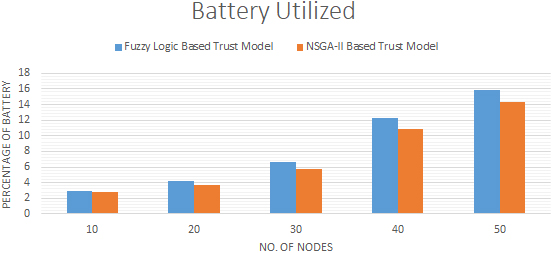
CPU utilization.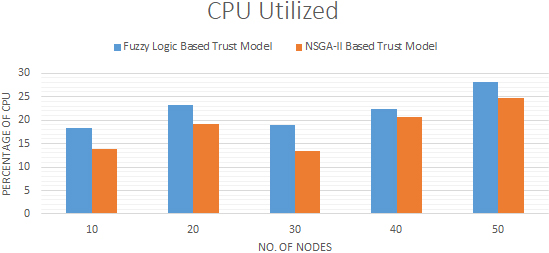
Let
Let
Repeat until the maximum number of iterations is reached.
To demonstrate the effective application of NSGA-II to solve the multi objective problem of trust management in mobile grid system we have deployed a mobile grid system by connecting a set of pervasively available android smartphones of different make like Samsung Galaxy On7 Pro, Xiaomi Redmi Note-11, Motorola G3 etc. using Wi-Fi. Experimental test bench includes corei7 with 3.6 Ghz CPU and 16 GB RAM. Environmental setup uses Node.js version 11.2.0, XAMPP Server version 7.3.5. The initial parameters used as input for the deployed mobile grid environment are shown in Table 4. In the deployed mobile grid system initially the trust value of all the mobile nodes is uncertain. Initial trust value of a node is calculated based on the features indicating the capacity of the node to perform or process the submitted task. Once the task is completed successfully the trust value of the nodes performing the task is revaluated based on successful or unsuccessful completion of the task. This direct trust value is calculated using the direct interaction based features. Similarly the recommendation trust is evaluated using recommendation based features. The total trust of each node is then obtained by aggregating the direct trust and recommendation trust. The proposed trust management model based on NSGA-II is then applied to find the most trustworthy nodes in the mobile grid to perform the further task with maximum job success rate and minimum security threat. The sample task submitted to each node is to process the ECG dataset of about 10000 patients. ECG data contains the cardiological signals that show the electrical activity. From the ECG data we can measure the heart rate of a patient and analyse if the patient requires immediate attention.
To prove the efficiency and applicability of the proposed trust management model based on NSGA-II we have compared it with a hierarchical fuzzy logic based trust management model HFSTrust [16] since fuzzy logic is most common approach used in majority of the trust management systems in literature. The performance of both the solutions is compared in terms of time taken by both the approaches to identify the trusted nodes in the network as well as utilization of resources such as battery and processor as mobile nodes are limited in these resources.
Identifying the trusted nodes in a reasonable time using optimum resources of the nodes in the network maximizes the job success rate of the system. Figure 2 shows the job success rate before applying the trust management model and after applying the trust management model on the mobile grid network with 40 nodes consisting of 10, 20, and 30 percentage malicious nodes.
Average precision
Average precision
Accuracy in percentage.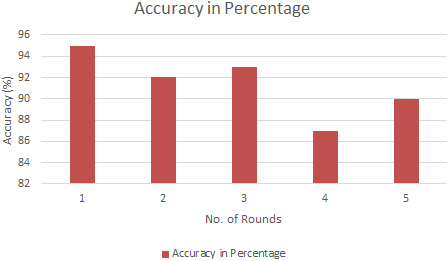
The graph shown in Fig. 3 shows the time taken for execution of both the trust management systems. It can be clearly seen that the proposed trust management system based on NSGA-II outperforms the existing fuzzy logic basedsystem. Also the proposed system proves to be more efficient in terms of consumption of precious and limited mobile device resources like battery and CPU for computation of the trust of all the devices as shown in Figs 4 and 5 respectively.
Each model is executed for five rounds. During each round, both the algorithms are executed ten times to evaluate the trust index of 5 devices. The precision and accuracy of the algorithm is shown in contingency Table 5 and represented graphically in Fig. 6.
Trust management in mobile grid network is a NP-hard problem having dual objectives maximizing the job success rate and minimizing the security threats by allowing only trusted nodes to participate in processing or performing the task. In this paper a novel method is proposed to solve this multi objective problem by applying a fast and elitist multi objective optimization algorithm NSGA-II for trust management in mobile grid network. Experimental results prove that the proposed model identifies the trusted nodes at higher speed as compared to the existing fuzzy logic based trust model and consumes fewer resources like battery and processor. The proposed approach can be used as an efficient and alternative solution for most of the commonly used approaches like fuzzy logic, neural network etc.