



Abstract
This study investigated the interactions between B12N12, B12P12, Al12N12 and Al12P12 nanoclusters and titanocene dichloride anticancer drug complex using B3P86 functional. The bonding interaction between the nano-clusters and anticancer drug were examined through energy decomposition analysis (EDA). A good quadratic equation between interaction energy and molar volume (Vm) were provided. Charge transfer between fragments were illustrated with electrophilicity-based charge transfer (ECT). According to calculations, the values of heat of formation of the studied systems were negative (exothermic), which shows that these molecules are thermodynamically stable. The relationship between molar refractivity (MR) and Vm presented linear correlation.
Keywords
Introduction
After discovering of the anticancer activity of titanocene dichloride(namely bis(cyclopentadienly)titanocene dichloride, Cp2TiCl2, Cp =η5-(C5H5)2) in the 1980s, and continuous attentions have attracted in the experimental literatures [1–3]. This compound reveals promising antitumour properties against numerous human tumours. Cp2TiCl2 included in Phase II clinical trials with patients with progressive renal cell carcinoma and breast metastatic carcinoma [4, 5]. Metallocene titanium(IV) complexes are less toxic against healthy cells than to the well-known cisplatin [6–8]. The mechanism of action of the Cp2TiCl2 is not well identified, original investigations recommended that it might be related with the purine bases of DNA [9–11]. Computational illustration of hydrolysis chemistry of anticancer drug titanocene dichloride has been reported [12]. Later, more synthetic efforts have been used to increase the cytotoxicity of titanocene dichloride derivatives [13–15]. A different method initial from titanium dichloride and fulvenes [16, 17] allowed straight access to highly substituted ansa-titanocenes [18–20].
Also, various titanocene dichloride compounds have been shown good activities for ethylene polymerization [21]. The similar activities have been reported for methylaluminoxane (MAO). Ethylene polymerization with hafnocene adamantolate/MAO system has been investigated [22].
Neutron Capture therapy is another possible starting point. Ru arene complexes having carborane ligands, are useful in Boron Neutron Capture Therapy (BNCT). In BNCT, neutrons are captured by 10B which degrades to α-particles and high energy 7Li which destroy cancer cells [23].
Attentions to the Nano structures such as fullerene hollow nanocages of elements other than carbon have increased because of due to their exclusive electronic and optical properties [24–27]. Group III-V nitrides are between most favorable nanocages [28, 29]. Preparation of the B12N12 nanocluster has been reported by laser desorption time of flight mass spectrometry [30, 31]. Several computational investigations about of interactions between B12N12 cage and various molecules have been reported [32–38]. Useful applications have reported for AlN nanocages. These nanocages have revealed thermodynamic stability, and high thermal conductivity and low electron affinity [39]. The investigation of Aluminum nitride nanocages (n = 2–41) explored that (AlN)12 nanocage is energetically the most stable one, and can be reflected as an appropriated nanocage [40]. Al12N12 nanocage has been shown interesting applications in gas sensing and hydrogen storage [41].
Adsorption properties of various analytes on the surfaces of Al12N12, Al12P12, B12N12, and B12P12 nanocages have been reported [42–44]. Furthermore, application of these nanocages explored as sensors [45–47].
In their attempts to develop a drug delivery system, many researchers have assessed the ability of carbon nanotubes (CNT) and nanocages [48]. Drug delivery can be performed either through filling the inner space of the tubes with metals [49], porphyrins [50] and biomolecules [51] or by attaching proteins and compounds (via a specific adsorption or covalent bond) on their external surface. In other investigation, loading of a phenanthroline-based Platinum(II) complex onto the surface of a carbon nanotube via π–π Stacking has been studied [52]. In a computation study, interaction between titanocene dichloride anticancer drug and Al12N12 nanocluster has been reported [53]. In other study, the complexation of Cp2TiCl2 with C20 and M+@C20 (M+= Li, Na, K) cages has been investigated [54]. Also, external electric field effect on interaction of this anti-cancer drug with carbon nanotube has been illustrated [55].
This theoretical study examined the interaction between B12N12, B12P12, Al12N12 and Al12P12 nanoclusters and titanocene dichloride. Variation in the molar volume, structural parameters, frontier orbital energies, molar refractivity and electron transfer between fragments were illustrated. Thermodynamic parameters of the formation of these systems were evaluated.
Computational methods
Optimization and vibrational analysis were done with Gaussian 09 software package [56]. The standard 6–311G(d,p) basis set [57–60] were considered in the calculations. The B3P86 functional was employed for the purpose of geometry optimization [61, 62]. B3P86 defines clearly the same functional with the non-local correlation provided by Perdew 86. The identities of the optimized structures as an energy minimum were confirmed by vibrational analysis.
Energy decomposition analysis (EDA) was studied for illustration of the bonding interactions between the titanocene dichloride anticancer drug and nano-clusters (B12N12, B12P12, Al12N12 and Al12P12) with Multiwfn 3.7 software package [63]. The interaction energy (Eint) between the two fragments was evaluated as:
where E polar , E els and E Ex are the electron density polarization term (the induction term), the electrostatic interaction and the exchange repulsion terms, respectively.
Results and discussion
Energy decomposition analysis (EDA)
The optimized geometries of nano-cluster ... TiCl2Cp2 complexes (nano-cage = B12N12, B12P12, Al12N12 and Al12P12) are shown in Fig. 1.
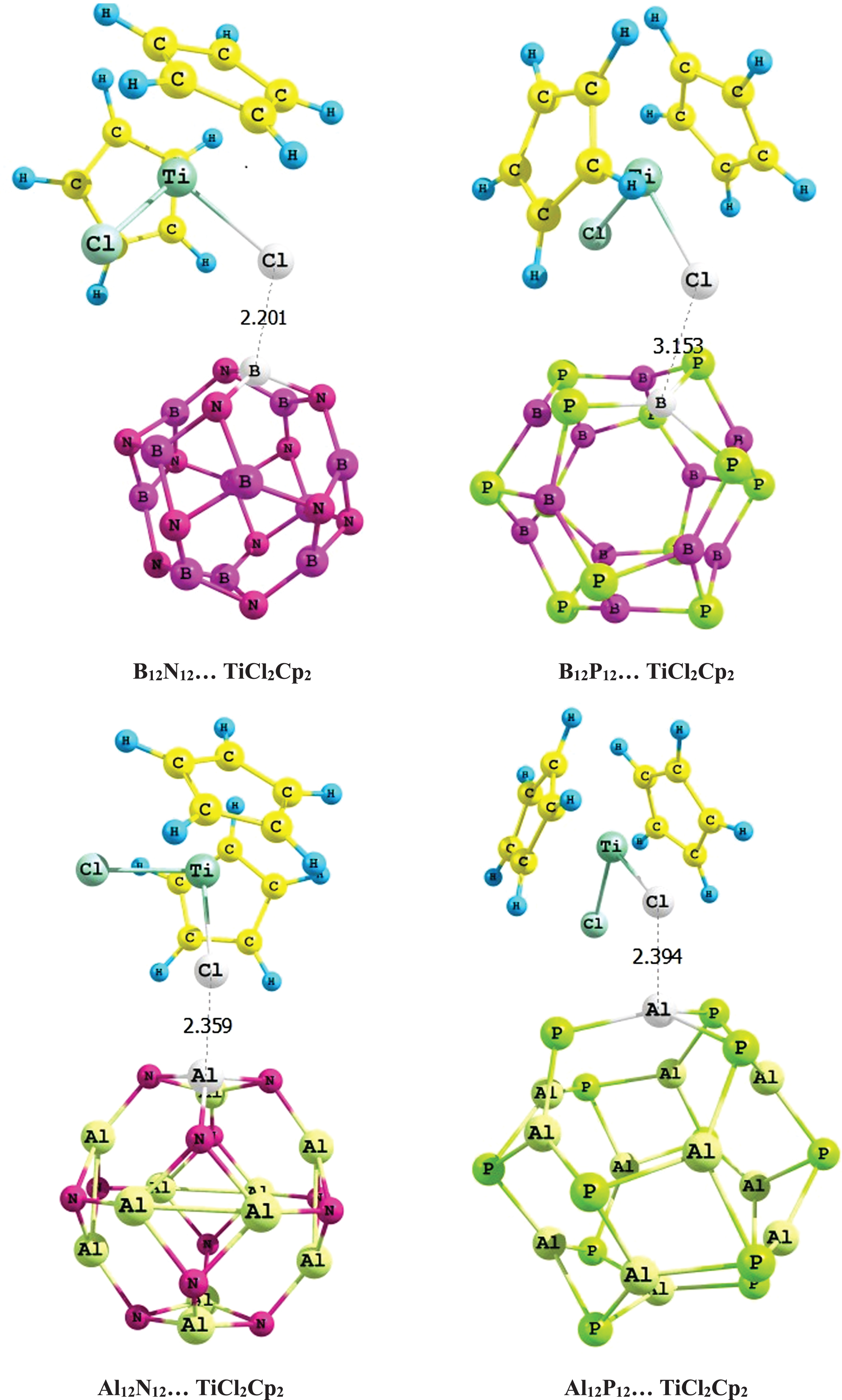
The structures of nano-cluster… TiCl2Cp2 complexes (nano-cage = B12N12, B12P12, Al12N12 and Al12P12.
Energy decomposition analysis (EDA) was used to clarify the nature of the Al ... Cl and B ... Cl interactions in the studied complexes are investigated. The EDA calculations results of these complexes are listed in Table 1. It can be deduced, the variation in the interaction energies between nanocages and cp2TiCl2 as: Al12N12 > Al12P12 > B12P12 > B12N12. Therefore, the most significant interaction corresponds to Al12N12 nano-cluster.
Total energy (E, a.u), EDA results (kcal/mol), cohesive energy (Ecoh, eV), molar volume (Vm, cm3/mol), polarizability (Bohr3) and molar refractivity (MR, cm3/mol) of the nano-cage ... cp2TiCl2 complexes
The negative polarization energy value for Al12N12 ... TiCl2Cp2 complex stabilizes Al12N12 ... TiCl2Cp2 complex. But, the positive value of the electrostatic and exchanging energies destabilizes complex.
In the other complexes, the polarization energy and the sum of the electrostatic and exchanging energies are positive and negative, respectively. Therefore, polarization energy values destabilize the B12N12 ... TiCl2Cp2, B12P12 ... TiCl2Cp2, Al12P12 ... TiCl2Cp2 complexes. In contrast, the sum of the electrostatic and exchanging energies, stabilize these complexes.
Stabilities of nanocluster ... TiCl2Cp2 complexes (nanocage = B12N12, B12P12, Al12N12 and Al12P12 are evaluated by cohesive energy (Ecoh):
Where, EX12Y12…TiCl2cp2 is energy of complex, EX, EY, EC, ETi, EH and ECl are energy of X (aluminum or boron), Y (nitrogen or phosphorous), carbon, titanium, hydrogen and chlorine atoms, respectively. The cohesive values of these complexes are listed in Table 1. The calculated Ecoh values show that Al12P12 ... TiCl2Cp2 complex is more reactive than Al12N12 ... TiCl2Cp2 complex. Also, it can be found, B12P12 ... TiCl2Cp2 complex is more reactive than B12N12 ... TiCl2Cp2 complex. Therefore, B12N12 and Al12N12 are more useful than the B12P12 and Al12P12 for further applications, and to calculate drug interaction on the native and modified B12N12 and Al12N12 can be of interest.
Molecular volume
Compounds with small molecular volume (Vm) cannot interact with the biological receptor. The Vm values of these complexes are listed in Table 1. In this respect, the bigger Vm gives rise to bigger biological activity. Vm and interaction energy of the studied molecules can be fitted with a quadratic equation:
Molecular orbital analysis
The frontier orbitals energy, the corresponding HOMO–LUMO energy gaps, hardness, electrophilicity, chemical potential values of nano-cage ... TiCl2Cp2 complexes, nanocages and TiCl2Cp2 molecules are given in Table 2.
Frontier orbital energies, HOMO-LUMO gap, hardness, and chemical potential of nano-cages, cp2TiCl2 and nano-cage ... cp2TiCl2 complexes (in eV)
Frontier orbital energies, HOMO-LUMO gap, hardness, and chemical potential of nano-cages, cp2TiCl2 and nano-cage ... cp2TiCl2 complexes (in eV)
Comparison of the frontier orbital energy values in the nanocluster ... TiCl2Cp2 complexes with nanoclusters indicates cp2TiCl2 adsorption meaningfully destabilizes and stabilizes the HOMO and LUMO levels, respectively. However, it seems that the TiCl2Cp2 share electron with the LUMO level because of its strong stabilization.
HOMO-LUMO gap
Comparison of the HOMO-LUMO gap values in the nanocluster ... TiCl2Cp2 complexes with nanoclusters indicates TiCl2Cp2 adsorption meaningfully decrease these values.
Plots of the nanocluster ... TiCl2Cp2 complexes (nanocage = B12N12, B12P12, Al12N12 and Al12P12) complexes are presented in Fig. 2. It can be observed, the most contributions in the HOMO and LUMO belong to nano-cages and TiCl2Cp2 complex in the all complexes, respectively.
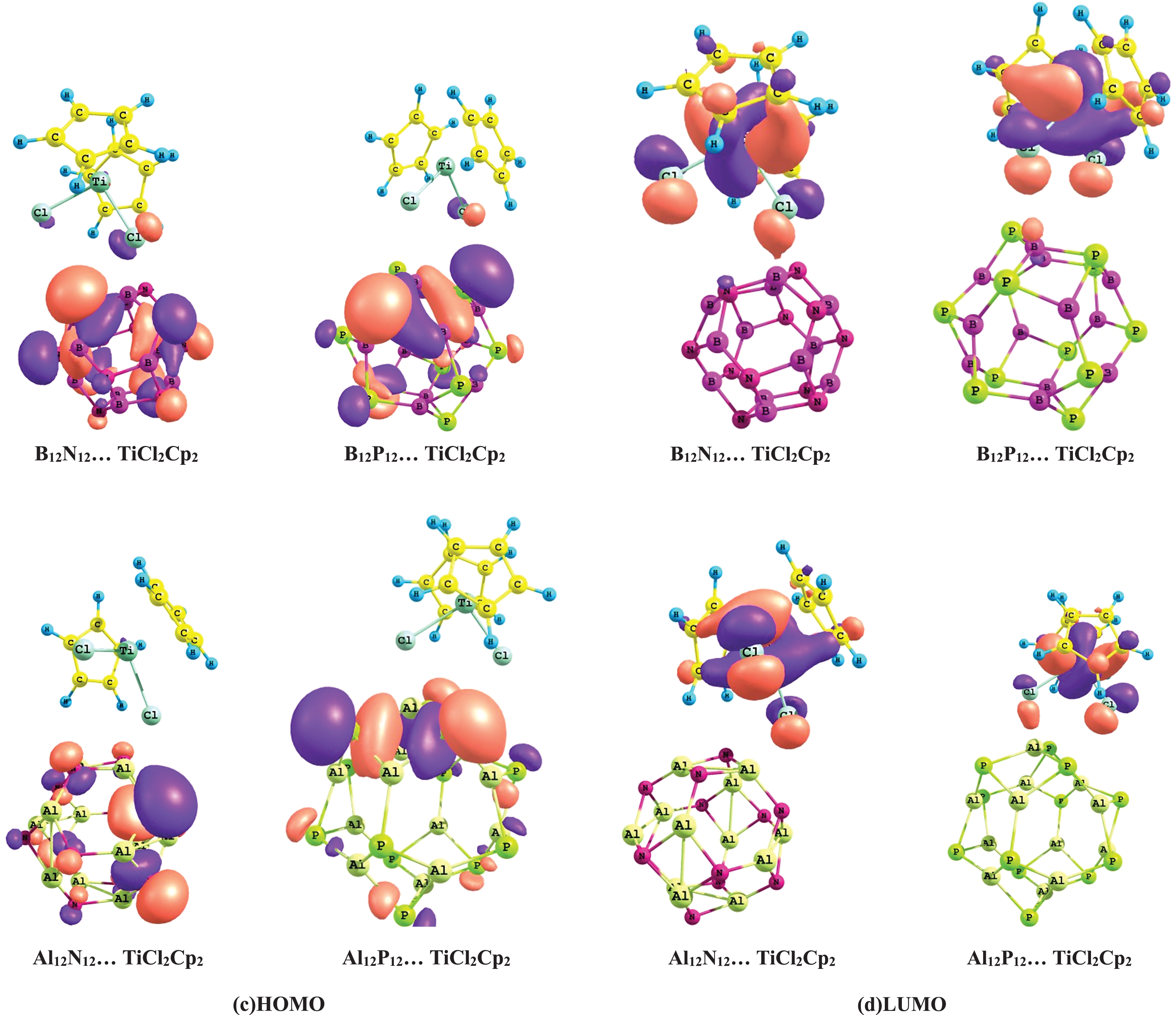
Plots of frontier orbitals in the nano-cluster… TiCl2Cp2 complexes (nano-cage = B12N12, B12P12, Al12N12 and Al12P12.
Now, electrophilicity-based charge transfer (ECT) of nanocluster ... TiCl2Cp2 complexes are calculated. ECT is defined as the difference between ΔNmax values of interacting molecules [64]:
In this equation ΔNmax is defined as:
η and μ are global hardness and chemical potential. They are defined as global reactivity descriptors [65–68] and determined on the basis of Koopman’s theorem [69]. These values for nanoclusters, cp2TiCl2 and nano-cluster ... TiCl2Cp2 complexes are calculated by the following equations and listed in Table 2.
The calculated ΔNmax values are –1.31 and –0.32 for B12N12 and Al12N12 nanoclusters, respectively. The negative value of ECT reveals charge transfer from TiCl2Cp2 to B12N12 and Al12N12 nanoclusters.
On the other hand, the calculated ΔNmax values are +0.27 and +0.70 for B12P12 and Al12P12 nanoclusters, respectively. The positive value of ECT indicates charge transfer from B12P12 and Al12P12 nanoclusters to TiCl2Cp2.
Structural parameters
Al − Cl distances in the Al12N12 ... TiCl2Cp2 and Al12P12 ... TiCl2Cp2 complexes are 2.359 and 2.394 Å, respectively. It can be observed, the Al ... Cl interactions are stronger in Al12N12 ... TiCl2Cp2 complex than Al12P12 ... TiCl2Cp2 complex. B − Cl distances in the B12N12 ... TiCl2Cp2 and B12P12 ... TiCl2Cp2 complexes are 2.201 and 3.153 Å, respectively. It can be observed, the B ... Cl interactions are stronger in B12N12 ... TiCl2Cp2 complex than B12P12 ... TiCl2Cp2 complex. It can be found, these results are compatible with EDA prediction.
Thermodynamic parameters
Free energy enthalpy and entropy changes values (ΔG, ΔH and ΔS, respectively) of nan-cage...Ticp2Cl2 (nanocage = B12N12, B12P12, Al12N12, Al12P12) complexes formation are calculated in the basis of the following reactions:
nanocage + Ticp2Cl2 ⟶ nanocage ... Ticp2Cl2;
ΔX = X(nanocage ... Ticp2Cl2) –X(nanocage)-X(Ticp2Cl2); X = G, H, S
These calculations are at 298 K and 1 atm pressure. The calculated parameters are listed in Table 3. The positive ΔG and negative ΔH values of the B12N12...Ticp2Cl2 and B12P12...Ticp2Cl2 complexes formation reveal that these reactions are non-spontaneous and exothermic. The negative ΔG and ΔH values of Al12N12...Ticp2Cl2 and Al12P12...Ticp2Cl2 complexes formation reveal that these reactions are spontaneous and exothermic, respectively. The negative ΔS values of these reactions are logical. Because, formation of the one molecules after interaction between two molecules decreases the entropy of reaction.
Frontier orbital energies, HOMO-LUMO gap, hardness, and chemical potential of Al12N12, cp2TiCl2 and two isomers of Al12N12 ... cp2TiCl2
Frontier orbital energies, HOMO-LUMO gap, hardness, and chemical potential of Al12N12, cp2TiCl2 and two isomers of Al12N12 ... cp2TiCl2
Formation constant values (K) of the nanocage...Ticp2Cl2 complexes are calculated by the following formula:
The calculated K values are listed in Table 3. It can be seen, these values increase as: Al12N12 > Al12P12 > B12P12 > B12N12.
Molar reactivity (MR) is an important property used in the quantitative structure property relationship. It is directly related to the refractive index, molecular weight and density of the steric bulk and is responsible for the lipophilicity and binding property of the investigated system. It can be calculated by the LorentzeLorentz equation [70–72]:
where n is the refractive index; ρ is the density; MW is the molecular weight; (MW/ρ) is the molar volume; N is the Avogadro number; α is the polarizability of molecular system and its value depends only on the wavelength of light used to measure ‘n’. This equation is usable for both solid and liquid states of the system under study. It is related to the volume of the molecules as well as to the London dispersive forces that act in the drug receptor interaction. For a radiation of an infinite wavelength, the value of MR denotes the real volume of the molecules.
MR and molecular polarizability values of the studied systems are given in Table 1. There is a linear relation between MR and Vm for the studied complexes (Fig. 3):
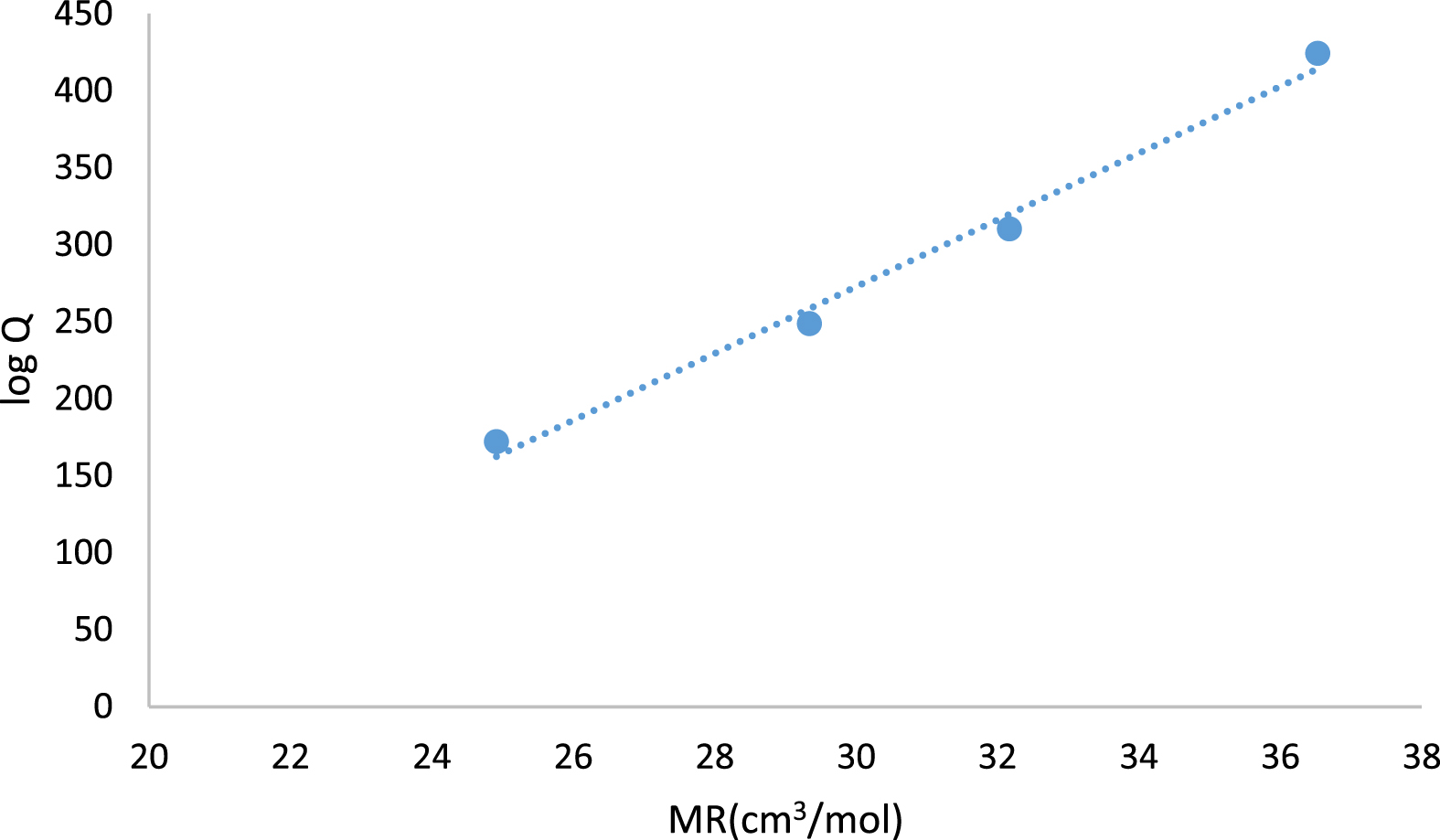
Linear relation between MR and log Q values in the nano-cluster… TiCl2Cp2 complexes (nano-cage = B12N12, B12P12, Al12N12 and Al12P12.
Computational investigation of the interaction behavior of titanocene dichloride complex with B12N12, B12P12, Al12N12 and Al12P12 nanoclusters revealed: In the basis of EDA results, the strongest interaction occurs between Al12N12 and titanocene dichloride. Molar volume and interaction energy values of the studied molecules were fitted with a quadratic equation. The most contributions in the HOMO and LUMO belong to nanocage and TiCl2Cp2 complex in the studied systems, respectively. In the basis of the electrophilicity-based charge transfer (ECT) results charge flow from titanocene dichloride to B12N12 and Al12N12 nanocages. In contrast, charge flow from B12P12 and Al12P12 nanocages to titanocene dichloride. In the basis of thermodynamics parameters, the formation reactions of the B12N12...Ticp2Cl2 and B12P12...Ticp2Cl2 complexes were non-spontaneous and exothermic. But, the formation reactions of the Al12N12...Ticp2Cl2 and Al12P12...Ticp2Cl2 complexes were spontaneous and exothermic, respectively. A good linear relation between molar refractivity and molar volume found in the studied complexes