



Abstract
This study investigated the cisplatin (anticancer drug) interaction with C20 bowl and C20H10(Bowl) molecule including hydrogen-saturated with using mPW1PW91 functional. The stability of the various isomers of drug interaction with C20 bowl was investigated. The interaction energy values were estimated in these systems. Changes in the structural parameters and the frontier orbital energy and HOMO-LUMO gap values were evaluated. Charge transfer between fragments were shown with electrophilicity-based charge transfer (ECT). The Octanol–water partition coefficient (log P) and molecular volume (Vm) of these drug precursor molecules were studied. Also, Pt-C bond characterizations were illustrated using QTAIM analysis. The results showed that C20 bowl can be a promising nanocarrier for cisplatin anticancer drug.
Keywords
Introduction
Cisplatin (Cis-diamminedichloroplatinum (II)) is the first-line treatment for different types of solid tumors [1]. Previously studies demonstrated that cisplatin can bind to nuclear DNA and mitochondria DNA (mtDNA) [2, 3]. But it has a several side effects against normal tissues and cells [4, 5]. Recent studies apply novel carriers for delivery of cisplatin to reduction of its side effects [6, 7].
Application of nanomaterials for drug delivery (active or inactive drug delivery), enhancement of therapeutic efficacy of the traditional anticancer drugs as well as prevention of its side effects is the goals of nanomedicine. Fullerene derivatives have been employed as drug delivery agent [8]. In a few years ago, C60 was covalently attached to paclitaxel (anticancer drug) via an ester bond [9]. In another study, doxorubicin was attached to the fullerene and results showed that doxorubicin- fullerene complex was distributed mostly in the cytoplasm instead of the cell nucleus [10]. Prylutska et al. demonstrated that C60 combined with cisplatin effectively induced tumor cell death, inhibited tumor growth, and overcoming drug resistance [11].
In other side, Prylutska et al. showed that the cytotoxic effect of cisplatin against normal cells was prevented at complexation with C60 fullerene. It indicates that nanocomplex of fullerene(C60)-cisplatin has a potential to be used for the minimization of anticancer drug side effects [6]. The C20 by multifunctionalized can be considered as an interesting nanocarrier at drug delivery systems.
Fullerene is one of the allotrope of carbon that are individual molecules with an in finite number of discrete. It discovered after diamond and graphite, and unlike them, each type of Fullerenes has its own unique properties [8]. Fullerene generally produced by electric arc vaporizes, laser ablation, pyrolysis or combustion [12–16]. The lowest energy members of the C20 family are cage 1, bowl 2 and ring 3. While Fullerene molecule is insoluble in water, but it showed very low solubility in common organic solvents [17]. Then, partially mask the a polar fullerene surface or covalently modify the aromatic structure were used to overcome its compatibility limitation with biological media [17].
In this paper, we investigated interaction cisplatin drug with C20 bowl. The four possible isomers of cisplatin interaction with C20 bowl and C20H10 (Bowl) molecule including hydrogen-saturated were considered. The frontier orbital energy and HOMO-LUMO gap values, changes in the structural parameters and the interaction energy values were calculated. Finally, Pt-C bond characterizations were illustrated using QTAIM analysis.
Computational methods
Gaussian 09 software package was used for calculations [18]. The standard 6-311G(d,p) basis set [19–22] and the Def2-TZVPPD basis set [23] were applied for main groups of elements and the Pt element, respectively. The studied molecules were considered in the neutral form and singlet state. For exclude direct calculation of the exchange and correlation integrals related to 60 electrons of the Pt atom, pseudo-potential effective core potential (ECP) was applied to the Def2-TZVPPD basis set [24].
The one-parameter hybrid functional with adapted Perdew-Wang exchange and correlation (mPW1PW91) was used for Geometry optimizations [25]. In compared with B3LYP, the mPW1PW91 functional revealed better results in the transition metal complexes [26–29].
For prove that the optimized structures have no imaginary frequency, harmonic vibrational frequencies were evaluated.
In this study, we applied a self-consistent reaction field (SCRF) method to investigate of the solvation impacts. Specially, non-electrostatic terms for Solvent Model Density (SMD) solvation model and the conductor-like polarizable continuum model (CPCM) [30, 31] with radii was used [32].
The partition coefficient octanol/water (c log P) [33] was calculated by the following equation:
These thermodynamic parameters were provided from frequency calculations on the optimized structures of gas phase at the same level of theory in the corresponding solvents.
Quantum theory of atoms in molecules (QTAIM) analyses were performed on the optimized geometries with the used level of theory for optimization using Multiwfn 3.8 software package [34, 35].
Contour map of electrostatic potential was provided using the Multiwfn 3.8 package [34, 36].
Results and discussion
Energetic aspects
Four possible isomer structures of C20(Bowl) . . . cis-PtCl2(NH3)2 nanocomplex are demonstrated in Fig. 1. Also, cis-PtCl2(NH3)2 complex with C20H10(Bowl) molecules including hydrogen-saturated (H-saturated) are considered (Fig. 1). The relative and absolute energies of the studied isomers are listed in Table 1. According to results, the order of stability of these isomers is:
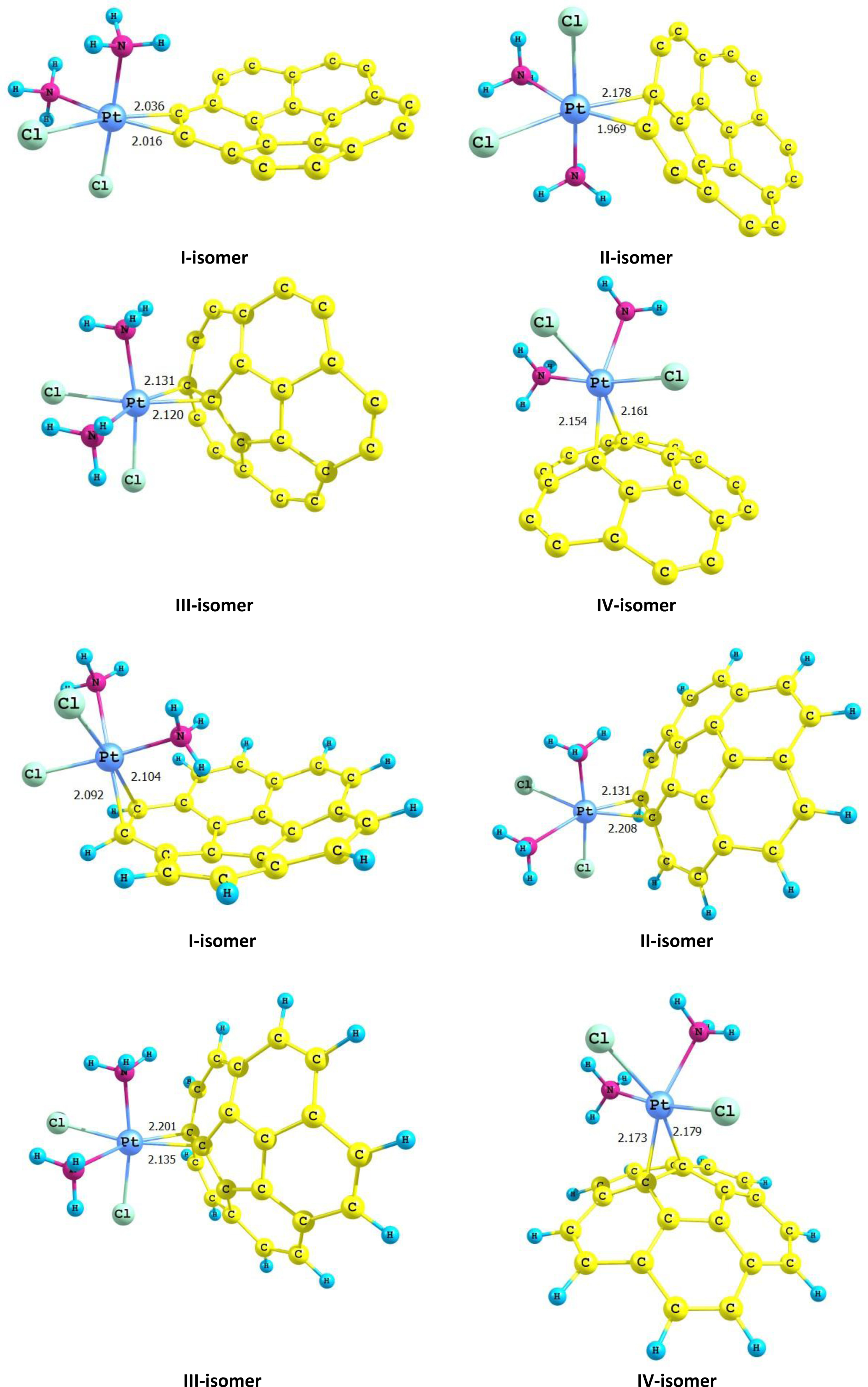
The structures of various isomers of cis-Pt(NH3)2Cl2 with C20(bowl) and H-saturated form of this molecule.
Absolute energy (E, a.u), relative energy (ΔE, kcal/mol), basis set superposition error (E(BSSE), kcal/mol), interaction energy (ΔEint, kcal/mol), octanol–water partition coefficient (log P) and molecular volume (Vm, cm3/mol)values of the various isomers of cis-Pt(NH3)2Cl2with C20(bowl)and its H-saturated form
The interaction energy (ΔEint) is typically measured as follows:
Where E(C20,sp) and E(cis-PtCl2(NH3)2,sp) are the energy values of isolated C20 or C20H10(Bowl) and cis-PtCl2(NH3)2 molecules in the optimized C20(Bowl) or C20H10(Bowl) . . . cis-PtCl2(NH3)2, respectively. E(C20 or C20H10(Bowl) . . . cis-PtCl2(NH3)2) is the energy of cis-PtCl2(NH3)2 interacted with C20(Bowl) or C20H10(Bowl). E(BSSE) is the basis set superposition error (as corrected of interaction energy) [37, 38].
Interaction energy and E(BSSE) values of numerous isomers of cis-PtCl2(NH3)2 complexation with the C20(Bowl) are listed in Table 1. It was revealed from the negative ΔEint values that the complex formation is energetically favorable. The interaction energies demonstrated that the
Molecular orbital analysis
The frontier orbitals energy, hardness, electrophilicity, the corresponding HOMO–LUMO energy gaps, chemical potential values of C20(Bowl) or C20H10(Bowl) . . . cis-PtCl2(NH3)2 isomers, C20(Bowl) or C20H10(Bowl) and cis-PtCl2(NH3)2 molecules are given in Table 2.
Frontier orbital energy (eV), HOMO-LUMO gap (eV) values of the Pt(NH3)2Cl2, C20(bowl)\\ and various isomers of cis-Pt(NH3)2Cl2with C20(bowl) and its H-saturated form
Frontier orbital energy (eV), HOMO-LUMO gap (eV) values of the Pt(NH3)2Cl2, C20(bowl)\\ and various isomers of cis-Pt(NH3)2Cl2with C20(bowl) and its H-saturated form
Comparison of the HOMO-LUMO gap values in the C20(Bowl) or C20H10(Bowl) . . . cis-PtCl2(NH3)2 isomers with C20 bowl showed that cis-PtCl2(NH3)2 adsorption meaningfully decrease the HOMO-LUMO gap values. Thus, these results indicated that the C20 bowl may be a suitable nano-carrier for cis-PtCl2(NH3)2. On the other hand, there are larger gap values for H-saturated isomers than non-H-saturated isomers.
It was demonstrated that the HOMO-LUMO gap of
Frontier orbitals plots of the studied isomers of C20(Bowl) . . . cis-PtCl2(NH3)2 nano-complex are presented in Fig. 2. For most stable isomer (

Plots of frontier orbitals of various isomers of cis-Pt(NH3)2Cl2. . . C20(bowl) complex.
Figure 3 shows PDOS (partial density of state) and DOS (density of states) diagrams in the C20(Bowl) . . . cis-PtCl2(NH3)2 nano-complex. The PDOS determined the composition of the fragment orbitals that are contributing at the molecular orbitals. The contribution percent of fragments in frontier orbital of the studied isomers are mentioned in Table 3. The most fragments which contribute in HOMO and LUMO are belongs to C20 and cis-PtCl2(NH3)2 nano-complex in the studied isomers, respectively.
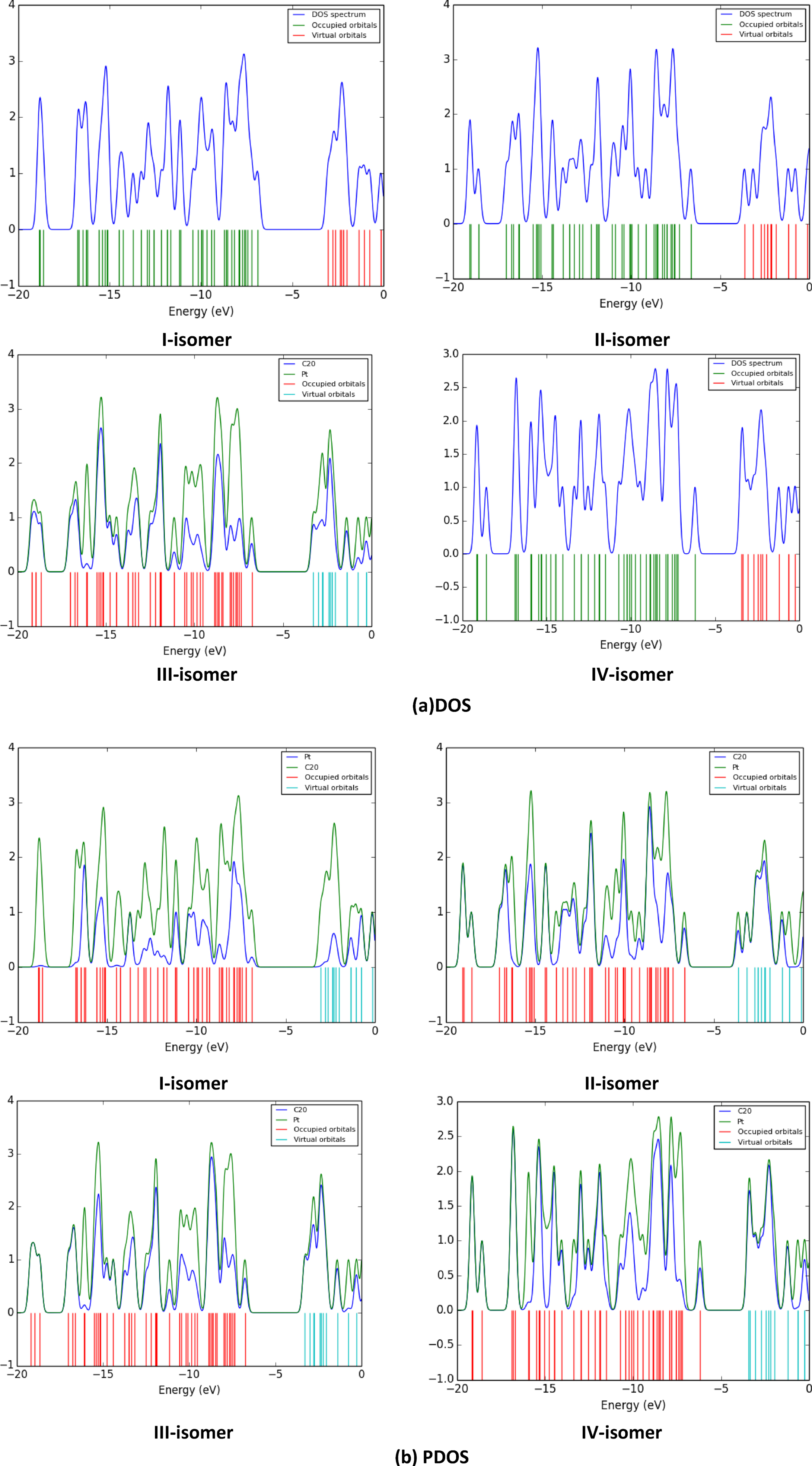
(a) DOS and (b) PDOS diagrams of frontier orbitals of various isomers of cis-Pt(NH3)2Cl2. . . C20(bowl) complex.
Percent of contribution of fragments in the frontier orbitals for various isomers\\ of cis-Pt(NH3)2Cl2with C20(bowl)
Calculation of the electrophilicity-based charge transfer (ECT) of C20(Bowl) . . . cis-PtCl2(NH3)2 isomers was evaluated. The difference between ΔNmax values of interacting molecules is defined as ECT [44]:
Where ΔNmax is defined as:
μ and η are global chemical potential and hardness, respectively. They are determined on the basis of Koopman’s theorem [45] and defined as global reactivity descriptors [46–49]. These values for C20(Bowl), C20H10(Bowl), cis-PtCl2(NH3)2 and C20(Bowl) or C20H10(Bowl) . . . cis-PtCl2(NH3)2 isomers are calculated by the following equations and results are mentioned in Table 2.
The calculated ΔNmax value is +0.859 and –0.032 for interaction of drug with C20(Bowl) or C20H10(Bowl), respectively. The positive value of ECT reveal charge flow from C20(Bowl) to cis-PtCl2(NH3)2. On the other hand, the negative value of ECT show charge flow from cis-PtCl2(NH3)2 to C20H10(Bowl).
Structural parameters
Pt-C bond distances in the optimized isomers of C20(Bowl) . . . cis-PtCl2(NH3)2 nano-complex are shown in Fig. 1. According to Fig. 1, the average of Pt-C bond lengths are 2.026 Å (
Quantum theory of atoms in molecules (QTAIM) analysis
Now, we employed QTAIM analysis for illustration of chemical and physical properties of the Pt-C bonds in the studied systems. The electron density and Laplacian of electron density values (ρBCP and ▿2 ρBCP) at bond critical points of Pt-C of the studied systems are gathered in Table 4. The positive ▿2 ρBCP values are compatible with closed-shell interactions in the Pt-C bonds. Total electron energy density (H) values at bond critical points of Pt-C are listed in Table 4. the negative H values are taken as an indicator of covalency [50]. The positive ▿2 ρ values and negative H values at BCP(Pt-C) are compatible with similar results for the metal–carbon bonds in organometallic complexes [51] and transition metal carbonyl clusters [52]. These values reveal a combination of the closed-shell and shared interactions for the metal–ligand bonds.
Bond distance (r) and QTAIM results at bond critical points of Pt-Cof four possible isomers of cis-Pt(NH3)2Cl2with C20(bowl) and its H-saturated form
Bond distance (r) and QTAIM results at bond critical points of Pt-Cof four possible isomers of cis-Pt(NH3)2Cl2with C20(bowl) and its H-saturated form
Contour map of electrostatic potential of the most stable isomer of C20(Bowl) . . . cis-PtCl2(NH3)2 nano-complex are presented in Fig. 4 (in xy-plane of molecules). The solid and dashed lines reveal the region having positive and negative value of ESP, respectively. The bold blue line relates to vdW surface.
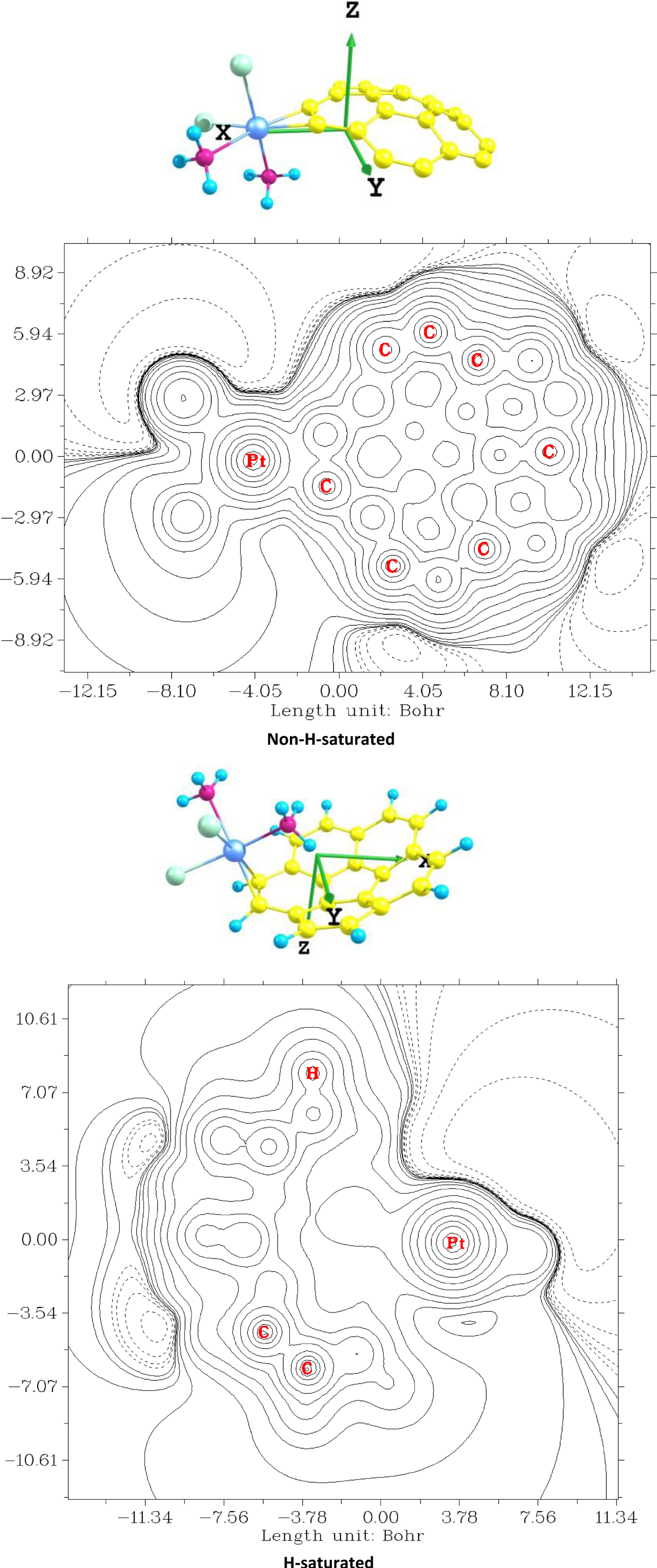
Contour map of electrostatic potential of the I- isomer of C20(Bowl) . . . cis-PtCl2(NH3)2 nano-complex in xy-plane of molecules.
Lipophilicity is a material properties that determine interactions between a drug and its biological receptor. Lipophilicity usually estimated by log P. The greater log P value demonstrate the more lipophilic character. Log P values of the studied systems are mentioned in Table 1. The largest and smallest Log P values are observed for
Molecular volume
The calculated molecular volume (Vm) of the studied isomers are gather in Table 1. It can be found that the
Conclusion
Computational evaluation of the interaction behavior of fullerene C20 bowl with cisplatin revealed that