



Abstract
Carbon monoxide (CO) is known as a deathful gas produced by burning of hydrocarbons in a lack of enough oxygen, in which breathing CO leads to serious issues on human life health quality. Therefore, adsorption of CO gas is an essential task for diagnosis or removal of this dreadful gas in environment. To do this, a HEME-like model of iron-nitrogen-doped beryllium oxide (FeNBeO) monolayer was investigated for adsorbing CO gas by performing density functional theory (DFT) calculations. Two models were obtained for this process, in which relaxation of CO with C-head or O-head towards Fe region of monolayer. The results indicated that the formation of FeNBeO-CO model could be achieved more favorable than the formation of FeNBeO-OC model. The obtained optimized geometers and energies all approved this achievement for favorability of FeNBeO-CO model formation. Moreover, molecular orbital based electronic features indicated variations of such features for the models upon adsorption of CO substance, in which the models could be detectable in a sensor function for the existence of CO gas in the environment. As a consequence, the investigated FeNBeO monolayer could be proposed useful for adsorption of CO gas at least for the CO deathful gas diagnosis purposes.
Introduction
Carbon monoxide (CO) is a deathful gas mainly generated by burning of hydrocarbons in lack of enough oxygen, which is indeed a serious problem of those environment dealing with hydrocarbons processing [1–3]. Breathing smell-less CO gas has deathful impacts on human health and so many victims are still reporting from the news [4–6]. Therefore, diagnosis of CO gas in the environment is of the most importance besides its need to be removed from that environment [7–9]. Several attempts have been always dedicating to explore new materials for sensing and removal of CO gas in addition to other hazardous gases [10–12]. Innovation of nanotechnology and related nanostructures has raised attentions of researchers to investigate potency of these novel materials for applications in adsorption devices [13–15]. It has been known that the nanostructures showed advantages for several applications from living systems up to industries [16–18]. To this point, gas adsorption has been seen applicable for nanostructures because of their proper wide surfaces for participating in interactions with other substances [19–21]. Therefore, exploring features of such nanostructures could reveal insightful information regarding the issues of adsorption processe [22–24]. In addition to the first introduced carbon nanostructures, existence of other non-carbon nanostructures have been seen achievable from both of computational and experimental sides [25–27]. To this time, several types of nanostructures in shapes and atomic compositions have been introduced for employing in various fields of science and technology [28–30]. In this regard, layer-like structures have been seen very useful for providing appropriate surfaces for adsorbing other substances in atomic and molecular forms [31–33]. Graphene is a typical monolayer of carbon atoms with characteristic features especially in electronic responses [34–36]. Therefore, such monolayer structures could be expected for adsorbing gaseous substances even for hazardous CO gases [37–39]. Like other nanostructures, non-carbon monolayers have been seen available providing heteroatimc surfaces for enhancing adsorption features [40–42]. In addition to original composition, atomic dopants could raise new features for specific applications [43–45]. Within this work, a model of beryllium oxide (BeO) monolayer was investigated for adsorption of CO gas, in which iron and nitrogen (FeN) atoms were doped instead of original Be and O atoms at the center of monolayer (Fig. 1). To this point, a model of FeNBeO monolayer was prepared for adsorbing CO gas through performing quantum-chemical calculations at the smallest molecular and atomic scales. Indeed, it is an advantage of employing computational approaches to investigate such interacting systems to provide insightful information for examining hypotheses of developing new applications for novel materials [46–48].
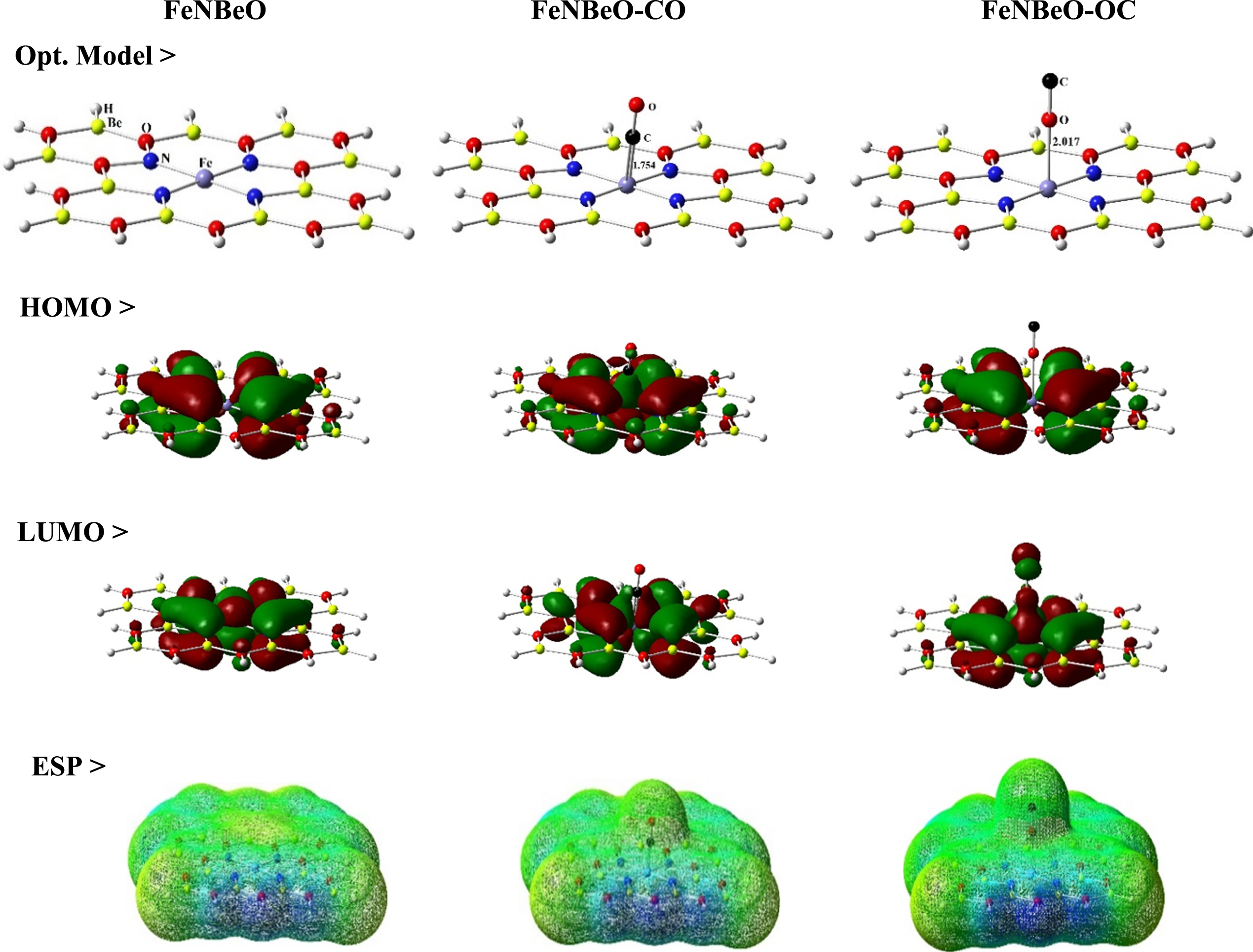
Optimized models, HOMO and LUMO distribution patterns, and ESP surfaces.
In this work, idea of CO gas adsorption by a model of FeNBeO monolayer (Fig. 1) was investigated by performing density functional theory (DFT) calculations. The models were optimized and required features were evaluated (Table 1) for analyzing the models systems to reach the goal of this work. Earlier works showed achievability of BeO nanostructures [49–51], in which a monolayer of BeO model was investigated in this work for adsorption purposes. It is important to mention that the heteroatomic surface itself could work as an appropriate adsorbent, in which Fe and N doped atoms could enhance ability of surface for specified substance adsorption [52–54]. Indeed, the investigated model of this work could somehow resembles HEME structure of living systems, which has characteristic functions in human health maintenance [55–57]. To this point, the idea could be somehow related to developing biologiclal-like structures for further applications in thechnogical processes. Therefore, the model of this work was expected to be known regarding availability of similar HEME structure as a significance for current idea. As a consequence, different configurations of CO gas adsorption at the surface of FeNBeO monolayer were investigated to reach a point to show benefit of this model for sensing and removal of hazardous gas. It is important to remind that detection and removal of CO gas is very muc important because of its hazardous nature and several attempts have been dedcated to figure out a model system for this purpose, but the idea has been still under development [58–60].
Molecular features for the optimized models*
*See Fig. 1 for the models.
This work was performed at the B3LYP/6-31G* level of DFT calculations using the Gaussian program [61]. A model of HEME-like FeNBeO monolayer with the stoichiometry of FeN4Be11O11H14 was investigated for working as an adsorbent surface for CO gaseous substance (Fig. 1). The model was optimized to reach the minimized energy structure, in which hydrogen atoms were added at the edges for monolayer particle to avoid occurrence of dangling effects [62–64]. By performing the mentioned optimization calculation, the model surface was prepared for adsorbing CO gas substance by perfuming additional calculations. Several configurations of CO molecule were examined at the Fe-centralized surface of FeNBeO, in which two models were finalized calling FeNBeO-CO and FeNBeO-OC based on orientation of C-head or O-head of CO towards the Fe atom of surface. Besides obtaining optimized geometries for the investigated structures, other features including total energy (ETot), adsorption energy (EAds), energy of the highest occupied molecular orbital (HOMO), energy of the lowest unoccupied molecular orbital (LUMO), energy gap (EGap), chemical hardness (H), chemical softness (S), and dipole moment (DM), were evaluated (Table 1). Bwesides obtaining such quantitative values, qualitative representations of HOMO and LUMO distribution patterns and electrostatic potential (ESP) surfaces were exhibited in Fig. 1. Moreover, diagrams of density of states (DOS) were plotted to show electronic levels of molecular orbitals for detecting based on electronic devices (Fig. 2). As a consequence, all required results were obtained for the optimized models systems to be discussed for reaching the purpose of this work.

DOS plots for the optimized models.
In In this work, a HEME-like model of BeO monolayer including FeN4-doping region (FeNBeO) was investigated for adsorption of CO hazardous gas. The models were optimized to reach the minimized energy structures yielding two models of FeNBeO-CO and FeNBeO-OC regarding the orientation of relaxed CO substance towards the Fe-doped region (Fig. 1). The obtained results indicated that the models were stabilized by the computed values of energies, in which the results showed two levels of strength for adsorption of CO by the monolayer surface. In this regard, obtained distances of interactions were found 1.754 Å and 2.017 Å for FeNBeO-CO and FeNBeO-OC models, respectively. This achievement indicated that the models were stabilized by favorability of FeNBeO-CO formation more than FeNBeO-OC model. Accordingly, the obtained values of total energies (ETot) and adsorption energies (EAds) approved the achievement of optimized geometries for more favorability of FeNBeO-CO model. It is important to mention here that the CO molecular substance could work as a carbonyl ligand group suitable for chelation by Fe metal atom, in which such mechanism was occurred for the model system by obtaining strong Fe-CO chelating bond. CO itself could work as a ligand with available lone pairs of electrons, in which Fe could adsorb this ligand by available vacant orbitals. Therefore, reasonability of the initial idea could be affirmed by such expected lone pair –vacant orbitals interactions. In this case, molecular features indicated effects of such CO adsorption by analyzing values of HOMO, LUMO, and related molecular orbital features. This point indicated that the models were changed based on their characteristic features, in which values of HOMO and LUMO levels were moved to other energy levels. HOMO and LUMO could imply for ionization and electron affinity of a molecular substance showing favorability of a molecules for participating in such electron transferring processes. Therefore, levels of HOMO and LUMO for the original model and fluctuation by the CO adsorption could show impacts of such bimolecular formation on such importance electronic characteristic features of molecules. Moreover, energy gap (EGap) between HOMO and LUMO levels could indicate the function of a molecular system for involving in semiconducting processes, in which wider or shorter gaps could show the required energy for internal electron transferring inside a molecule. In this regard, the molecular changes during CO adsorption process showed that such molecular orbital based electronic features were changed in comparison with the original monolayer model. Analyzing molecular orbital distribution patterns and ESP for the models showed variations of CO adsorption for the molecular patterns and surfaces. Changes of atomic charges environment could be also seen by variations of such HOMO and LUMO patterns and ESP, in which the colors and occupied spaces could reveal such changes for the models before/after occurrence of adsorption process. In addition to such features and representations, chemical hardness and softness (H and S) also detected effects of such CO adsorption at the FeNBeO monolayer with more or less significant variations for the model systems. Accordingly, values of dipole moments (DM) approved such changes of electric charge distribution for the investigated models. As a consequence, adsorption of CO at the surface of FeNBeO monolayer was seen possible and detectable by variations of electronic features. For strength of obtained complexes, comparisons with other works [58] could reveal that the current models of this work could be considered for almost strong adsorption of CO gas to make complex systems. In the case of releasing the adsorbed CO gas, providing an energy resource equivalent to/more than the adsorbed energy could release CO and the monolayer could be considered for working again in the adsorption process.
For better analyzing the investigated models in accordance with sensing and diagnosis functions, density of states (DOS) plots were shown in Fig. 2. As exhibited in DOS plots of the models, variations of molecular orbitals features showed possibility of diagnosis of adsorbed CO at the surface of monolayer not only by variations of HOMO and LUMO, but also by variations of other molecular orbital levels lower than HOMO and upper than LUMO levels. Therefore, such features could help the models to be diagnosed regarding the adsorption of CO substance. As a consequence, the hypothesized FeNBeO monolayer could be expected for adsorption of CO and such mechanism could be detectable based on variations of molecular orbital features. Therefore, the HEME-like FeNBeO monolayer could be proposed at least for diagnosis of existence of CO in the environment to save human life from toxicity of this deathful gas.
Conclusion
The main goal of this work was to investigate a HEME-like model of FeNBeO monolayer for adsorption of deathful CO gas regarding the purposes of diagnosis and removal of this gas. DFT calculations were performed and two models were obtained for CO adsorption mechanism by orientation of C-head and O-head of CO towards the Fe region. The results indicated that the formation of FeNBeO-CO model could be done more favorable than the formation of FeNBeO-OC model, in which the results showed appropriate geometrical and energetic values. Moreover, molecular orbital based electronic features showed variations of such features could be occurred in the processes of CO adsorption making possible diagnosis function. As a consequence, the model of FeNBeO monolayer could be proposed useful for adsorption of CO gas regarding the importance of diagnosis and removal of this dreadful gas from the environment.