



Abstract
Due to importance of the gas uptake topic in environment and energy issues, this work was performed for investigating ozone (Oz) gas uptake by means of a beryllium oxide (BeO) nanoflake. To this aim, density functional theory (DFT) calculations and the quantum theory of atoms in molecules (QTAIM) analysis were performed. The monolayer BeO nanoflake was decorated by a HEME-like N4Fe region to prepare an interacting region towards the Oz uptake. Accordingly, three models were optimized based on configurations of Oz molecule relaxation at the BeO surface, in which two types of O ... Fe and O ... N interactions were observed. In this case, Oz3@BeO model was involved with two mentioned types of interactions and three occurred interaction between Oz and BeO making it as the strongest bimolecular formation model of Oz@BeO. Moreover, electronic molecular orbital features indicated that the models formations could be also related to sensor functions by variations of electric conductivity because of Oz gas uptake. As a consequence, the investigated BeO nanoflake of this work was proposed for employing in Oz gas uptake for different purposes.
Introduction
Gas uptake has been always an important expected role of nanostructures for sensing and removal of gases from environment to keep safe the human life system [1–3]. In this regard, considerable efforts have been dedicated to analyze the structural features of available nanostructures for playing such gas uptake function in addition to innovating novel nanostructures for approaching this purpose [4–6]. To this aim, both of computational and experimental methodologies helped each other to catch the benefit of gas uptake for the specified substances [7–9]. It is worth to mention here that the wide surfaces of nanostructures have advantages contributing to interactions with other substances including gases and other compounds [10–12]. Moreover, heteroatomic nanostructures could be even better than homoatomic ones for approaching the purpose, in which the heterogeneous surface could work better than homogenous surface for providing appropriate surface of interactions [13–15]. Accordingly, several types of nanostructures have been innovated with compositions of various atoms up to now in addition to the pioneering full carbon atoms composed models of fullerenes and carbon nanotubes [16–20]. Therefore, investigating features of such innovated nanostructures could be helpful for providing information for further developing applications of nanostructures especially in the fields of gas uptake [21–25]. For various purposes and fields of applications, the nanostructures were vastly used in different shapes and structures [26–28]. Even in biological related systems, the nanostructures could be used as useful materials for approaching various purposes [29–31]. Surface interactions are also important roles of nanostructures with capability of separating other substances [32–34]. In this regard, various types of models could be prepared for specified purposes of applications in different media [35–37].
Beryllium oxide (BeO) is composed of two beryllium and oxygen atoms of with total number of twelve electrons identical with the total number of electrons for two carbon atoms. In this case, this is an advantage of innovating BeO nanostructures with similarities of electron numbers to the carbon ones but with heteroatomic surfaces for participating in more successful adsorption processes in comparison with the carbon nanostructures [38–42]. Moreover, earlier works indicated that atomic-dopants could raise new features even better than the original nanostructures especially for involving in the adsorption processes [43–45]. Indeed, measuring electronic features of nanostructure before/after occurrence of adsorption could help for recognition of adsorbed substance in the mode of sensor function [46–48]. In this regard, such sensor function could be also considered as benefits of nanostructures for involving in gas uptake processes in addition to their expected gas removal applications [49]. As a consequence, a model of nitrogen-iron (N and Fe) doped model of BeO nanoflake was investigated in this work to examine its function towards the ozone (Oz) gas uptake. It is very well known that the existence of Oz gas in environment could seriously damage the human health systems, in which its recognition and removal is indeed a must [50–52]. In this regard, earlier works tried to introduce novel adsorbent materials for the Oz gas uptake, but the results have not been certain yet and further investigations are still required [53–56]. To this aim, the current work was carried out to investigate features of a model of NFe-doped BeO nanoflake for approaching the expected function of Oz gas uptake. The results were provided by performing quantum chemical calculations, in which the obtained quantitative and qualitative parameters were summarized in Tables 1 and 2 and Figs. 1 and 2.
Results of optimization calculations*
Results of optimization calculations*
*S is in eV-1, all other features are in eV.
Results of QTAIM analysis
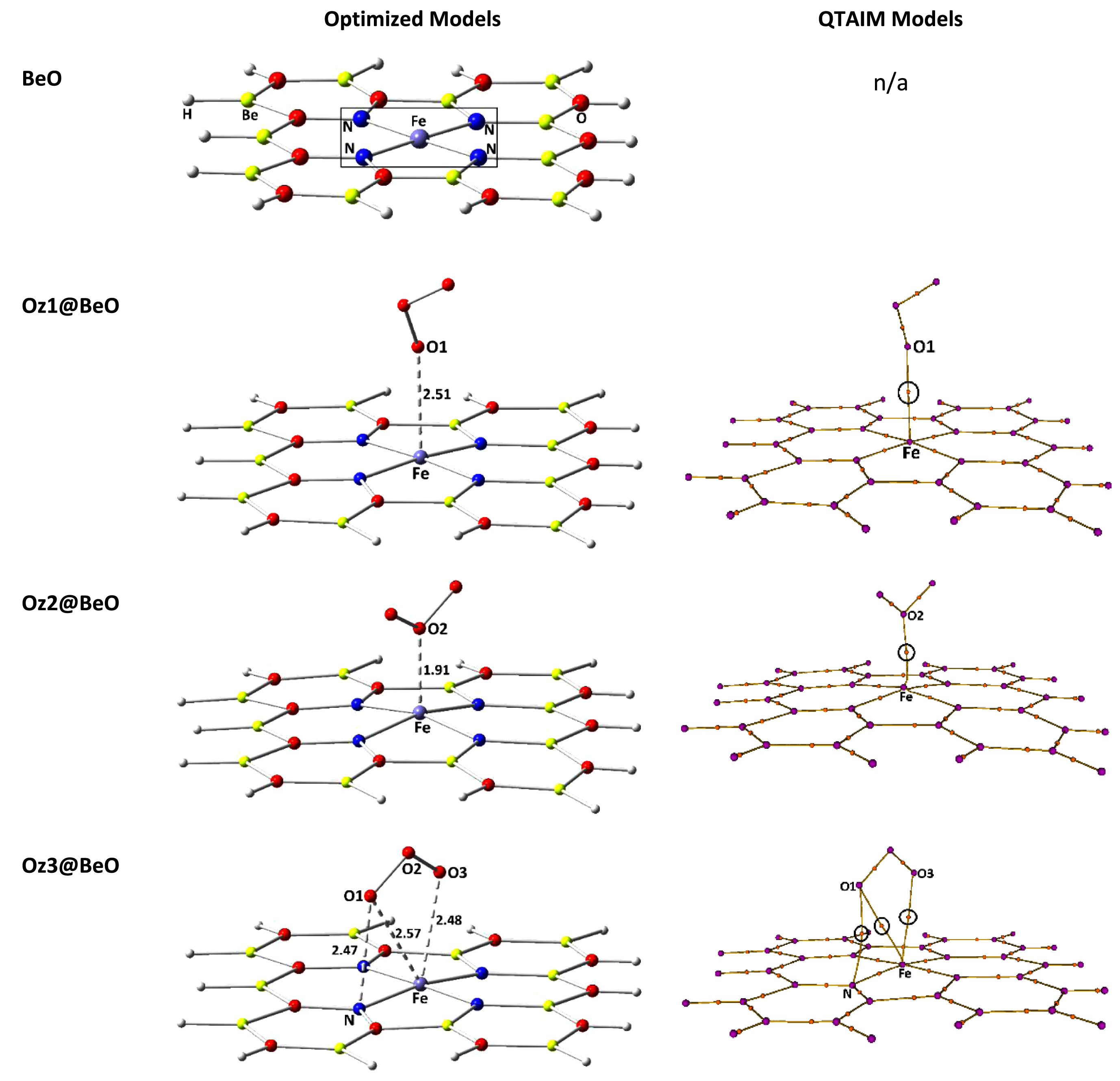
Optimized and QTAIM models for the investigated systems. The N4Fe-doped region is shown by square box. The interactions are shown by dashed lines and the distances are written in Å in the optimized models. The critical points of interactions are shown by circles in the QTAIM models.

The visualized distribution patterns of HOMO and LUMO, ESP surfaces, and DOS diagrams for the optimized systems.
One of the essential requirements of performing computer-based research work is to prepare 3D models for the investigated systems. In this regard, a monolayer of BeO nanoflake was employed in this work, in which the central region was doped by N4Fe atomic group to represent the HEME-like structures [57]. As could be seen in Fig. 1, the optimized models of singular nanoflake and those of Oz uptake complexes were shown. Indeed, after preparing each of singular BeO and Oz models, their combinations were optimized to find Oz relaxation configuration at the surface of BeO nanoflake. In this regard, the wB97XD/6-31 + G* level of density functional theory (DFT) calculations was employed to run the required computations by means of the Gaussian program [58]. By obtaining such optimized structures, their energy features and electronic-based descriptors were evaluated to characterize the models systems. To this aim, values of uptake energy (EUpt) were evaluated to recognize strength of complex formation for Oz and BeO nanoflake. Moreover, evaluating the molecular orbital levels of energies, especially for those of the highest occupied and the lowest unoccupied molecular orbitals (HOMO and LUMO), could help to generate other related features including energy gap (EGap), Fermi energy (EFermi), chemical hardness (H), and chemical softness (S), all summarized in Table 1. The evaluated representations of HOMO and LUMO distribution patterns of the optimized models were also exhibited in Fig. 2 besides visualizing the corresponding electrostatic potential (ESP) surfaces. To see the changes of such molecular orbitals features regarding the electrical conductivity, diagrams of density of states (DOS) of the optimized models were also exhibited in Fig. 2. Additionally, the strength of interacting substances were analyzed by employing the quantum theory of atoms in molecules (QTAIM) approach using the Mutliwfn program [59]. The evaluated features of QTAIM were summarized in Table 2 and the visualized representations were shown in Fig. 1. As a consequence, this work was performed to investigate a BeO nanoflake for the Oz uptake by advantages of employing computational approaches to provide insightful information for the research topics [60–62].
Results and discussion
The topic of gas uptake is important regarding the need of pollutant gas removal and also exploring gas storage devices [63]. To this aim, such topic has been always interesting for researchers of various fields [64]. Accordingly, this work was carried out to recognize the ozone (Oz) gas uptake by means of a representative beryllium oxide (BeO) nanoflake. As shown in Fig. 1, the investigated BeO nanoflake was a monolayer-like particle with centralized HEME-like N4Fe-doped region as indicated by square to easily catch it. Moreover, the edges were saturated by assistance of hydrogen atoms avoiding existence of dangling effects [65, 66]. This singular model was optimized to reach the minimized energy structure, in which the monolayer-like structure was obtained as the result of this process. Subsequently, configurations of Oz relaxation at the surface of BeO nanoflake were investigated by performing additional optimization processes to obtain interacting Oz@BeO bimolecular models. In this case, three configurations were successfully converged during the optimization processes based on the orientation of Oz molecular substance towards the N4Fe-doped region of BeO surface. As a consequence, the obtained three models were indeed representing the mechanism of Oz uptake by such BeO nanoflake, in which the intermolecular distances and interacting atoms were different for the models. Oz1@BeO was found to be in one-interaction model with the BeO nanoflake through O1 ... Fe interaction with the distance of 2.51 Å. For Oz2@BeO, the type of interaction was still similar to that of Oz1@BeO model but the distance of O2 ... Fe was found 1.91 Å. However, something different was happened for formation of Oz3@BeO model, in which three interactions were observed between the Oz molecule and the BeO nanoflake. Additionally, a new type of O ... N was found in this model in addition to already observed O ... Fe interactions. The interaction distances of Oz3@BeO model were found 2.57 Å, 2.47 Å, and 2.48 Å for each of O1 ... Fe, O1 ... N, and O3 ... Fe interactions, respectively. Comparing the optimized results of Table 1 could show that the third model of bimolecular formation was indeed the most favorite one among three investigated models, in which the evaluated value of EUpt was found –0.23 eV for Oz3@BeO model. Based on the evaluated values of such EUpt feature, Oz2@BeO and Oz1@BeO were placed at the next ranking of formation suitability of bimolecular models. In this regard, the results of QTAIM analysis could very well describe the nature of interacting systems. As shown in Fig. 1 and listed in Table 2, the models were analyzed based on the features of interaction natures by assigning the existence of critical points of interactions between two atom of Oz and BeO nanoflake. In complementary with the achievements of optimized processes, the results of QTAIM indicated that the models were in reasonable interaction strengths, in which the values of ρ(r) and ∇2 (r) were positive and that of H(r) was negative in almost all interacting modes. It is here defined that density of electron (ρ(r)) and Laplacian of electron density (∇2 (r)) could both emphasize on how much electron was concentrated ay the critical point of two interacting atoms. In this case, existence of such magnitudes could affirm the existence of interaction between two atomic sites. In the case of their positive values, physical interactions could be expected whereas their negative values could stand for existence of covalent bonds. Additionally, the combination of values of Lagrangian kinetic energy (G(r)) and potential energy density (V(r)) yields energy density (H(r)) implying for the strength of interaction, in which the obtained negative value is slightly stronger than the positive value. As a consequence, the results of Table 2 approved the obtained strength ranking by the evaluated values of EUpt, in which such order could be expected for the bimolecular models formations: Oz3@BeO > Oz2@BeO > Oz1@BeO. It could be mentioned here that the formation of Oz@BeO models were almost by occurrence of physical interactions, and as could be seen in Fig. 1, the original structure of Oz was not dissociated at the surface of BeO. Accordingly, the Fe-region helped to activate the surface of BeO for providing more vacant orbitals for interacting with the lone pairs of electrons of Oz and this role was indeed an important role for existence of Fe-atom in the investigated BeO surface structure. In the case of occurrence of such physical interactions, the adsorbed Oz substance could be also released in another specified step making the surface for a re-use step of gas uptake process. As a consequence, the observed physical interactions of Oz substance and BeO surface could help to collect Oz gaseous substances besides their detection and adsorption.
For analyzing electronic molecular orbital features, the HOMO and LUMO levels were quantitatively and qualitatively analyzed for the optimized models. As shown in Fig. 2 and listed in Table 1, the related features were significantly changed by occurrence of Oz gas uptake, in which such variations could indeed help to make a sensor device based on measurements of electric conductivity of HOMO and LUMO levels. It is very well known that each of HOMO and LUMO levels could stand for symbols of electron transferring process with the direction of HOMO ⟶ LUMO or vice versa. Accordingly, interacting tendency of a substance with other substances could be also defined by employing such electronic molecular orbital based features. As listed in Table 1, the values of LUMO levels detected more significant effects of Oz uptake in comparison with the values of HOMO levels. In this case, the corresponding energy distance of HOMO and LUMO, as indicated by EGap, was significantly reduce in the Oz@BeO models in comparison with the original singular BeO. As a result, the level of conductivity was significantly changed and it could be measured to show the sensor function of BeO for showing occurrence of Oz gas uptake. Additionally, the visualized distribution patterns of HOMO and LUMO in Fig. 2 could show the qualitative effects of such Oz gas uptake, in which the distribution patterns were shifted to other molecular sites because of formation of Oz@BeO bimolecular models. As mentioned before about the mechanism recognition of Oz gas uptake by BeO, the visualized distribution patterns could show that the models of interactions could determine the distribution patterns features, in which such features were different for the three models in comparison with each other. Accordingly, the colorful volumetric results of ESP indicated such variations of features for the investigated models. Many more details could be obtained when comparing the results of DOS diagrams, in which the results show the energy gap between the two remarkable HOMO and LUMO levels even other levels prior to or after than these levels. These results could emphasize on expected sensor function for the investigated BeO nanoflake to recognize the existence of Oz gas in the environment. Indeed, changes of HOMO and LUMO levels could make a signal of recognition for sensor function. Movement of Fermi level, as indicated by EFermi, could also affirm such expectation for making possible recognition of Oz gas uptake. Moreover, the evaluated features of chemical hardness and softness, as indicated by H and S, could somehow show the favorability of models for recognition processes with more or less significant for each model. Indeed, such features were in complementary with each other to show the benefit of employing the BeO nanoflake for participating in the Oz gas uptake process.
Conclusion
To approach the goal of this work for recognition the role of BeO nanoflake for employing in Oz gas uptake, the required information were evaluated by performing DFT calculations and QTAIM analysis. In this regard, the models indicated that the configurations of Oz relaxation at the surface of HEME-like N4Fe-doped region of BeO nanoflake could be different showing the mechanism of occurrence of such gas uptake. Accordingly, the models were recognized by the type and strength of involved interactions in the Oz@BeO bimolecular formations. The results of QTAIM affirmed the existence of interactions between two molecular substances, in which Oz3@BeO model was seen the most favorite model for Oz gas uptake by the BeO nanoflake though three interactions and two types of O ... Fe and O ... N interactions. In addition to such energetic results, the evaluated features of HOMO and LUMO and their related features indicated that the BeO nanoflake could also work as a sensor of such Oz gas uptake because of variations of such levels by significant impacts on electric conductivity. As a consequence, the Oz gas uptake was occurred by means of the investigated BeO nanoflake for employing in sensing, storing, or removing purposes.
Footnotes
Acknowledgments
The author acknowledges the support of the Deanship of Scientific Research at Prince Sattam bin Abdulaziz University.