



Abstract
Existence of iron (Fe) is important for cells of living systems; however, its level of magnitude for those patients infected by novel coronavirus disease (COVID-19) is still a challenging issue. Therefore, such mechanism of function was investigated in this work by assistance of thiofavipiravir (TFav) compounds generated by the well-known favipiravir (Fav) drug used for medication of COVID-19 patents. To this aim, sulfur-substitutions of oxygen atoms of Fav were done and the obtained parent structures were prepared for participating in Fe-chelation function. The results indicated that the modes were suitable for running such Fe-chelation processes, in which favorability and strength the models were ranged in this order: 1O2S-Fe > 1S2S-Fe > 1O2O-Fe > 1S2O-Fe. As a consequence, such idea of sulfur-substitution of Fav drug for more appropriate favorability of participating in Fe-chelation process was sensed by results of this work proposing 1O2S compound as the most favorable one for doing the function. Hence, information about capability of TFav compounds for participating in Fe-chelation processes were provided in this work regarding the challenging issue of Fe-chelation in medication of COVID-19 patients. All results of this work were obtained by performing computations using the density functional theory (DFT) approach
Introduction
Iron (Fe) is an important element in living system cell mechanism, in which its level of magnitude is an important factor for keeping safety of human health [1]. Excess and lack of Fe could seriously damage the living tissues and controlling its level is a crucial task [2]. Therefore, the topic of Fe-chelation has been always important for those researchers dealing with chemistry and biochemistry of living systems for removal of excess of Fe or supplying lack of Fe by providing appropriate Fe-chelators [3–5]. In this regard, removal of Fe from cancer cells is an essential task for preventing mechanism of cancer cell growth [6]. By appearance of novel coronavirus disease (COVID-19), Fe-chelation has been a challenging task unknowing certainly if its removal is useful or harmful for the patients [7–9]. Therefore, it is important to investigate this topic to show possible mechanism of function of Fe-chelation by those drugs for medication of COVID-19, which is indeed a serious problem of these days all around the world [10–12]. Favipiravir (Fav) has been well-known by expectations for its efficacy against COVID-19 [13]. Several attempts have been dedicated to show various features of Fav in single-standing status or in participation in interactions with coronavirus related enzymes [14–16]. However, COVID-19 has been not solved yet and information on medication by Fav has been still a challenging issue [17–19]. Hence, providing further information about the topic is necessary.
Fav (Fig. 1) has a heterocyclic structure and earlier studies on similar structures indicated that substitution of oxygen atom by sulfur atom could yield thio- compounds with new features for therapy of related diseases [20–22]. Indeed, sulfur substituted compounds could work as better substances for participating in interactions based on advantage of longer lengths of S-mediated bonds than those of O-mediated bonds making the atomic site more polarizable [23–25]. To this point, S-mediated compounds have been seen applicable for participating in Fe-chelation processes an addition existence of thio-compounds of biological molecules [26–28]. Hence, the idea of formation of thiofavipiravir (TFav) and evaluating its function regarding Fe-chelation was investigated in this work. To this aim, density functional theory (DFT) calculations were performed to optimize parent TFav compounds for preparing required structures for contributing to Fe-chelation function. In this regard, four parent structures (Fig. 2) were prepared and four corresponding Fe-chelated structures (Fig. 3) were obtained. Indeed, several compounds have been proposed for participating in metal chleation processes for working in relation with the living systems [29–31]. Therefore, such idea was investigated in this work to show possible function of TFav compounds for participating in Fe-chelation functions. To make sense the idea, structural and electronic features were evaluated for the models to show details of such Fe-chelation process by assistance of TFav compounds by benefit of performing computer-based works for characterizing features of materials [32–34]. It is important to mention here that computational tools and approaches could help solving problems related to chemical structures at the smallest molecular and atomic scales avoiding the existence of any interferer, in which computer-aided drug design (CADD) has been seen an important methodology for this purpose [35–37]. In this work, such computational benefit was used to predict and interpret formations of Fe-chelated complexes of TFav with the obtained results as summarized in Table 1 and Figs. 1–4.
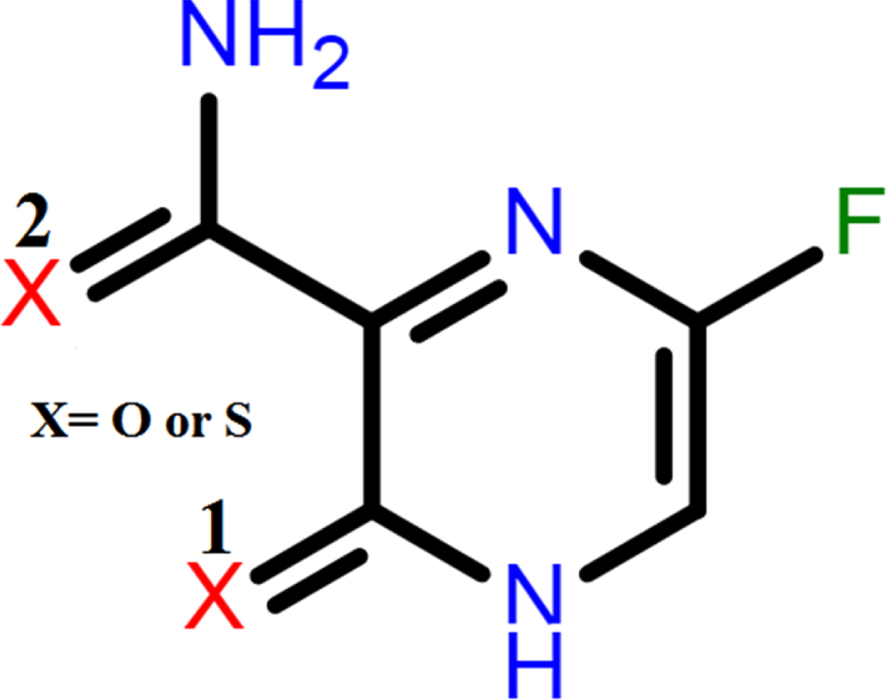
Parent TFav compound.
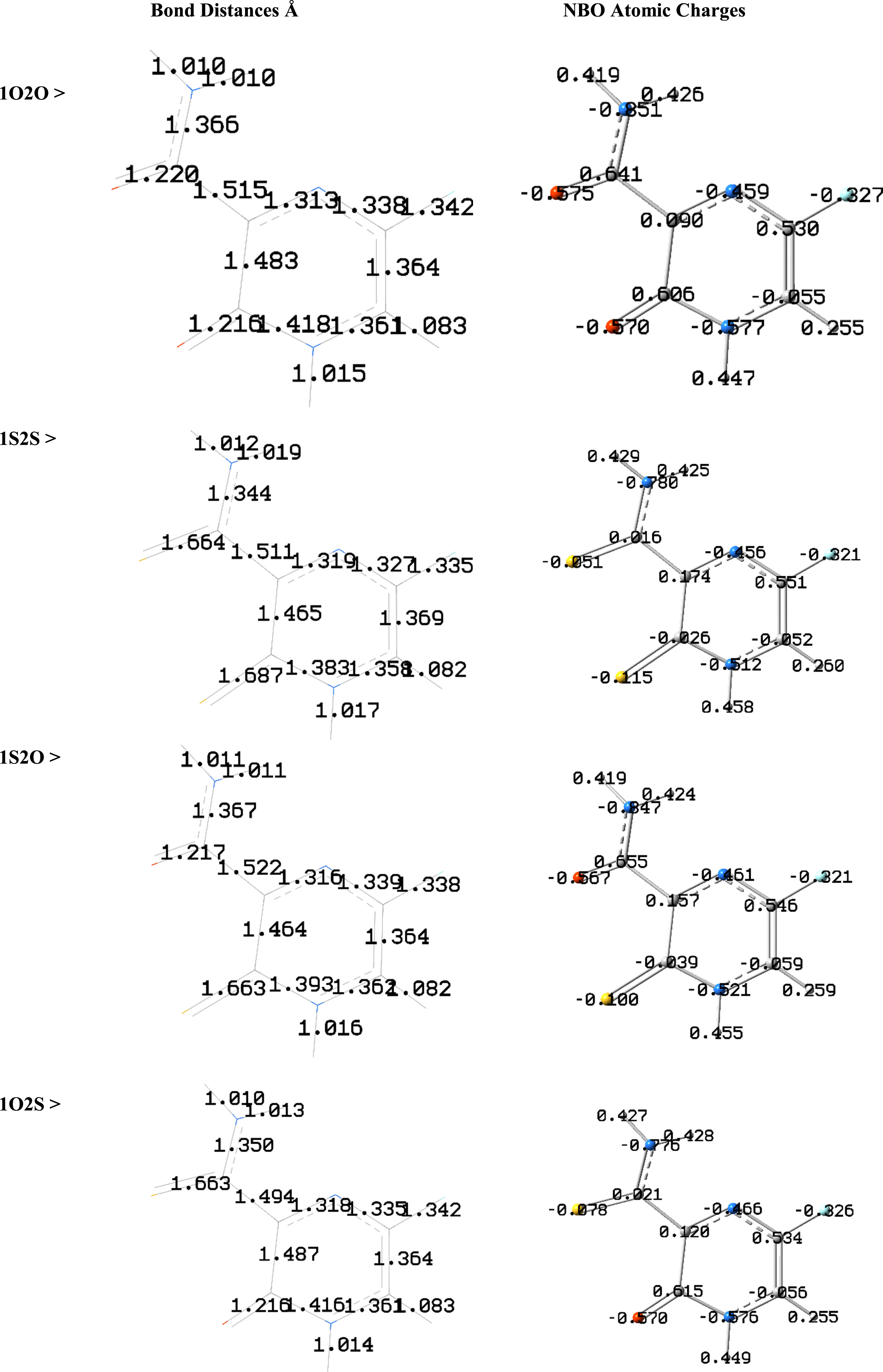
Optimized geometries and NBO charges for parent TFav compounds.
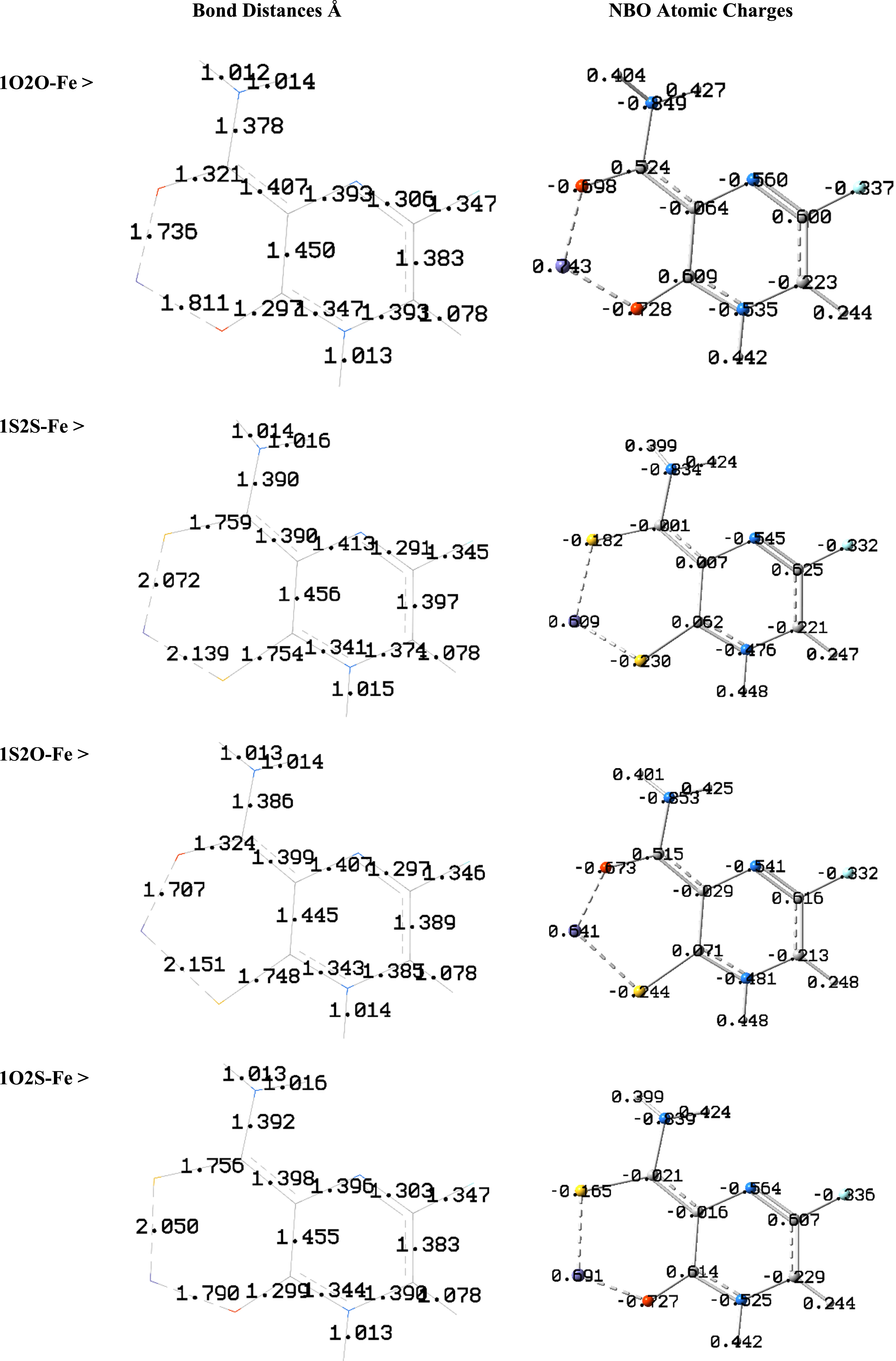
Optimized geometries and NBO charges for Fe-chelated TFav compounds.
Obtained features for the optimized TFav models*
*DM is in Debye, S is in eV–1, and all others are in eV.

HOMO, LUMO, and ESP representations for the optimized parent and Fe-chelated TFav compounds.
Fav is a heterocyclic compound including amine, keto and peptide groups (Fig. 1), in which oxygen atoms of two keto groups were substituted by sulfur atoms to make parent models of TFav inducing 1O2O, 1S2S, 1S2O, and 1O2S (Fig. 2). The modes were optimized to obtain stabilized geometries of minimize energy level for providing parent structures for participating in Fe-chelation process. Next, four Fe-chelated models were obtained by performing optimization calculations on combinations of Fe and each of TFav compounds yielding 1O2O-Fe, 1S2S-Fe, 1S2O-Fe, and 1O2S-Fe compounds. Optimized bond distances and natural bonding orbital (NBO) atomic charges were shown in Figs. 2 3. Evaluated values for total energy (ETot), chelation energy (EChel), energies of the highest occupied and the lowest unoccupied molecular orbitals (HOMO and LUMO), energy gap (EGap), chemical hardness and softness (H and S), and dipole moment (DM), were all summarized in Table 1. ΔEChel was evaluated to show efficiency of the modes for Fe-chlation in comparison with the most powerful chelator structure. HOMO and LUMO distribution patterns and electrostatic potential (ESP) surfaces of the optimized models were exhibited in Fig. 3. All calculations of this work were performed using the B3LYP/6-31G* level of DFT as implemented in the Gaussian program [38].
Results and discussion
The major goal of this work was to investigate Fe-chelation by assistance of thiofavipiravir (TFav) compound (Fig. 1) regarding the importance of medication of COVID-19 patients. As mentioned before, level of magnitude of Fe for COVID-19 patients is still a challenging issue and further information are needed especially for chelating function of those drugs used for medication of this disease. In this work, possible models of TFav were investigated to show capability of Fe-chelation by means of computer-based approaches. There were four parent models in this work including 1O2O, 1S2S, 1S2O, and 1O2S, in which 1O2O resembled the original Fav compound and 1S2S resembled the pure TFav compound. Each of 1S2O and 1O2S were mixtures of thio and keto groups for examining all possibilities of structural formations. The parent models were optimized to reach the minimized energy geometries to provide structures for participating in Fe-chelation. In this regard, all four parent models were stabilized and their optimized bond distances were exhibited in Fig. 2. Based on he obtained optimized structures, appropriate atomic sites for possible chelation of Fe by keto/thiol groups were prepared for running the Fe-chelation process. Comparing obtained energies for 1S2O and 1O2S models indicated that the first model was slightly more stable than the second model. Comparing bond distances of the optimized models indicated structural variations for the modified models, in which almost all bonds detected such effects in the four parent models. Indeed, such structural variations could put significant impacts on electronic properties of the models, in which the evaluated NBO atomic charges showed such changes for the model systems. Negative charges of O and S atoms of TFav models made them appropriate atomic sites for interacting with Fe atom, in which magnitudes of charges of these two atoms were changed among the models reminding different expected strength for the Fe-chelated model systems. Viewing levels of HOMO and LUMO could indicate changes of electronic transferring tendency, in which values of EGap showed different distances between these levels in the parent models in addition to variations of each level. These observation could show that the models were provided with different structural and electronic feature, in which values of H and S approved these changes besides values of DM. HOMO and LUMO distribution patterns and ESP surfaces (Fig. 4) helped to recognize keto-thio sites for interacting with metal component. As indicated by the HOMO patterns, localization of HOMO was significant at the keto-thio sites and ESP showed red color for these sites with negative charges. Therefore, the models were prepared for participating in Fe-chelation through keto-thio sites of TFav structure.
Four models were obtained for the Fe-chelated TFav structures including 1O2O-Fe, 1S2S-Fe, 1S2O-Fe, and 1O2S-Fe, by performing optimization processes for the separated models. As shown in Fig. 3, bond distances and NBO atomic charges were shown for the optimized models of Fe-chelated TFav. Changes of bond distances and atomic charges affirmed the formation of Fe-chelated models, in which the significance of such variation was different from model to model. Analyzing values of energies could show that the strength of Fe-chelated models could be ranged in this order: 1O2S-Fe > 1S2S-Fe > 1O2O-Fe > 1S2O-Fe, in which the 1O2S showed the highest favorability and 1S2O showed the lowest favorability for participating in Fe-chelation processes. For declaring this case, the models were analyzed by values of EChel and ΔEChel to show the efficiency of the Fe-chelation function by TFav compounds. Comparing the magnitudes of obtained energies for Fe-chelated TFav models with those of other Fe-chelated complexes could affirm the possibility of formation of complexes of this work with meaningful strength [39]. By existence of a transition metal in the structures, levels of HOMO and LUMO detected significant changes in both of each level and distance shown by EGap. Shorter distances of HOMO-LUMO affirmed contribution of Fe to electronic system of TFav yielding TFav-Fe structures. Moreover, chemical features of H and S detected variations of such electronic changes as continued by changes of values of DM. Distribution patterns of HOMO and LUMO (Fig. 4) showed localization of molecular orbitals at whole structure of TFav-Fe models even at the Fe atomic site, in which ESP surfaces affirmed formations of such structures by neutralizing the red color regions of parent TFav compounds. As a consequence, examining the idea of Fe-chelation by TFav compounds showed capability of employing this structure for Fe-chelation function as a challenging issue in medication of COVID-19 patients. Furthermore, existence of such thio molecular systems were affirmed according to obtaining stabilized structures by performing optimization calculations.
Conclusion
This work was done to examine the idea of Fe-chelation by TFav compounds, as a possible mechanism of function in medication of COVID-19 patients. Four parent models were stabilized and Fe-chelation processes were investigated by their assistance. Accordingly, four models of optimized TFav-Fe compounds were obtained and their features were recognized for the systems. Evaluated molecular orbital features proposed keto-thio atomic sites could be suitable for participating in Fe-chelation processes, in which further obtained results approved such hypotheses. The obtained strength of Fe-chelated TFav compounds were ranged in this order: 1O2S-Fe > 1S2S-Fe > 1O2O-Fe > 1S2O-Fe, in which the most and the least favorability for Fe-chelation were obtained for 1O2S and 1S2O compounds. This achievement indicated that sulfur substitution of original Fav compound could increase favorability of molecule for participating in Fe-chelation, in which keto of connected peptide group could be seen in priority for being substituted by the sulfur atom. Evaluated molecular orbital features also approved such metal chelation processes. Finally, the idea of Fe-chelation by TFav compounds was sensed in this work for providing information about the challenging issue of Fe-chelation process in medication of COVID-19 patients.