



Abstract
This work was performed to examine an idea about full chelation of Iron (Fe) by well-known favipiravir (Fav) as a possible mechanism of action for medication of COVID-19 patients. To this aim, formations of Fe- mediated dimers of Fav were investigated by performing density functional theory (DFT) computations of electronic and structural features for singular and dimer models. The results indicated that the models of dimers were suitable for formation, in which two cis (D1) and trans (D2) models were obtained regarding the configurations of two Fav counterparts towards each other. Energy results indicated that formation of D1 was slightly more favorable than formation of D2. Molecular orbital features affirmed hypothesized interacting sites of Fav for Fe-mediated dimers formations, in which atomic charges and other molecular orbital related representations affirmed such achievements. Moreover, detection of such dimer formation was also possible by monitoring variations of molecular orbitals features. As a consequence, formations of Fe-mediated dimers of Fav could be achievable for possible removal of excess of Fe as a proposed mechanism of action for Fav in medication of COVID-19 patients.
Introduction
Appearance of deadly novel coronavirus disease (COVID-19) has attracted almost attentions of all researchers to focus on developing characterization techniques and medication protocols all around the world [1–3]. Serious harmful impacts of COVID-19 emerged researchers to use available protocols for medication of this unknown disease [4–6]. To this time, several works have been performed to explore various features of favipiravir (Fav) as one of those drugs for the purpose; however, a certain decision for medication of patients has not been made yet [7–9]. Therefore, further investigations are still required for characterizing features of Fav for providing more information about this issue [10–12]. Concentration of iron (Fe) has been seen as another challenging issue about the health system of the infected patients by coronavirus [13–15]. It is almost hypothesized that Fe-chelation could help the COVID-19 patients for increasing their health quality level [16–18]. Therefore, possible mechanism of action of Fav as a Fe-chelator could be important to be understood regarding its expected role for medication of COVID-19 patients [19–21]. Indeed, earlier works showed importance of existence of Fe for pushing the cell growth whereas Fe-chelation from cancer cells could be seen as a function of anticancer drugs [22–24]. To this point, such idea was examined in this work by investigating formations of Fe-mediated dimers of Fav.
Fav (Fig. 1) is a heterocyclic compound with a connected peptide group, in which chemistry of its structure could provide appropriate atomic sites for participating in Fe-chelation mechanism. To approach this aim, quantum computations were performed to obtain full chelating condition of Fe by formations of Fe-mediated dimers of Fav (Fig. 2). Indeed, such dimer formation is an advantage of full chelation not to release the captured Fe easily. Therefore, such full chelation condition was investigated in this work by benefits of performing computations for solving the problems in science and engineering [25–30]. Indeed, several works have been developed for investigating the features of those related materials to living systems in both of food and drug issues [31–35]. Several efforts have been developed for recognition of interacting systems regarding the importance of adsorption processes [36–40]. Among which, the computer-based approaches have been seen useful techniques for knowing details of such complicated systems [41–43]. Indeed, such methodological approach could for recognition of several features in the investigated models systems [44–46]. Within this work, all required information including quantitative and qualitative features were evaluated by employing the computational methods to approach the current goal for characterizing electronic and structural features of Fe-mediated dimers of Fav (Table 1 and Figs. 1–3).
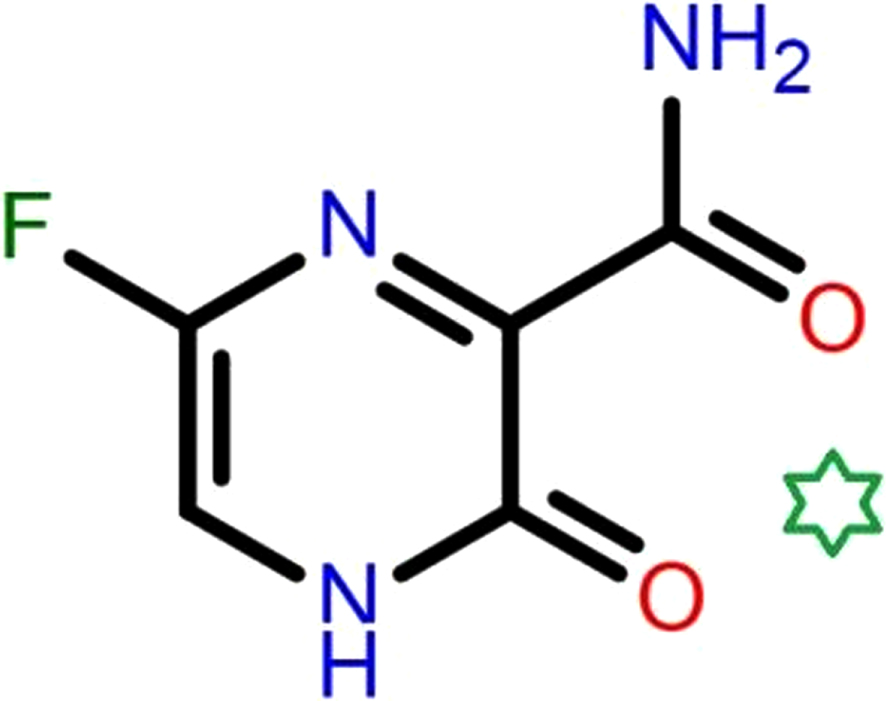
Structural representation of favipiravir (Fav). Star shows appropriate position for Fe-chelation.

Bond distances (Angstrom) and IR spectra of the optimized models.
Quantum descriptors of the optimized models*

NBO atomic charges, HOMO and LUMO patterns, and ESP surfaces of the optimized models.
To approach the goal of this work for characterizing electronic and structural features of Fe- mediated dimers of Fav, quantum computations were performed on 3D molecular systems to obtain their optimized geometries. To prepare the investigated models, the molecular models were drawn to provide the requested geometries for including in the calculations. Subsequently, the optimization calculations were performed to obtain the structures. As a consequence, the models were provided for further analysis of singular modes besides involving in further optimization calculations of bimolecular complex formations systems. Indeed, the optimized structures could work as the most important materials of computational works for pushing forward the work for the original optimized models of their combinations for involving in a new computational step. Employing such useful methodologies, two models of dimers were found based on relaxations of two connecting Fav molecules in cis or trans configurations named by D1 and D2. As shown in Fig. 2, optimized geometries, bond distances, and evaluated infrared (IR) spectra were exhibited for the singular and Fe-mediated dimers Fav models. By performing such computations, the investigated structures were available for evaluating further electronic features, in which evaluated natural bond orbital (NBO) atomic charges, patterns of the highest occupied and the lowest unoccupied molecular orbitals (HOMO and LUMO), and electrostatic potential (ESP) surfaces of the optimized models were all exhibited in Fig. 3. In addition to such qualitative representations, quantitative quantum descriptors including total energy (ET), dimerization energy (ED), HOMO energy (EH), LUMO energy (EL), energy gap (EG), Fermi energy (EF), and dipole moment (DM) were evaluated for the optimized models (Table 1). To evaluate ED, differences of values of ET of component structures were calculated. To evaluate EG and EF, differences of values of EH and EL were calculated for obtaining EG and average values of EH and EL were calculated for obtaining EF. All computations of this work were performed employing the b3lyp/6-31g* level of density functional theory (DFT) as implemented in the GAMESS program [47].
Results and discussion
This work was performed due to importance of exploring mechanisms of medications of COVID-19 patients by Fav drug. To this aim, full Fe-chelation was investigated by means of formations of Fe- mediated dimers of Fav, in which two configurations of cis and trans dimers were found for this purpose. As shown in Fig. 1, two keto groups are available in the structure of Fav, which are both appropriate for participating in Fe-chelation mechanism. One importance of such chelators is their ability of keeping the captured substance; therefore, full chelation could assure for this purpose. DFT computations were performed to characterize electronic and structural features of Fe-mediated dimers of Fav to see how full chelation could be occurred by means of employing Fav drug.
As shown in Fig. 2, three models were investigated in this work including singular model indicated by Fav and two models of cis and trans of Fe-mediated dimers indicated by D1 and D2, respectively. The models were optimized to obtain the minimized energy geometries, in which the corresponding bond distances were shown in Fig. 2. Analyzing the results could indicate that the bond distances detected structural variations of formations of cis and trans configurations, in which the obtained bond distances of parallel positions were not identical in two models. Another important point is that both models were relaxed to out of plane configurations but different in cis and trans models meaning the managing role of Fe atom for providing deformation for structural configurations. In this regard, such variations were also seen by the evaluated IR spectra for two dimers, in which changes of peaks in the region of 1500 cm–1 were typical symbols of such variations. Based on such achievements, different features could be expected for the dimers with more or less significant changes in comparison with each other. For clarifying the magnitudes of such changes, quantitative descriptors of Table 1 could help to reach the purpose.
Based on the obtained values of energies (Table 1), comparing values of ET indicated that D1 was slightly more stable than D2 meaning that cis configurations was more suitable than trans configuration for the Fe-mediated dimer formation. Analyzing values of ED also approved such achievement that D1 was slightly stronger than D2 with a magnitude of 0.015 eV. It is important to mention here that the magnitudes of ED were significantly meaningful for formation of a dimer complex revealing that the idea of Fe-mediated dimer formation of Fav was almost achievable by obtaining such values of ED. For describing more details, two cis and trans configurations could be obtained with better favorability of formation for D1 than D2. As a consequence, full Fe-chelation could be achieved by assistance of Fav through formations of Fe-mediated dimers complexes. Besides such structural energy features, molecular orbital based features indicated that the models of singular and dimers detected impacts of such complex formations by obtaining different features between singular and dimer models in addition to observed variations between two D1 and D2 dimers complexes. It is known that energy levels of HOMO and LUMO could imply for occurrence of electron transferring tendency of a molecule, in which differences of these two levels (assigned by EG) could imply for showing conductivity features. Therefore, changes of these levels could bring significant effects for the investigated systems yielding different features for the constructed model systems. In this regard, changes of such HOMO and LUMO could change also the tendency of a molecule for participating in interactions with other substances even making different conditions of their detections by means of electrochemical sensing devices. Therefore, for detection of Fe or its chelation and removal, it could be an advantage to measure magnitudes of changes of such HOMO and LUMO levels for detecting Fe concentration in the investigated media. Comparing levels of HOMO for singular and dimer models could show significant impact of dimerization on the energy level of HOMO whereas variations of HOMO levels in D1 and D2 were almost negligible. This is indeed a remarkable achievement regarding the major role of HOMO level for participating in electron transferring mechanism as a donor side. On the other hand, variations of LUMO levels between singular and dimer models and even between D1 and D2 were almost negligible. Therefore, impact of dimerization was meaningful for HOMO levels but negligible for LUMO levels. As a consequence, magnitudes of EG were changed by such variations of HOMO level, in which obtaining shorter distances between HOMO and LUMO levels implied for higher conductivity for the Fe-mediated dimer complex. As a brief note, the singular Fe model could be stay at Off mode, but in the condition of Fe-mediated dimer complex formation it will be switched to On mode alarming for Fe-chelation mechanism. It could be also hypothesized that excess of Fe concentration could be detected by such dimerization process, in which the magnitude of conductivity could be a symbol of detection mechanism. Different values of EF could also affirm such hypothesis with significant variations from singular model to dimers models making possible detection process of Fe-chelation by variations of such Fermi levels, which is indeed an essential factor of constructing sensor devices. To this point, the quantum descriptors indicated that strong Fe-mediated dimer models could be achieved for such chelation processes with somehow slight changes for formation of two dimers of cis and trans configurations, in which the cis model (D1) was a winner for the process of Fe-chelation. Moreover, variations of molecular orbitals levels helped for detection of such dimers formations by significant difference of values from singular to dimers models. As a consequence, the idea of Fe-meditated dimers formations could be also used for detection purposes in addition to desired Fe-chelation purpose.
Further characterizations of the investigated models of this work were performed using the evaluated NBO atomic charges and visualized patterns of HOMO and LUMO in addition to ESP surfaces of the optimized structures (Fig. 3). The atomic charges could help for detecting positive/negative points for predicting of participation in interactions with other substances. In this regard, atomic charges of oxygen atoms of Fav could show appropriate negative site of interactions with Fe atom consisting of plenty of vacant orbitals considered as a positive point. For more clarification, the visualized ESP surface of Fav showed red color at the oxygen sites meaning negative point charge site. It could be mentioned that red and blue colors imply for negative and positive charges whereas green color means neutral point. Moreover, yellow color shows some negative charges at the molecular site whereas light-blue shows some positive charge. As a consequence, combinations of achievements by NBO atomic charges and ESP surface reveal that the Fav model could be considered for interaction with the Fe atom through oxygen atomic sites.
Based on the achievements, such Fe-mediated dimerization was occurred to yield two cis and trans configurations for Fav dimers complexes. Examining charges of oxygen atoms in dimers could show that the models detected different conditions for atomic charges, in which the atomic charges of oxygen atoms of two Fav counterparts of D2 model were identical whereas they were different in D1 model. D1 was slightly stronger than D2, in which the charges conditions could somehow describe such observation. HOMO and LUMO patterns could show variations of localization of frontier molecular orbitals at the molecular surfaces, in which very careful examinations of patterns could show more changes of HOMO patterns in comparison with LUMO patterns. Continuous distribution of ESP surfaces for dimers could also affirm formation of such complexes. For making possible detections of Fe-mediated dimers of Fav of the optimized models could show variations of electronic features regarding conductivity aspect. Comparing the obtained results of this work with those of earlier works [14, 16–20] could show the importance of focusing on preparing novel agents for Fe-chelation processes in the COVID-19 infected patients, in which the know Fav compound could help to approach this goal. Indeed, the formation of such double-structure complex could make a sandwich of Fe between the fav layers to make a complete chelation process. As a consequence, the obtained Fe-mediated dimers were achieved and their features were recognized for showing full Fe-chelation process in addition to providing a tool for recognition of such dimerization process.
Conclusion
In this work, an idea of formation of Fe-mediated dimer of Fav was investigated by performing computational characterization of electronic and structural features to approach the goal. The results indicated that the hypothesized dimer model was achievable by meaningful strength, in which two dimers of D1 and D2 were obtained based on cis and trans configurations of two Fav models towards each other. Moreover, cis model was seen slightly more stable than trans model. As a consequence, formations of such Fe-mediated dimer complexes were achieved. Further analyses of the structures were done by evaluated electronic molecular orbital features, in which significant changes of HOMO levels were observed for dimers in comparison with singular Fav whereas changes of LUMO levels were almost negligible. Consequently, distances of HOMO and LUMO were significantly reduced in dimers increasing conductivity feature for them. By such variations, detection of Fe-mediated dimers were possible by measurement of such conductivity features before/after dimerization as seen by variations of molecular orbitals features. And finally, hypothesis of this work was made sense by benefits of such computer-based works to propose the models for further investigations especially for clarifying mechanism of action of Fav for medication of COVID-19 patients.
Footnotes
Acknowledgment
The author acknowledges the support of the Deanship of Scientific Research at Prince Sattam bin Abdulaziz University.