



Abstract
This computational work was performed to investigate drug delivery of 5-fluorouracil (FU) anti-cancer by assistance of an iron(Fe)-modified graphene (G) scaffold. The models were optimized to reach the minimized energy structures in both of singular and bimolecular models. Two models of FU@G complex were obtained including O2@G and O4@G by relaxation of FU through O2 and O4 atoms towards the Fe-atom region of G surface. The obtained results of energies indicated a higher stability and strength for the O2@G model in comparison with the O4@G model. The quantitative and qualitative features of electronic molecular orbitals indicated the investigated G surface could work as a carrier of FU by reducing the unwanted side effects and also playing the sensor role. As a final remark of this work, the investigated G model could be proposed for employing in the targeted drug delivery of FU in both of carrier and sensor agents.
Introduction
Targeted drug delivery has been always an important topic for researchers of life sciences to increase positive impacts of drug medications for the patients with lower levels of unwanted side effects [1–3]. To this aim, several efforts have been done to characterize possible carrier scaffolds for loaded drugs to carry them up to the specified target in living systems [4–6]. After the pioneering innovation of carbon nanotube, attentions have been focused on development of nanostructures for employing as drug carriers of the targeted drug delivery purposes [7–9]. The wide surface of nanostructures made them suitable adsorbents of other substances, in which the innovation of graphene introduced a wide surface layer-material for playing the role of an appropriate adsorbent [10–12]. Biological applications of graphene scaffold have been vastly investigated by performing several works in computer and laboratory media to show the structural features for developing further progresses [13–15]. In this regard, graphene has been seen useful for employing in the drug delivery systems of various pharmaceutical compounds [16, 17]. Additionally, sensor applications of graphene has been also seen for detecting the adsorbed substance and the specified target for delivery of the loaded drug [18]. Indeed, graphene scaffold could play dual roles of carrier and sensor in the targeted drug delivery systems [19–21]. Several earlier works have been done to recognize such features of applications of nanostructures for various fields especially in living systems regarding their specified roles and purposes [22–24]. Furthermore, several methodologies have been introduced to reach such purposes [25–27]. Such roles are especially important for delivery of those drugs such as anti-cancers with harmful impacts on other healthy tissues in the terms of unwanted side effects [28–30]. Accordingly, reduction of side effects of cancer medications is a must in the era of increasing number of cancer patients [31–33]. 5-Fluorouracil (FU) has been known as a useful anti-cancer drug for medication of different types of cancers for years [34–36]. Besides significant advantages of medications of cancer patients by FU, but the unwanted side effects are those restricting factors of prescription of 5FU for various cases [37–39]. To this aim, considerable efforts have been dedicated to characterize features of FU besides proposing novel carriers for setting up the targeted drug delivery systems [40–42]. Indeed, investigating adsorbing and releasing features are both very important for reaching a point of efficient drug delivery system [43–45].
Within the current work, we investigated the drug delivery of FU by assistance of an iron (Fe)-modified graphene scaffold by employing the computational chemistry approach. In this regard, we obtained the singular molecular systems of FU and graphene scaffold to examine their interactions and the resulted impacts on electronic and structural systems of the substances. As could be seen in Fig. 1, the optimized models configurations were exhibited in singular and bimolecular modes to show schematic representation of the investigated models. Moreover, several features in quantities and qualities were evaluated for the models as presented in Table 1 and Figs. 2 3. We did this work by benefit of performing computational procedures to approach the goals by providing insightful information at the smallest size scales [46–48]. In this regard, several earlier works showed benefits of employing such computational procedures for investigating complicates systems such as nano- and bio-related ones [49–51]. Accordingly, the required information were provided for discussing the topic of this work to show details of FU drug delivery by assistance of a mode of Fe-assisted graphene scaffold.

Top and side views of optimized models; a) FU, b) G, c) O2@G, and d) O4@G.
The evaluated features of optimized models*
*The models were shown in Fig. 1. All energy values are in eV and DM is in Debye.
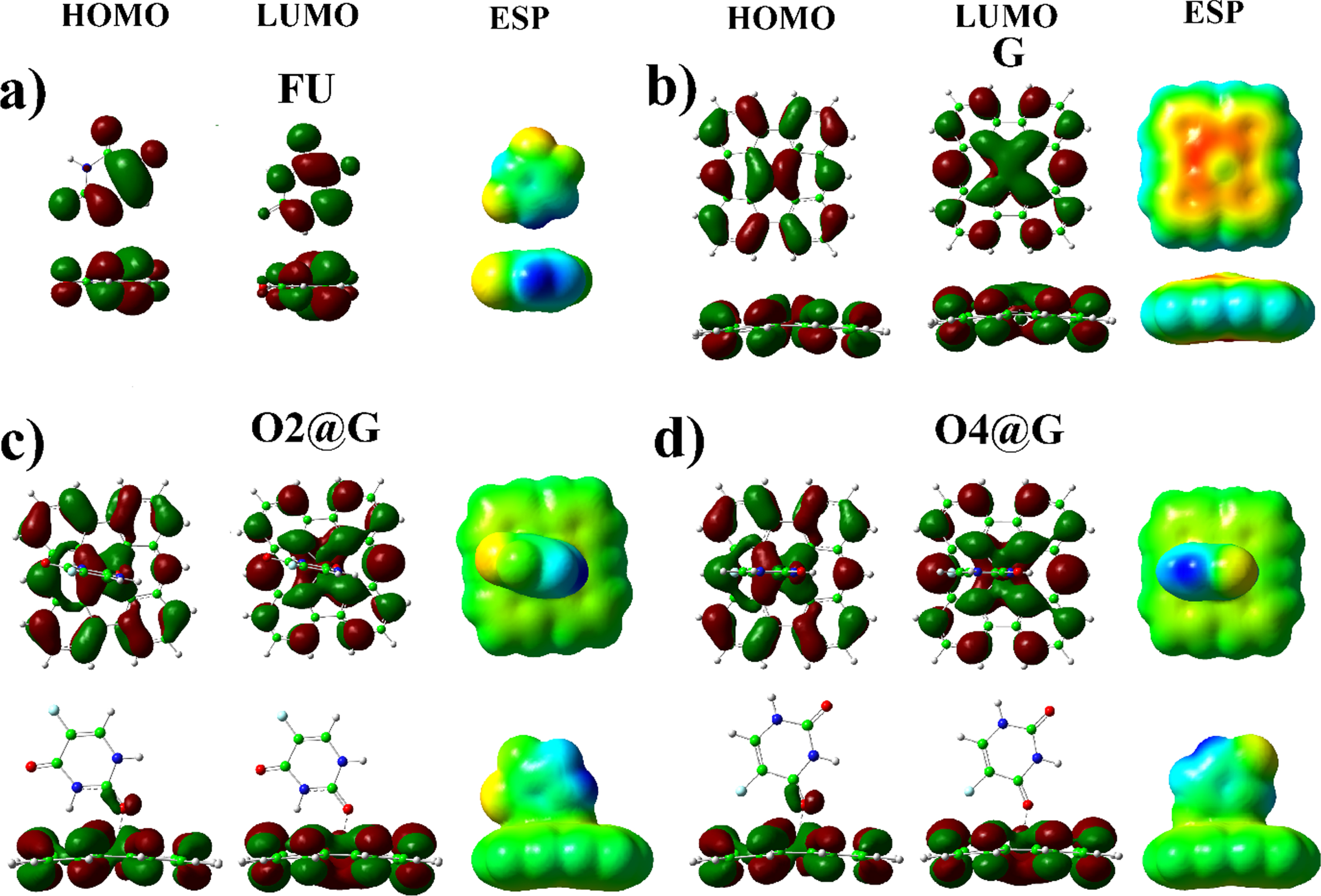
Top and side views of HOMO-LUMO distribution patterns and ESP surfaces.
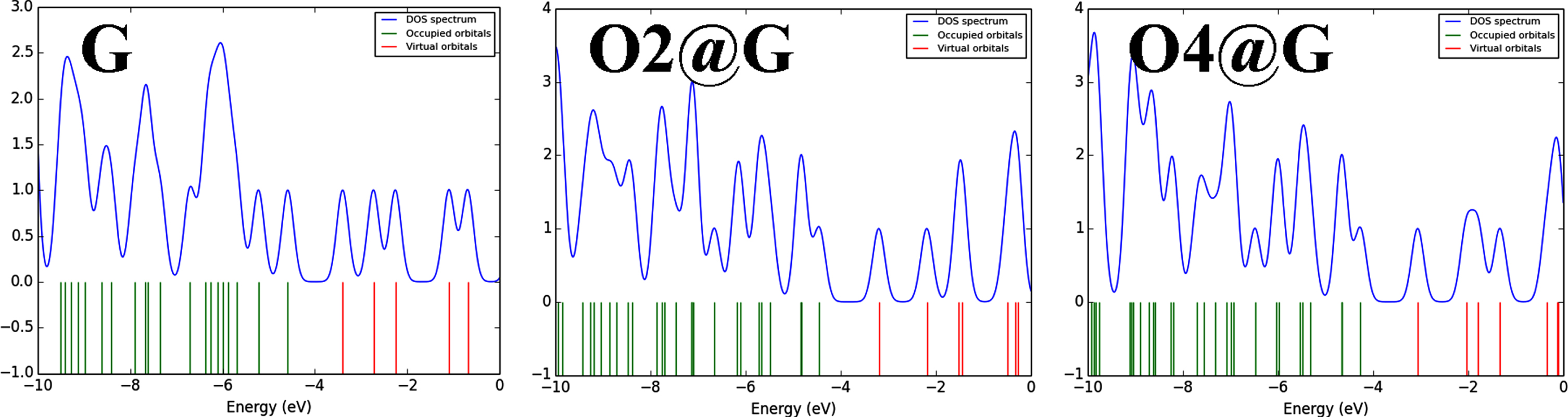
DOS diagrams.
This work was done for investigating 5-fluoruracil (FU) drug delivery by assistance of an iron(Fe)-modified graphene scaffold through employing the computational chemistry approaches. To approach this goal, 3D molecular models of singular FU and a representative Fe-modified graphene were prepared by preforming optimization calculations (Fig. 1). Next, bimolecular models of FU and graphene scaffold were created by performing additional optimization calculations to obtain the optimum interacting complex models configurations (Fig. 1). Up to now, the models were prepared for performing further calculations regarding the electronic and structural features, in which parameters such as total energies (TE), adsorption energies (AE), energy levels of the highest occupied and the lowest unoccupied molecular orbitals (HOMO and LUMO), energy gaps (GE), Fermi energies (FE), and dipole moments (DM) were extracted and listed in Table 1. Moreover, visual representations of HOMO and LUMO were exhibited in Fig. 2 besides the evaluated electrostatic potential (ESP) surfaces of the optimized models. To show sensor applications of employed graphene scaffold for detection of adsorbent, diagrams of density of states (DOS) were exhibited in Fig. 3 for the optimized systems. As a consequence, the required information of this work were obtained by performing the B3LYP/6-31G(d) density functional theory (DFT) calculations as implemented in the Gaussian program [52].
Results and discussion
In this work, a model of iron-modified graphene (G) was investigated for drug delivery of 5-flurouracil (FU) by performing quantum chemical DFT calculations. The models of singular FU and G were optimized first to prepare the substances of this work. Next, bimolecular models of FU and G were investigated by performing additional optimization calculations to obtain the minimized energy configurations of FU towards the G surface (Fig. 1). In this regard, two models were obtained including O2@G and O4@G bimolecular complexes implying for relaxation of FU through O2 and O4 atoms towards the Fe-atom of G surface. Earlier works indicated that the doped models of nanostructures could show significant features for developing further applications [53–56]. Accordingly, the Fe-atom of G surface was seen as suitable region for interacting with the FU substance. Based on the exhibited HOMO-LUMO distribution patterns, the green-like region of Fe-atom among the red region was the suitable region of G surface for adsorbing the FU substance. The optimized models of FU at G also indicated the suitability of Fe-atom for participating in interactions with the O atoms of FU substance. As a consequence, two models of O2@G and O4@G were obtained after performing the optimization calculations. The models of Fig. 1 showed that O2. . . Fe and O4. . . Fe interactions were located at 1.99 and 1.97 Å, respectively. The results of Table 1 indicated more stability of O2@G model in comparison with O4@G model based on values of total energies (TE), in which the evaluated values of adsorption energies (AE) approved such achievement by yielding –1.02 and –0.82 eV for O2@G and O4@G models, respectively. In this regard, the values of electronic molecular orbital features indicated variations of HOMO and LUMO levels among the investigated models. As could be seen by the results of Table 1, the values of HOMO and LUMO of FU were changed to the values of G surfaces, in which the O2@G and O4@G models showed different values in comparison with the singular FU. Accordingly, the values of GE and FE detected the effects of such FU adsorption processes at the G surface. Analyzing the content of Fig. 2 could help to visually see the impacts of such Fu adsorption at the G surface by variations of HOMO-LUMO distribution patterns. The results indicated that the molecular orbital patterns of FU were moved to the G surface in both of O2@G and O4@G models revealing the suitability of G surface for employing in drug delivery of FU. This claim could be described in terms of unwanted reactions of FU with other targets in conventional drug delivery processes to raise unwanted side effects. In comparison with the earlier works [5, 18], the employed models of this work showed reasonable stability regarding their obtained strengths in addition to obtaining characteristic electronic features. In the case of employing G surface for drug delivery of FU, the conducting substance of FU was the G surface by movements of HOMO-LUMO patterns to the G surface. This achievement somehow affirms the hypothesis of employing the G surface for drug delivery of FU, in which such models could be expected to reduce the unwanted side effects of FU medications. Continuous surfaces of ESP also affirms the formations of both of O2@G and O4@G models. It is obvious that because of occurrence of such electronic molecular orbital variations, values of DM were changed in the models. Here it is important to mention that the appropriate size of employed surface could be affirmed by the evaluated ESP surfaces, in which the adsorbed model was placed at the center of surface still far from the edges. Moreover, different colors of ESP surfaces from red to blue show the charge points from negative to positive and those colors of yellow and light blue show the charge points from semi-negative to semi-positive regions and the green color shows the neutral region. Accordingly, the homogenous surface of original graphene was changed to a heterogeneous surface in the Fe-modified model to probably reduce the toxicity of those homogenous carbon nanostructures because of occurrence of self-aggregations. As a consequence, by benefits of evaluating the ESP surfaces for both of singular and complex models, the models were affirmed for the expected purpose of this work.
To examine the sensor application of G surface in the drug delivery process of FU, diagrams of DOS were evaluated for the optimized models (Fig. 3). As could be remembered by the content of Table 1, both values of GE and FE were changed in the FU@G models, in which such features could help to measure electric conductivity in the case of sensor applications. The energy distance between the HOMO and LUMO levels could determine the electric conductivity of a model, in which the electric conductivity could be performed by supplying the required energy. Additionally, Fermi level was also changed in the models to help the possibility of such electric conductivity sensor activity. The evaluated diagrams of DOS also approve such achievements by variations of levels between the occupied and unoccupied molecular orbitals levels.
As a consequence, the obtained results indicated that the models of O2@G and O4@G bimolecular complexes could be applicable for employing in the drug delivery of FU for reducing the unwanted side effects. Such claim was seen by movements of HOMO-LUMO patterns from the adsorbed FU to the G surface in both of O2@G and O4@G models. In addition to benefit of employing the G surface for drug delivery of FU, sensor features were also observed for the bimolecular models to help detection purposes of both of the adsorbed drug and the specified target.
Conclusion
In this work, a hypothesis of FU drug delivery by assistance of a models of Fe-modified graphene (G) was investigated by means of perfuming quantum chemical DFT calculations. The results indicated that the models of adsorbed FU drug at the G surface could be achievable based on measuring the energies of adsorption and the stability of models. FU was relaxed towards the Fe-atom region of G through O2 and O4 atoms yielding O2@G and O4@G bimolecular complex models. The results indicated that the O2@G model was at a higher stability than the O4@G model. Moreover, variations of HOMO and LUMO features in both of quantities and qualities affirmed benefit of employing the G surface for drug delivery of FU for reducing unwanted side effects. Moreover, the evaluated diagrams of DOS showed benefit of employing the G surface for sensor applications of both of the adsorbed drug and the specified target. As a final remark, the investigated G model could be proposed for applications in the targeted drug delivery of FU anti-cancer.