



Abstract
Time-dependent fracture mechanics (TDFM) is used to predict the remaining life and safe inspection intervals as part of maintenance programs for components operating in harsh, high temperature environments. The influence of creep deformation and time-dependent damage accumulation presents very significant challenges in accurately predicting life of these components. A critical assessment of the current state-of-the-art of TDFM concepts, test techniques and analytical procedures is made to demonstrate the potential of this technology. In addition, future developments needed to enhance the application of this technology to interface with field data and online data from sensors to improve prognostics and assure reliable performance are discussed in this paper.
Introduction
The performance of high temperature components such as natural gas-fired turbines, aircraft turbines and steam turbines has steadily improved with the continuous development of advanced materials and design concepts. Since these materials are being pushed to the limits of their capability, accurate mathematical models are needed to predict the life of high temperature components to prevent unscheduled outages due to sudden failures. There is also a need to develop realistic inspection intervals but ones that are not too conservative because of operational cost considerations.

A methodology for prognostics of high temperature component reliability. (Colors are visible in the online version of the article;
Figure 1 shows a schematic diagram of all elements of a methodology for prognostics of high temperature component reliability that includes the use of constitutive equations, crack formation and crack growth models under high temperature conditions. The models must be able to account for complex conditions consisting of low frequency cyclic stress associated with thermal and mechanical loads generated during startup and shutdown, sustained stress resulting from centrifugal loading and aerodynamic loads during steady-state operation leading to creep conditions, and damage phenomena in high temperature materials under conditions of creep, oxidation, fatigue and the synergistic effects of creep–fatigue–oxidation.
The goal for technologies used for assessing reliability of hot gas path parts in industrial and aero gas turbines and steam turbines must be to realistically estimate:
Frequency and extent of required inspections during outages.
The level of online monitoring needed to update the prognostics of reliability in the face of changing operating conditions dictated by economic considerations.
Establishing better and more realistic process control and inspection criteria for acceptance of components.
Avoiding unexpected outages and reducing maintenance costs.
Deriving the full useful life from expensive components.
Due to advances in online sensors, better service and maintenance records and the availability of operating data during service, including results from the prior non-destructive inspections, more reliable estimates of remaining life of high temperature components are possible that are individualized to the component-specific operating history. These predictions can replace the need to make generalized recommendations that apply to whole fleet of components that by nature must be conservative.
In this paper we first review the developments in physics based time-dependent fracture mechanics (TDFM) models for predicting crack growth in high temperature components and demonstrate how artificial neural network (ANN) based algorithms can be used to solve inverse problems to combine service inspection data to improve the reliability of remaining life predictions from the physics based models.
Creep crack growth
When a constant load is suddenly applied to a cracked body at elevated temperature, creep deformation accumulates in the crack tip region due to high stresses resulting from the localized stress concentration [1]. In some materials, that are called creep-ductile materials, considerable creep deformation accumulates prior to crack extension. Thus, the crack extension occurs in the presence of substantial creep strains and the crack tip lags considerably behind the advancing creep zone boundary. In materials that are known as creep-brittle materials, the crack extends rapidly as the creep strains accumulate and in the steady-state, the creep zone boundary and the crack tip move at equal rates. Thus, to an observer situated at a fixed distance from the moving crack tip, it appears that the stress distribution ahead of the crack tip is constant and is uniquely determined by the magnitude of the applied stress intensity parameter, K [2]. A necessary condition for an ideal steady-state to exist is that the size and shape of the creep zone be uniquely determined by K. In practice, certain amount of time and crack extension may be required prior to the achievement of steady-state conditions. During this transient period, the relationship between crack growth rate and K cannot be unique. In the following discussion, the approaches used for characterizing creep crack growth in creep-ductile and creep-brittle materials are briefly discussed. This will then be followed by a discussion of crack growth under creep–fatigue conditions.
Creep crack growth in creep-ductile materials
Examples of creep-ductile materials include materials such as Cr–Mo steels, austenitic stainless steels and Cr–Mo–V steels extensively used in pressure vessels and in rotors of steam turbines. Typically, the creep ductility in these materials exceeds 5% as a rule of thumb. In applying time-dependent fracture mechanics (TDFM) to creep-ductile materials, an assumption is made that the crack tip is essentially stationary. This implies that the elastic stresses due to crack growth in the forward sector of the crack tip are small in comparison to the creep strains that accumulate due to high stresses in that region. The assumption of a slowly moving crack makes it possible to use stationary crack tip parameters for correlating creep and creep–fatigue crack growth rates [3]. The uniaxial version of the creep constitutive law used for describing these materials is given by the following equations:
Equations (1a) and (1b) are equivalent forms in which σ = stress, ε = strain, t = time, and the dots indicate derivatives with respect to time, E = elastic modulus,
In creep-ductile materials, the time rate of crack growth,
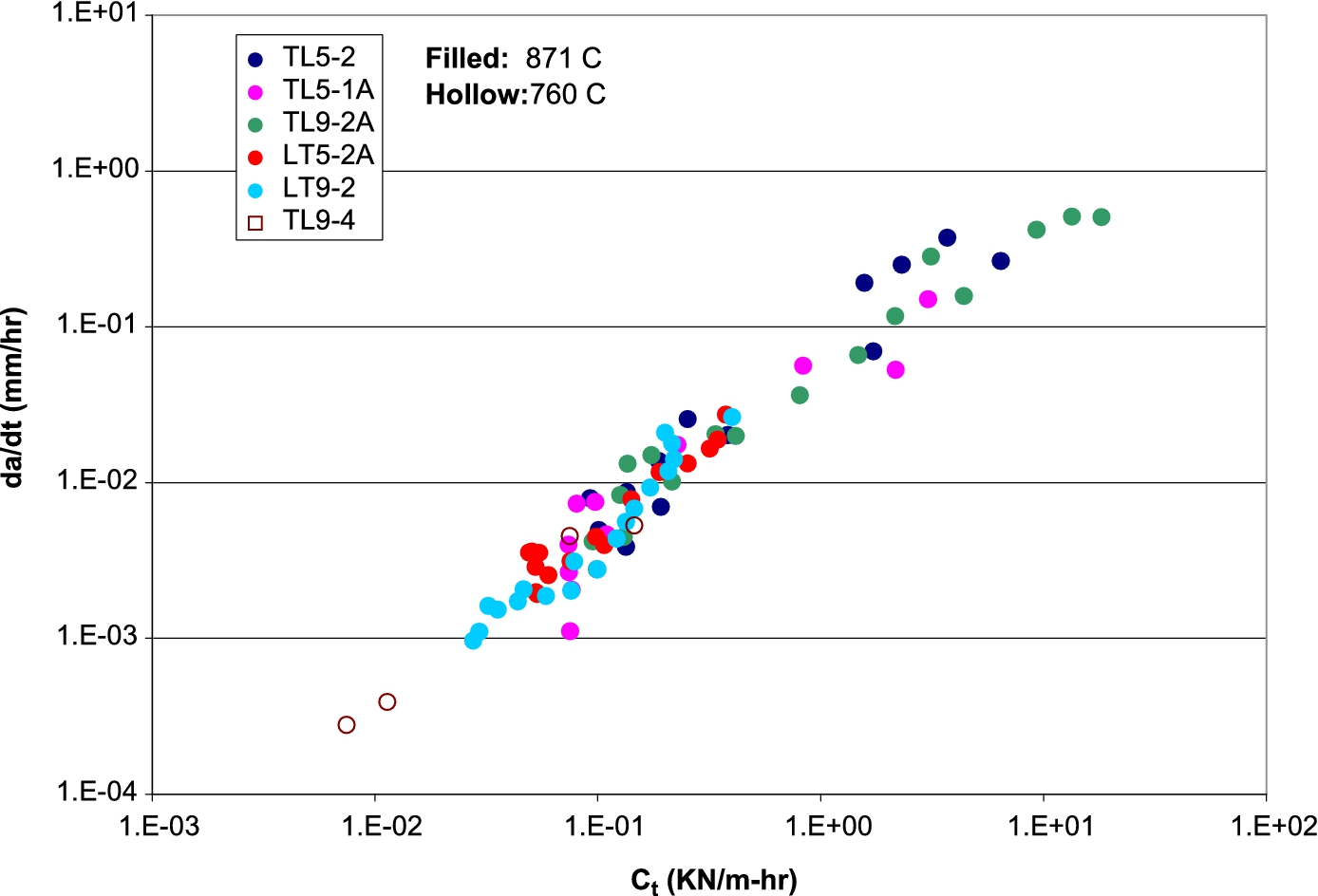
Creep crack growth behavior of DS-GTD 111 at different temperatures [9]. (Colors are visible in the online version of the article;
In creep-brittle materials, following application of the load, transient conditions are observed in the form of an incubation period during which time-dependent creep damage accumulates at the crack tip prior to crack growth. Some models have been proposed to address the incubation period and are described elsewhere [10,11]. A second type of transient occurs during crack growth while the creep zone size and shape has not achieved steady-state conditions. A parameter equivalent to the
Creep crack test methods
The techniques for measuring creep crack growth rates have been standardized in an American Society for Testing and Materials (ASTM) standard [12]. It can be therefore concluded that for long-term sustained loading conditions, the fracture mechanics methods for characterizing crack growth rates are reasonably well established. Some areas that need further development include:
The deformation based global fracture mechanics parameters are only valid when creep cavitation damage is limited to a small region in the vicinity of a crack. If the damage is widespread, other approaches based on damage mechanics are perhaps more appropriate.
The
In creep-brittle materials, considerable amount of crack extension can occur under transient conditions. The approaches for characterizing the crack growth rate under such transient conditions are not as well established [11].
Several high temperature materials in gas turbine applications are single crystal or directionally solidified materials with strong directional characteristics. This problem has been addressed for example see the correlation between
Creep–fatigue crack growth
Crack growth during continuous cycling
Under isothermal, elevated temperature conditions and load ratio, R, the fatigue crack growth per cycle,
The above relationship is valid only for isothermal conditions. Frequently, cyclic loads in elevated temperature components are caused by the high thermal gradients during the start-up cycle. The resulting high thermal stresses can easily induce significant amounts of plasticity in regions where cracks are present. Since the flow properties of the material are temperature dependent, the above simple equation that applies to isothermal conditions may not be valid. Since the cyclic flow properties of the material are also temperature dependent, it cannot be assumed that the cyclic stress-cyclic strain properties through-out the body are uni-valued, a necessary condition for the
The application of

Average time rate of crack growth during hold-time as a function of
The simplest model for combining the effects of cyclic loading and hold time is to linearly sum the crack growth during the two segments of the cycle. Such a model has been referred to the damage summation hypothesis in the literature. This leads to the following equations for the crack growth during one complete cycle,
For long hold times, the difference between the two approaches is negligible. For very short hold times approaching the value of zero where the cycle-dependent component dominates, the two approaches are also essentially the same. However, for intermediate hold times, differences between the two are expected but again small as observed in Fig. 3. It can be argued that creep deformation can blunt the crack substantially and decrease the amount of cyclic crack growth. Indeed, studies have shown that at low
A comprehensive crack growth model was developed by Evans and Saxena [18] incorporating a thermally activated dislocation model [19] and the environmentally assisted time-dependent crack growth model to predict the creep–fatigue-environment interactions in creep-brittle materials. The cycle dependent component,
The total crack growth rate,

A comparison between predicted and experimental results for ME3 [19]. (Colors are visible in the online version of the article;
One of the biggest sources of uncertainty in physics based life prediction models is in having access to accurate service histories of components. The progress in the development and implementation of sensors that provide real-time data has seen significant growth in recent years, and has provided new information that can improve prognostics for system reliability and risk assessment. The real world problems in reliability and risk assessment are often too complex to be given tractable mathematical formulations. Similarly, multiple nonlinearities, simplifying assumptions, combinatorial relationships and uncertainties render the physics-based deterministic solutions less useful. A hybrid approach that combines the predictions from physics based models to learn the relationships between life and the various service and materials related variables that influence life as outlined in Fig. 1, with actual online service data and maintenance and inspection data can be very useful in improving the prognostics. A simple example of this approach is described further.
The novelty of the approach is in combining neural network algorithms with the physics based models. If successful, there is substantial potential to not only extend the inspection intervals but to also relax the extent of the nondestructive inspection necessary thereby reducing operating costs significantly. The dominant degradation mechanisms in gas/steam turbine components include fatigue, creep, corrosion, erosion and oxidation as well as their synergistic effects. With historical data consisting of operating temperatures, pressures, average operating time between starts and stops etc., and an extensive data base of relevant material properties, an accurate model can be created that can be used to assess the risk of fracture in critical components and inspection strategies that mitigate the risks and lower them to acceptable levels.
The artificial neural network (ANN) is capable of exhibiting complex global behavior, determined by the connections between the processing elements and element parameters and uses data to ‘train’ the network of interconnected weighted nodes. It uses various models for training based on principles of optimization and statistical estimation. Figure 5 shows the inter-relationships between how the input and output variables are connected via nodes and the relationships between the variables are established using actual data. This is best illustrated using an example of a failed steam turbine rotor.

Schematic of the ANN approach for solving complex multivariate inverse problems. (Colors are visible in the online version of the article;
In this example, the neural network was trained using a large set of input and output vector pairs that were generated from the physics based models outlined by Saxena [3]. Model with three input parameters was evaluated to determine the feasibility of using ANN for life predictions. Models with more input parameters can be developed as the model is further refined. The three input variables included the normalized crack size,
This paper assesses the state-of-the-art in the ability to predict crack growth behavior in high temperature structural metals and components.
Analytical frame-work exists for predicting creep and creep–fatigue crack growth in creep-ductile materials and in creep-brittle materials. Additional work is needed for extending these concepts for DS and single crystal high temperature materials. For DS materials, we need to account for grain boundaries and difference in crystallographic orientations on the creep deformation at the crack tip as the crack transitions from one grain to the next.
Several high temperature problems are connected with welded joints. Some progress has been made in the assessment of crack growth in welds under creep–fatigue. Additional studies that consider microstructural gradients and transition layers between the weld metal and the base metal are needed. Sharp interfaces, though useful for qualitative judgments, are not realistic. Plastic and creep deformation zones and their evolution in the welds, including their interaction with the transition layer must be studied in detail to understand the limitations of nonlinear fracture mechanics to problems of mismatched welds. Crack growth studies performed should model cracks that meander from one region of the weld to another. Fundamental studies are needed to better understand creep–fatigue-environment interactions.

Comparison between predicted cycles to failure from the artificial neural-net algorithms and that from the physics-based analytical models for a steam turbine rotor at three stress levels (a) for a hold time of 1000 hours (b) for a hold time of 10 hours (c) for hold time of 1 hour and (d) hold time of 0.1 hours. The data for hold times of 1000 and 10 hours was used to train the neural-net and that for 1 and 0.1 hours for testing the neural-net predictions. (Colors are visible in the online version of the article;
ANN algorithms were trained to learn the relationships between different input variables for predicting the creep–fatigue crack growth behavior of a steam turbine rotor using physics based analytical models. Stress levels, crack size and the average time between starts and subsequent stops were varied and the cycles to failure were predicted using the trained ANN model. The ANN predictions compared very favorably with the analytical predictions as seen in Fig. 6. In this figure parts (a) and (b) show data and predictions from cases that were used to train the nets. The plots in parts (c) and (d) pertain to the predictions from the ANN model and compared to predictions from the data obtained by implementing the physics based models. The next step is to develop algorithms to use the trained ANN model to pin down the input variables such as material properties based on service experience. This is a major undertaking but the pay-off from it will result in good return on investment.
Footnotes
Acknowledgements
The authors wish to acknowledge the support of the Irma and Raymond Giffels’ Endowed Chair at the University of Arkansas, Fayetteville for the financial support of this research. The ANN calculations were performed by Dr. Sau-wee Koh while working as a Post-doc at the University of Arkansas. His contribution is gratefully acknowledged.