



Abstract
The present paper discuss a multiple site damage (MSD) problem of three collinear straight cracks exist in an infinite isotropic elastic perfectly plastic plate. Uniform stress distribution is applied at the infinite boundary of the plate in a direction perpendicular to the faces of the cracks. As a result, yield zones are developed ahead each crack tip. These yield zones are sensitive about the load applied at the boundary of the plate. Since the regions near the crack tips are very week as compared to other parts of the plate, therefore, it is assumed that the behaviour of yield stress of the plate near the yield zones is in linear fashion. Hence, rims of the yield zones are subjected to linearly varying stress distribution to stop further opening of cracks along the real axis. The problem is solved using widely used complex variable technique and closed form expressions are derived for stress intensity factor (SIF), crack tip opening displacement (CTOD) and length of developed yield zones at each crack tip. Under small-scale yielding, numerical results for yield zone length and crack-tip opening displacement as a function of remotely applied stress are obtained and presented graphically.
Nomenclature
constants of the problem Young’s modulus incomplete elliptic integral of first, second, third kind, respectively cracks crack-tip opening displacement at the crack tip x
crack tips tips of the developed yield plastic zones applied stresses on the yield zones components of displacement complex variable
developed plastic/yield zones complex stress functions Poisson’s ratio shear modulus = components of stress remotely applied stress at infinite boundary of the plate yield stress of the plate
Introduction
Multiple site damage (MSD) problems are characterised by the presence of multiple interacting cracks which may occur due to the application of repeated load or by environmental attacks [1]. Strength of the structures beset by the presence of cracks or crack like defects. Therefore, its becomes imperative to estimate the residual strength of the structures. In order to evaluate the residual strength of the plate in the presence of cracks, a model was developed by Dugdale [2] for an infinite plate weakened by a crack. This model was used to estimate yield zones length at the crack tips. Similar work was done by Barenblatt [3] for the brittle materials. After that some more fracture parameters like stress intensity factor, plastic zone size and crack tip opening displacement are estimated approximately at the crack tip by Rice [4] using Dugdale–Barenblatt model. Dugdale–Barenblatt model was further modified by Theocaris et al. [5] in case of strain hardening material and show that the model is not limited to constant yield stress but also useful for variable pressure. In addition to that the case of linearly varying tensile loading studied by Kanninen [6] and quadratically yield stress distribution was used by Harrop [7]. A massive collection of SIFs for various cracks geometries under different types of linear/non-linear stress distributions are given in [8].
Further, Dugdale model was widely used to solve multiple crack problems. For example, Theocaris [9] solved a problem of two equal/unequal cracks problem under general yielding conditions, Collins et al. [10] derived closed form solution for two equal cracks and also discussed the criterion of coalescence of yield zones. A numerical algorithm was presented to obtained crack tip opening displacement by Kaminsky et al. [11] for three collinear cracks. Recently, Hasan et al. [12] studied load carrying capacity of an infinite plate weakened by three equal/unequal collinear straight cracks under general yielding conditions.
Moreover, Nishimura [13] obtained plastic zone sizes and crack tip opening displacements for two collinear cracks subjected to remotely applied stress. Bhargava et al. [14] also evaluate yield zone sizes and crack tip opening displacements for two unequal straight cracks under quadratically yield stress distribution. A comparative study has been carried to study the nonlinear interaction between two equal-length collinear cracks; analytically and numerically by Chang et al. [15] using Dugdale model.
On the basis of cracks geometries and mechanical loading conditions, many methods have been presented to solve crack problems. Few examples, Chen [16] used integral equation method to convert multiple crack problems into a system of Fredholm integral equations and solved them numerically. Bhargava et al. [17] used complex variable method to obtain closed form solution of SIFs and CTODs for the multiple crack problem. Weight function approach was applied by Wu [18] to approximate plastic zone sizes and crack tip opening displacements for multiple collinear cracks.
The complex variable method due its mathematical simplicity provides a flexible way to solve the multiple crack problems [19]. Therefore, complex variable method has been used in this paper to solve the problem of three collinear straight cracks exist in an infinite elastic perfectly plastic plate. Developed yield zones, due to uniform tensile stresses acting at the infinite boundary of the plate, are subjected to linearly varying stress distribution to stop further opening of cracks. It is mentioned by Gdoutos [20] that some of the structure fails at stress which is well below the yield stress of the material, therefore, linearly varying stress distribution is considered in this work such a stress distribution. Analytical expressions for stress intensity factor and crack-tip opening displacement are obtained in the form of elliptical integrals defined in [21]. Numerical results of yield zone length and crack-tip opening displacements as a function of applied load ratio is presented graphically. Finally, the results are compared with the results of two equal cracks and/or a single crack under similar mechanical loading conditions.
Complex variable formulation
Consider an isotropic elastic-perfectly plastic plate occupy entire
It is assumed that functions
On adding and subtracting Eqs (4) and (5) we get
The general solution of the boundary problems given in Eqs (6) and (7) may be written using Sokhotski–Plemelj formula as
Constants appear in the polynomial
The formulation discussed in this section is taken from Muskhelishvili [22] to make the paper self-sufficient.
Analysis of the problem
Consider an isotropic infinite plate in which three collinear straight cracks exist. Strength of the plate is decreases in presence of theses cracks. These cracks are open in mode-I type deformation due to stresses applied, in a direction perpendicular to the rims of the cracks, at the infinite boundary of the plate. As a result, yield zones are develop at each crack tip. These yield zones are subjected to linearly varying stress distribution
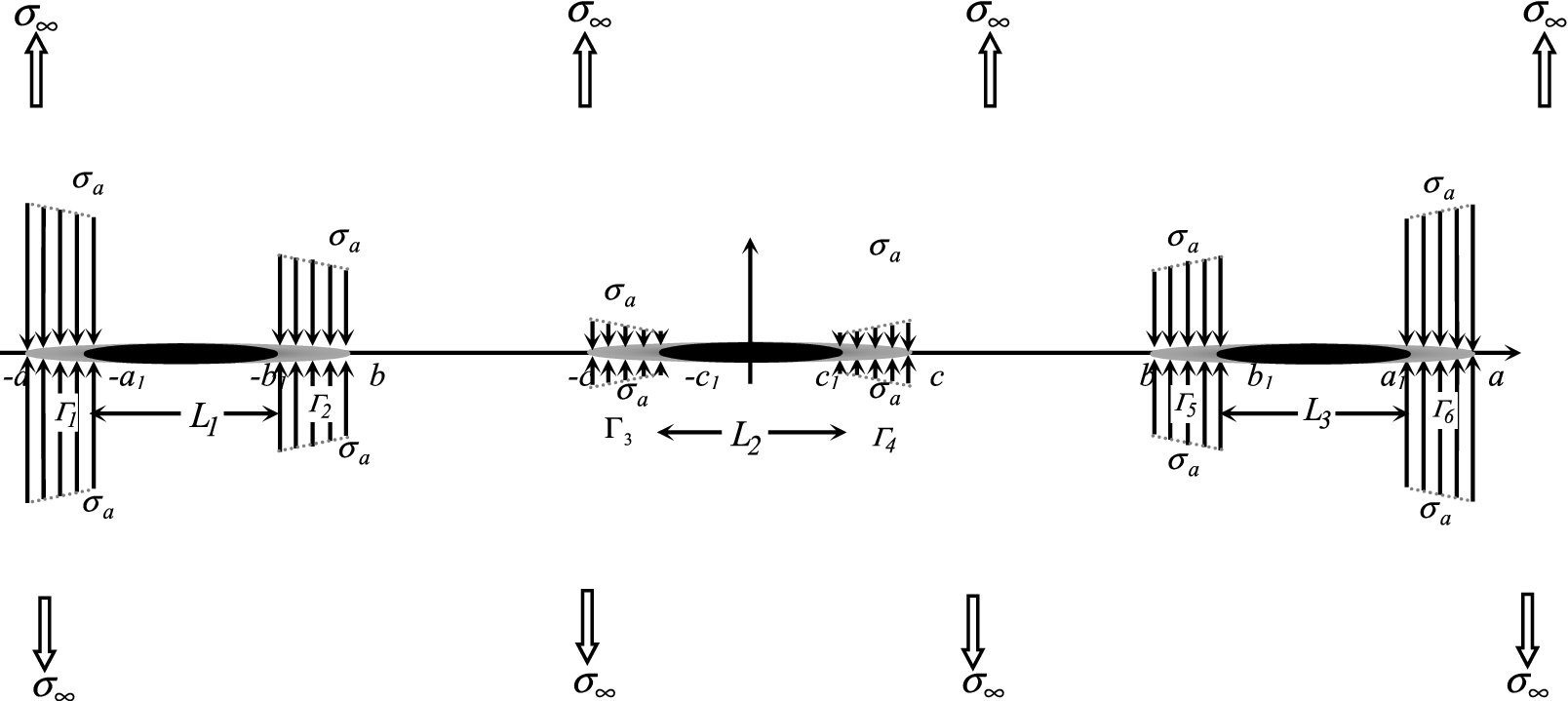
Modified Dugdale model for three straight cracks.
Problem posed in Section 3 is solved by dividing it into two subproblems, representing the case of opening and closing of cracks (linearly varying stress distribution applied over the rims of the yield zones). These two subproblems are denoted by subproblem-I (opening case,
Subproblem-I and its solution
Opening of the cracks, due to stresses applied at the infinite boundary of the plate, is discussed in this section. Consider an infinite elastic perfectly plastic plate weakened by three collinear straight cracks. Boundary of the plate is subjected to a tensile stress,
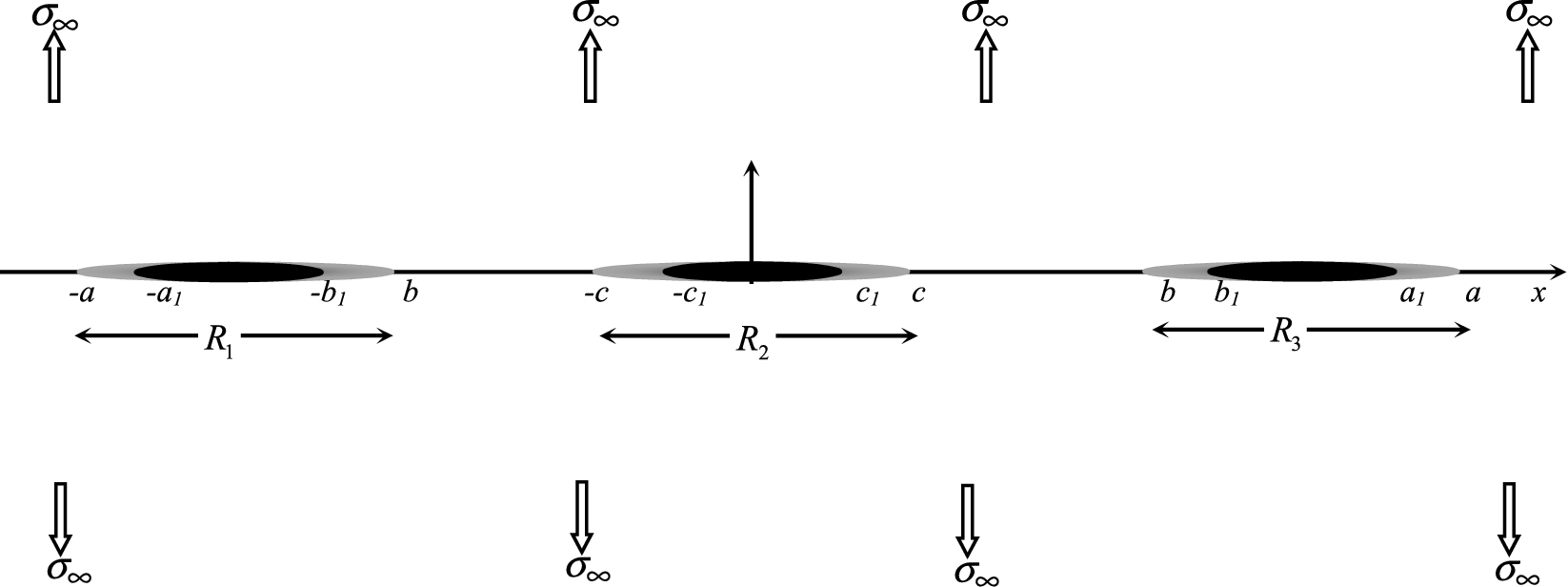
Configuration of the subproblem-I.
Mathematical form of the boundary conditions of the problem are
Complex potential function for this case under the boundary conditions given in Eqs (13) and (14) and formulation given in Section 2 may be written as:
Opening mode stress intensity factor at crack tip
Therefore, analytical expression for stress intensity factor at each external crack tip of three cracks may be obtained by putting Eq. (15) into Eq. (16). Hence,
These stress intensity factors are validated with the results was given by Tada [8] and Hasan et al. [12].
Analytical expressions for the component of displacement,
Results written as Eqs (20) and (21) are validated with the results given in [17] by taking
Consider, an isotropic infinite elastic perfectly plastic plate weakened by three collinear straight cracks. Developed yield zones
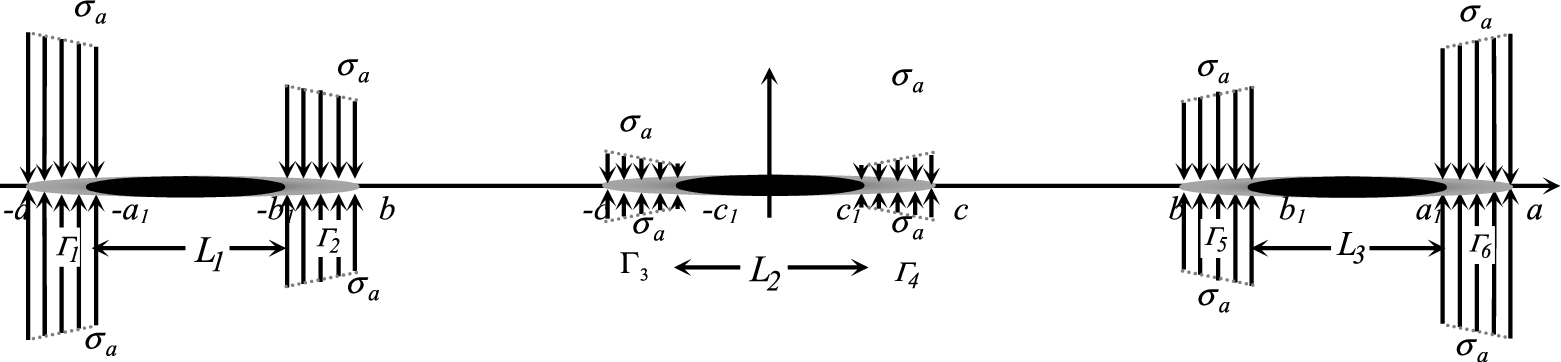
Configuration of the subproblem-II.
The complex potential function
Due to symmetrical loading conditions the constants
The integral over yield zones
Hence,
Complex potential function
Closed form expressions for stress intensity factor at the crack tips a, b and c may be obtained by putting Eq. (30) into Eq. (16). Hence,
Using Eqs (3) and (30), one can obtain components of displacement at cracks tips
According to Dugdale’s hypothesis [2] that the stresses remains finite at each crack tip. Hence, stress intensity factors for both the cases (applied and yield) must vanishes together. Therefore, after superposing the solution of two component problems final stress intensity factor must be equal to zero [13] at the extended crack tip
So, after putting the corresponding values of
Analytical expression for crack-tip opening displacement
Closed form expressions for the CTODs
Therefore, the expressions for CTOD at each crack tip
The results for remotely applied load stresses given in Eq. (38) and CTODs given in Eq. (42) are validated with the results of a single crack subjected to linearly varying stress distribution, as given by Harrop [7].
Illustrative examples
Applied stresses and yield zone size
Numerical results are obtained for applied load ratio,
Case of three equal cracks
In this section, growth of normalized yield zone size,
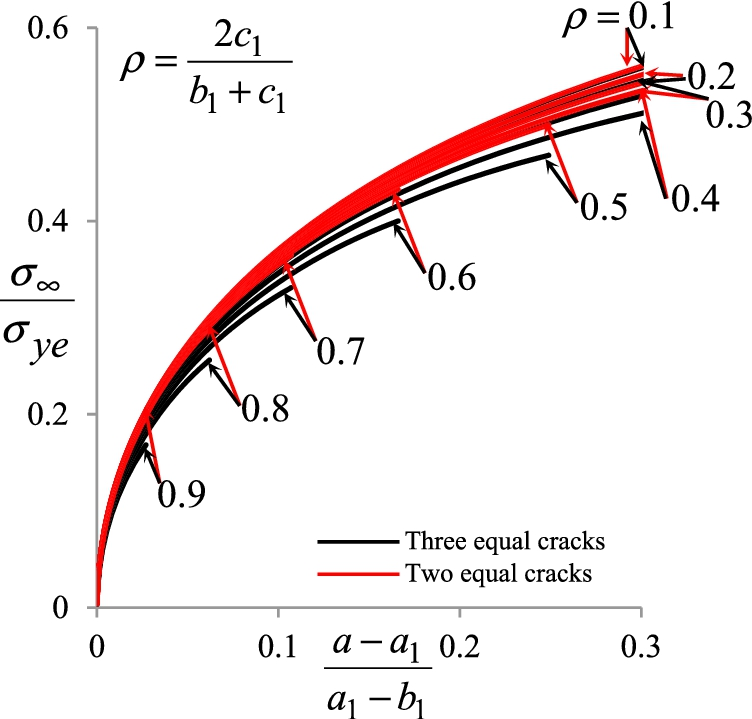
A relation between yield zone ratio

Normalized yield zone ratio
A parameter
Same variation has been plotted in Fig. 5 at the crack tip

A relation between yield zone ratio
To investigate the importance of inner crack, it is taken five times longer than the outer cracks. At the outermost tip,
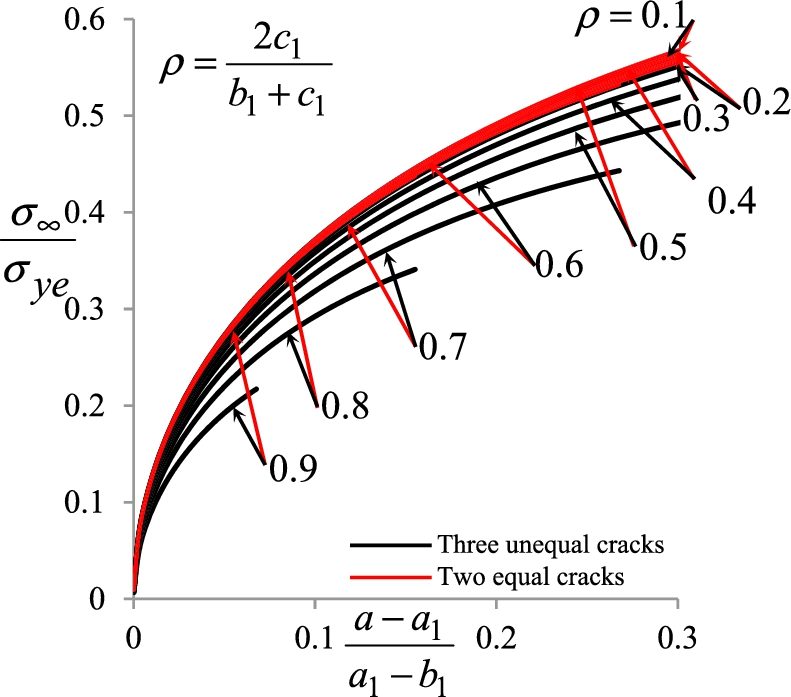
A relation between yield zone ratio
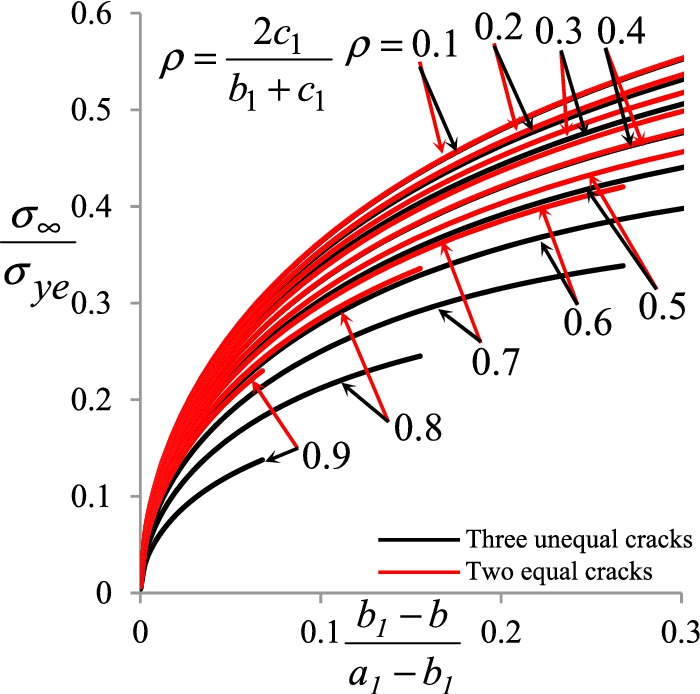
Normalized yield zone ratio
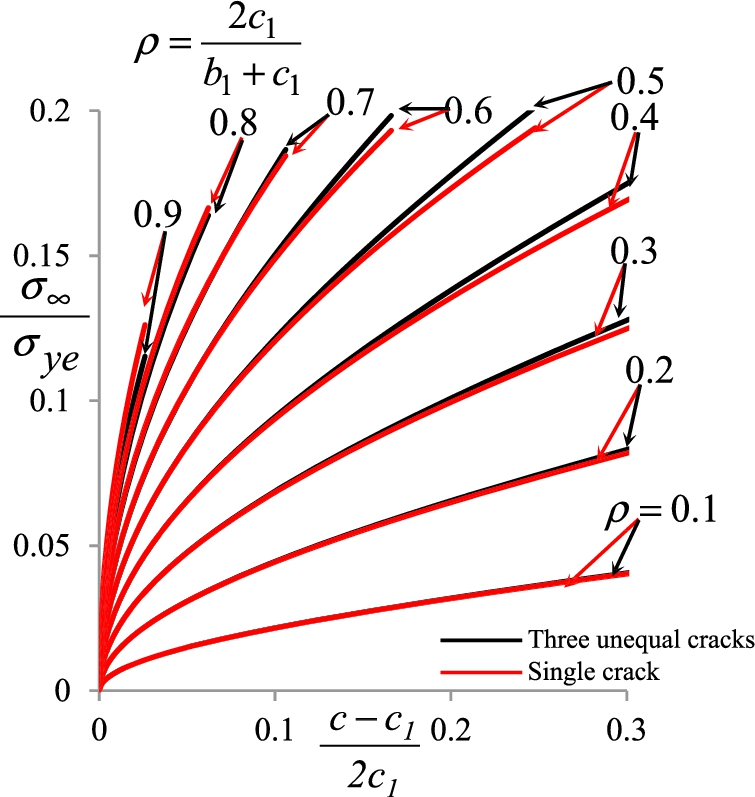
Normalized yield zone ratio
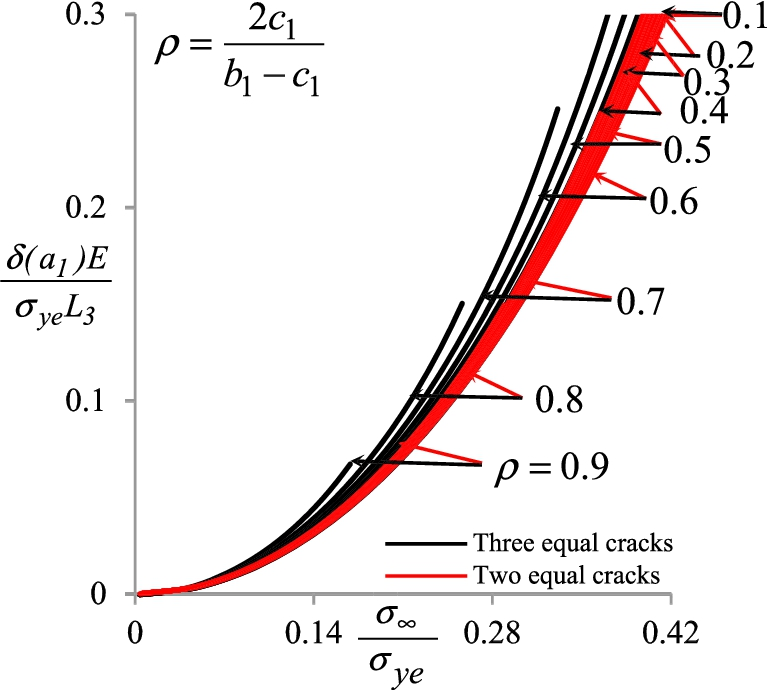
Normalized CTOD
Figure 8 shows the same variation at crack tip
It this section, the effect of increasing tensile stress is examined on the opening of cracks when all cracks are equal/unequal in nature. Graphs are plotted between applied load ratio
Case of three equal cracks
Figure 10 shows opening of cracks at the outermost tip
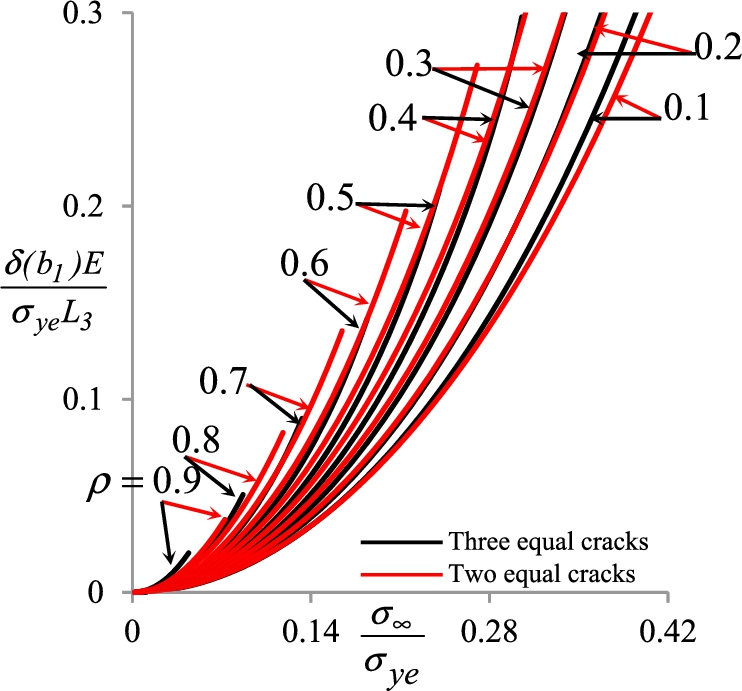
Normalized CTOD
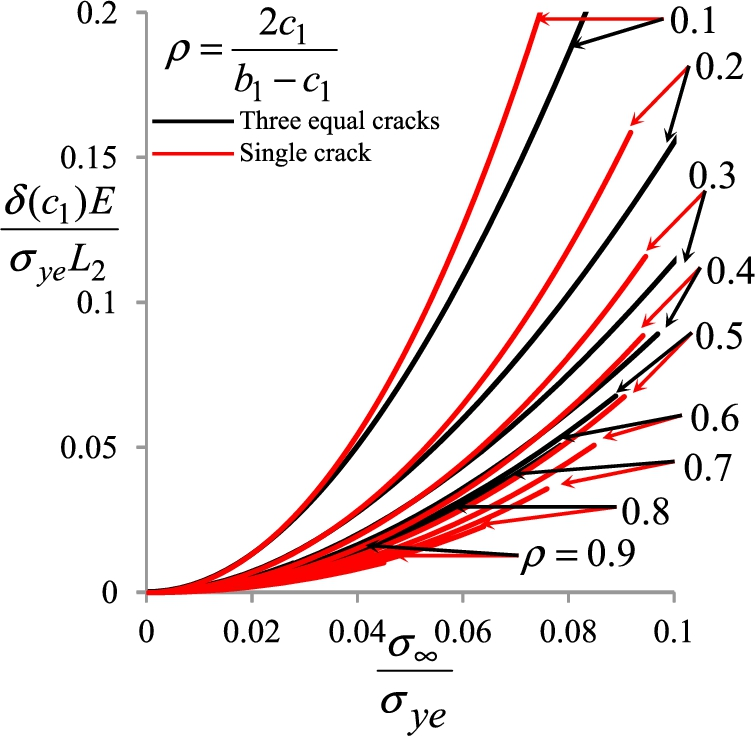
Normalized CTOD
Further studies are conducted to investigate the influences of sizes of cracks on CTOD. Consider, the internal crack
Figure 14 shows the variation between normalized CTOD and applied load ratio at the crack tip
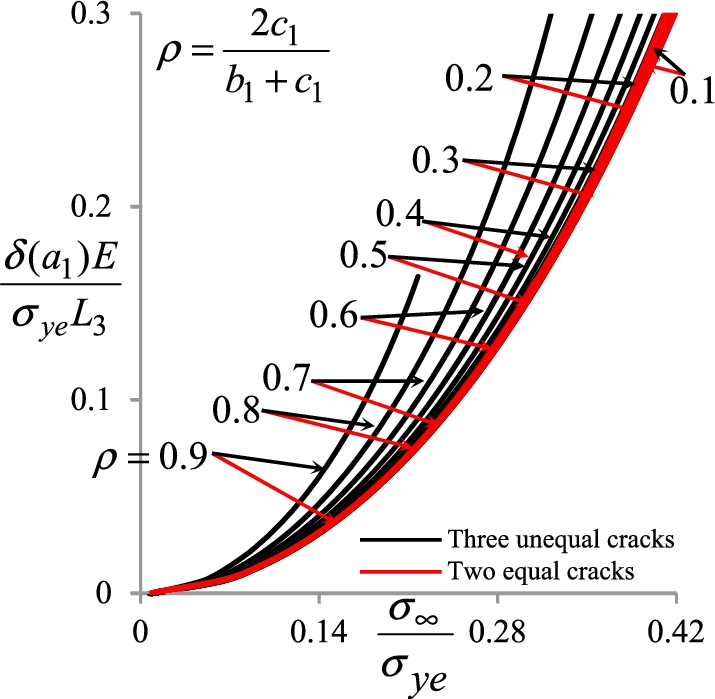
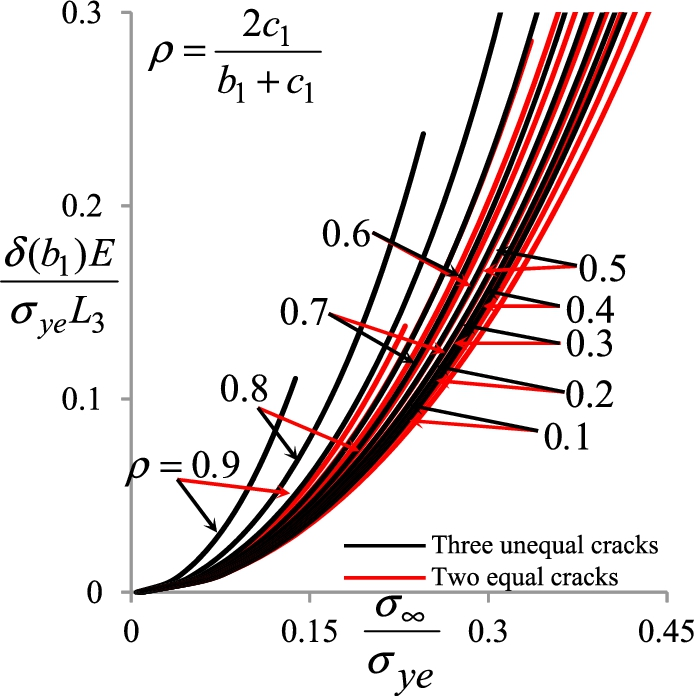
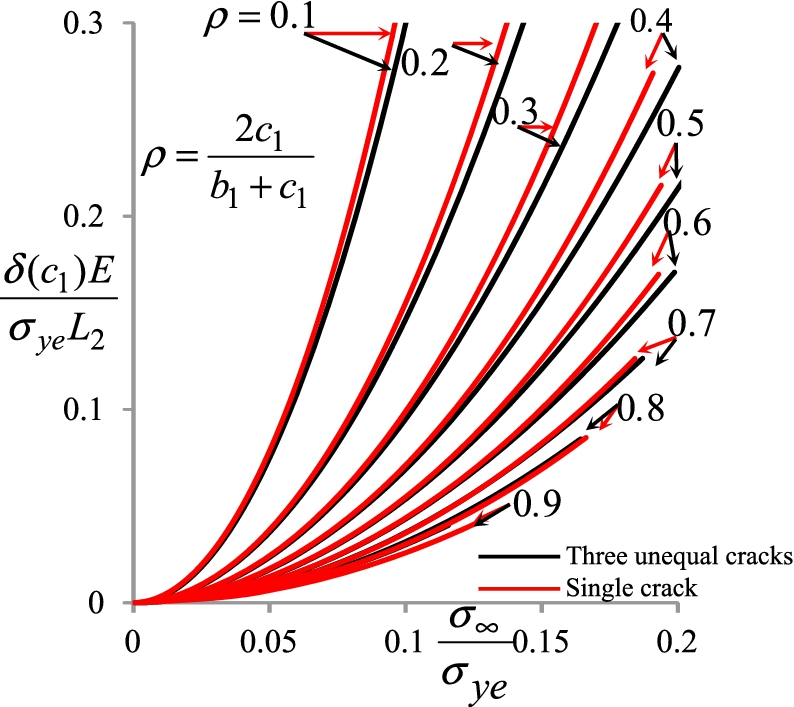
At extended crack tip
Three equal cracks
Ratio of yield zones lengths
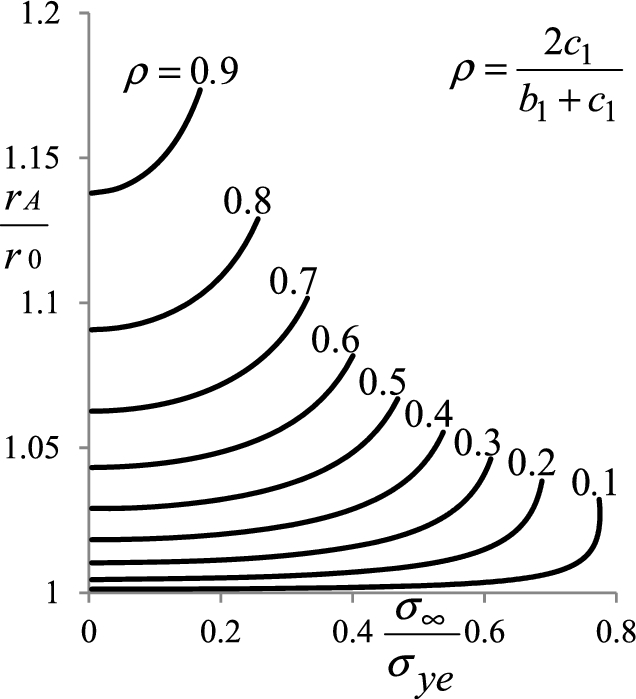
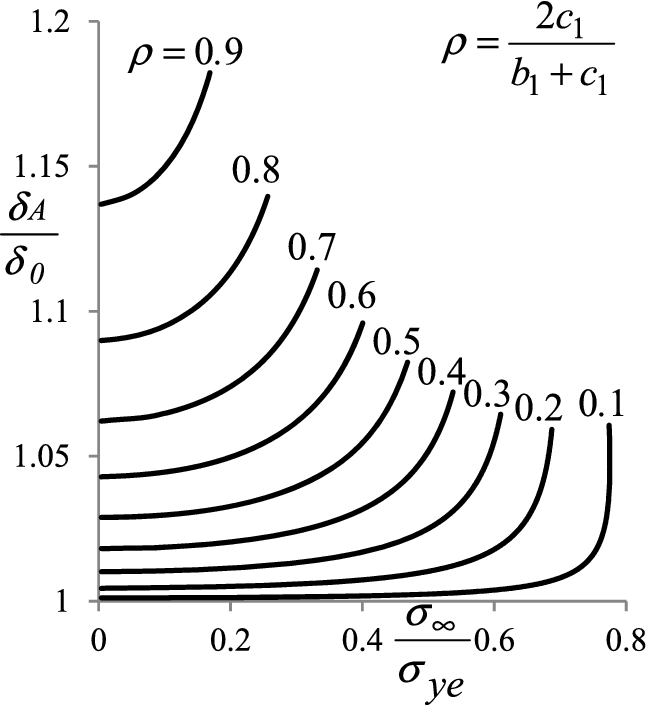
In this section inner crack

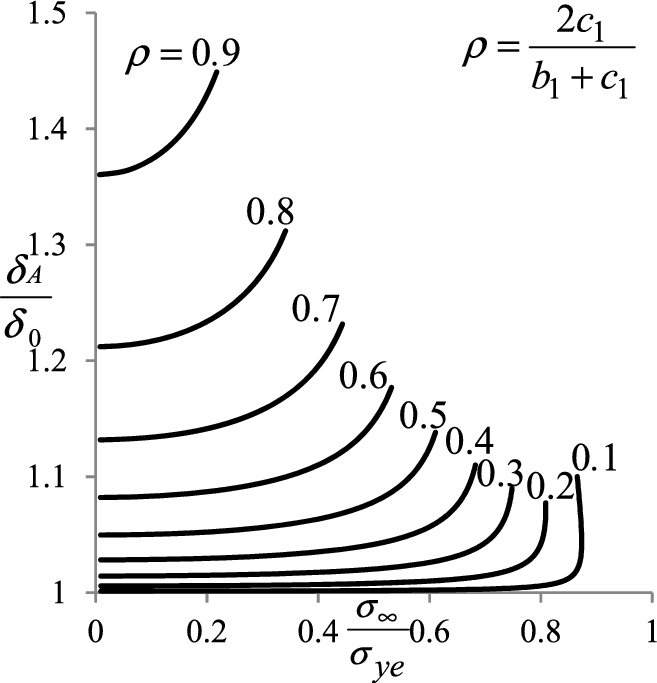
The plane problem of three collinear straight cracks is considered in the paper when the cracks were subjected to a mode-I loading and yield zones are subjected to a linearly varying stress distribution. Closed form solution is obtained for SIFs and CTODs in terms of elliptic integrals using Muskhelishvili’s complex variable method. Numerical results are obtained for applied stresses and CTODs. These results are compared with the results of two equal collinear straight cracks and/or a single crack under similar mechanical loading conditions. It may be noted from the results that the yield zones at the outermost tip approximately behave like the yield zones of two equal cracks when all cracks are equal in sizes and far away located. The middle crack will dominate over entire configuration and behave like a single crack when taken five times bigger than outer cracks.
Footnotes
Acknowledgements
The second author is grateful to University Grant Commission, Government of India for providing financial support under UGC-BSR fellowship scheme. Authors are grateful to the referees and the editor for their suggestions, which improved the understandability of the paper.
Conflict of interest
The authors have no conflict of interest to report.