



Abstract
The aim of this research is to interpret the relationship between indicators of education, human development, economy and justice based on current indicators measured by international independent organizations. The coverage of this study was composed of 41 countries. Statistical evidence was collected that countries were divided into two clusters according to 15 indicators as education, law, human development and economy. The relationships between the average year of schooling in developed countries with the global competition; income inequality and freedom of the press; the rate of investment in basic education and freedom of the press; PISA-reading comprehension and judicial independence; PISA-reading comprehension average score and judicial independence; income inequality and fundamental rights; the rate of investment in basic education and fundamental rights; the rate of investment in basic education and the rule of law; income inequality and investment in basic education; investment rate in basic education and gender inequality, income inequality and rule of law were found to be statistically significant. However, it was observed that the correlation coefficients between the same indicators were not statistically significant for developing countries.
Keywords
Introduction
The planned execution of the process of developing and changing the cognitive, affective and psychomotor behaviors of individuals is defined as “education and training”. Through a planned education process, qualitative differences are created in individuals’ knowledge and skills, abilities, interests and desires, attitudes, characters and habits. In this respect, the quality indicator of an education system is measured by the knowledge and skills of the individuals-briefly-who are exposed to the related education. Indicators such as winnings based on the quality of individuals’ knowledge and skills, and income inequality, per capita income as a result of these winnings constitute a strong correlation with economic growth and development. However, this correlation is not yet causal. Each practice in the fields of law, economics and education is bi-directional due to both interactive and affected from each other.
Indicators related to the fields of economy, justice and human development can be developed and changed through education as they depend on the quality of knowledge and skills provided by individuals [1]. Habermeier [2] emphasized that education is a necessary prerequisite for a country’s sustainable economic performance. Because the qualified knowledge and skills put forward by individuals who undergo a qualified education have a positive effect on both the development of the country and the welfare of the individual. In this respect, a qualified education system constitutes the capital and financing of the economy at all times. An education system provides both the performance of the economy and the sustainability of regulatory and distributive justice. It is observed that countries that educate their people well are more economically successful [3]. The rule of law is maintained in countries that educate people well [4]. Fair competition of the entrepreneurial sector is increasing in countries where law is held superior [5]. Fair competition in the markets reduces income inequality and also increases the income level of individuals [6]. In countries that educate people well, freedom of access to information does not interfere [7]. Therefore, the freedom to acquire, access to and disseminate information increases the possibility of revealing qualified knowledge and skills. Knowledge and skills that are likely to be revealed are actually creative and original ideas produced in the fields of science, technology, sports and art. Original, creative ideas also appear as economic
Since an increased level of welfare and the use of fundamental rights in an orderly manner is very important for people around the world, indicators of educational, economic, health, law, etc. practices in many countries are measured by independent organizations based on data sharing by participating countries. The quality indicators of human development measured by the United Nations, the law indicators measured by the World Justice Project, and the global competition indicators measured by the World Economic Forum are among the most important institutions known. Based on these indicators, both the current information on the current welfare levels of the countries is obtained and predictions can be made on the potential for future competitiveness.
Aim of the study
Previous studies ignored the distinction between short, medium, and long term by decomposing macroeconomic variables and human development index at different time scales.
It is now obvious that, according to the nature of education, people’s social demands such as competitive behavior and democratic rights and freedoms differ significantly. In particular, the quality of human development, global competitiveness and fairness indicators measured at regular intervals by international independent non-profit organizations provide an important source of information for policymakers in these fields.
Hung [9] said that previous studies ignored the distinction between short, medium, and long term by decomposing macroeconomic variables and human development index at different time scales. Therefore, this research aims to interpret the relationship between indicators of education, human development, economy and justice based on current indicators measured by international independent organizations. Therefore, the problem sentences of the research are expressed as follows.
How are countries classified according to education, economy, law and human development indicators? According to the classification results, how are the relationship coefficients between education, economy, law and human development indicators?
Conceptual framework
Indicators of development that apply to many countries and people are important sources of information. Moreover, these policies are used in the policies made or to be made for change and development. Many indices such as the human development index (HDI), global competitiveness index (GCI), income distribution index, schooling rates, life expectancy, rates of access to information and communication technology (ICT), ICT skills and fundamental rights index (FRI) give information about education, economy, healthcare system, and legal system of a country. Current welfare levels and future competitive potentials of countries are measured based on these indicators. Besides, medium- and long-term estimates of economic growth are made based on such indicators. A review of the literature reveals that it is possible to see comparison reports among countries and progress reports for a given country based on such indicators. An examination of these indicators reveals that there are calculation formulae based on a certain rationale, and data are gathered by independent international organizations and rely on data shared by participant countries. What should be kept in mind is that these indicators are based on estimates and do not imply a quantitative sense of order. Also, such indicators are made up of fluctuating variables that are largely affected by the socio-economic decisions of countries in the medium term.
It is seen that explanation of development indices in many national and international studies are made up of the change brought about by development. The effects of economic development on cultural, social and political domains are undeniable. On the contrary, the economy has a regulatory effect on cultural, social, and political areas. Educated people with qualified skills constitute the driving power of economic development. Therefore, the answers of “why we should give importance to education and economy” are worth discussing in the present time.
Why education?
Education is a tool of economic and social change. Quality of education is a decisive variable in achieving the desired social order, economic power or healthcare system among other matters. For instance, the human development index (HDI) includes basic social indicators such as life expectancy, education and income [10]. Therefore, a high indicator of HDI also indicates a high level of educational process and quality. The same results were observed in several studies, including [11, 12, 13, 8].
Education was the tool for social change, though, it should be noted, without disturbing the basic structural features of the economy. Education and economy are artificial and open systems. They are artificial because they do not function as natural processes such as the solar system, biological systems, or the ecosystem but rather are designed by human beings. They are open systems because their functioning depends on elements of input, output, system and feedback. All systems have a clearly declared or defined purpose. The degree of realization of such purposes makes a system permanent. So, what is the purpose of education as an open system?
Elements of an education system.
The knowledge and skills of individuals are discovered and developed through education systems. An individual enters the education system as an input with his/her talents. The existing talents of an individual are discovered, developed or processed during the process. When the period of processing is completed, the individual becomes an output of the system as a graduate. What is expected in the element of the output is a quantitative and qualitative difference among mental, emotional and physical talents. What measures the difference between input and output is the feedback element of the system. The element of feedback provides feedback about the level of accomplishment of purposes, and the quality and quantity of input and output to maintain the system. This is very important for the innovation of a system.
At the macro level, an education system is an intentional process of acculturation based on systematic and scientific methods and techniques. This makes education systems a field of application for state policies. The process of acculturation is very important for the maintenance of social relations since enslaving or liberating a society is a part of this intentional process of acculturation.
The science of economics is based on scarcity. Individuals have unlimited needs but there are limited resources to satisfy these needs. Therefore, the purpose of the economy is to use limited resources to satisfy unlimited needs. In other words, the economy is a process of using (producing-consuming) and sharing (marketing) scarce resources. This depends on the knowledge and skills of management and administration. This means that economy is a field of application for the economy, resources, capital, consumption, production, marketing, labor, land, and efficiency. While the science of economics analyzes the balance of supply and demand in the economic activities of individuals as consumers at the micro-level, it analyzes and designs the economic activities (GDP, unemployment, growth, inflation, etc.) of countries at the macro level. So, why is it important to satisfy unlimited needs with scarce resources? Because the extent to which unlimited needs are satisfied helps to achieve a level of welfare for individuals and societies. A rise in the level of welfare is increased income at the micro-level, and economic growth at the macro level. Therefore, independent organizations keep the economy and welfare indicators of countries.
The relationship between education and economy
Individuals produce “qualified information and skills” with economic value, which are achieved by means of “education.” This leads us to the conclusion that educated people who produce qualified information and skills make the driving force of an economy [1]. Habermeier [2] emphasizes in his study that education is an obligatory precondition of the economic performance of a country. The relationship between education and economy is so clear that;
Countries that educate their people well are more successful in economic terms. Rule of law prevails in countries that educate their people well. Where the rule of law prevails, there is free competition in the private sector. A fair competition in markets eliminates income inequality and increases the level of income. The right of information is not subject to any interference in countries that educate their people well. Therefore, creative ideas and qualified high-level skills are more likely to arise in environments where freedom of acquisition of, access to, and dissemination of, information is guaranteed.
Why do creative and original ideas matter? Because the existence of creative and original ideas implies intellectual activity. What does intellectual activity mean? It means science, technology, arts, and sports. The information and skills produced in the field of science, technology, art and sports mean innovation and economic value. In short, qualified information and skills are programmed by the education system. A high-quality education system is the capital and fund of the economy. The relationship between education, economy, and human beings is shown in Fig. 2.
The relationship between education, economy and human beings.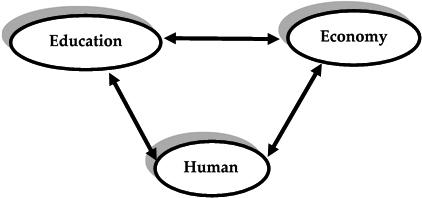
As can be seen in the figure, there is a two-way interaction between human and education, human and economy, and education and economy. The variables of economy and education affect and get affected by each other. There is a two-way relationship among them. However, it is not possible to say that there is a causal relationship among these variables. Croes, Ridderstaat, Ba̧k and Zientara [14] pointed out economic growth has a positive impact on human development.
The focus of this study is not to discuss the indicators and indices that international official bodies share with the public. Nevertheless, international indicators help simplify complex issues, making them measurable and clearly interpretable. Thus, this study is non-experimental. But, it is descriptive and correlational.
Sampling
All variables in this study were based on the data input from several official databases. Fifteen variables measured by four different organizations were selected. The coverage of this study was composed of 41 countries. These countries, their region and the income group they belong to are shown in Table 1.
Region and income group of countries
Region and income group of countries
51% of the countries are high-income group; 34% of them are in the upper-middle-income group and 15% of them are in the lower-middle-income group. In terms of their regions, 51% of the countries are in Western Europe, the European Free Trade Association or North America; 17% of them in Latin America or the Caribbean; 12% of them in East Asia or the Pacific; 12% of them in Eastern Europe or Central Asia and 7% of them in the Middle East or North Africa.
No measurement instruments such as questionnaires, tests or scales were used in the research. However, the data of the research was obtained from databases that are kept open to public access by international official institutions. A total of 15 indicator values were obtained from the databases of international organizations. The Global Competitiveness Index(GCI), Percentage of individuals using the Internet, Freedom of the press and Judicial independence of 140 countries from the database of World Economic Forum (WEF ) [15], WJP Rule of Law Index and Fundamental Rights indicators of 113 countries from the database of World Justice Project [16]; Human Development Index (HDI), Mean years of schooling, gross national income (GNI) per capita, Gini coefficient, Gender Inequality Index, Government expenditure on education (% of GDP) of 189 countries from the database of United Nations Development Programme (UNDP) [17] and PISA-Mathematics, Reading and Science average scores of 72 countries from the database of OECD [18] were obtained. Descriptive information about the indicators is presented in Table 2.
Descriptive information about the indicators or variables
Descriptive information about the indicators or variables
The number of countries for indicators derived from four different databases varies. However, a total of 41 countries, complete 15 indicators included in the research, were obtained. Descriptions and measuring ranges of the indicators are summarized in Table 3.
Indicator information related to indicators and metric of indicator
The fact that Freedom of the press, Gini coefficient and Gender Inequality Index measurements are close to zero indicates the ideal or the positive of the situation. In this respect, Freedom of the Press, Gini coefficient and Gender Inequality Index measurements were required to be small in quantity, while other measurements were required to be large in quantity. Particular attention should be paid to the interpretation of the correlation coefficients.
Data were analyzed using clustering, separation analysis, multidimensional scaling and Spearman order difference correlation coefficient techniques. In the first stage of the data analysis, the number of clusters was determined by performing gradual clustering analysis according to fifteen indicators of 41 countries. Due to the presence of two distinct clusters, the clustering analysis was repeated with the k-mean algorithm where the number of clusters was 2. In the second stage, the consistency and validation of the classification of the countries divided into two clusters were tested by Discriminant analysis. In the third stage, since the metrics for the indicators are not homogeneous at the metric level, all the metrics for the indicators are converted to z values based on the data sets to which they belong to. In the fourth stage, multi-dimensional scaling was performed to visualize the positions of the countries on the two-dimensional plane. In the last stage, the correlation coefficients between the indicators of human development, education, economy and law are obtained for the countries in each cluster.
Stages of data analysis.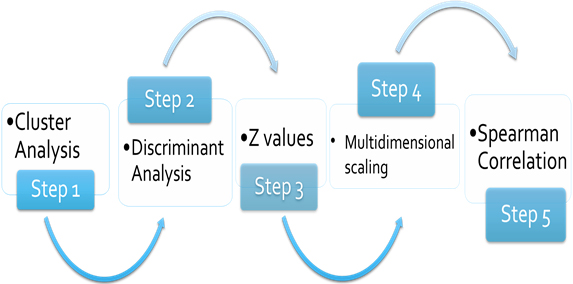
How are countries classified according to education, economy, law and human development indicators?
According to 15 indicators related to education, law, human development and economy, firstly, gradual clustering analysis was performed and it was observed that countries were divided into 2 distinct clusters. Clustering analysis was repeated according to the 2-average algorithm. Whether the 15 indicators are important in the clustering of countries is examined and the results are shown in Table 4.
Significance of indicators in clustering of countries
Significance of indicators in clustering of countries
Distribution of countries by clusters
Findings related to classification analysis of countries
According to the table, these 15 indicators were found to be significant in the division of countries into two groups (
Two clusters are formed as 28 (68%) countries in the first cluster and 13 (12%) clusters in the second one. Discriminant analysis was performed for the consistency and validation of this classification obtained by clustering analysis. Whether the discriminant function is significant, in other words, the success of assigning (separation) countries to groups, has been demonstrated by the help of Wilks’ Lambda and Chi-square test statistics given in Table 6.
Locations of countries by indicators.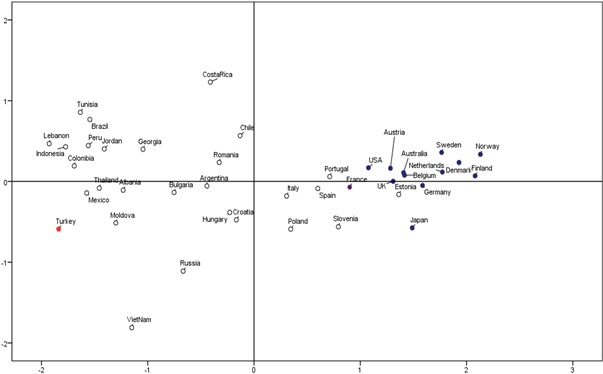
Structure matrix on indicators
Accuracy of classification by discrimination analysis
One discriminant function was found and the success of countries’ assignment to two clusters was significant according to education, law, economy and human development indicators (
GCI, Gross national income (GNI) per capita, Judicial independence, WJP Rule of Law Index and Human Development Index were the first five indicators that were important in the separation of clusters. The accuracy of the classification by clustering analysis is shown in Table 8.
It was observed that the countries which were divided into two clusters by clustering analysis were classified 100% correctly by discriminant analysis. Also, the locations of the countries according to the indicators with the multi-dimensional scaling technique on the two-dimensional axis are shown in Fig. 2.
Relation coefficients between indicator pairs by clusters
Since the suitability between the original distances and the indication distances was determined by the measure of stress, the stress value between the distances of the countries was found to be 0.08. Since this value is close to zero, two-dimensional classification was deemed appropriate. RSQ coefficient was investigated for reliability of multidimensional scaling. RSQ coefficient was obtained as a high-reliability measure of 0.97.
In the field of education, law, human development and economics, the relationship between each of the 15 indicators will be calculated as a combination of 2 of 15, which is 105 for each cluster. Instead of interpreting each of these correlation coefficients, significant relationships were determined in the second cluster and non-significant relationships were determined in the first cluster since the average indicator values of the countries in the second cluster were higher than the first cluster, and the results are shown in Table 9.
Countries in the first cluster were named as “developing countries”; and ones in the second cluster were named as “developed countries”. There was a high positive correlation between developed countries’ global competitiveness and average schooling year which was 0.720 (
In developed countries, there was a significant negative correlation between gender inequality and state investment in education, which was
In developed countries, a significant and negative correlation coefficient was found as
In developed countries, a middle-level positive correlation coefficient was found as 0.639 between rule of law and state investment in education. The relationship found is significant (
In developed countries, a significant and negative and very high-level correlation was found between income inequality and fundamental rights (
In developed countries, a significant and negative and high-level correlation was found between income inequality and the investment rate of the state in education (
In developed countries, a middle-level positive correlation coefficient was found as 0.671 between fundamental rights and state investment in education. The relationship found is significant (
In developed countries, there is a positive relationship between judicial independence and reading comprehension and science literacy averages of children of countries. These relationships found significant (
In developed countries, a very high positive correlation between freedom of the press and income inequality was found to be 0.823. The relationship found also is significant (
In developed countries, there was a significant and negative correlation between freedom of the press and state investment in education, which was
Conclusions
Statistical evidence was collected that countries were divided into two clusters according to 15 indicators as education, law, human development and economy. GCI, Gross national income (GNI) per capita, judicial independence, WJP Rule of Law Index and Human Development Index indicators are determinants in the separation of clusters.
There was a significant difference between cluster averages related to indicators of education, law, human development and economy. The average of 13 countries in the second cluster in terms of education, law, human development and economy were found to be higher than the 28 countries in the first cluster. Therefore, countries in the first cluster were named as developing countries and ones in the second cluster were named as “developed countries”.
Relation coefficients between indicators related to education, law, human development and economy were examined according to clusters. In this study, particular attention was paid to the indicator pairs in which were significant in developed countries cluster (cluster 2) and non-significant in the developing countries cluster (cluster 1). The relationships between the average year of schooling in developed countries with the global competition; income inequality and freedom of the press; the rate of investment in basic education and freedom of the press; PISA-reading comprehension and judicial independence; PISA-reading comprehension average score and judicial independence; income inequality and fundamental rights; the rate of investment in basic education and fundamental rights; the rate of investment in basic education and the rule of law; income inequality and investment in basic education; investment rate in basic education and gender inequality, income inequality and rule of law were found to be statistically significant. These relationships are monotonic. However, it is observed that the correlation coefficients between the same indicators are not statistically significant for developing countries.
Recommendations
Empirical studies suggest that the quality of education and training of cognitive, affective and dynamic knowledge and skills is determinant not only in economic development but also in socio-cultural terms, and the role of education is highly emphasized. Therefore, rather than the quantitative measure of investment in education (such as the number of buildings, classrooms, materials), the intellectual investments of practitioners (such as teachers, experts) and decision-makers (such as school administrators, education ministers, undersecretaries) should be focused. Also, education has strong indirect impacts on economic growth through their effect on the distribution of income and as education become more broadly based, low-income people are better able to seek out economic opportunities [20].
The encouragement mechanisms to increase competition between schools and teachers should be increased without sacrificing the principles of justice and accountability. Thus, the demands of students and parents on the quality of higher education will automatically direct education policies. Suitable environments must be provided for this. In particular, the freedom of the press should be created to ensure the demand for a high-quality education system based on fair competition. Because Tudorache [21] found that an inverse relationship between two variables (early leavers from education and training rate, and employment in agriculture) and the human development index.
For the global competitiveness of the developing countries in terms of economic competitiveness, the schooling rate of the age population, as well as the time spent by individuals in lifelong education, should be considered.
Regional conditions of physical investments such as buildings, classrooms and materials to be made for education in developing countries should be considered. The concepts of the rule of law, gender inequality, income inequality, fundamental rights and freedom of the press should be taken from cities to villages, especially from villages to cities. These concepts should be especially associated with the producers. Gender inequality, income inequality and fundamental rights are the problems that producers mostly face. Therefore, education investments should be directed to the settlements where production is made and the population is low (such as villages).
A climate should be created and kept alive where decisions that are taken by education decision-makers, undersecretaries and school administrators are held responsible for the results of their actions. This climate should feed both the rule of law and freedom of the press. Freedom of the press will not only contribute to accountability but also provide the opportunity for restorative criticism.
To eliminate income inequality, corruption should be tackled and property rights should be controlled. In order to this, the confidence in the independence of the judiciary and the rule of law must either be provided or increased.
Particular attention should be paid to GCI, Gross national income (GNI), judicial independence, WJP Rule of Law Index and Human Development in a consistent education system. Education objectives should not be disconnected from these elements and education and training programs integrated with related elements should be designed.