



Abstract
BACKGROUND:
Teacher retention and development of the full potential of teachers is important at a national level in order to be able to belong to the top world economies. A number of studies suggests that part of the group of experienced teachers with more than 20 years of experience perform didactically at a lower level than would be expected and are at a greater risk for attrition.
OBJECTIVE:
The aim of the present study is to find explanations for this by making use of the Job Demands Resources Model.
METHODS:
Specific demands of the teaching profession, interpersonal demands related to the developmental stage of experienced teachers, job resources and personal resources in relation to health and motivation are explored by reviewing a vast amount of literature.
RESULTS:
The proposed conceptual model is an extension of the Job Demands Resources Model with the inclusion of personal demands related to adulthood and personal resources.
CONCLUSIONS:
The resulting model provides us with clues on how attrition and decreased performance could be counteracted.
Introduction
Internationally, nations are struggling to belong to the top world economies. Accordingly, in Europe one of the goals is to increase the proportion of highly educated citizens and therefore, much is invested in knowledge and innovation [1]. In the Netherlands, to attain this goal, as in other European countries, investments in secondary education and professionalization of teaching staff in secondary education are deemed crucial [2]. That is, as student characteristics determine academic achievement for a large part [3], teachers seem to impact differences between student learning for approximately 20 to 30% [5]. In the long term, teacher quality appears related to students’ future salaries. Hanushek [6] argues that teacher performance of one standard deviation above the mean may result in annual marginal gains of over $20,000 in present value of future student earnings. Thus, having sufficient high quality teachers is of great importance.
While this seems straightforward, there appear to be two problems. The first problem concerns the retention of teachers in the profession. Worldwide, retention of qualitative good teachers is an issue [7–9]. Resignation from the teaching profession is most prominent among new teachers, but is a problem among experienced teachers as well. A number of researchers [10, 11] describe a U-shaped relationship between the level of experience and teacher attrition, with beginning teachers and teachers in the latter stages of their careers most likely to withdraw from the profession. Especially the loss of experienced teachers is disadvantageous, as with their departure years of experience and investment are lost.
The second issue concerns the professional development of teachers throughout the career. Contrary to certain teacher development models, which postulate that teacher development can be conceived as linear growth of teaching competence throughout the career [12, 13], a number of studies report that the teachers with the most experience do not necessarily perform at a higher didactical level than less experienced teachers. Lopez [14] showed that during the first seven years teaching, student achievement increases as a function of the experience of the teacher. Between eight and 24 years of experience, student performance remains stable, followed by a decline in the years beyond. Similarly, Van de Grift, Van der Wal and Torenbeek [15] reported that beginning teachers undergo a rapid development in terms of their didactical skills during the first five years in the occupation. This development appears to continue during the subsequent years, as the level of expertise reaches a high when teachers have about ten years of experience. It remains at a more or less stable level among teachers with ten to twenty years of experience. Then, in the group teachers with 20 to 30 years of experience two groups can be distinguished. While about 55% performs at a level comparable to those teaching for 10 to 20 years, the didactical performance of about 45% of these teachers is of a lower level than that of teachers with ten to twenty years of experience.
Together, these findings suggest that at the beginning of their careers, teachers undergo a rapid development in their teaching skills, which remains stable during the subsequent years, and (at least a large number of teachers) show a decline after about twenty to 25 years. However, the results could also be interpreted in another way. For example, it may be the case that the best and most experienced teachers leave the teaching profession not for negative reasons, but because they have, thanks to their vast experience and potential, professional opportunities elsewhere. They may receive the chance to make promotion and become a school leader, an educational policy advisor or an educational researcher.
While we are in need of high quality teachers, there appears to be a group of experienced teachers who are at risk of attrition and perform at a lower didactical level than might be expected. Which difficulties do these experienced teachers face that causes this undesired situation? Relatively much is known about the challenges of beginning teachers and their reasons to leave the profession [16–21], compared to more experienced teachers. The studies that did focus on teachers with more than 20 years of experience are descriptive and do not relate the issues reported by teachers to outcome measures [22–24]. Therefore, the aim of the present study is to find explanations for the high level of attrition and decreased effectiveness among part of the teachers with more than twenty years of experience as reported by Lopez [14] and Van de Grift et al. [15]. We use the Job Demands Resources Model [25] to describe specific demands of the teaching profession, interpersonal demands related to the developmental stage of experienced teachers, job resources and personal resources. As such, this study will yield insight into the job demands and resources teachers with more than twenty years of experience may be struggling with and what their reasons may be for early retirement and/or the decrease in performance after about twenty years. This in turn, will provide us with clues on how early retirement and decreased performance could be counteracted.
Job demands and resources of teachers
In the past, a considerable number of theories about work-related stressors and well-being have been developed, in which causes and outcomes are more or less conceptually integrated and ordered into a causal pattern of relationships. A well-known innovative example is the Job Demand-Control model [26] in which psychological strains are considered a consequence of the joint (interaction) effects of job demands and job control. More recent developed models emphasize not only the effect of demands but also of resources on health effects, e.g. the Job Demand-Resources model (JD-R); [25]. The JD-R model is heuristic in nature about how job and personal characteristics may influence employee health, well-being, and motivation [27]. According to the JD-R model, each occupation has its own specific risk factors associated with job-related stress [25] and the model can be applied to various occupational settings. These risk factors can be classified in two general categories: job demands and job resources.
Job demands refer to those physical, psychological, social, or organizational aspects of the job that require sustained physical and/or psychological (cognitive and emotional) effort or skills and are therefore associated with certain physiological and/or psychological costs [28].
Job resources refer to those physical, psychological, social, or organizational aspects of the job that are either/or: functional in achieving work goals, reduce job demands and the associated physiological and psychological costs, and stimulate personal growth, learning, and development. Two different underlying psychological processes play a role in the development of job strain and motivation: the health impairment process and a motivational process. In the health impairment process, poorly designed jobs or chronic job demands exhaust employees’ mental and physical resources and may therefore lead to the depletion of energy, and to health problems. The second process is motivational in nature, whereby it is assumed that job resources have motivational potential and lead to high work engagement, low cynicism, and excellent performance [27, 28].
Personal resources are, according to the Conservation of Resources (COR) theory psychological characteristics or aspects of the self that are linked to resiliency and refer to individuals’ self-evaluations of their ability to control and impact upon their environment successfully [29], Similar to job resources they can predict desirable work outcomes, such as motivation, performance, job satisfaction and stimulate personal growth and development [27]. Personal resources have been integrated into the JD-R model, because most behavioral theories assume that human behavior results from an interaction between personal and environmental factors [27], but how personal resources should be incorporated in the framework is still unclear [27].
Motivational aspects of teachers
A mere handful of studies has addressed motivation of teachers with more than 20 of experience. The variables most studied in this respect are motivation and commitment. Teacher motivation can be seen as what attracts teachers to teaching, how long they intent to continue teaching, and the extent to which they engage with their teaching and the profession [30]. Day et al. [24] studied 300 elementary and secondary teachers during three years. They found that experienced teachers (16–23 years of experience and 24 to 30 years of experience) could roughly be divided into two groups. The teachers were either able to maintain or increase their motivation throughout the years, or suffered a decrease herein. Day and colleagues also observed that loss of motivation was relatively higher among the most experienced teachers. The results of a Portuguese [22] and Dutch study [31] support the findings reported by Day et al. [24]. Gonçalves [22] found two groups veteran teachers (23+ years of experience): teachers who managed to remain their motivation and teachers who lost motivation, awaiting their retirement. Canrinus et al. [31] reported that about 45% of the teachers with 20 to 30 years of experience felt motivated, about 15% felt dissatisfied and demoralized and the remaining 40% felt uncertain as regards to their motivation.
Occupational commitment is the degree to which an individual identifies with, and is involved in a particular organization [32]. Teacher commitment has both directly been related to the intention to stay in the profession [33, 34], as well as indirectly, through its relation with job satisfaction [35]. Three aspects are usually distinguished: a belief in the goals and values of the organization, willingness to exert considerable effort on behalf of the organization and the intention to remain attached to the organization. Again, studies reporting on teachers with more than 20 years of experience are scarce. Hargreaves [23] studied a small sample of 14 veteran teachers (more than 20 years in the profession) and found that these teachers were characterized by emotional distancing and a loss of commitment resulting from experiencing continuous change. Huberman [36] distinguished four types of teachers with more than two decades of experience: teachers who remain committed, teachers staying committed inside the classroom but not beyond, teachers low in commitment, searching for ways to resist and undermine change, and teachers who have lost commitment resulting from failed reforms they have put their hearts in.
Other researchers focusing on experienced teachers did not specifically study teachers with more than 20 years of experience or differentiate between teachers within the distinguished experience groups. Fokkens-Bruinsma and Canrinus [37] reported that teachers with more than 15 years of experience reported the highest continuance commitment compared to teachers with zero to five and six to 14 years of experience, but had equal levels of affective and normative commitment. Veteran teachers (mean experience 13 years) in Klassen and Chiu’s study [34] showed lower occupational commitment than teachers with fewer years of experience. Rosenholtz and Simpson [38] compared veteran teachers (more than ten years of experience) with mid-career (six to ten years of experience) and beginning teachers. They found that commitment of veteran teachers was higher than among beginning teachers, but lower than the intermediate group. Kinman, Wray, and Strange [39] found that experienced teachers reported higher levels of emotional labor.
Health impairment aspects of teachers
The dropout and underperformance of part of the experienced teachers may be the result of burnout symptoms. For example, Hakanen, Bakker and Schaufeli [40] showed in their study of more than 2000 teachers with on average 13.5 years teaching experience that burnout negatively predicted work ability and organizational commitment. A similar study reported that emotional exhaustion positively predicted the motivation to leave the profession in more than 2500 teachers with on average 16 years of teaching experience [41]. Wang, Hall and Rahimi [42] described positive correlations between emotional exhaustion, depersonalization and quitting intentions and a negative relationship between personal accomplishment and the intention to quit teaching. Näring and colleagues found that emotional work was positively associated with emotional exhaustion [43].
Job demands of teachers
The teaching profession has been identified as one of the most stressful occupations [44, 45]. Johnson et al. [44] compared 26 different occupations and demonstrated that teachers score among the lowest on physical health, psychological well-being and job satisfaction. Various job demands may account for these findings. First, teaching involves emotional labor. It is a profession of high face-to-face interaction with pupils, who may show poor behavior, attitudes, motivation and performance [46, 47], while teachers are required to follow strict rules when displaying their emotions (e.g. restrain frustration and irritation) [44]. Various studies showed that student behavior and the relationship teachers have with their students affect experienced teachers [24, 48]. Teachers in the Ahlgren and Gådin [49] study report that noisy, unmotivated and disrespectful students outweigh students who are eager to learn and respect them. In Day et al.’s [24] study the loss of motivation and detachment that some experienced teachers have, can be partly attributed to deteriorating pupil behavior. Klassen and Chiu [34] showed a direct negative effect of stress from student behaviors on commitment. Hakanen et al. [40] showed that pupil misbehavior was negatively related to work engagement. In their review, Silva & Fischer [50] identified student behaviors as one of the variables affecting mental health.
A second factor is the heavy workloads that the majority of teachers experience [44], related to frequent meetings which interfere with preparation time, ineffective organization of meetings, paper works generated by the management, increased report writing and constant reform and change [46, 51]. Santana et al. [52] related higher workload to a higher score for emotional exhaustion. Other stressors include having to cope with parental pressure and unrealistic expectations of parents and society, a lack of influence on decisions, a lack of autonomy in planning activities, and resources and information to facilitate change [46, 53].
Besides the apparent fact that teaching is a stressful job, over the past decades, teachers increasingly have been assigned new roles next to their teaching role, accompanied by new and more responsibilities. For example, teachers have become involved in the tutoring and coaching of new colleagues, curriculum and assessment adaptation and development, remedial teaching, mentoring students, research, as well as management tasks [53–55]. The more experienced teachers seem more likely to be assigned such tasks than their younger colleagues. For example, Day et al. [24] showed that over 90% of the teachers with sixteen to 23 years of experience hold additional out-of-classroom responsibilities, compared to 75% of the teachers with less experience. Conceivably, the younger teachers are as yet spared from such duties, as they are still learning the art of teaching [28, 56]. Experienced teachers are more proficient at their job, and therefore may be assumed to have time and energy for additional tasks. The additional roles involve tasks for which the teachers initially were not trained for [49]. This means that they may perform these tasks without mastering the requisite skills. Even when teachers do receive training to carry out new duties, this does not guarantee that in the end, they are suited to fulfill the job.
Job resources of teachers
Despite possible attempts from principals to protect teachers from heavy workloads and additional tasks, increasing time pressure seems to be an inevitable international tendency in the teaching occupation [57]. Thus, a second point of interest is how teachers perceive and deal with stress. An important variable in this respect is social support. [58, 59]. The availability of social support has a buffering effect on the experience of stress. For example, Houkes, Janssen, De Jonge and Nijhuis [60] reported in a sample of experienced teachers a negative effect of social support on turnover intention and exhaustion. When it concerns work-related stress, the support of coworkers seems especially effective [24, 61]. Colleagues can for instance help reframe teachers’ experiences in a positive way, thereby decreasing the negative effects of job stress [62]. Ahlgren and Gådin [49] report teachers working together in order to be able to share tasks and help each other out. Leadership support is important as well. Littrell, Billingsley and Cross [63] showed that when principals are emotionally supportive and provide informational support, teachers report greater job satisfaction, occupational commitment and health. Skaalvik and Skaalvik’s [41] study also showed that both the principal support and support from colleagues lead to a sense of belonging, greater job satisfaction and greater vigor. A cross-sectional study among 628 teachers [39] showed that social support mitigates the negative impact of emotional demands on emotional exhaustion, feelings of personal accomplishment and job satisfaction. Hakanen, et al. [40] found in a large sample of Finnish teachers that job control, supervisory support, information, social climate, and innovative climate were related to higher organizational commitment via higher work engagement and to less ill-health via less burnout.
Personal resources of teachers
Perceived control is a personal factor that has been found to moderate the effects of occupational stress. Perceived control refers to the degree to which an individual believes that a situation is controllable, and is able to get positive outcomes or avoid negative effects through one’s own actions. Low perceived control has been related to negative psychological and physical health outcomes [64, 65]. Research suggests that teachers’ sense of control moderates the effects of work stress on health outcomes [66, 67]. Perceived control itself is negatively related to family demands, job pressure, family-work conflicts and general stress [59, 66].
Self-efficacy is a second personal resource for teachers. It concerns the appraisal of one’s capabilities to successfully carry out a particular course of action [68]. With respect to teacher self-efficacy a distinction can be made between self-efficacy of managing student behavior, self-efficacy of implementing instructional strategies and self-efficacy of engaging students in the learning process [69]. Only two studies we encountered studied self-efficacy among teachers with more than 20 years of experience [34, 70]. Both studies, performed with 1,800 Canadian elementary and secondary school teachers, reported a non-monotonic relationship between these three types of self-efficacy and teaching experience: up to 23 years of experience teachers’ efficacies gradually increase, after which they show a decline. Previous research has proven the relationship between motivation, self-efficacy and/or commitment, teacher effectiveness and retention. For example, Allinder [71] showed that teachers with higher levels of efficacy exert more effort in planning, organizing and delivering the lessons, and are more flexibility in meeting students’ learning needs. Efficacious teachers further set goals that reveal higher instructional aspirations and enthusiasm and are more open to ideas and experimentation with innovative teaching methods [71–73]. Self-efficacy is further related to job satisfaction [34, 75], thereby impacting teaching performance [75, 76] and retention [41] also indirectly.
Middle adulthood
In the previous sections, we have given an overview of the available literature on teacher burnout, engagement, job demands and job resources. However, we argue that some important variables are overlooked when we specifically focus on experienced teachers with more than twenty years of teaching experience. What sets this group of teachers apart from other teachers is their chronological age and developmental stage or life-span age [77]. In the next sections, we explore how this characteristic may relate to dropout and underperformance.
Apart from exceptions, for example when teaching is a second career, teachers with twenty to thirty years of experience are roughly between 45 and 55 years of age. Erikson’s [78] stages of psychosocial development model describes the stage of 45 to 55 year as middle adulthood. Erikson argues that the main role in this stage is making a contributing to the development of a new generation (generativity). When individuals fail to succeed herein, feelings of uselessness and stagnation may arise [78]. Levinson [79, p. ix-x] describes this stage as follows: “Middle age is usually regarded as a vague interim period, defined primarily in negative terms. One is no longer young and yet not quite old”. Neugarten [80] proposed that a change in time perspective is one of the main psychological issues during middle adulthood. Up to a certain moment, the future is seen as open-ended, but as the years pass by, this gradually changes into a limited perception of the future. Simultaneously, the goals people set for themselves change from an orientation towards growth and achievement to goals that help regulate emotions and are oriented towards maintenance and the avoidance of loss [81, 82], and these goals may feel more consequential than in previous life stages [83].
One of the key challenges people have during middle adulthood is having multiple roles next to their paid job (e.g. being a parent, spouse or care giver) possibly indicated by life-span age [84]. Many middle-aged adults are employed, have an intimate relationship and are raising (teenage) children. Some may also be responsible for the care of their sick or widowed parents [85]. High expectations from family are among the causes of problems with mental health [50]. Related to these responsibilities, middle aged adults experience daily hassles frequently [86]. At the same time, middle age is commonly associated with gradually increasing health issues [87]. Cau-Bareille [88] reported increased health issues in a group of middle-aged kindergarten teachers. Energy and strength slowly decline as the years pass by, resulting in a lower capacity to deal with responsibilities and stress and more time to recover [88].
In more optimistic views on middle adulthood this stage is characterized by relative psychological stability [89], and through a well-developed identity, middle-aged individuals function well psychologically [90], and are able to regulate emotions effectively [91]. Some regard midlife as a peak period in terms of intellectual functioning [92], resulting from the accumulation of skills, knowledge and experience. To conclude, it seems that middle adulthood can involve both negative changes and positive changes. To our knowledge little literature is available on the relationship between these changes and occupational engagement and burnout. However, it does seem logical that negative changes in this life stage, such as having multiple roles and health issues, may influence feelings of burnout, comparable to the negative influence of job demands. Likewise, positive changes, such as an accumulation of skills, knowledge and experience, may serve as a buffer for the development of burnout symptoms, by serving as personal resources.
Conclusion
Figure 1 presents the conceptual model for attrition and decreased effectiveness among experienced teachers based on our literature findings. We propose that teaching effectiveness and attrition are dependent on motivational and health impairments aspects, which in turn are the predicted by job demands and job resources. Personal resources seem to be a more distal factor than the job demands and job resources by influencing commitment and attrition via job demands and resources. According to Schaufeli and Taris [27] they could act as personal resource influencing the perceptions of these demands and resources or probably also influence the commitment and health, acting as a “third variable”. Supporting this, Xanthopoulou et al. [93] showed that personal resources are related to engagement via job resources. Positive changes in middle adulthood may also serve as personal resources, while negative aspects of this life-span age may negatively impact upon (the perceptions of) job demands and resources.
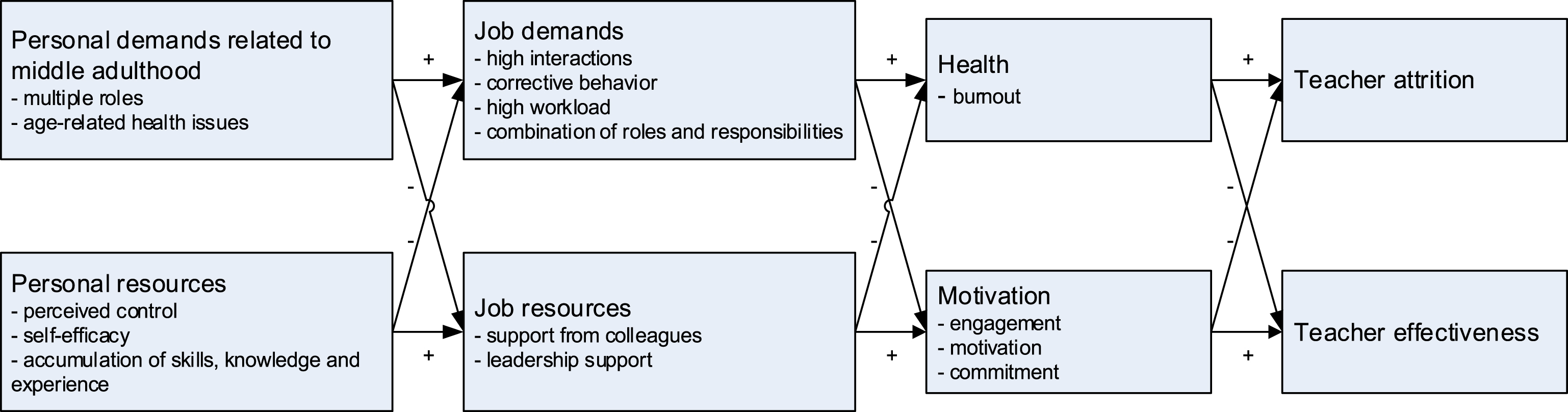
Conceptual model for attrition and effectiveness of experienced teachers.
The aim of this study was to find explanations for the high level of attrition and decreased effectiveness of many teachers who are involved in the teaching profession more than twenty years. Using the Job Demands Resources Model [25], specific demands of the teaching profession, interpersonal demands related to the developmental stage of experienced teachers, job resources, personal resources and personal demands related to middle adulthood were discussed. According to the proposed model, the fact that experienced teachers are at risk for dropout and low effectiveness is the result of high risk of burnout and low motivation, which in turn are dependent of an interplay between job demands (e.g. corrective behavior) job resources (e.g. support from colleagues), personal resources (e.g. self-efficacy) and personal demands (e.g. age-related health issues related to middle adulthood). It seems that the teaching profession has increasingly become a high-demanding profession (didactical changes, more tasks, more responsibilities, more articulate and less well-behaving pupils and parents), which requests more from the teachers than they were initially trained and equipped for. When combined with issues related to middle adulthood, like decreasing health and family issues, it does not seem odd in any way that some of these teachers start underperforming and/or resign. It seems thus that much is demanded from these teachers (high stress), while their capacity to cope with these demands is decreasing. In line with this hypothesis is research that has demonstrated that the amount of stress experienced by teachers has a negative effect on their motivation and commitment [70, 95] which in turn negatively affects the intent to stay teaching and teacher effectiveness [33, 97].
Less effective teaching behavior among some teachers with more than 20 years of experience as reported by Van de Grift et al. [15] may be ascribed to generation effects. Longitudinal data on teacher development is not available, thus the inferences are based on cross-sectional research with heterogeneous teacher populations. Each of the experienced-based subgroups of teachers represents different teachers, who attended teacher training at different moments, started their careers at different points of time, and may have different teaching skills and conceptions of learning and teaching. Nevertheless, what remains standing is the high attrition rate among experienced teachers. More research is needed on what work motives do experienced teachers have and explanations of these changes can help to confirm predictions about work behavior of older experienced teachers [77].
This study has an important limitation. The formulated model is the result of a narrative, summarizing a large number of primary studies from which conclusions are drawn to explain high attrition and low effectiveness of experienced teachers. The research synthesis is not exhaustive, which may have influenced the conceptual model and the conclusions based on this model.
Theoretical implications
First, future research should be focused at validation of the conclusions we have drawn based on the available literature. The conceptual model we proposed should be empirically tested. Such research should preferably be longitudinal, following teachers during several years, enabling to identify the mechanisms behind the well-being of teachers with more than twenty years of experience, and its relationship with retention, teaching behavior in the classroom and student learning. By doing this, what characterizes those teachers who do manage to remain teaching at a high didactical level and stay a teacher until retirement needs to be examined. Considering the mediated model sophisticated statistical techniques such as structural equation modeling should be used [98]. Specifically, the role of personal resources needs further investigation, as research suggests that these may be related to job demands and resources in various ways [27].
According to Van de Grift et al. [15] about forty to fifty percent of the experienced teachers perform at a lower didactical level than teachers with less experience. The remainder of the group experienced teachers perform on or above average. Future research should focus on what separates both groups, for example in terms of issues in the personal life and additional responsibilities at school. Both teachers working in primary and secondary education and involved in different subjects should be studied, as the causes for the loss of engagement and effectiveness may be different in these groups of teachers. Therefore, different indicators of age, such as life-span age, functional age and organizational age [77, 84] should be used. A mixed-method approach is recommended to maximize the validity and accuracy of the research.
Practical implications
The conceptual model we drew based on empirical findings provides us with directions on how to counteract early retirement and less effective teaching behavior observed in part of the experienced teachers. It suggests that by increasing personal resources and job resources and decreasing job demands, teacher retention and didactical performance in the classroom may be enhanced, via increased motivation and decreased burnout risk. It may therefore be advisable to protect experienced teachers in terms of workload and additional responsibilities. For example, Skaalvik and Skaalvik [41, 99] showed that as time pressure due to meetings, administrative work and documentation is lower, this has a positive effect on teachers’ job satisfaction, vigor, self-efficacy and intention to stay in the profession, and a negative impact on emotional exhaustion.
Further, when additional tasks are allocated to teaching staff, this should take place dependent on who is able to manage these in terms of time, energy and capacity, rather than on experience. When teachers are confronted with new responsibilities and/or reform, specific training to prepare them for the new requirements of the job may be indispensable. Day et al. [24] found that a lack of opportunities for professional learning is related to teachers’ demoralization and decreased effectiveness. Ross and Bruce [100] found in an experimental study that teachers’ participation in a professional development program was related to greater efficacy for classroom management. Likewise, in a study among almost four hundred teachers, a training program using the Internet as a classroom resource significantly heightened teachers’ efficacy short term and long term [101]. Teachers should further be offered professional development courses in order to improve continuous development and help them adapt to policy, curriculum and role changes. In addition, workplace stability and job security should be warranted. Teachers themselves should carefully balance stressors from their personal and work lives and engage with and be supportive to their colleagues.
Conclusion
This research offers insight into the specific situation of teachers with 20 to 30 years of experience which may account for a decrease in motivation and commitment prevalent in this group. The teaching profession is a stressful job, with a high level of interactions, much paper work, frequent meetings and high expectations. Most experienced teachers have additional responsibilities. The goal of this study was to find an explanation for the issues experienced by part of the experienced teachers concerning less effective teaching behavior and early retirement. Based on a vast amount of literature, we formulated several explanations for these phenomena, which have important implications for theory and practice.
Conflict of interest
None to report.