



Abstract
BACKGROUND:
Considering that, environments with information and communication technology innovations, including educational institutions, are providing more interaction among individuals anywhere in the world and contributing to higher learning flexibility, it is necessary to pay extra attention to the radiation dissipated by technological equipment in these environments.
OBJECTIVE:
Investigate whether the behavior of the globe temperature (tg) in relation to the air temperature (ta) could affect the performance of students in information technology laboratories (ITLs).
METHODS:
The methodological procedures adopted consisted of the following analyses in six institutions: thermal variables - mean radiant temperature (trm) and (tg-ta); students’ performance and architectural elements.
RESULTS:
ITL G was the ITL with the highest incidence of thermal radiation, thus a mathematical model was proposed for this sample to determine whether (tg - ta) and trm are related to overall student performance (Dt). For each increase of one degree in the difference between the globe temperature and the air temperature (tg-ta), the students’ performance in the institution G decreased by approximately 29%.
CONCLUSION:
As well as productivity can be altered due to changes in air temperature in air-conditioned teaching environments, in this specific case, if tg> >ta, possibly the thermal radiation may interfere with the performance of the people present in the environment technological innovations of communication and information.
Introduction
Thermal comfort is closely related to the energy consumption in facilities, the productivity of the occupants, and, in the case of schools, student performance and learning [1]. Therefore, the thermal comfort inside classrooms, laboratories, and other learning environments gains significance and is a variable that greatly influences student performance [2]. A study on environmental ergonomics finds evidence that favorable thermal conditions in a classroom promote more comfort, greater safety and better performance. These conditions are presented in the International Standards Organization (ISO) 7730: Ergonomics of the thermal environment [3]. Among environmental comfort variables, temperature and classroom lighting have the greatest influence on students’ learning and are the most common reasons for student complaints [4, 5].
However, the thermal comfort in the heat conservation equation is the result of six parameters: temperature, air humidity, thermal radiation, relative air velocity, personal activities, and clothing [6]. It is emphasized that merging environmental ergonomics with architecture engenders multidisciplinary knowledge where ergonomic aspects are incorporated into the design process in the interest of creating environments that ensure greater attractiveness and comfort [7].
Many researchers have been attracted to this field in recent years because of the growing public discussion about global climate change [8]. According to the report on climate change of the Brazilian Ministry of Science and Technology (2013), it is expected that the mean air temperature in Brazil will be 3 to 6°C higher in 2100 than at the end of the 20th century. These climate changes can raise the mean temperature in all Brazilian regions even more [9] and because of the growing inclusion of information and communication technology innovations (new ICT) in educational institutions that result in an increase in thermal radiation, it is important to investigate how this increase can affect students’ comfort and performance.
According to Yang et al. [10], given the rapidly increasing use of these technologies during class (e.g. computers, projectors) researchers have been motivated to examine the effect of those equipment have both on learning and on the perception of students in the educational environment. However, a consensus regarding their benefit or harm to students has not been reached because some authors advocate that the technology used in the classroom is a positive factor whereas others claim that it has a negative effect on learning. Nevertheless, according to Yang et al. [11], temperature is one of the most significant factors affecting the perception of students regarding comfort in the classroom.
Therefore, considering that environments with new ICT, including educational institutions, are providing more interaction among individuals anywhere in the world and contributing to higher learning flexibility, it is necessary to pay extra attention to the radiation dissipated by the technology in these environments. According to Silva [2], these types of radiation are low in frequency and are transformed into thermal radiation, which, together with the heat emitted by humans and the environment and climatic and personal variables, increases the total radiation in a room.
Research on thermal radiation has received little attention in the literature reviews on thermal comfort research and practices by Rupp et al. [8], De Dear et al. [12], and Van Hoof (2008) [13], which has limited the development of studies in this area. According to research conducted by Halawa et al. (2014) [14], most of the published work attributes the level of thermal comfort of the environments only to dry bulb temperature (air temperature), without taking into account the influence of other comfort variables. In Fanger’s equation (1970) [6], the thermal radiation factor is represented by the mean radiant temperature (trm), but its impact on thermal comfort is often neglected.
The globe temperature is one of the variables of the equations for calculating the mean radiant temperature, and it corresponds to the temperature that allows assessment of the thermal radiation level of the surfaces in a certain environment, [15], where a significant difference between the globe temperature and the air temperature indicates an increase in thermal radiation in a work environment. The globe temperature is the temperature also used in the thermal stress indicator Wet-bulb globe temperature (WBGT). WBGT seems to be still used world widely for the evaluation of heat stress conditions and it is recommended by ISO and American Conference of governmental Industrial Hygienists as a screening method [16–19]. In a study conducted by Vasconcelos (2015) [20], with cadets from the Military Police of Paraíba (PMPB), it was evidenced that in addition to air temperature, the globe temperature also exerted an influence on general cognitive performance. Several studies on thermal comfort have been conducted, but in most of these studies, the mean radiant temperature is assumed to be equal to the air temperature of the room [21, 22].
Mean radiant temperature is one of the most important variables for assessing thermal comfort, particularly under hot and sunny climatic conditions [23]. According to Akimoto et al. [24], an increase in the mean radiant temperature of an internal environment can reduce the productivity of its occupants, considering the significant influence of thermal comfort on their productivity and satisfaction. Halawa et al. [14] provide a critical overview of the impact of the thermal radiation field on thermal comfort and energy control and consumption in buildings. This critical overview shows that the thermal radiation field is an essential parameter of thermal comfort. Arslanoglu and Yigit [11] study thermal comfort inside a climate chamber under the effects of radiation from lighting lamps in shopping centers. Their results show that the heat flux due to radiation from these lamps causes local differences in skin temperature and that these differences cause thermal discomfort. Furthermore, the incidence and increase of thermal radiation in an environment are related to the architectural design. Walikewitz et al. [22] show that different environmental characteristics (such as wall exposure, construction materials, and room and window size) may play fundamental roles in determining the internal climate and the incidence of thermal radiation in an environment; therefore, these characteristics must be considered in the architectural design.
Working and learning environments are undergoing changes related to technological aspects. Today, it is possible to teach classes, participate in lectures, and even ask and answer questions without the restrictions of time and space. The link between wireless communication systems, computers, and projectors allows student-teacher interactions, facilitating communication and increasing learning. However, with the inclusion of new technologies in the educational environment, it is necessary to rethink the quality of buildings and to propose lighting and air conditioning designs that are compatible with the activities performed in them. If on the one hand, these new designs, together with the inclusion of new technologies, are modernizing, then, on the other hand, they may further increase the thermal load in the environment.
Adverse external environmental conditions, which may be related to climatic changes leading to air temperature increases, are another factor that contributes to a higher thermal load. The increase in air temperature in the environments with new ICT may still be related to cardiovascular dysfunctions, and with the reduction of physical and cognitive performance in humans. According to research conducted by Siqueira et al. [25], the cognitive performance of undergraduate students in the field of engineering and technology increased while performing activities in a learning environment with an air temperature of approximately 23.3°C (according to their thermal perception), when students have an initial blood pressure of 93.33 mmHg and a heart rate 60 bpm.
Therefore, it is important to investigate the behavior of the globe temperature relative to the air temperature, with possible effects on the increase in the mean radiant temperature, in classrooms where students perform learning activities with new ICT subject to air temperature variations.
Experimental methods
The methods adopted in this study consisted of the following stages: analysis of thermal variables, student performance, analysis of architectural elements, data processing, mathematic modelling, and ethical considerations.
The study was performed in air-conditioned information technology laboratories (ITLs) with new ICT (multimedia and wireless systems, air conditioning and lighting, personal computers, online printers) in the following institutions: (A) the Federal University of Piauí (UFPI), Teresina-Piauí; (B) the Federal University of Santa Catarina (UFSC), Florianopolis - Santa Catarina; (C) the University of Brasília (UnB) - Gama Campus, Brasília - Federal District; (D) the Federal University of the São Francisco Valley (UNIVASF), Petrolina - Pernambuco; (E) the Mathematics and Computer Sciences Institute (ICMC) of the University of São Paulo (USP), São Carlos - São Paulo; (F) the Federal University of Amazonas (UFAM), Manaus - Amazonas; and (G) the Paraíba Military Police Educational Center (MPEC), João Pessoa - Paraíba. The number of participants per institution, location, and information related to the data collection period of three consecutive days are summarized in Table 1. The study was conducted between 2012 and 2016 and that most of the measurements were carried out in 2016.
Sample size per institution
Sample size per institution
Data were obtained from measurements performed in the ITLs, one session per day from 1:00 p.m. to 3:00 p.m. For each ITL, the measurements were performed at three dry bulb air temperatures (ta) of 20°C, 24°C and 30°C, according to the ASHRAE 55 [26], ISO 7726 [27] and ISO 7730 [28] standards. The temperatures were regulated by the conditioned air. All data were measured continuously during collection at 1-minute intervals to determine whether the thermal conditions of the environment were constant. During the measurement sessions, the activities performed by students included the use of personal computers and/or laptops (Institution G) to access the electronic address (link) for the Battery of Reasoning Tests-5(BPR-5) [29]. The BPR5 is designed to assess overall cognitive functioning and is used by specialists, for instance, as an auxiliary measure for psychodiagnosis, job selection and learning assessment. The instrument comprises five subtests that assess the following skills: Abstract Reasoning (AS), Verbal Reasoning (VR), Spatial Reasoning (SR), Numerical Reasoning (NR) and Mechanical Reasoning (MR). A survey was created using the website Qualtrics.com to apply the instrument and measure the amount of time the participant required to answer each question. The number of hits, the time required to answer and the relationship between these factors was calculated. The tests were randomly distributed; each participant completed one test on each of the study days.
As for the thermal resistance of clothing, the mean was 0.45±0.12. In view of the fact that the students were instructed to wear similar clothing over the three days of data collection. Before the students performed their activities in the laboratories, they were taken to a room with favorable environmental conditions to provide a rest time for stabilization of their bodies, which was verified through the measurement of their arterial pressures using a HEM-7220 automatic arterial pressure monitor and a Polar FT7 heart rate monitor. The procedures for measuring blood pressure complied with the VI Hypertension Guidelines [30].
The dry bulb temperature (ta), the globe temperature (tg), and the relative humidity (RH) were collected by a BABUC-A microclimate station and a TGD300 thermal stress meter. The instruments met the requirements of the ISO 7726 [27] standard. The air velocity was considered constant V = 0.1 m/s, an estimate for closed environments [14, 27].
The transducers connected to the instruments measured the thermal variables and had the following features: Aspiration psychrometer: This instrument measures the air temperature or dry bulb temperature (Ta) as well as the wet bulb temperature, Tbu, with a resolution of 0.03 K, an accuracy of±0.13 K, a 90 s response time, and a – 20°C to 60°C measurement range. It provides the RH value OF THE AIR with a 0.1% resolution and accuracies of±0.5% from 70 to 98%,±1% from 40 to 70%, and±2% from 15 to 40%, with a measurement range of 0 to 100%. Globe thermometer: The globe temperature, dry bulb temperature and air velocity are necessary to obtain the mean radiant temperature. The globe thermometer has a globe painted black, with 0.95 emissivity (□) and an external diameter of 0.15 m, a resolution of 0.03°C, an accuracy of±0.15°C, about 20 to 30 minutes response time, and a measuring range from 10°C to 100°C.
According to the guidelines of the ISO 7726 [27] standard and considering that the environments were uniform in terms of temperature distribution, the microclimate station was installed in the middle of the laboratories at a height of 0.6 m from the floor, once the students were seated. The instruments were programmed to record the measurements every minute from the time the students entered the classroom. For stabilization purposes, the instruments were installed in the laboratories 30 minutes before data collection.
Moreover, to check whether heat exchange occurred by radiation between the students and the environment, the following hypotheses were tested according to the mean radiant temperature equation (equation (1)) from ISO 7726 [27]: If tg = ta, then trm = tg, and there is no heat exchange by radiation. If tg > ta, then trm increases proportionally with tg, which indicates heat exchange by radiation. If tg < ta, then trm decreases proportionally with tg, which indicates that there is no heat exchange by radiation.
Where trm = the mean radiant temperature; tg = the globe temperature;
Simultaneously with the thermal measurements in the ITLs, which mainly assessed the behavior of the globe temperature relative to the air temperature (Tg-Ta), the students performed activities related to the (BPR-5) to determine their general cognitive performance during the climatic variations in the ITLs. The BPR-5 consists of five sub-tests. It is an instrument that assesses cognitive abilities and provides estimates of general cognitive functioning and of strengths and weaknesses in five specific areas analyzed by the following five sub-tests: the Abstract Reasoning (AR) Test, the Verbal Reasoning (VR) Test, the Numeric Reasoning (NR) Test, the Spatial Reasoning (SR) Test, and the Mechanical Reasoning (MR) Test. According to the authors, the BPR-5 is used by professionals in psycho-diagnosis, personnel selection, professional orientation, and learning assessment, among other areas; in other words, it is used to check general cognitive functioning [31].
In this study, the BPR-5 was decomposed and reorganized into three summarized tests of the same difficulty level to be applied each day. For this purpose, Siqueira [32] developed a survey in the Qualtrics platform, which enabled the application and measurement of the response time for each question. The total number of right answers varied from 0 to 20, considering that the overall reasoning test score consisted of the sum of the scores of the five sub-tests, each containing four questions, with a value of 1 for each question. Each test battery consisted of four questions for each reasoning test, as shown in Table 2.
Reasoning sub-tests based on BPR-5
Reasoning sub-tests based on BPR-5
Source: Almeida and Primi [20].
Based on this classification and categorization, similar items were randomly distributed among the tests; thus, each student answered one test per day, for a total of three reasoning tests. Performance could be classified into three ranges: below average, with up to 25% correct answers; average, with between 25% and 75% correct answers; and above average, with more than 75% correct answers [31].
A short architectural analysis of the building envelopes and their constituent materials was performed according to the NBR 15220 – Thermal Performance of Buildings standard [33] in addition to analysis of the architectural design following several recommendations by Roriz [34], considering that these factors may be associated with a possible increase in tg relative to ta that would cause an increase in trm. The architectural analysis was performed to better understand the possible thermal behavior of the building, mainly regarding the differences in the air and globe temperatures with a possible increase in trm. It is possible to examine the thermal performance as well as of the architectural design of a building through a brief assessment of the building envelope and its constituent materials because an adequate design together with the correct use of materials may contribute to thermal comfort, with repercussions on general comfort and productivity.
Thus, if the architectural design has more negative than positive aspects in relation to architectural elements and tg > ta, it is likely that some architectural element combined with the internal heat sources contributes to an increase in the globe temperature, thus increasing the thermal load of the environment. However, if the architectural design has more positive aspects and tg > ta, it is likely that the increase of the thermal radiation in the environment is associated with only internal sources of heat.
Table 3 shows the architectural design recommendations according to Roriz [33].
Architectural design recommendations according to Roriz
Architectural design recommendations according to Roriz
The NBR 15220 standard [33] makes recommendations for good building thermal performance and provides data on the thermal transmittance (U), thermal capacity (CT), and thermal delay (φ) of walls and roofs. Thus, reference information from NBR 15220 [33] was used to obtain data on side closings and roofing listed in Table 3. These considerations may explain the increases in the mean radiant temperature in the classrooms under study.
The data collected were tabulated in a Microsoft Excel® spreadsheet and prepared for use in the programs R, SPSS® and STATISTICA to perform descriptive data analysis, create graphs, establish correlations between the variables, and build the mathematical model. Non-parametric Kruskal-Wallis tests were used to test the hypothesis that the distribution of the parameters was similar over all the days of the experiment. Spearman’s correlation was used to test the correlations between the variables of interest.
Mathematical modeling
A mathematical model was built using the generalized linear model (GLM) class to investigate the behavior of (tg - ta) and trm in the cognitive performance (Dt index – overall performance as a function of time) of the students, considering that (tg - ta)>0 indicates an increase in trm with repercussions on the increase in the internal thermal load and that the effects of these variables on the variability of the students’ cognitive performance must be analyzed.
GLMs correspond to a large class of statistical models defined in terms of a set of independent random variables, in which each variable has a certain exponential distribution [35]. The model has two parts: Probability distribution of Y(Dt), Y ∼ N(μ, σ2) The function that links the expected value Y(Dt) with a linear combination of the explanatory variables trm and (tg - ta), according to equation (2):
This study followed the Brazilian guidelines (Resolution CNS 466/12 and complements), which state that any study involving human beings must be submitted to a Committee on Ethics in Research. This study was submitted, acknowledged, and approved as ethically adequate under registration number CAAE 57408416.3.0000.5188.
Characterization of the rooms and architectural elements
Information technology laboratory A – UFPI
The ITL of Institution A has an area of approximately 112 m2 and 48 computers with LCD monitors are installed. The room temperature is controlled by two split-type air conditioners, and there is artificial and natural lighting. The windows are in the back of the room and covered with 50% transparency film, mirrored on the outside to reduce the entry of solar radiation.
The largest building façade is oriented to the northeast, but the elongated shape of buildings reduces exposure to solar radiation and increases exposure to the prevailing winds. The building has two floors, and the laboratory under study is on the west side of the ground floor; thus, it receives solar radiation on the northwest wall in the afternoons. The windows, located in the southwest façade of the building, have no protection elements; thus, they receive direct solar radiation. The window area is 10.43 m2, or 41.68% of the laboratory. The most common construction materials in the ITL are concrete and masonry, and the ceramic tile roof is supported by a wood structure. Because of its porosity, this material helps reduce the flow of heat into the building.
Information technology laboratory B – UFSC
The ITL of institution B has an area of approximately 100 m2 with 25 computers with LCD monitors. The glass windows are located in the back of the room. The upper parts of the windows are tinted and have curtains. The room temperature is controlled by two split-type air conditioners, and there is artificial and natural lighting.
The building has three floors and its façades are practically the same size. The laboratory is located on the first floor, and the windows are in the southwest façade with an area of 10.35 m2, or 47% of the laboratory. There is vegetation that helps cool the air entering the building. The use of curtains, an internal solar protection element, was observed, although they do not impede the entrance of direct solar radiation which is then obstructed by the curtain after crossing the glass and reflected as heat that remains inside the building. The predominant construction materials of the ITL are concrete and masonry, and the roof is constructed of fiber-cement tiles that contribute to heat gain inside the building because of their high thermal transmittance and solar heat factor.
Information technology laboratory C – UnB
This ITL has an area of approximately 186.93 m2 with 80 computers with LCD monitors. There are glass windows on the side of the laboratory. The room temperature is controlled by two split-type air conditioners, and there is artificial and natural lighting.
The largest façade is oriented to the northeast, and the building has a central courtyard. The building has two floors, and the laboratory is on the east side of the ground floor; thus, it does not receive direct solar radiation in the afternoons. The windows are located in the southeast façade with an area of 33.82 m2, or 59.22% of the laboratory. They have brises-soleils as external solar protection elements to reduce the heat flow to the inside of the building. The main construction materials used in the ITL are concrete and masonry, and the roof is constructed of fiber-cement tiles.
Information technology laboratory D – UNIVASF
This ITL has an area of approximately 100.24 m2 with 24 computers with LCD monitors. The laboratory has a total of five air conditioners; three of them are split-type units and the other two are for ceiling installation.
The largest façade is oriented to the northwest, which, together with the elongated shape of the building, increases the incidence of solar radiation. The building has three floors, and the laboratory is located on the north side of the first floor, receiving solar radiation on the northwest façade in the afternoons. The windows are made of matte glass (some are covered with sheets of dark paper) and are located on the northwest façade, having an area of 15.21 m2, or 43.89% of the laboratory. There is no concern with protecting the windows, which are very hot; it is uncomfortable to stay close to them. The pillars external to the building help protect the windows, but they are ineffective in avoiding a large heat gain due to direct solar radiation. The main construction materials used are concrete and masonry, and the roof is constructed of fiber-cement tiles, which contribute to increasing the heat gain because of their high thermal transmittance and solar heat factor.
Information technology laboratory E – ICMC
This ITL has an area of approximately 61.68 m2 with 40 computers with LCD monitors. The windows are made of glass and located on the side of the laboratory. The room temperature is controlled by two split-type air conditioners, and there is artificial and natural lighting.
The building has an elongated shape, and its largest façade is oriented to the north, which reduces exposure to solar radiation. The windows have an area of 7 m2, or 40.79% of the laboratory area. The vegetation in the surroundings helps cool the airflow that enters the building and protects against solar radiation. The predominant construction materials are concrete and masonry, and the roof is constructed of fiber-cement, although its solar heat factor is reduced because it is not blackened. The side closings are composed of PVC partition panels.
Information technology laboratory F – UFAM
This ITL has an area of approximately 69.42 m2 with 30 computers with LCD monitors. The laboratory has two split-type air conditioners installed in the north wall and wood and glass windows in the north and south façades.
The largest façade of the building is oriented in the north-south direction, and the elongated shape of the building reduces exposure to solar radiation and increases the effect of the prevailing winds on the largest façades. The windows are large and located on the north and south façades, with areas of 17.85 m2, or 61.78% of the laboratory area, and 14.5 m2, or 42.37% of the laboratory area, respectively. The gardens around the building help cool the airflow toward the building and protect it against solar radiation. The predominant construction materials are steel, concrete, and masonry. The roof is constructed of fiber-cement tiles and is independent of the structure, which helps protect the building because of the air circulation in the sides and the cushion of ventilated air between the fiber-cement tiles and the concrete ceiling.
Information technology laboratory G – MPEC
This ITL has an area of approximately 76.38 m2. In it, the temperature is controlled by two split-type air conditioners, and it has artificial lighting and some natural light that enters through small crevices in the windows. The windows are made of wood and glass and oriented to the south, with no view to the outside. The north wall receives solar radiation. The students used their own laptops during data collection.
The largest façades are oriented in the north-south direction, which, together with the elongated shape of the building, reduces exposure to solar radiation. The building that houses the laboratory is far from other buildings in the area, which allows the passage of air currents. The ITL is located in the west side of the building; thus, it receives solar radiation in the afternoons, although vegetation and a low external wall provide protection to this façade. The windows are in the south façade, with an area of 3.81 m2, or 20.19% of the laboratory area. The predominant construction materials are concrete and masonry. The roof is constructed of fiber-cement tiles on top of the rooms’ slab and is supported by hollow elements, which creates a cushion of ventilated air between the tiles and the concrete ceiling.
Results
Analysis of the thermal variables
Table 4 shows the mean values of the thermal variables measured in the three data collection sessions for each ITL.
The analysis of the heat exchanged due to radiation between the environment and the individuals in each session per ITL was performed using the data in Table 4 and equation (1). The results are shown in Table 5.
Mean thermal conditions by information technology laboratory (ITL)
Mean thermal conditions by information technology laboratory (ITL)
Summary of the heat exchange due to radiation by session and by information technology laboratory (ITL)
The highest amount of heat exchange due to thermal radiation occurred in ITL G, in the city of João Pessoa, which may have been due to the number of laptops (40) in the room, considering that they emit more radiation than personal computers [2], and/or due to the architectural characteristics of the room that could have resulted in a high incidence of thermal radiation. There was no heat exchange due to radiation in ITLs C (Brasília) and F (Manaus). These results could be explained by a low outside temperature (22°C in Brasília) or by the presence of architectural elements or construction materials that favor the non-emission of thermal radiation to the environment (ITL F).
To better visualize these findings, Fig. 1 shows that the increase in globe temperature relative to air temperature was more accentuated in ITL G in the 20°C, 24°C and 30°C sessions, when the increase in tg changed over time. Therefore the heat exchange in the laboratory of institution G was the highest, with the mean radiant temperature being higher than the globe temperature by 2.25°C

Globe temperature (tg) and air temperature (ta) for each information technology laboratory.
Table 6 shows the analysis of the students’ cognitive performance for each ITL according to the classification by Almeida and Primi [31] detailed above in the Experimental Methods section.
Analysis of student performance according to information technology laboratory (ITL)
Analysis of student performance according to information technology laboratory (ITL)
ITL - A = UFPI; ITL - B = UFSC; ITL - C = UnB; ITL - D = UNIVASF; ITL - E = USP; ITL - F = UFAM; ITL - G = MPEC.
The results show that the students did not perform below average in the reasoning tests in any ITL, except for laboratory F in the session at 20°C, when approximately 4% of the students had an unsatisfactory performance. The results for ITLs E and G are more satisfactory on average than those of the other laboratories. ITL F has a less satisfactory result on an average than the other institutions.
Heat exchange between the outside and the inside of a building occurs through the building envelope. The envelope can be divided into two parts: opaque and transparent closing elements. The main difference between the two is the ability to transmit solar radiation to the inside [36] and for this reason, the geographical orientation of the building and its windows, solar protections, and space organization are important [37], in addition to their constituent materials, considering that they have a direct relationship with the thermal performance of buildings. Therefore, the thermal transmittance (U) of each construction material, which represents the heat flux transmitted per unit of area and unit of temperature difference, must be considered [25].
Table 7 shows the architectural analysis of each ITL following the methodology defined for this study.
Architectural analysis of each information technology laboratory (ITL)
Architectural analysis of each information technology laboratory (ITL)
ITL - A = UFPI; ITL - B = UFSC; ITL - C = UnB; ITL - D = UNIVASF; ITL - E = USP; ITL - F = UFAM; ITL - G = MPEC.
The general result (Table 8) for each ITL was obtained from the architectural analysis. With this result, it was possible to verify whether the architectural design and the constituent materials of the ITLs had more positive than negative aspects, in other words, whether these factors contributed to the incidence of radiation from external sources. Accordingly, it could be observed whether the external heat sources contribute to the increase in thermal radiation in the environment.
General result of the architectural analysis for each information technology laboratory (ITL)
The results of these analyzes showed that, in institutions A, B and D, projects had more negative aspects, thus finding that some element could be contributing to the exchange of heat by radiation in the internal environment, in addition to the internal heat sources (news ICT). Institutions C, E, F and G presented a positive result to the architectural project implicating that most of this heat exchange was probably coming only from internal sources of heat.
The results of the heat exchanges due to radiation and of the architectural analysis showed that ITL G, the Paraíba Military Police Academy Educational Center in João Pessoa, was the ITL with the highest incidence of thermal radiation. Thus, a mathematical model was proposed to determine whether (tg - ta) and trm were related to overall student performance (Dt) in this ITL G.
It was observed that the data distribution of Dt was close to an exponential distribution (Fig. 2), which allowed the use of a model from the GLM class. The application of the Shapiro-Wilk test of normality to the dependent variable showed that the distribution was significantly different from a normal distribution (for a level of significance equal to 0.05). Therefore, the adequate fitted regression model was an inverse Gaussian model with a log link function, according to equation (3).
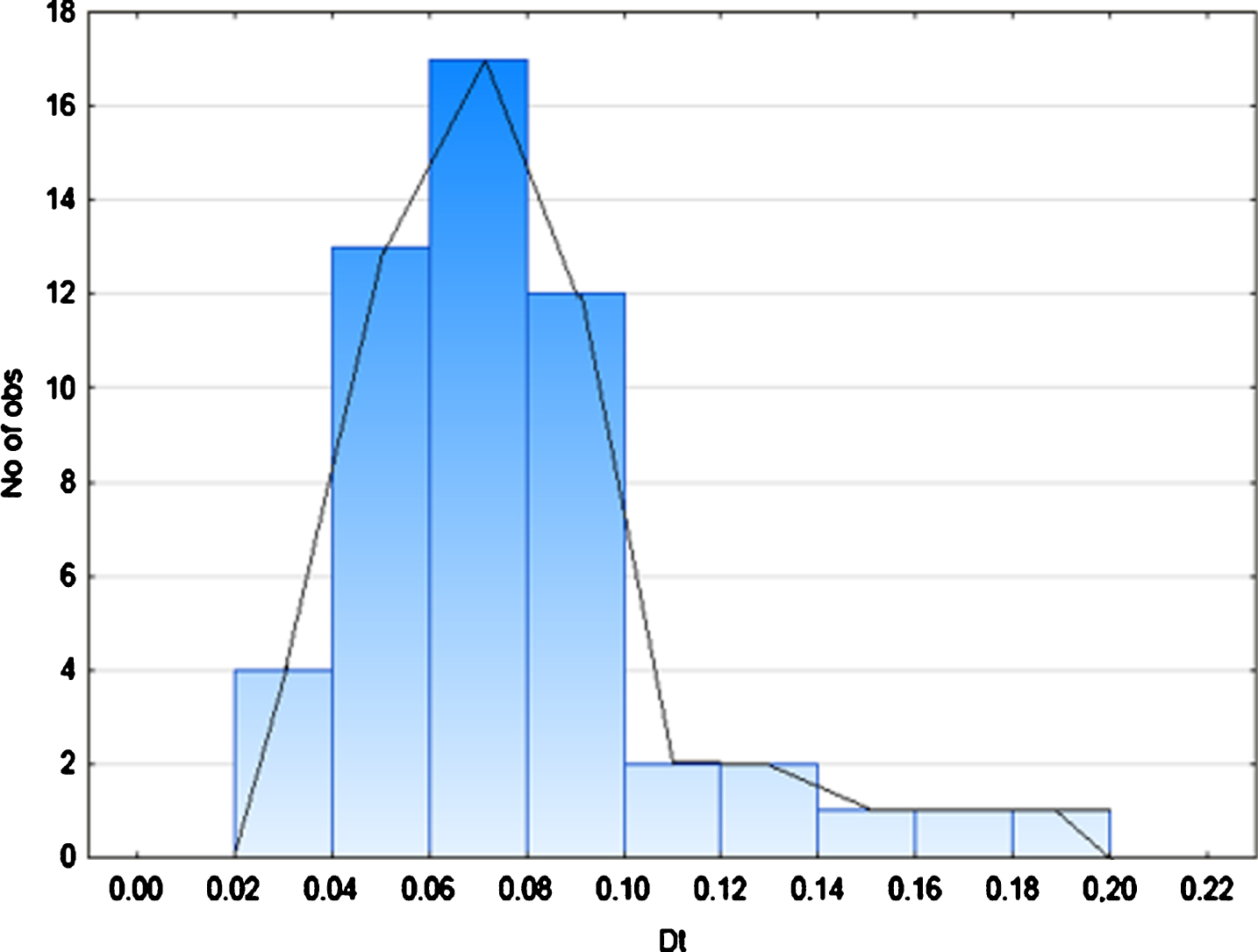
Frequency distribution of Dt – Sample G.
In addition, the presence of systematic deviations in the model was verified through an analysis of the adequacy of the distribution, the variance function, and the presence of inconsistent influential points. This analytical procedure of systematic deviations was repeated until there were no more inconsistent influential points. Every time an inconsistent influential point was removed, a new model was generated, and each systematic deviation was analyzed again. The fit of the final model without these points resulted in the estimates shown in Table 9.
Estimated final model coefficients
These analyses confirm the model’s consistency. Thus, based on the estimates shown in Table 9, substituting coefficients β1 and β2 in the equation (3) results in the equation (4):
It is important to note that in Table 9, the p-values are <0.05 but the pseudo R2 is low (0.1548). However, regarding the fit of GLMs, Cordeiro and Demétrio [38] highlight that, in fact, a favorable result of the likelihood ratio test (for a certain level of significance) can be considered evidence that a model has a reasonable fit to the data. Thus, considering that the p-value of the likelihood ratio test is <0.001, equation (3) is well fitted.
Based on model (4), for a constant mean radiant temperature (trm), student performance is reduced by approximately 29% for each 1°C increase in the difference between the globe temperature and the air temperature (tg - ta). This statement is confirmed in Fig. 3 given that by setting three values for the mean radiant temperature (23°C, 25°C and 28°C) and varying (tg - ta) between 1°C and 4°C, student performance tends to decrease with the increase in (tg - ta).
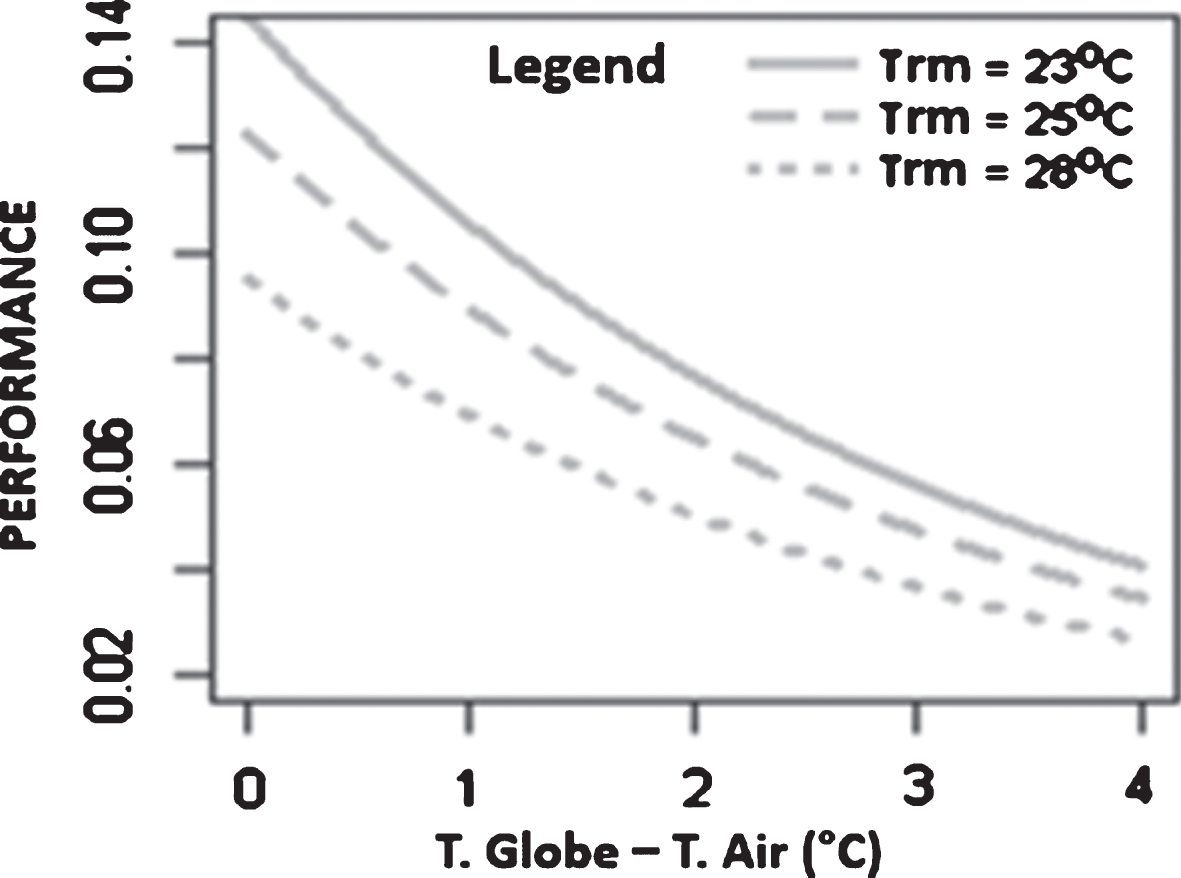
Performance as a function of Tg - Ta .
The globe temperature was higher than the air temperature in laboratories A and B on the first two days of data collection; therefore, there was heat exchange due to radiation. Considering that in the ITLs of both institutions the project and its constituent elements were considered negative (Table 8), both the internal and external thermal conditions could be responsible for the difference between the globe and the air temperatures. In the case of ITL D, the globe temperature was higher than the air temperature on the three data collection days. As the project and the constituent materials of this laboratory were also considered negative, there were internal (new ICT) and external factors that resulted in the increase in thermal radiation in the environment. The temperature of the internal surface of the external wall of buildings without adequate insulation and materials are affected by the external conditions, particularly solar radiation. Therefore, the temperature of the internal surface of these walls increases considerably, which increases the thermal radiation in the room.
Heat exchange due to radiation was observed in ITL E. Considering that the results of the architectural analysis of this project indicated that there were more positive than negative aspects, the implication is that most of the heat exchanged likely originated from internal heat sources. In the cases of laboratories C and F, all globe temperatures collected were lower than the air temperature, indicating that there was no heat exchange due to radiation. This finding, together with the good performance of the materials, indicated that the projects had more positive characteristics in both ITLs. Therefore, there was no incidence of thermal radiation originating in the internal and external environments of these ITLs.
ITL G had the highest heat exchange due to radiation, given that tg > ta. However, the results of the architectural analysis indicated that the project had more positive aspects. Its north-south orientation minimized exposure to solar radiation and the good thermal performance of the construction materials reduced the incidence of outside radiation. According to Atmaca et al. [39], when a building’s envelope contains adequate insulation and materials, only small internal and external heat gains occur due to solar radiation, considering that the temperature of the internal surface of the walls helps protect from external environmental conditions. Therefore, in this specific case, the number of laptops (40 units) and other heat sources in the ITL of Institution G most likely combined to increase the globe temperature, considering that the mean radiant temperature was higher than the globe temperature by 2.25°C
It was found, through the mathematical model, that with each increase of a degree in the difference between the globe temperature and the air temperature (Tg-Ta), the students’ cognitive performance in the computer lab of institution G decreased by around 29%. Therefore, it is likely that in an air-conditioned room with different heat sources such as new ICT, students, walls, and surfaces, where tg > ta, these factors may influence the heat exchange due to radiation between the students and their environment.
Limitations
With the development of modern society, it is observed that individuals are in most of their time in indoor or closed environments, which has become a concern of several researchers in the search to investigate the conditions of environmental comfort during the activities of workers in the their workspaces. One of the concerns in closed environments is the thermal conditions, and if not controlled can generate a certain effort, thus overloading the human organism and, consequently, interfering in the performance.
In this work, students perform their cognitive activities in information technology laboratories located in the different Brazilian regions. Thus, the climatic differences in Brazil provide different acclimations, so the students participating in this research are acclimated to the climatic specificities of their respective regions, which may interfere in the determination and analytical interpretation of comfort with reflection in the underestimation of some results of the cognitive tests performed students during the collection of thermal data.
Another limitation of the study was about the architectural analysis. When analyzing the relationships between the globe temperature and the air temperature in a constructed environment, especially when there are several sources of heat in this environment, it is important to evaluate the thermal characteristics of materials and the elements and constructive components of the building, because for some building is essential to obtain knowledge about the transfer of heat from the external environment.
In this sense, in the specific article, only a succinct architectural analysis was carried out in accordance with the precepts of NBR 15220 - Thermal Performance of Buildings (2003) to have better understand the possible thermal behavior of buildings, especially regarding differences in air temperature and globe temperature with possible increase of Trm.
Conclusions
Several factors contribute to increasing thermal radiation in a work environment. They include (1) the external thermal conditions – climatic change; (2) the architectural design; (3) the building envelope materials; (4) the communication and information technology equipment installed in the room; and (5) the generation of body heat. Thus all these parameters can contribute to the increase of thermal radiation in an air-conditioned environment. Therefore, urban and human aspects must be considered when heat exchange due to radiation and the environment is investigated [40].
All of these parameters may contribute to increasing thermal radiation in air-conditioned environments, which in this study were ITLs at Brazilian educational institutions where the thermal radiation was investigated through the behavior of the globe temperature relative to the air temperature and by observing the variation in the mean radiant temperature while students performed cognitive tasks. It was found that on the three consecutive days when the air temperature was 20, 24, and 30°C, institutions C and F were the only ITLs in which there was no heat exchange due to radiation between students and the environment, which did occur in institutions A, B, D, E, and G. The heat exchange in the laboratory of institution G was the highest, with the mean radiant temperature being higher than the globe temperature by 2.25°C
The possible causes were assessed and it was found from the analysis of the architectural elements that the design of the building containing laboratory G had more positive than negative aspects, considering the north-south orientation and the good thermal performance of the construction materials. Therefore, the internal heat sources in the laboratory may have led to an increase in thermal radiation, given the substantial numbers of students and laptops. To confirm these findings, the mathematical model for this ITL showed that for each 1°C increase in the difference between the globe temperature and the air temperature, the performance of the students in the ITL decreased by approximately 29%. This result demonstrates that a higher mean radiant temperature results in a higher thermal radiation in this laboratory and this increase can affect student performance. In this way, as well as productivity can be altered due to changes in air temperature in air-conditioned teaching environments, as already proven by international publications, in this specific case, if tg> >ta, possibly the thermal radiation may interfere with the performance of the people present in the environment technological innovations of communication and information.
Conflict of interest
None to report.