



Abstract
BACKGROUND:
Research has suggested that balance ability contributes to musculoskeletal injury (MSKI) rates in firefighters. Though the Y-Balance Test (YBT) can predict injury, it is unclear what physical measures inform YBT performance in firefighters. Thus, there is a lack of knowledge regarding best practice for improving balance in firefighters.
OBJECTIVE:
To evaluate the relationship between the YBT and fitness measures, including body composition, aerobic capacity, functional total-body power, upper and lower-body strength, and movement efficiency, among firefighters.
METHODS:
Dynamic balance (YBT), body mass index (BMI), body-fat percentage (BF%), fat free mass (FFM), aerobic capacity (VO2max), stair climb (SC), upper (1RMbench) and lower-body (1RMsquat) strength, and Fusionetics™ Movement Efficiency Screen (ME) measures were collected among 35 firefighter recruits. Pearson correlation coefficients were used to examine relationships between YBT and the performance measures.
RESULTS:
Dynamic balance ability in firefighter recruits is significantly (p < 0.05) related to BMI, lower-body strength, and movement quality, but not with aerobic capacity, stair climb performance, and upper body strength.
CONCLUSIONS:
Greater YBT performance in firefighter recruits is associated with lower BMI, greater functional movement, and greater lower-body strength. Future research is warranted to incorporate these elements into balance training programs for firefighter recruits.
Introduction
In 2017, there were an estimated 58,835 firefighters injured in the line of duty [1]. Of the musculoskeletal injuries (MSKI) that occurred on the fire ground, 20%were related to falls, jumps, or slips [1]. Prior research has suggested that one possible contributor to fall and slip rates, and in turn MSKI risk, in firefighters is balance ability [2]. In athletic populations, balance testing has been suggested to provide insight into risk for injury. Specifically, poor balance or lower balance ability has been associated with high risk for injury in physically active young adults [3], adolescent baseball athletes [4], high school and college aged football athletes [5, 6], high school aged basketball athletes [7], division-1 college athletes [8, 9], and professional soccer athletes [10]. Research suggests that firefighters that perform significantly poorer on a dynamic stability test consequently experienced longer slip distances when walking at a fast speed [2], which may link firefighter balance to MSKI risk. Modifying the work environment for a firefighter can be unrealistic and at minimum, have limitations. However, there is potential to better prepare firefighters to manage unknown changes in ground surface through effective balance training and physical readiness. To date, the firefighter literature is void of information providing insight into the determinants of balance in a firefighter.
The Y-Balance test (YBT) is a low cost, field-based dynamic balance test that represents a modified version of the Star Excursion Balance Test (SEBT; 10–16). The YBT is a single leg stance balance test where the individual reaches as far as possible with the free limb. Previous research has reported that the longer the reach, the better the balance ability in a variety of populations such as female high school basketball athletes [7], college football players [6], and healthy, physically active adults [18]. Furthermore, the asymmetry in the anterior reach [8, 9] and/or total composite score [3, 19] has been associated with a greater risk for lower extremity injury in division-1 collegiate athletes [8, 9] and physically active young adults [3], adolescent baseball athletes [19], high school and college aged football athletes [5, 6], high school aged basketball athletes [7], and professional soccer athletes [10], respectively. To date, however, there is a gap in the literature regarding YBT performance in the firefighter population. It is possible that the low-cost and simplicity of the YBT may be an ideal balance evaluation tool for fire departments.
The existing literature would suggest that improving balance may reduce the risk for lower extremity injury, however, the physiological determinants of balance as measured by the YBT remain unclear. It has been suggested that YBT performance does not differ across the normal, overweight, and obese body mass index (BMI) categories [16]. Previous research has also suggested that composite YBT scores have a significant relationship with greater functional movement performance measured through a composite score of Functional Movement Screen™ (FMS™), specifically the in-line lunge and shoulder mobility tests of the FMS™ [20]. Increased YBT performance has been linked to greater ankle dorsiflexion range of motion in both military and civilian populations [21, 22]. Firefighter personal protective ensembles (PPE) with a self-contained breathing apparatus negatively impacts anterior, posteromedial, and posterolateral reach distances for both limbs on the YBT [23], which may be due to the known decreases in ankle dorsiflexion range of motion in firefighters in boots [24]. Though a positive relationship between composite dynamic balance scores, as measured by the SEBT, with hip strength has been reported [25], other studies [25, 26] have reported no link between lower-limb strength and SEBT performance making it difficult to conclude how strength is related to YBT performance. Power output has also been linked to YBT performance amongst military personnel, however it remains unknown how YBT performance is related to functional power output in firefighters, a population where balance and power are important to job performance [21]. Though there are suggested connections between YBT performance with BMI, functional movement, and ankle range of motion, as well as influences of PPE on YBT performance, it remains unclear what other physical variables are indicative of dynamic balance in firefighters.
Despite the ability of the YBT to predict injury, there is minimal evidence to link YBT performance to other performance measures, which is fundamental to developing strategies or training programs to improve balance [20]. Therefore, the purpose of this study was to evaluate the relationship between the YBT and comprehensive fitness measures, including body composition, aerobic capacity, functional total-body power, upper and lower-body strength, and functional movement, within the firefighter population.
Methods
Participants
A total of 35 (30 males, 5 females) firefighter recruits (Age = 23.9±5.4 yrs., Height = 177.0±8.0 cm, Weight = 81.6±15.0 kg) enrolled in a 16-week academy training program for an urban, Midwest fire department volunteered to participate in the cur-rent study. All data was collected at the fire training academy during the fourth week of the recruit training program. The study was approved by the Institutional Review Board at the University of Wi-sconsin-Milwaukee and all participants gave written informed consent before data collection.
Body composition
Body density was calculated using the Jackson & Pollock three-site skinfold method in accordance with the methods described by the American College of Sports Medicine (ACSM) [26] for males (triceps, subscapular, and pectoral) and female (triceps, abdominal, suprailiac). All skinfold sites were measured by the same investigator to the nearest millimeter (mm) using a Lange skinfold caliper (Beta Technology, Santa Cruz, CA). Based on the body densities calculated, percent body fat (BF%) was calculated with the Siri body fat equation [26] and used to determine fat free mass (FFM) from participant body weights.
Dynamic balance
Dynamic balance ability was assessed with the Y-Balance Test (YBT) by two researchers with extensive prior experience with YBT testing utilizing the following technique. The YBT was performed on the floor using the YBT device (Functional Movement Systems, Inc., Chatham, VA) while wearing general athletic apparel and no shoes. Participants were asked to stand on one foot placing their toe on the line of the kit and maximally reach along all 3 rays with their free limb while maintaining hands on the hips (Fig. 1). Distance from the distal end of participant’s planted hallux to the distal touch point of the reach with the opposite hallux was recorded to the nearest centimeter. Participants completed a total of 3 practice and 3 test reaches in each direction on both limbs (Fig. 2). For reach normalization purposes, leg length was measured by the same investigator in cm from the anterior superior iliac spine to the medial malleolus [18] using a cloth tape measure with a spring-loaded handle. YBT scores were determined following previously identified methodology [7] where each reach distance was normalized to the respective leg length for each participant. The normalized composite YBT score for each limb was created by summing the reach distances in each direction and dividing by three. A repeated-measures ANOVA was conducted to examine for differences in the normalized composite YBT scores between lower limbs prior to combining the limbs for an ave-raged composite YBT score per participant (%). Results of the repeated-measures ANOVA indicated no significant (F1,68 = 0.248, p = 0.620) difference in composite YBT scores between the right (91.17±9.40%) and left (91.79±6.62%) limbs. As a result, the right and left limb composite YBT scores were averaged for each participant resulting in an overall composite YBT score (91.38±6.42%) that was included in the bivariate Pearson correlation analyses. Inter-rater reliability of the YBT protocol has been previously reported (ICC = 0.99–1.00) and similar methods were used in this study [19–23] and accepted in balance literature [27].
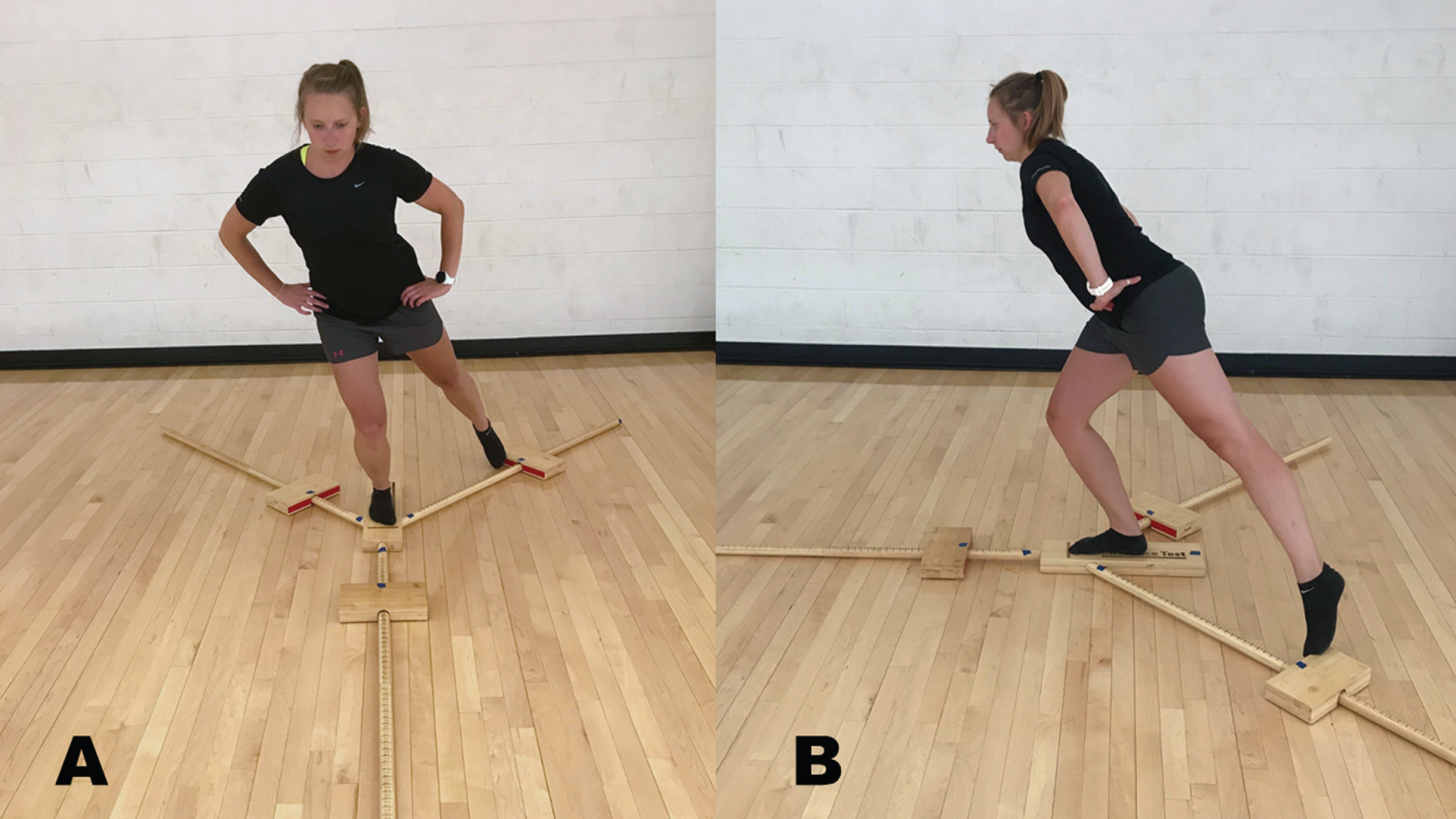
Right stance posteromedial reach on the Y-Balance Test Kit, A: Anterior view, B: Lateral view.

Reaching directions of the Y- Balance Test (YBT) from centralized starting location.
Aerobic capacity (VO2max) was estimated from the Forestry Step Test, a submaximal five-minute step-test used previously among the firefighter population [28–30], that was conducted by the same investigator for all participants. Prior to starting, each participant was fitted with either a Polar T31i heart rate monitor (Polar Electro, Lake Success, NY) or a Zephyr™ Bioharness (Medtronic, Annapolis, MD) around their chest and sat quietly for approximately five minutes. A one-way ANOVA indicated no differ-ence (F1,32 = 2.849, p = 0.101) in heart rate between the Polar (124.88±14.72 bpm) and Zephyr (117.78±9.52 bpm) monitors. Participants were then instructed to step up on to and down off of a 40 cm step to the beat of a metronome driven cadence set to 90 beats per minute. After completing the five-minute stepping protocol, participants were instructed to immediately sit down. Each participant’s heart rate was recorded immediately upon conclusion of the test and at the time-point 15-seconds following the conclusion. These post-test heart rate values were then utilized to determine gender-specific, age-adjusted, estimated measure of VO2max [31]. Finally, all estimated VO2max values were normalized to each participant’s body weight (mL/kg/min).
Functional power
A maximal stair climb test (SC) was performed using an outdoor, 5-story burn tower on the grounds of the fire academy. In total, the SC test required participants to ascend a total of 74 stairs (6 per level one, 17 per levels 2–5). Participants completed the SC while donning personal protective equipment (PPE) and a self-contained breathing apparatus (SCBA; total weight of approximately 19 kg), as well as an uncharged, folded hose (approximately 16.33 kg). Participants were asked to complete the test as quickly and safely as possible. Participants began the test in a standing position and upon the “go” command given by the same investigator, proceeded to pick-up the uncharged hose, place it over the shoulder most comfortable to them, and begin climbing the stairs as fast as possible. A timer, operated by the same investigator for all tests, was started by the investigator on the “go” command and stopped when the participants reached the highest stair landing. The total time in seconds was normalized to the participant’s body weight while wearing PPE with SCBA and holding the uncharged hose and used as a measure of functional power (sec/kg) [32, 33].
Muscular strength
Upper and lower body strength were determined through a commonly utilized indirect one-repetition maximum protocol with both the bench press (1RMbench) and back-squat (1RMsquat) exercises, respectively [34]. The tests were conducted by the same investigator for all participants. Participants first completed a warm-up set (i.e., 15 repetitions of 60%of their perceived 1 RM). The barbell was then loaded with 85%of the participant’s perceived 1RM and each participant performed as many repetitions as possible at this weight (kg) until failure. Estimation of one repetition maximum was completed through the following equation and normalized to each participant’s respective body weight (kg/kg) [35, 36]:
Movement quality
Functional movement quality was estimated thro-ugh the use of the Fusionetics™ Movement Efficiency (ME) Screen, which is part of the Fusionetics™ Human Performance System (Fusionetics™, Inc., Alpharetta, GA). Following the methodology used previously by Cornell et al. [37], all participants com-pleted the ME Screen in athletic apparel and without shoes. All participants completed the 2-leg squat, 2-leg squat with a heel-lift, and 1-leg squat sub-tests approximately 5 times each and were instructed to squat to a depth equal to the height of a chair for all movements. Two inve-stigators completed all ME Screen tests in real-time in a binomial (yes/no) fashion based on a standard set of movement compensations commonly observed during each sub-test. After scoring each sub-test, these binomial data were then entered into the Fusi-onetics™ Human Performance System. This online platform utilizes a proprietary algorithm to calculate a MET score for the overall assessment that range from 0 –100 (worst –best). The Fusionetics™ movement assessment system has been previously found to be reliable for the seven sub-tests (ICC = 0.750 –0.976) [38].
Statistical analysis
All statistical analyses were conducted using IBM Statistical Package for the Social Sciences (SPSS) version 25 statistical software (IBM Corp., Armonk, NY) with an alpha value of 0.05 utilized to determine significance. Relationships between the composite YBT scores and comprehensive fitness measures of BMI (kg/m2), aerobic capacity (mL/kg/min), stair climb (sec/kg), normalized 1RMbench and 1RMsquat (kg/kg), and functional movement (ME) were examined utilizing bivariate Pearson correlations.
Results
Bivariate Pearson correlations
Table 1 provides descriptive statistics for all var-iables. There were no significant relationships bet-ween the normalized YBT composite scores and BF%(r = –0.286, p = 0.096), FFM (r = –0.288, p = 0.094), VO2max (r = 0.226, p = 0.198), SC (r = –0.138, p = 0.444), and 1RMbench (r = 0.139, p = 0.426). However, there were moderate significant relationships between the normalized YBT composite scores and BMI (r = –0.355, p = 0.036), 1RMsquat (r = 0.360, p = 0.034), and ME (r = 0.590, p < 0.001).
Performance measure descriptive data (N = 35)
Performance measure descriptive data (N = 35)
Normalized YBT, Y-Balance Test; BMI, body mass index; BF%, body fat percentage; FFM, fat free mass; VO2max, aerobic capacity; SC, stair climb; 1RMbench, upper body strength; 1RMsquat, lower body strength; ME, movement efficiency.
The purpose of this research study was to investigate the relationship between YBT performance and comprehensive fitness measures, including BMI, BF%, FFM, VO2max, SC, 1RMbench, 1RMsquat, and ME within a firefighter recruit population. The normalized YBT composite reach scores of the current study (91.38±6.42 %) were consistent with those of De La Motte et al. [39] from a sample of U.S. Marines (94.3±9.3 %), but differed from those reported by Cosio-Lima et al. [40] for a U.S. Coast Guard sample with separate right and left limb scores (111.5±10.8%and 112.5±9.8%, respectively). In comparison to previous SEBT results, the normalized YBT composite reach score of the current study were consistent with Cornell et al. [16] for firefighter recruit scores (93.69±7.60%) and Filipa et al. [41] for female soccer athletes with separate left and right leg scores (96.4±11.7%and 96.9±10.1%, respectively), but differed from Plisky et al. [7] for high school basketball athletes (100.9±8.4%). Plisky et al. [7] have suggested that female high school basketball athletes who presented with a score less than 94%of limb length were 6 times more likely to have a lower-extremity injury than those with a score greater than 94%of limb length. Similarly, football players with composite YBT scores of less than 89.6%of limb length have been reported to be 3.5 times more likely to experience a non-contact injury in football [6]. Accordingly, 34.3%(12/35) of the firefighter recruits in this study may be more likely to experience a non-contact lower-extremity injury as they had composite scores that fell below 89.6%of their leg length. The results of the present study provide initial insight into modifiable factors that may influence firefighter recruit balance ability. Specifically, firefighter recruits with lower BMI, greater lower body strength, and greater movement efficiency were associated with significantly better performance on the YBT.
Body composition
Obesity has been suggested to be one component of physical fitness that may increase the risk of balance-related MSKI in firefighters [42, 43]. Hue et al. [44] demonstrated that body weight contributes to more than 50%of the variance observed in postural stability, as measured by center of pressure of the foot, when standing on both feet. Higher levels of body fat increase the weight loaded on major joints during functional movements like the YBT and can lead to pain and discomfort, inefficient body mechanics, and reductions in mobility, thus, increasing stress on connective tissues and overall risk of MSKI [45, 46]. Furthermore, BMI has been found to be positively related to increased postural instability, suggesting that greater postural shifts are necessary to maintain postural balance as BMI increases [47]. Cornell et al. [16] reported research specific to the firefighting population that suggests a greater obesity-level is associated with lower quality of movement, as measured by the FMS™, which may be a result of the additional non-functional mass leading to reductions in mobility and, therefore, inefficient body mechanics. Further, firefighters classified within the obese BMI category (BMI≥30 kg/m2) are 5.2 times more likely to experience a MSKI when compared to individuals within the normal BMI category (BMI = 18.5–24.9 kg/m2) [42, 43]. In the present study, 91.4%of the participants would be classified as normal or overweight based on the BMI index (i.e., > 24.9 kg/m2), with only 8.6%classified as obese, which may be related to the YBT results. The lack of relationship between both FFM and YBT, taken together with the moderate-negative relationship (r = –0.355) between BMI and composite YBT scores in the present study, are consistent with prior research and suggest that a distribution of lower body mass across height is associated with better dynamic balance performance in firefighter recruits regardless of muscle and fat mass. Future studies are warranted to determine if interventions that improve BMI result in improved YBT performance, as well as the relative contribution to injury risk, in firefighters.
Aerobic capacity
Aerobic capacity is a measure of fitness that is essential to firefighter job-task performance, however, the current results indicate that it is unrelated to firefighter recruit dynamic balance when measured by the YBT. The literature is inconclusive with the relationship between aerobic capacity and balance and the relationship appears to be population specific. In a military population, Keenan et al. [48] found separate negative correlations between both dynamic balance, as measured by a single-leg jump landing, and aerobic capacity with lower extremity MSKI risk, however, the relationship between dynamic balance and aerobic capacity in this population was unexamined. Outermans et al. [49] discovered a significant relationship between postural control and peak VO2 in a stroke population. Similarly, Sandroff et al. [50] found aerobic capacity to be significantly associated with gait (i.e., velocity, cadence, step length, base of support, and time in double support) in persons with multiple sclerosis, with aerobic capacity explaining a significant amount of variance in double support (R2 = 0.318). However, Venckunas et al. [51] suggested that balance explains only approximately 3%of the variance in aerobic capacity in children 11 to 18 years of age. The results of the present study suggest that firefighter recruit fitness, as measured by VO2, is unrelated to dynamic balance. These results imply that firefighter recruit YBT performance is the result of how well one can manage their center of mass, independent of fitness. However, these findings could also suggest that the YBT, which evaluates unilateral dynamic balance, may not capture bilateral balance necessary for double support stances where aerobic capacity may influence such performance. Future research should examine the relationship between aerobic capacity and bilateral dynamic balance performance in firefighter recruits.
Functional power
Stair climb performance has been identified as a functional power-based exercise to evaluate firefighter physical ability to complete specific job-tasks. According to a needs analysis of firefighting tasks by Abel et al. [33], stair climbing is a multi-joint movement that requires the use of shoulders, back, arms, legs, and core muscles. Due to the time-oriented completion goal associated with a stair-climbing task, it requires both the strength and power of the muscle groups listed previously. Decreased lower body power, measured by a standing broad jump or vertical jump without countermovement, has been linked to increased risk for MSKI, in addition to a link between poorer performance on a single-leg balance test and risk for an ankle sprain injury [52]. Mota et al. [17] indicated that increased rapid strength production in the first 100–200 ms following the onset of muscle contraction during isolated, isometric knee extension (r = –0.336 to –0.405) and flexion (r = –0.315 to –0.410), appear to benefit dynamic balance performance in firefighters. Sekulic et al. [53] found that dynamic balance is significantly related to agility in men, such that better dynamic balance is related to improved agility performance. Furthermore, Roth et al. [54] suggest that trunk and leg muscle fatigue negatively impact power, as measured through sprint speed and the agility, and YBT dynamic balance. In addition to the suggested relationships between power output and balance performance, there may be a meaningful relationship between stair climbing performance gait patterns that becomes a component of balance performance in a functional task. In particular, stair climbing while carrying an asymmetric load, such as the hose pack carried by participants in this study, can lead to shorter step lengths, stride length, shorter single leg support time, and longer double leg support time [55], as well as decreased foot clearance during stair ascent [56]. Firefighter PPE with the SCBA, both with and without the facemask [57], have been linked to poorer dynamic balance performance. Teyhen et al. [21] linked poorer YBT performance to both decreased power output, as measured by single-leg vertical jump, triple cross-over hop for distance, and 6 m single-leg timed hop. Furthermore, Hrysomallis et al. [58] indicated that both strength training and balance training can improve power output while also suggesting that competition level was positively related to balance ability. As a result of the literature supporting links between power output and balance, as well as the relationship between gait patterns and balance performance, it was expected that the results would indicate a negative relationship between stair climb performance and dynamic balance, such that greater power, demonstrated by quicker stair climb completion time, would be related to greater YBT reach distance. However, the results of this study suggest that YBT is unrelated to stair climb performance. As suggested by Hrysomallis et al. [58], it is possible that the greater experience level of active-duty firefighters may expose them to more balance activities, thereby, resulting in a different relationship between YBT and power in comparison to firefighter recruits. Future research is warranted to examine the change in the relationship between YBT and power across time during a recruit academy as this may represent attainment of balance more in line with active-duty firefighters. It is also possible that these results may suggest that despite the dynamic nature of the YBT measure, it may not capture the components of balance that are necessary for functional, power-based stair climbing. As such, future studies should investigate the relationship between balance and other more job-specific power tasks in both recruit and active-duty firefighters populations.
Strength
The YBT is a lower extremity balance task that allows for free movement of the upper extremity to execute a maximal performance effort. Prior research has examined the potential influence of lower extremity strength, but not upper body strength, on the YBT or other lower extremity balance tasks. Michaelides et al. [59] found that upper body muscular strength was significantly related to firefighter ability test performance. Given that upper body strength is essential for firefighters to complete job-tasks, the present study also examined the relationship between upper and lower body strength on YBT performance. The results of the present study, not surprisingly, indicated that upper body strength was unrelated to YBT performance (r = 0.139, p = 0.426), while lower body strength was related to YBT performance (r = 0.360, p = 0.034).
According to recent research, greater leg strength appears to be associated with better dynamic balance. A study conducted by Mota et al. [17] indicated that increased peak torque during leg extension (r = –0.362) benefits dynamic balance performance in firefighters. Further, Ambegaonkar et al. [25] reported positive relationships between composite dynamic balance scores, as measured by the SEBT, with isolated, isometric right hip abduction (r = 0.34), left hip flexion (r = 0.38), right hip extension (r = 0.38) and left hip extension (r = 0.34). On the contrary, McCann et al. [60] found a weak inverse relationship between anterior SEBT balance and isometric hip extension strength (r = –0.33), however the assessment of strength was completed with the hip near full-extension, which is different from the flexed position seen at the hip during the SEBT protocol. Similarly, Thorpe & Ebersole [61] examined dynamic balance using the SEBT and isolated, isokinetic strength in female soccer athletes and the results suggested that, aside from a moderate relationship between hip-extensor strength and medial reach performance (r = –0.58), strength of hip-extension and flexion, ankle plantarflexion and dorsiflexion, and knee extension and flexion were unrelated to dynamic balance. The isotonic strength measure used in the present study methodology is similar to the movements that comprise YBT dynamic balance, while Thorpe & Ebersole [61] measured isokinetic strength, which measures strength while holding velocity of the movement constant. These differences in types of strength measured between studies may explain the discrepancy between the results from Thorpe & Ebersole [61], and the consistency in findings with Ambegaonkar et al. [25], with those from the present study. An intervention study that used a training program focused on improving core and leg strength in collegiate female soccer players did result in improved balance measured by the SEBT for both the right limb (pretraining, 96.4±11.7%; posttraining, 104.6±6.1%) and the left limb (pretraining, 96.9±10.1%; posttraining, 103.4±8.0%)[41]. The present study demonstrated a moderate-positive relationship (r = 0.360) between isotonic, multi-muscle leg strength (1RMsquat) and dynamic balance in firefighters. These results, taken together with the current literature, suggest a positive relationship exists between lower extremity strength, including both knee and hip flexion and extension, and dynamic balance performance. Thus, increased lower body strength may improve a person’s ability to maintain a base of support during challenges to that base.
Movement quality
Functional movement is another component of performance, in general, that has been suggested to in-fluence balance. Impeded normal movement patterns and joint angles may disrupt neuromuscular res-ponses and lead to fatigue and injury [62, 63]. A study completed by de la Motte et al. [39] indic-ated that better functional movement, as measured compositely by the FMS, is a significant predictor of overall YBT performance. Further, Teyhen et al. [20] demonstrated that greater functional movement performance as measured by the FMS™ is linked to greater anterior YBT reach distances, and that two FMS movements in particular, the in-line lunge (r = 0.40) and shoulder mobility (r = 0.29) tests, are significantly positively related to composite YBT scores. The in-line lunge FMS™ movement requires mobility and stability of the hip and ankle while also challenging lower body balance [64]. Shoulder mobility in the FMS™ requires normal scapular and thoracic spine mobility, and a limitation in either can cause alterations in posture such as rounded or for-ward shoulders which inhibit proper postural control and therefore, balance [65]. In the present study, the Fusionetics™ ME screen, a similar assessment of functional movement, suggests that a moderate-positive (r = 0.590) relationship exists between movement efficiency and composite YBT scores. These findings remain consistent with previous findings that movement quality is positively related to dynamic balance, thus suggesting that poor movement quality can negatively influence dynamic balance performance in firefighter recruits. As such, balance performance may be improved through enhancing overall functional movement in this population, with a particular focus on hip, ankle, scapular, and thoracic spine mobility and stability.
Limitations
A limitation of the current study was that the sample population were firefighter recruits. As such, these individuals were not yet active-duty firefighters. Due to the fact that firefighter recruits have not yet fully experienced all aspects of the firefighting occupation, it is possible that the results of the current study may be conflicted in active-duty firefighters. Therefore, future research should examine if these performance measures are similarly related to balance performance in active-duty firefighters as well, as different relationships may be identified compared to the current study.
Conclusion
Despite prior literature [3–10] indicating the YBT may have the ability to predict injury, there had previously been a gap in the knowledge of balance performance in firefighter recruits as it relates to other physical performance measures. The results of this study suggests that dynamic balance ability in firefighter recruits, as measured by the YBT, is significantly related to BMI, lower extremity strength, and movement quality, and not related to aerobic capacity, stair climb performance, and upper body strength. Specifically, YBT performance in firefighter recruits is better with lower body mass index, greater functional movement, and greater lower-body strength. Future research is warranted to examine if these performance measures influence balance similarly in active-duty firefighter populations as well as how these parameters respond to balance training programs.
Conflict of interest
None to report.
Footnotes
Acknowledgments
We would like to acknowledge the City of Milwaukee Fire Department and the Fire Academy for their support of this project.