



Abstract
BACKGROUND:
Smokejumpers are required to parachute from planes, carry gear weighing more than 50 kg, and hike on steep terrain. With a majority of injuries sustained to the lower extremity, it is imperative to understand the influence a weighted pack may have on functional performance.
OBJECTIVE:
To examine the effects of external load on functional movements in Smokejumpers.
METHODS:
Using repeated measures design, ten Smokejumpers completed two trials consisting of 3 movements in weighted (50 kg) and unweighted conditions. Nine males and one female (age of 40.1±8.4 years, mass 81.1±8.3 kg) performed overhead squat, hurdle step and anterior reach. Movements were scored based on established guidelines. The mean of three trials was recorded for anterior reach on both limbs.
RESULTS:
Differences between weighted and unweighted scores in the overhead squat (p = 0.001), ND hurdle step (p = 0.005), D hurdle step (p = 0.000) and overall composite scores (p = 0.006) were found to be significantly different. Differences were also noted in D (p = 0.035) and ND (p = 0.045) anterior reach.
CONCLUSIONS:
The addition of a weighted pack negatively influences functional movements in Smokejumpers, which may lead to greater injury risk. Implementation of injury prevention strategies to reduce occupational injury risk should be explored.
Introduction
According to the United States Forest Service (USFS) more than 2.8 million hectares burn each year in the United States [1, 2]. In 2019, approximately 50,477 fire incidents resulted in 1.9 million hectares burned in the U.S., compared to 1.4 million hectares burned in 2010. In 2017, the land burned an all-time high of 4 million hectares [1].
This rise in wildfires can be attributed to changing climate conditions, causing an increase in size and severity of fire incidents and an overall increase in length of fire season [3, 4]. In addition, development in the Wildland Urban Interface (WUI) continues to increase, making fire incidents more complex as the demands increase to protect structures and people [3]. Fire suppression is rigorous requiring intense physical labor for 12–16 + hours a day, up to 14 days at a time [3]. The severity and complexity of fires often determines time spent working the fire. Due to the intense and physical nature of the job, wildland firefighters (WLFF) are at an increased risk for injury and illness which is a rising concern for the USFS. Wildland fire management costs reached record numbers in 2019 with the USFS spending over $2.5 billion, and the additional burden on federal agencies for cost of injuries and illness is quickly a growing issue [1, 2].
At present, most of the injury and illness data that exists for WLFF has primarily focused on understanding the nature of injuries and identifying the demographics and crew types impacted by injury [5, 6]. Recent studies indicate that the majority of injuries and illnesses reported by WLFF are musculoskeletal in nature. Most of these injuries are sprains and strains to the lower extremity often caused by slips, trips and falls followed by accidents involving equipment, tools or machinery [5–10]. However, little attention has been given to the possible influence that occupational equipment may have on risk of injury.
Smokejumpers are highly specialized WLFF, and were the focus of this study due to the specific physical demands of their job. These demands primarily include parachuting from planes into remote areas and hiking on steep terrain with gear often weighing more than 50 kg for several hours [11]. With the rising concern regarding injury and associated costs, it is critical to better understand how Smokejumpers withstand these loads in a dynamic environment with the hopes of minimizing risk of injury. Therefore, the purpose of this study was to examine movement and mobility patterns with and without the addition of an external load in Smokejumpers. We hypothesize that the addition of an external load will negatively influence movement and mobility in Smokejumpers.
Methods
Study design
This study utilized a single cohort, repeated measure design, where subjects were asked to repeat a battery of functional movements with and without the addition of a 50 kg pack. Subjects were recruited from a single Smokejumper base who employ approximately 80 Smokejumpers each season. The study was approved by the University of Montana Institutional Review Board and adhered to ethical handling of human subjects.
Subjects
Smokejumpers who were on active duty in the 2019 fire season and were passing through the Missoula Smokejumper base were eligible to participate in this study. Subjects were excluded from the study if they were not on active duty and were other fire personnel (i.e. not a Smokejumper). All measures were collected at the Missoula Smokejumper Base in Missoula, MT, USA.
Functional movements and dynamic balance assessment
To ensure readiness for study participation, subjects were asked to complete their preferred warm up for 10 minutes. A series of three functional movements were completed in unweighted and weighted conditions including overhead squat, hurdle step and anterior reach. A five minute rest period was provided between unweighted and weighted conditions. Overhead squat and the hurdle step were selected to grossly examine core strength, lower extremity mobility and dynamic stability. The anterior reach was selected because this movement assesses dynamic stability and strength [12, 13]. Using this information helps to determine asymmetries and imbalances with an individual that can be addressed through corrective exercise.
For each movement, three pratice trials were performed followed by three recorded trials. An average score was recorded for each movement. Each subject completed three unweighted movements in sequence (squat, hurdle, anterior reach) before adding the 50 kg pack (average weight of a Smokejumper’s pack) and repeating the movements. The measurements were collected using the commercially available Functional Movement Screen kits (Functional Movement Systems Inc., Chatham, VA) and the same researcher scored each movement to improve score reliability. A score of zero was assigned if the subject experienced pain with any of the movement patterns; a score of one indicated that the subject did not experience pain but was not able to complete the movement pattern as instructed; a score of two was received if the participant completed the task pain-free but exhibited compensatory movements; and lastly, a three was awarded if the subject was able to complete the task as instructed with no pain and no compensatory movements [12].
An overhead squat was the first movement assessed (Fig. 1). Subjects started with their feet shoulder width apart and the feet aligned in the sagittal plane. A dowel was pressed overhead with the shoulders flexed and abducted and the elbows extended. Maintaining an upright torso, subjects attempted to keep their heels pressed into ground and the dowel in the overhead position [12].
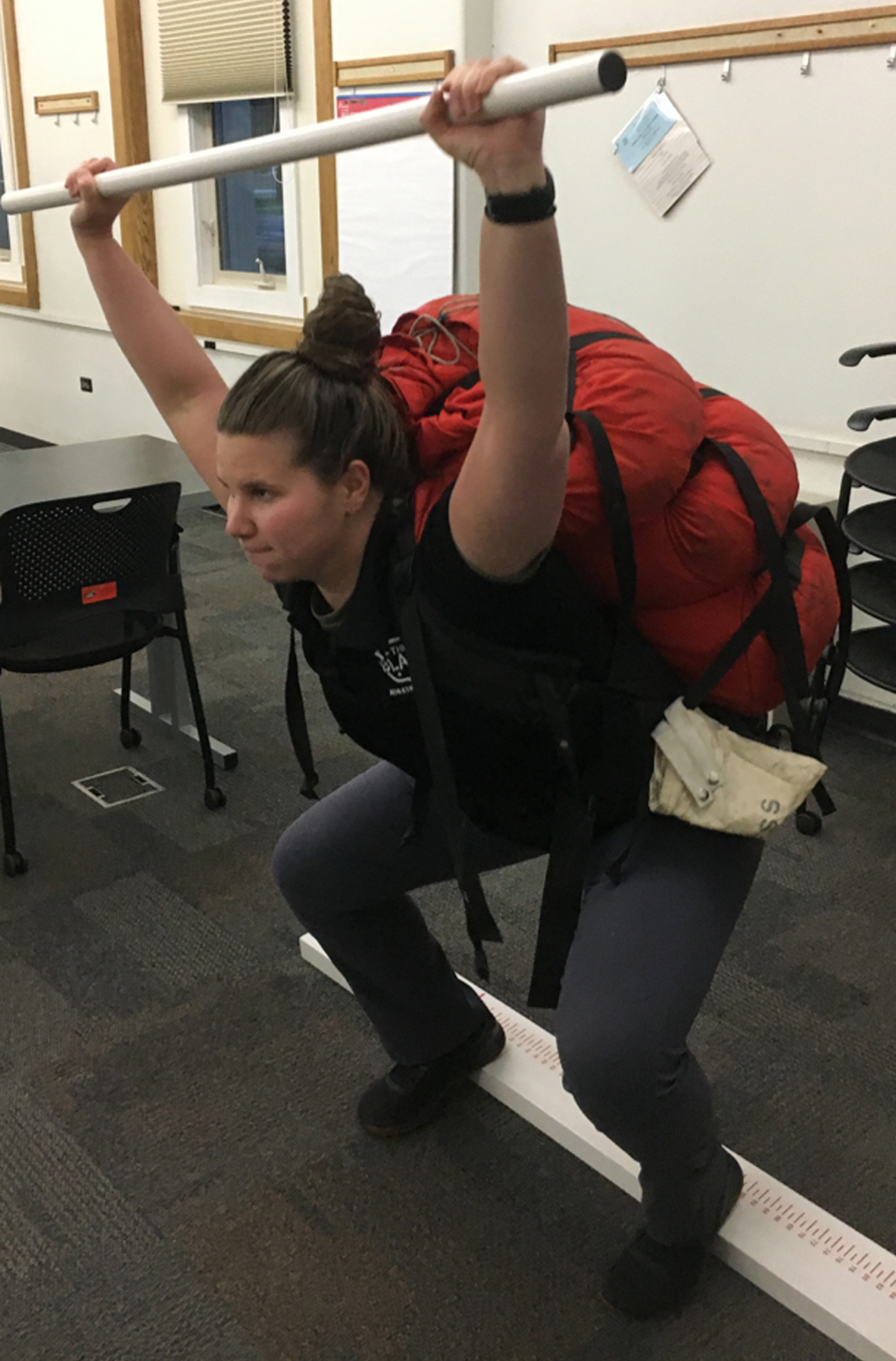
Overhead squat with weighted pack.
Next, subjects performed the hurdle step with their toes touching the base of the hurdle (Fig. 2). The hurdle was adjusted to the height of the individual’s tibial tuberosity and the dowel was positioned behind the neck and across the shoulders. Subjects were asked to maintain an upright posture and to step over the hurdle, while maintaining alignment between the foot, knee, and hip. Subject’s touched their heel to the floor (without accepting weight) while maintaining the stance leg in an extended position. The moving leg was then returned to the starting position and the other leg was assessed [12].

Hurdle step with weighted pack.
Last, subjects were asked to perform anterior reach in a single leg stance (Fig. 3). Anterior reach is a modification of the Y-Balance and Star Excursion Balance Test which demonstrate high intra and interrater reliability of 0.85–0.91 [14]. Subjects stood with their toes up against a line on the floor and were asked to push a sliding block as far as possible with their non-weight bearing leg. Subjects returned to a standing position without placing weight on their non-weight bearing leg [15]. Once this sequence was completed in the unweighted condition, a 5-minute break was given prior to subjects being asked to put on a 50 kg pack and repeat the movement assessment.

Anterior reach with weighted pack.
Demographic outcome variables analyzed in this study include age, sex, and body mass. Additional outcome variables of interest in this study include weighted and unweighted overhead squat, hurdle step dominant leg, hurdle step non-dominant leg, composite movement score (sum of squat and hurdle step scores), anterior reach dominant leg, anterior reach non-dominant leg, and limb symmetry during anterior reach [12–15].
Statistical analyses
Microsoft Excel was used to calculate descriptive statistics for subject’s age, sex, body mass, effect size and limb symmetry. SPSS v26.0 was used to run paired t-tests (alpha was set a priori at p = 0.05) to determine how the addition of weight might influence functional movements and dynamic balance assessment. Paired t-tests compared lower limb dominance (non-dominant (ND) and dominant (D)) when appropriate for the task. The limb symmetry index (SI) was calculated as the difference between D and ND limbs divided by the average of both the D and ND limb measures. Limb symmetry was in turn measured as a percentage, where positive values represents a greater value on the ND side. As the cohort observed was fairly small for statistical analyses, Cohen’s d effect size (large = 0.8, medium = 0.5, small = 0.2) was also calculated for each of the previously mentioned comparisons between weighted and unweighted conditions.
Results
Ten Smokejumpers participated in this study (9 males, 1 female; average age 40.1±8.4 years; average mass of 81.1±8.3 kg). Of the 10 Smokejumpers, 9 were right lower limb dominant and 1 was left lower limb dominant.
Differences between weighted and unweighted scores in the overhead squat (mean difference –1.1, p = 0.001), ND hurdle step (mean difference –0.6, p = 0.005), D hurdle step (mean difference –1.0, p = 0.000) and overall composite scores (mean difference –2.7, p = 0.006) were found to be significantly different, whereas scores were lower in the weighted condition. Differences were also noted in D (mean difference –6.1, p = 0.035) and ND (mean difference –3.5, p = 0.045) anterior reach with scores being lower in weighted conditions; however, anterior reach limb symmetry index was not statistically significant between conditions (mean difference 4.5, p = 0.236). The addition of weight did have a medium to large effect on all measures (Table 1). Regardless of significance, all measures trended to have worse functional scores, less anterior reach distance, and more asymmetry in the weighted condition.
Calculated effect size for the addition of 50 kg weighted pack for overhead squat, hurdle step and anterior reach performance
Calculated effect size for the addition of 50 kg weighted pack for overhead squat, hurdle step and anterior reach performance
D: dominant limb; ND: non-dominant; W: weighted; UW: unweighted.
While only one female volunteered to participate in this study, the female participant performed comparably to her male counterparts across all measures. The female participant scored a composite score of 8 and 4 in the unweighted and weighted scores respectively, compared to her male counterpart’s average composite score of 6.7 and 4.1. Additionally, scores between the weighted and unweighted anterior reach differences did not differ between the female and male subjects in this study.
Results from this study suggest that the addition of an external load increased the difficulty of performing functional movements. Increasing asymmetry between limbs was noted and may suggest a greater risk of injury when Smokejumpers are in the field. The rising cost of injury, coupled with the increased demand for WLFF for extended fire seasons, necessitates understanding factors that may influence risk of injury. Because WLFF’s work in remote areas, often on rocky terrain or steep mountainsides, while being asked to carry heavy equipment and packs, it is imperative to gain further understanding as to how this might impact function.
Other studies have examined the influence of personal protective equipment on dynamic balance. Games et al. [14] compared Y-balance scores of structural firefighters with and without their personal protective equipment. They found that adding an external load also had a negative effect on reach, suggesting that this decrease in reach distance and dynamic balance could predispose structural firefighters in increased risk of lower extremity musculoskeletal injury. Plisky et al. [13] also identified that individuals with anterior reach asymmetries between their right and left limb greater than 4 cm were 2.5 times more likely to sustain a lower extremity injury. The increased asymmetry when completing a weighted single-leg anterior reach may suggest the need to incorporate weighted single-leg tasks into a smokejumper’s training regimen and injury prevention programming.
Other studies have examined the impact that personal protective equipment has on structural firefighters when performing the Functional Movement Screen (FMS) [16]. While firefighters in this study were not wearing their helmets or self-contained breathing apparatus (SCBA), results from this study still demonstrated a negative impact on functional movements. Research studies on other tactical populations, such as military personnel, also demonstrate a negative impact in functional movement performance when external loads are applied [17, 18]. Although functional movement deteriorates with external load, previous studies suggest that these weighted conditions are better predictors of tactical performance [19]. Similarly, in our study, applying an external load decreased functional movement performance in both the overhead squat and hurdle step. Compromising mobility and stability of a Smokejumper while working on the line could place the WLFF at serious risk of injury. While there is limited data on injuries and illnesses reported by WLFF, strong evidence suggests that a majority of these injuries are musculoskeletal in nature and occur to the lower extremity [5–7]. Recognizing the impact that occupational equipment has on functional performance is critical when designing injury prevention programming and physical training programs for WLFF.
Results from this study suggest a need for injury prevention programming to mitigate the effects of an external load on functional movement and dynamic balance tasks. Specifically addressing single limb dynamic stability may lead to decreased asymmetries on anterior reach performance. Existing research suggests that dynamic stability improvements may be evident as soon as two weeks after incorporating single leg balance exercise into training regimens [20]. Incorporating hip mobility exercises, along with core and hip stability exercises may also lead to decreases in asymmetry. Core stability is essential for Smokejumpers due to the physical demands of the job. If core stability is lacking, this may lead to poor performance and increased potential for injury [21]. Core stability programming should be progressive in nature starting with core stabilization in a variety of postures advancing to whole body dynamic movements [21]. Hip mobility and stability are also critically important for Smokejumpers. and emphasis on hip mobility and stability improves performance on functional tasks [22, 23] and may minimize risk of injury while working in a dynamic environment. Future research should specifically examine the relationship between occupational equipment, functional movement scores, anterior reach scores and injury incidence.
Limitations
Several limitations exist in this study. First, subjects were not tested in all of their personal protective gear or their work boots. The smokejumpers work in fairly dense and rigid boots, which may impact scores due to restriction of movement. Several studies have documented diminished ankle mobility while wearing firefighting personal protective equipment, ultimately decreasing limb reach distances [15, 24]. Second, the order of movements was not randomized which may influence subject’s performance. Third, our sample size was small and we did not have an equal number of male and female subjects; however, the number of males and females in this study is proportionate to the distribution of male and female Smokejumpers. Future work should explore the relationship between sex, anthropometric characteristics, external load and functional movements.
Conclusions
The addition of weighted packs significantly reduced functional movement and dynamic balance scores among Smokejumpers and medium to large effect sizes were observed with the addition of the added pack for all measures. The addition of the weighted pack negatively impacted the scoring of functional movements and medium to large effect sizes were observed with the addition of the added pack for all measures. Continued research exploring the influence of personal protective equipment on WLFF job performance and injury risk is critical to sufficiently design injury prevention programming.
Footnotes
Acknowledgments
None to report.
Conflict of interest
None to report.
Funding
This project was funded by the US Forest Service National Technology and Development Center grant 16-CR-11138200-005. The views and conclusions contained herein are those of the authors and should not be interpreted as necessarily representing the official policies or endorsements, either expressed or implied, of United States Forest Service or the U.S. Government.