



Abstract
BACKGROUND:
Law enforcement recruits (LER) often encounter shoulder injuries, which may cause attrition from academies. Investigating required upper body muscular fitness may inform of muscular balance around shoulder joints through anterior and posterior ratios in LER.
OBJECTIVE:
To investigate push to pull ratios (P2P) and factors related with P2P in LER.
METHODS:
LER (95 males; 12 females) completed testing during a single session in the academy’s first week: body mass, one-repetition maximum (1RM) bench press, push-up repetitions (reps) to failure, and pull-up reps to failure. Calculations were: estimated pull-up 1RM=body mass+0.033*(body mass x pull-ups); endurance P2P (eP2P)=push-ups / pull-ups; strength P2P (sP2P)=bench press 1RM / estimated pull-up 1RM. Pearson correlation coefficients assessed relationships among tests and P2P (p < 0.05).
RESULTS:
The sP2P was positively correlated with bench press 1RM and push-ups. The eP2P was negatively associated with pull-up reps and 1RM. Females had similar eP2P, but lower sP2P than male recruits (p < 0.05).
CONCLUSION:
Practitioners may benefit from examining eP2P and sP2P as they should not be used interchangeably. Future research should examine whether the P2P ratios are associated with injury and subsequent inability to successfully complete law enforcement training academies.
Introduction
Total annual expenditures for United States academies to conduct training for approximately 45,000 law enforcement recruits (LER) is approximately 725.6 million dollars [1]. Estimates suggest 24% of LER do not complete the academy, resulting in significant countrywide financial loss [1]. Recruits typically fail to graduate from law enforcement academies due to injury (males, 15%; females, 15%), inadequate fitness (males, 19%; females, 24%), and academic reasons (males, 38%; females 25%) [1]. Others have also suggested injury occurrences to be a prominent reason for attrition from police academies [2–4]. It should be stated that low levels of fitness have been associated with higher injury risk [5–7]. The most common injury diagnoses in LER are sprains and strains, of which the upper body makes up a significant portion [8]. Many of these injuries are likely due to insufficient stability of anterior ‘push’ and posterior ‘pull’ musculature surrounding the shoulder joint [9–11]. Due to the prevalence of upper extremity injuries, it is necessary to explore alternative fitness testing to inform training and attenuate injuries and attrition in LER [2, 4].
In the police academy, LER have periodic fitness assessments and participate in frequent bouts of physical training. Fitness assessments are intended to test physical abilities needed for occupational tasks such as pursuing a fleeing subject, controlling those resisting arrest, grappling, handcuffing, and crowd control [2, 12]. Areas assessed typically include muscular strength using one-repetition maximum (1RM) and muscular endurance by completing as many repetitions as possible during upper body pushing and pulling movements [2, 11]. Strength assessments often require specific equipment and should be monitored by certified strength and conditioning specialists. However, for many reasons, including time constraints associated with testing a large group of cadets, the fitness assessments predominately include common endurance focused tasks (i.e. repetitions to failure). A shortcoming of this approach is that muscular endurance is not always indicative of maximal strength, both of which are necessary fitness capabilities of tactical personnel [13, 14]. Furthermore body mass is an important factor to consider when interpreting performances on muscular fitness assessments such as the bench press [15] and pull-ups [16]. Thus, understanding the relationship among strength, and endurance assessments, as well as confounding factors such as body mass, would inform tactical strength and conditioning facilitators of appropriate testing options.
Previous literature has investigated a push to pull ratio (P2P) of the shoulder joint based on common upper body fitness assessments in various populations. It has been suggested that the P2P ratio should be approximately 1.00 [17, 18], indicating that the same amount of mass can be lifted in the pushing and pulling movements (i.e., upper body musculature balance). Historically, P2P ratios have been reported for muscular endurance related measures but recent evidence suggest that both strength and endurance P2P ratios should be assessed [19]. Recreationally trained males and females produced 1.6 and 2.7 times as many push-ups than modified pull-ups, respectively, suggesting that P2P may vary between males and females [20]. In elite male sailors, one-repetition maximum (1RM) bench press and overall forces were approximately 17% greater than 1RM and force capabilities during the bench pull [18]. Strength P2P (sP2P), as horizontal plane pressing to vertical plane pulling strength, resulted in the bench press 1RM being approximately 98% of pull-up 1RM in well trained rugby athletes [17]. The sP2P ratios in these studies [17, 18] were lower than the endurance P2P ratios (eP2P) in the study of Negrete and colleagues [20]. Further, power production has been shown to be greater across a range of loads during the bench pull compared to the bench press, suggesting that the P2P ratios may be dependent on the fitness test parameter being evaluated [18]. These comparisons have been directly made in firefighters using bench press 1RM, maximal push-up and pull-up assessments, where sP2P was 0.84 and eP2P was 6.77 [19]. Therefore, the P2P of different testing (e.g., planes of motion) or fitness parameters (e.g., strength versus endurance) should not be used interchangeable and require further investigation.
For aforementioned reasons it would be desirable to compute P2P ratios from fitness assessments commonly used by law enforcement academies. Therefore the purposes of this study were to: 1) report sP2P and eP2P ratios using bench press 1RM, maximal push-up and pull-up assessments in LER, 2) examine potential correlations between common upper body fitness assessments and 3) investigate the agreement between sP2P and eP2P.
Methods
Participants
This study used a cross-sectional design and retrospectively analyzed data obtained from baseline fitness testing of LER. Law enforcement training was completed at a regional criminal justice academy from the period of 2016 to 2019. Recruits were included in the analysis if they were aged 18 or older, were not removed from the academy due to academic or disciplinary reasons, and completed the entire fitness testing battery. Initially, 157 participants completed the fitness testing but, due to the purpose of the study, recruits unable to perform one pull-up were removed from the analysis (male = 26 [17.2% ], female = 24 [57.1% ]). In total, 95 men and 12 women recruits were included in the data analyses. A retrospective analysis of deidentified data was approved by George Mason University’s Institutional Review Board (IRB#: 1491152-1).
Protocols
The Law Fit testing protocol (www.lawfit.org) was conducted during the first week of the law enforcement academy from 0800–1100. Certified academy fitness specialists conducted all testing to ensure the procedures were consistent for all recruits. Testing occurred in the following order: body mass measurement, 1RM bench press, push-ups to failure, and pull-ups to failure. To ascertain maximal pulling strength, the pull-up 1RM was estimated as body mass+0.033*(body mass x pull-up repetitions) [19, 21]. Relative strength values were calculated as 1RM values divided by the individual’s body mass. The eP2P was computed by dividing the number of push-up by pull-up reps performed, whereas sP2P was computed by dividing the bench press 1RM by the estimated pull-up 1RM.
One-repetition maximum bench press
Maximal upper body strength was assessed via the bench press 1RM according to previously published procedures [22–25]. Prior to all testing recruits completed a 5-minute general supervised warm-up focused on the upper extremities (e.g., shoulder rolls, arm swings, deltoid stretches, triceps stretches). Then recruits completed an incremental warm-up beginning with approximately 40% of their estimated 1RM for 5 repetitions. Following 2 minutes of rest they completed 60% estimated 1RM for 3 repetitions, rested for 3 minutes, then performed 2 repetitions at 80% estimated 1RM. After a 3-minute rest period, single maximal attempts were made with progressive incremental loading until the subject reached their true 1RM. The 1RM testing session was terminated after two failed attempts or the inability to continue with correct form. A successful trial involved the barbell traveling from full elbow extension to chest contact and back to full elbow extension.
Maximum repetition push-up
Upper body pushing endurance was assessed via push-ups to failure. Recruits started in the “up” position, forming a straight line from head to toe with elbows fully extended and hands flat on the floor. On a “go” command, recruits lowered their bodies until elbows were at or below 90° of elbow flexion, then returned to full elbow extension, all while maintaining a flat back during each repetition. The number of push-ups performed were recorded.
Maximum repetition pull-up
Upper body pulling endurance was measured via pull-ups to failure. For additional warm-up and preparation for pulling motions, recruits completed a 30 second active hang and 5 scapulae pulls for 2 sets. Recruits were instructed to hang from the bar with a pronated grip, elbows fully extended, and hands approximately shoulder width apart. Recruits pulled themselves up while maintaining a vertical alignment until their chin was completely over the bar. The recruits then returned to the start position where elbows were required to be completely extended. Recruits performed the maximum number of repetitions until they were unable to achieve required elevation.
Statistical analysis
Data are reported as mean and 95% confidence intervals. Based on Shapiro-Wilk tests and visual inspection of Q-Q plots the following variables were not normally distributed: age, maximum repetition pull-ups, estimated pull-up 1RM, pull-up 1RM to body mass ratio, sP2P and eP2P. Gender differences were assessed for parametric variables via independent sample t-tests and Cohen’s d effect sizes and for non-parametric variables via Mann-Whitney U tests and respective effect sizes. The magnitude of Cohen’s d effect sizes were determined to be small, medium and large using cutoff values of 0.2, 0.5 and 0.8, respectively [26]. To determine the agreement between sP2P and eP2P a linear regression analysis was performed. Correlational matrices were created to evaluate the relationships among variables of interest. Strength of relationships among variables was assessed using the following effect size determinants; weak, r = 0.10–0.40; moderate, r = 0.41–0.70; strong, r > 0.71 [26]. All statistical analyses were completed in R version 4.0.5 [27] with an alpha level of p < 0.05. However, to account for potential error in multiple correlations, despite no direct comparisons between the correlations, Bonferroni corrections were employed with an adjusted alpha level of p < 0.001.
Results
Female recruits had lower body mass, bench press 1RM, pull-up 1RM, relative bench press 1RM, and sP2P than male recruits (Table 1). However, measures of muscle endurance (i.e., push-up and pull-up repetitions) and the eP2P were not different between genders. The linear regression results noted no association between sP2P and eP2P (R2 = 0.009, p = 0.340). The sP2P ratio was strongly positively correlated with the bench press 1RM and relative bench press 1RM and moderately associated with push-ups (Fig. 1). The eP2P ratio was moderately negatively associated with pull-up repetitions to failure and 1RM capabilities (Fig. 1). Age was not correlated with any metrics, but body mass was negatively correlated with push-up and pull-up repetitions (although these results were no longer significant after Bonferroni correction) and positively correlated with maximal strength testing (Fig. 1).
Law enforcement recruit descriptive characteristics reported as mean (CI95 %)
Law enforcement recruit descriptive characteristics reported as mean (CI95 %)
Notes: 1. *indicates significant effect of gender of p < 0.05, **p < 0.01, ***p < 0.001. Abbreviations: sP2P, strength push to pull ratio; eP2P, endurance push to pull ratio. 2. † indicates nonparametric tests and effect sizes were conducted.
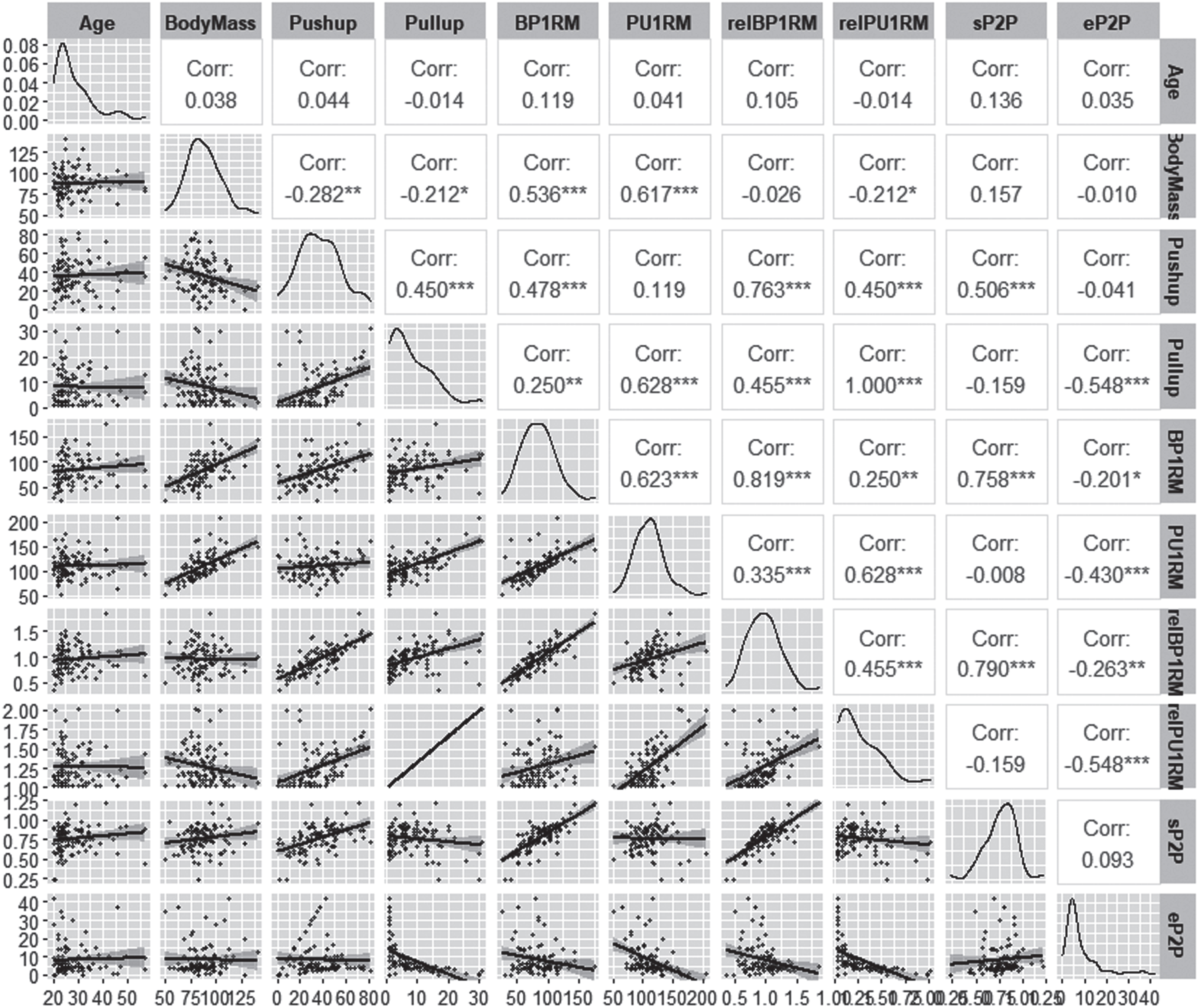
Intercorrelation matrix of variables. Strength and direction of the correlation is highlighted according to the scale on the right of the figure. Abbreviations: eP2P, endurance push to pull ratio of push-up repetitions to pull-up repetitions; sP2P, strength push to pull ratio of bench press to pull-up maximal strength; 1RM, one-repetition maximum. * indicates significant correlation at p < 0.05, ** at p < 0.01, *** at p < 0.001. Following a Bonferroni correction, only those with p < 0.001 are considered significant.
The current study’s purpose was to investigate associations among the various upper body fitness capabilities (endurance, absolute, and relative strength) and the sP2P and eP2P ratios. We found the male and female LER demonstrated sP2P below the recommended 1.0 threshold [17, 18]. The males in the present study had a sP2P of 0.8 and the females average sP2P was 0.6. This suggests that LER, particularly the females, have more pulling strength than pushing strength. The current sP2P are also lower than those found in collegiate wrestlers (0.89) [28] and professional rugby athletes (0.97) [17], when performing the bench press 1RM in relation to the bench pull 1RM and weighted pull-up 1RM, respectively. It is likely that one reason for the lower sP2P in the current study is the estimation of pull-up 1RM, which may overestimate strength levels when high numbers of pull-ups were performed [29]. However, compared to professional firefighters, the same sP2P ratio calculations were lower in the current study, particularly for females (0.74 versus 0.60) [19]. Interestingly, the eP2P ratio in the current study was much higher than prior findings in a group of professional firefighters (6.77 versus 8.4) [19]. Both of which were much higher than previously reported for strength trained individuals performing timed push-ups to inverted rows (1.6–2.7) [20]. However, the aforementioned study restricted each exercise to 15 second intervals, which will result in a ceiling effect on the number of repetitions possibly performed. Whereas, assessing repetitions to failure will reveal maximal capabilities in each exercise and provide more accurate depictions of eP2P. Further, more direct antagonist comparisons of muscle balance around a joint (i.e., same planes of motion, bench press and pull) may be more appropriate, but current testing batteries in LER assess upper body pulling via pull-ups (lawfit.org).
Similar to prior research [19], the current findings suggest that there may be too great of a focus on upper extremity muscle endurance compared to muscle strength. The observed ratios in the current population are as a result of below average upper body pushing strength and the above average eP2P. The eP2P negatively correlated with pull-up performance, while sP2P positively correlated with bench press and push-up performances. As in an increase in pull-up performances may relate more with eP2P while pushing performances will increase sP2P more. Although correlation does not mean causation, these same conclusions were made in prior literature [19]. Further, the pull-ups may have been a test of upper body strength for those that could not complete≥15 repetitions, which would also result in a lower estimated 1RM, lower eP2P and higher sP2P. Any underestimation in pulling strength or endurance would falsely inflate the P2P ratios, while any underestimation of pushing strength or endurance would falsely deflate the P2P ratios. Moreover, the individual is pulling nearly their entire body mass during the pull-up and approximately 64–75% of their body mass in the push-up [30, 31], which must be considered when interpreting the current eP2P results. Thus, rather than a P2P ratio of 1.0 it would be expected that approximately 1/3 fewer pull-ups would be performed due to the additional mass required to be lifted, resulting in a P2P of approximately 1.5 (1 divided by 0.67). Therefore, it is important to consider the fitness parameter being assessed (e.g., strength, 1RM versus endurance, repetitions to failure), as well as the plane of motion (i.e., vertical versus horizontal) which may require slightly different musculature or loading requirements. This makes comparisons to prior literature rather difficult considering the various protocols previously used to establish P2P ratios. Still, considering the lack of association between eP2P and sP2P these ratios should not be used interchangeably.
Future research may consider testing P2P ratios of 1RM pull-up to overhead press and 1RM bench pull to bench press. However, it is still necessary to consider the common tests conducted for the population of interest, as pull-ups and bench press or push-ups would be more common assessments in tactical populations that would not require additional testing to calculate P2P. Additionally, the pull-up has been found to be ecologically valid in tactical populations, as it is associated with occupational tasks such as body dragging and wall or fence climbing [32]. This may be problematic considering the high number of LER that were uncapable of performing at least one pull-up (total n = 50 [25.9% ], male = 26 [17.2% ], female = 24 [57.1%]). When coupled with the low sP2P and high eP2P findings, this study would suggest that LER entering training academies require greater initial upper body pushing and pulling strength. It is also important to note that the ability of the LER to move their own body mass during the pull-ups and push-ups was negatively related with their body mass. This is likely due to increased levels of non-contractile mass (fat mass), which has shown to negatively influence one’s ability to perform these movements [19], as well as occupational tasks of law enforcement officers that require moving one’s own body mass [33]. Thus, LER should place an emphasis on reducing body fat mass and increasing maximal upper body strength prior to entering the police academy.
This is particularly important to consider for female LER as their absolute and relative bench press 1RM and pull-up 1RM were lower than the male performances. Yet, their ability to perform push-up and pull-up repetitions did not differ. Although females tend to be more capable of performing endurance-based tasks, this finding is somewhat unexpected considering the large differences in upper body fitness often noted between men and women [34, 35]. Nonetheless, the lower strength in females should be addressed, within reason, as their lower ability to perform occupational tasks (e.g., body drag) may be subject to absolute maximal strength differences [36, 37]. Thus, considering the previously mentioned relations of upper body strength to occupationally relevant tasks and sex differences in upper body strength, it is suggested that female LER should target upper body strength training prior to entering the academy to improve the gender gaps on physical occupational tests throughout the academy and reduce the risk of injury [10].
The recommendations from the current findings should be considered along with several limitations. To start, the data were from baseline testing prior to starting the academy, which should not be used to represent LER fitness throughout the academy or after graduation as a law enforcement officer. Yet, this poses a strength of the current study as limited research has been conducted on these groups of LER and as a result may add value to informing assessment considerations to improve evidence-based testing and subsequent training for law enforcement academies. Other considerations have been mentioned, such as the push-up requiring less mass to be lifted compared to the pull-up ( 67%) [30, 31]. However, the eP2P was still much higher than the expected eP2P of 1.5 after adjusting for the different loading requirements of the push and pull tasks. Of more concern is that the common assessment of pull-ups may reflect different fitness parameters across individuals, as some may be testing their strength (≤6 repetitions) and others their muscular endurance (≥15 repetitions). As such, those performing below 8 pull-up repetitions in the current study had an eP2P of 11.69, while those performing more than 8 pull-ups had an eP2P of 3.46. Thus, the comparisons of eP2P are affected by the number of pull-up repetitions capable of being performed, while the sP2P ratio remained unaffected (7.5–7.7 for more than and less than 8 reps). Therefore, when utilizing pull-ups in P2P ratio calculations it may be necessary to consider both sP2P and eP2P to fully understand comparisons. Additionally, many of the recruits failed to complete a single pull-up, suggesting minimum pulling strength capacities to be an issue in LER. As these individuals were not included in our analyses, consideration must be given to the interpretation of the actual P2P values. Yet, one may argue that the ability to perform at least 1 pull-up is a reasonable requirement for LER. Another option is to consider the repetitions to failure approach on exercises using strength repetition ranges of 3–8 repetitions, as opposed to 1RM testing and endurance testing where many individuals are actually being tested on strength. Directly testing endurance and strength-based tasks across similar planes of motions is likely necessary to compare true muscular balances in this population, which should be conducted in future research along with investigating the relation of P2P with performances and injury occurrences.
Conclusions
Overall, the LER at the start of their police academy training demonstrated lower sP2P and greater eP2P than the expected values based on previously reported findings. We found a lack of agreement between these ratios and recommend practitioners not use these values interchangeably. Factors influencing the ratios (i.e. body mass, gender) must be considered when interpreting assessment results. Further, the lower sP2P and eP2P in females compared to males would suggest maximal pulling strength was a deficit and resulted in further muscular imbalances. Therefore, training to improve upper body maximal pulling strength should be a focus of LER physical training in preparation for the academy, particularly for female LER. Future research should examine whether the sP2P and eP2P are associated with musculoskeletal injury as well as failure to complete the academy for fitness-related reasons.
Footnotes
Acknowledgments
The authors would like to thank Rappahannock Regional Criminal Justice Academy for supporting this project.
Conflict of interest
None to report.