



Abstract
BACKGROUND:
The development of musculoskeletal disorders (MSDs) associated with forestry operations is an alarming issue.
OBJECTIVE:
In the present paper, an attempt was made to assess the location and the prevalence of the MSDs in timber harvesting tasks.
METHODS:
The analysis of logging-related risk factors was carried out by observing working postures with the use of the assessment tool RULA (Rapid Upper Limb Assessment) during harvesting jobs. In addition, the standardised Nordic Musculoskeletal Questionnaire (NMQ) was used in order to record self-reported MSDs symptoms.
RESULTS:
Results revealed that, in all work stages, risk levels were extremely high. According to the results of the RULA analysis, 77.5% of the working postures adopted by the left side of the body and 61.25% of postures involving the right side belong to the very high-risk level. According to the results of the questionnaire, a high percentage of loggers (34%) reported that they were facing problems in their backs and knees.
CONCLUSIONS:
Training and informing operators about the correct positions and the manual movement techniques, as well as increasing the mechanisation level of harvesting operations could reduce physiological work hardship.
Introduction
In recent years there has been an increased effort to investigate the causes of the musculoskeletal disorders (MSDs) and to take measures in order to prevent them [1].
Musculoskeletal disorders are a major health problem in both industrialised nations and developing countries [2–4]. Also, almost 2/3 of the workers in Europe report being exposed to repetitive hand-arm movements and a 1/4 to vibrations: these are important risk factors for the development of the WRULD (Work-related Upper Limb Disorders) [5]. This appears to also be happening in other parts of the world, such as the United States and Asia [6]. MSDs are injuries or pain in the human musculoskeletal system, including the joints, the ligaments, the muscles, the nerves, the tendons, and the structures that support the lower limbs, the neck, and the lower back [7]. The MSDs can arise from sudden exertion (e.g., lifting a heavy object), or they can arise from making the same motions repeatedly, causing repetitive strain, or from repeated exposure to force, vibration, or awkward posture. MSDs can result from sudden exercise (e.g., lifting a heavy object) or they can result from repeated and repetitive exercise of the same movements or from repeated exposure to force, vibration or unpleasant posture. Injuries and pain caused by acute traumatic events like a car accident, or a fall, are not considered to be musculoskeletal disorders [8]. As Lagestrom et al. [9] reported in their work, the symptoms of lumbar musculoskeletal disorders in Montana occurred mainly in the shoulders, the lower back and in the knees. Also, in research conducted by Dimou et al. [10, 11] which was based on self-reported symptoms of musculoskeletal disorders of Greek lumberjacks it was found that musculoskeletal problems also occurred in the same parts of the body (shoulders, lower back, knees) as well as in the wrists, the hands and the upper back.
Harvesting takes place in a vast area of a landscape. It is carried out far away and isolated from the control and decision-making centres so, inevitably, the forest workers work autonomously most of the time and with minimal control from these centres. Due to the nature of this heavy and difficult work, the risks of mortality, accidents and the occurrence of chronic musculoskeletal diseases are apparent, i.e., they cannot be ignored. Reliable evidence was shown that harvesting is one of the most dangerous of all non-military activities [12–14]. Wood harvesting is associated with a large number of awkward postures such as turning and bending the body in awkward positions during the felling of trees, lifting heavy logs over the shoulders during stacking, as well as handling chainsaws tractor-driving, which expose workers to chronic vibrations. It is certain that in the context of harvesting work, the number of mortalities, injuries and musculoskeletal complaints vary and are related to other environmental factors such as soil slope and exposure of workers to various weather conditions, since it is a job in which the worker is exposed to outside environments [9]. For all the above-mentioned reasons, it is important to highlight the parts of the body that are strained, as well as to assess the risk of incorrect postures of the workers.
There are several methods for evaluating work postures and risk factors associated with MSDs. The NIOSH (National Institute for Occupational Safety & Health) system has been developed for repetitive static work, while the OWAS (Ovako Working Posture Analysis System), RULA, PATH (Posture, Activity, Tools and Handling) and the OSHA (Occupational Safety and Health Administration) can be used in dynamic working conditions. The WRULD, OCRA (Occupational Repetitive Action), Strain Index and the HAL-ACGIH / TLV (Hand Activity Level- American Conference of Governmental Industrial Hygienists / Threshold Limit Value) are among the most common methods for analysing the posture of the body [15]. According to Yazdanirad et al. [16], who examined three MSD assessment methods such as RULA, LUBA (Loading Upper Body Assessment) and NERPA (Novel Ergonomic Postural Assessment Method), the NERPA method, compared with the other two methods, better identified MSDs of postures which belong to the Low Level of Danger. LUBA better recognises mid-risk body postures while RULA better recognises high-level body postures. Forest work is one of the most difficult tasks, so it was considered that the RULA method would better respond to the real working conditions of wood harvesting and would give more reliable results. The RULA method is also based on observation and is one of the most commonly used methods as it is simple, low cost and more flexible than any other on-the-spot study [17]. Dev et al. [18], investigating the risk factors for MSD and the postures of welders working in unorganised tasks such as forestry, conducted their research using the RULA method in combination with the NMQ. Gómez-Galán et al. [19] concluded that the RULA method could be applied to workers of various sectors, usually in combination with other methods. Besides, technological progress provides benefits in its application. Lucinda et al. [20] used the RULA method in combination with a semi-structured interview to investigate the risks of musculoskeletal disorders of surgeons during their work. Also, Jadhav et al. [21], using the RULA method evaluated musculoskeletal disorders in unorganised tasks such as those of shoe-makers manufacturing handmade shoes.
In general, the RULA method is particularly suitable for the analysis of exposure to work involving various risk factors for the upper limbs (load, unpleasant postures, repeatability, and lack of recovery periods). These body postures are mostly included in forest work. It is also a tool which allows the assessment of the loads placed on the musculoskeletal system due to posture, muscle use and strength training. Of all the research efforts specifically related to biomechanics and ergonomics of unorganised tasks, forestry lacks literature. Thus, highlighting the risks of forestry work was considered more than imperative.
The aim of this study was to evaluate, according to the RULA method, the risk of the body postures of forest workers, as well as to highlight those parts of the body where the musculoskeletal symptoms accumulate. The research was conducted with the help of an approved NMQ [13, 11].
Taking into account all the factors of work-related injuries, it is possible to assume that harvesting operations include all those activities that could cause occupational injuries. In forestry, which includes forest harvesting, about 39% of injuries are to the intervertebral discs and about 26% to the tendons [22].
Also taking into account the importance of MSDs financially in respect of humans, these disorders should be prevented via interventions to reduce the risk factors associated with exposure [23]. Prevention of MSDs is one of the most important factors that can have a significant impact on boosting productivity and promoting health and safety at work.
Material and methods
Tools used
The study tool used in the present work, in order to assess the degree of difficulty of the harvesting work, was the RULA method.
Also, in order to identify the parts of the body where there was an accumulation of self-reported musculoskeletal disorders, data was obtained with the help of the NMQ.
Experiment conditions
Data collection was conducted under actual working conditions in the forest and from relevant information of the foresters. It took place in the forest of Elatia, Drama in Greece at an altitude of around 1500m, with a slope of 20–35%. In order to use the RULA method, loggers were video-recorded after receiving consent from the foresters during their working hours. The wood-harvesting works were divided into 4 work phases which were: (i) cutting (tree-felling), (ii) shaping (trees into logs), (iii) processing, and (iv) stacking of timber. The casting and shaping of the logs were done with the aid of a chainsaw in the stump area. The log lengths were 6–8 metres long (long-length-system). The logs were pre-hauled and transported to the forest road by means of a tractor equipped with a winch. Two workers stockpiled the logs in the forest road manually. The pile was about 2 to 3 metres high (Fig. 1).
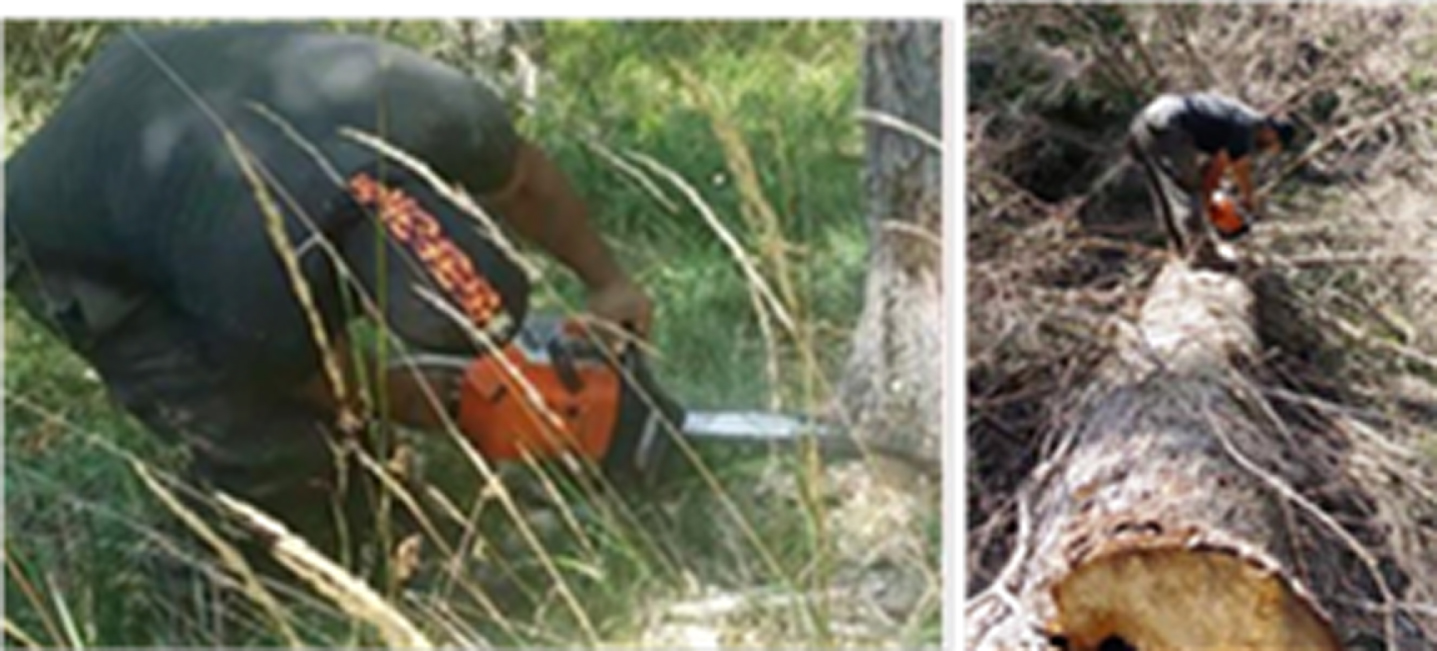
Examples of incorrect postures used by an operator during felling and delimbing.
Questionnaires were also distributed to the workers to record self-reported musculoskeletal problems. After being informed and giving their consent, the respondents were asked to fill in the relevant questionnaire.
For the video recording (RULA method), a woodworking stand was used. It consisted of 3 lumberjacks who did the casting and shaping of the wood as well as two other woodworkers who undertook the shifting and stacking of the logs.
The questionnaire (NMQ) was completed by a total of 32 foresters who belonged to other stands of the same forest of Elatia, Drama. In general, all the foresters who worked in the entire forest complex of Elatia, Drama agreed to complete the questionnaire.
Study design
The RULA method
After videotaping the harvest work, the various postures taken by the workers during their work were observed and identified. 40 different work postures from each work phase were selected (cutting, shaping, processing and stacking). A total of 160 different work postures were analysed using the RULA assessment method. 80 of these postures regarded the right side of the body and the other 80 concerned the left side, respectively.
Each posture was evaluated according to the RULA method. In the first phase, the appropriate grades were assigned by examining the postures taken by the workers’ arms, forearms and wrists (steps 1 to 4). Then, using Table A, the score for the upper limbs (step 5) of each posture was extracted. The points for the use of the muscles and the exercise of force from the upper limbs (steps 6 and 7) were also added to this score. Thus, the total score of the upper limbs (step 8) of each posture was extracted. It should be noted that according to the RULA method the total score was calculated separately for the right or left upper limbs and, each time, the higher of the two points was kept for the next step (step 15).
In the second phase, the postures of the neck, trunk and lower limbs were scored (steps 9, 10 and 11). With the help of a second Table B, the score for these three body parts was calculated (step 12). To this point, spots for muscle use and strength training were added or subtracted (steps 13 and 14), in order for the overall score (Score B) of the neck, trunk and lower limbs group (step 15) to be extracted.
The final grade of each posture studied was extracted using a third Table C. The total score of the upper limbs, found in step 8, was used as a line input, while the total score found in step 15 was used as a column input.
The final score (RULA score C) according to the RULA method is outlined below: Score 1 or 2: Negligible risk; the body posture is considered acceptable, so no further action or investigation is required. Score 3 or 4: Low risk; it is advisable to take further action or conduct an investigation for its improvement in the near future. Score 5 or 6: Medium risk; further investigation is required in order to implement change soon. Score 7: Very high risk; it is highly recommended to investigate and implement change immediately.
NMQ questionnaire
The NMQ consists of general demographic questions pertaining to the loggers’ age, weight, height, and working hours per week. The first part of the questionnaire also included questions related to problems of the whole body, in order to identify those parts of the body which had accumulations of musculoskeletal problems. The second part of the questionnaire included questions regarding problems of specific body parts such as the lower back, the neck and in the shoulders. A body map was also used to make it easier for workers to locate their problems in every part of the body.
Statistical analysis
The questionnaires were completed through a structured interview and then analysed via the SPSS software programme (ver.21 IBM Corp., Armonk, NY, USA).
Methods
The correlation of the variables’ questionnaire was calculated via the Kendall’s tau-b correlation coefficient, which is a appropriate in questionnaires including a mixture of quantitative and qualitative variables. Kendall’s tau-b coefficient is non-parametric, therefore normality of variables examined is not required [24].
Results and discussion
Results from the NMQ questionnaire
The NMQ was completed through structured interviews by all the loggers that participated in the study (32 loggers). The age mean was 36 years old (Table 1) with 50% of the participants belonging to the age class 21 to 29 years old. 21.9% were from 21 to 24 years old and 28.13% from 25 to 29 years of age. The mean of work experience was 10.5 years, and its standard deviation was equal to 10.02 years. More specifically, 68.75% of the participants had 1 to 9 years of work experience. Analyzing their weight in comparison to height, age and gender, it was found that 48.9% of the participants fell into the category ‘overweight’ and 15.6% into the category ‘obese people’.
Average and standard deviation of age, weight, height and work experience of participants (n = 32)
Average and standard deviation of age, weight, height and work experience of participants (n = 32)
Table 2 shows the results of the first part of the questionnaire, regarding the identification of the nine most common parts of the body where there is an accumulation of symptoms. The area of the body that suffers most often from MSD in all employees was the knees (34.4%), followed by the wrist / hands (31.3%), lower back (31%), shoulders and upper back (25% and 22% respectively).
Percentage of workers reporting musculoskeletal symptoms (one-year period prevalence)
The results of the second part of the questionnaire, in which specific parts of the body such as lower back, neck and shoulders were analysed and evaluated, are presented in Table 3. Out of the 32 respondents, about half, namely 31.3%, 6.3% and 25% respectively, had a problem at some point in the lower back, neck and shoulders, while 12.5%, and 9.4% reported that they had an undefined problem during the last 7 days in the lower back and shoulders, respectively.
The prevalence (%) of musculoskeletal symptoms lower back, neck and shoulder among forest workers
During the last 12 months, 15.6%, 6.3% and 18.8% of the respondents had visited a doctor for lower back, neck and shoulders problems, respectively.
The symptoms regarding the body parts in question were so severe for the respondents that they had to reduce their activities while working, mostly due to shoulder problems (18.8%).
Figure 2 shows snapshots of various harvesting operations with their equivalent RULA Score C. According to the RULA, both the right and the left side are evaluated, and the highest side score is taken into consideration [25].
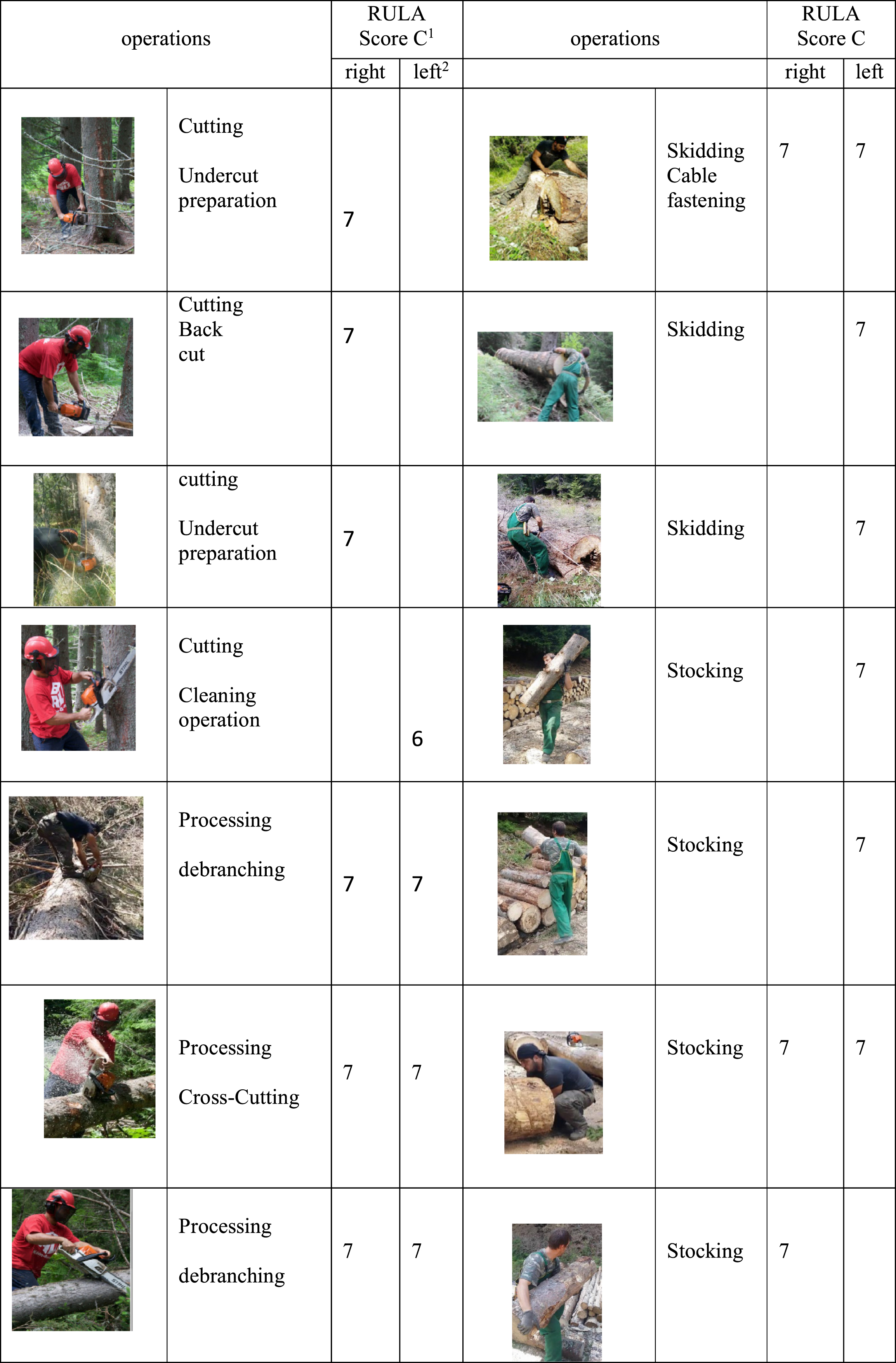
Selected images of operations sampled every 5 seconds through the use of video with the corresponding RULA scoring. 1Score C is the final score derived by evaluating the postures of upper/lower arms and wrists, muscle score and force score from the upper limbs (Score A) plus the total score (Score B)from the neck, trunk, lower limbs, muscle use score and force score(Score C= Score A+ Score B). 2The highest score of the right or left side of upper limbs is taken into consideration (Score A) and, based on this, Score C of the left or right side is derived.
In Table 4, the number of working postures that were considered for the final RULA score (Score C) is shown. Specifically, we can see the total working postures of the left and right side during each of the targeted tasks (cutting, processing, skidding and stacking) per risk level (1-2: negligible, 3-4: low level, 5- 6: medium level, 7: high level).
The final score of RULA in the different working stages
Abbreviations: L = Left, R = Right & T = Total.
Processing tasks, in particular, being 32 out of the 40 postures analysed (13 left-side postures and 19 right-side postures), fell into the high-risk category. 33 out of the 40 postures examined (17 left-side postures and 16 right-side postures) classified skidding into the high-risk level. Concerning the number of body postures in each work phase, as the RULA final score C shows in Table 4, that there are a greater portion of postures during the phases of processing and skidding, an average of 81.25%, which belong to the last risk level (High level - 7). With regard to cutting and stacking, more than half of the body postures (52.5% for the cutting operations and 62.5% for the stacking jobs) can also be rated into the last risk level (High level - 7).
Table 5 shows that the majority of the working postures belong to the most hazardous level, and this is true for both the left and the right side of the body. More specifically, 77.5% of the working postures, which burden to a greater degree the left side, as well as 61.25% of the working postures which burden the right side, are classified into the highest risk level (High level - 7).
The final risk level of RULA
Wrists and arms
It is apparent from the NMQ results that, as the upper limbs relate to the upper extremities (wrists and arms), 25% of the participants reported experiencing problems of the shoulders and, to a lesser degree, the elbows (9.4%).
Neck, trunk and leg
From their responses to the questionnaire concerning the areas of the neck, trunk and legs, a high percentage of the participants were found to be suffering from problems in the lower back, wrist / hands (31%) and knees (34.4%). Also, 22% of the participants faced problems in their backs.
It can be stated that the body regions of the neck, trunk and legs experience higher overload during harvesting operations than the upper limbs, wrists and arms. This is in agreement with the results of the NMQ where many participants reported having problems in the lower back and knees. From a similar study by Dimou et al. [10], it was found that the largest percentage of accumulated musculoskeletal problems were located in exactly the same parts of the body and in almost the same percentage order: wrist / hand (65%), knee (57%), lower back (52%). The higher percentage of accumulated problems in the wrist / hand, knee and lower back are justified by the higher average age and greater work experience, as well as more working hours per week (48 years average age with 58 working hours per week, versus 36 years average age and 43 working hours per week in the present study). According to Lagerstrom et al. [9], the high rates of accumulated problems were mainly due to the increase in working hours per week. It was also found that (see appendix) there was a weak correlation between years of work experience and problems in parts of the body such as lower back, neck and shoulders. This is justified by the fact that a large percentage of respondents (68.75%) had relatively little work experience (0–9 years). In relation to the work of Dimou et al. [11], where it was found that with increasing years of work experience there was a tendency to reduce problems in the corresponding parts of the body, it was concluded that the increasing professional experience contributed positively to the appropriate way of working and the use of the correct techniques for felling trees and their displacement. There is no forestry school in Greece, so harvesting is learned empirically [13].
There is also a strong correlation between MSD problems (lower back, neck, shoulders) and the reduction of work activity, as well as the increase of visits to a doctor / physiotherapist (see appendix Fig. 1A). A strong correlation was also found between difficulties in work performance and overall duration of MSD problems (> 30 days versus on a daily basis), recording MSD (lower back, neck, shoulders) problems in the last year (Fig. 1A). We see that MSDs prevent employees from performing their job duties and this happens for relatively long periods of time (> 30 days), or on a daily basis (Fig. 1A). There is also a strong correlation between the reduction of their work duties and the frequency of their visits to a doctor / physiotherapist. In other words, employees who visit a doctor / physiotherapist have reduced work activity due to the accumulation of MSD. Dev et al. [18], in their investigation into the risk factors of MSD in unorganised tasks such as forestry, found that workers were at high risk of developing MSD and that work attitudes needed to be changed immediately to reduce the risk of musculoskeletal disorders. In his research, which was conducted on a sample of 909 forest workers, Lewark [14] found that 16% of the participants were diagnosed with MSDs in their locomotive organs. The same study pointed out that musculoskeletal symptoms in loggers tended to lead to more sick leaves events than accidents.
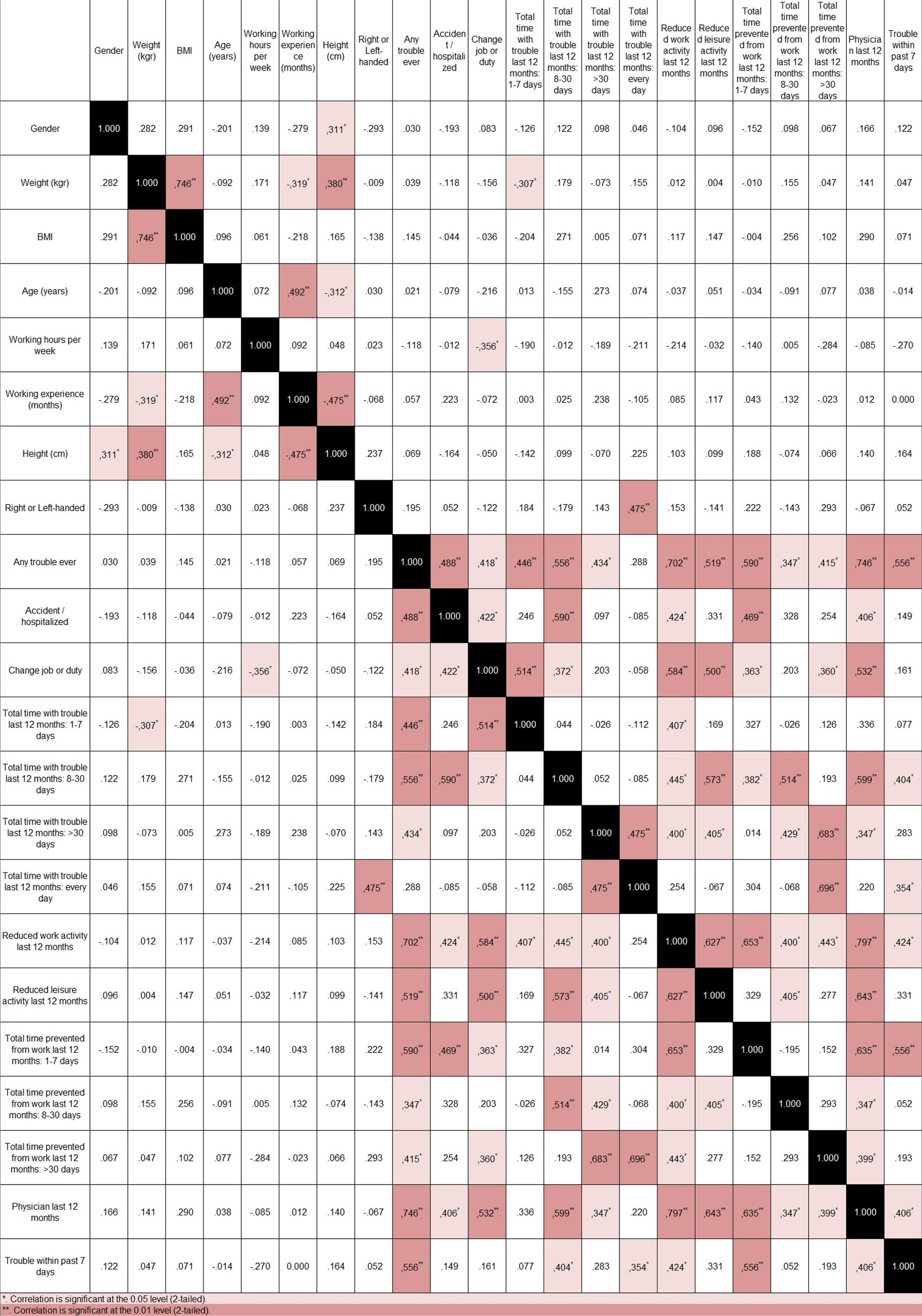
Correlogram
The highest percentages of MSD symptoms reported in their study, regardless of the type of work, were related to the lower back (32.9%), knees (26.4%), and shoulders (18.8%). The relatively low prevalence of MSD symptoms observed in the current study, in comparison with the results by Saraji et al. [26], with regard to the same body regions, was not due to the different types of work, as forest operations are proven to be extremely demanding and detrimental to the workers’ health [15, 27]. It is more likely to be associated with the fact that half of the participants were relatively young, up to 29 years old, and 40.6% of the participants only had 1 to 4 years’ work experience, while the group in the study by Saraji et al. [26] was up to 43 years old with 20 years’ experience. This could probably explain, and is corroborated by the statistical study that was carried out (SPSS statistical software ver.21), why none of the variables taken into account such as gender, weight, age, working hours per week or work experience, had statistically significant correlation with the loads on the individual parts of the body, like the neck, the shoulders, the locomotive organs and the lower back (Fig. 1A).
Regarding the working stages (Table 4), processing and skidding (80% and 82.5% respectively) were found to fall into the very high-risk category (Very high risk: Score 7). These results agree with the NMQ scores which revealed that a high number of employees (34%) complained about problems in their backs and knees.
According to the RULA results (Table 5), 77.5% of the working postures adopted by the left side of the body and 61.25% assumed by the right side belong to the very high-risk level, followed by 21.25% and 38.75%, respectively, of postures adopted by the left and right sides that were found to fall into the medium risk category (Medium risk: Score 5 or 6). According to Gallo et al. [22], 50% of the postures investigated presented a very high level of risk and 28% of the postures were found to present medium level risk.
It should also be taken into consideration that half of the participants who responded to the NMQ were relatively young, up to 29 years of age, and 40.6% of the participants had just 1 to 4 years of work experience. This could probably explain, and is corroborated by the statistical study that was carried out (SPSS statistical software ver. 21), why none of the variables taken into account such as gender, weight, age, working hours per week or work experience, had statistically significant correlation with the loads on the individual parts of the body, like the neck, the shoulders, the locomotive organs and the lower back.
The RULA method of the ergonomic analysis is an assessment tool of the workers’ awkward postural attitudes. In the present study, according to the RULA, the body postures assumed during the felling, processing, skidding and stacking stages were classified to a significant extent into the high-risk category. This means that the loggers observed were at high risk for musculoskeletal disorders, and, as a result, ergonomic interventions are required. In conclusion, we could say that in the future, the prevalence of the symptoms, mainly in the back and knees’ regions, may increase, since these disorders are cumulative, sustained and are caused by repetitive movements [28]. This is also demonstrated by comparing the results of Dimou et al. [10] with the results of the present study, where the accumulated MSD problems appear in the same parts of the body (wrist / hand, knee, lower back) with the only difference being the percentage of respondents who have a problem in the specific parts of the body. In the present study, the mean age was 36 years with 68.75% of employees having 1–9 years of work experience while, in the study of Dimou et al. [11], the mean age was 48 years, showing that, in the future, the percentages of workers who may have a problem in these parts of the body will increase.
The high scores obtained in this paper are due, among other things, to the tough environmental conditions of the harvest area (great slope, intense terrain, coping with standing vegetation) as well as the type of machines (especially the chainsaw).
The detection of erroneous or awkward postures through the RULA plays a crucial role in reducing the problems forest workers face. Awareness of problematic postures can be raised among loggers through training so that it may cease functioning as a topic of statistical analysis at a research level. As Calvo [15] points out, “training and informing operators about the correct positions and the manual movement techniques may reduce many incorrect postures”. Additionally, increasing the mechanisation level of harvesting operations could reduce physiological work hardship.
The working methods of the foresters expose their bodies to prolonged and difficult postures, thus subjecting the foresters to unnatural forces and pressures and movements of the body. Cumulative reports of such postures lead to MSD.
In the present study, it was found that the accumulated MSD problems prevent the performance of the work tasks and also reduce the work activity for long periods of time (>30 days), or even on a daily basis. It was also found that the accumulated MSD problems lead to an increase of visits to a doctor / physiotherapist. In general, the MSD has a significant impact on the health and financial situation of the individual, family and workplace. The MSD generally contributes to increased days of absence and it reduces productivity. For all of the above-mentioned reasons, highlighting problems and dangerous work postures is the best way to prevent the onset of MSD and, more generally, to avoid injury and disability.
Finally, we should mention that the current study was retrospective in design with all the inherent limitations of such studies. In addition to retrospective design and relatively small sample size, there were significant differences in demographic characteristics, specifically, that half of the participants who responded to the NMQ were relatively young (up to 29 years of age with little work experience) However, our statistical analyses were designed to account for such baseline differences and provide valid results.
Conflict of interest
None to report.