



Abstract
BACKGROUND:
Human error and violation of rules are perceived as deviations from some desired behavior, appearing variably in literature as either similar or opposing concepts. Behavioral deviations may be linked to accidents or considered a protective factor against them.
OBJECTIVE:
This article aims to explore definitions, characteristics, classifications, and management approaches for behavioral deviations, specifically human error and violation of rules.
METHODS:
A systematic literature review was conducted.
RESULTS:
The authors differ in defining and classifying error and violation, associating them with generation of accidents or their prevention. The management proposals for deviations highlighted by the authors were emphasized.
CONCLUSION:
The findings of this article reinforce the prominence of authors Jens Rasmussen and James Reason in the field. They assert that deviations are a natural aspect of the work process and even serve as a preventive factor against accidents, although their frequent association with accidents remains common in organizations. This study contributes to theoretical understanding by systematizing prevalent perspectives on deviation, human error, and violation of rules. It proposes a taxonomy and emphasizing the need for managing deviations, rather than combating them, especially in an organizational context.
Introduction
In the Safety Sciences literature, deviations are conceptualized as the values of a system that fall outside accepted rules, representing a rupture with previously established organizational artifacts, whether formalized or not, such as rules, standards, and best practices [1]. Reason asserts that “errors and violations are viewed, reasonably enough, as deviations from some desired or appropriate behavior” [2]. Within this framework, human error and violation of rules collectively constitute a category of the broader concept of deviations, referred to as behavioral deviations.
While human error and rule violation are recognized as types of deviations from pre-established standards, their definitions and classifications vary across the literature. They may be considered closely related, with violation seen as a type of error, or distinct, defined and classified differently [3, 4]. Some authors even categorize errors as unintentional actions and violations as intentional, a classification that is subject to debate [5, 6].
In parallel, behavioral deviations are depicted in the literature as both a serious problem and a potential solution. On one hand, they are identified as a significant threat to the safety of complex systems [7, 8]. On the other hand, they can be associated with overcoming organizational contradictions, leading individuals to adapt and ensure the development of safe production [5, 9]. Behavioral deviations are thus portrayed as both a cause and an effect of organizational problems [10].
This article aims to address fundamental questions regarding the definition, classification, and relationship of behavioral deviations, specifically human errors, and violations of rules, to industrial safety. It also explores alternative management strategies outlined in the literature for these deviations.
To achieve this objective, a systematic literature review (SLR) was conducted. The research process for this SLR involved searching, selecting, and reading articles from the queried databases, as well as analyzing and categorizing the data extracted from these articles.
Throughout the research process, it became evident that the works of Jens Rasmussen and James Reason were frequently cited, serving as the cornerstone for structuring this article. By synthesizing the current state of the art on behavioral deviations, this study contributes to the theoretical discourse in this field. It provides a nuanced analysis of concepts and classifications while shedding light on their intricate relationships with industrial safety.
It is crucial to clarify the scope of this research. While the concept of deviations encompasses various situations, this study specifically addresses behavioral deviations, human error, and violation of rules. Furthermore, behavioral deviations can impact different aspects of an organization, such as safety, quality, and productivity. This research, however, focuses on analyzing the consequences of behavioral deviations in relation to industrial safety.
In essence, this article plays a pivotal role in advancing theoretical discourse by systematically presenting the current state of the art and providing valuable insights into the complexities of behavioral deviations within the context of industrial safety.
Methods
This study consists of a SLR developed through the operationalization of eight steps proposed by Thomé et al. [11]: 1) planning and formulation of the problem regarding the definition of the object of study; 2) literature search, involving the definition of the research bases and keywords used; 3) data collection, corresponding to the process of capturing the researched papers; 4) quality assessment by reading and selecting the papers to be contemplated in the research; 5) data analysis and synthesis, based on the selected papers; 6) interpretation, through an in-depth analysis of the selected information; 7) presentation of results, or the organization of the analyzed data; and 8) review update, showing the contributions and perspectives of the review performed.
Starting from the planning and formulation of the problem (step one), this study seeks to understand the definitions attributed to concepts related to behavioral deviations, namely, human error and violation of rules, as well as the relationship between them, their association with industrial safety, and their possible management alternatives.
In step two, the literature search was conducted in Scopus and Web of Science (considered by previous research as the two largest databases hosted on the topic) in January 2024 using the following keywords: (safety) AND (deviation OR deviance) AND (“human error” OR violation) AND (procedure OR rule OR instruction OR document OR standard). The choice of keywords is justified by the objective of this review, namely, to discuss the concepts around human error and violation of rules and their relationship with industrial safety. No restriction was placed on the period during this search. At this stage, 109 articles were returned from the two databases researched, considering scientific articles as inclusion criteria, whether empirical research or review articles, given the scientific relevance of these documents.
Out of the 109 articles returned, 12 were repeated in the databases consulted. After excluding these intersections, 97 articles were selected for titles and abstracts reading. As exclusion criteria, articles about specific technical errors from the medical field (40 papers), such as changes in medication dosage, errors in diagnosis or ineffective treatment (because these articles are usually focused on discussions from the physiological or biological approach) and articles that deal with deviations from everyday life (17 papers), such as traffic violations (as they are not related to industrial environments) were deleted. Once these exclusion criteria were applied, 40 articles were selected for complete analysis and considered for drafting this study. Figure 1 illustrates the different steps of this systematic literature review and the number of articles associated with each step.
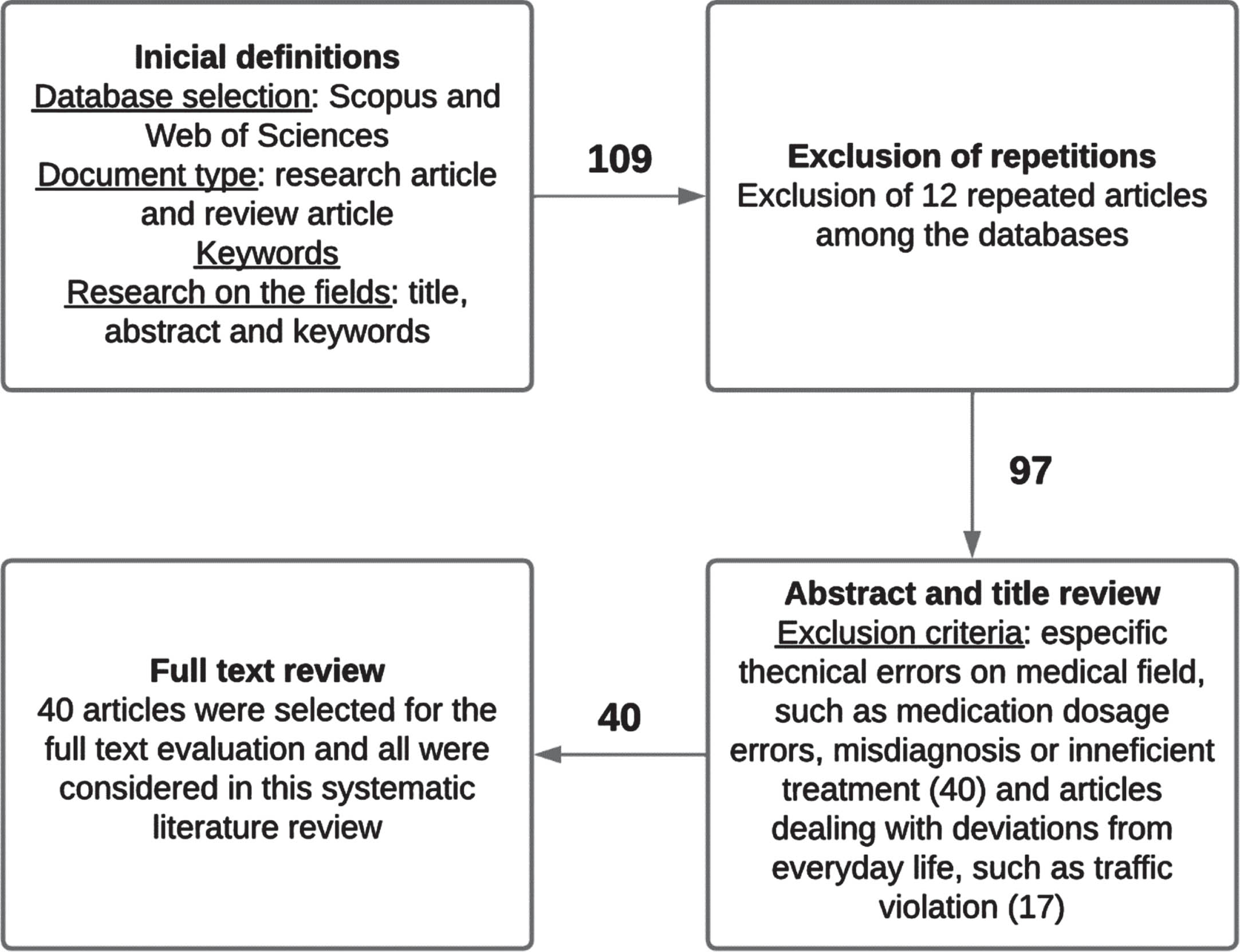
Number of articles in each SLR stage.
Step three, referring to data acquisition, involved the completion of auxiliary tables, built in text format, in which the characteristics, definitions and management alternatives attributed to the concepts studied in the articles that were analyzed were recorded. Here, the following points were inserted in the auxiliary tables: Relationship between human error and violation: it was scored whether the article considers error and violation as different concepts, the same concept (violation as a category of error) or whether they did not elucidate this relationship. Categorizations and classifications presented for the concepts of human error and violation, as well as the references adopted. Relation of behavioral deviations (human error and violation of rules) to accidents: whether they are considered a cause or an instrument of prevention. The positioning of each article was highlighted in the records. Management alternatives: note of management alternatives pointed out by the authors.
Quality assessment (step four) involved full reading of the articles included in the tables, checking whether they met the selection criteria of the research. The data analysis and synthesis step (step five) involved grouping the analyzed articles according to the concepts, characteristics, and alternatives presented for the terms human error and violation of rules. These data have been compiled into a synthesis table, encompassing the results of this SLR, in which all analyzed papers and their categorization within the adopted analysis categories in this research are displayed. The outcome of this process is presented in Table 1.
Definitions, classifications, relationship with accidents, and alternatives for deviation management
Since these groupings had been established, it then became possible to calculate percentages that show that are the recurrent points in the literature concerning the subject analyzed hereby.
Based on these metrics, the method proceeded with the interpretation (step six) to clarify the main elements discussed in the literature concerning the terms human error and violation of rules. The presentation of the results (step seven) involved the organization of the data from the previous step, that is, the ordering of the themes, definitions, and classifications of the concepts being addressed. Finally, step eight addresses the topics “discussion”, “conclusion” and “implications and limitations”, reflections about the contributions, limitations, and perspectives that the review about behavioral deviations, human error and violations of rules can contribute.
The conducted review enabled the discovery of information regarding the definitions and classifications of behavioral deviations – human error and violation of rules – as well as their relationship with accidents and their possible management alternatives. It is evident that human error and rule violation may appear in the literature as both distinct concepts and associated, in which case violation becomes a category of error. Additionally, behavioral deviations are either directly associated with the causes of accidents, emphasizing their negative bias, or, conversely, related to their prevention, placing more emphasis on their positive bias.
Recurrently, some authors depict behavioral deviations as equally associated with both situations, i.e., both as a cause and prevention of accidents, without a greater weight to the negative or positive bias. Finally, part of the researchers identified in this review also provides varied alternatives for behavioral deviation management. Table 1 delineates the different categories that were found, encompassing definitions, characteristics, or management alternatives for each of the selected studies. In this table, the researchers are listed in ascending chronological order.
Definitions and classifications of human error and violation of rules
Out of the 40 articles that were reviewed, 40% (n = 16) advocate rule violation as a category of human error, 42.5% (n = 17) show error and violation as distinct categories, and 17.5% (n = 7) have no conceptual discussion between error and violation.
In 16 articles violations were considered as a category of human error [3, 40]. Among these, Reason’s definitions and classifications predominated, adopted in 11 of them [3, 40]. Human errors are divided herein into slips (correct intention but wrong execution), mistakes (wrong intention regardless of execution), lapses (omission in performing actions known to be necessary), and violations (intentional deviations from the rule). In the remaining five articles of this group, three additional definitions and/or classifications for the concept of error emerge, all formulated by the authors of the respective articles. Chen, Qui and Tan propose a classification whereby errors are divided into three groups, namely, procedure violations, management errors, and poor design, without providing the definitions of these classifications [14]. Guo et al. classify them into five groups, namely: omission (failing to do something that should have been done), disorder (lack of organization in the execution of tasks), sequence (performing actions in the wrong order), time (errors involving chronology), and agent (centered on the attitude of the individual, including violations and reckless acts in this category) [17]. Vanderhaegen et al. divide human errors into unintentional (those with no intentions), intentional (also called violations), and additional tasks (those that are not formally requested but may affect the operation of the human-machine system in terms of safety, quality, production, and workload) [22]. Finally, Lombardi et al. and Zhang and Liu, while indicating rule violations as a category of human error, do not provide definitions or classifications of the terms [4, 26]. Table 2 summarizes the definitions and classifications of human error and violation of rules as introduced by the articles that consider violations of rules as a category of human error.
Authors, reference, definitions and classifications of human error (including violations)
Authors, reference, definitions and classifications of human error (including violations)
In 17 articles out of the total number in the research, violation of rules and human error were considered distinct concepts, with specific approaches for each of them [5, 41].
The classification of human error proposed by Rasmussen is the only one that is repeated among the articles in this group, and being considered in four of them [20, 38]. In it, errors are classified and defined herein as decision-based (when the intended conscious behavior is achieved but is inappropriate to the situation), perception-based (coming from degraded or impaired sensory input), and skill-based (when they occur without conscious thought, such as when performing automatic tasks that are more susceptible to attention and memory failures) [44].
Molesworth et al., although not referring to any author, classify errors as errors and lapses. Both categories correspond to failures in the processing of information due to overload in working memory, attention deviation, failure to recognize clues and/or failures in the retrieval from long-term memory. The difference between them is given by the severity of the situation, with errors being more severe than lapses [21]. The remaining 12 articles, although they distinguish between error and violation, do not provide definitions or classifications of error [5, 41].
Still in the group of 17 articles that distinguish between human error and violation of rules, six of them propose definitions and classifications for the concept of violation [7, 41]. Four articles of these group adopt the violation classification proposed by Reason [12, 41]. In it, violations are divided into routine (regular deviations from the rule, which have already become common practice), exceptional (occurring in unplanned situations whereby following the rules does not lead to the expected result), optimization (motivated by the desire to improve results), necessary or situational (occurring in situations in which it is impossible to follow the rules and without which the activity cannot continue), and acts of sabotage (motivated by the desire to cause damage to the system) [45]. English and Branaghan, in turn, propose their own classification of violations, dividing them into four groups, namely: improvement violations (when the intention is to improve safety or production), harmful (intention to cause damage or to reduce production), indolent (intention to increase the ease of activities for the operator), and hedonic (aimed at increasing the excitement and pleasure related to the execution of activities, through which the operator seeks some fun) [7]. On the other hand, Punzet et al., who had already brought the concept of error based on Rasmussen, divide violations, through their own classification, into routine (those incorporated into work routines) and exceptional (when they occur eventually in the face of unplanned situations) [38]. The remaining 11 articles in this group do not bring any classification of the concept of violation of rules [5, 39].
Therefore, out of the four articles that reference Rasmussen in the definition and classification of human error, one presents a classification for the concept of violation of rules [38], and three do not provide proposals on this concept [20, 29]. Among the articles that approach error and violation as distinct concepts, one proposes a classification of its own for the concept of human error but makes no proposition about the concept of violation of rules [21].
There are five articles that do not provide definitions and classifications about the concept of human error but offer proposals regarding the concept of violation of rules [7, 41]. Among them, four categorize the concept of violation based on Reason [12, 41] and one presents its own classification for this concept [7]. Finally, seven articles in this category do not present propositions for either of the two concepts analyzed. Table 3 summarizes the information about the distinction between the concept of human error and violation of rules.
Authors, reference, definitions and classifications of human error and violation of rules as distinct concepts
Finally, among the 40 articles selected for this study, seven of them do not provide a clear conceptual discussion between error and violation [19, 43]. Figure 2 illustrates the conceptual framework of error and violation in the evaluated articles, emphasizing the proportion of each category.

Conceptual reference of human error and violation of rules.
The articles researched herein also offer information about the relationship between behavioral deviations and the occurrence of accidents. Three distinct groups emerge from this discussion: one that directly associates behavioral deviation with accidents; another that, conversely, positions behavioral deviation as a factor in accident prevention; and a third group in which behavioral deviation may be, depending on the context, either an accident generator or a prevention factor.
In the first group, 37.5% of the 40 analyzed articles (n = 15) predominantly demonstrate a negative bias towards human error and violation of rules, directly associating them with accidents. This perspective emphasizes the need of compliance and adherence to procedures by performers to ensure the system’s integrity [3, 40].
Behavioral deviations, noted herein as causing direct changes at work and consequently reducing safety, leave the organization more vulnerable to accidents, making them one of the most frequent causes of occupational accidents [17, 38]. These deviations are also capable of leading to major accidents [8, 27]. Furthermore, behavioral deviations are associated with adverse events related to patient safety [40], incidents involving aircraft maintenance crews [20], experienced commercial aviation pilots [21], and air traffic controllers [6]. They have also been observed in recent accidents occurring on speed-restricted trains in the United States [4].
In the second group, 25% of the total articles (n = 10) emphasize the positive bias of behavioral deviations, associating them with accident prevention [9, 41]. In this group, human error and violation of rules are perceived as methods to meet demands at work and ensure the achievement of better health, safety, and quality conditions, serving as an alternative to obtain better results in terms of costs and safety conditions of operations [22, 28]. Such behaviors are also viewed as strategies to overcome procedural inadequacies [31, 41] or failures in the systems [32] while contributing to the overall improvement of working conditions [9, 35].
Finally, 37.5% of the total number of articles (n = 15) point out that behavioral deviations may also exhibit a negative bias, being directly associated with the onset of accidents, or positive bias, being associated with prevention thereof [5, 43]. Thus, behavioral deviations may result from a well-intentioned desire to get the job done and ensure productivity, although they may occasionally threaten safety and lead to accidents [12, 30]. These deviations have been identified as responsible for severe accidents in contemporary times, such as Piper Alpha and Texas City [5, 42], but may be the best alternative to follow given the limitations of the prescriptions and the differences between imagined and performed work [25, 43].
Human error and violation of rules are regarded as paradoxical issues in patient safety. On one hand, they can enhance individual satisfaction and system performance; on the other hand, however, they have the potential to result in real dangers and damage [16]. Depending on the perspective, they are indicated as behaviors to be eradicated or as inevitable responses to emergencies, seen as undesirable or as adaptations to the complexity of the work [34, 36].
In the context of the reliability of engineering systems, human error and violation of rules are interpreted as natural consequences of human involvement throughout the lifecycle of these systems, from specification, design, and implementation to installation, start-up, operation, and maintenance. While potentially negative, these human factors are acknowledged for enabling the functioning of the systems [39].
Behavioral deviation management alternatives
Half of the analyzed articles (n = 20) propose alternatives for managing behavioral deviation [6, 43]. Among them, only Lombardi et al. do not mention organizational issues in the process of managing behavioral deviations [26]. The other authors highlight organizational issues as crucial tools in this management process. These organizational aspects include prescriptions, either through direct work in their construction or in their articulation with the real activity that it seeks to represent. The remaining 50% of the articles (n = 20) do not discuss alternatives for managing these types of deviations.
In the group that proposed a management approach for behavioral deviations, Lawton, Sharit, and Phipps et al. advocate improving the textual quality of prescriptions. They emphasize the importance of making procedures precise, detailed, reflective of the real work context, and free from ambiguities [12, 30]. Amalberti et al. also support addressing prescriptions by adapting the discussion to the medical field, focusing on patient safety [16]. According to these authors, ongoing dialogues on the topic of deviations should take place with the workforce. Recognizing the need for adaptive deviations, related procedures should be adjusted to align with the actual work context. The authors assert that while these deviations cannot be eliminated, they can be effectively managed.
Ávila et al. propose that procedures should be designed to promote autonomy among individuals. This approach allows individuals to use their creativity to safely operate systems when the context deviates from the expected [23]. Dekker complements this idea by mentioning operators’ strategies that enhance operational safety, even in resource-constrained situations, emphasizing the importance of autonomy [10]. Jones et al. suggest introducing flexible procedures and guidelines that provide various options and decision criteria for the team, rather than imposing a single ‘safe’ way of working. The authors advocate for procedures that prioritize managing variability instead of attempting to eliminate it outright, encouraging beneficial ways of working if individuals are aware of associated risks and responsibilities [36].
Shin points out that managing deviations involves designing spaces, processes, and procedures, along with providing training for work activities [27]. Le Coze suggests continuous exchange of experiences to enhance cognition and decision-making processes, recommending regular use of feedback and feedforward tools for this purpose [29]. Dekker and Breakey support the adoption of a “just culture,” aiming to establish an organizational environment based on trust that encourages reporting of experiences. This approach enables operators to highlight critical situations and limitations of procedures [31].
Tripathi et al. emphasize the importance of promoting operators’ reporting of deviations and limitations in procedures [35]. Kanse et al. assert that those who use procedures should be engaged in the construction, implementation, and updating processes. Managers should also leverage unexpected events as learning opportunities for the team [37]. Lastly, Hendricks and Peres highlight the necessity of providing training and capacity-building to workers, ensuring they understand how and when procedures should be adjusted in response to unplanned situations [42].
Reason emphasizes the necessity of managing organizational factors that serve as determinants of deviations. The author distinguishes between active and latent failures for this purpose. Active failures, which include failures related to human nature, occur at the end of processes (sharp end) and are challenging to predict and manage. On the other hand, latent failures are inherent to the work context and the organization and naturally occur before incidents and accidents take place. Consequently, latent failures serve as precursors to unsafe acts and, for this reason, are more suitable for treatment. The author critiques deviation treatment measures applied at the individual level, such as sanctions, exhortations, the implementation of more rigorous procedures, selection, additional training, and improved certification. According to him, these measures are only significant in scenarios involving inexperienced, unmotivated, and poorly trained professionals, which is rarely the case in high-risk industries (such as anesthesiologists, aviation professionals, and military commanders), where deviations are thoroughly discussed. The author aptly states, “unsafe acts are like mosquitoes. They can be swatted or sprayed, but they keep coming. The only effective remedy is to drain the swamps in which they breed” [15, p.60].
Morgan et al. also propose that the management of deviations encompasses organizational issues, such as work characteristics, safety management system and social interaction (both among colleagues and in relation to leadership) [34]. Similarly, Hale and Borys along with Olivares et al. suggest actions in organizational aspects, such as prescriptions and the human-machine interface, given that individual’s decision-making process is based on these questions [25, 34]. Xu and Luo, following the same line of recommendations, highlight, in addition to prescriptions, performance in equipment, leadership style and working hours (which can lead, according to the authors, to fatigue scenarios that significantly contribute to deviations) [6].
In addition to the factors previously mentioned, Rajapakse and Reza emphasize the importance of considering the following aspects in an effective deviation management system: the need to perform simultaneous tasks, frustrations, time restrictions, fatigue, and inherent doubts related to procedures [43].
Lately, Lombardi et al., the only authors who do not mention organizational issues in the deviation management process, recommended the adoption of quantitative techniques for reliability, availability, maintainability, and safety to control the human factor, considering it is a variable to be manage. The authors argue that relying solely on procedures and regulations is insufficient to control human behavior and prevent potential negative consequences [26].
It is interesting to note that there is a trend to seek deviation management alternatives among authors who consider both positive and negative biases of deviations and those who emphasize their positive bias. Out of the 15 articles emphasizing the negative bias, only Lombardi et al. and Shin present management alternatives [26, 27]. Meanwhile, among the 15 articles arguing for both negative and positive biases, 12 propose alternatives [10, 43] while three do not [5, 18]. Concerning the ten articles emphasizing the positive bias of deviations, five offer alternatives [13, 37] while the remaining five do not [9, 41].
Figure 3 illustrates the percentiles of the articles found regarding the classification of error and violation, the relationship between behavioral deviations and accidents, as well as alternatives for managing behavioral deviations.

Classification of error and violation, relationship between behavioral deviations and accidents, and behavioral deviation management alternatives.
This article presents, firstly, significant controversies among authors concerning the concepts of human error and violation of rules, as well as their relationship and prevention. Given the uniqueness of this research, it was not possible to find past literature reviews with the same combination of keywords for comparison purposes. Despite this, the broad temporal spectrum covered by this SLR allows for a discussion of this article in relation to previous works on the same theme. This research covers articles from 1988 to 2022. Over the thirty-four years represented by the analyzed articles, a consistent opposing stance on behavioral deviations emerges – sometimes portrayed as a cause and at other times as a preventive strategy against accidents. This highlights the persistent lack of theoretical consensus regarding their relationship with industrial safety.
A recent literature review on the influence of human and organizational factors (HOFs) on safety corroborates the contradiction regarding the discussion of behavioral deviations in literature presented in this article. In this literature review, the authors point out the existence of two approaches to behavioral deviations in the literature: one focused on the individual, where behavioral deviations are seen as causes of accidents, also referred to as the “old view,” and another focused on the system, where behavioral deviations are viewed as symptoms of underlying system issues. The system approach is also known as “the new view” [49].
Out of the 40 articles that were analyzed, 16 advocate violation as a category of error, while 17 depict error and violation as distinct concepts. In relation to this latter group, some authors still adopt the classification of violation proposed by Reason, even though this author, as mentioned earlier, considers violation as a category of error [12, 41]. The number of articles that do not engage on conceptual discussion (n = 7) is still considerable. Similarly, in developing the relationship between deviations and safety, 15 articles emphasize the negative bias of deviations, and another 15 emphasize the positive bias, while ten of them argue that deviations may also exhibit characteristics linked to accident prevention or generation.
Although there is no consensus among the articles about whether violation is a category of error or whether these are distinct concepts, as well as whether deviations cause or prevent accidents, the most fundamental references mobilized by the authors in the research are based exclusively on both Jens Rasmussen and, especially, James Reason, which is not a surprise, given the relevance of these researchers in the field. Out of the 16 articles that point to violation as an error category, Reason’s classification appears in 11 of them, while three articles propose their own classification and two does not propose any classification at all. Out of the 17 articles that differentiate error and violation, four define error based on Rasmussen, one brings its own classification for error (while another 12 do not classify error) and out of the six articles that classify violations, four reference Reason and another two bring their own classifications (while 11 articles do not classify violation).
In tandem with this discussion, 20 articles presented proposals for managing behavioral deviations, of which only one did not indicate the need to act on organizational issues. These data lead us to underscore the importance of Reason and Rasmussen in this reflection and to briefly revisit the discussion of these authors on the different viewpoints presented by the researched articles. This will allow us to reposition the definitions and classifications of human error and rule violation in line with the original discussion and with the impact it continues to have on publications on the topic. At the same time, the discussion of the possibilities of managing behavioral deviations made by the authors of this review will lead us to model a proposal according to the influence of organizational factors on human behavior.
Rasmussen was an early mover on the reflection on human error, while Reason, strongly influenced by Rasmussen, also advanced the notion of violation. For Le Coze, the great influence of Rasmussen’s works is given by its structuring through basic mechanisms, which do not demand great abstractions, allowing its understanding by a wide audience [29].
In the late 1980 s, Rasmussen proposed reconsidering the concept of error, moving from fragments of behavior, as studied until then, to cognitive control of behavior in complex environments [47]. The author proposes some taxonomy for human error based on a cognitive control framework for information processing and decision-making, divided into three different levels. At the 1st level, skill-based error occurs in automated, subconscious routines in which performance is controlled by embedded patterns of behavior. The errors here are related to attention failures, such as skipping an activity step or leaving the site without completing the service. At the 2nd level, the rules-based error is about a misapplication of a rule recognized by the workgroup, because the rule is imprecise or leads to an undesired consequence. It is about erroneous associations with tasks or memory lapses in retrieving procedures. Finally, at the 3rd level, knowledge-based error occurs in complex or unknown situations, in which actions must be planned based on analysis of the objectives and the functional properties of the system. These are situations of limited rationality, incomplete or imprecise knowledge, and inexperience with the task [48].
Reason, in turn, considers that the division sometimes accepted in the field of Safety Sciences – that human error would always be involuntary, while violations of rules would be voluntary – is not adequate, since there will always be a “compromise,” or a component of involuntariness in violations, while errors are “at least in part, voluntary actions” [1, p.127].
Error, defined as “the condition resulting from a person’s actions, when there is general agreement that the actions should have been other than what they were” [1, p.151] can lead us to actions with correct intention but wrong execution (slip), with wrong intention regardless of their execution (mistakes), or to omission in the performance of actions known to be necessary (lapse). Moreover, error can lead us to undesired results in intentional deviations from the rule, what Reason calls violations, or “deviations from safe operating procedures, standards or rules” that “can be either deliberate or erroneous” (ibid., p. 72). For Reason, all types of violations have unintentional components - and therefore can be called “erroneous violations.”
Concomitantly to this, according to Rasmussen and Reason, there seems to be no sense in associating errors and violations as determining factors of accidents. For Reason, we may intend to violate a rule for different reasons: because it has already become a common practice in certain situations (routine violation), because the situation is not provided for by the rule (exceptional violation), because one hopes to improve the outcome (optimization violation) or because, by following the rule, the activity may be interrupted (necessary or situational violation) [45]. In all these cases, the intention of the violation was always to “get it right,” that is, to achieve the previously determined goal of safe production, which is achieved most of the time when deviations appear. Therefore, Rasmussen advocates retaining the autonomy of individuals in solving actual problems in the field of work. According to him, safety “depends on the introduction of locally visible boundaries of acceptable adaptation and the introduction of related control mechanisms” [47, p.1198].
Thus, according to both authors, behavioral deviations, namely human error and violation of rules, have a strong system protection component and almost never have “the objective of causing injury or damage” [49, p.1316]. For Reason, there is only one situation whereby a violation can generate real harm, being acts of sabotage or the deliberate desire to cause harm to the system. In this case, there is an explicit will to circumvent the purpose of the action to cause harm. Reason thus suggests that the entry point of reflection should be an understanding about the intentionality of causing harm. If this is the case, we are in a situation of sabotage and violation proper. Otherwise, all other violations are considered within the perimeter of human error and seem to generate more protection than harm to the system [1].
According to Reason’s perspective, human errors contain a significant system protection component, making them not suitable for punitive measures. This highlights a clear opposition in the literature regarding the approach to handling human errors. A recent study in the aviation field, for instance, argues that punishments for errors (considered unintentional actions) positively impact workers’ performance, presenting itself as an effective strategy for enhancing organizational safety levels [50].
On the contrary, in another recent study, the authors align with Reason’s assertions, considering that, in most cases (except acts of sabotage), behavioral deviations (with an emphasis on rule violations) are intended to achieve a goal, namely, the safe production achieved in most instances. In this sense, they view rule violations as often legitimate, pointing out that, most of the time, the issue lies not with individuals but rather in the organizational context. For these authors, punishment is therefore used as an instrument of power and domination [51].
The analysis of recent studies on the subject indicates that the divergence of viewpoints observed in past articles continues in current studies. This suggests that contradictions regarding the relationship between behavioral deviations and industrial safety persist over time.
In relation to the management of behavioral deviations, prescriptions must be built in a precise, clear, and corresponding way to the real work context [6, 43]. Despite the quality of organizational artifacts, performers must have the autonomy to adjust according to the context and act based on their experience to ensure the continuity of work safely in situations where rules and procedures are not sufficient [10, 23]. Flexibility also needs to exist so that individuals can choose the criteria they will adopt in their decision-making processes, assuming that there is no single way to work safely [36, 42].
In a recent study, Peres and Hendricks discuss the fact that over time, procedures have been used as safety barriers to prevent accidents. Despite this attempt, the procedures themselves are often cited as contributing causes to accidents. Faced with this contradiction, the authors argue that the frequently elaborated procedures are based on formal and rigorous strategies of social control that do not encompass the necessary decision-making process when aspects of the task and the context faced by workers vary from what is written in the procedures, reinforcing the need for autonomy and flexibility [52].
At the same time, the provided infrastructure must allow the performance of activities safely, and for that, the reliability and integrity of facilities and equipment must be satisfactory [6, 39]. Regarding working hours, they must allow sufficient physical and mental rest, preventing individuals from working under fatigue conditions [6, 43]. Time management should also be observed, so that there is time to perform tasks, and time pressures and excessive simultaneous tasks are eliminated from the work routine [6, 43].
Relationships must be positive both between colleagues and in relation to leadership roles, so that a cooperative and collaborative environment can be structured based on dialogue [16, 37]. Finally, the organizational context must be based on trust so that reports of deviations and nonconformities can be made without reservations, serving as fuel for improvement of safety practices [31, 35].
Conclusions
In conclusion, the exploration of human errors and violations of rules in the field of Safety Sciences reveals a distinct gap characterized by the absence of clear definitions, classifications, and relationships with industrial safety. This article aims to address this gap by explicitly stating these elements. Through a systematic literature review, it brings to light significant contributions that help elucidate the subject.
By discussing contradictions within the literature, this article allows for a nuanced analysis of concepts and classifications related to human error and violation of rules. It plays a pivotal role in advancing the theoretical discourse on behavioral deviations by systematically presenting the current state of the art in this domain. Moreover, it sheds light on the diverse categorizations and classifications while exploring the intricate relationships of these concepts with industrial safety, capturing the divergent perspectives present in the literature.
This study reaffirms the prevailing references of current researchers, particularly acknowledging the influence of classic authors such as Jens Rasmussen and James Reason. Their perspectives view behavioral deviations as inherent to the work process and as a factor that protects the system from accidents.
Through a nuanced exploration, this research establishes the various points of view on human errors and violations of rules, offering a comprehensive understanding of argumentative possibilities developed in the literature.
Notably, the article emphasizes that proposals for managing behavioral deviation in the literature predominantly possess an organizational character. Recognizing that acting on errors and violations necessitates addressing the work context in which these deviations arise, this research underscores the organizational dimensions crucial for effective intervention strategies.
Implications and limitations
The objective of this session is to elucidate the contribution of the present study to the following contexts: theory, researchers, practice/reality, and practitioners. Additionally, this topic will address the primary limitations inherent to this article. To synthesize the knowledge about deviations, human error, and violation of rules available in the literature, this article shows the most common classifications and definitions on the themes and summarizes the necessary characteristics for the construction of an organizational environment favorable to the management of behavioral deviations. Therefore, in possession of these results, the contribution of this research will be pointed out below from the following perspectives: i. theory; ii. Researchers; iii. Practice/reality; iv. Practitioners.
i) Theory: the herein study contributes to the theory as it systematizes the most recurrent positions in the literature on the themes of deviation, human error and violation of rules, signaling the fact that there is no theoretical consensus on the conceptual relationship between human error and violation, while they can be presented either as distinct concepts or as close concepts, in which violation is defined as a category of human error. The most recurrent taxonomy about these terms was also presented in this research. The fact that behavioral deviations are seen as causing accidents as well as resources necessary for the progress of activities also became known through this study. It was also possible to show that the management proposals about these deviations mostly deal with organizational issues.
ii) Researchers: the main contribution of this article to researchers on the subject and related areas is the elucidation of the different points of view that fall on the concepts analyzed and the systematization of the relationship between human error and violation of rules and between behavioral deviations and the industrial safety.
iii) Practice: the main practical contribution from this study lies in recognizing the positive bias of behavioral deviations. Depending on circumstances, they can represent the safest or even the only viable course of action. Moreover, the article underscores that effective management of behavioral deviations is intricately linked to organizational issues, necessitating intervention specifically in organizational aspects for efficient management.
iv) Practitioners: for those involved in organizational safety, this research proposes an efficient management approach for behavioral deviations. Importantly, it highlights that these deviations are a natural aspect of the work process and can even serve as preventive strategies. The proposal is not to combat them but to manage them proactively.
In relation to study limitations, it is important to highlight that the search in research databases was exclusively conducted in English. Furthermore, the decision to focus on two databases, Scopus and Web of Science, and to exclude conference papers may limit the inclusivity of papers in the study. Future research that incorporates multiple languages and a broader array of databases and types of papers has the potential to enhance the comprehensive understanding of the topics under discussion.
As a future research agenda, it is recommended to conduct studies aimed at comprehending the impact of behavioral deviations on parameters beyond safety, including aspects such as quality and productivity. Exploring these dimensions will contribute to a more holistic understanding of human errors and violations of rules in industrial contexts.
Additionally, there is a need for investigations covering other types of deviations, specifically those that influence physical installations and equipment. Extending the scope of research to encompass a broader range of deviations will enrich the insights into potential risks and challenges across industrial domains.
Ethical approval
Not applicable.
Informed consent
Not applicable.
Conflict of interests
The authors report no conflicts of interest. The authors alone are responsible for the content and writing of this article.
Footnotes
Acknowledgments
The authors acknowledge the funding agency that subsidized the development of this research.
Funding
This study was developed with financial support from the Human Resources Program of the brasilian National Agency of Petroleum, Natural Gas and Biofuels, funded by investments from oil companies qualified under the P, D& I clause of ANP Resolution n. 50/2015.