



Abstract
BACKGROUND:
The literature acknowledges that when there is a failure of expectations in the organization-employee relationship, namely the Psychological Contract Breach, it can potentially contribute to deviant behavior such as Counterproductive Work Behavior (CWB). A justice perspective helps to disentangle this link by suggesting that unethical behaviors may represent the revenge response to perceived organizational unfairness.
OBJECTIVE:
To gain a more granular understanding of the pathway from Psychological Contract Breach to CWB, this study explores the mediating role of negative emotions in eliciting CWB. It also proposes that the mechanism of moral disengagement helps to deactivate self-sanctioning processes, allowing individuals to engage in deviant behaviors.
METHODS:
A cross-sectional design was employed, and conditional process analysis was conducted on a sample of 635 Italian police officer cadets, who were entering the prison system, a context highly susceptible to a failure of expectations and where, at the same time, counteracting unethical behaviors is a key issue.
RESULTS:
The results supported the tested model, highlighting the mediator role of Job-Related Negative Emotions in the Psychological Contract Breach–CWB relationship and their interaction with Moral Disengagement in shaping CWB.
CONCLUSIONS:
By examining the interplay between affective and cognitive components, the study provides valuable insights into the underlying processes involved in the relationship between failure in expectancies and deviant behavior. From a managerial perspective, the findings emphasize the importance of prioritizing fairness within organizations through balanced mutual obligations, and raising awareness of moral regulation mechanisms that may shape deviant behaviors.
Keywords
Behavioral ethics has become a crucial area of focus within organizational life because of the detrimental consequences of unethical conduct, such as organizational reputation [1] and performance [2]. Unethical conduct encompasses a broad spectrum of Counterproductive Workplace Behavior (hereafter, CWB) disregarding organizational norms and involving voluntary and potentially destructive acts against an organization or its members, such as verbal or physical aggression, withdrawal, absenteeism, theft and sabotage. Research on CWB has primarily focused on its detrimental effect, overlooking the underlying processes that drive its intentionality [3].
According to the widely acknowledged model proposed by Robinson and Bennett [4], employees might engage in unethical conduct as revenge for a sense of injustice in their relationship with the organization. Thus, CWB may represent a coping strategy that enables an employee to overcome the feeling of injustice and restore a sense of equity [5].
This study adopts this justice perspective to explore the potential role of psychological contract breach, namely a sense of unfairness in an employee-organization relationship due to a failure in mutual obligations, in encouraging deviant behavior. Indeed, the psychological contract establishes mutual expectations, commitments and obligations between the organization and the employee. Research has shown that when these promises are broken or unfulfilled, this leads to a perception of unbalanced obligations, leading to negative outcomes [6], CWB included. However, the literature has left the process of developing this relationship unexplored.
The purpose of this study is to explore the underlying process that links the perception of inadequately fulfilled obligations to unethical conduct. According to the affective events theory [7], emotional arousal complements a rational evaluation of a situation. More specifically, the frustration-aggression model suggests that negative events foster negative emotions (e.g., anger, frustration) that in turn affect responses to counteract them [8]. While some empirical evidence supports these pathways from psychological contract breach to negative emotions, and from these two to CWB, a comprehensive understanding of the entire process is lacking. Furthermore, the existing literature points out that emotions only induce a readiness to act, not necessarily resulting in behavioral responses [9].
To disentangle this non-linear relationship between job-related negative emotions and CWB, the study also examines the role of moral disengagement as a regulatory mechanism. Moral disengagement is a cognitive process that allows individuals to rationalize or justify their unethical behavior by downplaying the self-sanctioning processes associated with such conduct [1]. By investigating the role of moral disengagement, the study seeks to shed light on the interplay between affective and cognitive components in the occurrence of CWB.
Overall, this study aims to contribute to the existing literature on unethical behavior by enhancing our understanding of the possible factors that contribute to their occurrence [3]. In doing so, it seeks to provide a more comprehensive understanding of the pathway from unbalanced obligations to the occurrence of CWB in the workplace, exploring the mediating role of affective components and how a moral regulatory mechanism shapes the effectiveness of these components in engendering concrete unethical behavior.
The paper is structured to provide, first, an outline of the literature relevant to psychological contract breaches from an equity perspective, followed by an overview of the research methodology. Next, the paper delves into the results of the tested model. Concluding remarks include a summary of key findings and their implications for managerial practice to hinder deviant behavior, areas for future research and limitations of the study.
Theoretical framework
Psychological contract breach and employees’ deviant behavior in the workplace
The psychological contract refers to the mutual obligations and expectations in an exchange agreement between an employee and their employer, in the eyes of the beholder [10]. It is temporal in nature and may have fluctuating patterns, due to ongoing negotiations between employees and organizations to ensure that their mutual expectations are met, although the degree of negotiation and adjustment is higher during its constitutive phase as both parties seek to establish a mutual understanding of expectations [11]. The principles of social exchange theory and equity theory [12] state that individuals evaluate whether and how the psychological contract is fulfilled or breached based on a cost and benefits analysis [13, 14]. In workplaces, employees view the relationship with their employer as being fair in terms of give-and-take when their commitment is acknowledged by the organization and balanced by the resources provided in return [10].
The literature broadly acknowledges that when employees perceive a balanced psychological contract, it shapes the employee-organization relationship positively [14]. This positive impact enables beneficial processes and outcomes for work life, such as higher levels of performance, employee innovativeness, organizational citizenship behavior [15, 16], job satisfaction [17, 18] and affective commitment [18]. Conversely, employees may perceive a mismatch –that is, “an imbalance in the social exchange relationship” [17]–when they assess the situation as unfair, due to the organizational failure to comply with its promises and obligations in terms of reciprocal returns, and have feelings of betrayal and frustration due to the psychological contract violation [10]. It is not uncommon for employees to express complaints about breaches in the psychological contract. For example, Conway and Briner [19] discovered that within just ten days of their daily diary study, over 69% of the 45 employees surveyed perceived that their organization was failing to fulfill at least one of the promises and expectations that were initially shared.
Some scholars have suggested that the breakdown of the psychological contract may lead employees to respond by disengaging or reducing their commitment, seeking to restore a sense of equity in the exchange. This equity perspective is supported by empirical evidence. For instance, Coyle-Shapiro’s [14] review indicates that a psychological contract breach can lead to reduced commitment, lower job satisfaction, decreased organizational trust, lower organizational citizenship behavior, and increased turnover intent, as well as undermine positive outcomes such as job satisfaction, organizational citizenship behavior, trust and employee performance [6, 20].
Some research has also focused on the effect of psychological contract failure on CWB. CWB is by its nature a form of behavior that deviates from the norms established by an organization. It encompasses a broad range of destructive behavior that oppose organizational norms and aim at hurting the organization or some of its members. Examples of CWB include physical aggression, verbal hostility, sabotage, theft and absenteeism [21]. Drawing on the workplace deviance model proposed by Robinson and Bennett [4], which suggests that deviant behavior may be a revenge response to perceived unfair conditions, Bordia and colleagues [5] argue that perceptions of contract breach create a state of imbalance that triggers counterproductive behavior in workplaces. Hence, employees may engage in such behavior whenever they feel that they are receiving unfair treatment from the organization (that is, a failure to fulfill the expectations of reciprocity underpinned by the psychological contract). In response, employees may seek to rebalance their relationship with the organization by engaging in counterproductive behavior as a form of “payback” to the party they perceive as responsible for betraying their obligations [22].
Consistent with the tenets of social exchange theory [12] and the justice perspective, the literature suggests that perceptions of (in)justice may influence employees’ engagement in counterproductive behavior as a way of restoring perceived equity [23–25]. Some studies have found evidence of a relationship between psychological contract breach and specific negative behavioral reactions such as discretionary absenteeism [26], anti-citizenship behavior [27], neglecting in-role job performance [28], theft, sabotage and withdrawal of work efforts [29]. Despite a relative dearth of research specifically examining the effects of a psychological contract breach on CWB [21, 22], there is reason to expect that when employees perceive a violation of the psychological contract, the likelihood of engaging in counterproductive behavior increases. Therefore, we hypothesize:
H1: Psychological contract breach will be positively related to CWB.
Psychological contract breach, job-related negative emotions and deviant behavior
The research that examined the relationship between psychological contract breach and counterproductive behavior has not provided a comprehensive understanding of the underlying process, leaving unexplored how perceived unfulfilled obligations may result in unethical behavioral responses [21, 22]. Indeed, perceiving unfairness is a state of readiness that does not necessarily lead to subsequent engagement in deviant behavior.
Weiss and Cropanzano’s [7] affective events theory offers a theoretical framework for understanding the whole process [6]. It suggests that even before individuals engage in a rational evaluation of a situation, they respond with negative affect or emotional arousals, setting the stage for a range of attitudinal and behavioral outcomes [19]. Hence, Zhao [6] argues that, in order to comprehensively explain the causal and mediating process of the effects of contract disruption on outcomes, the contribution of employees’ job-related emotions should be considered. This affective component has received little attention, since the exploration of the contract breach process has predominantly adopted a cognitive perspective, focusing on the evaluation of the costs and benefits balance in mutual obligations [13, 22].
Specifically addressing the emotions–CWB relationship, Spector and Fox [9] suggest that emotions act to help formulate intentions to engage in a certain behavior aimed at reducing negative states and enhancing positive states. They produce a readiness to act, that in the case of positive emotions tends to encourage citizenship behavior while in the case of negative emotions tends to increase the likelihood that CWB will occur. However, Spector and Fox [9] underline that this readiness elicits concrete behaviors only when emotions are particularly strong or other factors are present.
Unfortunately, a granular understanding of the entire process from psychological contract breach to counterproductive work behavior, is still lacking. Existing studies investigating the emotional component of attitudes have typically focused on singular pathways within the process, developing separate hypotheses without fully elucidating the mechanisms driving the process as a whole [6]. For instance, some research demonstrates that a psychological contract breach triggers negative work-related emotions [30, 31]. On the other hand, others reveal that negative emotions related to work experiences –such as anger, anxiety or fear –may be detrimental to attitudinal and behavioral outcomes [19], including CWB [2, 32–36]. One exception is the study by Bordia and colleagues [5], which shows that the feeling of violation (the affective component of psychological breach) mediates the path from contract breach to revenge attitudes and deviant behavior. Similarly, the study by Restubog and colleagues [37] provides evidence of the mediating role of negative emotions in the relationship between psychological contract breach and CWB.
Collectively, this limited body of literature suggests that perceiving a breach in the psychological contract triggers job-related negative emotions such as anger and frustration [38], dissatisfaction and feelings of betrayal [19]. The emotions, in turn, act as precursors to negative behavioral outcomes that, in the case of a psychological contract breach, tend to be deviant, harmful and damaging. Therefore, we expect the following:
H2: Job-related negative emotions will mediate the relationship between psychological contract breach and CWB.
The buffering role of moral disengagement
Counterproductive behavior inherently involves unethical conduct as it deliberately causes harm and deviates from established norms. Individuals who engage in such behavior therefore are aware of its unethical nature. Surprisingly, literature reviews on counterproductive behavior have highlighted the paucity of studies exploring the role of morality and ethics in connection with CWB [39–43].
A powerful mechanism to rationalize and justify deviant behavior is moral disengagement, which enables individuals to overcome the dissonance between moral standards and the intended action, which does not meet these standards, making it easier to perform unethical behaviors. Indeed, moral disengagement is a rationalization process that allows individuals to downplay the resulting dissonance, in this way relieving the self-sanctioning and guilt associated with violating ethical standards [1]. This cognitive mechanism deactivates moral self-regulation processes [44, 45] through various means, such as redefining the meaning of one’s own behavior, altering one’s perception of its consequences, or shifting the perception of victim-responsible roles [1, 46]. Some literature suggests that higher levels of moral disengagement provide individuals with a greater incentive to engage in counterproductive behavior [47].
We propose that moral disengagement could contribute to determining whether individuals ultimately engage in counterproductive behavior, buffering the process linking job-related negative emotions to CWB, by reducing moral deactivation processes [48]. The existing literature indicates that emotions play a role in shaping individuals’ readiness to act, but it is unclear how this process leads to actual engagement in deviant behavior. For instance, Spector and Fox [9] posit that experiencing strong emotions may affect the likelihood of immediately engaging in citizenship or counterproductive behavior. On the other hand, Miao and colleagues [49] show that a regulatory process, namely emotional intelligence, influences the employees’ ability to regulate their potentially disruptive feelings in their performance of organizational citizenship behavior. With these points in mind, we propose that moral disengagement may serve as a cognitive mechanism to alleviate the inhibition of moral standards, thus potentially contributing to the occurrence of counterproductive behavior:
H3: Moral disengagement moderates the relationship between job-related negative emotions and CWB. Specifically, higher levels of moral disengagement may significantly increase the level of CWB when job-related negative emotions are running high.
Overall, based on the relationships we have hypothesized above, we propose that engaging in CWB represents an employee’s revenge response to a perceived breach in the psychological contract, aiming to restore rebalance to the employee-organization relationship. To provide a more granular understanding of the nature of this link, we suggest that negative emotions serve as an intermediary variable in this process, and moral disengagement plays a central role in turning the readiness for negative behavior driven by negative emotions into tangible negative outcomes (see Fig. 1).
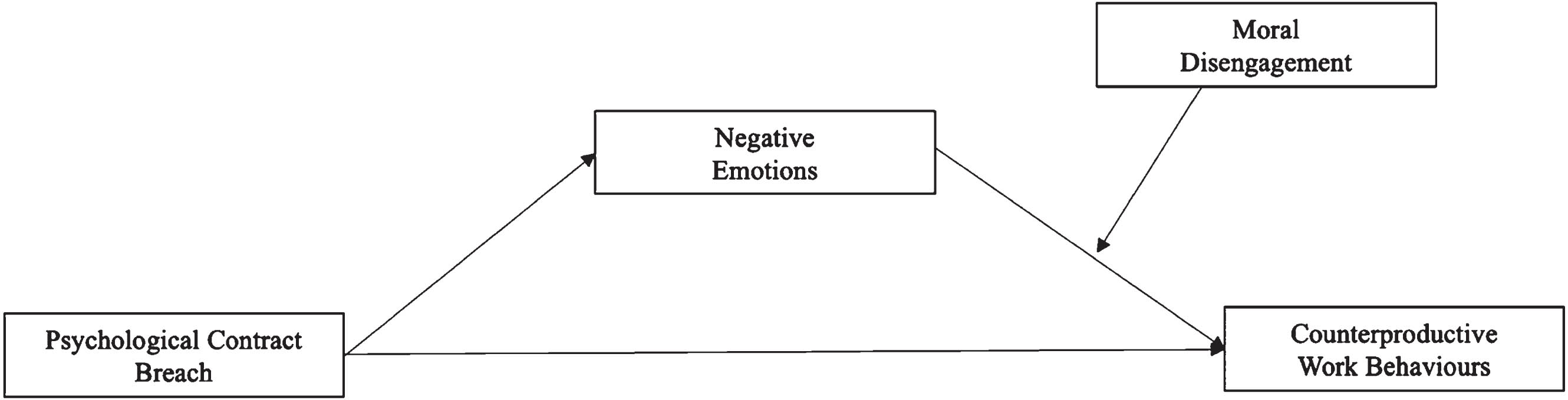
The tested model.
The research context
This study focuses on the context of Italian prisons, specifically involving correction officers who were at the entry stage of their careers. The prison environment is widely recognized as a critical workplace, due to several factors such as work overload, demanding social interactions, role ambiguity and conflict and low social status due to low wages and a stigmatized public perception [50, 51]. These stressors lead to possible reactions related to behavioral (e.g., high turnover and absenteeism rates), attitudinal (e.g., job dissatisfaction, feelings of alienation and cynicism), emotional (e.g., burnout) [52] and physical (e.g., psychosomatic diseases) dysfunctional outcomes [51].
Overall, prisons represent a highly demanding workplace, particularly for newcomers who experience significant fluctuations in their socialization patterns. This fluctuation is often referred to as the honeymoon-hangover phase, where new employees initially have high expectations and enthusiasm for their new role, but eventually experience disappointment when they encounter the challenges and realities of the job [11]. These rapid shifts in expectations and emotions during this transitional period can lead to the perceived failure to fulfill mutual obligations and feelings of violation of the psychological contract.
Surprisingly, existing research on correction officers has mostly focused on individual-level characteristics such as age, sex and tenure, while largely neglecting the organizational determinants that influence their well-being [53]. Only few studies have addressed the perceived fulfillment of obligations, namely the balanced or unbalanced nature of the psychological contract, as a key precursor to effective performance in a sensitive phase of the employment relationship, the entry stage [54].
Furthermore, the prevention of unethical behavior is a key issue in an organizational context that has the mission of supporting the execution of justice. Indeed, performing the role of a corrections officer requires an awareness of moral obligations and an adherence to values that are challenged daily by contact with inmates who have been found guilty of violating societal norms. As such, it might be proposed that in this context, the likelihood of CWB may be higher since this type of behavior may be an expression of the correction officers’ revenge on the probable failure of the psychological contract, and may also be due to the close contact with deviant behavior models. At the same time, CWB is particularly detrimental because it adversely impacts the core values of this organization, the Ministry of Justice. To the best of our knowledge, however, no study has focused on CWB in the prison workplace.
Participants and procedure
A total of 635 Italian correction officer cadets undergoing mandatory training joined the study. Their ages ranged from 19 to 33 (M = 25.25; SD = 2.27), and 496 of them (78.1%) were male.
Data were collected as part of a more extensive study on the socialization processes of corrections officers, undertaken jointly by the Training Office of the Italian Ministry of Justice and the Department of Psychology at Sapienza University of Rome. The focus was to identify the supportive and detrimental factors that impact newcomers during their entry stage. When cadets enter the Prison Administration, they attend a mandatory twelve-month course that includes, as a part of this training, a two-month internship in a prison setting. This internship is an important step in their pre-professional development as it allows them to observe, question and experiment, thus having the opportunity to understand their future work context and gain experience in the field of corrections [55]. Cadets were asked to participate in the research soon after this internship (in the eighth month of their course).
The entry stage is critical for defining an effective psychological contract, at a time when both parties employ social negotiation to adjust their expectations and shape the newcomers’ motivation and commitment, and establish their intended length of stay in the organization [54].
During their training sessions, the cadets completed an online questionnaire introduced by a presentation letter from the administration. The letter outlined the research and its main objectives and assured the confidentiality of the participant’s responses. The study received approval from the local ethics committee (Institutional Review Board of the first author’s University) and complied with the revised version of the Helsinki Declaration.
Measures
Psychological contract breach (PCB) rated the extent to which the organization fulfilled or failed to fulfill its obligations. A four-item scale from Robinson and Morrison [38] was utilized to capture the perceived breach component (e.g., “I have not received everything promised to me in exchange for my contributions”) and the feelings of violations component (e.g., “I feel betrayed by my organization”). The responses were given on a five-point Likert scale ranging from 1 = “strongly disagree” to 5 = “strongly agree”.
Job-related negative emotions (JNE) were assessed using nine items reflecting high- and low-arousal negative affective states from the Job-Related Affective Well-Being Scale (JAWS; Van Katwyk et al., 2000). Participants were asked to indicate how frequently they experienced each of the described emotional states (for example, anxious, depressed, or annoyed) as a result of their job during the previous month (that is, during their internship in prison). Responses were provided on a five-point scale, ranging from 1 “never” to 5 “very often or always”.
Counterproductive work behavior (CWB) was assessed using four items from the CWB checklist developed by Spector and colleagues [57] (e.g., “Taken a longer break than you were allowed to take”, “Insulted or made fun of someone at work”). Participants were asked to indicate the frequency with which they engaged in each listed behavior on a five-point scale, ranging from 1 “never” to 5 “very often or always”.
Moral disengagement (MD) was assessed with a seven-item scale developed by Fida and colleagues [48]. It captures the extent to which individuals adopt moral disengagement mechanisms in relation to their work activities (e.g., “It is not a big deal to be absent from work since everyone does it”). Participants were asked to rate their level of agreement on a five-point Likert scale, ranging from 1 = “strongly disagree” to 5 = “strongly agree”.
Data analyses
Means, standard deviations, reliabilities and intercorrelations among study variables were implemented using the statistical software SPSS 25.
The hypotheses concerning direct, mediated, and moderated effects were tested through conditional process analysis based on ordinary least squares (OLS) regression using a bootstrapping technique [58], a nonparametric resampling procedure that does not assume normality and involves the extraction of several thousand sub-samples (5000 in our case) from the dataset. Through bootstrapping, the distribution of effects is empirically approximated and used for calculating confidence intervals [59]. Specifically, the models examined in the current study correspond to the conceptual model numbers 4 and 14 of Hayes templates [58]. Gender and age were inserted in the model as control variables.
Results
Table 1 presents the zero-order correlations and Cronbach’s alpha reliabilities for the study variables. Strong positive correlations were found among all four study variables. Additionally, a positive correlation was found between sex and JNE, indicating that women reported a higher level of job-related negative emotions. Conversely, age was negatively correlated to MD, suggesting that younger participants reported a lower sense of moral disengagement. The reliability of the measures, assessed by Cronbach’s alpha coefficients, was satisfactory for all variables, with values ranging from 0.74 to 0.86, although only sufficient for PCB (0.67).
Descriptions, inter-correlations, and reliabilities of the study variables
Descriptions, inter-correlations, and reliabilities of the study variables
Note: Gender was coded as 1 = man and 2 = woman; **p < 0.01; *p < 0.05; Cronbach’s alphas are in the diagonal in brackets.
Table 2 reports the results of the conditional process analysis conducted on two models: Model 1 is a simple mediation model where JNE mediates the path from PCB to CWB; Model 2 consists of Model 1 with the addition of moderation by MD on the JNE–CWB relationship (see Fig. 1).
Results of the conditional process analysis
*p < 0.05; **p < 0.001; LLCI, ULCI: lower and upper levels for the confidence interval.
Model 1 confirmed Hypothesis 1, which stated that there would be a positive relationship between psychological contract breach and CWB, showing a significant direct effect of PCB on CWB (β= 0.29, LLCI = 0.24, ULCI = 0.35). Hypothesis 2 was partially supported, as the results showed the existence of a significant partial mediating effect of JNE in the PCB–CWB relationship (β= 0.08, LLCI = 0.03, ULCI = 0.14). In particular, this mediating effect explained 26% of the variance of the direct effect (Model 1: R2 = 0.26). Among the control variables, only sex had a significant, albeit weak, negative effect in the tested model (β= –0.10, LLCI = –0.17, ULCI = –0.02).
In Model 2, a mediated moderated model was tested. In line with Hypothesis 3, we found a significant interaction effect between JNE and MD on CWB (β= 0.10, LLCI = 0.05, ULCI = 0.15) and the JNE mediating effect explained 31% of the variance (Model 2: R2 = 0.31).
Finally, Figure 2 shows the plots regarding the interaction between JNE and MD on CWB. The findings show that MD moderates the JNE–CWB relationship only when JNE are high. Specifically, when the cadets experience high Negative Emotions in their job, these emotions affect CWB only when they feel highly morally disengaged (β= 0.40, p < 0.001), whereas the JNE–CWB relationship is not significant when MD is medium or low. On the other hand, when the cadets experience low Negative Emotions in their jobs, MD does not moderate the JNE–CWB relationship. In fact, a simple slope analysis revealed that, although the effect of JNE on CWB was positive and significant only at a high level of the moderator (β= 0.40, p < 0.001), The results indicate that when MD is high, it significantly enhances the effect of the predictor on CWB.
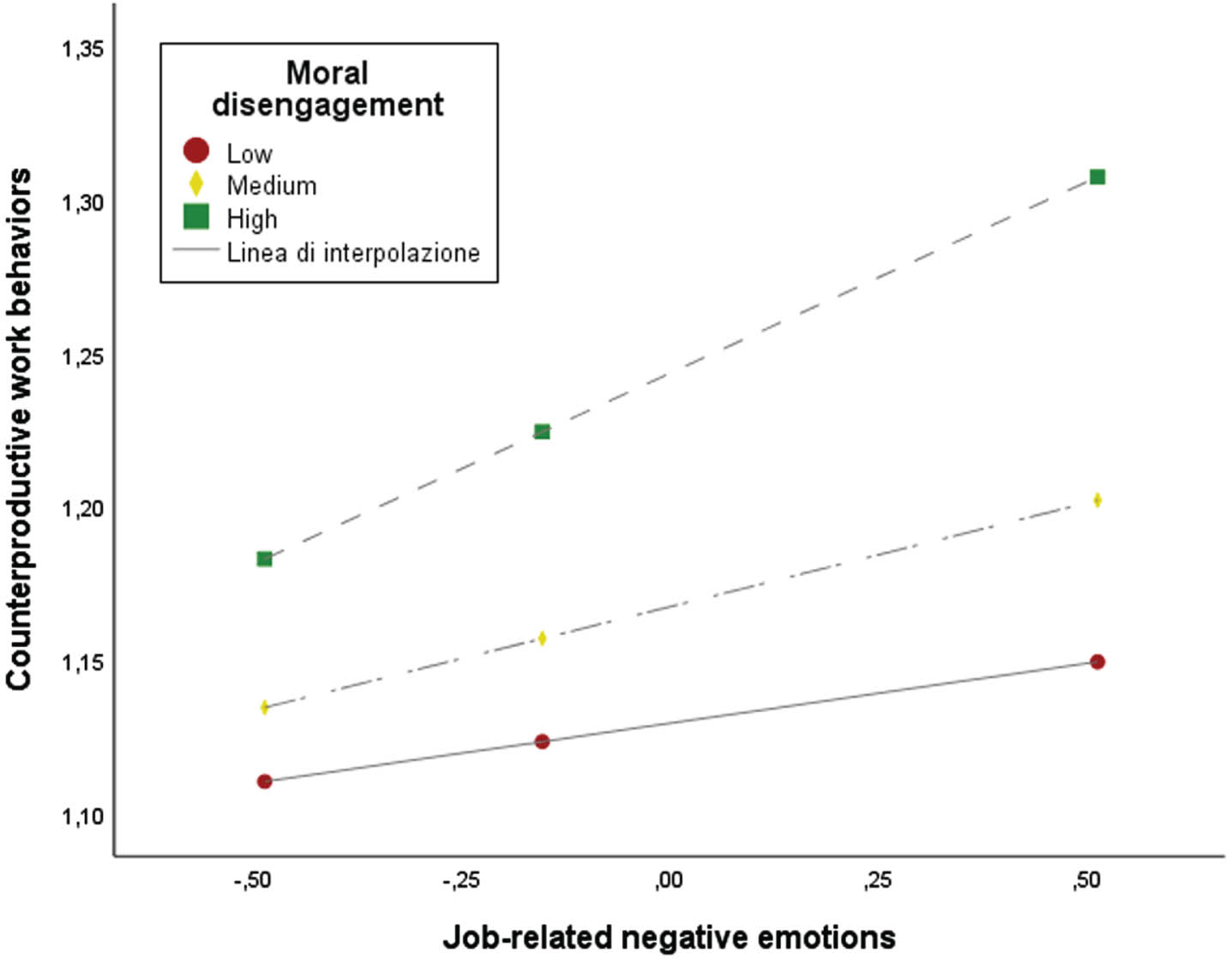
Plots of the interaction between Job-related Negative Emotions and Moral Disengagement on CWB.
This suggests that MD may act as a boosting factor of CWB, above all when individuals also experience high JNE. In other words, the NE–CWB relationship is strengthened when the new cadets adopt cognitive moral disengagement mechanisms. Furthermore, the buffering effect of MD is more powerful when individuals experience stronger negative emotions. These findings imply that the combination of high JNE and MD intensifies the likelihood of engaging in CWB among the new cadets.
Theoretical implications
This study has sought to examine the relationship between a failure of a psychological contract and the enactment of deviant behavior in the workplace, providing a deeper understanding of this detrimental process. The findings of the study aligned with the limited empirical evidence on this relationship, contributing to a justice framework that helps disentangle the nature of unethical behavior and shed light on perceived unfairness as a potential motive for CWB [5].
Our findings also offer a novel perspective by incorporating the affective component in the pathway from the trigger –namely the failure of the psychological contract –to actual behavior. While perceiving an unfairness in mutual obligations enhances a state of readiness for engaging in deviant behavior [5, 37], the tested model shows how job-related negative emotions mediate this pathway, thus providing insight into how CWB can manifest in concrete actions.
Finally, this study contributes to the justice literature by highlighting the buffering role of moral disengagement and confirming its function in regulating moral standards through a cognitive process of justification aimed at reducing the perceived dissonance [1]. The findings of this study highlight the interplay between moral disengagement and negative emotions, indicating that the transition to CWB occurs primarily in cases of high negative emotions.
In line with the frustration-aggression theory [8], the results suggest that experiencing negative emotions at work fosters the transition from the breach of the psychological contract and the related feeling of violated expectations to the enactment of revenge-oriented deviant behavior aimed at rebalancing perceived unfairness. However, it is only when negative emotions are heightened, increasing the likelihood of deviant behavior, that the moral disengagement mechanism is enacted. By helping to reduce the internal dissonance, moral disengagement paves the way for the enactment of concrete deviant behavior (CWB). Overall, the study reveals a more nuanced understanding of the relationship between psychological contract breach and CWB, highlighting the contribution of affective and cognitive components underlying this link.
Practical implications
From an organizational development perspective, the findings of this study provide some relevant insights for management practice, highlighting the various processes that can contribute to a loss spiral and ultimately lead to counterproductive behavior. In general, organizations should prioritize fairness and transparency in their policies and practices to avoid breaching the psychological contract, also implementing specific measures that effectively prevent and address CWB, such as designing practices to promote ethical behavior or providing training on moral reasoning aimed at detecting and downplaying moral disengagement mechanisms.
One avenue for intervention is the early socialization phase, which is a critical period for establishing mutual obligations between the organization and newcomers. During this phase, organizations can proactively manage the psychological contract by implementing training programs that clarify expectations, define shared commitments and foster a clear understanding of the psychological contract. Mentoring programs might also be effective in supporting employees, particularly newcomers, by creating awareness of possible dysfunctional cognitive mechanisms such as moral disengagement. Mentors can serve as guides and role models, helping mentees recognize and navigate these mechanisms, thus contributing to downplaying the self-sanctioning processes [60]. They can also provide alternative models for mentalization and managing negative emotions, and offer functional coping strategies to address failures in the psychological contract, ultimately reducing the likelihood of engaging in counterproductive work behavior (CWB).
Organizations could also implement interventions to address negative emotions, for instance creating a supportive and conducive work environment that fosters employee well-being and reduces the occurrence of counterproductive behavior; providing support for employees who may be experiencing negative emotions, above all during the early stages of their careers when they are highly sensitive to understanding and assimilating the values and shared attitudes of the workplace; or helping employees to develop effective coping strategies for managing negative emotions related to their jobs.
These insights are particularly relevant for corrections officers, who often face challenges related to their professional status and high job demands. However, the implications extend to other professions where employees may experience imbalances in their psychological contracts, such as high demands and low rewards.
Limitations and future studies
This study has several limitations that should be acknowledged. First, the cross-sectional design of the study limits our ability to establish causal relationships between breaches of expectations and counterproductive work behavior (CWB). Further research employing longitudinal designs could provide a more robust understanding of the temporal dynamics and causal effects between these variables.
Second, the study focused specifically on newcomers. While this helps in understanding the process at an important career stage, this may limit the generalizability of the findings to more senior workers. Investigating whether similar processes occur in more experienced employees would provide a more comprehensive understanding of the phenomenon.
Third, the participants were exclusively from the Ministry of Justice, an organization specifically focusing on ethical issues. Therefore, caution should be exercised when generalizing the findings to other types of organizations with different values, cultures and contexts.
Another limitation is the risk of a social desirability response bias, in fact CWB are sometimes “carefully hidden” [9], hence future studies could complement self-report measures with other reports (co-workers, supervisor) to enhance the measures’ accuracy.
Finally, the study examined overall negative emotions related to job experiences. Future research could delve deeper into the specific types of negative emotions (for instance, low versus high arousal or specific emotions) and their differential impact on CWB and its targets (i.e., individuals or the organization). This would provide a more nuanced understanding of the emotional processes underlying CWB. Addressing these limitations in future research would enhance our understanding of the complex dynamics between breaches of expectations, negative emotions and CWB, allowing for more robust and generalizable findings.
Data availability statement
The data that support the findings of this study are available from the corresponding author, M.F., upon reasonable request.
Ethical approval
Institutional Review Board of Department of Psychology, Sapienza University of Rome, prot. 00941.
Informed consent
All study participants provided informed written consent prior to study enrollment.
Conflict of interest
Not applicable.
Footnotes
Acknowledgments
The authors gratefully thank dr. Paola Gubbiotti and all the employees of Training Office of the Italian Ministry of Justice for their support and commitment.
Funding
Not applicable.