



Abstract
BACKGROUND:
For sparse and limited angle projection Computed Tomography (CT), the reconstructed image usually suffers from considerable artifacts due to undersampled data.
OBJECTIVE:
To improve image reconstruction quality of sparse and limited angle projection CT, this study tested a novel reconstruction algorithm based on Dictionary Learning (DL) from sparse and limited projections.
METHODS:
The study used signal sparse representation and feature extraction to render the DL technology, which is constrained by L2 and Lp norms, respectively. A Lp Norm Dictionary Learning term is suitable for regular term of objective function for CT image reconstruction. This is helpful for solving the objective function by combining algorithm of ART. Based on these features, the new algorithm of ART-DL-Lp is proposed for CT image reconstruction. The alternate solving strategy of the algorithm of “ART first, then adaptive DL” is provided in sequence. The impact on reconstruction results of ART-DL-Lp at different p values (0 < p < 1) is also considered.
RESULTS:
For non-ideal projections with noise, the digital experiments show that ART-DL-Lp data were superior to those of ART, SART, and ART-DL-L2. Accordingly, the objective evaluation metrics for non-ideal situation of RMSE, MAE, PSNR, Residuals and SSIM are all better than those of contrasted three algorithms. The metrics curves of ART-DL-Lp algorithm are recorded as the best. In both incomplete projection situations, smaller p-value of ART-DL-Lp algorithm induces more close reconstructed images to the original form and better five objective evaluation metrics.
CONCLUSIONS:
Overall, the reconstruction efficiency of the proposed ART-DL-Lp for CT imaging using the noisy incomplete projections outperforms ART, SART and ART-DL-L2 algorithms. For ART-DL-Lp algorithm, lower p-values result in better reconstruction performance.
Introduction
Computed Tomography (CT) technology uses attenuation information of X-rays through the object to reconstruct its CT images. CT does not only revolutionize the medical diagnosis but also impact the industrial nondestructive testing routes. From the practical viewpoint, only incomplete projection data can sometimes be acquired due to restriction and constraints of acquisition time, radiation dose, bins configuration, and scanning geometry. Incomplete angle projection of image reconstruction mainly contains sparse and limited angle projection reconstruction [1–3]. Hence, investigating image reconstruction technology of incomplete angle is an effective measure to solve such problems, which plays important roles in practical applications.
Compressed sensing(CS) theory is a signal acquisition and decoding code based on the precondition that the signal can be compressed or represented sparsely in some (or transformed) domain [4, 5]. In X-ray CT, CS algorithms based on iterative technology cannot only reduce the amount of projection data requirements but might ensure the quality of reconstructed images. As a result, CS theory is increasingly utilized in CT image reconstruction, where dictionary learning methods became an important mainstream research field [6–8].
Dictionary learning includes two main key steps. The first consists of sparse coding (or representaion) and the second is dictionary learning (or updating). Matching pursuit algorithms, such as MP (Matching Pursuit) [9] and OMP (Orthogonal MP) [10], are commonly used in sparse coding. One building method to an over-complete dictionary consists of inciting the dictionary to learn by training samples to ensure sparse representation of the signal. The main dictionary learning algorithms currently include the optimal direction method [11] and K-SVD(K-means Singular Value Decomposition) [12, 13] learning algorithm. The latter developed in 2009 by ELAD is found compatible with today’s sparse decomposition algorithm, which is a commonly used method. Generally, the sparse representation of current dictionary and updating process of atoms are alternately executed to achieve the purpose of dictionary learning.
From the viewpoint of optimization, sparsest coding is essentially a L0 minimization problem, which, in turn, is an NP-hard problem. Therefore, many pioneering algorithms have been developed based on these features, which could basically be classified as greedy algorithm [14], L2 minimization, and Total Variation (TV) minimization algorithm [15]. Compared to greedy algorithm and L2 minimization algorithm, TV minimization algorithm could provide good capability of noise suppression [16], which is a very important feature in image reconstruction field.
For instance, Xu et al. [17] introduced GDSIR and ADSIR dictionaries as two sparse representation methods, and satisfactory results were reported in their work in terms of low dose CT image reconstruction. Lu et al. creatively developed double dictionary learning method by combining TV constraint using transition dictionary for atoms matching and global dictionary for image updating. Other studies used dictionary learning by adopting L2 norm of signal reconstruction error as regularization item of the objective function [18]. If based on L2 norm of signal reconstruction error, the solution tended to spread the signal energy to all elements of the image to yield a solution that is not really a sparse one. Other researchers employed dictionary learning method based on L1 constraints to low dose CT image reconstruction [19]. Compared to optimization problem with L2 norm, the L1 norm based constraint problem could provide more optimized solutions [20]. On the other hand, Lp norm has also been employed to replace L2 constraints [21]. Better sparse representation properties can be acquired for reconstruction signal with the less required number of the sampled data for accurate reconstruction. Cao et al. [22] demonstrated that half threshold iterative algorithm of L0.5 constraint performed better in solving sparse problems when compared to soft threshold iterative algorithm of L1 constraint. All the above literature imply that Lp constraint would yield better sparse and convergence characteristics. However, only a handful of studies have focused on applications of dictionary learning restrained by Lp in CT image reconstruction.
In this study, DL method and ART of algebraic iterative reconstruction algorithm are combined. The reconstruction objective function is put forward naturally by considering the DL constrained by Lp norm. Next, by taking the iteration result of one round by ART as the initial learning value of adaptive dictionary, both OMP and K-SVD algorithms are employed to complete atom matching and dictionary update, respectively and iteratively. Consequently, the objective function is divided into two equivalent sub-problems of ART part and Lp DL part. Using alternately solving principle, the ART-DL-Lp algorithm based on over-complete DL and ART are solved first by reduced iterations of “ART followed by DL” mode. Finally, the proposed algorithm is respectively applied to CT image reconstruction of sparse and limited angle using computer simulations. The results are then compared with those of other algorithms to verify the feasibility and effectiveness of the proposed algorithm. The effects of different p values for Lp norm constraint are also evaluated by comparing the simulation data.
The rest of this paper is organized as follows. In Section 2, sparse representation and dictionary learning method will be introduced. In Section 3, the proposed reconstruction approach and its implementation will be described. In Section 4, representative reconstruction results from sparse and limited angle projections will be reported based on a novel algorithm, and the performance of the proposed methodology will be quantifed. Finally, in Section 5, the paper will be concluded.
Dictionary learning method
Sparse representation
According to the sparse representation theory, the signal can be represented by linear combination of finite number of dictionary atoms. One image patch can be represented by Equation (1).
In general, after determination of the dictionary, the sparse representation of an image patch x is needed to be found, ensuring minimum non-zero elements number of coefficient of the sparse representation. This process is equivalent to solving constraint optimization problem shown in Equation (2):
By introducing the factor δ of fidelity constant adjustment, Equation (2) can be transformed into Equation (3) with non-constraints:
Greedy algorithms like OMP could generally be adapted to Equations (2) and (3). During iteration process, the best match atoms in the signal are constantly searched, and the orthogonal projection in space of selected atoms and calculations of residual error after projection information can successively be calculated until the results meet a predefined error limit ɛ.
Before performing sparse representation of extracted image patch, the corresponding dictionary for image requires building. The commonly used image dictionaries are fixed, which are obtained by discrete cosine or discrete wavelet transforms. However, due to non-adaptivity of fixed dictionary, this cannot approximately represent the signal to the greatest extent.
Therefore, the dynamic learning image method is often adopted to gain adaptive dictionary. The process assumes that training images of N × N for iteration are randomly divided into small image patches (S) to construct the training set, where
In this study, transitional image during iterative reconstruction is employed as training samples for dictionary training. The appropriate dictionary is gradually and adaptively obtained using K-SVD algorithm. Simultaneously, the atoms in the dictionary are updated successively. Hence, Equation (4) could be transformed into Equation (5). The role of K-SVD algorithm is to yield minimum value of Equation (5).
Iterative reconstruction with L2 dictionary learning
Iterative reconstruction algorithms of CT have good abilities to noise and artifacts inhibition ability. For incomplete projection data, they can also reconstruct better quality images. Thus, iterative reconstruction algorithms have received increasing attention.
The reconstruction algorithms based on dictionary learning do not only reduce the number of equations but also include the structure information of the image. The dictionary learning method and iterative reconstruction method combined with the image might effectively implement incomplete projection CT image reconstruction. The process of reconstruction image consists of solving the objective function presents in Equation (6):
The first term of Equation (6) minimizes the deviation between the computed projection and actually measured projection, called the fidelity term. The second term is called a penalty term of prior sparse representation, which uses sparse representation of the dictionary. Hence, the objective function shown in Equation (6) can be broken down to the following three steps of alternate solving iteratively: Using previous last iteration (or initial) results, ART would be employed to update the image X for once, and dictionary D will be learned by parches from X. The sparse representation vector will next be solved with dictionary D and image X from step (1), according to Equation (7):
The image X will then again be updated according to the dictionary D from step (1) and α
s
from step (2) using Equation (8):
The regularization of Equation (6) is constrained by L2 norm, and its function is to constrain the deviation summation of L2 norm between each image patch and its sparse representation of over-complete dictionary. The calculation principle shows that the regular component corresponding to image patch of convergent solution of reconstruction algorithm constrained by L2 norm will have the same order of magnitude. In terms of energy distribution, the optimal solution has the tendency of evenly distributing the energy to each dimension based on global average energy strategy. However, most CT images only meet the characteristics of local smoothing. Thus, most overlapped image patches extracted from training samples contain less image information due to characteristics of local smoothing of the original image. Using the same premised sparse level, the residual value from sparse representation of over-complete dictionary is often close or equal to zero. Only small numbers of image patches on the edge structure of original image contain more image information. For those patches, the residuals value corresponding to the sparse representation of over-complete dictionary is relatively larger. Therefore, by taking the dictionary learning as a regular item and making most energy of the image patches close or equal to zero, as well as distributing the regularization energy to limited image patches, the sparse distribution method could be more matched to characteristics of CT image, a more conducive method to extract prior information of images. By definition, a regular item of Lp norm could fit the energy distribution with the above sparse distribution [22, 23]. In this study, Lp norm of regular constraint item is employed to replace existing reconstruction algorithm of L2 norm regularization, and build a new dictionary learning reconstruction method in the form of the objective function shown in Equation (9):
In Equation (9), deviation between the extracted image patches and sparse representation with an over-complete dictionary is constrained by Lp norm regularization
The replacement of L2 constraint with Lp would provide a novel idea for image reconstruction of incomplete CT. Based on Equation (9), the pseudo-code process is employed for iterative reconstruction algorithm (ART-DL-Lp) using ART and Lp dictionary learning as follows:
Initial: P0, X0, ARTIter, Lambda, SATIter, Beta, DL params: patch, atoms, T0, th, stride
for k = 1 to num1 do
Implement ART algorithm for one time and output Randomly extract a set of patches sized N3 = min(N, N2); Randomlyextract N3 columns from TE to form training data YHK ×N3; Principal components analysis operation for YH based on SVD; Construct the initial dictionary D(0) by selecting the column vectors (atoms) corresponding to the principal components; K-SVD starts: Normalize the sictionary D(0); for num2 = 1 to numK-SVD do
Sparse represent YH by atoms of D(0) based on OMP, update D(0) as D and initialize α (s.t sparsity levels < T0), namely Equations (4)/(5); Sparse represent YH by atoms of D, the representation error is perform by SVD, and the corresponding dictionary atom to be updated is obtained by solving the maximum full rank column vector of the representing error. So update D column by column. (s.t. representing error < th).
end for
K-SVD ends: Computing sparse representations of all patches by D based on OMP; Summing up the patch approximations and update the image X(k–1) as X
(k); X =X
(k);
end for
Output final image X.
end
To verify effectiveness of the proposed algorithm, the classic Shepp-Logan image [24] was selected to complete the projection and reconstruction experiments. The reconstructed results of ART-DL-Lp were then compared to those of ART, SART, and ART-DL-L2 algorithms. Contrast work was carried out regarding both aspects of subjective reconstruction quality and objective reconstruction quality metrics. The objective reconstruction quality metrics will include: 1) Root Mean Square Error (RMSE), 2) Mean Absolute Error (MAE), 3) Peak Signal to Noise Ratio (PSNR), 4) Residual image L2 norm value (Residuals), and 5) Structural Similarity (SSIM) [25, 26].
Experimental Parameters
Experimental Parameters
During the process of actual projection and image reconstruction, generation of noise is inevitable. To verify the validity of the algorithm, the numerical simulation reconstruction experiments were based on non-ideal conditions (noise) case. The p-value of Lp was set to 0.667 for the sparse and limited angle situation.
The reconstruction images of each algorithm for 360° with noisy sparse projection are shown in Fig. 1. Note that noise is inevitable during actual projecting process. To test the algorithm practicability, 5% Gaussian random noise was added to the projection data, and the reconstruction work was performed for the four algorithms mentioned above. The comparison between the algorithms through observation and contrast revealed that curve of ART-DL-Lp is better than other sub-graphs, with reconstruction effect closer to that of sub-graph of original image of Shepp-Logan. The effect of ART-DL-L2 is close to that of ART-DL-Lp. However, the details indicate that reconstruction quality of ART-DL-L2 is slightly less than that of ART-DL-Lp. Classical ART algorithm and SART algorithm induces the worst quality of reconstruction with obvious noise and artefacts. Also, the anti-noise abilities of these algorithms are insufficient, as can be observed from the noisy reconstruction images. To evaluate the advantages and disadvantages of reconstruction image quality of all above algorithms, the error images of iterative reconstruction after 15 times are collected and the results are displayed in Fig. 2.

Reconstruction images for sparse noisy projection: (a) original image of Shepp-Logan, (b) reconstruction result of classical ART algorithm, (c) reconstruction result of SART algorithm, and (d) and (e) respectively represent the results of ART-DL-L2 and ART-DL-Lp (p = 0.667). Display window [0,1].

Error images for noisy sparse projection: (a) classical ART algorithm, (b) SART algorithm, and (c-d) represent the error images of ART-DL-L2 and ART-DL-Lp (p = 0.667), respectively. Display window [0,1].
Figure 2(d) shows an error image with almost uniform distribution of gray value and minimum noise. Hence, the reconstruction of ART-DL-Lp (p = 0.667) algorithm under these conditions is the best. The error image of ART algorithm illustrates obvious phenomena of strips artifacts (Fig. 2(a)), indicating substantial noise and artifacts in the corresponding image. The error image of ART-DL-L2 depicts uniform gray scale distribution with no obvious strips artifacts. Compared to Fig. 2(d), the error images in Fig. 2(a) and 2(b) depict apparent edges, showing ART-DL-Lp algorithm with better edge-reserve ability than both traditional algorithms. Meanwhile, obvious sporadic spots can be observed in Fig. 2(a) and 2(b) while the numbers of sporadic spots gradually reduce in Fig. 2(c) and 2(d).
Figure 3 represents the objective evaluation metric curves of reconstruction effect, where (a), (b) and (d) gather RMSE, MAE and Residuals curves of different algorithms. It will be noted that RMSE, MAE and Residuals curves of ART and SART algorithms are higher than those of the two other algorithms, showing bigger error. On the other hand, the deviation evaluation metric curves of RMSE, MAE and Residuals of both dictionary learning algorithms are close to zero. This indicates that reconstruction effect is close to the original image. Figure 3(c) represents the PSNR value of the image. The ART-DL-Lp (p = 0.667) algorithm shows the largest PSNR (close to 25) while PSNR value of SART has reached minimum of 19. The PSNR curves of ART-DL-L2 and ART are located between the above-mentioned values of both algorithms, The PSNR for ART-DL-Lp (p = 0.667) algorithms appears slightly better than the corresponding ART-DL-L2. Figure 3(d) depicts the Residuals curves. The observations are similar to those of Fig. 3(a). Figure 3(e) shows the SSIM curves. The features look almost similar to those of Fig. 3(c). The SSIM index for reconstruction image of ART-DL-Lp algorithm is the best among others, with a value close to 0.8. The SSIM metric curve of ART-DL-L2 increases along with iteration times. The SSIM curve of ART algorithm is the lowest, showing that the reconstructed image using ART is the worst and its similarity to the true image is only 30%.

Metrics curves for sparse projection reconstruction image with noise: (a) RMSE curves of ART, SART, ART-DL-L2, and ART-DL-Lp (p = 0.667) algorithms. (b) MAE curves of ART, SART, ART-DL-L2, and ART-DL-Lp (p = 0.667) algorithms. (c) PSNR curves of ART, SART, ART-DL-L2, and ART-DL-Lp (p = 0.667) algorithms. (d) Residuals curves of ART, SART, ART-DL-L2, and ART-DL-Lp (p = 0.667) algorithms. (e) SSIM curves of ART, SART, ART-DL-L2, and ART-DL-Lp (p = 0.667) algorithms.
The reconstruction images using the same parameters and 150° limited angle results are shown in Fig. 4. The existing random noise worsens the images of the algorithms. Experimental phenomena similar to those described in subsection 4.1 are obtained. Figure 4(b) depicts the reconstruction result of classical ART algorithm. Figure 4(c) shows a certain degree of artifacts but lesser than Fig. 4(b). Figure 4(d-e) correspond to reconstruction results of ART-DL-L2 and ART-DL-Lp (p = 0.667). Obvious strips artifacts exist in the missing directions of the projection angle. Also, clear noise in images of ART and SART algorithms reconstruction is observed. By comparison, the reconstructed images using ART-DL-L2 and ART-DL-Lp (p = 0.667) based on dictionary learning depict no obvious noise, except existence blurry blocks in the image caused by excessive smoothing.

Reconstruction images for limited angle noisy projection: (a) original image of Shepp-Logan, (b) reconstruction result of classical ART algorithm, (c) reconstruction result of SART algorithm, and (d-e) represent respectively the results of ART-DL-L2 and ART-DL-Lp (p = 0.667). Display window [0,1].
Figure 5 illustrates the error images corresponding to limited angle noisy projection reconstruction. Obvious noise distribution is observed for ART (Fig. 5(a)) and SART (Fig. 5(b)) algorithms while ART-DL-L2 and ART-DL-Lp (p = 0.667) show even gray distributions (Fig. 5(c) and 5(d)). Error image of ART-DL-Lp (p = 0.667) reveals the most uniform gray distribution (Fig. 5(d)), suggesting strongest ability of this algorithm in resisting noise and artifacts.
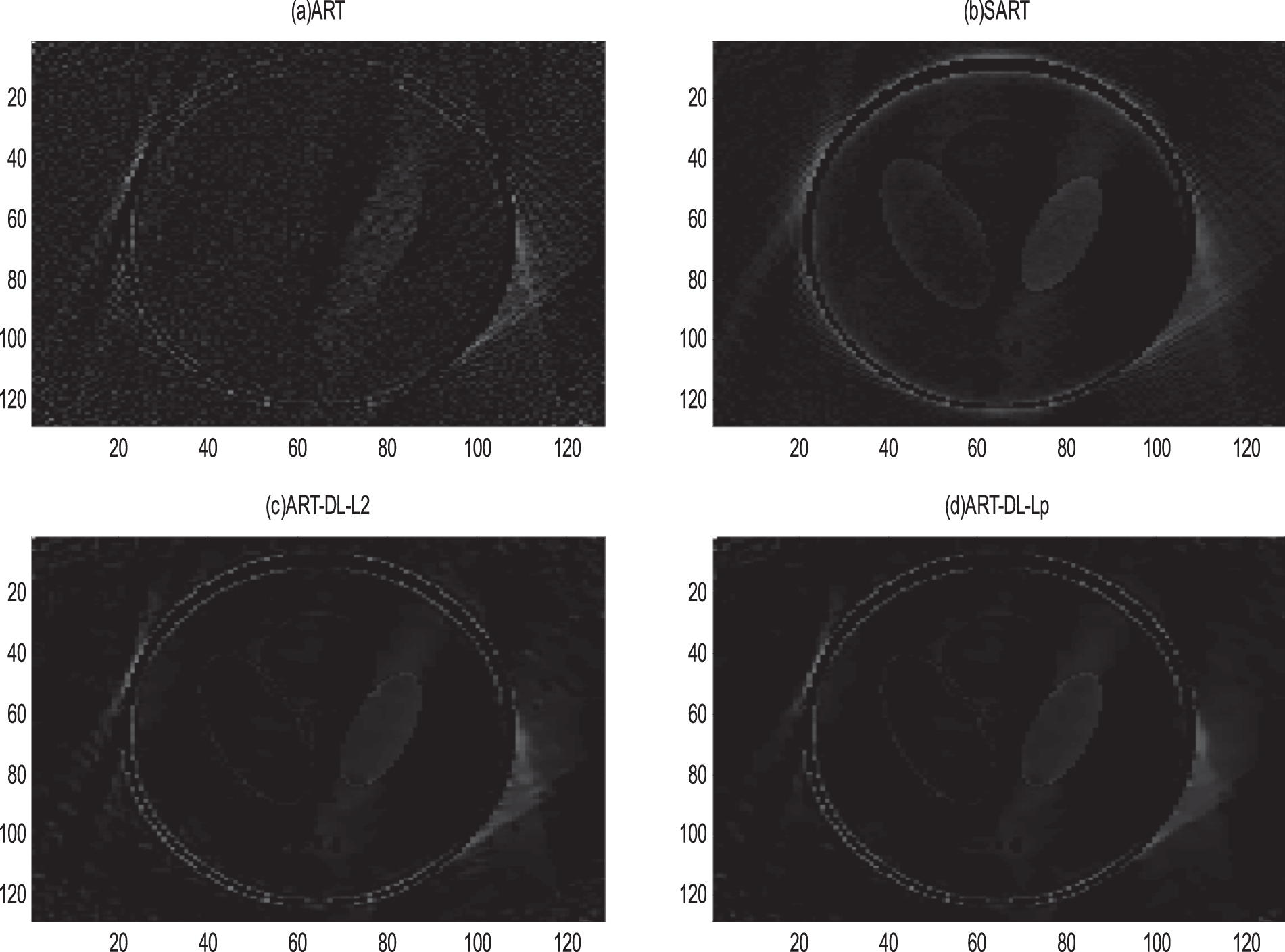
Error images for limited angle noisy projection of: (a) classical ART algorithm, (b) SART algorithm, and (c-d) represent respectively the error images of ART-DL-L2 and ART-DL-Lp (p = 0.667). Display window [0,1].
Figure 6 provides the evaluation metrics curves for limited angle projection reconstruction with noise. Similarly, the RMSE, MAE and Residuals curves of reconstructed image by ART tend to spread as number of iterations increased. This shows that reconstruction error increases gradually with iteration. The evaluation metrics curves of SART decreases obviously with the iterative process. The RMSE, MAE and Residuals curves of ART-DL-L2 and ART-DL-Lp (p = 0.667) look all better than those of ART and SART. The deviation metrics curves namely decline gradually as iteration number rose. The deviations become smaller for ART-DL-L2 and ART-DL-Lp (p = 0.667), revealing the pros and cons of an obvious difference. The curves of PSNR and SSIM look almost consistent with each other (Fig. 6(c) and 6(e)). The PSNR curves of ART-DL-L2 and ART-DL-Lp (p = 0.667) are all beyond those of ART and SART, and PSNR profiles of ART-DL-Lp (p = 0.667) algorithm are superior to those of ART-DL-L2. The PSNR curves of ART-DL-L2 looks obviously better than those of ART and SART. Figure 6(e) shows the SSIM metrics curves. It can be seen that the SSIM metrics of ART-DL-Lp (p = 0.667) algorithm are the best with final value of 65%. On the other hand, the SSIM metrics of ART-DL-L2 appears obviously better than those of ART and SART.
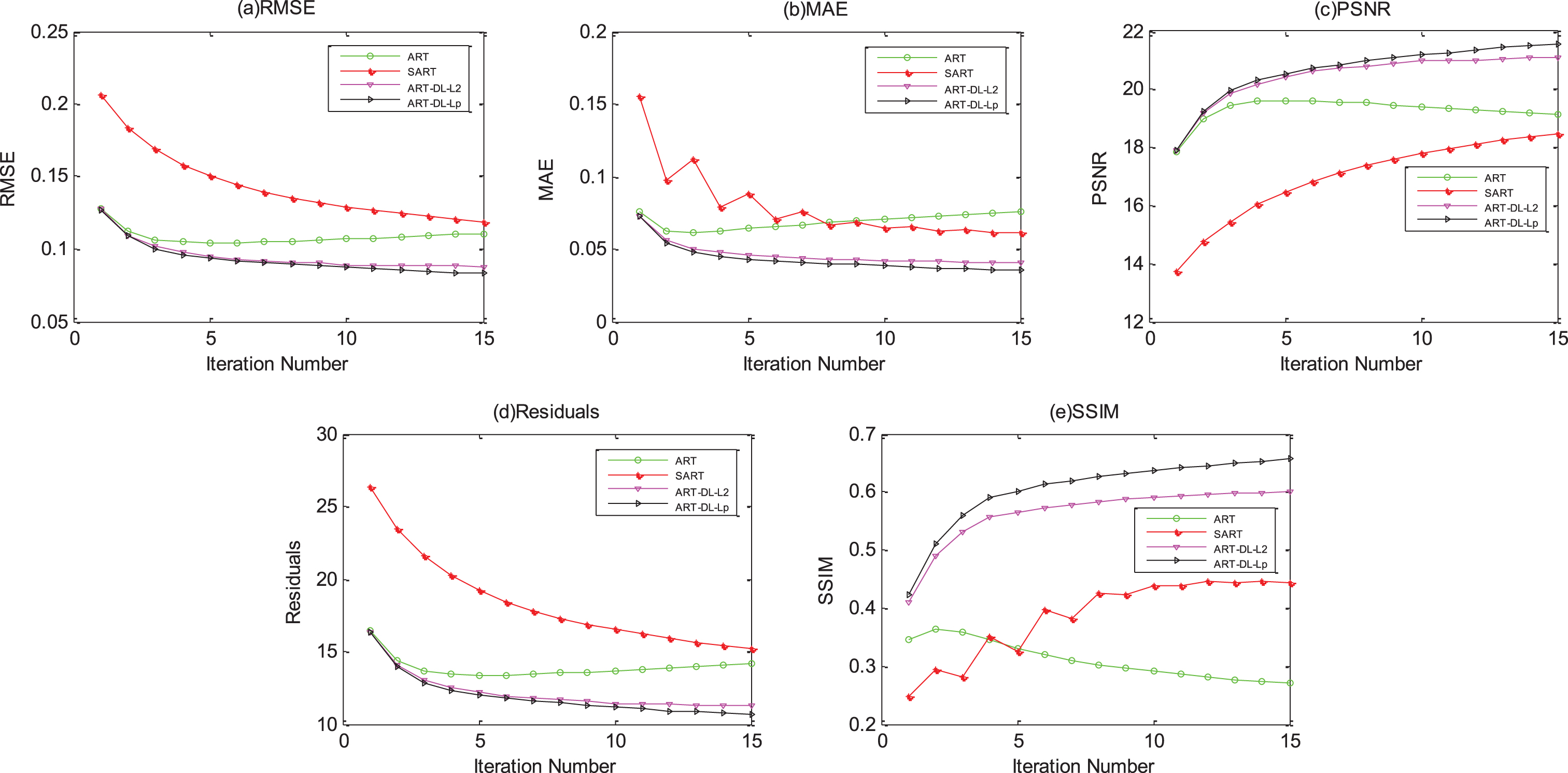
Metrics curves for limited angle projection reconstruction image with noise. (a) RMSE curves of ART, SART, ART-DL-L2, and ART-DL-Lp (p = 0.667) algorithms. (b) MAE curves of ART, SART, ART-DL-L2, and ART-DL-Lp (p = 0.667) algorithms. (c) PSNR curves of ART, SART, ART-DL-L2, and ART-DL-Lp (p = 0.667) algorithms. (d) Residuals curves of ART, SART, ART-DL-L2, and ART-DL-Lp (p = 0.667) algorithms. (e) Represent the SSIM curves of ART, SART, ART-DL-L2, and ART-DL-Lp (p = 0.667) algorithms.
To further explore the reconstruction effect of ART-DL-Lp, the contrast experiments were performed for sparse noise (5%) projection of 360° with different p values using corresponding reconstruction algorithms. The p values were selected as 0.1, 0.5, 0.75, and 0.9. Four circumstances of Lp norm constraint dictionary learning were used to carry out the reconstruction experiments, and the results are shown in Fig. 7. The 1st row shows the reconstruction data of ART-DL-Lp algorithm with different p values corresponding to different reconstruction image effects. From the subjective standpoint, distinguishing the difference between reconstructed images is pretty difficult. However, the 2nd row of Fig. 7 indicate that the five objective evaluation metrics of RMSE, MAE, PSNR, Residuals and SSIM vary obviously with p-value. The comprehensive comparison of five metrics curves suggest that smaller p values induce lower error metrics curves of RMSE, MAE, and Residuals. Obviously, smaller error metric led to closer images to the real ones. By contrast, smaller p values induce higher PSNR and SSIM metrics curves of reconstructed images. On the other hand, higher PSNR and SSIM metrics testify of corresponding images closer to the real ones. Comprehensively, for sparse projection and Lp norm constraint dictionary learning image reconstruction, smaller p values should lead to better-reconstructed images.
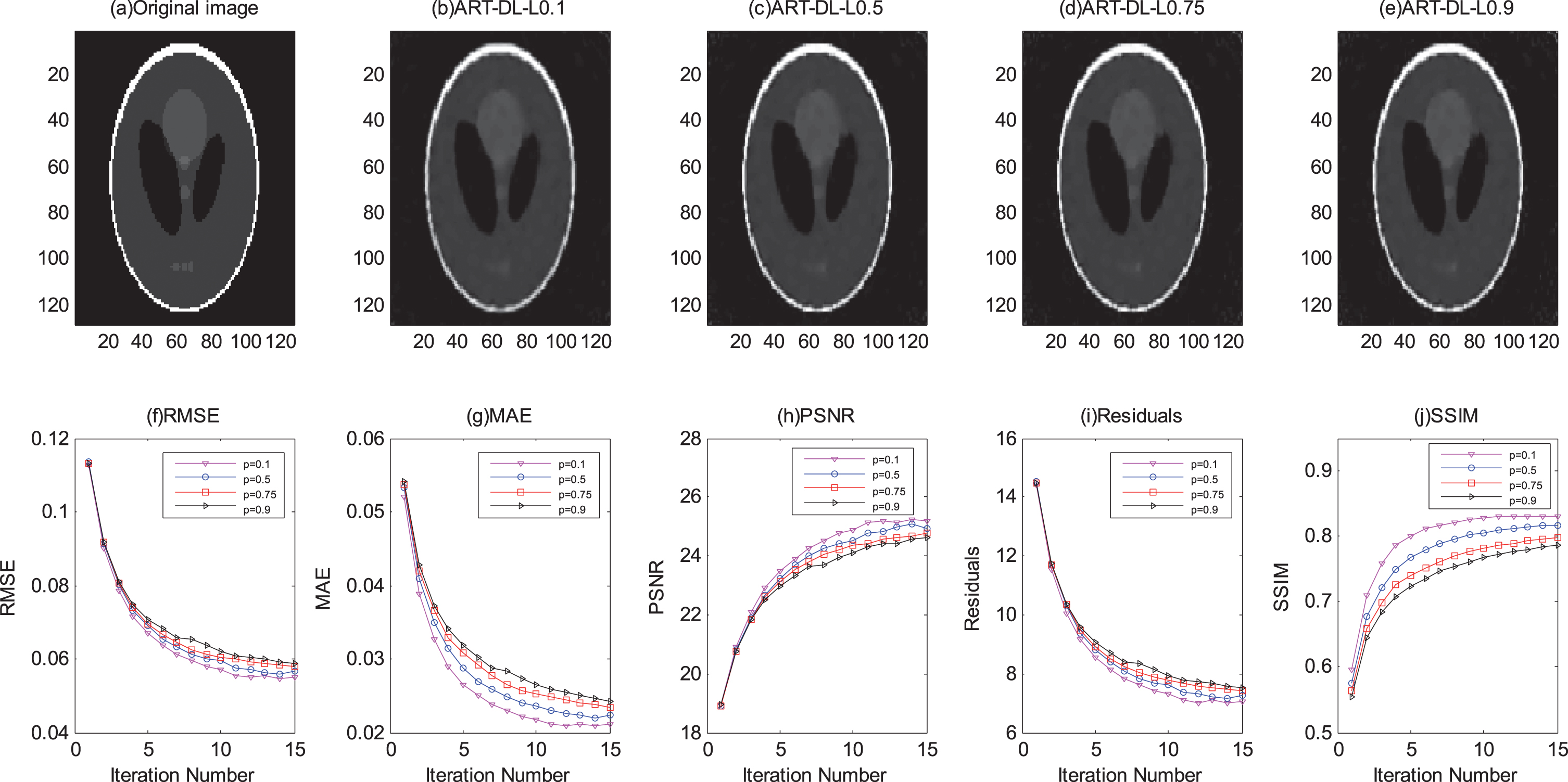
Reconstruction images and evaluation metrics for different p values under sparse projection. (a) The original image of Shepp-Logan. (b–e) Present respectively the reconstruction results of ART-DL-Lp algorithm with p values of 0, 1, 0.5, 0.75, and 0.9. (f–j) Demonstrate the metrics curves of RMSE, MAE, PSNR, Residuals, and SSIM corresponding to p values of 0, 1, 0.5, 0.75, and 0.9. Display window [0,1].
For reconstruction of 150° limited angle noise (5%) projection, image reconstruction validations for different p values of Lp (0 < p < 1) norm constraint dictionary algorithm ART-DL-Lp were also performed and the data are gathered in Fig. 8. The 1st row indicate an unclear subjective restriction of different p values for the images. The 2nd row show obvious differences between the five objective evaluation metrics with different p values. Overall, smaller p values led to better reconstruction image for limited angle.
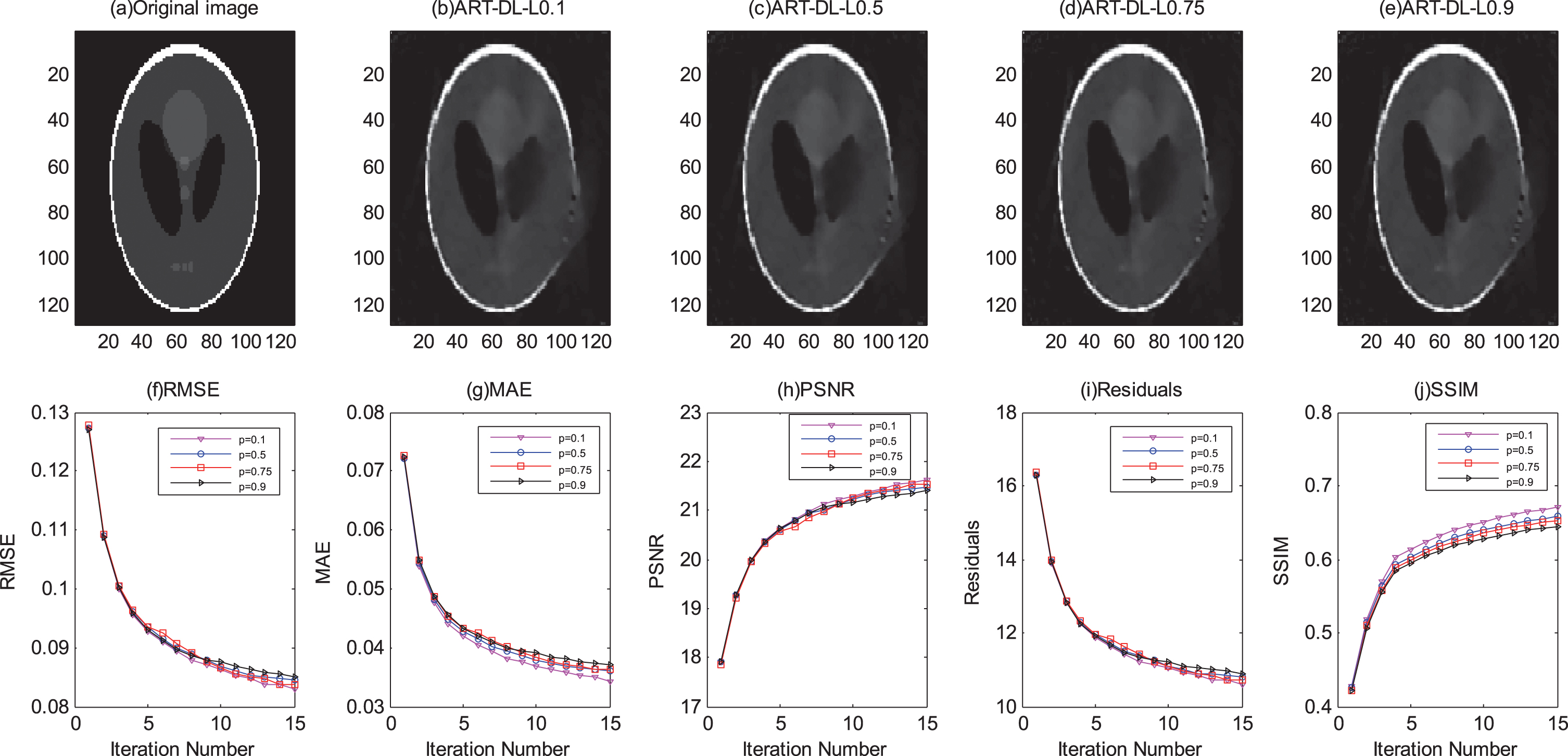
Reconstruction images and evaluation metrics for different p values under limited angle projections. (a) Original image of Shepp-Logan. (b–e) Represent the reconstruction results of ART-DL-Lp algorithm with respective p values of 0, 1, 0.5, 0.75, and 0.9. (f–j) Demonstrate the metrics curves of RMSE, MAE, PSNR, Residuals and SSIM. Display window [0,1].
Due to insufficient artifacts and noise elimination of existing reconstruction algorithms, CT image reconstruction algorithm of ART-DL-Lp for sparse and limited projections was proposed and tested. The simulation results show that good reconstruction effect can be achieved by ART-DL-Lp iterative algorithm for sparse projection of 360° and limited angle projection of 150° (with 5% Gaussian noise). The proposed algorithm depicts better reconstruction abilities than ART, SART, and ART-DL-L2. For incomplete noisy projection of sparse and limited angle, different p values of ART-DL-Lp algorithm led to variable effects. Smaller p values induce better reconstruction curves of the images, indicating improved reconstruction quality. Overall, the proposed ART-DL-Lp algorithm could better support incomplete projection CT image reconstruction with good ability to noise and artifacts resistance.
Footnotes
Acknowledgment
The authors gratefully acknowledge the financial support provided by Opening Foundation of Key Laboratory of Opto-technology and Intelligent Control, Ministry of Education (KFKT2018-14).