



Abstract
Dual phase grating X-ray interferometry is radiation dose-efficient as compared to common Talbot-Lau grating interferometry. The authors developed a general quantitative theory to predict the fringe visibility in dual-phase grating X-ray interferometry with polychromatic X-ray sources. The derived formulas are applicable to setups with phase gratings of any phase modulation and with either monochromatic or polychromatic X-rays. Numerical simulations are presented to validate the derived formulas. The theory provides useful tools for design optimization of dual-phase grating X-ray interferometers.
Introduction
Currently, the Talbot–Lau X-ray interferometry is widely used for X-ray differential phase contrast imaging [1–20]. In the Talbot–Lau grating-based interferometry, a phase grating is employed as a beam splitter to split the X-ray into diffraction orders. The interference between the diffracted orders forms intensity fringes. The sample imprints the X-ray beam with the phase shifts, and distorts the intensity fringes. By analyzing the fringes, a sample attenuation, phase gradient, and dark field images [1–10] are reconstructed. To increase the grating interferometer’s sensitivity, fine-pitch phase gratings of periods as small as a few micrometers should be used. Nevertheless, in medical imaging and material science applications, it is only feasible to utilize common imaging detectors whose pixels are of a few tens of micrometers. To enable fringe detection with common image detectors, one method is to use a fine absorbing grating to indirectly detect fringe patterns through grating scanning. This is also known as the phase stepping procedure [1–4]. However, the absorbing grating blocks more than half of the sample-exiting X-ray, and it will increase the radiation dose for a given imaging exam. In addition, the phase stepping procedure itself is cumbersome, especially for tomography in which phase stepping is required for each angular view. Another method is to use the brute-force geometric magnification to resolve the fine intensity fringe generated by a fine-pitch phase grating. In such an inverse geometry, the setup of the phase grating is placed close to the source such that the fringe period is geometrically magnified by a factor of a few tens or more [14–16, 21]. A disadvantage of this kind of setup is that it stipulates a large system length because of the high-magnification factor [14, 21].
Recently, the advantages of dual-phase grating X-ray interferometry were demonstrated through the pioneering studies of [22, 23]. Different from Talbot-Lau interferometry, this new interferometry technique adds one more phase grating and ditch away the absorbing grating, which is the culprit for radiation dose inefficiency of Talbot-Lau interferometry. One of its unique advantages is that it enables the use of a common image detector to directly resolve the intensity fringes generated by the fine-pitch gratings without the need of absorbing grating and keeps the system length in check. A typical dual-phase grating interferometer employs two phase gratings, G1 and G2, as the beam splitters, shown in Fig. 1. The multiple splitted waves overlap and interfere with one another, creating the intensity fringes of different diffraction orders. The imaging detector, through its pixel averaging effects, only resolves the beat patterns of the large periodicities. This indicates that a common imaging detector with a resolution of tens of micrometers is able to resolve the fringes generated by the fine phase gratings with a pitch of few micrometers. Therefore unlike the Talbot–Lau setups, the dual-phase grating enables direct fringe detection without the need of the absorbing grating. Moreover, in contrast to the inverse geometry setups, the dual-phase grating keeps the system’s length compact because the fringe period can be conveniently tuned by adjusting the grating spacing without an increase in the size of the system. In designing an interferometer, it is desirable to be able to quantitatively predict the fringe visibility, which is the figure of merit for interferometer performance. A high fringe visibility reduces the quantum noise in differential phase images and increases the interferometry sensitivity. To predict the fringe visibility, one needs to develop a quantitative theory of dual-phase grating interferometry. Considering the efforts of seeking a theoretical understanding of the dual-phase grating interferometry, [22] derived an implicit expression of the fringe visibility for the 1st diffraction order, which is applicable only to monochromatic X-ray source and the π/2-grating setup. Moreover, the fringe visibility values have to be extracted through a numerical computation from this implicit expression. It will be more convenient for a system design optimization if one can derive explicit expressions of the fringe visibility. In addition, in [22], the detector-pixel binning effects are not considered. However, the pixel averaging effects play an important role in the fringe detection. Therefore, a complete quantitative theory is required for establishing a rigorous analysis, and shedding a new light on the design optimization of this new technique. Recently we developed a quantitative theory of a dual-phase grating interferometry, using the Wigner distribution formalism [24]. As is demonstrated in this previous study [24], we derived and validated these explicit expressions of the fringe visibility for any dual grating setup. These expressions are in terms of elementary functions of the grating phase modulation (π/2- or π-shifting or other values), the interferometer geometry such as the grating pitch as well as the spacing between the two gratings and the X-ray wavelength, the focal spot width, and the detector’s pixel size. These formulas of the fringe visibility provide a useful tool for system optimization. Quite recently, a study obtained the same results as ours [24] for the π-grating setups by using the theory of dynamic wave analysis [25].
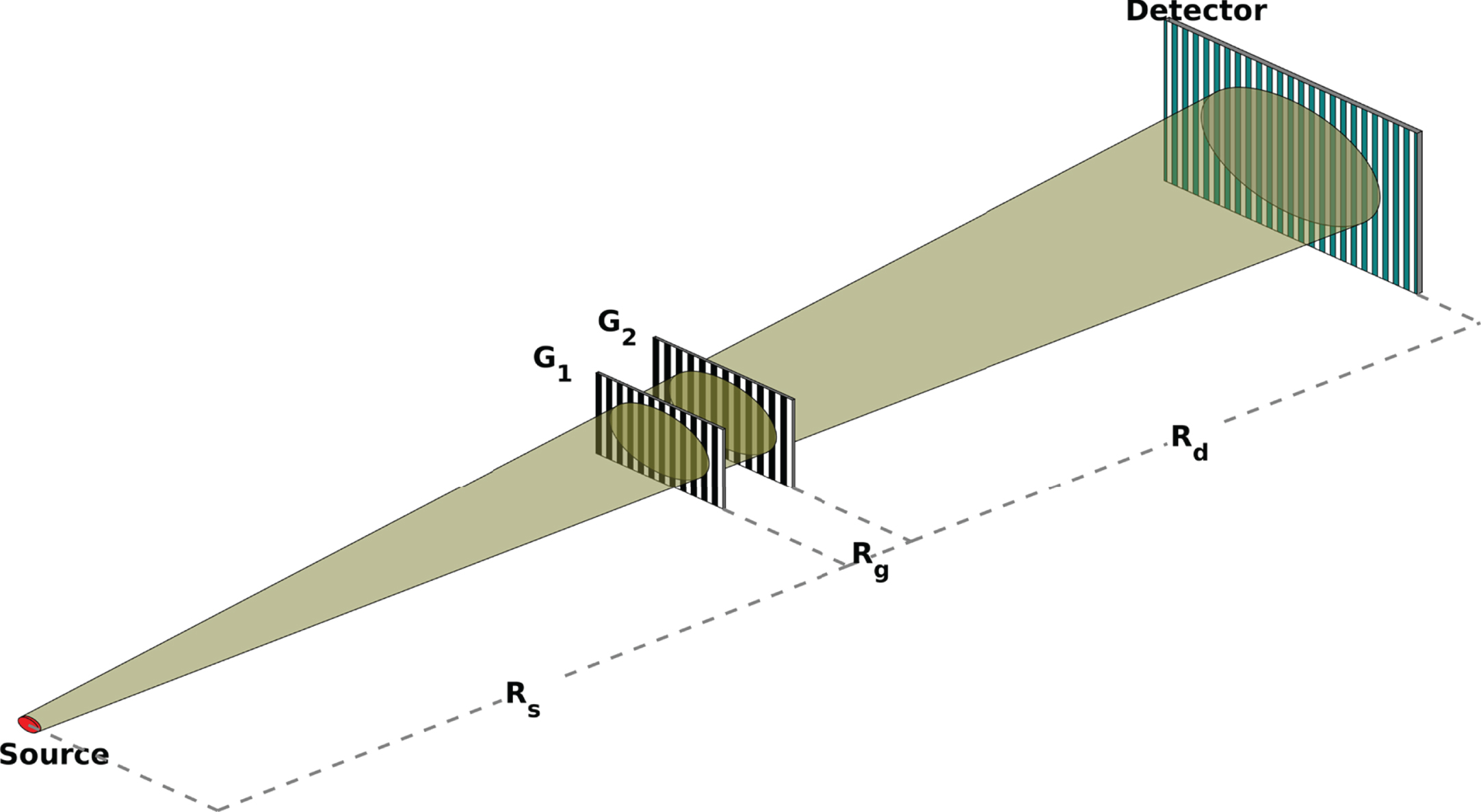
Schematic of an X-ray dual-phase grating interferometer.
In these published theoretical analysis of the dual phase grating interferometry [22, 25], all assumed the use of monochromatic X-ray source, while most imaging applications employ polychromatic sources such as X-ray tubes, which emit X-ray of broad spectrum. Then how can one predict fringe visibility of the setups with polychromatic X-ray? At the first glance, one might think that an X-ray spectral integral of the visibility formula derived in [24] would predict fringe visibility with polychromatic X-ray. Unfortunately, this is not true.
To clarify this issue, note that the fringe visibility, V, of a fringe pattern is defined as V = (Imax - Imin)/(Imax + Imin), where Imax and Imin are the maximum and minimum intensities, respectively. We may denote the contribution of the n-th fringe-harmonics to the fringe visibility by V n . The fringe visibility receives the contributions from all harmonics of the intensity fringe pattern, though the contributions from V n of n ≥ 3 are negligible in most of practical cases [24]. Mathematically, the intensity fringe visibility V is not a weighted sum of V1 and V2, rather it is indeed a complicate function of V1 and V2, as is shown below. The fringe visibility formulas derived in [24] are applicable only for π/2- or π-gratings with a monochromatic X-ray setup at the grating design energies. In that work we showed that, in π/2-dual grating setups, V1 dominates the contribution to fringe visibility [24]. On the other hand, for π-dual grating setups, we found that V1 is diminishing and V2 dominates for fringe visibility [24].
For the setups with polychromatic X-ray, the phase-shift value of a grating varies with photon energies. For example, a π-grating of design energy 15-keV X-ray becomes π/2-grating for 30-keV X-ray, assuming absence of absorption edges in the spectrum’s energy range. Hence a grating will exhibit various phase shifts for a broad-band X-ray spectrum. Consequently, both V1 and V2 would contribute to fringe visibility in setups with polychromatic X-ray. Moreover, as will be shown below, the intensity fringe visibility V is indeed a nonlinear function of V1 and V2.
In order to provide a design optimization tool for dual phase grating interferometry, in this work we set out to derive formulas to predict the intensity fringe visibility V of dual phase grating setups with polychromatic X-ray. The formulas are validated by numerical simulations. In Section 2, we briefly explain the formation of the intensity fringe patterns derived in [24]. Other than the formulas in [24] where the two phase gratings are assumed to be identical, a more general resolvable intensity fringe pattern representation is presented for different phase gratings. In Section 3.1, we derive the formulas of the fringe visibility as a function of the X-ray photon energy. These formulas present a useful tool for optimizing the fringe visibility in polychromatic setups. In Section 3.2, we present numerical simulations to verify the formulas derived in Section 3.1. We summarize and conclude this study in Section 4.
We consider a typical setup of a dual-phase X-ray interferometry as shown in Fig. 1, in which two phase gratings, G1 and G2, with a duty cycle of 0.5 are employed. Let R
s
be the source-to-G1 distance, R
d
be G2-to-detector distance, and R
g
be the spacing between the two phase gratings (Fig. 1). In discussion, we define the geometric magnification factors from G1 and G2 to detector plane as M
g
1
and M
g
2
, respectively, as demonstrated in the equation below:
Notably, the intensity fringe of order (l, r) has a periodicity of pfr = (l/(M
g
1
p1) +1/(M
g
2
p2)) -1. Because the grating periods are only a few micrometers, most of the interference fringes are too fine to be detected using a common imaging detector. However, among the fringe patterns, there are beat patterns formed by those diffraction orders characterized by l = - r when p1 ≈ p2. These beat patterns are generated by the interference beat patterns. The beat pattern consists of a fundamental frequency and its harmonics. The period of the 1st harmonics of the beat patterns is [24]
Equation (5) is the key equation for the analysis of beat pattern periods and fringe visibility. In following sections, we will comprehensively discuss how to properly setup the geometries for predicting a high fringe visibility based on Eq. (5).
Fringe visibility as a function of X-ray photon energy
Fringe visibility is a common figure of merit for an interferometer’s performance [1–4]. This is because the formation of a high-modulation fringe pattern is crucial to a robust interferometry. To examine the fringe visibility, we consider the detected intensity fringe without a sample. The fringe visibility, V, of a fringe pattern is defined as V = (Imax - Imin)/(Imax + Imin), where Imax and Imin are the maximum and minimum intensities, respectively. Equation (5) shows that the fringe visibility depends on the dual grating phase modulation, spatial coherence of the illumination, system geometry setup, and X-ray spectrum. In a previous study, we derived and validated the formulas of the fringe visibility, assuming a monochromatic X-ray of the grating design energy [24]. In that study, we demonstrated that the fringe visibility can be conveniently adjusted by tuning the G1 - G2 spacing [24]. However, in practice, most X-ray sources are polychromatic. The fringe visibility is X-ray energy dependent. The energy dependency of the fringe pattern is in two folds. First, the phase shift of a grating inversely scales with the photon energy. Second, the visibility coefficients, C l , of the diffraction orders are energy-dependent as well. Therefore, to achieve design optimization, it is useful to derive an explicit formula to understand how the fringe visibility varies with the X-ray energy as well as the G1 - G2 spacing and predict the fringe visibility for the setups with polychromatic sources.
To achieve this, we combine Eqs. (7) and (5). For conciseness, we assume p1 = p2, Δϕ1 = Δϕ2 = (ED/E) · Δϕ
d
, and R
s
= R
d
. With this symmetric setup, we found that the detected intensity pattern in the absence of a sample is given by:
We refer to V
l
(E, Δϕ
d
) in Eq. (8) as the visibility coefficient of the diffraction order, l. In Eq. (8), Δϕ
d
is the gratings’ phase modulation at the design energy, ED. To derive the fringe visibility formulas, the high diffraction orders made only a negligible contribution to the intensity fringe pattern. This is because factor
To validate the Eqs. (8–11-formula) for predicting the fringe visibility of the setups with the polychromatic X-ray, we compare the calculated fringe visibility using Eqs. (8–11-formula) to the one determined using the intensity patterns obtained from the numerical simulations of the wave propagation. Considering an interferometer with an X-ray tube, the setup consists of two identical π-shift phase gratings with a design energy of ED = 20 keV. The system configuration is assumed as follows: the grating’s period, p = 1μm, and the source-G1 distance, R s , and the G2-detector distance, R d , are fixed to 450 mm. For the source, we assume that the tube is of a tungsten target and a rhodium filtration, and the tube operates at 34 kVp (a typical source setting employed in breast tomosynthesis). Figure 2 shows the X-ray spectrum of such a source. In addition, we assume that the focal spot has a width of 40μm, and the detector-pixel is 25μm in size. We calculated the visibility coefficients V1 and V2, using Eqs. (8–11) and the spectrum plotted in Fig. 2. Figure 3(a) shows how the calculated V1 and V2 vary with the gratings’ spacing R g . The blue curve plots V1 as a function of R g while the red curve depicts how the V2 varies with R g . The visibility curve V = (max(I) - min(I))/(max(I) + min(I)) calculated using Eq. (11-formula) is shown in Fig. 3(b) as the solid blue curve.
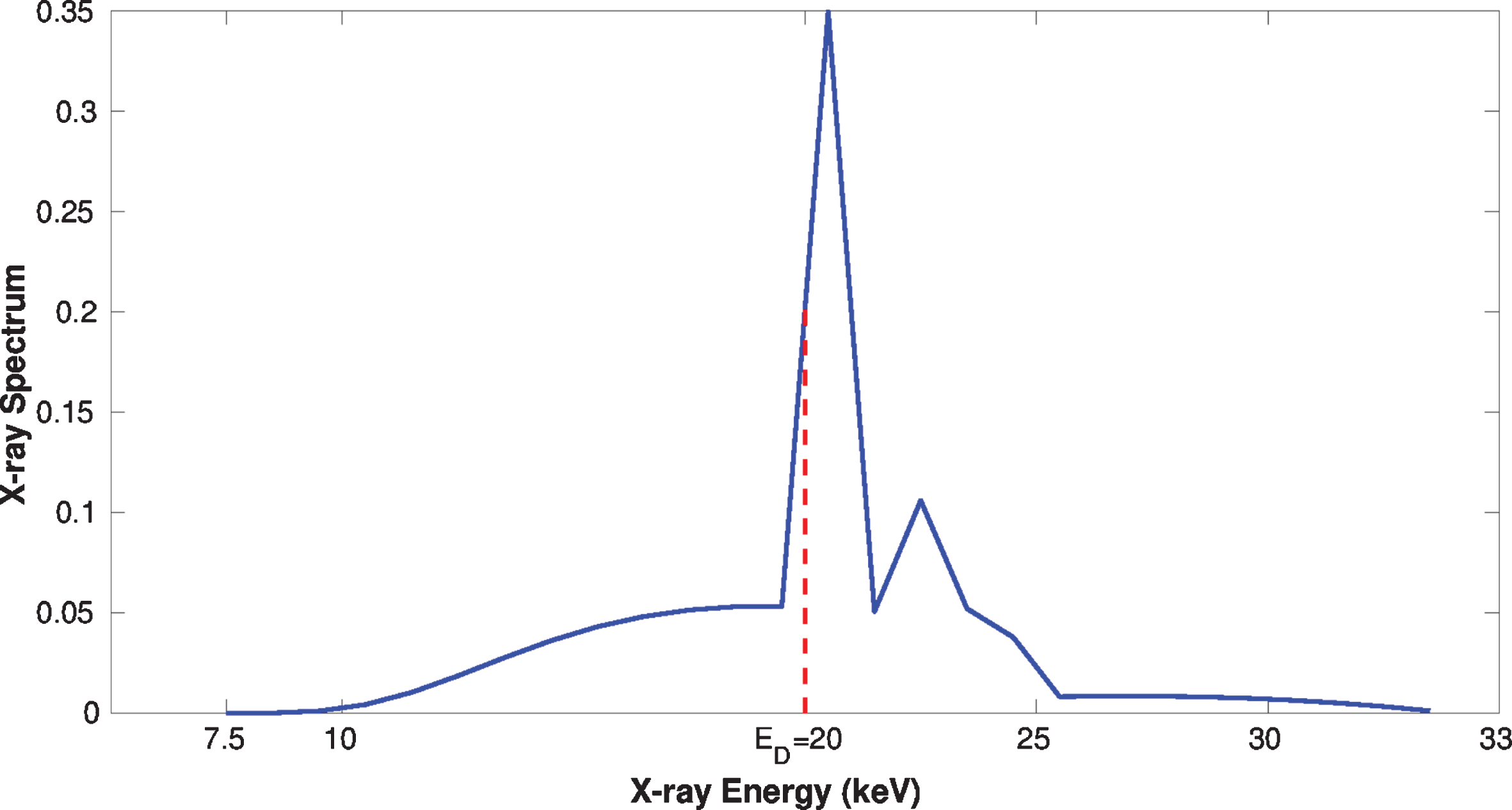
34 kV, Rh/Ag target/filter spectrum employed in the simulations.
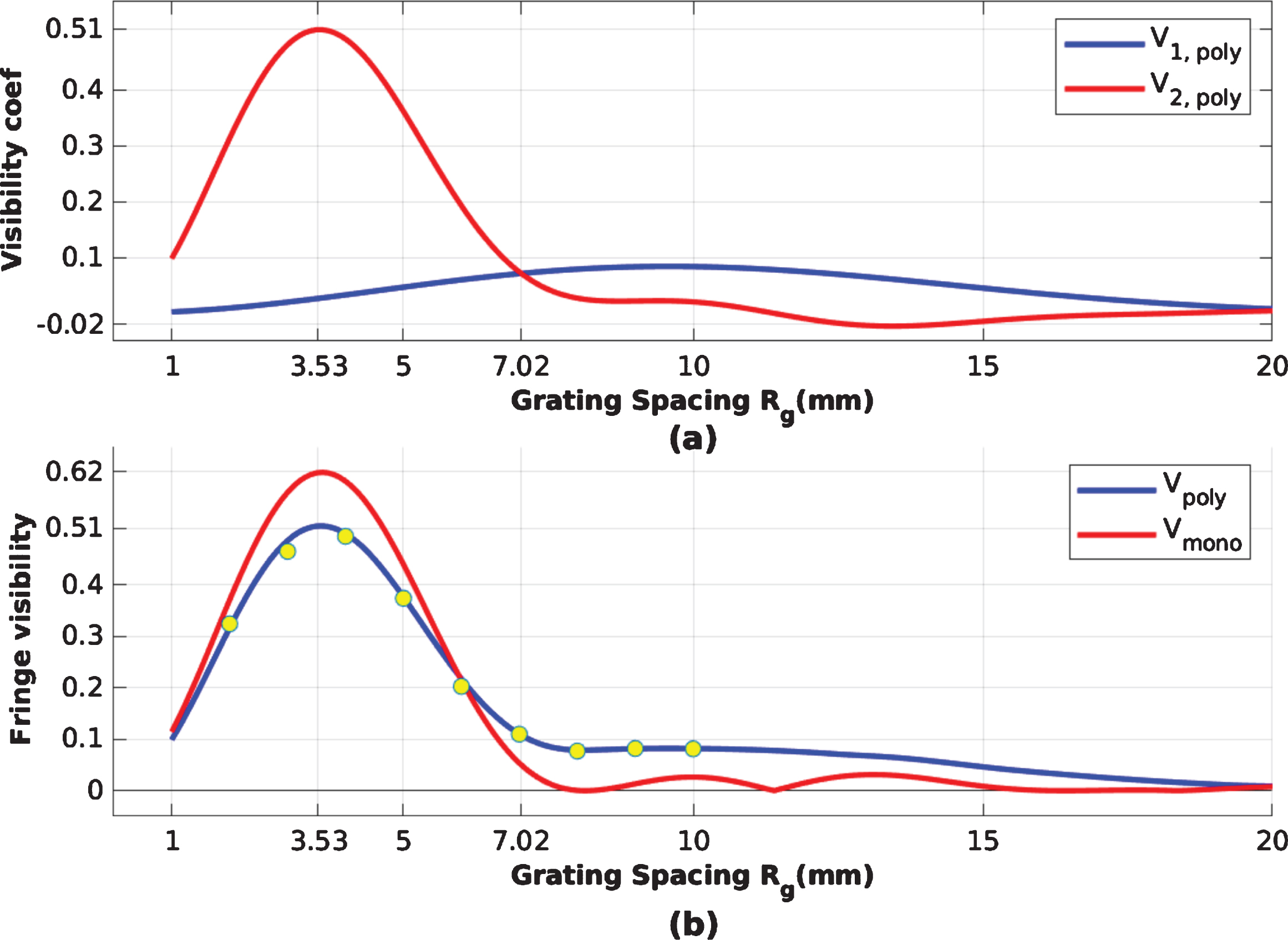
Plot of the fringe visibility with respect to the G1-G2 spacing R g for two identical π phase gratings. In the figure, we assume that the dual-phase grating has a period, p = 1μm, and a phase shift, π, at the design energy, ED = 20keV. A 34 kVp X-ray tube (Fig. 2) with focal spot of width a = 40μm is also assumed. The detector-pixel size is set to m. The geometry is set symmetrically with R s = R d = 450 mm and dual-grating spacing R g changes from 1 mm to 20 mm. The blue and red curves shown in Fig. 3(a) represent the visibility coefficients, V1 and V2, respectively. The solid blue curve shown in Fig. 3(b) is the change of the theoretical visibility value, V = (max(I) - min(I))/(max(I) + min(I)), calculated from Eq. (11-formula) with respect to the G1-G2 spacing R g . As a reference, the visibility curve of the monochromatic X-ray source is shown in Fig. 3(b) as the red curve. The yellow dots in Fig. 3(b) represent the measured fringe visibilities from the intensity patterns generated using the numerical wave propagation. For details, see text.
Figure 3(a) shows that V2 ⪢ V1 are the R g values ranging from 1 mm to 6 mm. Therefore, in this range of R g values, the fringe visibility is simply equal to the corresponding V2 values in a good approximation. Because the R g ranges from 8 mm to 15 mm, V1 ⪢ V2, the fringe visibility will simply be equal to the V1 values. However, when R g is between 6 mm and 8 mm, the values of V1 and V2 are comparable, and the visibility value will depend on both the V1 and V2.
To validate the fringe visibility of Eqs. (8–11-formula), we performed numerical simulations for the fringe patterns through wave Fresnel diffraction propagation. Recall the Fresnel wave propagation equation from R1 to R2 can be expressed as
List of visibility values measured from the fringe patterns of numerical simulations and the theoretical values computed from Eq. (11-formula) and that for a 20 keV monochromatic x-ray source
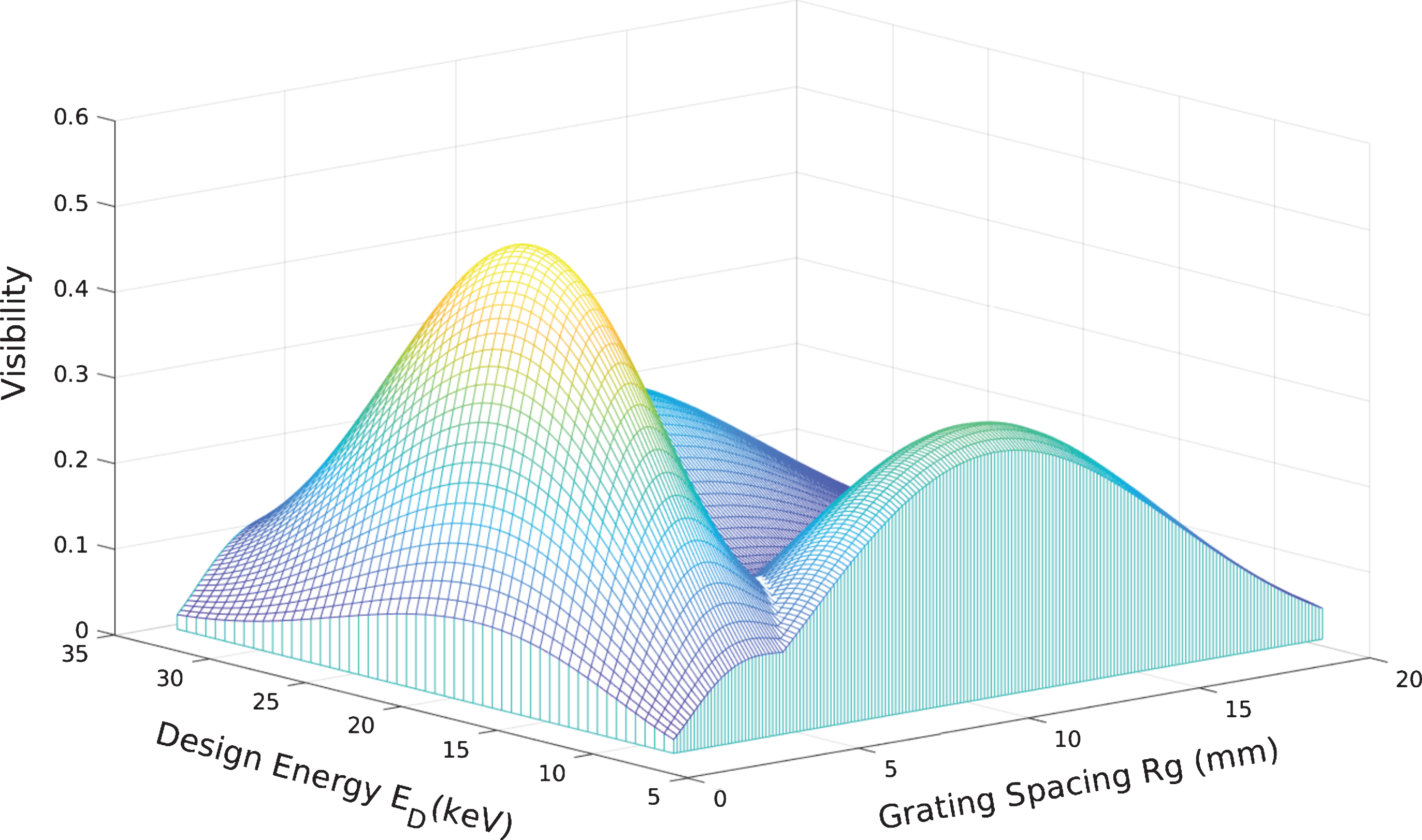
To better understand the relationship between the fringe visibility with respect to grating spacing R g and gratings’ design energy ED, we present a mesh plot of the fringe visibility as a function of R g and ED as is shown in Fig. 4. In this study, the setups of R s , R d , p1, p2 as well as the X-ray spectrum are the same as in Fig. 3, and the two gratings have a π-shift at the corresponding design energy ED ranging from 7.5 keV to 34.5 keV. The grating spacing R g spans from 1 mm to 20 mm. As can be seen, the fringe visibility peaks at R g ≈ 3.5 mm and ED is approximately 20 keV (a position where most of the X-ray is distributed). Therefore, in practice, a grating of a design energy close to the peak of the X-ray’s spectral distribution is preferred. However, the selected grating spacing, R g controls the fringe period. Therefore, it relies on the detector-pixel size. With this consideration, it can be determined from Fig. 4 that R g = 3.5 mm, and ED = 20 keV are optimal configurations.
Another popular choice of phase gratings is the π/2-shifting grating. We now consider a dual-phase grating interferometer with an identical setup as that described in above example, except that the two phase gratings are both π/2 gratings. Figure 5 shows the calculated V1 and V2 as functions of the grating spacing R g . The green-dashed curve plots V1 and the red-dashed curve plots V2 as functions of R g . The solid blue curve in Fig. 5 plots the visibility curve, V = (max(I) - min(I))/(max(I) + min(I)), calculated from Eq. (11-formula). In contrast to the case of the two π gratings, Fig. 5 shows V1 ⪢ V2 for R g values ranging from 6 mm to 16 mm. Therefore, in this range of R g values, the fringe visibility is equal to the corresponding V1 values in a good approximation. As shown in Fig. 5, the fringe visibility peaks at approximately 30% for the R g values ranging from 8 mm to 12 mm. In this range of R g values, the fringe periods, pfr, range from 76 – 113.5μm. Nevertheless, for the R g values ranging from 1 mm to 4 mm, V2 is larger than V1, and both V1 and V2 are small. This range of the R g values is not a good choice for the π/2-grating based on the dual grating interferometer.
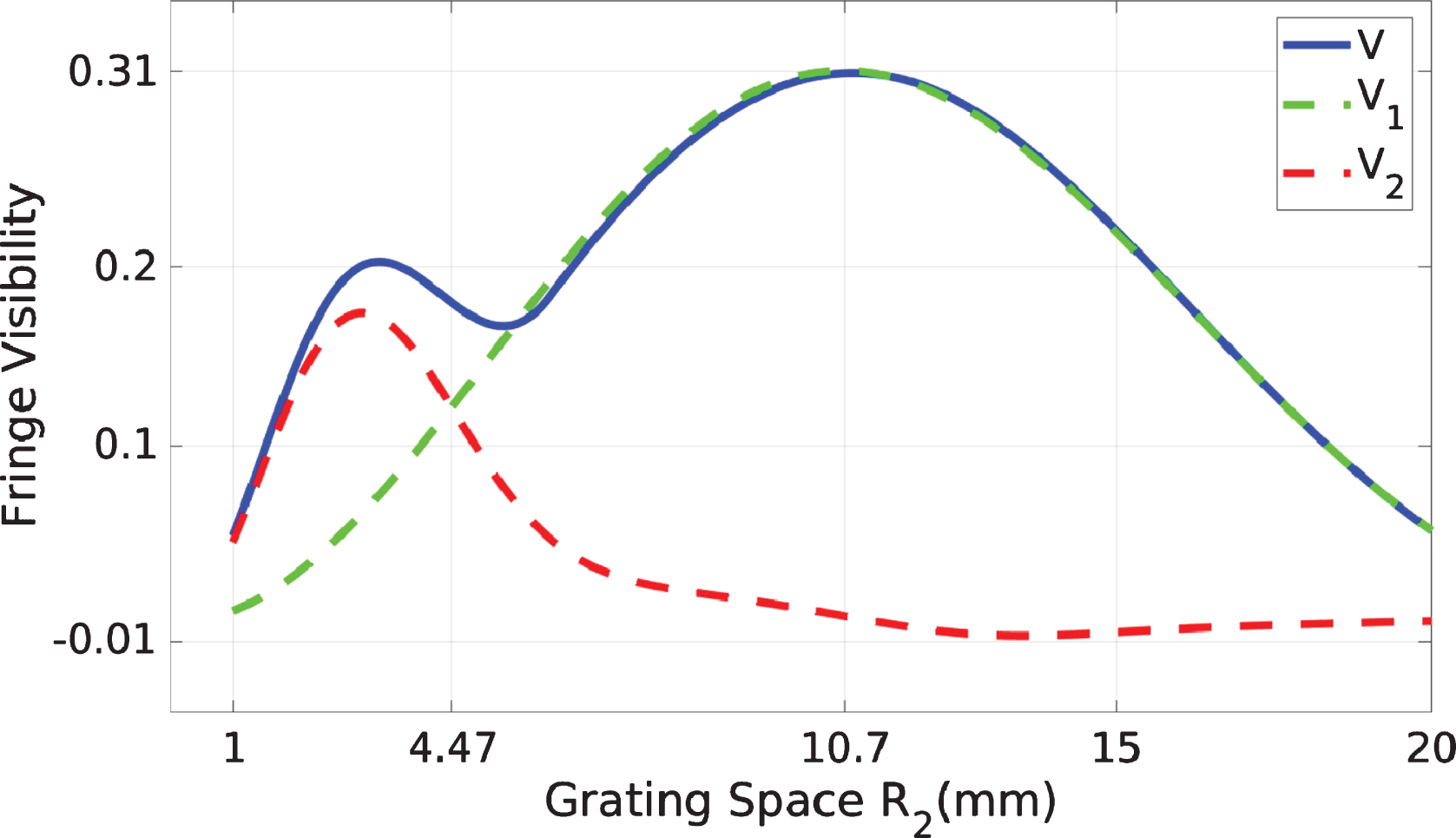
Plot of visibility coefficients V1, V2, and fringe visibility V with respect to the G1-G2 spacing R g for dual-π/2 phase gratings. The same set up as in Fig. 3 is assumed, except that the dual π-gratings are replaced with the π/2-gratings. The green curve is the change in the coefficient V1 with respect to the G1-G2 spacing R g . The red curve is that of V2. The calculated visibility, V = (max(I) - min(I))/(max(I) + min(I)), based on Eq. (11-formula) is also plotted as the solid blue curve in Fig. 5. In contrast to Fig. 3, the visibility is dominated by V2 when R g < 4 mm. When R g > 5 mm, the visibility is dominated by V1.
As shown in the previous sections, in contrast to the Talbot–Lau X-ray interferometry, the dual-phase grating interferometry enables the use of a common image detector for the directly resolving the intensity fringes generated by the fine-pitch gratings without the need of absorbing the grating and keeping its system length in check. Removing the absorbing grating with a high-aspect ratio resolves the challenge in grating fabrication and enables the radiation dose reduction by a factor of two. In addition, with this new technique, one can conveniently adjust the fringe period and fringe visibility with almost no change in the total system length. The features of dose saving and system compactness are both critical for future application of grating-based X-ray interferometry in medical imaging.
To facilitate the implementation of this new technique of X-ray interferometry, one needs to quantitatively know how to control the intensity fringe periods, achieve a high fringe visibility with a polychromatic X-ray, and compute a sample’s phase gradients from the measured fringe shifts. The fringe visibility is a figure of merit for the interferometer’s performance. A high fringe visibility reduces the quantum noise in the differential phase images, and increases the interferometry sensitivity. In practice, it is desirable to have explicit expressions of the fringe visibility for systems with phase gratings of any phase modulation and X-ray spectrum. In this study, Eqs. (11) and (11-formula) provide the fringe visibility formulas for the setups with two identical phase gratings with any geometric configuration and any X-ray spectrum of the interferometers. These formulas also incorporate the effect of the focal spot size and detector-pixel size on fringe visibility. As shown in Fig. 3, a numerical simulation of the fringe visibility with a dual π-grating interferometer validates our formula for the fringe visibility of Eqs. (11) and (11-formula). These formulas provide a useful tool for design optimization of dual-phase grating interferometers.
The fringe visibility in dual phase grating interferometry varies significantly with G1-G2 spacing and X-ray spectrum. Fig. 3(b) shows that, the peak fringe visibility is 0.51 for the π-gratings setup studied. But for π/2-gratings setup studied in Fig. 5, the peak fringe visibility is 0.31. One thing is sure, the peak fringe visibility should be lower than that with Talbot-Lau interferometer. This is understandable from our formulas of Eq. (5). In Talbot-Lau interferometry fringe visibility is proportional to C1 (for a π/2-grating) or C2 (for a π-grating). But in dual phase grating interferometry, as is shown in Eq. (5), fringe visibility is proportional to C1 × C-1 (for π/2-gratings), or proportional to C2 × C-2 (for π-gratings). These C m coefficients are given in Eq. (7), their magnitude are always less than 1. Therefore, the peak fringe visibility in dual phase grating interferometry should be lower than that with Talbot-Lau interferometer. In literature there is a report on fringe visibility in dual phase grating interferometry [27], but it is hard to compare that result to ours, because the interferometer setups are completely different. We hope our work will stimulate more experimental studies on dual phase grating X-ray interferometry.
In addition to the formulas for quantitative analysis of fringe visibility, this study also reveals several implications of X-ray polychromaticity of fringe visibility. As shown in Fig. 3, the most convenient way to adjust the fringe visibility is to simply tune the grating spacing R g . Figure 3(b) shows that the achievable fringe visibility is only moderately reduced compared to the monochromatic X-ray setups, provided that the grating spacing, R g , is properly set. In contrast, in the Talbot–Lau grating interferometry, the fringe contrast can be reversed by the polychromaticity of the setups with π/2 phase gratings. Such a reversal in the fringe contrast can cause cancellation and a significant reduction in the fringe visibility for the Talbot–Lau interferometry with the polychromatic X-ray [28]. Furthermore, as shown in Fig. 4, the grating design energy, compared to the average photon energy of the X-ray beam, has a significant effect on the fringe visibility. In practice, the probable range of the average photon energy of the X-ray beam can be easily approximated. Figure 4 shows that, for a good fringe visibility, one should select the phase gratings with a design energy that falls into this range. If it is infeasible to make the “match”, one should select the phase gratings with a design energy that is lower, rather than one that is higher than the average photon energy as suggested by Fig. 4.
In conclusion, this study, presents a general quantitative theory of a dual-phase grating X-ray interferometry. The theory provides explicit expressions that predicts the fringe visibility in the dual-phase grating X-ray interferometry. The derived formulas are applicable to the setup with phase gratings of any phase modulation with either monochromatic or polychromatic sources. Numerical simulations are presented to validate the derived formulas. The theory provides a useful tool for design optimization of dual phase grating X-ray interferometers.
Funding
National Institute of Health (NIH) (1R01CA193378).