



Abstract
The main objective of this work is to explore the X-ray interaction properties of P2O5- SnCl2-SnO bioactive glass system using Photon Shielding and Dosimetry (Phys-X/PSD) software in the energy range 10–150 keV. The study of these parameters will have applications in various fields of nuclear medicine, medical technology, and other medical applications. The value of mass attenuation coefficients (μm) and effective atomic numbers (Zeff) decrease whereas the value of mean free path as well as half value layer increases with rises in energy in the selected energy range. The study results indicate that bioactive glass composition of T2 of chemical composition (35P2O5- 55SnCl2-10SnO) possesses the lowest value of mean free path (MFP), and highest value of μm, and Zeff, among the chemical composition.
Introduction
Glass is a useful material across numerous applications due to its unique characteristic of being transparent. The property allows glass to be used in construction, as common windows, in optics to create screens and fiber optic cables, for medical technology, and many others. Glass, however, has a lesser known application that also makes it incredibly useful: radiation protection [1–3].
Radiation has been increasingly more emergent in the past century, as it can be used for a wide range of technologies. Energy production, agriculture, and medicine are a few of the more commonly known applications of radiation. In addition to the benefits, unfortunately, there are also the harmful effects of radiation on people and the environment [4–6]. Ionizing radiation has enough energy to ionize atoms or molecules by detaching electrons, which is dangerous to the human body. Some side effects of long-term exposure to ionizing radiation include nausea, vomiting, cell DNA damage, permanent tissue damage, Acute Radiation Syndrome (ARS), cancer, and death. People who come in contact with radiation are advised to stay as far away from the source as possible and limit the time of exposure. Nevertheless, to further protect humans from these harmful effects, protective materials are used to absorb radiation and minimize the dose [7–9].
Radiation shields, as they are commonly called, are placed between the individual and the radiation source and serve to absorb, or attenuate, as many photons as possible. Several kinds of materials, vary depending on the application, have been implemented for this purpose [10]. Concrete is often used to line the walls of nuclear reactors or medical facilities that utilize radiation [11]. The material offers the advantage of being sturdy, having a low cost, and being especially effective against X-rays; however, they are prone to water loss and cracking over periods of time, and are difficult to replace due to their bulkiness. Glasses can provide similar advantages to concretes, in addition to their transparency, which makes them useful for windows in X-ray rooms, for instance. The radiation shielding properties of glasses can be improved by doping metal oxides into its composition, heavy metal oxides (HMOs) especially. These HMOs can greatly increase the density of the glass system, which previous studies have demonstrated to positively correlate with an improved shielding ability [12, 13].
Glass formers are the metal oxides that create the interconnected backbone of the glass network and are essential in developing effective radiation glasses. The two most common glass formers are silicate and borate. Recently researchers have been interested in better understanding the properties of different glass formers. One of these, phosphate, can lower the melting temperature, glass transition temperature, and increase the thermal expansion coefficient of glasses, which makes them desirable for optical applications [14]. By itself, the poor chemical durability of phosphate makes it unsuitable in practice. Nevertheless, by introducing other metal oxides, the chemical durability of the glass system can be improved to make the glasses viable in radiation shielding applications. Adding SnO to the glass network can replace P-O-P bonds with Sn-O-P bonds, leading to a dramatic improvement in the chemical durability of the glasses. The introduction of chlorine, through stannous chlorophosphite and lead (II) chloride, has also been tested to examine its effects on phosphate glasses.
Bioactive glasses (BAG) are solid, nonporous, biomaterials. They consist of the main component Silicate (SiO2), Calcium Oxide (CaO), Sodium Oxide (CaO) and Phosphorus oxide (P2O5) with different concentrations. By means of diversifying these components, various forms of BAG can be attained. They are favorable biomaterials for bone and tissue repair and reconstruction, due to the fact that they proved to bond to tissues stimulating cells for the sake of a path of regeneration and self-repair. However, from a negative point of view, their mechanical properties are rather poor, particularly, their fragileness, fracture toughness and inadequate bending strength. Accordingly, their utilizations are restricted to non-load-bearing implants. Nevertheless, BAG can be effectively used as coating substances on the metallic implants surfaces in order to join the suitable mechanical characteristic of metal alloys to biocompatibility and bioactivity of BAG [15].
To date, limited research has been conducted on the radiation shielding properties of phosphate glasses to determine their full potential. With this mind, this study aims to investigate the attenuation capability of a P2O5-SnCl2-SnO glass system for applications in various field of nuclear medicine, medical technology, and other medical applications.
Materials and methods
Five chlorophosphate glasses with different concentrations of SnCl2 and SnO were selected in this study. The five samples are coded as following in the Table 1 [16]:
Chemical compositions and densities for the selected samples
Chemical compositions and densities for the selected samples
T1: 35P2O5- 65SnCl2, ρ= 3.62 g/cm3
T2: 35P2O5- 55SnCl2-10SnO, ρ= 3.63 g/cm3
T3: 40P2O5- 60SnCl2, ρ= 3.61 g/cm3
T4: 40P2O5- 55SnCl2-5SnO, ρ= 3.67 g/cm3
T5: 40P2O5- 50SnCl2-10SnO, ρ= 3.51 g/cm3
For the evaluation of the radiation shielding factors of the above T1-T5 samples, Phy-X/PSD [17] program was applied. We performed the calculations for the shielding parameters between 0.01 and 0.15 MeV photon energies. The users must follow three steps to get the radiation shielding factors from this software namely: (a) definition of the investigated sample: this is the first step where the users must input the composition of the sample with its density. As an example, for T1 glass in this work, we defined it in this software as: 35P2O5 + 65SnCl2 and we selected the option “mol% ”, since the users can define the sample in mol% or w.t%, (b) selection of the investigated energy values: in this software there are three options for the energy, where we selected 0.015 and 15 MeV and chose only the energy values between 0.01 and 0.15 MeV, while the third step is (c) select the radiation shielding factors to be determined.
For the selected bioactive glasses, we determined the mass attenuation coefficient (μm). It represents one of the most basic parameters that determines the basic quantities required in determining the penetration of X-ray in a medium. We can calculate the μm for any glass sample using the next relation:
where wi denotes the weight fraction of each element in the glass sample. From this essential parameter, we can compute the linear attenuation coefficient (μ). Simply, if we multiply the μm for a glass with its density, then we can get the μ of this glass. From these parameters, we can find other parameters such as the effective atomic number which can be determined by the next equation:
From the Zeff, it is easy to determine the electron density using equation 3 namely:
In the above formula, 〈A〉 is the mean atomic mass, while NA represents Avogadro constant. Moreover, the following equations are used for determination of HVL and MFP [18]:
The radiation interaction parameters were calculated using the Phy-X/PSD computer software in the photon energy range of 10–150 keV. The study of photon interaction parameters and their variation with chemical composition and photon energy is discussed in the following paragraphs:
Table 2 represented the values of mass attenuation coefficients (μm) for bioactive glasses for the photon energy range of 10–150 keV. Figure 1 shows the variation of μm values for selected bioactive glasses with incident photon energies in the energy range 10–150 keV. The maximum values of μm for samples are T1 (83.042 cm/g2), T2 (83.397 cm/g2), T3 (79.068 cm/g2), T4 (79.180 cm/g2), and T5 (79.296 cm/g2) for the selected bioactive glasses respectively and this maximum is observed to be at 10 keV. After that values of the μm decrease in selected photon energy range which is due to the dominance of photoelectric effect (PE) which has the Z-dependence of Z4 - 5 and energy dependence as E–3.5 [19]. It is noticed that there is a peak at photon energy 30 keV which is due to K-absorption edge of Sn present in the selected bioactive glass systems at 29.2 keV. The maximum value of μm is found for T2 sample (35 P2O5-55 SnCl2-10SnO) whereas, the minimum for the T3 sample (40 P2O5-60 SnCl2).
Mass attenuation coefficients (cm2/g) for the selected samples
Mass attenuation coefficients (cm2/g) for the selected samples

Variation of mass attenuation coefficient with energy.
Figure 2 represents the variation of the linear attenuation coefficient (μ) for the bioactive glasses with selected photon energies in the range of 10–150 keV. The maximum values of μ for the selected bioactive glasses are T1 (300.61 cm–1), T2 (302.73 cm–1), T3 (285.43 cm–1), T4 (290.59 cm–1), and T5 (278.32 cm–1) and this maximum value is found to be at 10 keV. It clearly seen that the values of μ for bioactive glasses decrease in the selected photon energy range which is due to the dominance of photoelectric effect (PE) [20, 21]. The maximum value of μ is noticed for T2 sample among all the selected samples. The variation of μ is similar to the variation of μm with selected photon energy range.

Variation of linear attenuation coefficient with energy.
The Zeff has also been computed using Phy-X/PSD computer software for the bioactive glasses. We used the same energy range used in the previous parameters. The variation of Zeff values for the bioactive glasses T1-T5 with photon energies in the energy range 10–150 keV is shown in Fig. 3. The Zeff increases in the energy range of 10–30 keV. The range of Zeff values of the selected glasses are T1 (32.06–45.15), T2 (32.83–45.50), T3 (31.29–44.76), T4 (31.67–44.94) and T5 (32.06–45.13). A sharp peak in Zeff is observed at 30 keV which is due to K-absorption edge of Sn presents in the selected bioactive glass systems at 29.2 keV. After that the values of Zeff for selected bioactive glass systems decrease with increases the photon energy range 30–150 keV which is due to the dominance of photoelectric absorption process, which has Z-dependence of Z4 - 5 [22, 23]. It is clear from Table 1 that the sample T2 contains more weight fraction of the heaviest element Sn as compared to the other samples. Thus, it possesses maximum value of Zeff. Whereas the sample T3 contains the least fraction of the Sn, Thus, it possesses the minimum value of Zeff.

Variation of effective atomic number with energy.
The variation of values of electron density (Ne) for selected bioactive samples with incident photon energies is shown in Fig. 4. The Ne increases in the energy range of 10–30 keV. The range of Ne values of the selected glasses are T1 (4.91×10²³–6.92×10²³ electrons/g), T2 (5.08×10²³–7.04×10²³ electrons/g), T3 (5.08×10²³–7.27×10²³ electrons/g), T4 (5.17×10²³–7.34×10²³ electrons/g), and T5 (5.26×10²³–7.41×10²³ electrons/g) in the photon energy range 10–30 keV. A sharp peak in Ne is observed at 30 keV which is due to K-absorption edge of Sn present in the selected bioactive glass systems at 29.2 keV. After that the values of Ne for selected bioactive glasses decrease with increases the incident photon energy range 30–150 keV which is due to the dominace of photoelectric (PE) process [24, 25]. The variation of Ne is similar to the variation of effective atomic number with energy.
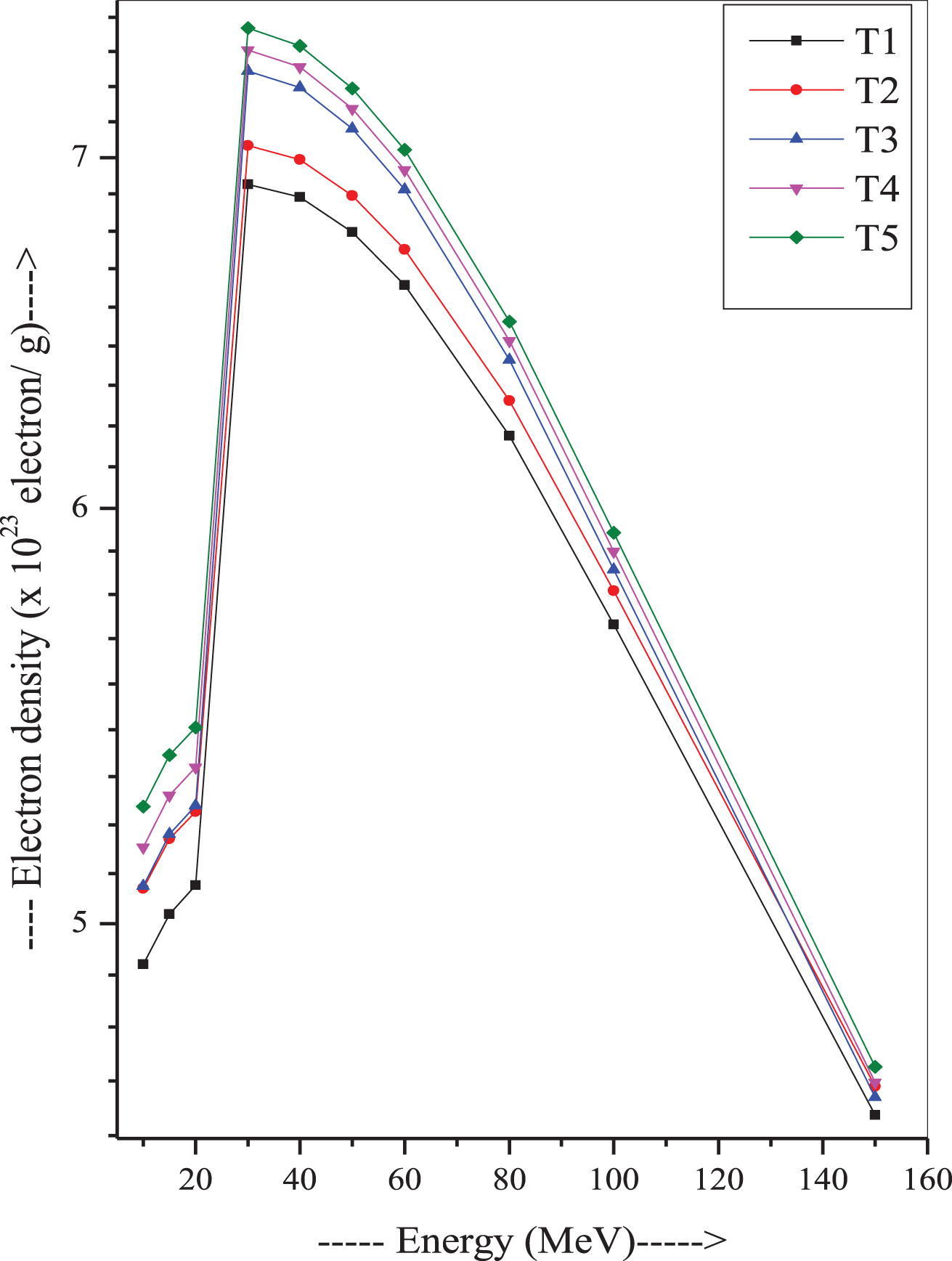
Variation of electron density with energy.
The variation of values of HVL with incident photon energy is shown in Fig. 5 for the selected samples. All the selected bioactive glass systems have same value equal to 0.002 cm at 10 keV and the HVL values are observed to be increasing with increasing the selected energy range [26–28]. The T2 bioactive glass possesses the lowest value of HVL among all the selected bioactive glass systems which is due to the presence of higher concentration of SnCl2 and SnO present in it. Figure 6 represents the variation of MFP values for bioactive glasses with selected incident photon energies. The variation of MFP of these selected bioactive glasses has similar to the variation of HVL in the selected range. The values of MFP for bioactive glasses (T1, T2, and T4) are 0.03 cm, whereas the value of MFP for sample T3 and T5 are 0.04 cm at 10 keV and the values of MFP are observed to be increasing with increase in photon energy in the selected energy range. The bioactive glass T2 (35 P2O5-55 SnCl2-10SnO) has lowest value of MFP as compared to all selected bioactive glasses which is due to the presence of higher concentration of SnCl2 and SnO present in it.
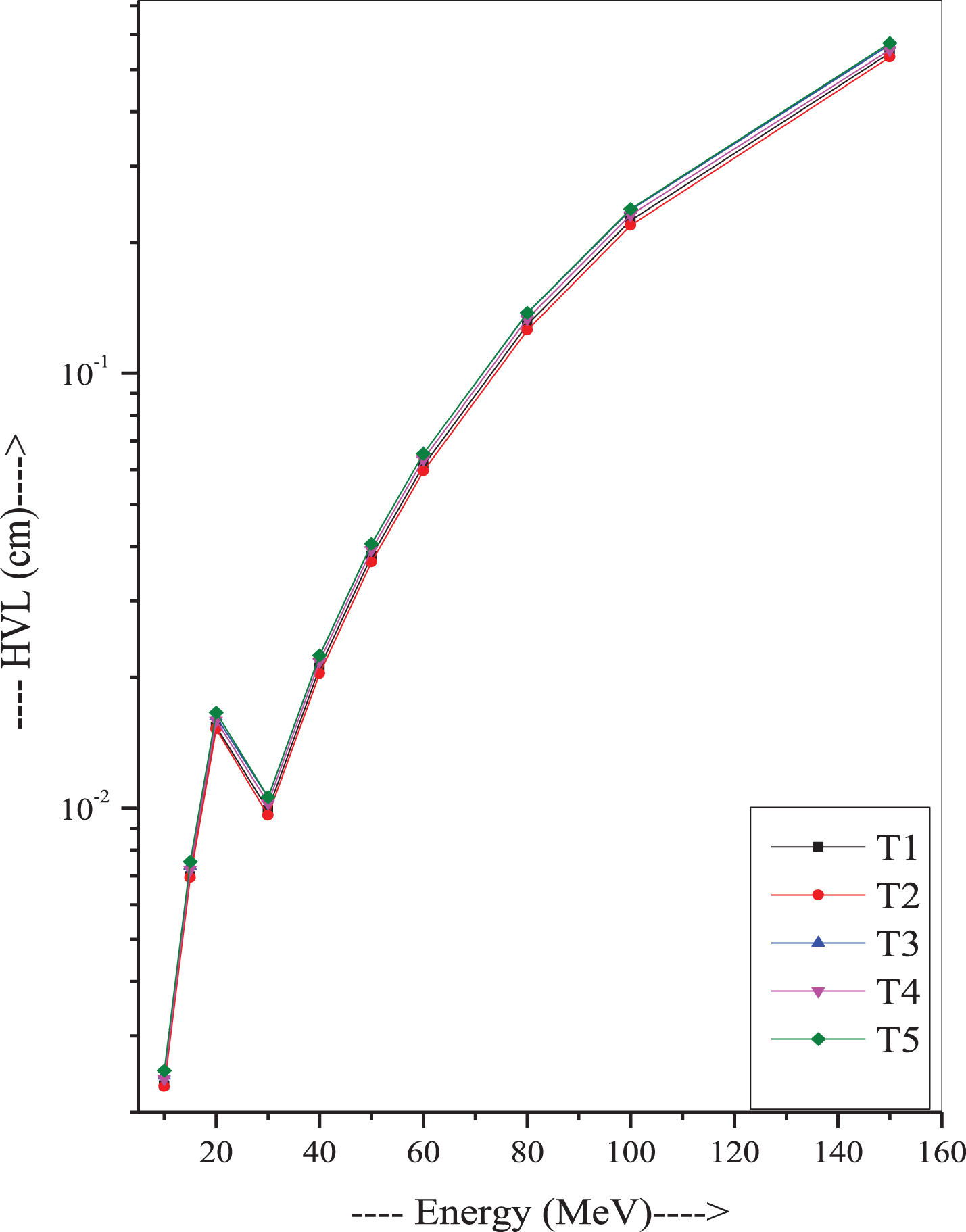
Variation of half value layer with energy.
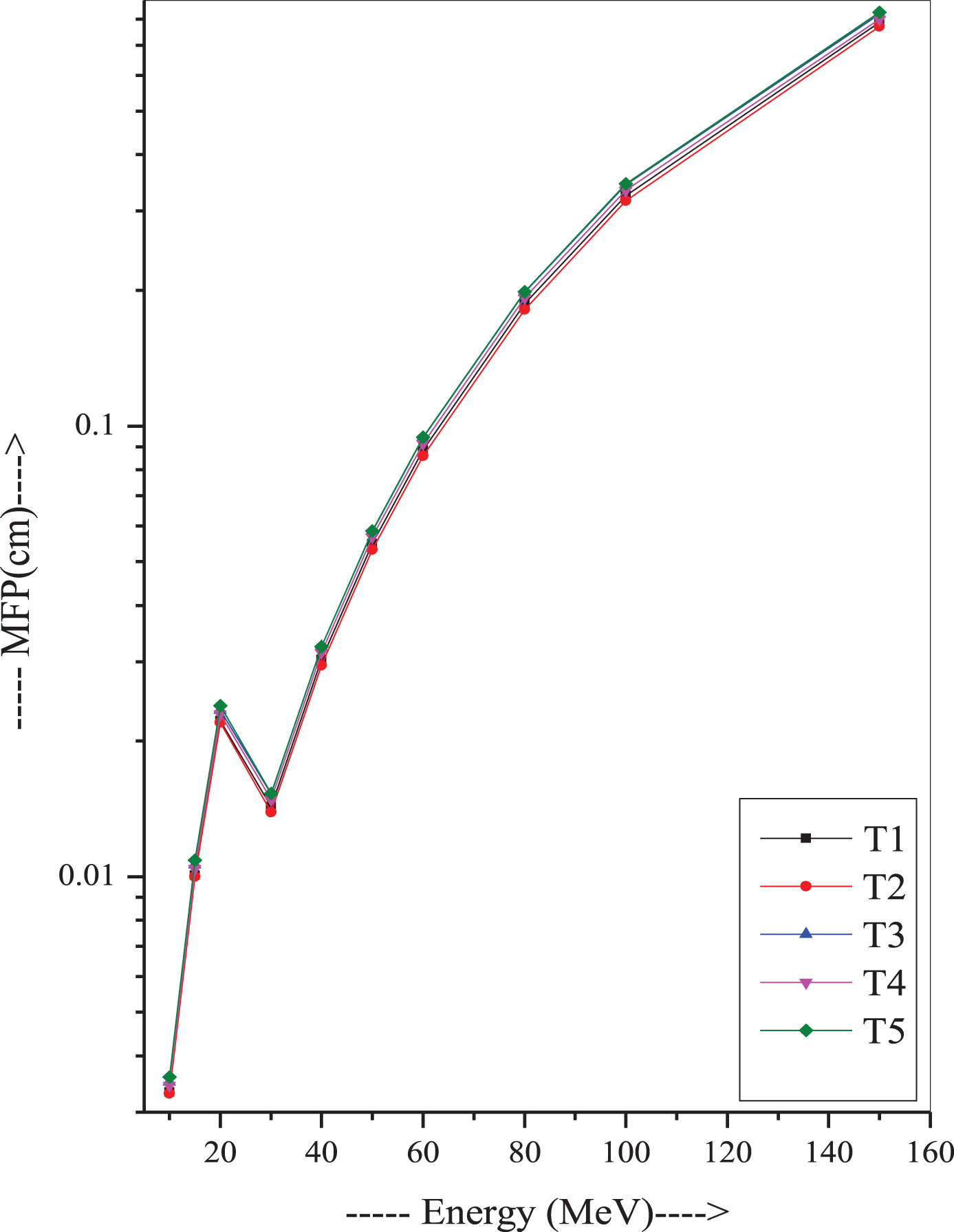
Variation of mean free path with energy.
The X-ray interaction parameters such as μm, μ, Zeff, Ne, HVL and MFP of the P2O5- SnCl2-SnO bioactive glasses has been studied using the Phy-X/PSD computer program. The value of μm and Zeff is decreasing whereas the value of MFP as well as HVL is increasing with increase in energy in the selected energy range. The maximum values of μm for samples are T1 (83.042 cm/g2), T2 (83.397 cm/g2), T3 (79.068 cm/g2), T4 (79.180 cm/g2), and T5 (79.296 cm/g2) for the selected bioactive glasses respectively and this maximum is observed to be at 10 keV. The range of Zeff values of the selected glasses are T1 (32.06–45.15), T2 (32.83–45.50), T3 (31.29–44.76), T4 (31.67–44.94) and T5 (32.06–45.13). The bioactive glass chemical composition of T2 of chemical composition (35P2O5- 55SnCl2-10SnO) possesses the lowest value of MFP, HVL, and highest value of μm, and Zeff, among the chemical composition. The studied data will be useful in the applications of radiation in the field of nuclear medicine and other medical applications.
Footnotes
Acknowledgments
We would like to thank Taif University Researchers Supporting Project number (TURSP-2020/226), Taif University, Taif, Saudi Arabia for financial support.