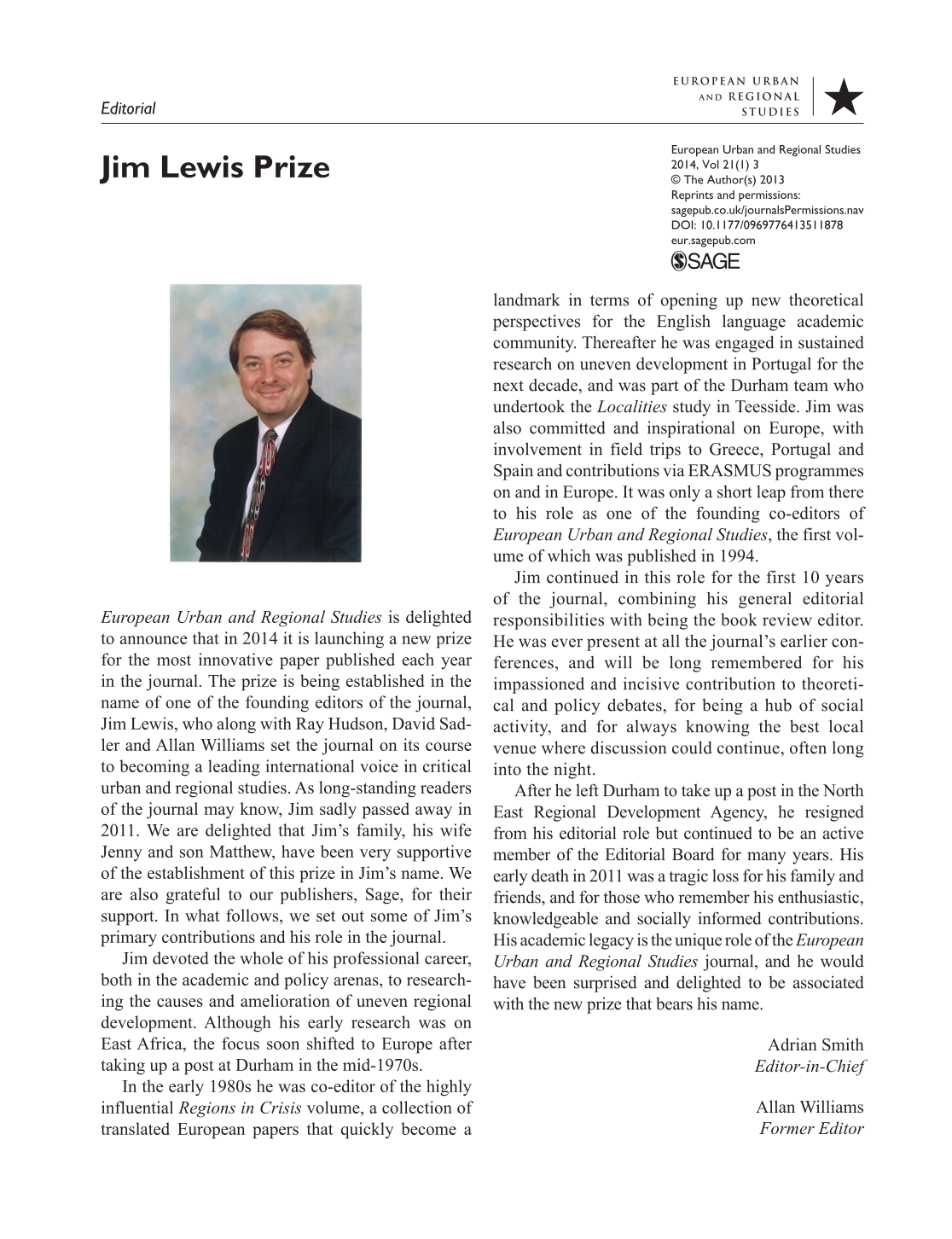
Editorial
 Available accessEditorialFirst published January, 2014pp. 3-3

Select search scope: search across all journals or within the current journal


 Available accessEditorialFirst published January, 2014pp. 3-3Available accessResearch articleFirst published January, 2014pp. 4-20
Rural regions in Europe are facing diverging pathways of development. On the one hand, the influence of urbanisation and the intensification and continued up-scaling of agriculture make it more difficult for many regions to remain distinctive and increase sustainability. Places, as well as goods and services, have become increasingly interchangeable. For many regions an obvious choice is to compete with other regions for global mobile capital and labour. On the other hand, and as a counterforce to these global logics, new strategies, which are more place-based, are being developed, such as the construction of identities or images around new agricultural goods and services. These strategies can be seen in the context of the ‘New Rural Paradigm’ for European rural regions. In the search for new trajectories for sustainable development, different models can be identified: the bio-economy paradigm and the eco-economy. Each model has its own sustainability claim and can be analysed in the context of the overarching development theory of ecological modernisation. The central question in this article is what types of strategies and pathways for eco-economic development can be witnessed in rural regions in Europe? The empirical analysis is based on 62 European cases. Three key eco-economic strategies that show a shift from an agricultural-based development to a more integrative rural and regionally based development are identified. The article concludes with some consistent parameters for understanding the dynamic complexity of rural regional development.
Available accessResearch articleFirst published January, 2014pp. 21-41Recent decades have been dominated by discourses describing a resurgence of regions. Yet despite its prominence the region remains a largely Delphian concept. In the period of new regionalist orthodoxy, for example, while it was recognized that regions take various forms, the normative claim that we were living in a ‘regional world’ became narrowly focused on regions as subnational political units. Nevertheless, the emergence of city-regions, cross-border regions, and European Metropolitan Regions is leading some scholars to suggest the formation in this century of a brave new ‘regional world’. With economic, social and political activity increasingly orchestrated through regional spaces that cross-cut the territorial map that prevailed through much of the twentieth century, the literature is adorned with accounts advancing the theoretical and policy rationale for relational approaches to regions and regionalism. Yet far less has been written on the struggle to construct these spaces politically, thereby neglecting questions of territory and territorial politics. With this in mind, our paper draws on the experience of Germany to consider the political struggle to overcome the contradictions, overlaps, and competing tendencies that result from new regional spaces appearing alongside, rather than replacing, existing forms of state scalar organization. In particular, we observe how the Federal State is using the ambiguity of the regional concept to present territorial and relational approaches as complementary alternatives. The paper concludes by relating these findings to ongoing debates on how we, as ‘regional’ researchers, should approach the analysis of regions and regionalism; speculates on the degree to which they form progressive and effective spatial policies; and asks what lessons can be learnt about contemporary state spatiality more generally.
Available accessResearch articleFirst published January, 2014pp. 42-59In contrast to London’s image as a global city and its position as the most affluent region in Europe, the formally established empirical evidence assembled in this paper suggests that spatial inequality in the capital is a key economic and social problem that is unlikely to be resolved by the prevailing localism doctrine of the ‘big society’. Isolated from an initial and non-discriminate England-wide clustering analysis of 73 Audit Commission-defined quality of life indicators, the results of our study reveal that pivotal to London’s prevailing quality of life distribution is the influence of deprivation, health and educational inequalities, all of which are masked at a pure ‘inner’ and ‘outer’ London comparison, capable only of distinguishing the city’s borough-level transport and community safety diversity. The policy implications of our study are duly considered and several methodological insights are advanced for future research.
Available accessResearch articleFirst published January, 2014pp. 60-78There is an ongoing debate in the literature on urban policy networks about governance and, more specifically, the role of public bodies in urban policy implementation networks. This paper focuses on the specific debate in Dutch and Spanish academic and professional circles regarding property rights in land (hereafter property rights) and the need to separate development rights from property rights. The British nationalisation of development rights in 1947 is an important point of reference in these debates. This paper adds to these debates by providing empirical evidence about a land readjustment regulation that public bodies can use to modify the power relationships between public and private parties. This regulation can improve public value capturing by helping public bodies transfer the costs for public infrastructure and affordable housing to developers while capturing part of the enhanced economic value.
Available accessResearch articleFirst published January, 2014pp. 79-103Although enterprise support policies continue to be favored by policymakers in the European Union (EU) as tools for regional revitalization, there is as yet insufficient empirical evidence examining the effects of the policies on socially relevant outcomes. This paper helps fill that gap by utilizing firm-level data to offer robust counterfactual impact evaluation evidence on the employment effects of the coexisting European Regional Development Fund (ERDF) co-sponsored, national and regional programs commonly operated in many EU regions. By using data from a large northern Italian region, the analysis yields employment impact estimates of the policies under plausible identification assumptions. The paper finds no significant difference between the employment impacts of ERDF co-funded and national/regional programs, whereas, regardless of the funding body, the absolute per-firm employment effects of the programs are increasingly larger the higher the economic value of the incentives. However, the most generous incentives come with a much higher cost per each additional new job. The analysis also shows that the absolute per-firm employment effects of soft loans are similar to those of capital grants, but, because soft loans cost much less, they are more effective from a policy perspective.
Available accessResearch articleFirst published January, 2014pp. 104-122In the last 20 years, the number of cross-border cooperation structures in Europe has exploded owing to political and financial support by the European Union aimed at encouraging cohesion and developing peripheral regions. These policies are part of processes of de-bordering and political rescaling that have profoundly affected cross-border areas by creating new institutional territories and political structures. The purpose of this paper is to study the institutional history of cross-border metropolitan governance in Europe through the comparison of two of the most advanced cross-border metropolitan regions: Lille and Luxembourg. This paper asks how these cross-border structures have developed and changed. What can their patterns of institutional evolution contribute to understanding governance in other cross-border regions? Are these new spaces evidence of political rescaling? This paper presents and redefines cross-border governance as a cyclical and a long-term process and also explores the challenges that these partnerships face in becoming functionally effective and autonomous policy actors. Ultimately, we find that there is no replicable ideal of cross-border governance and that even long-standing partnerships are in a period of exploration and reinvention. Establishing a competitive and coherent cross-border metropolitan region is ambitious and complex, and it necessitates the coordination of policies at multiple scales and across institutionally diverse territories. This project requires the modification and/or construction of new institutional and legal frameworks. This reorientation of political attention has resulted in a reconceptualization of political space but not the empowerment of new political actors, indicating that the process of rescaling may be a work in progress.
Available accessCorrectionFirst published January, 2014pp. 123-123The publisher would like to apologize for the error that occurred in