




Abstract
This article connects the previously isolated literatures on corporate citizenship and corporate political activity to explain how firms construct political influence in the public sphere. The public engagement of firms as political actors is explored empirically through a discursive analysis of a public debate between the mining industry and the Australian government over a proposed tax. The findings show how the mining industry acted as a corporate citizen concerned about the common good. This, in turn, legitimized corporate political activity, which undermined deliberation about the common good. The findings explain how the public sphere is refeudalized through corporate manipulation of deliberative processes via what we term corporate citizenspeak—simultaneously speaking as corporate citizens and for individual citizens. Corporate citizenspeak illustrates the duplicitous engagement of firms as political actors, claiming political legitimacy while subverting deliberative norms. This contributes to the theoretical development of corporations as political actors by explaining how corporate interests are aggregated to represent the common good and how corporate political activity is employed to dominate the public sphere. This has important implications for understanding how corporations undermine democratic principles.
We are currently witnessing an increase in firm involvement in public policy (Barley, 2007; Dahan, Hadani, & Schuler, 2013; Scherer, Rasche, Palazzo, & Spicer, 2016). Businesses are political actors, deliberating (Moon, Crane, & Matten, 2005; Palazzo & Scherer, 2006) or advocating (Hillman & Hitt, 1999; Lord, 2000) in the public sphere. There are currently two dominant strands of theorizing for understanding how firms engage publicly as political actors: (a) the literature on how firms pursue corporate political activity (CPA) to influence public policy in line with their own economic interests (Hillman, Keim, & Schuler, 2004; Lawton, McGuire, & Rajwani, 2013) and (b) the corporate citizenship (CC) literature, and the closely related political corporate social responsibility (PCSR) literature (Scherer & Palazzo, 2011; Scherer et al., 2016) on the political nature of firms’ engagement in society (Matten & Crane, 2005; Moon et al., 2005). Despite the overlapping interest in firms as political actors, these two strands have emerged largely in isolation (Mellahi, Frynas, Sun, & Siegel, 2016; Rasche, 2015). We argue that these literatures can be connected to provide a productive friction for understanding how firms engage politically in the public sphere. In doing so, we address a core shortcoming in each literature—their democratic deficits—by analyzing how firms as political actors influence democratic processes.
Through CPA, firms seek to influence their nonmarket environment (Baron, 1995), with CPA commonly defined as deliberate firm actions intended to inform governmental policy or process (Getz, 1997). These actions can be categorized in three generic strategies: (a) providing information to political decision makers through, for example, lobbying; (b) providing financial incentives through, for example, campaign or party contributions; and (c) constituency building, which is an indirect strategy to influence political decision makers by gaining support from individual citizens (Hillman & Hitt, 1999). The literature is instrumental in that it provides recommendations on how to navigate the public policy process, with limited attention paid to the democratic implications of CPA (Barley, 2010; Dahan et al., 2013).
In contradistinction, the metaphor of CC emphasizes the role of corporations as members of society who participate in social and political affairs. It allows for theorizing how corporate citizens contribute to (a) the formulation, construction, and administration of political structures, such as policy and legislation, by influencing the relationship between ordinary citizens and governments; and (b) the production and distribution of societal goods, such as public health, education, and social security (Matten & Crane, 2005; Moon et al., 2005). The basis for CC is participation in the process of forming society on similar grounds as other collective surrogate citizens, such as civil society groups, associations, social movements, and so on (Crane, Matten, & Moon, 2008). However, CC theory appears to have difficulty conceptualizing the performative effects of the cloak of citizenship when corporations use it in the public sphere for self-interest (Matten, Crane, & Chapple, 2003). The emphasis has been on the possibilities for citizenly participation by corporations, rather than explaining how participation by corporations falls short of the ideal.
To extend the CC and CPA literatures and address their democratic deficits, we are interested in the political legitimacy of proclaimed corporate citizens when they engage in CPA in the public sphere. We define the public sphere as a public arena of discourse and associations for communicating information and points of view (Fraser, 1990), with streams of communication filtered and synthesized into public opinion (Habermas, 1996). It is an arena for discursive relations, “a theatre for debating and deliberating, rather than for buying or selling” (Fraser, 1990, p. 57). The potential for actors in the public sphere to influence public affairs ensures that “political power derives from the communicative power of citizens” (Habermas, 1996, p. 170). It is in the public sphere that firms take part as corporate citizens to deliberate about the common good (Matten & Crane, 2005; Palazzo & Scherer, 2006) and conduct “outside lobbying” to influence public opinion and put pressure on political decision makers (Kollman, 1998). It is through participation in the public sphere that firms gain legitimacy as corporate citizens and influence public policy (Moon et al., 2005). This raises the broad research question guiding our article:
How do corporations legitimately engage as political actors in the public sphere?
To respond to this question, we undertook a study of the debate in the public sphere between the government and the mining industry over the introduction of a new tax on resource companies in Australia. Considering the discursive basis of the public sphere, we undertook a discursive analysis of the debate between these two actors. The findings show how the mining industry acted as a corporate citizen concerned with the common good. This, in turn, legitimized the employment of CPA to undermine possible deliberation about the common good. This feat was accomplished by (a) constructing the industry as equivalent to the common good and representing the public interest, and (b) demonizing the government as acting against public interest.
The findings contribute to the development of understanding corporations as political actors by explaining how the language of CC is employed to influence public policy through CPA. These findings challenge prevailing assumptions about corporate political legitimacy by showing how the performative effects of CC negate the justification for CPA. Furthermore, we contribute to the explanation of how the deliberative function of the public sphere is weakened through corporate manipulation via what we term corporate citizenspeak—engaging in the public sphere as citizens but undermining citizenry activities. Firms promoting themselves as corporate citizens diminish the democratic processes the normative literature on CC aims to uphold. The article has practical significance for current debates over the role of corporations in society and distills key lessons by explaining how political campaigns attempt to influence public opinion and, subsequently, public policy. This is important as the investigated campaign remains significant in relations between business and society, and has offered a blueprint for other industries to oppose unfavorable reforms in the areas of gambling, tobacco packaging, and climate change policy.
The article is structured as follows. We first review the CPA and CC literatures’ assumptions on why and how firms engage in the public sphere to shape public policy. This generates a productive friction between the literatures for theorizing how firms act as political actors in the public sphere. Second, we present our case study and explain the methods used to collect and analyze our empirical material. Third, we present our findings, which explain how the public debate unfolded. Finally, we discuss the implications of our study for both theory and practice.
CPA in the Public Sphere
Within the CPA literature, engaging in the public sphere is normal profit-maximizing behavior by firms that seek to create value by enabling or enhancing market strategies (Baron, 1995) and thereby manage regulatory risk (Hillman et al., 2004). The political legitimacy of firms engaging in CPA is unquestioned, if rarely articulated explicitly in the literature. The implicit formulation is drawn from the possibility of market competitors and other interest groups influencing the political system in ways unfavorable to the firm (Gray & Lowery, 1997). For example, in the United States, between the years 1965 and 1975, over 25 pieces of major federal regulatory legislation were introduced despite corporate opposition (Vogel, 1983). This included the National Environmental Policy Act, the Occupational Safety and Health Act, the Consumer Product Safety Act, and the Equal Employment Opportunity Act. These reforms were associated with the effect of social movements in the United States during that time and an increased redistributive and regulatory tenor in public policy (Barley, 2010). Managers perceived this shift as excessive governmental intrusion into the traditionally private domains of managerial autonomy (Baysinger, 1984), which “reflected a relative erosion in the ability of business to both define the public policy agenda and to determine the outcome of specific legislative, administrative and judicial decisions” (Vogel, 1987, p. 402). Since the 1980s, the response from business has been a substantial expansion in the amount of CPA (Hillman et al., 2004).
Multiple groups engage in public debate to influence policy outcomes in democracies and, from this position, there is no common good or public interest beyond the aggregation of individual interests (Bonardi, Hillman, & Keim, 2005). The public sphere is similar to an economic market, with the public policy issue analogous to a product or service with suppliers and demanders of potential regulation (Bonardi et al., 2005). Those in government who make public policy decisions are on the supply side and on the demand side are voters, interest groups, firms, political parties, other governmental agencies, and so on (Hillman & Keim, 1995). The public sphere is then akin to a market of exchange; public policy favors are traded with votes, information, or financial support (Bonardi et al., 2005).
By engaging in CPA, firms can gain a competitive advantage through the political marketplace by creating, modifying, and sustaining favorable public policy and removing unfavorable public policy (Lux, Crook, & Woehr, 2011; Oliver & Holzinger, 2008). Through exchange in the political marketplace, firms can gain special monetary and anticompetitive favors (e.g., tax exemptions, governmental subsidies) or manage policy threats to organizational goals and methods of production (e.g., new legislation, shifts in societal norms; Baysinger, 1984). Through the public sphere, firms can also redefine the legitimacy of legislation or proposed policy (Oliver & Holzinger, 2008) and aggregate the firm’s position through the inclusion of other groups (Murray, Nyberg, & Rogers, 2016).
There are, however, warnings directed toward firms to tread lightly to avoid losing legitimacy (Baysinger, 1984). There are thus risks for firms that engage publicly to influence public policy processes, especially if they are not conforming to current social norms, values, and expectations that ascribe the firm legitimacy (Ashforth & Gibbs, 1990). This is particularly pertinent for firms engaging in political processes around contested public policies, such as recent disputes around climate change in Australia (Nyberg, Spicer, & Wright, 2013) and fracking in Quebec (Gond, Barin Cruz, Raufflet, & Charron, 2016). Thus, how corporations can aggregate private interests to public interests without losing legitimacy is yet to be resolved (Barley, 2007; Scherer, Baumann-Pauly, & Schneider, 2013).
Corporate Citizens in Political Processes
The metaphor of CC can fruitfully be employed to understand and evaluate firm participation in the public sphere (Matten & Crane, 2005; Moon et al., 2005). Corporations as citizens take part in societal governance by providing, enabling, and channeling citizenship rights of other citizens (Matten & Crane, 2005), and by deliberating in society by participating in debates promoting public good (Moon et al., 2005). In instances where nation-states have failed or retreated, corporations can provide social rights by, for example, improving education and working conditions; enable civil rights by, for example, supporting protest movements and protecting property rights; and, channel political rights by, for example, lobbying or campaign funding (Matten & Crane, 2005). It is this latter engagement with political rights that is of interest for developing a political conceptualization of CC, where “corporations might help to facilitate, enable, or block certain political processes in society, rather than directly take over former governmental prerogatives” (Matten & Crane, 2005, p. 172).
Néron and Norman (2008) supported this movement in arguing that the most productive development of CC is in terms of corporate political engagement: “corporate citizenship should be concerned with how a firm involves itself in the political process; and in particular how it participates in the process of developing government regulations or self-regulations regimes within industry-wide associations” (p. 15). Thus, rather than conceptualizing firms as a site of political activity beyond government regulation who accommodate and align with demands from stakeholders to maintain their legitimacy (as in PCSR, see, for example, Scherer & Palazzo, 2011), CC engages in a broader concept of democratic involvement through participation in public deliberation. From this view, CC activities can be seen as attempts to inform the possible realm of citizenship situated between the modern administrative state and the market economy—the public sphere (Habermas, 1992).
The public participation of corporations in shaping public policy raises concerns over their capacity to advocate for the welfare of society and not merely their own interests (Matten et al., 2003). The concern in CC debates is thus less with the adaptation or potential fashion of the label “corporate citizenship,” evident in how corporations are adopting the label of CC and participating in initiatives to promote CC (e.g., UN Global Compact); rather, the concerns are over how to evaluate the various forms of corporate participation in civil society, evident in increasing corporate public decision making in regard to public goods (Crane et al., 2008). This moves the discussion of CC from being a new brand of CSR to a conceptual framework of citizenship predicating an obligation toward the common good (Matten et al., 2003; Moon et al., 2005).
This corporate public involvement comes with concerns about corporate influence over public policy without democratic entitlement or control (Scherer et al., 2013). Corporate concern for the public interest may act as a facade for private interests. The language of citizenship has material effects and influences firm legitimacy in public participation (Gond & Nyberg, 2017). Consequently, CC needs to be evaluated in terms of how firms conduct their political influence (e.g., democratic deliberation vs. CPA) and what they are trying to achieve (public and/or private interests). Despite the potential effects of citizenship acts on public debates, there is limited theorization on how CC is employed in public deliberation about the common good. Understanding this requires attending to how firms legitimize their participation when deliberating or debating in the public sphere, that is, the discourses employed to influence relations in the public sphere.
The Firm as a Political Actor in the Public Sphere
CPA and CC provide alternative ways to conceptualize the political significance of corporations. These alternatives relate to modes of communication that corporations employ and imply different relationships with civil society actors. With a CPA lens, political communication by corporations is understood as strategic, instrumental in pursuit of corporate interests, and potentially in competition with civil society. Meanwhile, with a CC lens, political communication by corporations is understood as deliberative, moral in pursuit of an agreed common good, and in consensus with civil society. As such, CC resembles the communicative ideal of deliberation to legitimize collective decision making (see Habermas, 1989) by seeking an agreed common good before rationalizing policy preferences, while strategic communication in CPA suggests that corporations have policy preferences and seek political rationales for them.
Plural conceptions of the common good and disagreements over whether policies deliver this good suggest competing interests and compromises to ensure that interests overlap (Habermas, 1994). Engaging in public debate or deliberation over the construction and distribution of common goods requires that corporate involvement is seen to represent broader collective interests to retain legitimacy (Moon et al., 2005; Palazzo & Scherer, 2006). In the public sphere, communication is addressed to the mass made up of individuals: private citizens concerned about their work, school, pension, and so on, but with no need to communicate with each other. As the mass media driven public sphere is based on conflict and the negotiation of interests (Habermas, 1992), informing the public sphere requires finding common interests; constructing a mass, a public (Calhoun, 1992). A corporate position in the public sphere that resonates with the public can thus further legitimize firm activities by suggesting that firms have a “licence to operate” and are committed to the public interest (den Hond, Rehbein, de Bakker, & van Lankveld, 2014).
In summary, the CPA literature provides instrumental justifications for why corporations engage with CPA and what they do to achieve this—trading information, money, or votes for policy preferences. However, there are limited insights into how firms aggregate their private interests without losing legitimacy. The political conceptualization of CC helps us to normatively evaluate firm participation in the public sphere and problematize departures from good-citizen behavior. However, the CC literature has not fully accounted for the performative effects of corporate participation on the democratic structure principally upheld. This can partly be explained by the limited empirical investigations of how corporations engage as citizens in the public sphere. These limitations in the two literatures are the basis for our guiding research question:
In the following “Method” section, we employ discourse analysis to address this question to explain (a) how firms engage in the public sphere when debating or deliberating over public policy and (b) the strategies employed to manage legitimacy risks.
Method
This study analyses the political debate in the public sphere between the government and the mining industry following the introduction of a proposed new tax on resource companies in Australia. Large mining corporations and the mining industry association (Minerals Council of Australia [MCA]) considered the proposed tax adverse to industry profits and opposed it vehemently. The case of the public debate between the mining industry and the government offers a unique opportunity to study CPA in that it provides access to influence normally sought through lobbying behind closed doors (Dahan et al., 2013). The case is also revelatory in that the mining industry campaign was an exemplar for other industries engaging in CPA to address legislative risks (Eisenhardt & Graebner, 2007).
The Resource Super Profits Tax (RSPT)
On May 2, 2010, the Prime Minister Kevin Rudd and Treasurer Wayne Swan announced the planned introduction of an RSPT. Extensive consultation and deliberation occurred prior to the announcement. The Australia 2020 Summit (April 19-20, 2008) was an exercise in deliberation designed to identify challenges and “shape a long-term strategy for the nation’s future” (Commonwealth of Australia, 2008, p. 1). The summit received over 8,800 submissions, with 1,000 attendees who worked on 10 priority areas, and made 942 recommendations (Commonwealth of Australia, 2008). One recommendation was a comprehensive tax review (Commonwealth of Australia, 2008, pp. 44-45), subsequently announced on May 13, 2008, to be chaired by Treasury Secretary Ken Henry. The Henry Review received 1,500 submissions, held 10 public consultations, 13 focus groups, eight stakeholder forums, and made 138 recommendations. The proposed RSPT was one of the recommendations.
The mining industry launched a public campaign against the proposed RSPT on the same day as the announcement by the government, with press releases from the MCA, BHP Billiton (BHP), and Rio Tinto. On May 7, 2010, the MCA-led campaign began a print, radio, and television campaign that ran until June 24, 2010. The CPA strategies included full-page advertisements in newspapers across Australia, television advertisements that aired 1,236 times, and radio advertisements that aired more than 5,000 times. A campaign website was launched within a week of the announcement. Over the course of 2 months, from the announcement of the policy on May 2, 2010, until the announcement of a truce on June 24, 2010, the mining industry mounted an unyielding political campaign against the introduction of the RSPT.
Following the mining industry’s initiative, the government launched its own taxpayer-funded campaign of print, radio, and television advertisements. Government radio and print advertisements began on May 29, 2010, followed by television advertisements from June 6, 2010, and all ran until June 24, 2010. Print was the primary channel for government advertisements (Australian National Audit Office, 2012, p. 153). The government spent a total of Aus$10.6 million on its own media communication (Australian National Audit Office, 2012, p. 157), compared with the approximately Aus$22.2 million the individual mining companies and industry associations spent on political engagement in the public sphere during the debate (Davis, 2011). The debate culminated in the resignation of Prime Minister Kevin Rudd on June 24, 2010, with the new Prime Minister, Julia Gillard, immediately calling for a truce with the mining industry and announcing the replacement of the RSPT with an alternative (and reduced) Minerals Resource Rent Tax on July 2, 2010 (Kelly, 2010).
Data Collection
All public communication generated by the government and the mining industry, which entered the public sphere during the period between the announcement of the RSPT on May 2, 2010, and the declaration of a truce on June 24, 2010, were collected for analysis (see Table 1). We also collected secondary texts to contextualize the event in the public sphere but these were not part of the analysis below. We classified texts as secondary when participation in debate over the RSPT was initiated by third parties, such as invitations to provide comment or appear in the media. A total of 705 articles were drawn from the two national Australian newspapers, The Australian and The Australian Financial Review. These two newspapers represent the two major newspaper companies in Australia, Fairfax (The Australian Financial Review) and News Limited (The Australian), which ensure a broad coverage of the RSPT debate in the media.
Primary Communications by the Government, Mining Industry Peak Bodies and Mining Companies, May 3 to June 24, 2010.

Note. ASX = Australian Stock Exchange; RSPT = Resource Super Profits Tax; MCA = Minerals Council of Australia; AMEC = Association of Mining and Exploration Companies; BCA = Business Council of Australia; QRC = Queensland Resources Council; ACA = Australian Coal Association.
Data Analysis
The discursive nature of the public contest over the proposed tax qualifies discourse analysis as a method of analysis. It is through the production and circulation of texts that corporations contest public policy in the public sphere (Murray et al., 2016) and make claims to CC (Moon et al., 2005). There are various approaches to discourse analysis for systematically investigating how language is employed to influence a broader political context (Leitch & Palmer, 2010; Phillips, Lawrence, & Hardy, 2004). For this study, we employed critical discourse analysis (CDA), which has a tradition of close and detailed analysis of texts produced for the public sphere (see, for example, Fairclough, 2010; Reisigl & Wodak, 2009). CDA is suitable for the task in that the analysis connects the communicative practices employed by the actors with the discourses available in the public sphere (Wodak, 2009). Employing CDA contributes to descriptions of how the texts produced by actors in the debate inform the construction of actors and objects within the public sphere as well as how actions and processes are justified and legitimized.
Our analysis focused on the texts produced by the government and the mining industry in the debate over the RSPT within the public sphere. With text, we refer to speech acts—visual, written, or oral—made durable over time (Reisigl & Wodak, 2009). Texts are manifestations of discourses—socially constituted representations of the world—concretely realized for analysis (Wodak & Busch, 2004). Discourses are not neutral and the production of texts circulates how we understand the world through the assumptions in the texts (Fairclough, 2010). Discursive strategies engage discourses in a systematic way to produce particular social or political aims (Reisigl & Wodak, 2009), including how actors are presented and how actions are legitimized. Following this approach, our analysis of the texts in the debate over the RSPT attended to the discursive strategies to inform the public sphere.
The data analysis consisted of three stages. In the first stage, each piece of text was read to gauge a general awareness of its content and to identify significant topics in the debate. This created an overall picture of the various phases of the debate, the actors involved, and the key discourses engaged. In short, we mapped out who did and said what, where and when (Hardy & Maguire, 2010). In this initial analysis, we also noted that both government and mining industry texts were directed toward the public via mass media, rather than toward each other.
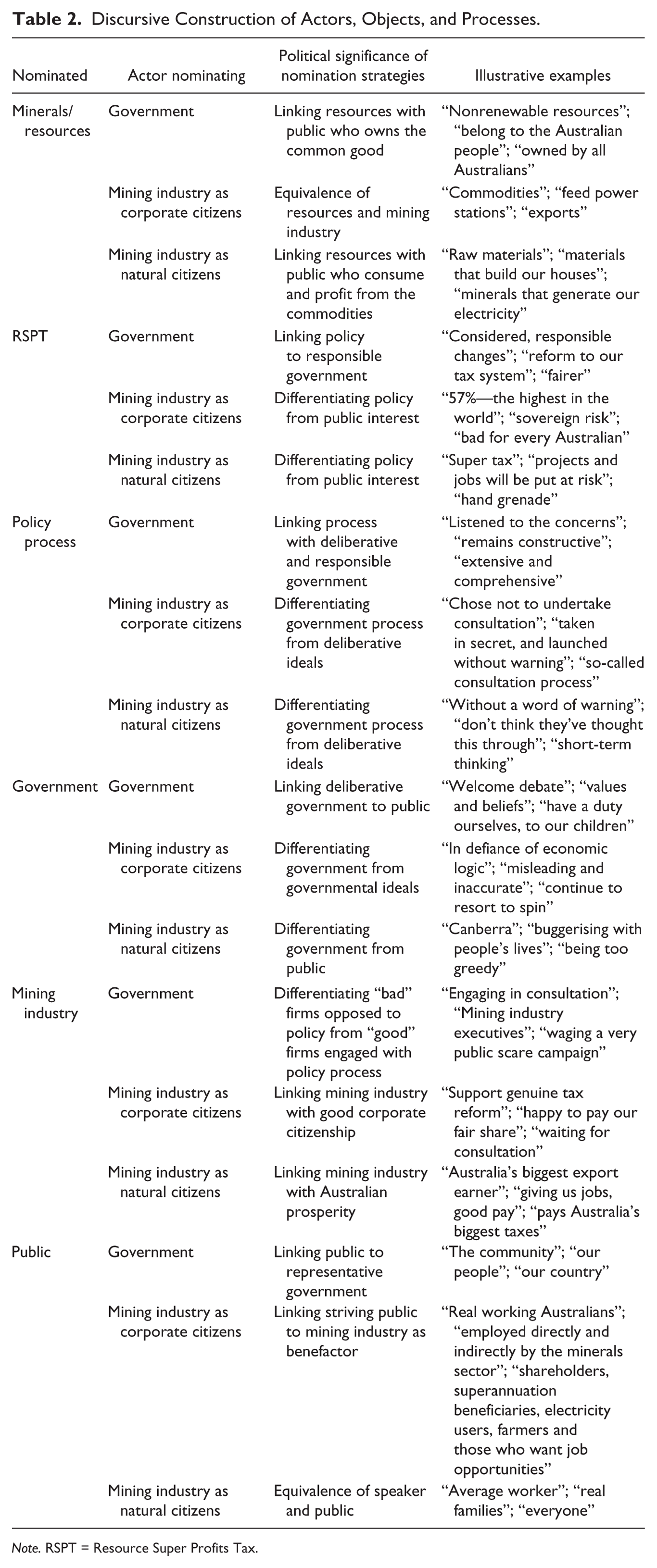
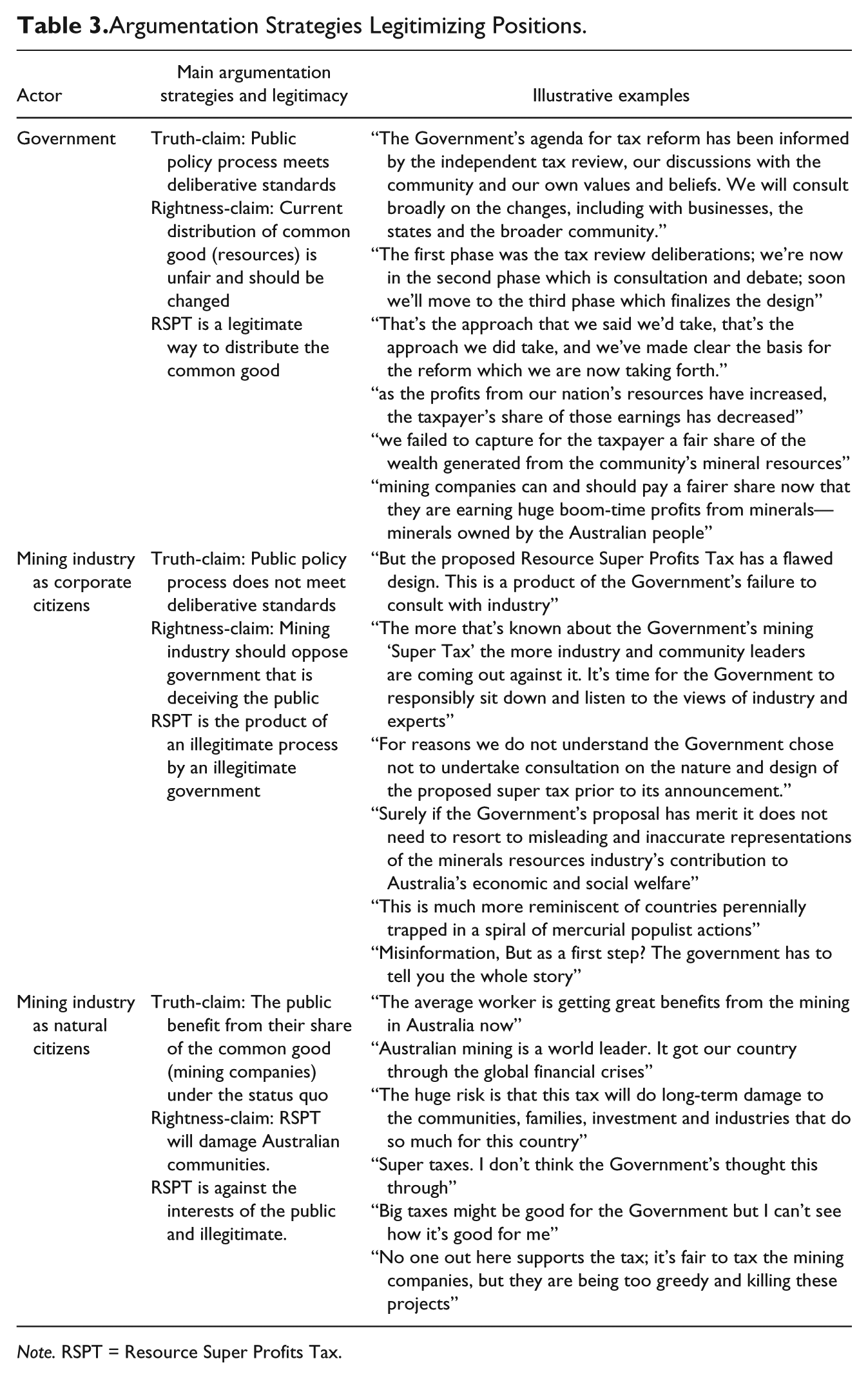
In the second stage, we conducted an inductive coding of the discursive strategies employed in the texts (Reisigl & Wodak, 2009). We analyzed each text in relation to (a) how actors (e.g., government, mining industry, the public), objects (e.g., RSPT, resources), and processes (e.g., consultation, deliberation) were referred to and characterized in the texts (see Table 2); and (b) the arguments employed to legitimize the position (see Table 3). The former analysis attended to how actors, objects, and processes were constructed by the mining industry and the government in the debate. Both the government and the mining industry engaged in positive self-presentation and negative other-representation (Wodak, 2009; Table 2). The latter analysis attended to the bases for argumentation in the debate. Argumentation strategies were based on (a) claims of truth to persuade the addressees regarding the justifications and effects of the RSPT, and (b) normative claims of rightness regarding the fairness of the RSPT (Reisigl & Wodak, 2009). Thus, truth claims legitimize a position by referring to utility or natural function, while rightness claims legitimize a position by referring to a value system (Table 3).
Discursive Construction of Actors, Objects, and Processes.
Note. RSPT = Resource Super Profits Tax.
Argumentation Strategies Legitimizing Positions.
Note. RSPT = Resource Super Profits Tax.
Finally, we analyzed the discursive strategies produced by the government and the mining industry in terms of what they achieved, that is, the political significance of the texts in the public sphere. In this stage, we attended to the constructed relations produced through the texts. The discursive strategies constructed meaning through linking actors, objects, and processes (e.g., resources are owned by the public); differentiating between actors, objects, and processes (e.g., the RSPT is bad for the public); and constructing equivalence between actors and objects (e.g., mining corporations and mineral resources are the same thing). The communication in the debate created in-groups and out-groups emphasizing differences between “us” and “them” (Wodak & Busch, 2004).
Findings
The findings set out the discursive strategies employed by the government and the mining industry throughout the dispute. Central to the analysis is the contrasting ways that the government and the mining industry constructed deliberation and the common good. The analysis shows how, through CPA, the mining industry engaged (a) as corporate citizens arguing for legitimate participation in deliberation and (b) as the public promoting the mining industry and their contribution to the public.
Government Deliberating Resources as the Common Good
When launching the RSPT, Prime Minister Rudd and Treasurer Swan argued that the government was obliged to obtain a better deal from the mining industry to prosecute the national interest (Commonwealth of Australia, 2010). First, the government argued that resources are assets held by the government on behalf of the community; that in effect mining companies resell community assets. Second, they argued that returns to the community had not kept pace with an extended boom in commodity prices, with existing arrangements “akin to underpricing the sale of a public asset” (Commonwealth of Australia, 2010, p. 17). Changing the tax arrangements and transferring the income would lead to a fairer distribution of income from resource assets owned by all citizens. The tax was presented as an opportunity to fulfill the public interest.
The government constructed natural resources as a common good which, due to underpricing, represented a financial burden for the public. The government provided truth claims that the “non-renewable resources that miners extract from our country” (Swan, 2010a) were “owned by all Australians” (Rudd & Swan, 2010), and rightness claims that “there should be a fair and reasonable distribution of the benefits” (Swan, 2010b). The reform itself was thus constructed as a mechanism to redistribute this common good from public cost to public benefit.
The process of distribution was constructed as deliberative in that it encompassed independent reviews, discussions with the community, and a wide ranging consultation process. The treasurer claimed to have “listened to the concerns of the mining industry executives” and that “their views are respected and valued” (Swan, 2010a). According to the government, the deliberation was open and inclusive in which “over 600 representatives from around 356 companies, industry and tax associations and financiers and states participated in the consultation process” (Swan, 2010c).
Through these discursive strategies, the government linked the resources as a common good with the Australian people. The RSPT was articulated as democratically legitimate, with the government representing the public interest in claiming their fair share of resource income. By arguing that the process had been and would be deliberative, the government differentiated between the executives of the major mining companies running a “scare campaign” and the majority of the mining industry and wider business community engaging in consultation (Swan, 2010d). Ministers openly mocked mining executives who announced the cancellation of projects that did not exist (Sherry, 2010), and recalled the mining industry’s previous scare campaigns (for policies with no ill-effect; Rudd, 2010). Thus, the government differentiated between, or isolated, the part of the industry that was opposed to the policy from the rest of the business community and the broader public interest.
The Mining Industry Deliberating as Corporate Citizens
The mining industry engaged in the debate as concerned corporate citizens and claimed there had been a deliberative deficit prior to and following the policy announcement. For example, industry texts claimed that the policy had “been developed in a vacuum” (Rio Tinto, 2010) and “launched without warning” (MCA, 2010m), with “no real consultation since” (Fortescue Metals Group [FMG], 2010) the announcement. Support for a deliberative process was illustrated in a print advertisement with an open letter from industry leaders claiming to represent the mining industry with the heading, “An industry wide solution requires industry wide consultation” (MCA, 2010f). As corporate citizens, the industry suggested that it remained “ready to engage in genuine good-faith consultation with Government” (MCA, 2010i).
This argument against the government was supported by depicting government actors as untrustworthy politicians. For example, one industry text asked, “When will the Government start telling the whole truth?” (MCA, 2010m). This challenged the government’s description of deliberation—“the consultation appears to be little more than window dressing” (MCA, 2010k)—and of governing—“fundamentally, abruptly and unfairly changes the rules of the game” (BHP, 2010b). Instead of tax reform, the untrustworthy government was portrayed as engaging in a “revenue grab” (MCA, 2010h) and having to “resort to misleading advertising” (MCA, 2010a).
This was in contrast to the trustworthiness of the mining industry—“What we’ve been saying all along is true” (MCA, 2010n). The mining industry was constructed as having “legitimate concerns” (MCA, 2010n), “waiting for genuine consultation” (BHP, 2010c), and “more than happy to pay our fair share” (MCA, 2010d). The mining industry was making a clear differentiation between the deceitful government unwilling to deliberate and the honest mining industry that was open to consultation.
In their construction of the common good to be deliberated, the mining industry texts made the mining industry equal to the natural resources in the ground. While the government asked for a deliberation about “the iron ore, the coal, the gas, the petroleum and other resources” (Swan, 2010b), the mining industry made itself the common good. The mining industry did not refer to the material resources and instead referred to the industrial activities of mining. According to industry texts, mining “got our country through the global financial crisis” (MCA, 2010l), pays for “schools, hospitals and roads” (MCA, 2010d), and “creates jobs” (FMG, 2010) and “superannuation returns” (MCA, 2010k). Thus, the mining industry claimed that if you “weaken mining, you weaken the country” (MCA, 2010l). The proposed RSPT was articulated as against public interest, “the future wealth and standard of living of all Australians” (BHP, 2010a).
By constructing mining as the common good, the texts could then differentiate the government from this common good. The government’s proposed RSPT was not a “threat” to the mining industry or its profits, but to “the whole of Australia’s future economic prosperity” (Rio Tinto, 2010). The voice of the industry was legitimate, as the government was not telling the truth, and the opposition to the RSPT was legitimized, as the RSPT was flawed due to a lack of consultation.
The Mining Industry Deliberating as Natural Citizens
Through the CPA in the public sphere, the mining industry also engaged in the debate as natural citizens. In doing this, they were not engaging as corporate citizens representing the public, but as natural citizens or the public itself. One of the television advertisements (MCA, 2010b) illustrates this well as it cuts between 22 different faces framed by job descriptions such as mechanic, geologist, and pilot, all repeating the same script to camera. These voices claim to speak for “real people,” “real families,” “working families,” and “real communities” (MCA, 2010b). The emphasis in constructing the public, speaking as the public, was the predication of them being “real” and “average” workers.
This construction of the public, by the public, and funded by the MCA, was closely linked to benefits the public receive from the mining industry. In one advertisement, the message from independent retiree Ross Bray to “Canberra” is as follows: “The average worker is getting great benefits from the mining industry through the superannuation they have” (MCA, 2010g; see Figure 1). The 10 different radio and four different television advertisements voiced by natural citizens generally linked their private interests with the mining industry through two goods for the public to identify with: superannuation and jobs. The overlapping mining and public interests were clearly spelled out in one radio advertisement: “For every mining job put at risk, there’s a worker. For every worker, there’s a family. For every family, there’s a community. Teachers, nurses, children, shop owners, all kinds of Australians all put at risk” (MCA, 2010c). By employing CPA to communicate as the public, the mining industry constructed equivalence between the industry and community dependent on mining.
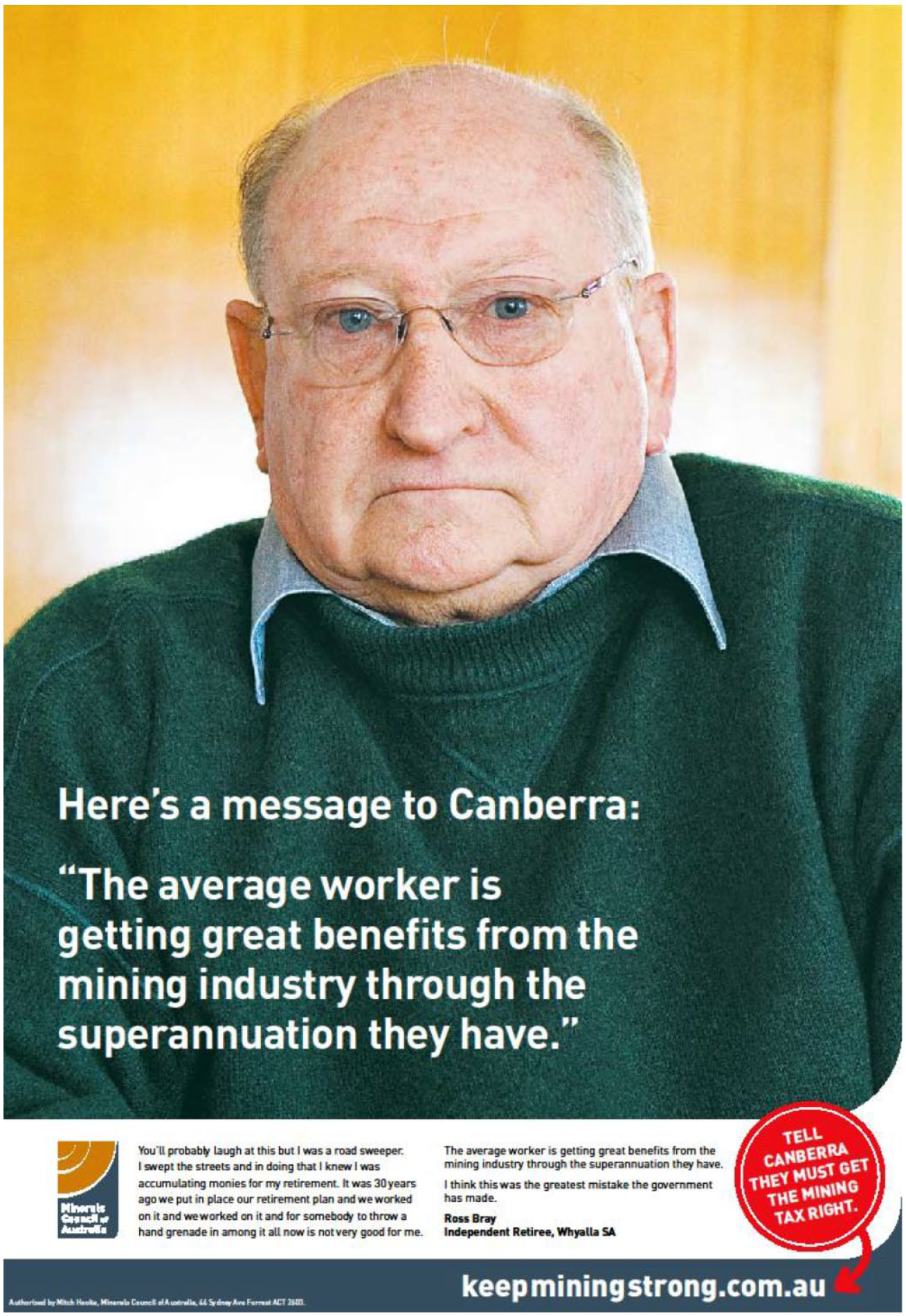
Example of corporate political communication.
The nomination of “real” people was a reference to how the government, nominated as “Canberra,” was distanced from the people they represented and only saw them as “statistics on a page” (MCA, 2010b). There was a differentiation in the argumentation between two groups to identify with as shown in Figure 1: (a) the public of Australia “getting great benefits from the mining industry” and (b) the Government that has thrown a “hand grenade in among it all now.” So, when one text suggested that “the government wants even more from us, a lot more” (MCA, 2010b), the nominated “us” in the text is simultaneously the Australian public and the mining industry. The differentiation in the public sphere was spelled out when the public in the mining industry advertisement is claiming that the government wants to hurt “the whole of Australia” (MCA, 2010b).
Through CPA in the public sphere, the mining industry constructed a public that represented the mining industry. The voices in the public sphere were “real” people speaking up for the mining industry that benefits Australia. Thus, the mining industry entered the public sphere as the public to debate the common good for the public.
Artificial Deliberation, Artificial Actors
Through CPA in the public sphere, the mining industry promoted itself as a corporate citizen legitimate to deliberate over the common good. As such, the industry used CPA to legitimize their participation in the public sphere. By constructing the private companies of the industry as the common good to be deliberated, the mining industry’s campaign discussed a fair rate of taxation on the common good of Australia—the mining industry. This is in contrast to the government, which deliberated over a fair distribution of income from resources owned by the public. By constructing equivalence between the mining industry and the common good, the industry positioned the government as against the common good.
The construction of the mining industry as a corporate citizen who should have been consulted justified the extensive CPA in the public sphere. As corporate citizens, the mining industry was a legitimate voice in the public sphere. A voice expressed through CPA. However, CPA was also used to provide space for other voices that promoted the mining industry as benefactors for the common good, that is, as good corporate citizens. Thus, the mining industry entered the debate both as good corporate citizens speaking up for the benefit of the Australian people and as “real” people promoting the industry as good corporate citizens hampered by a greedy government.
The nominated actors to identify with the mining industry included all Australians; “everyone.” The exclusion of the government as the differentiated “other” was therefore central to the positioning in the public sphere. The voices to construct the government as an actor were those of the “real” Australians nominating the government as the actor damaging and hurting Australia “for a long time” (MCA, 2010e). The CPA in the form of the Australian people argued that the “super tax” was “good for the government,” but “not good for me [the public]” (MCA, 2010j). The government was demonized as a threatening force that aimed to destroy the dreams and desires of the Australian population.
The mining industry’s CPA in the public sphere was directed toward the government in the form of corporate citizens seeking consultation, and toward the public as observers to pass judgment. The mining industry also engaged as natural citizens demanding that the government listen to the mining industry. The mining industry thus entered into an artificial deliberation with the aim of changing public opinion (rather than reaching a decision) and as artificial actors in the form of “real” people. This undermined the possibility of deliberation in the public sphere for the common good.
Discussion
The above findings show how the mining industry as political actors employed CPA in the public sphere, both as legitimate corporate citizens concerned with public interest and as individual citizens concerned about the mining industry. The findings have broader implications for how we understand corporations as political actors in terms of CPA and their role as corporate citizens in the public sphere.
Corporate Citizenspeak
Our findings suggest that the interplay between CC and CPA can provide a productive lens to understand corporations as political actors. Engaging as corporate citizens concerned with the common good provides legitimacy for CPA in the public sphere. CPA is seen as a way to participate in debates and take part in decision making. It is through CPA that corporate citizens can persuade the public that their interests are public interests. However, CPA is also used to promote the legitimacy of corporate voices and the role of corporate citizens in the public sphere. Through CPA in the public sphere, the CC metaphor becomes flat; CPA naturalizes CC, suggesting a dead metaphor (Wright & Nyberg, 2014). The construction and promotion of CC through CPA undermines the possibility to evaluate corporate participation as citizens as they participate to promote their natural inclusion in deliberation.
Our findings suggest that a particular type of CPA is enabled through the language of CC, a kind of Orwellian doublespeak that we term corporate citizenspeak—simultaneously speaking as corporate citizens and for natural citizens. In our case, the mining industry engaged in the public sphere as corporate citizens concerned about the welfare of natural citizens and as natural citizens concerned about the welfare of the mining industry. In contrast to Orwell’s doublespeak that deliberately obscures, disguises, or distorts what is being said, we found that the mining industry employed CPA to obscure, disguise, and distort who is saying what. Corporate citizenspeak illustrates the duplicitous engagement of firms as political actors and explains how they are claiming political legitimacy while subverting deliberative norms.
This citizenspeak is evident in how CPA was employed to simultaneously celebrate and subvert an inclusive deliberation process. The promotion of deliberation was exclusive and artificial in that it was directed toward an implicit reader or spectator for contemplation, rather than a deliberative process of engaging with the natural citizens that the mining industry claimed to represent. Engagement with the government was indirect, via public opinion, and without deliberating with the people represented. CPA was employed to undermine deliberative processes within a democratic public sphere.
Furthermore, citizenspeak was employed to construct the mining industry as a good corporate citizen providing common goods, such as “schools, hospitals and roads.” This wedged corporate interests between the government and natural citizens, with the industry laying claim to the political rights of natural citizens to grant assent. The industry constructed artificial citizens as “real” citizens and “average workers” to engage in citizenly political actions against the government. Through CPA, the mining industry channeled the political rights of artificial citizens. Thus, the political legitimacy claim was justified through the promotion of CC and validated by artificial citizen voices.
CPA can also be seen to politicize CC participation. The relationships between the state, businesses, and ordinary citizens are brought into focus when assessing corporate influence in the public sphere. In our case, the relationship between corporations and civil society was not activated by a regulatory void, and nor were the rights of ordinary citizens in jeopardy. Rather, the political rights of civil society were claimed for corporations, in pursuit of their own economic interests. The political rights of ordinary citizens to grant assent to policy were claimed to prevent new legislation changing the distributive relationship between the state, the industry, and ordinary citizens. Of course, the instrumental rationality of business firms can be seen as “bad” CC. This would be a highly selective reading in our case as bad CC stemmed from claims to good CC. As such, the corporate promotion and naturalization of CC changes civil society when corporations promote themselves as the common good in arguing that their private interests are equivalent to public interests—What is good for the mining industry is good for Australia.
This has implications for the understanding of CC. While Matten and Crane (2005) saw the potential for corporate citizens to facilitate or block certain political processes, their concept of CC is understood within a framework of democratic deliberation, analogous to other surrogate citizens, which may be in competition. That is, the ways in which corporate citizens engage in CPA, such as campaign funding or lobbying, may involve channeling (or preventing) the political rights of other interest groups. Our study suggests corporate interests have an additional capacity to extend influence into the process of deliberation itself. Rather than participating on equal footing with other interest groups, the mining industry displaced other voices in the debate. CC promotes the legitimacy of the firm as a political actor, yet one with the capacity to subsume the voices of natural citizens, which thus hindered democratic deliberation.
In resurrecting the metaphor of CC to be useful for understanding the political role of corporations, the aspects of the metaphor that are not applicable require further theorization. There are normative accounts of citizenship that are not applicable to corporations (e.g., jury duty, voting, military service) and there are aspects of corporations that allow us to question their proficiency in addressing the common good (e.g., limited liability, separation of ownership and control, lack of conscience; Sepinwall, 2012). Rather than presuming good CC, we can further problematize the metaphor to explain how corporate activities not only reflect but also effect change in relations between corporations, civil society, and the state. It is through political engagement in the public sphere, rather than through multistakeholder initiatives and engagement with nongovernmental organizations (NGOs), that such evaluations of CC can be made.
Our case also speaks to the need for studies of CPA that address its democratic implications (Barley, 2010; Schuler, 2008). Our analysis shows how corporate citizenspeak acts as a Trojan horse for a particular mode of CPA in the public sphere, through which industry appropriates the language of democratic legitimacy. This instantiation of CPA involved claims to speak on behalf of ordinary citizens and has the effect of colonizing the discursive spaces in civil society from which alternative political claims might emerge. As communicative power from the public sphere is the source of democratic legitimacy, evidence for the discursive colonization of the public sphere is especially problematic for understanding how corporate power can be curbed. To reformulate a line from Deetz (1992, p. 146), deliberation fails as the solution to power imbalances if it is how power is expressed.
Corporate Domination in the Public Sphere
Our analysis showed that communication through mass media is not only a medium for delivering arguments to the public sphere, but also a vehicle for domination of the public sphere. Mass media is used by groups, including the media itself, as a stage for politics. Rather than a debate in the public sphere enabling civil society to curb corporate interests, representations of natural citizens became the vehicle for the expression of corporate interests. Habermas (1989) referred to this move as the “refeudalization” of the public sphere, with the public sphere taking on characteristics it had in the feudal, premodern period, by largely functioning as a stage for the authority of particular interests. In the middle ages, public participation had been more of a “status attribute” (Habermas, 1989, p. 2), where the king would claim “L’ètat, c’est moi,” with the public not existing apart from the ruler (Calhoun, 1992, p. 7). The king was represented “not for but before the people” (Habermas, 1989, p. 8).
Our case showed how this refeudalization has led to manipulation of the public sphere, rather than deliberation in the public sphere. Instead of deliberative communication in accordance with a moral rationality, a politics of consensus, the industry engaged in strategic communication in accordance with an instrumental rationality, a politics of domination and exclusion. Deliberation in the public sphere is then about selecting policies and clarifying common goods post hoc, within bounds consistent with corporate strategy. Ordinary citizens are left to participate as consumers who have the option to “buy into” the positions or identities provided by corporations (Nyberg et al., 2013). Citizens are passive spectators, rather than active participants.
The deflation of the public sphere and deliberative democracy can be seen as a result of (a) the increase of corporate power resulting in vast inequalities in power and resources, and (b) the idea of a possible objective societal interest being replaced by negotiated compromises between plural interests (Calhoun, 1992). By manipulating the public sphere, actors can acquire political domination to influence society through the construction of consent. By engaging in a public political communication campaign, the mining industry delimited what could be said and done by the government and other actors. The campaign suggested, by constructing the mining industry as fair and the government as unfair, that the guarantor of civil society cannot be the state itself, but rather is guaranteed through the participation of other actors in civil society, such as corporations.
Of course, an alternative interpretation of the case is that it represents a functioning civil society, with communication flowing between the formal political sphere of institutionalized deliberation (e.g., parliament) and the informal public sphere of open and unstructured deliberation (e.g., in the media) of opinion formation. That is, tested in the court of public opinion, the government’s policy failed to gain the necessary assent of ordinary citizens and was withdrawn from consideration. We reject this line of argument. The empirical section points to the way that the mining industry campaign shifted the line of inclusion for actors in the public sphere, including how the mining industry portrayed itself as representatives of more traditional citizen groups. As we have shown, this involved displacing and subsuming alternative voices, colonizing the deliberative space for any potential competing interests.
Corporate domination in the public sphere has implications for how we theorize the firm as a political actor. Our contribution supports Habermas’s (1992) recognition that the normative approach in the CC literature “must be supplemented with the critical investigation of the mechanisms that . . . function to alienate citizens from the political process” (p. 450). In doing so, we have shown that CPA and CC are not only inseparable, but work together as a kind of mutually reinforcing legitimacy pump: CC legitimizes the use of CPA while CPA legitimizes the firm as a corporate citizen. By locating CPA and CC in the public sphere, our study advances our understanding of the firm as a political actor that can legitimately operate politically without being bound by deliberative norms of consensus and a license to operate. This is an alarming finding given Habermas’s (1992) proposed deliberative norms as the way to counter the disproportionate financial and administrative power already possessed by corporations.
That corporations have amassed resources for dominating the public sphere should be of concern for scholars promoting forms of democratic deliberation. Yet, there is an inherent conservatism in how the firm is portrayed in the CPA and CC literatures that seemingly accept the status quo. This is perhaps to be expected in the instrumental CPA literature detailing how firms effectively influence public policy. More surprising is how the broader literature in Business and Society, including the debates in CC and PCSR, generally takes present corporate capitalism for granted. There is nothing inevitable or natural with corporate political power and, as Perrow (2002) convincingly showed, the privatization and wealth of large corporations were triggered by contingent historical events. Corporations vigorously promote and reify their dominant role in national and global politics (Nyberg, Wright, & Kirk, 2017). Our concern is that by including corporations as citizens or political actors in deliberation, theories of deliberation and citizenship lose their normative and critical potential.
Conclusion
The findings respond to our research question by suggesting that corporations can employ citizenspeak in promoting themselves as citizens in the public sphere without losing legitimacy. This challenges the prevailing assumption in the CSR and CC literatures that firms acting in self-interest risk political legitimacy within the community that grants them a “license to operate.” By employing CPA to promote their citizenship credentials, they can moderate the legitimacy risks in pursuit of self-interest.
Corporate legitimacy can also be strengthened by undermining the government as an actor in civil society and the process of deliberative decision making. Through actions in the public sphere, corporations can impede the work of the state to remedy market failures and redistribute common resources. The duplicitous exclusion of the public undermines the CPA literature’s justification for CPA. Through citizenspeak, corporations are not aggregating their interest through exchange; they are undermining the possibility of a market for ideas. Their naked self-interest is cloaked in CC.
Considering the current political climate in many Western liberal democracies, it appears that business has a comparative advantage over government. While citizens are unhappy with the power of big business to influence public policy (den Hond et al., 2014), this does not necessarily tarnish the legitimacy of the firms involved. Instead, the loss of legitimacy appears to be charged against the democratically elected governments. The public arguably expect business to act in self-interest, which suggests that CPA in the public sphere undermines the democratic legitimacy of the public sphere itself rather than individual firm legitimacy or reputation. The disproportionate power of corporations to influence the public sphere undermines its function of deliberative decision making.
The performative effect of CPA, with successes in both influencing public policy and naturalizing corporate input in legislative decisions, ensures that corporations are seen as citizens in contemporary democracy. The implications of this for understanding relations between business and society are significant. Although the participation of corporate interests in public debate is well established as an empirical phenomenon, few have analyzed how CPA is employed to construct how interests are represented in the public sphere. Understanding how corporations influence public policy through the public sphere, by representing not only themselves but also claiming to represent other stakeholders, is especially important in terms of different forms of accountability—to the citizenry, and to the financial markets. These forms of accountability allow corporations to make two claims to the common good: (a) through explicit claims to the common good and (b) through claims to self-interest, which will produce the common good.
This raises a broader point though, which is that corporations are not held to account in the same way as representatives of the public. Claims by politicians are habitually contested in the public sphere, and it is a function of democratic accountability that determines any subsequent policy outcomes. There are no such democratic accountability measures for the claims of corporations in public sphere, with fiduciary accountability to profitability held to be a higher order adjudicator on any communication in public debate. By engaging as legitimate corporate citizens in the public sphere, corporations are changing the regimes or conditions for what they can legitimately say or do. As such, this study illustrates how the failures or the diminishing capacity of democratic regulation by states are partly due to the comparatively strengthened corporate power, rather than imperfection of state agencies.
Footnotes
Acknowledgements
We are grateful to Colin Higgins for his editorial guidance and the three anonymous reviewers for their valuable and challenging comments and suggestions. Their close reading and rigorous engagement greatly strengthened our article. We also like to thank the participants of the International Association for Business and Society (IABS) 2014 in Sydney for their comments and encouragement.
Declaration of Conflicting Interests
The authors declared no potential conflicts of interest with respect to the research, authorship, and/or publication of this article.
Funding
The authors received no financial support for the research, authorship, and/or publication of this article.
