



Abstract
While the presence of a strong civil society is recognized as desirable for democracies, an important question is what motivates citizens to join organizations. This article presents novel experimental evidence on the conditions under which citizens join interest organizations. We presented 1,400 citizens in two Mexican states with fliers promoting a new local interest organization. These fliers contain one of four randomly selected recruitment appeals. We find evidence that both brokerage of state patronage and demand-making for local public goods are effective recruitment appeals. The effect for patronage brokerage is especially pronounced among respondents with prior organizational contact, supporting our hypothesis of a “particularistic socialization” effect wherein organizational experience is associated with greater response to selective material benefits. Our findings suggest that under some conditions, rather than generating norms of other-regarding, interest organizations can reinforce members’ individualistic tendencies.
Why do people participate in social and political organizations? Over 50 years ago, Clark and Wilson (1961) famously established a typology of “incentives”—material, solidary, and purposive—that organizations can offer to induce participation. Olson (1965) amended this theory with the observation that organizations typically need to offer selective benefits—rewards whose receipt is contingent on participation—to deter potential members from free-riding on the labor of the organization. However, we lack systematic evaluations of the effectiveness of these different types of incentives. Furthermore, the world is full of organizations that sustain a large and active membership primarily through the pursuit of public goods, such as the environment and human rights, and organizations that pursue class interests that extend well beyond the immediate benefits enjoyed by members. Such “purposive” interest organizations play essential roles in designing policy, holding politicians accountable for good governance, and making demands on behalf of broad social groups.
Under what conditions are citizens motivated to join interest organizations in pursuit of collective goals, and when are they primarily compelled by the promise of individual benefits? Classic research suggests that previous experience as an organization member is a key trait that shapes the types of incentives that people are likely to value. On one hand, analyses in the Tocquevillian tradition have found that organizations can socialize citizens to have an interest in the common good (Ahlquist et al., 2014; Andrews et al., 2010; Putnam et al., 1994). Such solidaristic socialization can take place through multiple mechanisms, such as an increased sense of group identity, exposure to norms of reciprocity, or raised consciousness about policy issues that affect large social groups. Perhaps the most famous cases of solidaristic socialization are labor unions, which are credited with creating a working-class identity and a corresponding set of demands in 19th and early-20th century industrializing countries (Katznelson & Zolberg, 1986; Korpi, 1983).
However, interest organizations—those organizations that are founded to represent a defined set of interests in demand-making—play a variety of roles in shaping their members’ orientations to different types of benefits. While some organizations forge common bonds and a joint commitment to a set of programmatic goals, others act as intermediaries for patronage exchange, reinforcing a self-interested calculus for citizens entering into collective endeavors. 1 Through such arrangements, organization leaders negotiate with state or party representatives for control over discretionary benefits, in exchange offering to mobilize members politically on behalf of the patron. Organization leaders then allocate these state benefits—such as grants for housing, education, or microenterprise development—selectively to encourage people to participate in the organization. Although they can be found in any society, organizations that narrowly engage in this mode of brokerage are likely more prevalent in new democracies with weak institutions (Levitsky & Murillo, 2009) and high levels of economic exclusion.
In contrast to solidaristic socialization, those organizations that operate primarily as patronage intermediaries engender particularistic socialization among members. Through this process, members’ predisposition toward individual benefits is reinforced; they come to the organization because of the promise of accessing government programs and stay in the organization for the same reasons. The organization’s activities may even disabuse members of any faith in the merit of collective undertakings as they observe that the organization dedicates the greater part of its energies to extracting government benefits and conditions access on individual involvement in organizational activities—such as participation in electoral rallies. Most perniciously, particularistic politics within the organization may spill over to other areas of political life, predisposing members to clientelistic electoral appeals from political parties and inuring them to corruption and discretionary resource allocation.
Organizational scholars have advanced significantly in understanding the factors that lead social movement organizations and interest groups into a short-term resource-seeking orientation or a commitment to transformative goals. While some organizations may be formed with the primary purpose to intermediate state resources, others pass through a process of “goal displacement,” where they abandon transformative goals to focus their efforts instead on extracting resources necessary for the organization’s survival (Merton, 1968; Piven & Cloward, 1979; Selznick, 1949). However, the behavioral underpinnings of such theories have to be understood more fully and tested systematically. There are two fundamental aspects that deserve attention. First, we still know little about the factors that predispose some citizens to look to organizations as sources of material benefits and other citizens to join organizations in the pursuit of collective goals. Second, we know little about how organizations shape citizens’ likelihood of responding to material selective incentives and purposive incentives.
Our study addresses this gap by experimentally testing long-held hypotheses regarding (a) the differential effectiveness of distinct modes of organizational recruitment appeals and (b) the conditions under which organiza-tional membership generates solidaristic or self-interested behavior. The experimental design allows us to circumvent potential unobserved factors that typically shape both the types of recruitment appeals that citizens are exposed to and their degree of participation. For example, an observational study would likely find a strong correlation between poverty and participation in organizations that are centrally oriented to intermediating state resources. However, such a finding would not necessarily signal that poor citizens are more prone to respond to organizations that offer state material benefits over those that offer public goods; it could be that poor citizens are simply exposed to patronage appeals more frequently.
We conducted a randomized experiment recruiting citizens for a new organization—alongside a survey—with representative population samples of two Mexican states (n = 1,402). Participants were handed a flier advertising an organization that was new to their community. Respondents were led to believe that the fictitious organization was genuine during the experiment. 2 Separate versions of this flier mention different types of recruitment appeals, including help in accessing government distributive programs, demanding local infrastructure improvements, educational services for members, and the suggestion that many peers were already participating. The effect of these experimental conditions and a placebo control that consisted of a flier that contained no specific appeal was measured on a “declared” and a “behavioral” measure of the respondent’s interest in participating in the organization.
In line with Olsonian expectations and our own preregistered hypotheses, 3 we find the most consistent support for the promise of intermediation of excludable state benefits as an effective recruitment tool. Under the control condition, 55.7% of respondents replied affirmatively to the declared interest measure and 27.3% to the behavioral measure, whereas under the treatment condition promising help in accessing government subsidies, these figures are 62.5% and 36.6%. These differences are statistically significant. In contrast, the non-state-generated selective benefit treatment, which offered English and leadership classes to members, did not outperform the control, contrary to our expectations.
We further explore which respondents were most prone to this particularistic orientation. Counter the conventional wisdom that organizational membership generates norms of other-regarding, we find strong support for the “particularistic socialization” hypothesis. That is, current organization members (or people with organization members in their immediate social networks) responded more positively to the selective material treatment, whereas nonmembers responded more positively to the treatment emphasizing public goods. Counter expectations from the patronage literature that the poor are predisposed to seek private goods through political engagement (Calvo & Murillo, 2004, pp. 743–745; Stokes et al., 2013, pp. 158–171), we find that the conditional average treatment effect for the selective material incentives flier is at least as high among higher income organization members as among lower income members.
Based on interviews with leaders of Mexican interest organizations, we surmise that this heightened particularistic orientation is the result of being exposed to norms within organizations that focus narrowly on patronage brokerage, to the exclusion of demand-making in pursuit of collective benefits. This exposure can socialize organization members to particularistic politics in two ways. First, it can alter their preferences by normalizing a self-interested approach to civic engagement through interaction with fellow members whose participation is motivated by the promise of personal benefit. Second, contact with organizations may simply offer previously more idealistic citizens information about the ubiquity of patronage in their political systems and the central role of organizations in brokering patronage benefits.
This is not to say that participation in patronage politics at any level mechanically produces citizens disinterested in collective goals. Quite often organizations that are centrally focused on collective goals engage in some degree of patronage politics as a strategy to recruit new members and, through a process of solidaristic socialization, eventually socialize members to value broader goals. Thus, we conclude that the high prevalence of particularistic socialization that we detect in Mexico is attributable to a large swath of organizations that have abandoned purposive demand-making altogether. Such an abandonment can occur either through internal processes of oligarchization (Michels, 1915) and goal displacement or as a result of cooptation (Selznick, 1949) by a political party eager to mobilize the organization as a patronage network.
To substantiate the finding of a particularistic socialization effect, we drill down on the mechanisms behind this association through two additional analyses. First, we differentiate between members of the four most common classes of organizations in Mexico, two of which are strongly associated with the mediation of excludable state material benefits (rural associations, neighborhood associations), and two of which are not (labor unions and business associations). We find that it is members of rural and neighborhood associations that respond most positively to the particularistic appeal, supporting the notion that it is not exposure to organizational life in general that produces a particularistic orientation in citizens, but rather participation in patronage-oriented organizations in particular.
Second, to adjudicate between our purported socialization effect and a potential selection effect, wherein citizens with particularistic preferences are more likely to join organizations, we compare members and nonmembers in our study across a series of traits, differentiating between relatively stable sociodemographic traits (e.g., age, gender, class) and more elastic political behaviors (e.g., partisanship, exposure to clientelism), as well as social program beneficiary status. We find that members and nonmembers who participated in the experiment were quite similar across the former group of traits yet differed markedly on the second group of traits. Namely, organization members are more likely to be political partisans, to participate in political activities, and to be exposed to clientelism than nonmembers. This evidence is compatible with the notion that a heightened particularistic orientation in members is not due to organizations selecting for self-interested citizens as much as it is to organizations socializing members through norms and activities.
Our study builds on and adds to a recent wave of experimental literature that analyzes the determinants of civic participation. Previous studies have documented the factors that lead citizens to vote (Gerber et al., 2008) and to participate in protests (McClendon, 2014) as well as the determinants of politically relevant attitudinal outcomes such as preferences for redistribution (Kuziemko et al., 2015) and homophobia (Broockman & Kalla, 2016). Other experimental studies have exhibited the transformative potential of certain types of organizations in producing activists (Han, 2016). Extending these insights to organizational membership is valuable, given that this is an especially influential and common mode of political participation, both in mature (Verba et al., 1995) and transitional democracies (Collier & Handlin, 2009).
Mexico presents a particularly interesting case to focus on for two reasons. First, governments at the municipal, state, and federal levels offer a wide variety of social programs some of which are limited and discretionary, and are often appropriated strategically by elected politicians for political gain, and others that are broad-reaching and rule-based (Diaz-Cayeros et al., 2016; Garay, 2016). Second, Mexico presents a variety of both urban and rural organizations that rely on varied incentive structures to sustain collective action. Owing to its deep history of state corporatism, business, labor, and peasant organizations embedded into the once-dominant Institutional Revolutionary Party (PRI) have been relevant channels for distribution of state resources. Alongside these sectoral associations are others in both urban and rural areas that profess greater autonomy, some of which have nonetheless succumbed to patronage-exchange relationships, converting into patronage intermediaries or organizaciones de gestión. 4
While recognizing the challenges to external validity that experimental research faces, the intervention conducted in Mexico allows us to test systematically the types of incentives citizens respond to and to identify who responds to what type of incentive. This provides insights about the potential presence of particularistic socialization in other cases such as India (Auerbach, 2016; Thachil, 2014) or Brazil (Bueno, 2018; Gay, 1990), where both patronage and programmatic organizations are also present. The dynamics uncovered in this study likely extend to any context where interest organizations want for selective benefits and thus succumb to pressures to specialize as purveyors of patronage. We expect that such organizations are more common in low-income and weakly institutionalized democracies, however, where state benefits are more likely to be unevenly distributed, discretionary, and fall short of societal demand.
Interest Organizations: Recruitment and Socialization
Interest organizations as defined here are formally constituted collectivities, with established leadership roles and membership criteria, whose central purpose is to represent some group of interests or causes in the political system. Examples include organizations of workers (e.g., unions), business owners (e.g., chambers), members of a profession (e.g., bar associations, medical associations), identity organizations (e.g., LGBT, indigenous), geographic groups (e.g., neighborhood), or organizations of sympathizers with a particular cause (e.g., environmentalism, gun control, reproductive rights). Interest organizations are different from social movements in their heightened durability and degree of bureaucratization. They are also distinct from social organizations (e.g., bowling leagues, fraternal organizations) in their mandate to represent specific interests or causes in politics. Compared with these other groups, interest organizations face many challenges; chief among these is maintaining an active membership. 5
It is this very durability and sustained collective action capacity, however, that empowers organizations to execute several fundamental roles in the political system. First, interest organizations, through lobbying and other modes of pressure politics, are ideally suited for policy representation, as in congressional debates over trade policy in the United States where organized agricultural and business interests have traditionally acted as agenda setters and veto players (Hansen, 1991; Schattschneider, 1935). Second, organizations help connect citizens to political parties by signaling which candidates stand to promote the interests with which the organization is aligned. In Latin America, labor unions and other organizations affiliated with parties have been central for building partisan identities, mobilizing voters, and supplying candidates for public office (Collier & Collier, 1991; Murillo, 2001; Poertner, 2020).
Given that these representative roles derive from a “programmatic” (Kitschelt, 2000) or non-particularistic orientation to policy and the political process, such mass membership organizations are presented with something of a dilemma. On one hand, their representative function demands a preoccupation with the well-being of broad population groups—industrial workers or corn farmers, for instance. On the other hand, their ability to sustain collective action typically depends on the delivery of selective benefits (Olson, 1965) that are excludable to members and contingent on participation.
Typology of Organizational Incentives for Recruitment
We define four types of incentives that organizations may offer to recruit potential members. These incentives vary based on whether or not they are generated by the state, and whether or not they are excludable to individual members (see Figure 1). We assume that some type of incentive is necessary for individual participation. Excludable benefits appear in the upper row of Figure 1. These are the types of benefits that Olson hypothesized as necessary to induce participation for most organizations. The first type, labeled “subsidies,” includes excludable benefits generated by the state. In the case of interest organizations, such benefits may be obtained through the gestión process, wherein organization leaders aid members in accessing discretionary state distributive programs. But brokering state benefits is not the only way for organizations to generate selective benefits. Organizations may offer desirable “services” (upper-right) to members, such as training programs, social events, or information. When organizations sustain collective action on the basis of such self-generated selective benefits, they retain greater autonomy from the state than if they depend on the intermediation of state benefits (Palmer-Rubin, 2019).
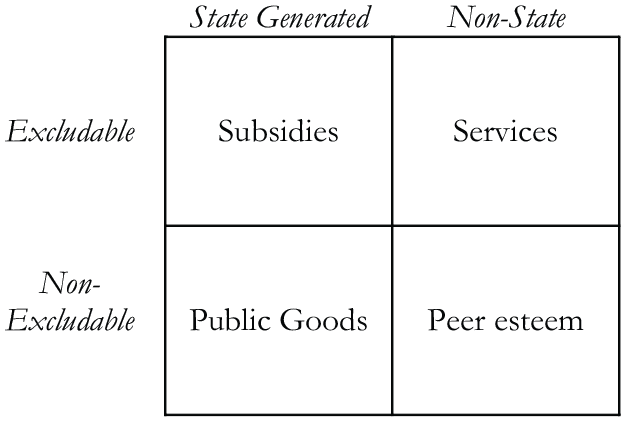
Types of organizational incentives.
Non-excludable benefits are represented on the lower half of Figure 1. Non-excludable state-generated benefits include investments in public goods and services such as roads, schools, and public security. A final category of incentives includes those that are neither excludable nor state generated. One type of incentive in this category relates to peer esteem (or “solidary” incentives). 6 These incentives include a feeling of obligation toward one’s social group or the positive feelings of contributing to one’s community. Olsonian logic would suggest that the incentives on the lower half of Figure 1 are not conducive to recruiting members, save in quite small-scale organizations. However, if solidaristic socialization does in fact take place, we may expect current organizational members to be predisposed to respond to these non-excludable incentives.
Using this typology, we produce a series of expectations about the effectiveness of distinct types of appeals under different conditions. First, as mentioned above, we expect excludable incentives to be more effective at recruiting members in general.
Second, given the greater desirability of patronage benefits to the lower classes, we expect subsidies to be relatively more effective at recruiting lower income respondents than higher income respondents.
Solidaristic and Particularistic Socialization
As a second inquiry, we turn the initial question on its head, asking not what types of appeals draw people into organizations, but rather what effect organizational experience has on citizens’ responses to the different types of appeals. Our approach does not allow us to “get inside” organizations and observe socialization processes as they occur. Instead, we conduct a subgroup analysis, comparing respondents who are organization members (or have members in their immediate social networks) with those who have no regular contact with interest organizations, probing whether organizational contact generates a proclivity to respond differently to these appeals.
Organizational socialization may modify the effectiveness of these different types of appeals for a given respondent through two mechanisms: by altering preferences or updating information. Echoing a Marxist insight, some scholarship attributes to interest organizations (particularly unions) a central role in shaping the preferences of their members by generating a collective (working-class) consciousness and shared set of policy goals or political objectives (Ahlquist et al., 2014; Katznelson & Zolberg, 1986). However, recent literature on party–voter linkages (Calvo & Murillo, 2013) and clientelist brokerage (Rizzo, 2019) suggests a simpler mechanism, based on updating of citizens’ information about the type of benefits likely to result from civic engagement. That is, through organizational contact citizens learn what organizations are typically able to accomplish and adjust their expectations accordingly. We are unable to adjudicate between these two mechanisms and expect that both are occurring to some degree in the organizations that we study.
Conventional wisdom about labor unions and other interest organizations is that these organizations sustain a purposive orientation through a dual incentives model. First, they recruit members by offering selective benefits, such as access to social activities, skills training, or discounts at commercial establishments. (Alternatively, where organizational membership is mandatory, as in a “union shop,” selective benefits are unnecessary, yet desirable to induce voluntary participation.) Second, organizations expose members to solidaristic socialization, aligning their own preferences with policies that promote well-being for larger population groups (such as all small-scale corn farmers, all small-business owners, or even all members of the “working class”). For instance, Putnam and collaborators (1994) find that the very act of membership in organizations that bridge societal divides produces norms of reciprocity, orienting members to contribute to the common good.
However, do organizations necessarily socialize their members in this way, or may their influence operate in the opposite direction? That is, rather than producing a concern with collective interests, might exposure to organizations sometimes reinforce an egocentric approach to participation resulting in particularistic socialization? This question has its roots in classic research on organized labor, which was concerned with the question how unions and the broader labor movement balance short-term goals of recruitment and resource generation with long-term transformative goals (Lipset et al., 1956; Michels, 1915; Przeworski & Sprague, 1986; Selznick, 1949). More recent scholarship analyzes the internal traits of unions, social movements, and interest organizations that produce a more transactional culture or one that is oriented to collective interest (Andrews et al., 2010; Fox, 1992; Palmer-Rubin, 2019; Voss & Sherman, 2000). We extend these concerns to test whether organizational exposure socializes individual citizens to view future organizational participation through a lens of narrow self-interest or broad collective interest.
We would expect particularistic socialization to occur in organizations that narrowly focus on the gestión process because of the central role that selective benefits from the state play for their survival. In post-neoliberal Latin America, intermediation of demand-based, discretionary benefits have become a fundamental way to attract members (Holland & Palmer-Rubin, 2015) and such gestión may impose restrictions on what organizations can do politically, especially if these groups are not strong. Although some organizations have been able to use selective incentives to generate a common identity and press the state for broader policy goals—such as the social movements of the unemployed in Argentina (Garay, 2007) or landless workers in Brazil (Tarlau, 2013)—many organizations in Latin America lack the ability or strength to generate solidary incentives or a common set of collective goals.
To test these theories, a second set of hypotheses concerns the effect of prior organization contact on response to excludable versus non-excludable recruitment appeals. We pose two competing hypotheses. First, the theory of solidaristic socialization predicts that organization members are more likely to respond to non-excludable appeals than nonmembers.
The theory of particularistic socialization, however, predicts the opposite—that organizational contact predisposes current members to respond at a greater rate to excludable benefits.
Notably, our approach is limited in that we are only testing recruitment appeals at initial contact and are thus unable to observe what appeals are most useful at retaining members. Existing research has shown that the factors that draw members into organizations, such as an “open-network structure,” are often at odds with the factors that position them to retain members, which demands building a close-knit member network (Shi et al., 2017). Perhaps some segment of the respondents that were amenable to particularistic appeals in the recruitment scenario would have been susceptible to solidaristic socialization if they sustained lasting ties within organizations with strong norms of collective demand-making and identity formation (Munson, 2010). However, if current organization members do, in fact, respond to excludable benefits at a higher rate than nonmembers, this can be interpreted as evidence that their present organizational affiliations are more likely to have produced particularistic than solidaristic tendencies.
Interest Organizations in Mexico
The practice of gestión, wherein organizations intermediate social programs and resources for members, is widespread in Mexico. In particular for organizations that represent the most precarious, such as residents of urban slums or the rural poor, access to and selective allocation of these benefits is central to recruiting members and sustaining collective action. For example, the leader of a 3,500-member rural organization in the Estado de México reported that upon joining [members] take on both obligations and rights. They have the right to apply for [subsidies for] housing or to raise sheep or whatever else. Their obligations are to fight for these benefits in marches and in election rallies. . . If they don’t support the organization, well the organization doesn’t support them either. It’s reciprocal.
7
Gestión is also a common mode of sustaining collective action in massive corporatist organizations, such as the National Peasant Confederation (CNC), the nationwide rural organization that is embedded in the PRI. Although the CNC was constructed as a sectoral organization of agricultural producers, primarily those tied to collectively held ejido land, the majority of CNC members today do not rely on agriculture as their primary source of income. The organization has therefore transformed into a clientelistic network for the PRI, which manages subsidies for agricultural inputs alongside those for small-business investments, housing, anti-poverty programs, and other distributive benefits. 8 An interviewed leader of this organization reported an elaborate pyramidal structure wherein base-level organizational brokers recruit members by promising subsidies, and higher-level leaders negotiate with party and government personnel for these discretionary distributive programs. The exchange of these handouts for political support cascades down the chain of command, and those who prove capable of mobilizing more voters are rewarded with a larger share. In the July 2018 national elections, this leader claimed that the organization mobilized 230,000 voters in one state alone through this process. 9
This is not to say that gestión is the only activity in which Mexican interest organizations engage. There are several that focus their efforts on policies that affect broad economic sectors or entire neighborhoods, such as infrastructure improvements or regulatory policy, and more yet that combine these programmatic demands with the intermediation of discretionary state benefits. What this research project seeks to uncover is the degree to which members look for individual material benefits in organizations and become socialized to viewing organizations primarily as a source of such benefits. In this case, those who have come into contact with organizations would exhibit a preference for organizations that offer excludable material benefits.
The process of gestión has its roots in a long history of corporatism based on party dominance and the weakening of popular organizations, which was constructed and cultivated from above by the PRI throughout the 20th century. Under one-party dominance in 20th-century Mexico, sectoral organizations were embedded into the PRI through complex corporatist ties that offered organizations crucially important roles in markets, such as monopolies over public employment decisions or the distribution of crop inputs for farmers. In exchange, these organizations supported the PRI and mobilized their members and communities in elections (Collier & Collier, 1991; Grayson, 1998). While this politics was certainly riven with patronage, organization ties to party and roles in policy were stable, and organizations’ membership was guaranteed through mandatory membership laws. Gestión of demand-based benefits operated mainly as a much less generous strategy of cooptation for groups that were not the central pillars of the corporatist system. For instance, classic research on the urban poor in Mexico during the heyday of one-party rule described how neighborhood leaders allocated government benefits and the spoils of land invasions selectively to reward those who participated (Cornelius, 1975, Chapter 6).
Like these squatters, the most prevalent organizations today are those that fall outside of corporatist structures, are more autonomous of the state, and more frequently renegotiate their access to state benefits. These include neighborhood associations, which have increased in size and political importance, particularly in the national capital in the aftermath of the 1985 earthquake, as well as rural associations, many of which tssoday are primarily composed not of agricultural producers but of poor rural populations employed in low-skilled service sector jobs (de Grammont, 2009).
Thus, organizational intermediation of discretionary state programs is not new to Mexico, yet has perhaps expanded in the neoliberal period, as sectoral organizations (labor unions, farmers’ associations) have declined in membership and political might, and geographically based organizations (neighborhood and rural associations) have ascended in importance. For peasant organizations, the late-20th century neoliberal turn spurred the curtailment of the most valuable inducements to organizations, such as mandatory membership requirements and crop purchasing monopsonies. Subsequently, federal, state, and municipal governments adopted a cornucopia of demand-based support programs that purport to follow formula-based targeting criteria, but are often allocated discretionarily in practice. The most common of these are proyectos productivos (productive projects), which offer small cash or in-kind benefits for capital investments for small-scale farmers or microentrepreneurs. Another common category of demand-based benefit, prevalent in low-income areas of both urban and rural Mexico, are vivienda (housing) programs that grant either space in public housing or construction material to lay concrete floors or add a bedroom. These programs have limited budgets and typically cover a small share of their target population. For example, scholars have found that 80% of all federal programs cover less than 40% of the population potentially eligible for the benefits they provide. State-level programs are even more limited, and 69% of those combating poverty had less than 10,000 beneficiaries in 2014, at a time when more than 60 million people were poor (Cejudo et al., 2018). In both urban and rural areas, access to proyectos productivos and vivienda benefits, which are in short supply, many times occurs through the intermediation of organizations or partisan brokers (Castellanos-Navarrete & Jansen, 2017; Garay et al., 2019; Hilgers, 2008).
Gestión of government patronage benefits is not equally prevalent among all classes of organizations. Labor unions, many of which continue to enjoy mandatory affiliation, tend to focus on wages and social security benefits for union members rather than selective material benefits accessed through gestión. Business chambers are quite prevalent, yet intermediation of state benefits tends to be less central to their political activity (Palmer-Rubin, 2016). On the contrary, given their focus on housing and economic conditions for the most vulnerable, hundreds of neighborhood and peasant associations throughout the country specialize in brokerage of proyectos productivos and vivienda.
The main analysis below pools organization members together, whether they belong to the corporatist protected class inherited from the 20th century or to the more autonomous, yet more precarious segment of organizations that has ascended in this century. However, in an additional analysis, we differentiate between members of these different types of organizations finding that members of neighborhood and rural associations are the ones most associated with particularistic recruitment as opposed to traditional corporatist associations (labor unions and business chambers).
Experimental Design and Data
The experiment was conducted on representative samples of roughly 700 voting age citizens in two Mexican subnational units—Mexico City (the national capital) and the state of Chiapas, for a total sample size of 1,402. These subnational units were chosen on the basis of two criteria. First, they have ample, yet relatively typical levels of organizational membership for Mexico, ensuring that our samples include a sufficient number of organization members while preserving some degree of generalizability. 10 Second, they vary in the type of organizations that are most common. Chiapas has many indigenous and peasant organizations, but also urban areas with high degrees of professional and neighborhood organizing. Mexico City has many prominent neighborhood organizations, unions, and political activist organizations. We are confident that findings from these subnational units would extend to the bulk of central and southern Mexico, where popular-sector organizations proliferate and are commonly embedded in patronage-based ties with political parties. However, our sample does not include citizens in Mexico’s wealthier northern states, where both popular-sector organizing and partisan patronage networks are likely less dense. The analysis in the article uses a pooled sample with both Chiapas and Mexico City respondents (replicated separately in Supplemental Appendix D). 11
To ensure that respondents of different ages and socioeconomic backgrounds are well represented in the samples, we stratified the random sample by census districts/zones/blocks. In the absence of a sampling frame with information on age and class on an individual level, this stratification can serve as a proxy for these factors as there is a fair amount of geographic clustering based on these characteristics. Within each cluster, a random sample of households was selected using an interval sampling method.
At the end of a face-to-face survey, enumerators handed a flier to the respondent with information on a (fictitious) organization (Lazos Comunitarios or Community Ties) that had “recently started work in their community.” 12 Survey enumerators reported that the vast majority of participants actually believed that the organization was real. Given the large number of civic associations operating in Mexico, the presentation of a new one was seen as credible. To the extent that respondents were ineffectively deceived, we would expect less willingness to participate overall, but have no clear prediction about whether it would bias the effect of any of the particular treatment conditions. It is still possible, however, that participants may have responded differently to recruitment appeals from somebody that they know personally, such as a neighbor or friend, as opposed to our hired enumerators. Perhaps a recruitment appeal from a personal contact would augment the participants’ sensitivity to solidaristic incentives or concern with peer esteem for participating in an activity on behalf of the common good, as suggested by prior experimental research into “relational” activism (Han, 2016; Sinclair, 2012). Our study, however, was designed to experimentally vary the content of the appeal and not the mode of appeal. In the conclusion we address future extensions that would involve personal recruitment appeals in the context of recruitment to an authentic organization.
Given that the experiment was conducted on a general population sample and not some subset with similar, narrow interests (e.g., members of a given neighborhood or profession), we presented the organization as general enough to appeal to any citizen. These conditions likely led to smaller effects compared with a scenario where respondents belong to a defined population (e.g., rural or urban, lower-class or upper class, farmer or service-sector worker), which would have allowed us to tailor recruitment appeals to their interests.
The particular appeals included on the fliers were chosen to be of interest to both urban and rural populations of different socioeconomic levels and to be representative of the types of demands and benefits that are typical to organizations across Mexico. Almost certainly, the average desirability of the various appeals varied. For instance, while the “public goods” treatment—mentioning demands to repair potholes and clean up parks—may be broadly appealing, the “services” treatment, offering classes in English and leadership, was likely of interest to a smaller segment of respondents. Such heterogeneity was difficult to avoid for a general population sample. However, the fact that each of the treatment conditions proved to be most successful on some subsample that we analyzed suggests that each of the types of appeals was realistic and influential in shaping respondents’ behavior.
English translations of the five versions of the recruitment flier are displayed in Figure 2. 13 Each respondent was presented with one randomly selected version of the flyer. 14 Respondents were not aware that there were multiple versions of the flier. Upon delivering the flier, the enumerator stated the following: “To the people taking part in this survey, we are providing information about a nonpartisan civic association that recently started doing work in your community. Here is a flier from the civic association.”
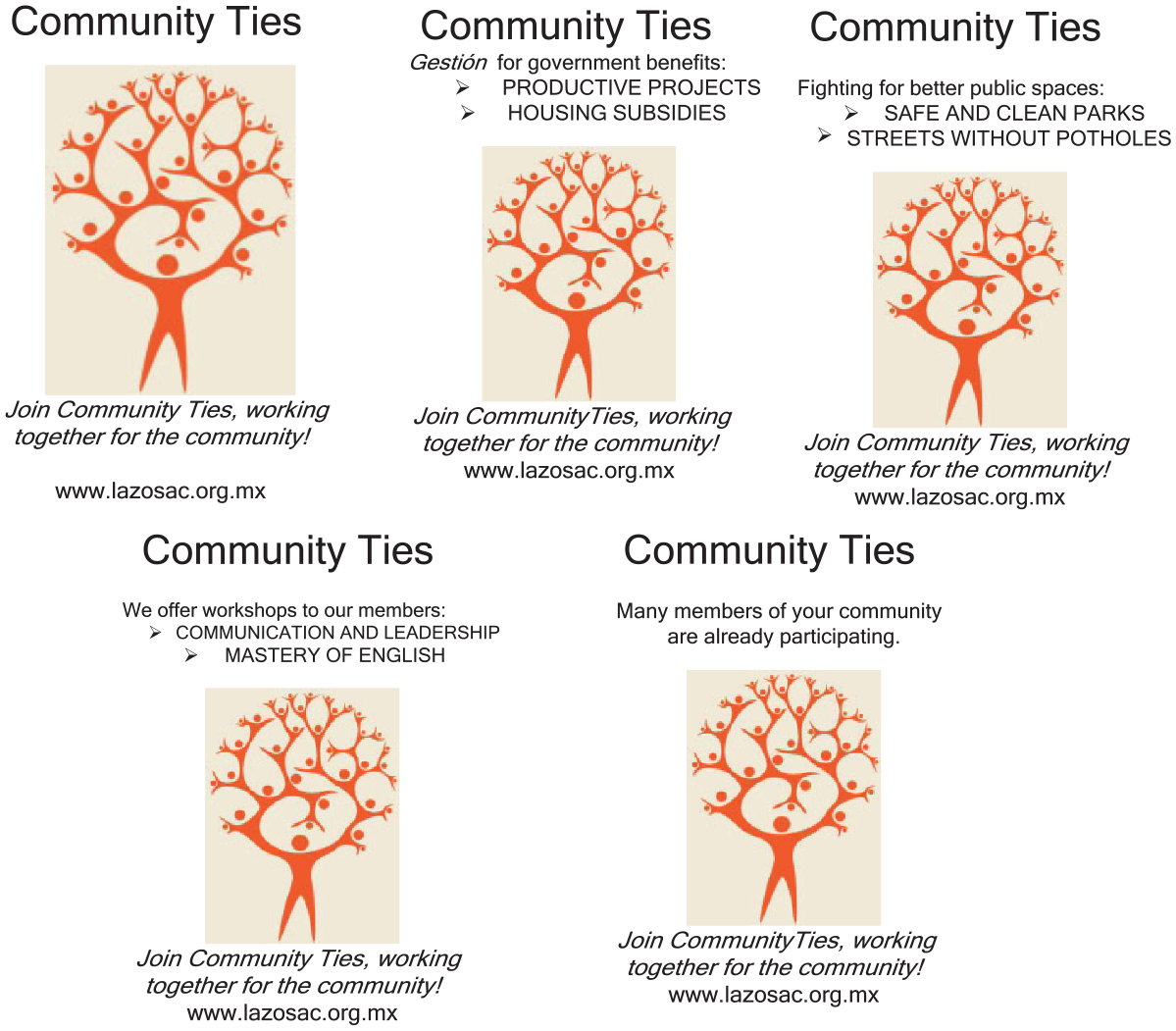
Control and treatment conditions.
The control version of the flier (top left of Figure 2) contained only the organization’s name, slogan (“Join Community Ties, Working Together for the Community!”), fictitious website, and logo. The four treatment conditions included these same elements with additional messages.
The subsidies condition (top-center) stated, “Gestión of government benefits: Productive Projects, Housing Subsidies.” As discussed above, “productive projects” (proyectos productivos) is a term commonly used to refer to a variety of typically application-based programs where citizens propose economic ventures for which the government offers small cash subsidies or in-kind contributions. Housing subsidies offer money or materials to build or expand one’s dwelling or to lower rent.
The public goods condition (top-right) stated, “Fighting for better public spaces: Safe and Clean Parks, Streets Without Potholes.” Again, the appeals in this condition were chosen to be relevant to both lower- and middle-class residents in both cities and in the countryside. Parks and potholes are both issues of concern in both urban and rural areas and for both lower and middle-class population. 15 These are also the types of local public goods that frequently are the currency of demand-making for geographical-based associations. Participation in an organization that pushes for better public spaces, however, is likely to be dampened by free-rider tendencies, as both participants and nonparticipants can enjoy these improvements.
The services condition (lower left) stated, “We offer workshops to our members: Communication and Leadership, Mastery of English.” These incentives qualify as excludable, given that the flier clearly communicates that they are limited to members. But rather than state material benefits, the incentives are generated by the organization itself and they aim to build human capital. We identified communication, leadership, and English language as skills that would be broadly desirable across different classes of respondents and are often offered by organizations.
Finally, the peer esteem condition (lower right) stated, “Many members of your community are already participating.” This message communicated that participation in the organization was a community norm, potentially arousing feelings of obligation. This type of message has been shown to encourage pro-social behavior in other settings, as in mailers sent to tax evaders in the United Kingdom stating that they are among a small minority of citizens who have not paid taxes (Hallsworth et al., 2017). Stronger social pressure may have been signaled by notifying the respondent that the names of participants would be publicized to the community, in line with the finding that the suggestion of publication of electoral participation increases turnout (Gerber et al., 2008). We chose not to include such a message out of concern that it may intimidate the participants, particularly in a context where participation in political organizations can expose citizens to violence from political rivals.
The outcome—interest in participation in the organization—was measured in two ways. First, after reading the flier, the participant was asked if she was interested in participating in the organization’s activities (declared interest). Second, if the response to this question was affirmative, the participant was asked if she would provide her phone number to be contacted about an upcoming event (behavioral measure). 16 This behavioral measure produces a more accurate depiction of the respondent’s interest in participating by assigning a cost to an affirmative response in the form of the risk of potentially unwanted contact. Thus, it filters out “cheap talk” or respondents who reply in the affirmative to the first question out of an interest in projecting a certain image to the interviewer. There is a significant drop-off from the declared interest measure to the behavioral measure (from 55.3% of respondents to 30.8%).
Responses to the survey questions preceding the experiment permitted us to analyze heterogeneous treatment effects within and across different subgroups, based on income levels, prior organizational membership, and other participant traits.
Analysis
As shown in Table 1, our central expectation that distributive benefits would be most effective at encouraging member recruitment is borne out by the evidence. The initial measure of whether subjects verbally express an interest in participating in the organization only yields a positive and significant effect for the subsidies treatment (Column 1 of Table 1). The subsidies appeal produced a 6.7 percentage point increase in respondents’ interest to join the organization (significant at the 0.10 level). However, the non-excludable benefits in the form of public goods did not produce a significant effect. Unexpectedly, the peer esteem treatment performs significantly worse than the control in the declared interest measure (not denoted as significant in the table due to one-tailed tests). Perhaps upon hearing that many of their neighbors were already participating, respondents either felt that their own participation was unnecessary or were put off by the potential of interacting with many people.
Overall Findings.
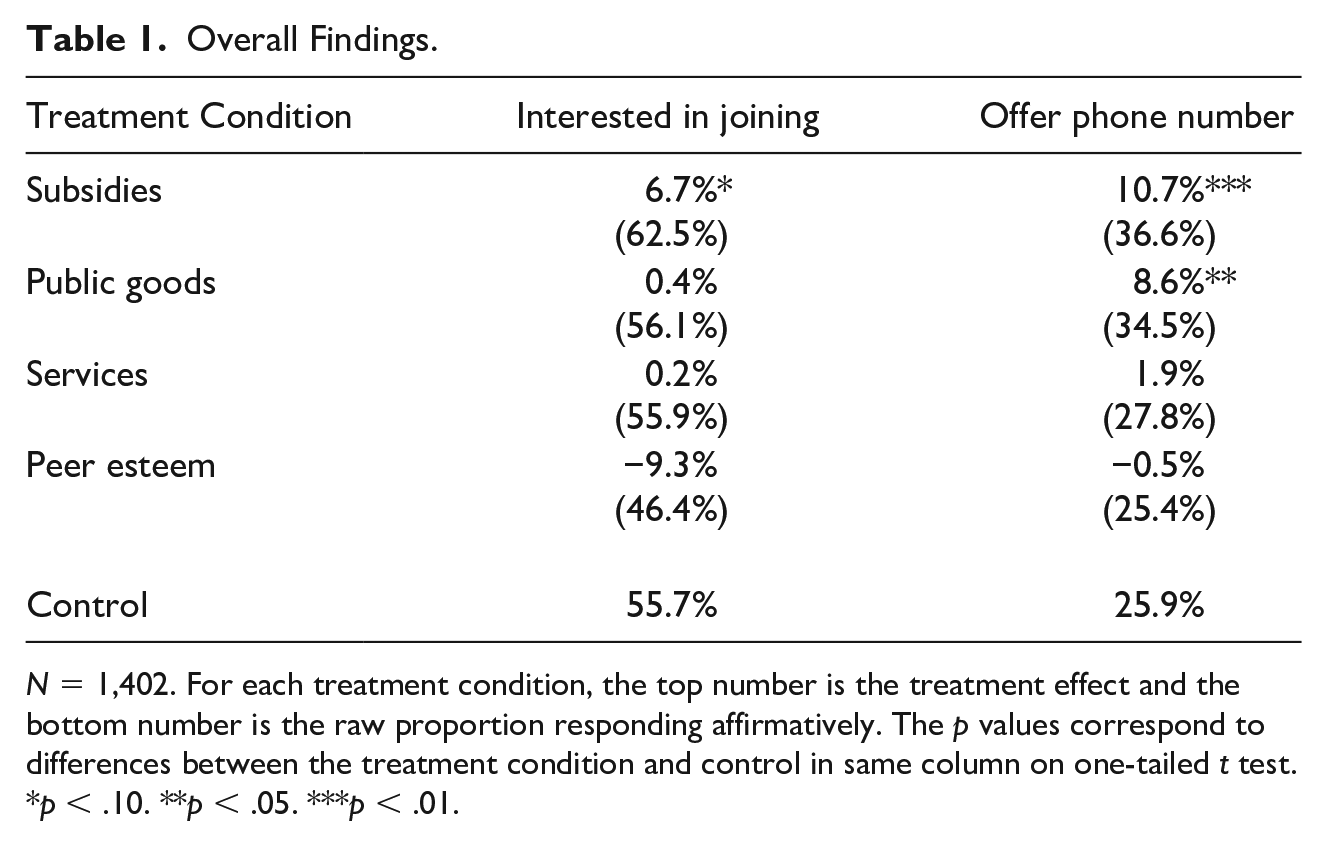
N = 1,402. For each treatment condition, the top number is the treatment effect and the bottom number is the raw proportion responding affirmatively. The p values correspond to differences between the treatment condition and control in same column on one-tailed t test.
p < .10. **p < .05. ***p < .01.
For the second dependent variable (Column 2 of Table 1)—the behavioral measure of providing one’s phone number—there is a 10.7 percentage point treatment effect corresponding to the flier that presented the organization as offering gestión of housing and economic subsidies. Furthermore, the public goods treatment—promising to push for clean and safe parks and streets without potholes—yielded a significant positive effect of similar magnitude. However, support for H1 is not complete, as there is no significant effect for the services treatment, an excludable benefit that the organization generates itself rather than a state-generated benefit brokered by the organization. Likewise, there is no significant effect for the peer esteem treatment. In the remainder of the analysis, we present results only from the behavioral outcome, but replicate results for the declared interest outcome in Supplemental Appendix A.
We next disaggregate results by whether the respondent belongs to some type of interest organization or is in the same social network as somebody who belongs to an organization (Table 2, Figure 3). 17 If nonselective treatment conditions (public goods and peer esteem) are more effective for members than for nonmembers, we would interpret this as supporting the solidaristic socialization thesis that belonging to organizations produces collective norms (H2a). In contrast, if the treatment effect of the subsidies flier is larger for members than for nonmembers, we would interpret this as evidence in favor of particularistic socialization (H2b).
Members Versus Nonmembers.

Members n = 624; nonmembers n = 749. For each treatment condition, the top number is the conditional average treatment effect, and the bottom number is the raw proportion responding affirmatively. The p values correspond to differences between the treatment condition and control in same column on one-tailed t test.
p < .10. **p < .05. ***p < .01.
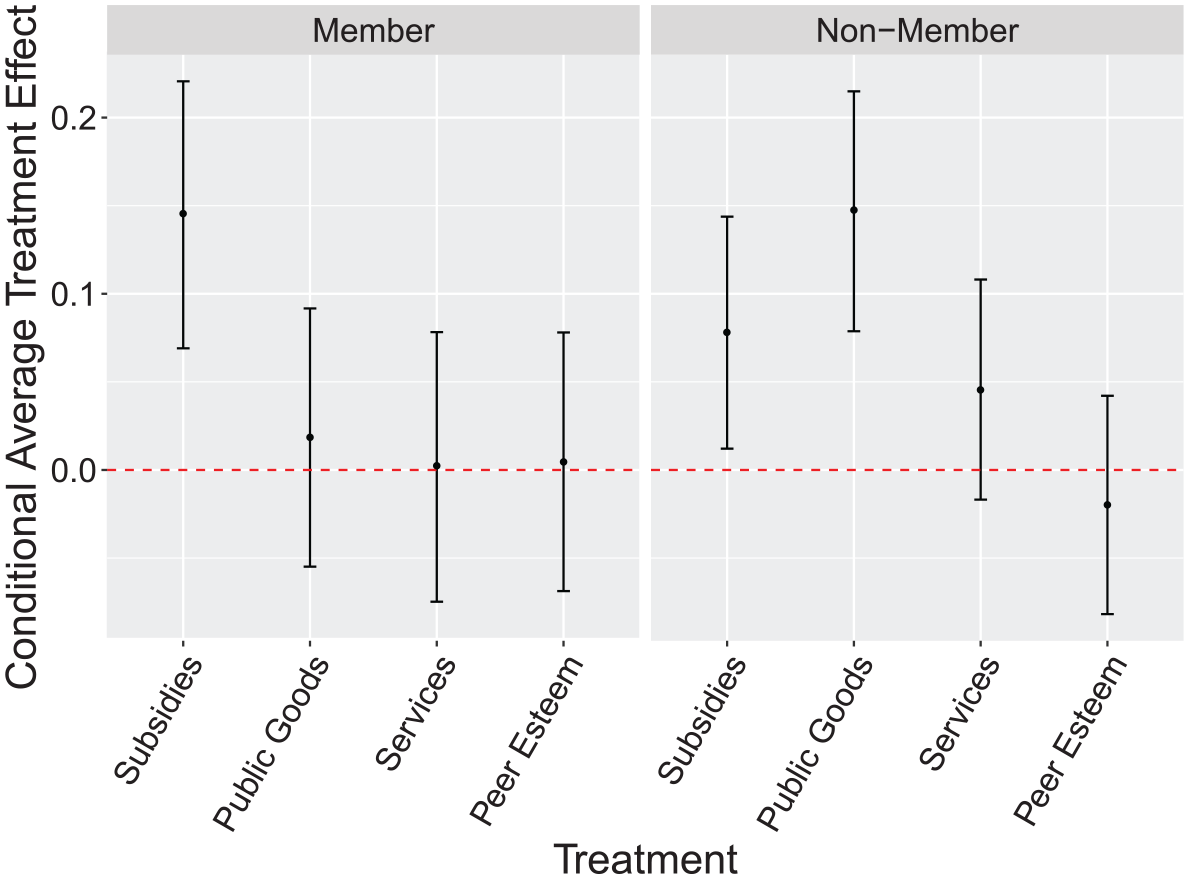
Members versus nonmembers.
Our findings suggest that organizational membership does, in fact, condition preferences for different types of appeals, supporting the particularistic socialization hypothesis (H2b). For members, the subsidies treatment yields close to 50% greater willingness to participate: 43.9% compared with 29.5% for the control. No other treatment condition is significantly superior to the control. And while the subsidies treatment does produce a significant estimate for nonmembers, the public goods treatment was most successful for this subgroup, with a conditional average treatment effect similar to that of the subsidies treatment for members. Experiment participants who do not come into contact with interest organizations appear to be quite civic minded, responding at a significantly higher rate to a recruitment appeal based on improvements in local public goods than to the control condition. Based on this finding, we can rule out the possibility that Mexican citizens in general are predisposed to view civic engagement through a particularistic lens. It is also quite unlikely that organizations are disproportionally made up of more self-interested or cynical citizens who self-select. However, these findings suggest sobering results for the impact of interest organizations on citizens’ political engagement. In short, those who have been exposed to organizations have either become more self-interested or simply learned what organizations are principally good for—“getting stuff” from the state.
The next step is to consider the effect of income on relative preferences for different types of recruitment appeals. The literature on clientelism and patronage produces the expectation that lower income respondents are more likely to demand excludable material goods than public goods given the higher marginal value that such benefits provide and their more precarious social positions (Stokes et al., 2013, pp. 158–171). Accordingly, H1a predicts that low-income citizens find subsidies appeals from organizations relatively more appealing than do higher income citizens. Table 3 splits the sample into low- and high-income groups, based on whether the respondent was below or above the median in a categorical income question. 18
Low-Income Versus High-Income by Membership.

For each treatment condition, the top number is the conditional average treatment effect and the bottom number is the raw proportion responding affirmatively. The p values correspond to differences between the treatment condition and control in same column on one-tailed t test.
p < .10. **p < .05. ***p < .01.
Our findings do not support the existing theory about the effect of income on demand for particularistic benefits. We do find a significant estimate for the subsidies appeal for low-income members, yet high-income organization members exhibit a remarkably high response rate to the subsidies treatment. Over 58% of these respondents agreed to provide their phone number when presented with an organization that offers help in accessing government subsidies. In contrast, high-income nonmembers responded positively to the public goods treatment, but not to the subsidies treatment. These findings suggest that the particularistic socialization effect of organization membership is driven mainly by relatively high-income organization members. 19 This notion is further supported by comparing conditional average treatment effect sizes for the peer esteem treatment. While this treatment condition yielded the largest estimate for low-income organization members (17.3%)—suggesting that organizational contact has made this subgroup more civic minded—the point estimate was of roughly similar size yet in the opposite direction for high-income organization members.
Probing the Mechanisms: Selection or Socialization?
The main rival to our purported particularistic socialization mechanism is a selection effect. That is, perhaps it is not the experience of participating in an organization (socialization) that produces particularism, but rather that an orientation to private goods is what motivates organizational membership in the first place (selection). In this section, we conduct two additional analyses to address this concern and further explore the mechanisms that mediate the relationship between organizational contact and responsiveness to the varying treatment conditions. First, we divide our sample of organization members into groups belonging to different types of organizations—including those that are traditionally associated with patronage-based mobilization strategies (neighborhood associations and peasant associations) and others that are not (labor unions and business associations). We find that members of the former category do, in fact, respond positively to the subsidies appeal, while members of the latter category do not. Second, we observe differences between members and nonmembers across a series of covariates. We divide these variables into relatively immutable sociodemographic factors versus political traits that may be outcomes of organizational contact. Given relative uniformity on the former group of variables and stark differences between members and nonmembers on the latter, this exercise produces suggestive evidence in favor of a socialization rather than selection mechanism.
In Table 4, we analyze members of different types of organizations, breaking them down into members of labor unions, peasant associations, neighborhood associations, and business associations. Union members exhibited the highest overall response rates, suggesting that union membership produces a greater participatory ethos among citizens than other types of organizations. Furthermore, there was no significant estimate for the subsidies appeals for union members. It appears possible that union members have not been socialized to organizational gestión as have members of other interest organizations. However, we found a negative conditional average treatment effect among union members for the public goods treatment—promising to push for clean and safe parks and streets without potholes—suggesting that unions in Mexico also do not socialize members to pursue solidarity initiatives outside of unions’ agenda, typically centered on labor and wage demands.
Distinct Types of Organization Members.
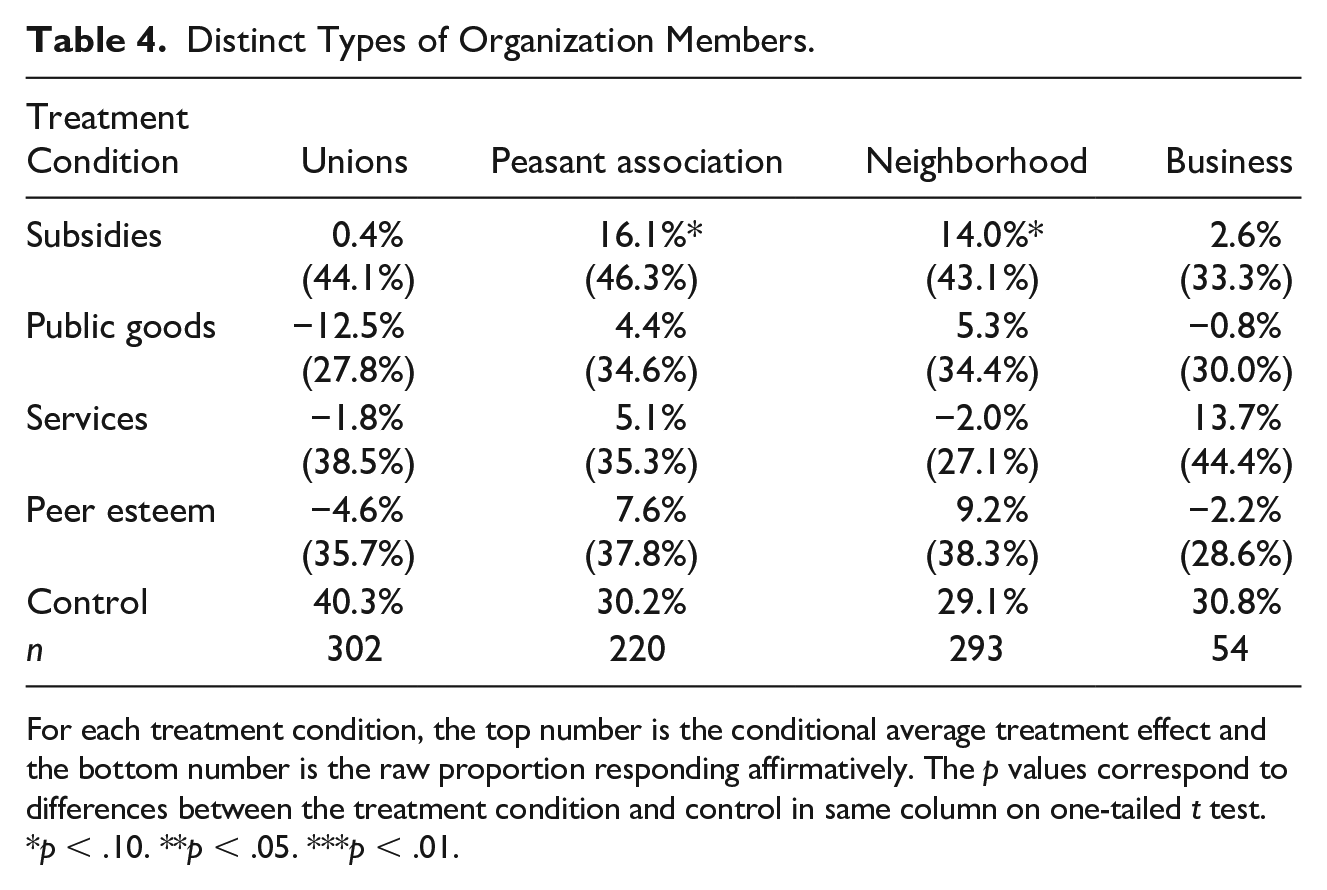
For each treatment condition, the top number is the conditional average treatment effect and the bottom number is the raw proportion responding affirmatively. The p values correspond to differences between the treatment condition and control in same column on one-tailed t test.
p < .10. **p < .05. ***p < .01.
It is, in fact, members of peasant and neighborhood associations for whom subsidies appeals appear to drive recruitment. This treatment condition produces a 16-percentage point conditional average treatment effect for peasant association members and a 14-percentage point conditional average treatment effect for neighborhood association members. This finding is unsurprising, as these are the types of organizations that have access to discretionary housing and productive subsidies and routinely operate clientelistic networks in rural and urban Mexico, respectively (Fox, 1994; Hilgers, 2008; Holzner, 2004). Labor unions, in contrast, do not have access to these types of benefits and are oriented to other classes of demands, including pay and working conditions or control over public sector hiring. Although it was impossible to conduct a true experiment to test these comparisons—for example, randomly assigning some respondents to labor unions and others to neighborhood associations—this evidence is compatible with our assertion that the experience of participating in patronage-centric organizations produces a particularistic orientation in members.
Our second exploration of mechanisms returns to the pooled groups of member and nonmembers, comparing these two classes of respondents on a series of variables derived from the survey that accompanied the experiment. As seen in Table 5, members and nonmembers are relatively balanced on sociodemographic traits. The fact that members are not, on average, poorer, less educated, or work more in the informal sector is strong evidence against the possibility that the association between organization membership and preferences for private material goods is confounded by economic precariousness. Members are significantly more likely to live in rural areas, all of which in our sample are in Chiapas. However, our main findings are consistent across rural and urban subsamples (Supplemental Appendix C) and samples restricted to Chiapas or Mexico City (Supplemental Appendix D).
Comparing Members and Nonmembers on Covariates.
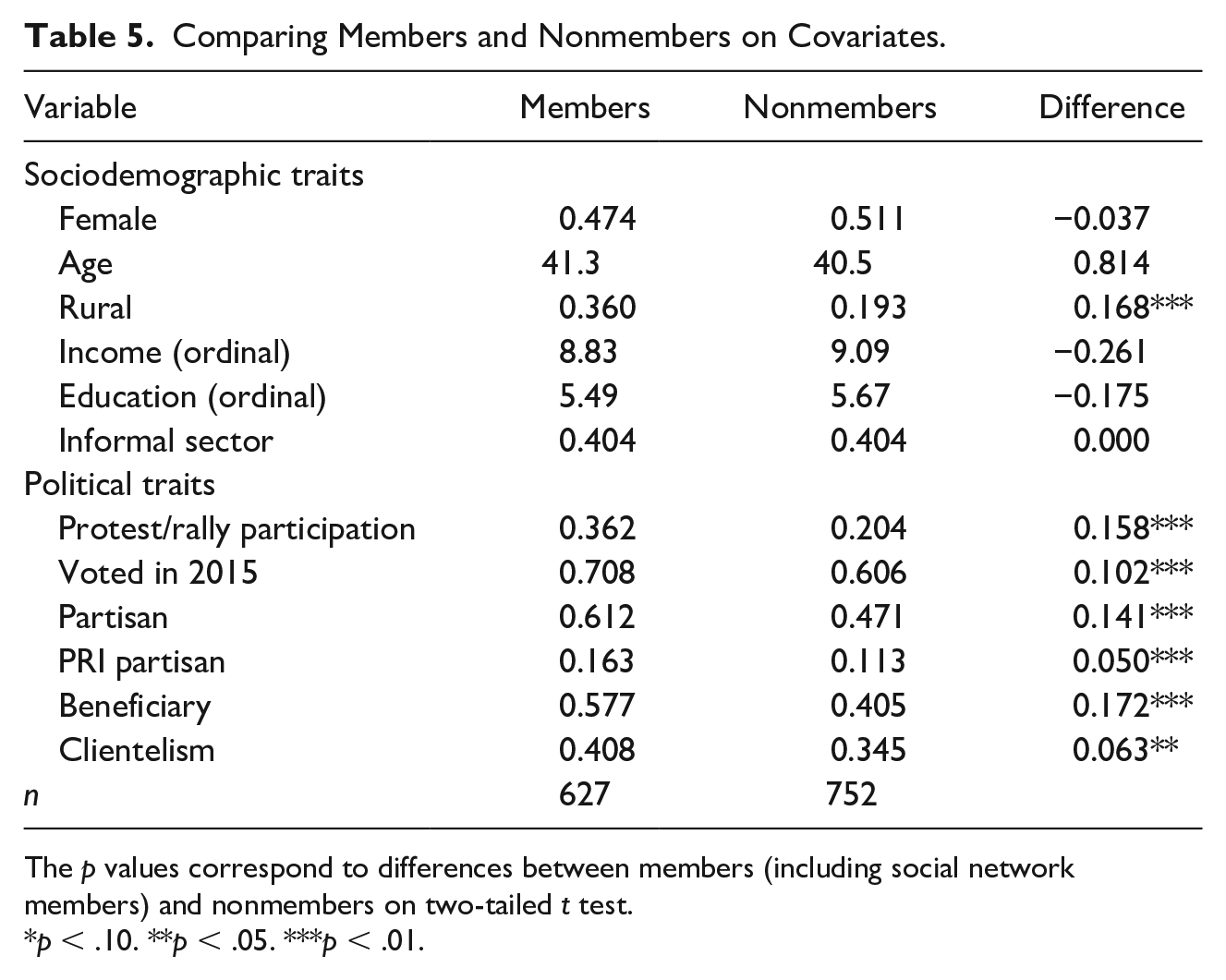
The p values correspond to differences between members (including social network members) and nonmembers on two-tailed t test.
p < .10. **p < .05. ***p < .01.
On the other hand, there are consistent differences between members and nonmembers on political traits. Members are significantly more likely to participate in electoral and nonelectoral politics and to be partisans of the PRI, the party most strongly associated with gestión through interest organizations. Several of the political traits may in fact act as mechanisms that drive the process of particularistic socialization. For instance, members are more likely to have partisan affiliations, to be beneficiaries of social programs, and to know somebody who has been exposed to clientelism. These three tendencies are consistent with having been exposed to the process of organizational gestión. It is certainly plausible that some of these traits precede organizational participation and make citizens more likely to join organizations in the first place. However, the overall similarities across members and nonmembers on socioeconomic traits, paired with contrasts in political behaviors, are consistent with organizational contact producing particularistic preferences among citizens who otherwise are similar to those who do not have contact with organizations.
Conclusion
This study contributes to the comparative politics literature by experimentally testing long-standing hypotheses about participation in organizations and by uncovering a new mechanism for the reproduction of patronage politics. Our findings reinforce received wisdom about the centrality of selective incentives to induce organizational participation while also controverting existing theories about the traits of persons that make them more or less receptive to appeals based on the collective good. In our experiment, organizations that promise to intermediate particularistic benefits from the state were most successful at recruiting new members, compared with those that promised to demand improvements in public goods, deliver non-material services to members, or generate peer-group esteem. However, such incentives did not turn out to be most appealing to lower income participants or those without previous organizational participation, as previous scholarship would lead us to expect.
Our findings offer support for the presence of particularistic socialization, where exposure to organizations that specialize in patronage produces in members the expectation of selective material benefits for future organizational participation. Not all segments of the population are equally exposed to these pressures, however. Surprisingly, the heightened particularistic orientation was most pronounced among higher income, rather than lower income organization members. Moreover, low-income organization members were the only subgroup analyzed that responded positively to the suggestion of a norm of community participation.
These findings underscore the importance of a research agenda that considers not only how much civil society as an explanatory variable for important political outcomes, but rather what kind of civil society. Although influential research has concluded that a robust civil society favors democracy (Gellner, 1996; Putnam et al., 1994), subsequent scholarship has uncovered important exceptions, showing how the predominance of illiberal civic associations can contribute to democratic erosion (Berman, 1997; Chambers & Kopstein, 2001; Riley, 2010). Relatedly, our findings offer a qualification to the conventional wisdom that associational membership socializes citizens to be concerned with collective interests. Under certain conditions, interest organizations that are designed to represent broad population groups in politics and policymaking may instead reinforce a preference for individual benefits among members. This finding is particularly relevant for transitional democracies, where a robust, accountability-generating civil society is most needed, yet also the context where organizations are most likely to deviate from collective goals in pursuit of patronage. Future research should explore whether particularistic socialization occurs in mature democracies. Lacking widespread discretionary programs, we would not expect to find this dynamic to the same degree.
Replication of this study in other Latin American countries and beyond could help address several additional questions of generalizability: How do interest organizations operate in other countries where comparable corporatist structures exist, but in which a higher concentration of internally democratic and civic-minded associations and unions have emerged alongside business unions and patronage organizations (e.g., Argentina)? Furthermore, how do interest organizations that are deliberately excluded from the distribution and intermediation of state resources—as are many organizations in Chile—socialize their members? What is the effect of patterns of socialization on aggregate levels of organizational membership size?
Another crucial extension concerns moving beyond interest organizations to test for particularistic socialization in other civic associations, such as those dedicated to mutual self-help, recreation, or worship. Given that these classes of associations are less oriented to demand-making on the state, they may be less likely to specialize in patronage intermediation. However, the appeals that these other types of organizations make to potential members certainly also vary in their degree of collectivist versus individualistic orientation. For instance, one might imagine a spectrum of fraternal organizations (e.g., Rotary Clubs) that runs from those that socialize their members to civic service and philanthropy (granting scholarships, investing in local parks, promoting disease prevention in foreign countries) to those that operate as little more than networking venues where members (real estate agents, accountants, attorneys) come into contact with potential clients. Similarly, echoing a classic Weberian concept, distinct religious organizations certainly cultivate a more collectivist or individualistic orientation in adherents. For instance—in Chiapas specifically—Trejo (2009) finds that indigenous populations in communities with Catholic churches that had embraced liberation theology were more likely to engage in ethnic insurgency with redistributive demands.
We would also advocate further testing these hypotheses using a field experiment involving existing organizations with real-world recruitment appeals. Such an approach would elude some of the challenges that result from our use of a fictitious organization, described in such a way as to appeal to the general population. First, respondents may be more amenable to participate in an organization that was a “known quantity” than one about which they had heard nothing previously. Rather than fliers presented by a stranger, such a design could use pre-existing social networks as the medium of recruitment, a medium which has proven superior at eliciting other modes of civic engagement in citizens, such as voting, campaign participation, or protest (Brady et al., 1999; McClendon, 2014; Sinclair, 2012). It is also plausible that a more “relational” (Han, 2016) mode of recruitment would predispose citizens to respond to solidaristic or peer esteem appeals by expressing how the organization responded to their personal goals or priming a sense of shared identity.
Second, partnering with a specific type of organization—for example, a neighborhood association, peasant association, or business chamber—would allow the researcher to tailor appeals to realistically correspond to the activities of the organization and the interests of its membership base. For instance, recruitment appeals for a neighborhood association could more credibly mention its role in pressing for local parks (a collective concern) or in mediating access to public housing (a particularistic concern). The drawback of this proposed approach, however, is that results may be biased by the reputation of existing organizations and their members. It is notable still that our experiment, which included a fictitious general interest organization and not especially strong treatments, yielded large effects. Among citizens that do not have contact with interest organizations in Mexico, appeals based on collective interests were associated with a 60% increase in willingness to participate over the control condition. In contrast, such collective appeals had no significant association with participation for organization members, who instead responded affirmatively 50% more often when presented with an organization that offered to broker excludable state benefits.
The implications of this finding are particularly concerning at the present global political juncture characterized by the rise of populism and the weakening of political parties as conduits of programmatic politics. In this context, it is imperative to understand how interest organizations engage citizens with the state, under what conditions they socialize citizens into collective goals or particularistic expectations, and to gauge the political effects of organizational participation both in mature and young democracies.
Supplemental Material
CPS_appendix_tabs,_final – Supplemental material for Incentives for Organizational Participation: A Recruitment Experiment in Mexico
Supplemental material, CPS_appendix_tabs,_final for Incentives for Organizational Participation: A Recruitment Experiment in Mexico by Brian Palmer-Rubin, Candelaria Garay and Mathias Poertner in Comparative Political Studies
Research Data
repdat for Incentives for Organizational Participation: A Recruitment Experiment in Mexico
repdat for Incentives for Organizational Participation: A Recruitment Experiment in Mexico by Brian Palmer-Rubin, Candelaria Garay and Mathias Poertner in Comparative Political Studies
Research Data
replicationCPSrecruitment for Incentives for Organizational Participation: A Recruitment Experiment in Mexico
replicationCPSrecruitment for Incentives for Organizational Participation: A Recruitment Experiment in Mexico by Brian Palmer-Rubin, Candelaria Garay and Mathias Poertner in Comparative Political Studies
Footnotes
Acknowledgements
The authors thank Enrique Mejía Fontanot for valuable research assistance and DATA OPM and Carlos López for data collection. Previous versions of this paper have been presented at the Midwest Political Science Association 2018 Annual Meeting in Chicago, IL; the 2018 Political Science from Mexico Workshop, Instituto Tecnológico Autónomo de México in Mexico City; the Latin American Studies Association 2018 International Congress in Barcelona, Spain; and the Western Political Science Association 2018 Annual Meeting in San Diego, CA. For their helpful comments and suggestions, the authors thank the organizers and participants at these presentations, as well as Michael Albertus, Leonardo Arriola, Miguel Carreras, Ruth Berins Collier, Alberto Díaz-Cayeros, Federico Estévez, Omar García Ponce, Yanilda González, Alisha Holland, Kyle Jaros, Risa Toha, and three anonymous reviewers
Declaration of Conflicting Interests
The authors declared no potential conflicts of interest with respect to the research, authorship, and/or publication of this article.
Funding
The authors disclosed receipt of the following financial support for the research, authorship, and/or publication of this article: Funding for this project was provided by the Weatherhead Center for International Affairs, Harvard University.

Notes
Author Biographies
References
Supplementary Material
Please find the following supplemental material available below.
For Open Access articles published under a Creative Commons License, all supplemental material carries the same license as the article it is associated with.
For non-Open Access articles published, all supplemental material carries a non-exclusive license, and permission requests for re-use of supplemental material or any part of supplemental material shall be sent directly to the copyright owner as specified in the copyright notice associated with the article.
