



Abstract
Growing concerns have been voiced about strategies employed in L2 reading in general and dealing with unknown words in particular. Among other strategies, lexical inferencing has received attention in the literature. However, more research is needed to further clarify how different levels of L2 reading proficiency may affect the readers’ inferencing behavior with respect to the level of success they achieve as well as the types, combinations, and frequencies of knowledge sources they use when inferring meanings of unknown words. Taking up the legacy left by the pioneering works in lexical inferencing, the present study is an attempt to shed more light on the role of reading proficiency in the Iranian EFL learners’ use of knowledge sources in second language lexical inferencing and their level of success in guessing the meanings of unfamiliar target words. To this end, a total of 86 Persian-speaking EFL learners inferred the meanings of unknown words in three authentic expository texts. The findings adduce the argument that differences in L2 reading proficiency have a profound impact on inferencing success. Further analysis of the protocols demonstrates that the contribution of the knowledge sources used by the participants to inferencing success is partial and restricted.
Introduction
Researchers’ interest in reading comprehension was rekindled in the 1960s and 1970s with the emergence of various trends of cognitive psychology and generative linguistics within the realm of SLA. Reading comprehension as one of the central skills of learning a language is closely related to vocabulary knowledge (Nagy, Anderson, and Herman, 1987; Nation and Coady, 1988; Paribakht and Wesche, 2006; Stahl and Nagy, 2006; Tannenbaum, Torgesen, and Wagner, 2006; Wang, 2011). Accordingly, a weak command of vocabulary knowledge can jeopardize the reading process and/or make it seem an insurmountable obstacle (Alderson, 1984). To overcome such an obstacle, EFL readers normally turn to different kinds of strategies to compensate for the incomprehensible input in general and lack of vocabulary knowledge in particular (Read, 2000). Coming across unknown words, Read (2000) notes, EFL readers either ignore the unknown words or seriously search for a strategy to compensate for their lack of knowledge. One of the most commonly used strategies has been guessing the meaning of the unknown words or, simply, lexical inferencing (Laufer, 1997; Paribakht and Wesche, 1999; Paribakht, 2004; Qian, 2004; Ying, 2001). Lexical inferencing, as Haastrup (1991: 40) defines it, ‘involves making informed guesses as to the meaning of a word in the light of all available linguistic cues in combination with the learner’s general knowledge of the world, her awareness of the co-text and her relevant linguistic knowledge’.
Indeed, learners’ lexical inferencing is not always successful. Kaivanpanah and Alavi (2008: 92) found that ‘the ability of learners to guess the meaning of unknown words is of limited value’ . Learners may make mistakes in their lexical inferences (Hunt and Beglar, 1998). The situation is bound to deteriorate when the teachers are unaware of unsuccessful inferences. It seems that EFL readers are prone to inexact and irrelevant guesses, hence misunderstanding the whole text. Hulstijn (1992) highlights the negative effect of unwarranted lexical inferences cautioning that wrong inferred meanings might be fossilized. Therefore, neither with all contexts nor with all learners should we encourage lexical inferencing (Dycus, 1997). In the same line of argument, Laufer (1991) maintains that for successful use of lexical inferencing a threshold level of vocabulary and general language mastery is essential. Hence, the purpose of the present study is to examine the degree of EFL readers’ lexical inferencing success and their patterns of use of knowledge sources across different levels of reading proficiency.
Literature Review
It is commonly accepted that reading and vocabulary knowledge are intricately intertwined (Alderson, 2000; Alavi and Kaivanpanah, 2009; Cain et al., 2004; Dunmore, 1989; Palmberg, 1987; Hsueh-chao and Nation, 2001; Paribakht and Wesche, 2006; Tannenbaum et al., 2006). Although this strong relationship is generally acknowledged, there is less consensus as to the precise nature of this relationship (Cain et al., 2004) and more empirical data clarifying the mechanisms and underlying processes involved are needed. Trying to address the issue at hand, Cain and her colleagues introduced a common variable which underlies vocabulary knowledge and reading comprehension. Such a framework, they suggested, was of greater use for studying this relationship because it was informed by theories proposing a common skill or mechanism which contributes to the determination of both. Their justification for this claim was that, ‘not all research supports a direct causal relation between vocabulary knowledge and reading comprehension’ (Cain et al., 2004: 671). In their opinion, the major limitation of such theories was the lack of a specific mechanism for explaining how differences in vocabulary knowledge occur. Yet, the issue becomes more perplexing when lexical inferencing comes on the scene. Dunmore (1989: 337) referred to inferencing as a ‘catalyst’ in the dynamic relationship of reading and vocabulary. As he depicted, the vital role of lexical inferencing can be perceived in ‘a picture of a powerful, cyclic relationship’ in which reading contributes to the expansion of vocabulary knowledge which leads to more efficient performance in reading and this leads to more vocabulary expansion (1989: 337). On the whole, although L1 learners acquire a great amount of their vocabulary knowledge through inferring the meaning from the available context, when it comes to L2 learners’ lexical inferencing and its relation to vocabulary acquisition, questions arise that addressing them conclusively requires more empirical evidence (Nassaji, 2003).
In their study, Cain, Lemmon, and Oakhill (2004) investigated whether skilled and less skilled comprehenders differ in their ability to infer the meanings of novel vocabulary items from context. Participants were 9 to10 year-old native speakers with different levels of reading proficiency. By and large, children with poor reading comprehension were poor at lexical inferencing. They also had problems with the acquisition of vocabulary. Memory capacity was another factor whose role was investigated. Findings revealed that less skilled comprehenders performed more poorly on the verbal working memory assessment. At the end, they concluded that ‘there is a role for instruction in the use of contextual cues in the curriculum to aid the increase and consolidation of vocabulary knowledge’ (Cain et al., 2004: 680).
In another study, Bengeleil and Paribakht (2004) examined the effect of reading proficiency on EFL university learners’ lexical inferencing. The purpose of the study was investigating the process and factors involved in lexical inferencing. Seventeen (ten intermediate and seven advanced) participants completed the lexical inferencing task while reading an English expository text. They found that the participants used the same knowledge sources and contextual cues during their inferencial task. In other words, differences in their L2 reading proficiency did not substantially affect their lexical inferencing behavior in terms of the number as well as the kinds of knowledge sources and contextual cues they used. In addition, results indicated that the more advanced readers made more successful inferences than the intermediate-level readers.
The Present Study
In view of the fact that English language teaching at universities in Iran, as Farhady and Hedayati (2009) state, serves the primary purpose of enabling students ‘to read and understand materials written in English in their majors’ (2009: 139), the importance of reading as well as its teaching is highlighted. Given that lexical inferencing plays a key role in understanding written materials, conducting further research as to the nature of lexical inferencing and factors involved seems justifiable in such a context. Hence, the present study first investigates the degree of EFL readers’ lexical inferencing success across different levels of reading proficiency in order to check if reading proficiency plays a role at all and whether the threshold assumption put forward by Laufer (1991) holds true for reading proficiency. Meanwhile, as a second purpose, the study seeks to delve into the patterns of use of knowledge sources in lexical inferencing by EFL learners at different levels of reading proficiency. Such an investigation seems important because the impact of EFL readers’ proficiency on their choice of knowledge sources should be known in order to discuss the possible implications of patterns of lexical inferencing which begin to emerge. Therefore, the following research questions will be investigated in this study:
Is there a relationship between EFL learners’ reading proficiency and their lexical inferencing success?
What are the patterns of use of knowledge sources in lexical inferencing by EFL learners at different levels of reading proficiency?
Methodology
Participants
A total of 86 male (n = 30) and female (n = 56) students from eight intact EFL classes from two language institutions in Tehran participated in this study. All classes were in the fourth level of a six-level communicative course for adults and young adults, considered as intermediate level and were homogeneous with respect to English proficiency. The rationale for the exclusion of beginners was to ensure that the participants were proficient enough to be able to infer the meaning of unknown words. The participants either had majored or were majoring in different fields of Humanities or Science and Technology at different State and Open universities. In order to examine the impact of reading proficiency on inferencing, the participants were divided into three groups based on their scores on the reading test. The groups were created based on standard deviation units after transforming the scores into Z-scores. All those scoring less than -0.51 SD were labeled as Low group, those scoring between -0.5 and 0.5 SD as Mid group, and those scoring higher than 0.51 SD as High group.
Instruments
TOEFL-PBT Reading Comprehension Subtest
A reading comprehension subtest of TOEFL-PBT was used as the criterion measure of participants’ reading proficiency. The participants read five passages followed by 50 multiple-choice items for each of which they were supposed to mark one of the four alternatives on their answer sheets. The test time was 55 minutes, including the reading of the directions.
Texts for Inferencing
Three authentic expository texts written by native speakers of English published on websites of general interest that were familiar to the participants of the study with respect to content were chosen: Critical Reception, 188 words; The Nobel Peace Prize, 265 words; Mini Biography, 330 words; henceforth called text 1, 2, and 3 respectively. A panel of four teachers, who were working in the same institutions where data were collected, was asked to comment on the appropriateness of the selected texts for participants’ level of reading proficiency. Since the success of inferencing attempts matters in this study, as the next step, it was ensured that Liu and Nation’s (1985) criterion for the choice of a text with only five percent of words unfamiliar to the reader was met. The logic behind this criterion is that such a condition would increase the possibility of accurate guessing of the meanings of unknown words. The percentage of target unknown words was then calculated for each text by dividing the total number of words informants reported as unknown by the total number of words in the each text multiplied by 100. The percentages of unknown words for text 1, text 2, and text 3 were 2.65 %, 3.39%, and 3.33% respectively. The percentages were less than 5%, hence fulfilling the criterion of 95% known words. The unknown words that were not content words (e.g., amongst and due to) were discarded from the plausible test items in order to have only nouns, adjectives, verbs, and adverbs. It is worth mentioning that the meanings of these unknown words which were not selected as test items were provided in a glossary in the final version of the texts. The panel of teachers verified that the unknown target words could be inferred from the text contexts. The texts were also field-tested with five EFL learners to check suitability for inferencing. The final version of the inferencing instrument represented a task with 25 unknown words as test items in a fully comprehensible context. This instrument which contains three texts is included in Appendix.
Procedure
Since part of the study was related to the types of knowledge sources and contextual cues utilized and also the participants’ degree of success in lexical inferencing at different levels of reading proficiency, distinct levels of reading proficiency were needed as for comparison groups (e.g. low, middle, and high) to determine the effect of reading proficiency level on knowledge sources use in inferencing. Given that, a TOEFL-PBT reading comprehension subtest was administered to select groups with distinct levels of reading proficiency. This subtest included 50 multiple-choice items for which the participants had 55 minutes to complete the task. Based on their scores, the participants fell into three groups: 31 into Low, 25 into Mid, and 30 into High. Next, a week before the introspective session, nine participants (three from each group mentioned above) who voluntarily had decided to take part in think-aloud sessions were trained how to verbalize their thought processes. This took 20 minutes. Once they were informed of the general purpose of the study, they were given the three unseen texts (text 1, text 2, and text 3) to infer the words underlined. Before doing so, at the very beginning of the inferencing exam session, a list of those 25 words (without their texts) that were going to be inferred was given to the participants. They were asked to write translations or synonyms or any explanation (using Persian, English, or both languages) they knew about the unknown target words. Not surprisingly, if a participant knew the meaning of each of these decontextualized words, it was bound to be ignored altogether for that participant in data analysis. The list was collected after five minutes. They were then given the texts one at a time. They were asked first to read the texts quickly for general comprehension and then to read them again and try to guess the meaning of the underlined words in the texts. They were also informed that they had as much time as they wanted to carry out the task. Each text was accompanied with a glossary of words which were previously pointed out by the panel as difficult regarding the participants’ level. Also, during the session the participants were allowed to ask questions as to the meaning of words which they did not know (of course, except for the underlined words).
Those nine participants representing the three levels of reading proficiency (three from each level) took part in the think-aloud session. It is noteworthy that these nine participants did not take the inferencing test since their inference behavior was planned to be recorded and scrutinized later through think-aloud introspection method. However, with the exception of two main differences in the way of data collection, this session was similar to the inferencing test. One difference was that the inferencing test was administered individually instead of en masse. The second difference was that each participant was asked to verbalize what s/he was thinking and doing while carrying out the task in their individual sessions. In addition, to make sure that the participants knew how to verbalize their thought processes, they were briefed on ways of reporting the contents of thoughts. Next, the texts were given to them one at a time and in the same order as it was administered to the other participants. Because of their rather limited English communicative ability, the participants were allowed to carry out the task in the language of their choice (i.e. Persian or English). This was done on the grounds that ‘permitting participants to use either their L1 or their L2 and to switch between them as needed allows them to more accurately report their thinking processes than would requiring them to use one language or the other’ (Paribakht, 2005: 733). The participants, however, all chose to report their thoughts in Persian.
Scoring
In the case of the TOEFL-PBT reading comprehension section, participants received a mark for each correctly answered item. Their total score was the sum of these marks. The maximum possible score was 50. To score the participants’ degree of success in lexical inferencing, their inferencing attempts on the 25 underlined words in the texts were examined. An experienced teacher and the researchers rated the participants’ responses to each of the unknown words independently using a 3-point scale (i.e. 2 = successful, 1 = partially successful, 0 = unsuccessful) proposed by Nassaji (2003). Successful inferences which were semantically, syntactically, and contextually appropriate were awarded 2 marks. Inferences which were semantically appropriate but syntactically deviant or the other way around were labeled as partially successful and were assigned 1 mark. Unsuccessful inferences which did not meet any of these conditions and were wrong altogether received no mark. Taking into account that there were 25 test items (words underlined) and that the scores ranged from 0 to 2 for each item, the maximum total score each participant could get for the lexical inferencing success test was 50. In initial rating, an interrater agreement of 90% was obtained. Disagreements were then resolved through subsequent discussion to reach the maximum interrater agreement (i.e. 100%) on all test items.
Results
Reading Proficiency and Lexical Inferencing Success
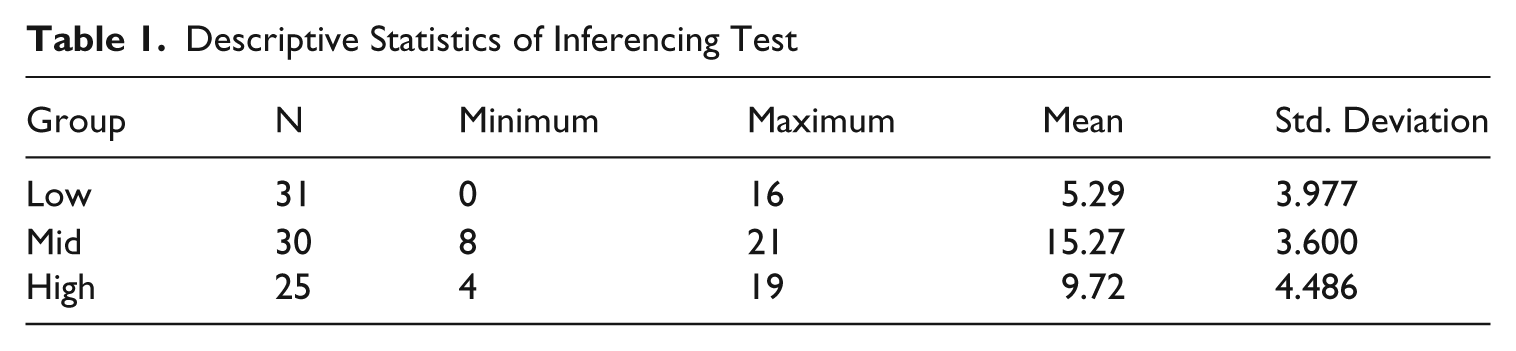
The descriptive statistics for the performance of each group on the inferencing test are displayed in Table 1. The statistics in Table 1 provide prima facie evidence that the mean performances of the groups are different. That is, the groups have not been equally successful in inferring word meanings. Cronbach alpha coefficient used to estimate the reliability of texts used for measuring lexical inferencing was .82 and falls in the ideal range indicated by DeVellis (2003).
Descriptive Statistics of Inferencing Test
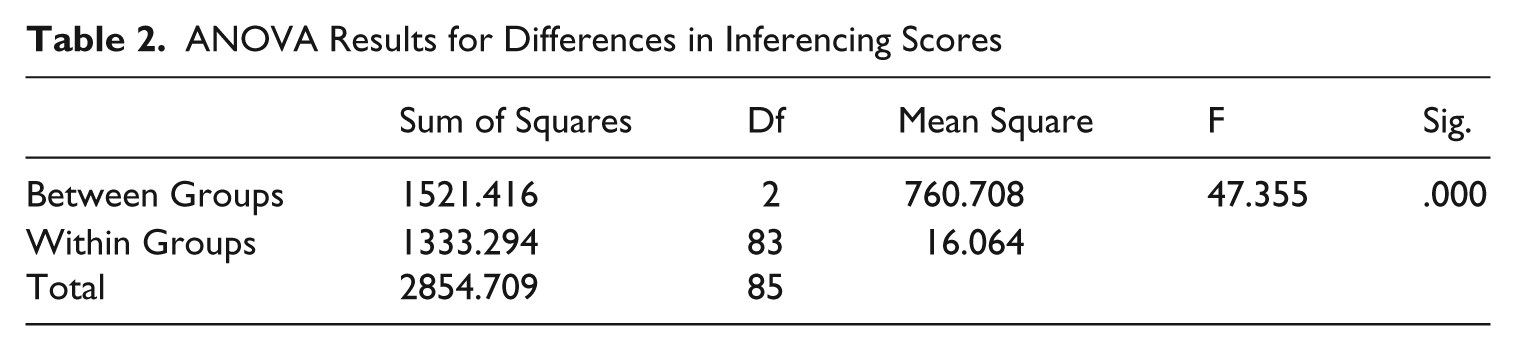
A one-way between-subjects ANOVA was run to compare the performance of the groups on the inferencing test. The results in Table 2 indicate that there is a significant difference between the means of at least two groups, F(2, 83)=47.355, p<.000. Such a result was predictable in the face of the large differences between the means. The effect size, calculated using the eta squared, was 0.53 which is much higher than the 0.14 threshold for a large effect proposed by Cohen (1988).
ANOVA Results for Differences in Inferencing Scores
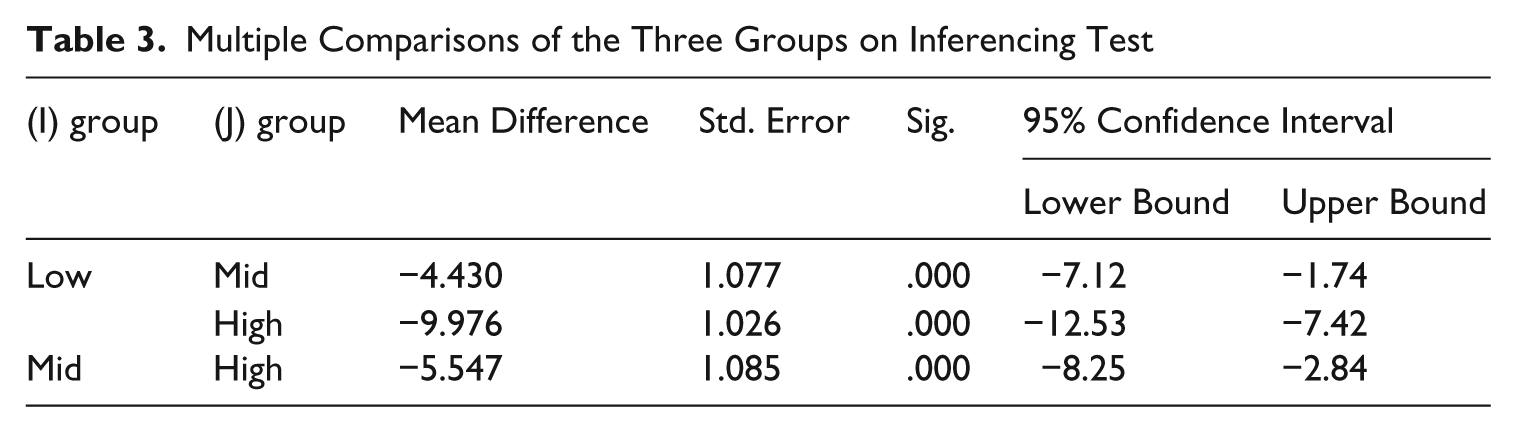
In order to see which mean differences were significant, a post-hoc analysis of the results was run. The results of Scheffe test appear in Table 3. Although there is a large number of post-hoc tests discussed in statistics texts, the Scheffe test was used in this study because it is ‘the most conservative test, and should be used unless there is a good reason not to’ (Boslaugh and Watters, 2008: 238). The results of this post-hoc test indicate that the mean performance of each group is significantly different from that of the other.
Multiple Comparisons of the Three Groups on Inferencing Test
In sum, the results of the ANOVA indicate that the mean differences in the performance of the three groups on the inferencing test are significant. Therefore, it may be safely concluded that the reading proficiency has a large effect on the rate of success of inferring word meanings.
Patterns of Knowledge Source Use across Reading Proficiency Levels
In order to identify the use of patterns of knowledge sources and contextual cues by learners with different reading proficiencies, the introspective think-aloud protocols were initially transcribed and then carefully examined for any knowledge sources and contextual cues used by the participants in inferring the meanings of the unfamiliar target words while reading the texts. As it was stated before, nine participants took part in this phase of the study. To make the observation of lexical inferencing behavior across the three groups (i.e. Low, Mid, and High) possible, three participants from each group were randomly selected. The subsequent analyses were based on the transcripts, the audio files, and the interviewer’s notes for each participant during each research session. Participants turned to different knowledge sources and contextual cues (either meaning-focused or form-focused), each coded separately. Identified knowledge sources and contextual cues were categorized based on the taxonomy (above) developed by Bengeleil and Paribakht (2004).
Intralingual sources
Target word level
word morphology
homonymy
word association
Sentence level
sentence meaning
syntagmatic relations
paradigmatic relations
grammar
punctuation
Discourse level
discourse meaning
formal schemata
Interlingual sources
Lexical knowledge
Word collocation
Knowledge of topic
Knowledge of medical terms
Their taxonomy provided a more comprehensive categorization of knowledge sources than the existing taxonomies (e.g. Nassaji, 2003, 2004; Paribakht, 2004), including word-, sentence-, and discourse-level linguistic sources as well as world knowledge. It should be noted that since the participants of the study conducted by Bengeleil and Paribakht (2004) were all medical students, they included a knowledge source (i.e. Knowledge of medical terms) in their taxonomy to account for the specialized knowledge of medicine and medical terms in their participants’ lexical inferencings. Therefore, this knowledge source was not considered in the present study given that participants of this study were students or graduates of different majors.
Participants employed a variety of knowledge sources and contextual cues in their lexical inferencing attempts, ranging from linguistic to nonlinguistic knowledge. Linguistic sources included features of the target word itself as well as the surrounding sentence and text. General knowledge of the subject, on the other hand, constituted a relatively small portion of sources labeled as nonlinguistic. In some cases, the participants used more than one knowledge source (maximum number was four) to derive the meaning of a target word.
Results show that the three groups made use of single as well as multiple knowledge sources in their lexical inferencing attempts. However, Mid and High groups used multiple sources more often and showed more variation in the combinations of knowledge sources and contextual cues they used in inferencing than the Low group (Figure 1). Moreover, the use of two sources among the Mid group had the highest percentage (45%) while the highest percentage for Low and High group was the use of single source, 62% and 46% respectively.
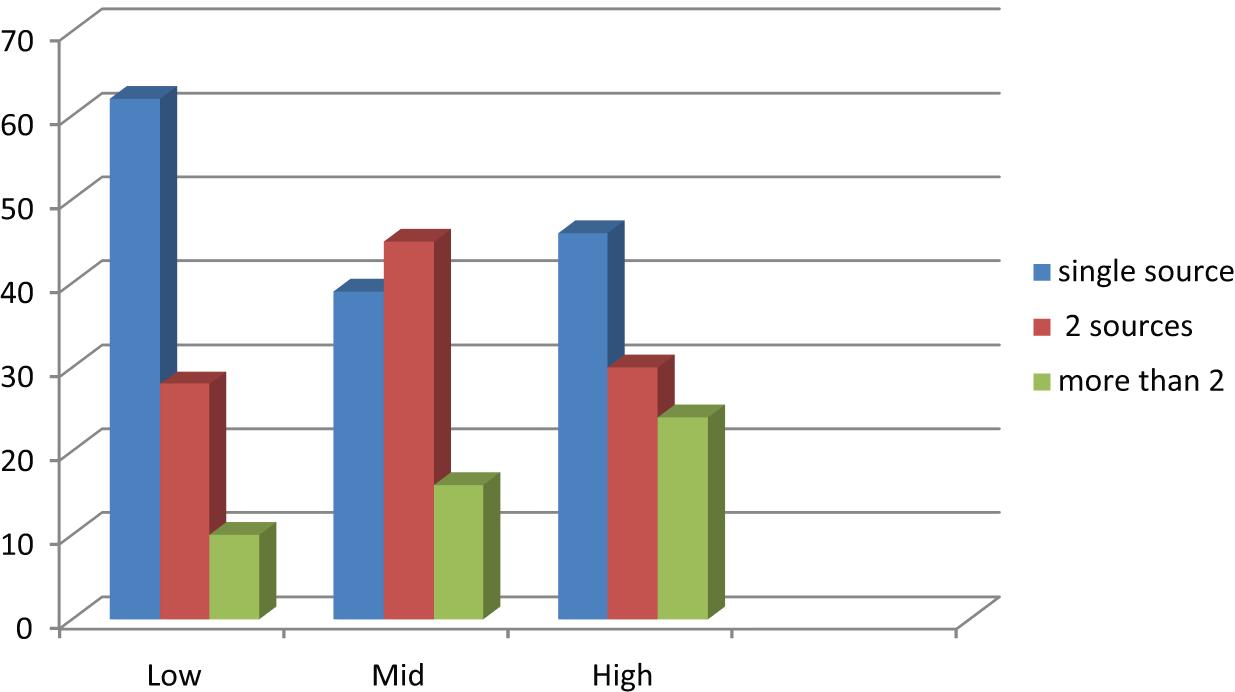
Percentages of Single and Multiple Knowledge Sources Used by the Three Groups
The frequencies of use of the knowledge sources by the participants in each proficiency group were calculated using a simple count of the number of times a knowledge source was used by each participant in inferring the meaning of the unfamiliar words. Table 4 presents the relative frequency of use of each knowledge source by each group and the combined sample.
Percentages of Knowledge Sources Used in L2 Lexical Inferencing
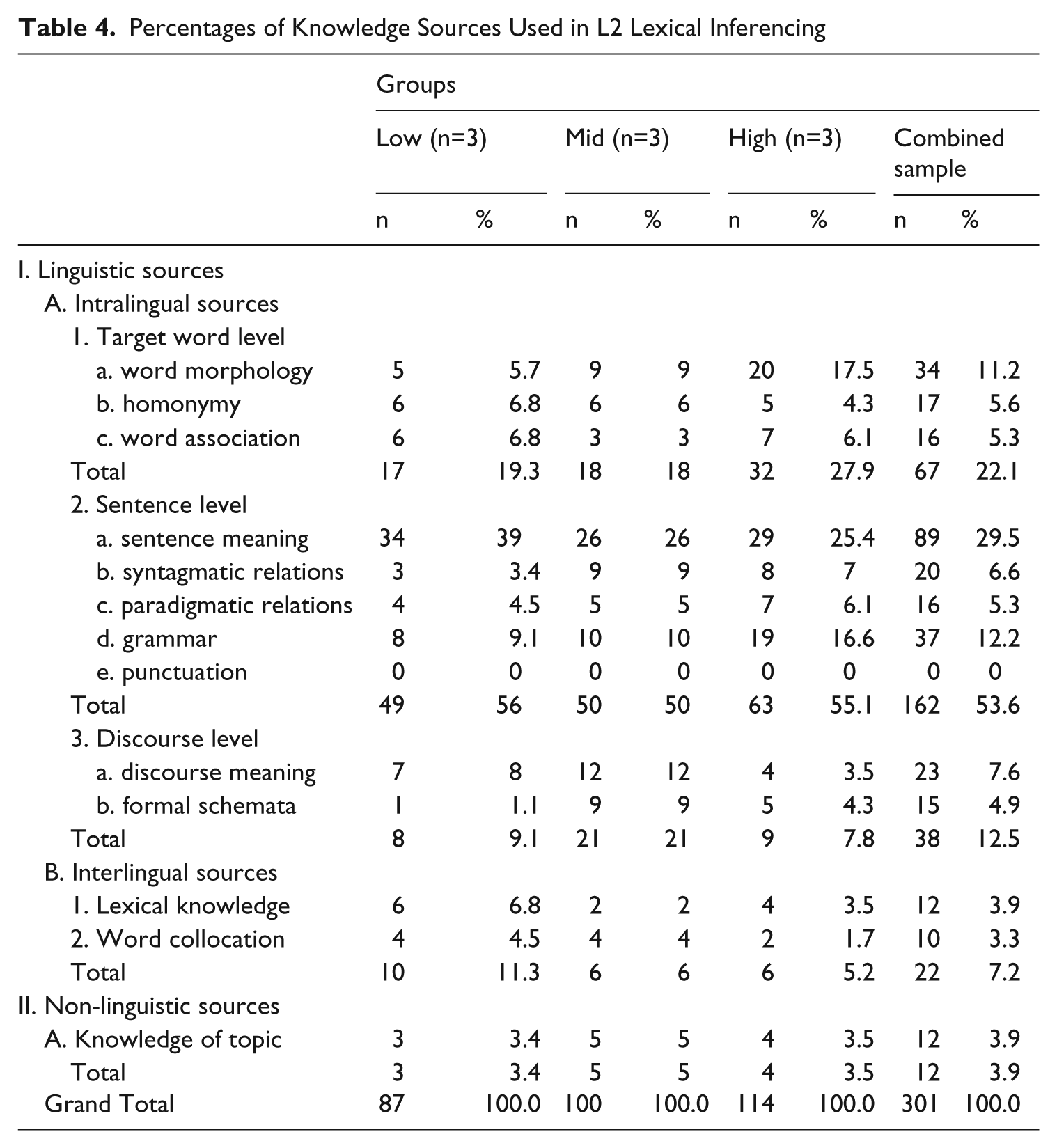
Results indicated that intralingual (English-based) sources were used far more often than interlingual (Persian-based) ones and that sentence-level meaning was used most frequently (29.5%) by the three groups. The order of relative frequency for the most frequently used knowledge sources was sentence meaning > word-morphology > grammar for the High group, sentence meaning >discourse meaning >grammar for the Mid group and sentence meaning > grammar > discourse meaning for the Low group. However, the order of frequency of use of major categories of knowledge sources for the combined sample was: sentence level > target word level > discourse level > L1 knowledge > world knowledge. Figure 2 depicts a summary of the results for the main categories of knowledge sources.
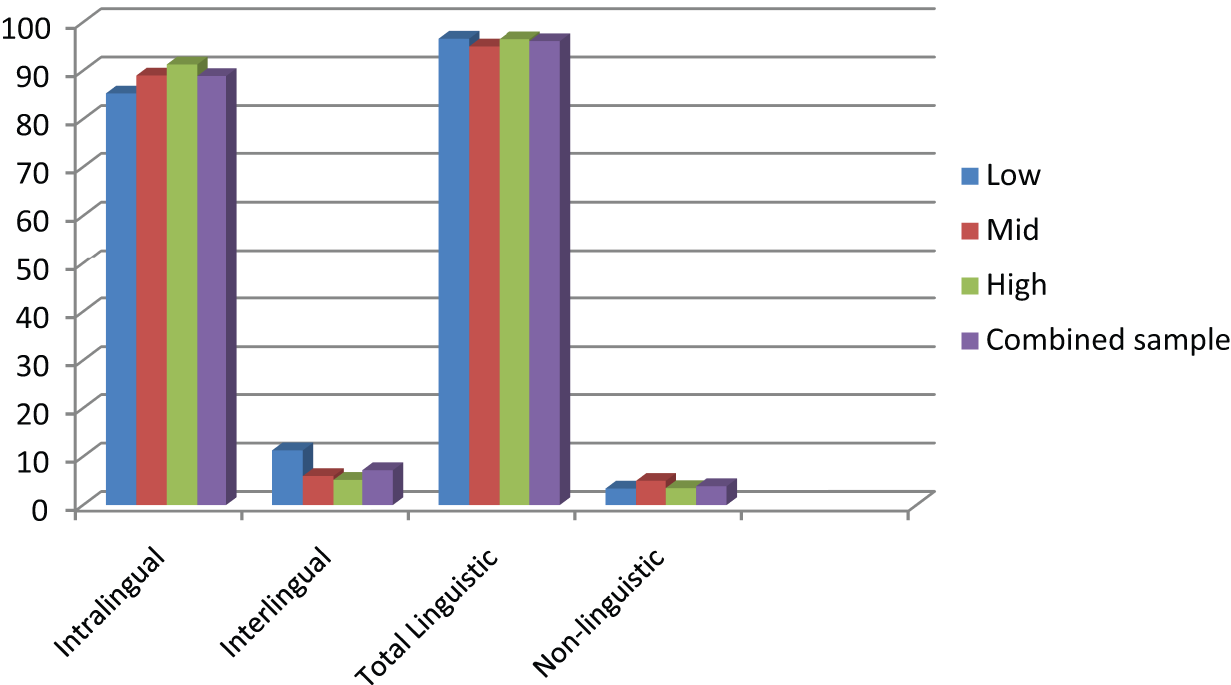
Summary of the Relative Frequencies of Use of Major Knowledge Sources by the Three Groups
In-depth Analysis of Protocols
The analysis of transcriptions and notes demonstrated that the Low group relied heavily on sentence meaning (39%) which was the highest percentage of the use of the knowledge sources among the three groups and the combined sample. Sentence meaning was mostly used as a single source insofar as they rarely coupled it with other knowledge sources. Another finding was that on five occasions they failed to correct the wrong meanings they had written on the list of target words given to them before the inferencing task started. This may indicate that context did not help them modify their lexical knowledge in the sense that the meanings they reported of the target words were the same, as those in isolation, and still wrong. Not only did they fail to make use of context, but also they even insisted on the meanings they held as correct trying to substantiate evidence on occasion. Furthermore, although two target words (i.e. ‘strengthen’ and ‘albeit’) were repeated in the texts twice, the Low group could not make use of this reappearance of the unknown word to infer the meaning. On the contrary, the Mid and High groups seized this opportunity efficiently and benefited from the repetition.
The use of one knowledge source which distinguished the Mid group from the High group and, more strikingly, the Low group was formal schemata. The frequency of the use of this knowledge source was 1.1% for Low group, 9% for Mid group, and 4.3 % for High Group. The Mid group proved to be familiar with text structure and text types and turned to them when trying to derive the meaning of unknown words. This was almost absent among Low group readers. Another noteworthy observation about the Mid group was that they tended to combine two knowledge sources (frequently sentence meaning and discourse meaning) to infer the target words. They did this carefully in a way that 75% of the combinations of sentence meaning and discourse meaning led to successful inferencing. Moreover, they recollected the meaning of some words (e.g. ‘negotiation’ and ‘initiative’) which they knew from somewhere but only a tinge of meaning was present in their minds. They made use of context to develop that superficial lexical knowledge into an overarching interpretation of target words. It is also worth noting that the Mid group corrected all the mistakes they had made on the list of words in isolation. They shared this amount of success with the High group.
The High group proved undoubtedly the most resourceful users of knowledge sources. A common algorithm of knowledge source use could be found among them. As a first step, not unlike the other two groups, they used only one knowledge source (usually sentence meaning). Secondly, if they were not sure about the accuracy of their inference, they would turn to word morphology or discourse meaning or both of them. If they still did not find something helpful through using these knowledge sources, Homonymy or word association and formal schemata were plausible alternatives. They checked their guesses against grammar every now and then. Occasionally, they would turn to interlingual sources and knowledge of topic when they did not find the previous knowledge sources available or helpful.
Discussion
By delving into the lexical inferencing behavior of Iranian EFL learners of different levels of reading proficiency, it was found that more proficient readers performed better than the less proficient readers who were at a disadvantage when faced with an inference task. The results indicated that the more proficient readers made more correct and partially correct inferences than the others in the sense that major differences in L2 reading proficiency had a profound impact on total inferencing success. One explanation might lie on the lower level of text comprehension and vocabulary knowledge of the less proficient readers. This highlights the findings of other researchers (e.g. Bengeleil and Paribakht, 2004; Cziko, 1980; Haastrup, 1991; Palmberg, 1987) who argue that a threshold level of vocabulary knowledge and L2 proficiency is essential for optimal reading and successful inferencing. Once such a threshold level is reached, consequent improvements in L2 proficiency can contribute to more success in lexical inferencing. Another possible explanation is that the more proficient readers might be more comfortable with linguistic risks and experimentation, hence more flexible and resourceful in efficient employment of available knowledge sources and contextual cues while reading passages. Such proficient readers might have been perceiving learners who are, according to Ehrman and Oxford (1990), open to the ambiguities of the language learning process and flexible in using compensation strategies, such as guessing or improvising.
The analysis of think-aloud protocols revealed concordant findings to the literature in that participants benefited from a variety of knowledge sources and turned to their knowledge of the L2 as well as other sources such as their L1 and their topical knowledge. It is reasonable to conclude that ‘in the process of lexical inferencing L2 readers’ prior linguistic and non-linguistic knowledge sources interact with contextual cues in the text to help them arrive at a meaning for the unfamiliar lexical items’ (Bengeleil and Paribakht, 2004: 239).
The results also indicated that the groups (Low, Mid, and High), irrespective of their reading proficiency level, used approximately the same knowledge sources and contextual cues while inferencing (with the exception of formal schemata, which was rarely used (1.1%) by the Low group). The three groups benefited from local cues (i.e. those found in the same sentence as the target word) as well as global cues (i.e. those found beyond the sentence containing the target word). However, Mid and High groups used multiple sources more often and showed more variation in the combinations of knowledge sources and contextual cues they used in inferencing than the Low group. In addition, the use of two sources among the Mid group had the highest percentage (45%) while the highest percentage for Low and High groups was the use of single source, 62% and 46% respectively. One indication could be that the less proficient readers are not familiar with formal properties of texts and their organization; hence they are restricted in using formal schemata or other knowledge sources available. Another indication would be that the language abilities of the Mid group for inferencing seems not to be fully developed in that although they show a marked tendency to combine two knowledge sources while inferencing, they appear to be occasionally confused and helpless as they want to make use of more than two knowledge sources.
The findings also indicated that the three groups shared an approximately similar pattern of relative frequency of use of knowledge sources. The order of relative frequency for the most frequently used knowledge sources was sentence meaning > grammar > discourse meaning for the Low group, sentence meaning > discourse meaning > grammar for the Mid group and sentence meaning > word-morphology > grammar for the High group. However, the order of frequency of use of major categories of knowledge sources for the combined sample was sentence level > target word level > discourse level > L1 knowledge > world knowledge. Of these, sentence meaning was the source used predominantly by the three groups. The preference of readers to use local cues in order to infer the meanings of unknown words is in line with the results of previous research (e.g. Bengeleil and Paribakht, 2004; Fraser, 1999; Huckin and Bloch, 1993; Paribakht, 2004). According to the findings of these studies, readers commonly tend to focus on the immediate context of the unknown word first and go beyond the sentence boundaries only when it seems necessary to them.
Further analysis of the immediate verbal reports demonstrated that the contribution of the knowledge sources used by the participants to inferencing success was partial and restricted although some of them such as word morphology were more related to successful inferencing than others. This implies that success of lexical inferencing might not depend only on the employment of certain knowledge sources and contextual cues but also, as Nassaji (2003) argues, on how effectively the use of them is combined and coordinated with the use of other knowledge sources and contextual cues; such profitable combination and coordination was mostly observed among the High group.
The in-depth analysis of think-aloud transcriptions also revealed that on occasions the Low group failed to make use of unmistakable knowledge sources, usually employed appropriately by the other two groups, insofar as they persisted in reporting their inappropriate take on the unknown words. However, more advanced readers (i.e. Mid and High groups) showed more flexibility in restructuring their lexical knowledge when finding knowledge sources and contextual cues useful. This finding underlines Mclaughlin’s (1990) argument that more successful learners – when compared to less successful ones – are more flexible in restructuring in terms of the replacement of existing knowledge with more efficient ones. Taking into account that Mid and High groups gained higher scores on lexical inference test, this finding also adds to and confirms Jalili’s (2011) conclusion that the learners who were more successful in their lexical inferences restructured their lexical knowledge more frequently.
One example of, using Nassaji’s (2003: 663) term, ‘nonstrategic attempt’ among participants was word repeating. The Low group more frequently resorted to this nonstrategic attempt than did the High group. Word repeating ‘may reflect a narrow word-based approach to lexical inferencing used by these intermediate-level ESL students, which may have contributed to the overall low rate of success as well’ (Nassaji, 2003: 663). In addition, word repeating, as Ellis and Beaton (1993) claim, can assist learners access the meaning of a word through eliciting a phonological or orthographic representation of the word in the lexicon. However, word repeating proved to be of no use for low-frequent target words of this study. One reason for such an abortive effort could be that the participants had no conceptual knowledge for the target word in their lexicon. This finding lends support to Nassaji’s (2003) assertion that for the low-frequent words which are completely unknown to the learners, word repeating is ineffective.
This study highlights the knowledge-based processes in second language reading comprehension which, as Nassaji (2002) believes, are dependent on extra-textual clues that activate knowledge structures stored in the reader’s mind. The activation of these mental knowledge structures, i.e. schemata, contributes to the inferencing of the meanings not clearly stated by purely linguistic forms and structures of a text. Moreover, this study has expanded the existing body of the related research on L2 inferencing by including an element in the design that has been downplayed: authentic and intact expository texts as the context. The significance of natural texts has been clearly underlined by Frantzen’s (2003) results which have shown that in deriving the meaning of unknown words while reading natural and intact expository texts the value of context is as variable as the learners’ ability and tendency to use it efficiently. In addition, as Nation (1990) notes, authentic written materials contain many novel words. These novel words are usually the low-frequency ones; accordingly, DeCarrico (2001) asserts that reading authentic texts yields the benefit of encountering and, in optimal conditions, inferring such words.
Conclusions and Implications
One of the most important skills that L2 learners should acquire is the ability to understand written texts. This skill greatly depends on vocabulary knowledge; consequently, learning vocabulary is one the most important tasks of L2 learners. Nonetheless, many language teachers have marginalized their systematic attempts at teaching words believing that the number of words to be learned in the class is unlimited. Instead they have encouraged learners to make inferences at the meaning of the unknown words they encounter while reading. Similarly, language learners are discouraged by the amount of vocabulary that they need to know and simply try to make use of available context cues in order to guess what the unknown words mean. Hence, lexical inferencing is regarded by both language teachers and language learners as a useful strategy in reading. Because of this, language teachers should be aware of research findings with respect to lexical inferencing to promote the vocabulary learning opportunities for L2 learners.
The findings of present study indicated that L2 reading proficiency contributes to lexical inferencing; we found that more proficient readers made more correct inferences than the less proficient ones. The range and frequency of the knowledge sources used by the participants encouraged us to conclude that success in lexical inferencing does not only depend on the employment of certain knowledge sources and contextual cues but also on effective use of these sources.
The present study contributes to our understanding of contextual inference in EFL contexts. One implication of the study pertains to EFL teachers’ expectations and learners’ expectations of lexical inferencing while reading. The learners cannot safely infer the meaning of unknown words unless the context makes the meaning of unknown words clear by providing proper clues. Teachers should not expect learners to infer every word they do not know; rather, the findings suggest teachers should warn learners against attempting to infer the meanings of words that they have no clue about. Moreover, EFL readers need to be explicitly instructed in detecting, using, and combining available knowledge sources in order to have successful inferences. Such need for instruction seems even more essential when it comes to less proficient readers. While instructing L2 reading, teachers have to take the learners’ level of reading proficiency into consideration in order to accommodate the differences in the classroom even if the learners are homogenous in terms of overall language proficiency.
Finally, not unlike most studies on lexical inferencing, this study has examined lexical inferencing in relation to reading. As a result, the generalizability of its findings to the listening module appears to be questionable. Further research into types of knowledge sources used in inferencing the meaning of unknown words in listening activities and into factors influencing this process would be insightful.
Footnotes
Appendix
Acknowledgements
We are extremely grateful to Professor T. Sima Paribakht for her comments and feedback during the study.
Funding
This research received no specific grant from any funding agency in the public, commercial, or not-for-profit sectors.