



Abstract
Understanding the mechanism by which internal migrants evaluate their quality of life is essential for understanding the social integration of migrants into Chinese cities. A few studies have examined the linkages between internal migrants’ objective socioeconomic status and subjective wellbeing in the Chinese context, but they assume that migrants compare themselves with either their sending communities or receiving cities when evaluating their working and living conditions. This paper examines the effect of internal migrants’ objective socioeconomic status on subjective wellbeing in Chinese cities, with a particular focus on the mediating role of perceived living standards relative to multiple reference groups and the differences between first- and second-generation migrants. Multi-level structural equation models are used to analyse data from the 2014 China Labour-force Dynamic Survey. Results from baseline regressions indicate that migrants’ family income is positively associated with their subjective wellbeing in both a direct and an indirect manner, while homeownership in the host city is only related to it in an indirect way. The relationship between family income, homeownership in the host city and subjective wellbeing is significantly mediated by perceived living standards relative to the reference groups of schoolmates, neighbours and local urban residents in the destination city. Results from the comparison between two generations of migrants indicate that only family income is positively associated with the subjective wellbeing of first-generation migrants. By contrast, for second-generation migrants, homeownership in the destination city is indirectly related to subjective wellbeing through perceived living standards relative to local urban residents.
Introduction
Migration is assumed to be accompanied by a significant change in subjective wellbeing. Some researchers have posited that migrants experience an increase in subjective wellbeing after their arrival in the destination city (Mitra, 2010Mitra, 2010; Switek, 2016). Other scholars supposed that migrants would have a sense of relative deprivation and thus a decrease in subjective wellbeing in the host city (Knight and Gunatilaka, 2010). The seemingly contradictory findings from earlier studies on migrants’ subjective wellbeing are partly attributable to different reference groups for social comparison. There are two competing theories that are used to unravel the linkage between migration, social comparison and subjective wellbeing. The foundational theories of migration assumed that immigrants who moved from developing countries to developed countries tended to initially compare themselves with their relatives, friends and countrymen in the home country and gradually shifted their reference groups to the majority group and peer immigrants in the host country over time (Piore, 1979; Stark, 1991). Immigrants would not feel dissatisfied with their life after arrival, despite their socioeconomic disadvantages under the new circumstances. By contrast, transnationalism scholars argued that these immigrants would develop a dual frame of reference when evaluating their socioeconomic standings, maintaining transnational ties to the home country and local ties with residents of the destination (Guarnizo, 1997; Vertovec, 2004). For this reason, staying in the receiving country for a long time would not necessarily lead to a feeling of relative deprivation, as those who were left behind and worse off were still an important reference group. Both the foundational theories and the transnationalism theories suggest that to whom migrants compare themselves in terms of their social standings would affect their subjective wellbeing in the context of interanational migration. Nevertheless, these theories neglect the fact that multiple reference groups, other than dual reference groups (i.e. family members and relatives in the place of origin and local residents in the recent host country), may exist and thereby influence migrants’ subjective wellbeing because of the increasing multiple and complex international migration trends in recent decades (King and Skeldon, 2010).
China’s internal migrants from rural to urban areas resemble immigrants from developing countries to developed countries, as both groups are confronted with social exclusion, socioeconomic disadvantages and institutional inferiority in the host society (Chan and Buckingham, 2008; Fan, 2008). Multiple reference groups may exist when China’s internal migrants evaluate their economic wellbeing and living conditions in the social hierarchy. On the one hand, they may adopt a new reference group in the destination city and therefore there may be a gap between rising aspiration for a better quality of life and the reality of poor living conditions (Cheng et al., 2014; Jin, 2016; Knight and Gunatilaka, 2010). On the other hand, their subjective wellbeing may be simultaneously influenced by the process of both upward comparison with local urban residents and downward comparison with those left behind in the place of origin (Chu and Hail, 2014; Nielsen et al., 2010). These studies infer that the relationship between migrants’ objective socioeconomic status and their subjective wellbeing is mediated by their perception of economic success and living standards relative to their reference groups.
Although a few studies have examined the linkages between internal migrants’ objective socioeconomic status and subjective wellbeing in the Chinese context (Cheng et al., 2014; Jin, 2016; Knight and Gunatilaka, 2010), they are based on the assumption that migrants compare themselves with either sending communities or receiving communities (instead of both communities) when evaluating their working and living conditions. They have failed to take into account the fact that migrants may have multiple reference groups in both place of origin and destination cities at a point in time, and such frame of multiple reference groups may influence how they evaluate their life. Besides, studies on internal migrants’ subjective wellbeing and their relations with socioeconomic status in China have paid insufficient attention to the generational differences of migrants. Recent research shows that second-generation migrants (born from 1980 onward) differ from first-generation migrants (born before 1980) in terms of educational attainment, identity and belonging, urban-settling intention, social networks, lifestyle and career aspiration (Chen and Wang, 2015; Cheng et al., 2014; Liu et al., 2012; Yue et al., 2010; Zhu and Lin, 2014). As second-generation migrants tend to treat themselves as urban residents and have a strong willingness to settle in destination cities, they may compare themselves more with local urban residents than with their relatives and other residents in their hometown (Cheng et al., 2014). By contrast, first-generation migrants tend to be more attached and willing to return to their place of origin (Yue et al., 2010; Zhu and Lin, 2014), so they may use residents of their hometown as their main reference groups.
To fill the research gap, this work aims to examine the effect of migrants’ objective socioeconomic status on their subjective wellbeing in Chinese cities by using multi-level structural equation modelling, with a particular focus on the mediating role of perceived living standards relative to multiple reference groups and differences between two generations of migrants. This research contributes to the body of knowledge on migrants’ subjective wellbeing in China in three aspects. First, it goes beyond earlier studies by taking into account the existence of multiple frames of reference when examining the mediating effect of perceived living standards on the relationship between objective socioeconomic status and subjective wellbeing. Second, it distinguishes between first- and second-generation migrants in the analysis, therefore disentangling the effect of socio-psychological and generational differences on migrants’ subjective wellbeing. Third, it extends the body of literature by examining whether migrants’ length of residence in the host city influences their selection of reference groups and subjective wellbeing, assuming that migrants’ main reference groups may change over time after their arrival in the host city.
Literature review and research hypotheses
Social economic status, social comparison and subjective wellbeing
Subjective wellbeing refers to individuals’ evaluation of their quality of life, including their cognitive evaluation (i.e. life satisfaction) of and emotional response (i.e. positive and negative affects) to their life (Diener, 1984). Considering that the cognitive component is more stable than the emotional component over a long period of time, we focus on the cognitive component rather than the emotional component in the present study. The cognitive component of subjective wellbeing represents how an individual assesses his/her life (i.e. family, life, work and other domains as a whole).
Earlier research has attempted to unravel the relationship between individuals’ socioeconomic status and their subjective wellbeing. Most earlier studies have focused on only one measure of socioeconomic status, income, and examined its relationship with subjective wellbeing (Clark and Oswald, 1996; Ferrer-i-Carbonell, 2005; Veenhoven, 1991). Nevertheless, research hitherto has generated mixed results. Some scholars pointed out that higher incomes enabled individuals to meet their universal needs, which were essential to individuals’ subjective wellbeing (Veenhoven, 1991). Regarding occupations, little research has been conducted about the association between occupational prestige and subjective wellbeing. Only a few studies examined the negative impacts of unemployment on subjective wellbeing (Hald Andersen, 2009; Jahoda, 1982). For example, some studies showed that being unemployed excluded individuals from social institutions where they could fulfill their psychological needs (e.g. social contacts, participation in activities for collective purposes) (Hald Andersen, 2009; Jahoda, 1982). Homeownership has been found to be positively associated with individuals’ subjective wellbeing in Western countries (Diaz-Serrano, 2009; Dietz and Haurin, 2003; Rohe and Stegman, 1994; Rossi and Weber, 1996). This is because owning a property would not only increase an individual’s self-confidence but also satisfy their need for long-term and secured accommodation (Diaz-Serrano, 2009; Rohe and Stegman, 1994; Rossi and Weber, 1996). By contrast, people who live in rental houses tend to be subject to residential relocation and rising rental rates, thereby having a poor sense of security and a weak residential satisfaction (Diaz-Serrano, 2009; Dietz and Haurin, 2003). A small body of research on residents’ subjective wellbeing in Chinese cities also shows that homeownership plays an important role in determining people’s subjective wellbeing against the background of rapid marketisation and housing reform (Cheng et al., 2016; Hu, 2013; Wang and Wang, 2020; Wu et al., 2019).
Other researchers argued that the effect of objective socioeconomic status depended on perceived standards derived from social comparisons (Clark and Oswald, 1996; Easterlin, 1995; Ferrer-i-Carbonell, 2005; Knight et al., 2009). They called for a need to examine the mediating effect of a number of socio-psychological factors on subjective wellbeing. Social comparison has been conceptualised as a process in which individuals evaluate their achievements and personal worth on the basis of the way(s) they compare themselves with others (Festinger, 1954). Empirical evidence has revealed the impacts of social comparison on individuals’ subjective wellbeing (Clark and Oswald, 1996; Ferrer-i-Carbonell, 2005). For example, Clark and Oswald (1996) argued that individuals’ comparison of income reduced positive impacts of income growth on their job satisfaction. Ferrer-i-Carbonell (2005) found that individuals were happier when earning a higher income than their cohort; and the higher their income level was in comparison with that of their reference groups the happier they tended to feel.
Hence, a crucial question arises from this line of enquiry: which reference group(s) do people normally compare themselves with? Festinger (1954) assumed that individuals tended to compare themselves with people with whom they interact on a frequent basis (e.g. friends, relatives, co-workers) or are geographically proximate (e.g. neighbours). Easterlin’s (1995) study on the link between happiness and income was based on the assumption that individuals made a comparison with the national average. Ferrer-i-Carbonell (2005) defined an individual’s reference groups as those with similar age and educational attainment and those who live in the same neighbourhood.
Migration and subjective wellbeing
Debates on (im)migration and subjective wellbeing in the recent decade are centred around whether and why migrants have not achieved a similar level of subjective wellbeing as natives of the destination country (Gelatt, 2013; Hadjar and Backes, 2013; Hendriks, 2015). Existing research reveals that immigrants have a happiness-gap relative to natives. This is partly because they have a higher expectation than the reality (Benson and O’Reilly, 2012), partly because they adapt sooner than expected to the improved economic benefits (Frederick et al., 1999). More importantly, immigrants did not predict feelings of relative deprivation as a result of a broader orbit of social comparison after migration (Gelatt, 2013).
Two theories offer competing views on how immigrants from developing countries to developed countries select their main reference groups when assessing their social standings. Foundational theories of migration assumed that immigrants would compare themselves with the past and those who stayed in the home country in the short term. Piore (1979) argued that most immigrants from less-developed countries just planned a temporary stay in the destination country and still retained their social identities in their home countries. Therefore, these immigrants might compare their socioeconomic status with their counterparts in the home country and experience an increase in subjective wellbeing after migration. Piore (1979) also indicated that immigrants who intended to reside in the destination country permanently might gradually become concerned about their disadvantaged socioeconomic status. Stark (1991) hypothesised that immigrants might compare themselves with both local residents in the destination country and their fellow countrymen in the home country concurrently, and they might shift their reference group to local residents and peer migrant groups in the destination country in the long run. Some empirical studies have revealed that some immigrants might keep their distance from local residents to avoid upward comparison (Fan and Stark, 2007).
Some transnationalism scholars refuted the view that migrants would shift reference groups to the host country over time. Instead, they argued that immigrants would have a dual frame of reference for social comparison, comparing themselves with those in both sending and receiving countries. Guarnizo (1997) and Vertovec (2004) found that transnational economic and socio-cultural ties motivated immigrants to consider their relatives, friends and countrymen in the home country as a reference group. Meanwhile, with established social ties in the destination country, some immigrants tended to compare themselves with the majority population. Under these circumstances, immigrants tended to develop a dual frame of reference. A vast body of literature has documented transnational practices and dual reference groups of immigrants moving to developed countries, yet little research has been conducted to examine the effect of transnational practices on their subjective wellbeing. Although a study of nearly 3000 Asian and Latino immigrants in the USA indicated that these immigrants retained dual reference groups in both home and host countries but it did not consider the prospective generational differences in the extent and determinants of immigrants’ subjective wellbeing (Gelatt, 2013).
Migrants’ socioeconomic status and subjective wellbeing in Chinese cities
China’s internal migrants, especially those from small towns and rural areas, resemble immigrants from developing to developed countries, as both groups confront social exclusion, socioeconomic disadvantages and institutional inferiority in the host society (Chan and Buckingham, 2008; Chen, 2011; Fan, 2008; S Huang et al., 2017; Li and Wu, 2013; Lin et al., 2020; Miao and Xiao, 2020). Migrants tend to have less schooling and a lower occupational status than local urban labourers (Chen, 2011; Fan, 2008). Most of them are concentrated in the secondary labour market sector with low pay, little job security and little opportunity to advance (Chen, 2011; Fan, 2008). They normally work longer hours and spend less time on family and leisure compared with their local counterparts (Fan, 2008). Migrants have disadvantaged positions in both urban labour markets and urban housing markets. Owing to the lack of urban hukou and low-income status, most migrants have no access to government-subsidised housing and are not able to purchase commodity housing (Huang and Tao, 2015). They tend to keep their standard of living to the subsistence level, not only because their earnings are relatively low but also because they have a low willingness to pay rent and other costs of living in the host city (X Huang et al., 2017; Li and Wu, 2013). Therefore, they have no choice but to live in private rental housing or dorms provided by employers. Their accommodation normally has limited living space, poor sanitation and poor quality facilities and their neighbourhoods normally have limited access to amenities and public services (Fan, 2008; Li and Wu, 2013; Wen and Wang, 2009). The lack of homeownership and the poor quality of housing may decrease the migrants’ subjective wellbeing.
According to the theory of social comparison, migrants living in Chinese cities tend to compare themselves with their reference groups on living standards when making judgements on their subjective wellbeing (Knight and Gunatilaka, 2010). This is a significant internal mediating process during which migrants draw upon their socioeconomic status to evaluate their subjective wellbeing. Positive outcomes derived from the process of comparison can contribute to migrants’ subjective wellbeing. To be specific, migrants tend to have a higher level of subjective wellbeing when they consider that they have a better living standard than their reference groups. Therefore, migrants living in the city are assumed to have a higher level of subjective wellbeing than when they live in the countryside, as they get higher pay in the city than in the countryside (Nielsen et al., 2011). However, some research has shown that migrants have a lower level of subjective wellbeing in spite of rising incomes in host cities (Cheng et al., 2014; Knight and Gunatilaka, 2010).
One explanation for this puzzle is the prospective change in migrants’ orbit of social comparison (Jin, 2016; Knight and Gunatilaka, 2010). According to the foundational theories of migration, migrants may shift their frame of reference from the rural setting to the urban setting over time. For one thing, migrants may become accustomed to urban culture and lifestyle in the process of engaging in socialisation and the exchange of help with their local urban neighbours (Wang et al., 2016, 2017; Wu and Logan, 2015). For another, migrants become increasingly inclined to settle in the host city, whereby they become acquainted with and evaluate their comparative socioeconomic status in their host society (Dang et al., 2019; Liu et al., 2012, 2017a, 2017b; Yue et al., 2013). In this sense, they may compare themselves with local urban residents instead of their relatives and fellow hometowners after a long stay in the host city. Adopting an urban frame of reference may result in a decrease in migrants’ perception of their socioeconomic status and an increase in the sense of relative deprivation. When migrants become psychologically integrated into the host city but find themselves trapped at the lowest rung of the social ladder, they may come to a judgement that they are disadvantaged compared with the rest of the host society. Therefore, a shift in frame of reference from the rural setting to the urban setting may exacerbate the negative effect of migrants’ socioeconomic disadvantages on their subjective wellbeing.
Generational differences may exist in the extent and determinants of migrants’ subjective wellbeing. Compared with first-generation migrants, second-generation migrants have gained higher levels of education, have higher career aspirations, broader social networks, more intense urban-settling intentions and a stronger sense of belonging to the destination cities (Chen and Wang, 2015; Cheng et al., 2014; Liu et al., 2012; Wang and He, 2019Wang and He, 2019; Zhu and Chen, 2010; Zhu and Lin, 2014). As second-generation migrants tend to treat themseleves as urban residents and have a strong willingness to settle in destination cities, they are assumed to compare themselves more with local urban residents than those in their hometown and have stronger aspirations for a better life (Cheng et al., 2014). By contrast, first-generation migrants tend to be more attached to their place of origin, be more willing to return to their hometown (Yue et al., 2010; Zhu and Lin, 2014) and may thereby keep those who are left-behind as their main reference groups. Therefore, we have developed our conceptual and analytical framework (see Figure 1), and proposed a set of hypotheses based on the literature and the reasoning as follows:
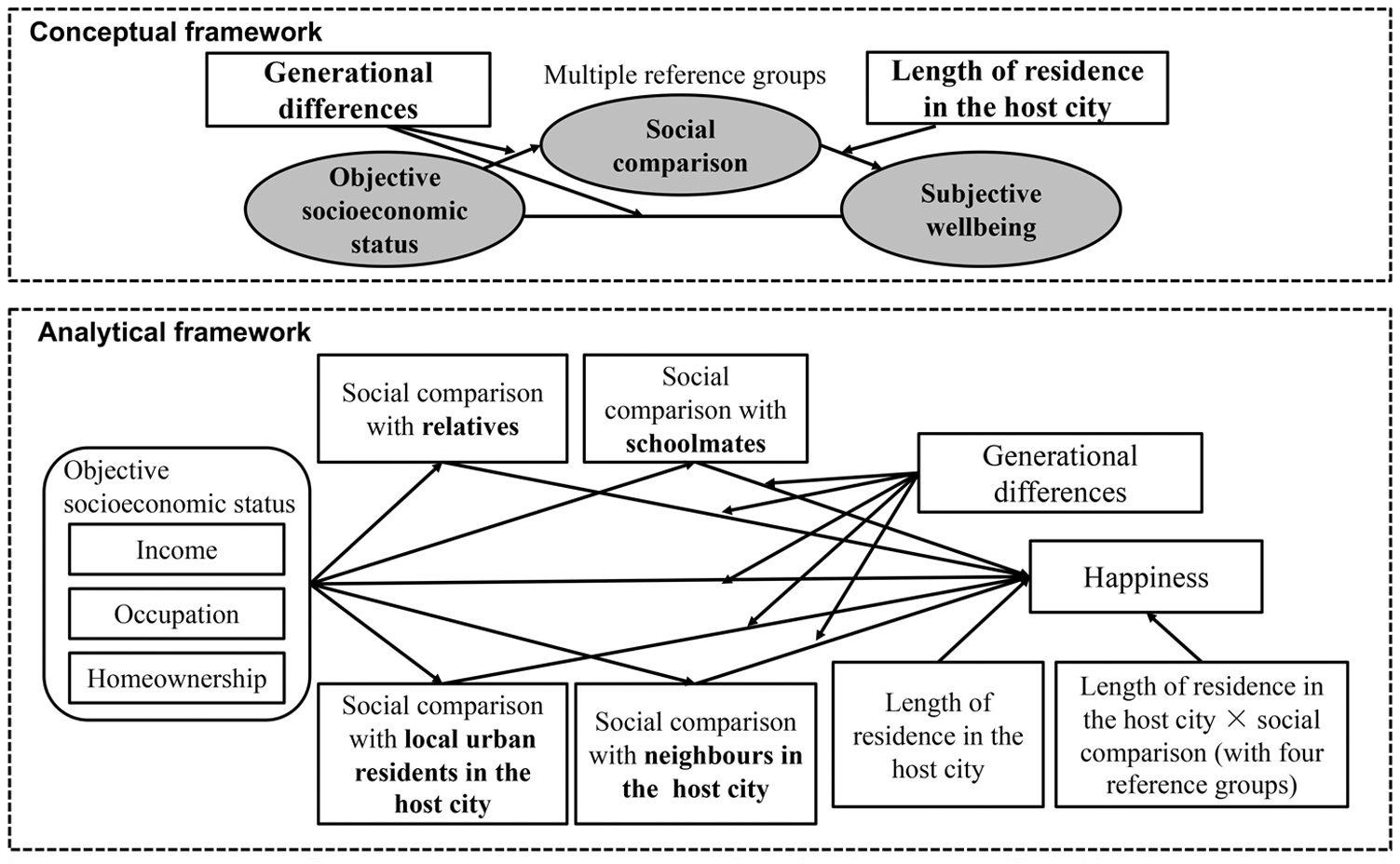
Conceptual and analytical frameworks.
Data and methods
Data collection
The data used in this study were drawn from the 2014 wave of the China Labour-force Dynamics Survey (hereafter CLDS, available at: http://css.sysu.edu.cn/Data for details). The CLDS was undertaken mainly by the Centre for Social Survey of Sun Yat-sen University. A multistage, cluster, stratified, Probability Proportional to Size (PPS) sampling technique was utilised to sample respondents. At the first stage of the sampling, the CLDS survey team divided 29 provincial administrative divisions (hereafter, provinces) into eight strata in light of the province’s population size. 1 The second stage of sampling involved the random selection of 160 primary sampling units (such as urban districts, counties or county-level cities) from 29 provinces. The third stage of sampling involved the random selection of 404 secondary sampling units (such as rural neighbourhoods and urban neighbourhoods) from the selected districts and counties. At the fourth stage, an average of 35 households was randomly selected from the sampled urban or rural neighbourhoods. For the sampled households, all members aged between 15 and 64 years and members aged above 64 years but who were still at work were sampled. In total, the 2014 wave of CLDS contained 23,594 individuals residing in 14,214 households within 401 urban or rural neighbourhoods across 160 urban districts or counties. The data have a hierarchical structure, with individuals nested within households, neighbourhoods and cities. As this study focused on migrants living in urban areas, we omitted 14,432 respondents living in rural neighbourhoods and 7730 urban residents who held local urban hukou. We defined migrants as those who did not have the local hukou of the host city. We then controlled for the hukou types (i.e. rural and urban hukou) in the models to distinguish rural–urban from urban–urban migrants (Wu and Wang, 2014). Therefore, a total of 1431 migrants living in urban areas were included in the analysis.
Variables and data analysis
Measures
Subjective wellbeing
The CLDS measures the level of individuals’ subjective wellbeing using a single-item scale which has been widely used in existing research on subjective wellbeing (Helliwell and Putnam, 2004). Specifically, sampled members were asked to respond to the following question based on a five-point Likert scale ranging from 1 (‘Very unhappy’) to 5 (‘Very happy’): ‘overall, how do you think about your life?’.
Objective socioeconomic status
Objective socioeconomic status refers to individuals’ economic and social position in relation to others (Campbell et al., 1986; Jackman and Jackman, 1973). It is usually measured separately by income, occupation and education (Campbell et al., 1986; Jackman and Jackman, 1973). Migrants’ objective socioeconomic status is measured by three indicators, including annual household income per household member, occupation and tenure in the host city. Annual household income per household member is measured by respondents’ household income per household member in 2013. Based on Lu’s (2002) research, this study divides the occupation into three categories, namely higher-, intermediate- and lower-level occupations. Higher-level occupations include leaders of state organisations, communist party organisations, public institutions and enterprises, as well as professionals of industrial sectors. Intermediate-level occupations consist of clerks and the self-employed. Lower-level occupations include commerce, catering and service personnel; producers of farming, forestry, animal husbandry, side-line production and fishery; operators of production and transport equipment. Homeowner in the host city refers to migrant respondents who own properties in the host city. The reason for using homeownership as an indicator of socioeconomic status is that most wealth amongst individuals and families in China is in the form of housing (Xie and Jin, 2015).
Evaluation of own living standards based on comparison with others
In the CLDS, respondents were asked to evaluate their own living standards relative to four reference groups: relatives, schoolmates, neighbours and local urban residents. Migrants’ evaluation of their own living standards relative to others is based on their real living standards, which are largely determined by their socioeconomic status in the host cities. Therefore, the evaluation of living standards can reflect migrants’ perceived disparities between their own socioeconomic status and that of their reference groups (S Huang et al.,2017). The four questions from the questionnaire of CLDS were asked in the following form and respondents were asked to select an answer from 1 (‘Much lower’) to 5 (‘Much higher’): ‘how would you evaluate your living standards compared to your relatives?’, ‘how would you evaluate your living standards compared to your schoolmates (with similar education)?’,’how would you evaluate your living standards compared to your neighbours?’ and ‘how would you evaluate your living standards compared to other local urban residents in the host city?’.
Controlled variables
We also controlled for a series of individual-level variables, including demographic characteristics (age, sex, marital status and family organisation), socioeconomic status (education), institutional status (household registration status), annual working hours, social ties, length of residence in the host city. The gap of GDP per capita between the host city and the place of origin was controlled in the models to explain the objective gap of economic development between the two places.
Multi-level structural equation models (MSEMs)
Multi-level structural equation models with ordinal variables were used to examine the relationship between migrants’ objective socioeconomic status, evaluation of living standards and subjective wellbeing. The advantages for applying the MSEM in the analysis are that: (1) it can examine the mediating effect of the evaluation of living standards (Hayes, 2017; Reise and Duan, 2003); (2) it can generate correct estimates by considering the hierachical nature of data (individuals nested within neighbourhoods); (3) it can predict the right-skewed distributed variable of subjective wellbeing (55.65% of migrants reported ‘happy’ and ‘very happy’).
The statistical analysis was accomplished in three steps. First, we applied MSEMs to examine the mediating role of the evaluation of living standards (relative to the four mentioned reference groups) in the relationship between migrants’ objective socioeconomic status and SWB. We then compared the statistical significance and strength of these mediating effects. Second, we estimated the moderating role of the length of residence in the host city in the relationship between migrants’ evaluation of living standards and SWB . Third, assuming that there are different underlying factors determining SWB between two generations of migrants, we stratified sampled migrant respondents into two groups (first- and second-generation migrants) and estimated the correlation between migrants’ objective socioeconomic status and SWB. The statistical analysis was conducted in the software STATA 13.1.
Results
Descriptive statistics
Table 1 provides summary statistics of sample migrants in Chinese cities. Over half of migrants were happy with their life (55.65%). When comparing themselves with reference groups, migrants tended to give a low rating to their living standards. Specifically, only 6.77% of migrants reported that they had a higher or much higher living standard than local urban residents, and 10.82% and 10.96%, respectively, considered that they had a higher living standard than schoolmates and neighbours. However, when comparing themselves with relatives, migrants tended to report a much higher living standard (15.78%). In terms of socioeconomic status, the majority of migrants were lower-educated (only 21.79% obtained higher education, χ2 = 30.58,p<0.001), over-represented in non-managerial and non-professional occupations (79.73%, χ2 = 143.64, p < 0.001), and less likely to own a property in the host city (only 29.26% had homeownership, χ2 = 1,900, p < 0.001) compared with local urban residents. Despite a decent level of annual household income (38,400 yuan per household member), migrants tended to work overtime (1866.74 annual working hours). Compared with first-generation migrants, second-generation migrants were more likely to have a higher level of annual household income (45,300 yuan per household member, F(11,430)=8.27, p < 0.05), receive higher education (31.64%, χ2= 217.64, p < 0.001), work in managerial and professional occupations (12.79%, χ2 = 87.19, p < 0.001) but less likely to own a property in the host city (21.46%, χ2 = 43.42, p < 0.001). To sum up, the majority of migrants had relatively disadvantaged socioeconomic status compared with their local urban counterparts in the host city. Compared with first-generation migrants, second-generation migrants attained a higher socioeconomic status in the host city.
Summary statistics of sample members, by hukou status and generation.

Multi-level structural equation models
Tables 2, 3 and 4 show the results of MSEMs. The goodness-of-fit indicators (e.g. AIC, −2log likelihood, etc.) reveal an acceptable goodness of fit for the MSEMs. Model 1 was used to estimate the mediating effects of comparison with multiple reference groups on the relationship between objective socioeconomic status and migrants’ subjective wellbeing. Model 2 examines the moderating effect of length of residence in destination cities on the relationship between social comparison and subjective wellbeing. Models 3 and 4 estimate the relation between objective socioeconomic status, evaluation on living standards and subjective wellbeing for first- and second-generation migrants.
The association between objective socioeconomic status, social comparison and subjective wellbeing using multilevel SEMs.
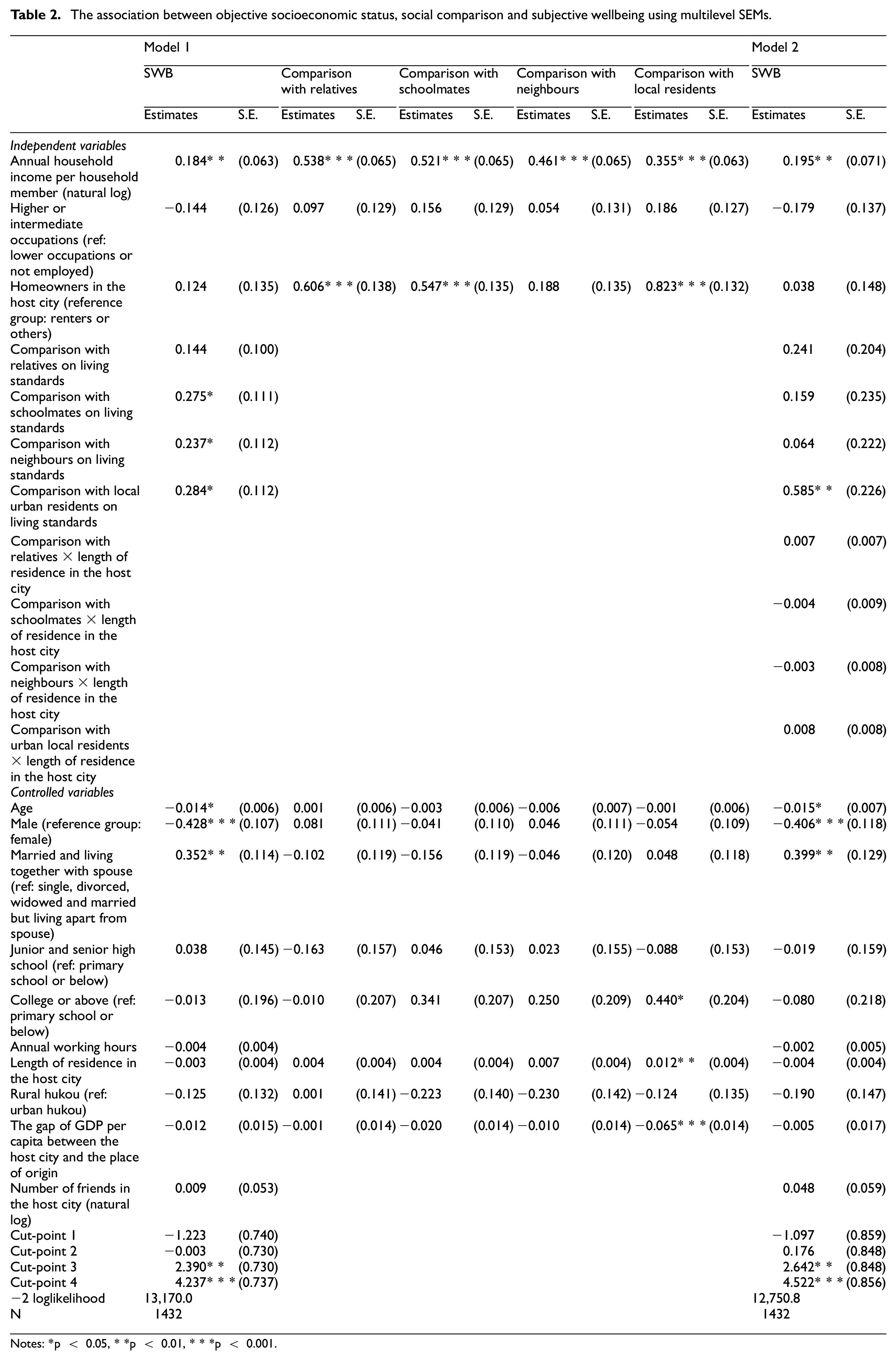
Notes: *p < 0.05, **p < 0.01, ***p < 0.001.
The association between objective socioeconomic status, social comparison and subjective wellbeing using multilevel SEMs: first- and second-generation migrants.

Notes: *p < 0.05, **p < 0.01, ***p < 0.001; models 3 and 4 have been adjusted for controlled variables listed in Table 2.
Migrants’ objective socioeconomic status and subjective wellbeing: Impacts from multiple reference groups
Results from Model 1 (Table 2) indicate a significant positive effect of migrants’ objective socioeconomic status on their subjective wellbeing. Migrants’ annual household income per household member was positively associated with their subjective wellbeing. Specifically, for a 1% increase in income per household member, the odds of reporting higher subjective wellbeing increased by 20.2% (exp(0.184) − 1 = 0.202, the odds of other variables are calculated in the same way). This observation is consistent with existing findings that migrants’ income is positively linked to their subjective wellbeing (Cheng et al., 2014; Nielsen and Smyth, 2008). No evidence suggests that migrants’ subjective wellbeing is directly linked to either occupation or homeownership in the destination city. Regarding social comparison on living standards, respondents with higher subjective living standards relative to schoolmates (0.275, p < 0.05), neighbours (0.237, p < 0.05) and local urban residents in the destination city (0.284, p < 0.05) were likely to report a higher level of subjective wellbeing. One-unit increase in subjective living standards relative to schoolmates, neighbours and urban local residents led to 31.7%, 26.7% and 32.8% increase in the odds of reporting a higher-level of subjective wellbeing among migrants. This finding reveals the existence of migrants’ multiple reference groups, as well as a stronger direct effect of comparison with urban local residents than the other reference groups. For controlled variables, migrants’ subjective wellbeing turned out to decrease with age. Male migrants were 34.8% more likely to report lower subjective wellbeing than female migrants. Migrants who were married and lived together with their spouse were 42.2% more likely than those who were single, divorced, widowed and married but living apart from their spouse to report higher subjective wellbeing.
The odds of migrants reporting higher living standards compared with their relatives, schoolmates and local urban residents were positively associated with their annual household income per household member (with a coefficient of 0.538, 0.461 and 0.355, respectively) and homeownership in the host city (with a coefficient of 0.606, 0.547 and 0.823, respectively). No evidence suggests that being employed in high and intermediate occupations is statistically correlated with the odds of reporting higher living standards relative to comparison targets. The results imply a possibility that income and homeownership as two important indicators of socioeconomic status may influence subjective wellbeing through perceived living standards relative to three reference groups.
Model 1 (Table 4) then indicates the pathways between objective socioeconomic status, social comparison on living standards and subjective wellbeing. The impacts of annual household income per household member on subjective wellbeing were mediated by comparison with schoolmates (0.143, p < 0.01), neighbours (0.109, p < 0.05) and local urban residents (0.101, p < 0.05). Despite its insignificant direct impacts, homeownership in the destination city was positively associated with a higher level of subjective wellbeing indirectly through a higher subjective evaluation on living standards relative to schoolmates (0.150, p < 0.05) and local urban residents (0.234, p < 0.05). Overall, these findings partly confirm Hypothesis 1 that migrants’ perceived living standards mediate the relationship between objective socioeconomic status and subjective wellbeing. In addition, comparison with local urban residents has a stronger direct and mediating impact on the relationship between homeownership in the destination city and subjective wellbeing than comparison with the other two reference groups.
Direct, indirect and total effects of objective socioeconomic status on SWB: social comparison as a mediator.

Notes: *p < 0.05, **p < 0.01, ***p < 0.001.
Model 2 examines whether the length of residence in the host city moderates the relationship between social comparison and migrants’ subjective wellbeing. Surprisingly, no interaction items between the length of residence in the host city and the social comparison of living standards are statistically significant. It indicates that there is no statistical evidence to support our Hypothesis 2.
The generation gap between first- and second-generation migrants
We conducted a stratified analysis to reveal the generational differences of the relationship between objective socioeconomic status, social comparison and subjective wellbeing. Models 3 and 4 regressed subjective wellbeing on the same set of variables as in Model 1 for first- and second-generation migrants, respectively. For first-generation migrants, only annual household income per household member was positively related to their subjective wellbeing (0.339, p < 0.001). As for second-generation migrants, those with a higher evaluation on living standards relative to urban local residents tended to report a higher level of subjective wellbeing (0.484, p < 0.05). Meanwhile, despite its insignificant direct impacts, homeownership in the destination city was associated with subjective wellbeing indirectly through the comparison with local urban residents (0.365, p < 0.05). For first-generation migrants, a higher income in the destination city fulfils their migration goals and thus contributes to a higher level of subjective wellbeing. In contrast, second-generation migrants are more concerned with their living standards relative to their local urban counterparts because most of them have been raised in the destination city and have a willingness to settle in the destination rather than return to the place of origin.
Conclusion and discussion
This paper has examined the pathway through which migrants’ objective socioeconomic status influences their subjective wellbeing using 2014 China Labour-force Dynamic Survey data, with a focus on the mediating effect of perceived living standards and the moderation effect of length of residence in the host city. Results from multi-level structural equation models have indicated that migrants’ family income is positively associated with their subjective wellbeing in both a direct and indirect manner, while homeownership in the host city only in an indirect way. The relationship between family income, homeownership in the host city and subjective wellbeing is significantly mediated by perceived living standards relative to the reference groups of schoolmates, neighbours and local urban residents in the destination city. Results from the moderation analysis have shown that the length of migrants’ stay in the host city does not matter for the relationship between perceived living standards and their subjective wellbeing. Results from the comparison between two generations of migrants have indicated that only family income is positively associated with the subjective wellbeing of first-generation migrants. By contrast, for second-generation migrants, homeownership in the destination city is indirectly related to subjective wellbeing through perceived living standards relative to the local urban residents in destination city.
These findings suggest that migrants have multiple reference groups (i.e. schoolmates, neighbours and local urban residents), and thereby rely more on social comparison with them when perceiving their living standards and quality of life. They also show that the mediating effect of migrants’ comparison with local urban residents does not increase as they stay in the host city longer. Findings further indicate that social comparison with local urban residents matters for the subjective wellbeing of second-generation migrants only. Moving beyond transnationalism theories (Guarnizo, 1997; Vertovec, 2004) or foundational theories (Piore, 1979; Stark, 1991), which both treat migrants as a homogenous group, our findings indicate the existence of generational differences in reference group selection and subjective wellbeing. First-generation migrants differ from second-generation migrants in terms of not only social identity, social circle and settlement intention, but also the frame of reference when evaluating their standards of living. Specifically, first-generation migrants are motivated by higher income in destination cities but are still more attached to their place of origin, and more likely to return to their hometowns after retirement. In contrast, second-generation migrants are motivated by higher income and urban lifestyle in the destination cities and attempt to settle down in destination cities (Cheng et al., 2014; Liu et al., 2012; Zhu and Lin, 2014). Consequently, for second-generation migrants, owning a property in the destination city is essential to settling down and to their subjective wellbeing. Also, the reference group of local urban residents plays a more significant role in social comparison than other reference groups. Therefore, this study also calls for a perspective of generational differences when examining how (internal or international) migrants’ selection of reference group influences their subjective wellbeing in China and other countries.
Moreover, in line with the assumptions from existing research (Cheng et al., 2014; Jin, 2016; Knight and Gunatilaka, 2010), this research reveals that migrants’ low level of subjective wellbeing is due to their lower socioeconomic status relative to their multiple reference groups based on empirical evidence. Migrants’ lower socioeconomic status can cause a strong feeling of relative deprivation in the destination city and result in a low level of subjective wellbeing. Our findings indicate that 46.23%, 24.65%, 28.00% and 27.86% of migrants have lower perceived living standards than local urban residents, neighbours, schoolmates and relatives, while only 6.77%, 10.96%, 10.82% and 15.78% of migrants have higher perceived living standards than the mentioned four groups. This study advances our knowledge on migrants’ subjective wellbeing by bringing up and verifying that social comparison with multiple reference groups mediates the relationship between migrants’ socioeconomic status and their subjective wellbeing. This study is amongst the first to take into account multiple reference groups when investigating the mediating effect of evaluation of living standards on migrants’ subjective wellbeing in the Chinese context.
Social policies should be developed to integrate internal migrants in the destination city and improve their subjective wellbeing. First, our findings have shown that household income is the foundation of migrants’ subjective wellbeing. Local government should take initiatives to help migrants climb the career ladder and gain higher incomes through vocational and professional education and training programmes. Second, we have demonstrated that homeownership in the destination city is positively associated with second-generation migrants’ subjective wellbeing through improving their perceived living standards relative to the local urban residents. Tailored housing policies could be formulated to promote homeownership and subjective wellbeing of second-generation migrants in the destination city. Eligibility to buy economically affordable housing and price-limited housing 2 in the destination city can be granted to migrants gradually. In short, the improvement of economic status and an increase in homeownership will contribute to the integration of migrants in Chinese cities, thereby enhancing social equity.
There are several limitations in the current study. First, the estimation of multi-level structural equation models might be biased because of the absence of unobserved individual characteristics. For instance, our models did not include variables representing individuals’ personalities, which have been found to be an important determinant of one’s subjective wellbeing. Readers should be cautious about the possible bias in the estimation of our models. Second, it is always the case that migrants may ignore the information gained from social comparison with others. For example, they may avoid making a comparison with someone who is better off (but not someone who is worse off), which may lead to a downward bias in the estimation of the mediation effect of social comparison. Third, the reference groups of relatives and schoolmates are not necessarily restricted to those living in the place of origin, since the CLDS data set questionnaire did not specify the residence for these two reference groups. Most rural and small-town residents migrated to cities for work rather than staying behind, given that there have been large waves of rural–urban and urban–urban migration in recent decades in China (Chan, 2018). It is also possible that migrants consider their relatives and schoolmates who moved to the destination city as targets of comparison.
Footnotes
Acknowledgements
The authors are grateful for three anonymous referees for their constructive comments. Data used in this article is from the China Labor-force Dynamics Survey (CLDS) by the Center for Social Science Survey at Sun Yat-sen University in Guangzhou, China. The opinions are the author’s alone. Please refer to  for more information about the CLDS data.
Declaration of conflicting interests
The authors declared no potential conflicts of interest with respect to the research, authorship, and/or publication of this article.
Funding
The authors disclosed receipt of the following financial support for the research, authorship and/or publication of this article: This work was supported by the National Natural Science Foundation of China [41871140, 51678380, 41871161].