




Abstract
Although an increasing number of studies have examined offending and victimization in China, little is known about the extent of the victim–offender overlap and what factors may explain differential tendencies toward offending versus victimization in the Chinese context. To fill this gap and to broaden the empirical base of the current literature on the victim–offender overlap, we examine the association of a number of prominent theoretical constructs with overall violent encounters and role differentiation. Using data collected from over 2,000 students from six schools in Changzhi, a city in Northern China, and multilevel item response theory modeling, we find a nontrivial overlap between violent offending and victimization and differential tendencies toward offending versus victimization. We also find that most of our theoretical constructs are associated with overall violent encounters, but only moral beliefs, peer delinquency, drinking, and gender are related to role differentiation. Findings for theory and research are discussed.
Keywords
Introduction
Youth offending in China has increasingly garnered research attention. In particular, researchers have been interested in whether theories originally developed to explain offending in the United States could be generalized to the Chinese context (Shen & Hall, 2015). Using self-reported survey data, various studies have investigated a range of risk and protective factors for juvenile delinquency, and the results of these studies have suggested that a number of criminological theories may be generalized to explain youth offending in China (Shen & Hall, 2015). Recently, some scholars have studied victimization in China and found that routine activity theory may also be generalized to explain victimization in the Chinese context (Messner, Lu, Zhang, & Liu, 2007; Ren, He, Zhao, & Zhang, 2017; Zhang, Messner, & Liu, 2007).
Although prior studies have significantly advanced scholarship on offending and victimization in China, they have estimated offending separately from victimization and no studies have investigated the offending–victimization overlap. This oversight is notable because the victim–offender overlap is one of the most consistent findings in the United States (Lauritsen & Laub, 2007; Reiss & Roth, 1993), but it has yet to be both theoretically and empirically extended to China, the most populous country in the world that “represents a distinct and unique social and cultural system that differs significantly from Western societies” (Liu, Zhang, & Messner, 2001, p. xi). The unique characteristics in the Chinese context may generate a different set of factors that is significantly related to offending and/or victimization and may produce a different association between offending and victimization.
The goal of this article is to broaden the empirical base of the current literature on victim–offender overlap by applying six prominent criminological theories in a significantly different social and cultural context. To this end, we examine four questions.
To address these questions, we use multilevel item response theory (IRT) modeling with data collected from over 2,000 youth and young adults in Changzhi, China. Here we focus on violent offending and victimization because the victim–offender overlap is more pronounced for violence (e.g., Jensen & Brownfield, 1986), and youth offending in China has shifted to more serious violent offenses in the past few years (Shen & Hall, 2015).
Background
Prior Research on the Victim–Offender Overlap
A number of scholars have found that many similarities exist between victims and offenders (see Lauritsen & Laub, 2007), and empirical studies have uncovered strong support for the victim–offender overlap through two observations. First, the demographic predictors (most notably gender and age) of offending also predicted victimization (Lauritsen, Sampson, & Laub, 1991). Second, a robust, positive correlation consistently emerged between frequency of offending and amount of victimization, particularly for violence (Jensen & Brownfield, 1986).
However, recent research has noted that despite a strong relationship between victimization and offending, exclusive groups of only victims and only offenders may exist (Broidy, Daday, Crandall, Sklar, & Jost, 2006; Klevens, Duque, & Ramírez, 2002; Mustaine & Tewksbury, 2000; Schreck, Stewart, & Osgood, 2008; Silver, Piquero, Jennings, Piquero, & Leiber, 2011). Furthermore, investigation into the possible correlates of falling into one category or the other has revealed important differences across different groups. For example, Mustaine and Tewksbury (2000) have found that the most notable distinction is between victims-only and victim-offenders: victim-offenders, compared with victims-only, are more likely to be male and to have prior criminal involvement and alcohol and drug use. Likewise, using a nationally representative sample from Bogotá, Colombia, Klevens and colleagues (2002) have documented that compared with victims-only, victim-offenders are more likely to be male, younger, and lower middle class; they tend to consume alcohol more frequently and in larger quantities and engage themselves in other risky activities, such as frequently passing through highly congested or very solitary areas of the city. Similarly, Broidy et al. (2006) have reported that homicide offenders are significantly more likely to fall into the 18 to 29 age group than victims, and victims are significantly more likely to fall into the older than 30 age group than offenders. In addition, Silver et al. (2011) have found a significant joint relationship between violent offending and violent victimization among discharged psychiatric patients, and identified “both complementary and unique risk factors for violent offending and violent victimization” (p. 57).
Overall, those aforementioned studies suggest that an overlap between violent offending and victimization exists, and victim-offenders are distinct from victims-only and offenders-only (see also Jennings, Piquero, & Reingle, 2012). Although these studies have significantly advanced scholarship, they have primarily drawn from a small set of theories (e.g., routine activity theory). More importantly, they have not paid much attention to the factors that would explain individuals’ differential tendencies toward offending versus victimization because of “a lack of means to take into account the correlation between offending and victimization” (Schreck et al., 2008, p. 894). As the sole exception, Schreck and colleagues (2008) used two waves of the Add Health data and multilevel IRT modeling, which takes into account this correlation, and found that in both waves, older teenagers were significantly more likely to report being victims of violence than being offenders, and those who reported getting drunk on a frequent basis tended to have a greater tendency of violent offending than victimization.
Importantly, Schreck and colleagues (2008) have provided a framework for exploring whether unique causal mechanisms are responsible for the differential tendency to offend rather than to be victimized. Thus, following their lead, we assess how theoretical constructs derived from a broader range of criminological theories could account for variation in overall violent encounters and the differential tendency toward offending versus victimization among Chinese youth and young adults. Below we group these theories into two categories: theories linking offending and victimization versus theories differentiating between offending and victimization.
Theories that Link Offending and Victimization
Self-control theory has often been used to explain the link between offending and victimization. Self-control theory argues that the underlying trait of low self-control is responsible for both offending and increased risk of victimization (Gottfredson & Hirschi, 1990). The relationship between self-control and offending has been well established (see Pratt & Cullen, 2000). In addition, self-control has also garnered strong support as an explanation of victimization (see Pratt, Turanovic, Fox, & Wright, 2014), and the relationship between low self-control and victimization risk has been supported by a number of empirical studies (Holtfreter, Reisig, & Pratt, 2008; Schreck, 1999; Schreck, Wright, & Miller, 2002). Furthermore, several scholars have also used self-control theory to explain the victim–offender overlap. For example, Holtfreter, Reisig, Piquero, and Piquero (2010) found that individuals with lower levels of self-control were more likely to report fraud offending as well as to be a fraud victim.
Routine activity perspective is the most dominant theory for explaining the victim–offender overlap (Jennings et al., 2012). This theory argues that individuals’ risky lifestyles or routine activities differentially expose them to both opportunities for offending and increased likelihood of victimization (Cohen & Felson, 1979). The idea that routine activities could explain the victim–offender overlap has been supported by several empirical studies. For example, after analyzing the data from two national victimization surveys (the British Crime Survey) in England and Wales from 1982 and 1984, Sampson and Lauritsen (1990) found that the same theoretical mechanisms essentially explained both offending and victimization because lifestyle factors (e.g., violent offending, going out at night, drinking, and crime rate in a neighborhood) were also related to personal victimization (e.g., assault and robbery). Drawing on routine activity theory, a number of subsequent studies have continued to link delinquent behavior with victimization (e.g., Lauritsen et al., 1991; Mustaine & Tewksbury, 2000).
In addition, general strain theory may also be used to explain the association between offending and victimization. This theory argues that strains increase negative emotions (e.g., anger, depression, anxiety, etc.), thus resulting in a higher likelihood of delinquency (Agnew, 1992, 2001, 2006). A number of studies have examined the empirical validity of this theory in explaining delinquency (e.g., Broidy, 2001; Paternoster & Mazerolle, 1994). Although no studies have directly examined the effect of strain on victimization, several studies have examined the link between negative emotions (e.g., anger and depression) and victimization (e.g., Felson, 1992; Schreck et al., 2008). In particular, Felson (1992) has contended that those emotionally distressed may antagonize others during social encounters and provoke aggression, thus resulting in interactions that may escalate into individuals alternating between roles of victims and offenders. Furthermore, general strain theory can also provide the causal pathways that lead victimization to offending. Specifically, victimization increases the likelihood of delinquency because it is a strain (Agnew, 2001), and a number of scholars have consistently found that victimization has a positive effect on offending (Hay & Evans, 2006; Turanovic & Pratt, 2013).
Overall, prior research that has tested and extended self-control, routine activity, and general strain theories has investigated both offending and victimization, “but so far has not yet identified any antecedents applicable only to crime or victimization” (Schreck et al., 2008, p. 874). Thus, we hypothesize that variables that reflect these theories would account for variation in both victimization and offending, and would explain little variation in the differential tendency toward offending versus victimization.
Theories that Differentiate Between Offending and Victimization
Several other theories have specified processes that may result in offending and have no clear implications for victimization. For example, social bond theory has primarily focused on offending and was not originally formulated to explain victimization (Schreck et al., 2008). In particular, this theory proposes that individuals with strong social bonds would be less likely to engage in criminal activities due to “sensitivity to the opinion of others” and fear of the social consequences that would result from delinquency (Hirschi, 1969, p. 16). A number of scholars have argued, however, that social bonds may influence risk of victimization indirectly through routine activity processes (e.g., Schreck, Fisher, & Miller, 2004). Specifically, because strong bonds lead individuals to consider negative consequences of their actions, they may be less likely to engage in risky activities. In addition, individuals with strong bonds to authority figures may be less vulnerable to victimization because family attachment can produce effective guardianship and in turn make adolescents less attractive criminal targets (Schreck et al., 2004).
Learning theories argue that individuals acquire criminality from other people who can provide specific techniques and motives of delinquent behaviors (Akers, 1998). Differential association/learning theory is generally geared toward explaining offending rather than victimization, simply because acquiring vulnerability to victimization would not make sense (Schreck et al., 2008). However, having delinquent friends may place individuals in greater contact with motivated offenders, thus increasing victimization risk (Schreck et al., 2002). For example, Schreck et al. (2002) found that having delinquent peers and spending time with deviant peers elevated risk of violent victimization even after controlling for peer delinquency (see also Schreck et al., 2004).
In addition, rational choice theory assumes that individuals make decisions based on the perceptions of costs and benefits (e.g., Warr & Stafford, 1983). Assuming that all individuals are rational actors, this perspective argues that offending is a behavioral consequence of individuals’ rational choice to maximize the benefits relative to the costs. Thus, individuals may not be engaged in risky lifestyle activities, such as drinking and going out at night alone, because the costs may outweigh the benefits and because these activities may be connected to victimization. Overall, a number of scholars have argued that rational choice theory may be used to explain victimization through routine activity process (e.g., Schreck et al., 2002).
In sum, the key variables of these theories (i.e., social bond, differential association, and rational choice theories) seem to have clear applicability to factors (i.e., routine activities) that may affect victimization and thus contribute to the victim–offender overlap. However, it is important to note that routine activities rather than these theories would produce the link between these theories and victimization. Because these theories offer theoretical constructs that may be more relevant for explaining offending than victimization, variables that reflect these theories may produce differentiation between offending and victimization, whereas routine activities would reduce that differentiation (Schreck et al., 2008). Thus, we hypothesize that variables that reflect social bond, differential association, and rational choice theories would be associated with a greater tendency toward offending than victimization.
The Chinese Context
Confucianism and collectivism play an imperative role in shaping Chinese individuals’ lifestyles and routines, and yield a distinctive social patterning of offending and victimization (Messner et al., 2007). First, Chinese society is based on Confucian ideology that establishes a strong set of moral codes. According to this ideology, “people should be directed by virtue and regulated by moral principles, which will enable them to develop a sense of shame and have concerns for others, resulting in a moral order in the society” (Jiao, 2001, p. 160). As a result, Chinese informal social control seeks to “develop moral character, and rule by moral example and persuasion rather than by formal, external law” (Rojek, 2001, p. 93). Research has found that Chinese youth tend to have a high level of conformity and adherence to the moral principles and rules set by authority figures (Bond & Hwang, 1986). In addition, Confucian philosophy also emphasizes the minimization of direct conflict (Chen, 2000) and values restrained behavior (Chen, Rubin, & Sun, 1992). Since childhood, Chinese youth are taught to be restrained, obedient, and submissive to parental control (Leung & Fan, 1996), and Chinese parents tend to suppress aggressiveness in their children (Leung & Fan, 1996; Ryback, Sanders, Lorentz, & Koestenblatt, 1980). Thus, personal moral beliefs, instilled from Confucian ideology, function for Chinese youth and young adults by inhibiting them from violence.
Second, Chinese culture is characterized by its collectivistic orientation. Specifically, there exists a family-centered tradition in China that stresses strong ties and stakes in extended family relationships (Ting & Chiu, 2002). Furthermore, there exists a relational culture, guanxi, which involves interpersonal connections and occurs predominantly among relatives and close friends. Overall, these strong extended family ties and interpersonal connections may increase the likelihood that many of the routine activities for Chinese youth and young adults are performed in a collective manner and in turn reduce the probability that they are alone inside and outside of their homes (Messner et al., 2007). As previously discussed, social bond, differential association, and rational choice theories offer theoretical constructs that may be more relevant for explaining offending than victimization, and routine activities rather than these theories would produce the link between these theories and victimization (see Schreck et al., 2008). Because of the characteristics of routine activities and lifestyles of Chinese youth and young adults, the ability of these theories to explain victimization through routine activities may be subdued. As a result, variables that reflect these theories may lead to an even stronger tendency toward offending than victimization in the Chinese context.
Hypotheses
Given each theory’s implications for offending and victimization, prior research, and the Chinese context, we develop five hypotheses. Hypothesis 1 anticipates that there will be a nontrivial overlap between violent offending and victimization among Chinese youth and young adults. Hypothesis 2 predicts that there will be a differential tendency toward violent offending versus victimization among Chinese youth and young adults. Hypothesis 3 anticipates that variables that reflect self-control, routine activity, and general strain theories will be associated with overall violence and not with the differential tendency toward either offending or victimization. Hypothesis 4 predicts that variables that reflect social bond, differential association, and rational choice theories will be associated with a greater tendency toward offending than victimization. Finally, because of the vital role moral beliefs play in Confucian ideology that remains powerful in Chinese society, Hypothesis 5 anticipates that personal moral beliefs will inhibit Chinese youth and young adults from violence.
Method
Data
To assess the violent victim–offender overlap in the Chinese context, we use self-reported survey data collected from students in Changzhi, China in December, 2009. Located in the province of Shanxi of the People’s Republic of China, the city of Changzhi has over 3 million people and is a transportation center with agricultural and industrial economic interests. The large agricultural and mining interests, together with the heavy industry that runs on the coal mined in the surrounding rural areas, have brought many rural residents into the city, thus endowing the city with a diverse population mix and in turn providing a varied set of respondents for this study (see Pyrooz & Decker, 2013). A total of 2,500 questionnaires were administered to students in six schools, consisting of one college, two high schools, one comprehensive school with both college students and vocational school students, and two vocational schools. The aim of this selection strategy is to maximize variation in student academic performance, personal life experiences, and job prospects. 1 We used a convenience sample in selecting the classes within each school. The questionnaire was translated from English to Chinese by a native of Changzhi, back-translated by a Chinese native, and reviewed by a school teacher at one of the schools where the questionnaires were administered.
Of the 2,500 questionnaires, 2,245 were returned, for a response rate of 90%. The sample was reduced to 2,116 because of missing information on the dependent variable. Thus, our analysis is conducted with 2,116 youth and young adults. Because the data were collected from nonrandom samples, the results reported in this study may not generalize easily to all students in China. However, research has demonstrated that patterns of correlations between psychological variables differ only minimally between studies using random and convenience samples (Hultsch, MacDonald, Hunter, Maitland, & Dixon, 2002). As we will show below, many of the observed correlations in this study are consistent with existing research. Nonetheless, the generalizability of our findings may have to be determined via replication.
Dependent Variables
The survey data contain seven items concerning violent offending and violent victimization, which indicates the involvement of a respondent in violence as either a victim or an offender. In particular, four items address violent offending, and three items address violent victimization. The items were originally coded as an ordinal variable (0 = never, 1 = once or twice, 2 = 3-5 times, 3 = 6-10 times, and 4 = more than 10 times). Following Schreck and colleagues (2008), we recoded each item to a dichotomous variable where it takes a value of “1” if a respondent was exposed to each form of violence during the past 12 months and “0” otherwise. Our approach involves decomposing our measures of violence to model total violent encounters and role differentiation using multilevel IRT modeling for the respective violent offending and victimization outcomes. This approach allows us to capture respondents’ latent propensity for total violence and role differentiation as a victim versus an offender (see Schreck et al., 2008).
We presented the specific items and their associated prevalence rates in Table 1. Similar to research conducted in the United States, the distribution of violent offending and victimization items is skewed with most respondents reporting no exposure to any form of violence and a small percentage, ranging from 2.74% to 10.82%, experienced some form of violence in our sample.
Item Parameters of Self-Reported Offending and Victimization Measures (N = 2,116)

Note. Lower values of item severity (γi0) indicate greater item seriousness.
Explanatory Variables
The survey data contain many measures relevant to important theories of crime. Here we highlight self-control, routine activity, general strain, social bond, differential association, and rational choice theories. First, low self-control consists of 13 items drawn from the Brief Self-Control Scale (Tangney, Baumeister, & Boone, 2004), such as “I have a hard time breaking bad habits,” and “I often act without thinking through all of the alternatives.” These items were scaled from 0 to 4, with higher scores reflecting lower levels of self-control, and our low self-control measure is the average score of these 13 items (Cronbach’s α = .72). Though brief, this self-control scale captures various dimensions of Gottfredson and Hirschi’s (1990) low self-control and has demonstrated good reliability and validity (de Ridder, Lensvelt-Mulders, Finkenauer, Stok, & Baumeister, 2012).
Second, we use several measures of risky lifestyles and routine activities, such as parental monitoring, skipping classes, drinking, and gang membership. Ranging from 0 (never) to 4 (always), parental monitoring is operationalized as an index averaged across responses to five items that measure the extent to which respondents report that their parents monitor their whereabouts and activities (Cronbach’s α = .73). 2 Skipping classes is an ordinal measure, ranging from 0 (never) to 4 (more than 10 times), capturing respondents’ answer to the question, “During the past 12 months, how often have you skipped classes without an excuse?” We also include an item, drinking, to measure how often respondents have used alcohol, ranging from 0 (never) to 4 (every day). Finally, gang membership has been linked to violent victimization and offending (Pyrooz, Moule, & Decker, 2014). In this study, gang membership is measured by individuals’ response to this question, “Do you consider your group of friends to be a gang?” Those responding “yes” were recorded as being involved in a gang and those responding “no” served as the reference category. Prior research has suggested that self-nominating to involvement in a gang is valid and reliable for operationalizing gang membership (Thornberry, 2003).
Third, the explanatory variables that we draw from general strain theory include negative family events, anger, and depression. Negative family events is an additive scale of eight dichotomous items indicating respondents’ stress of life, including parental or sibling death, illness, constant parental fighting, and broken home (Cronbach’s α = .50). 3 Furthermore, the survey data contain two negative emotions: anger and depression. To measure respondents’ level of anger, we created an index by averaging responses to 14 questions indicating how often respondents experience these emotions, such as “You lose your temper” and “You have urges to shout,” with responses ranging from 0 (never) to 4 (always; Cronbach’s α = .85). 4 Moreover, depression is an average score of responses to nine questions reflecting how often respondents experience such emotions as “You feel hopeless” and “You feel no interest in things” (Cronbach’s α = .90). It bears noting that we include anger and depression, not only because general strain theory argues that strain may affect delinquency through negative emotions (Agnew, 1992), but also because negative emotions may interfere with an individual’s interaction skills and make him or her more likely to behave in ways that may incite grievance from others, which in turn may produce a cycle of attack and retaliation (Felson, 1992).
Fourth, we use three measures to tap elements of Hirschi’s (1969) social bond theory, including attachment to parents, attachment to school, and moral beliefs. Attachment to parents consists of 13 items that ask respondents how much they agree with statements, such as “You enjoy talking over your plans with your parents” and “You depend upon your parents for advice and guidance,” with a scale ranging from 0 (strongly disagree) to 4 (strongly agree). We averaged these 13 items to construct our measure of attachment to parents (Cronbach’s α = .82) and higher scores on this measure reflect a stronger attachment to parents. Attachment to school is comprised of 10 items that evaluate respondents’ attitude toward school. Specifically, respondents were asked how strongly they agree on statements such as “In general, you like school,” and “Grades are very important to you,” with a scale ranging from 0 (strongly disagree) to 4 (strongly agree). All responses were coded such that a higher score indicated a stronger attachment to school. We averaged the responses across these 10 items to compose a scale on school attachment (Cronbach’s α = .78). Moral beliefs are based on 16 items asking how wrong respondents think about a range of deviant behaviors. The scale was from 0 (not wrong at all) to 4 (very wrong), with a higher score reflecting a higher level of moral beliefs, and our moral beliefs measure is the average across these 16 items (Cronbach’s α = .92).
Fifth, we use peer delinquency as the main theoretical construct for differential association theory. Peer delinquency is comprised of 15 questions that ask respondents to report their close friends’ delinquent behaviors, such as using a weapon in a fight and running away from home. The scale of responses is from 0 (none) to 4 (all of them), and all responses were averaged to build a peer delinquency scale (Cronbach’s α = .91).
Sixth, we include a thoughtfully reflective decision making (TRDM) scale to capture rational choice theory. Similar to Paternoster and Pogarsky (2009), the index of TRDM includes respondents’ agreement to four statements such as “When you have a problem to solve, one of the first things you do is get as many facts about the problem as possible” (p. 116). The response to each question ranged from 1 (strongly agree) to 5 (strongly disagree). TRDM is an average score of responses to these four items (Cronbach’s α = .80), and it is coded such that a higher score indicates a higher level of TRDM.
Demographic Variables
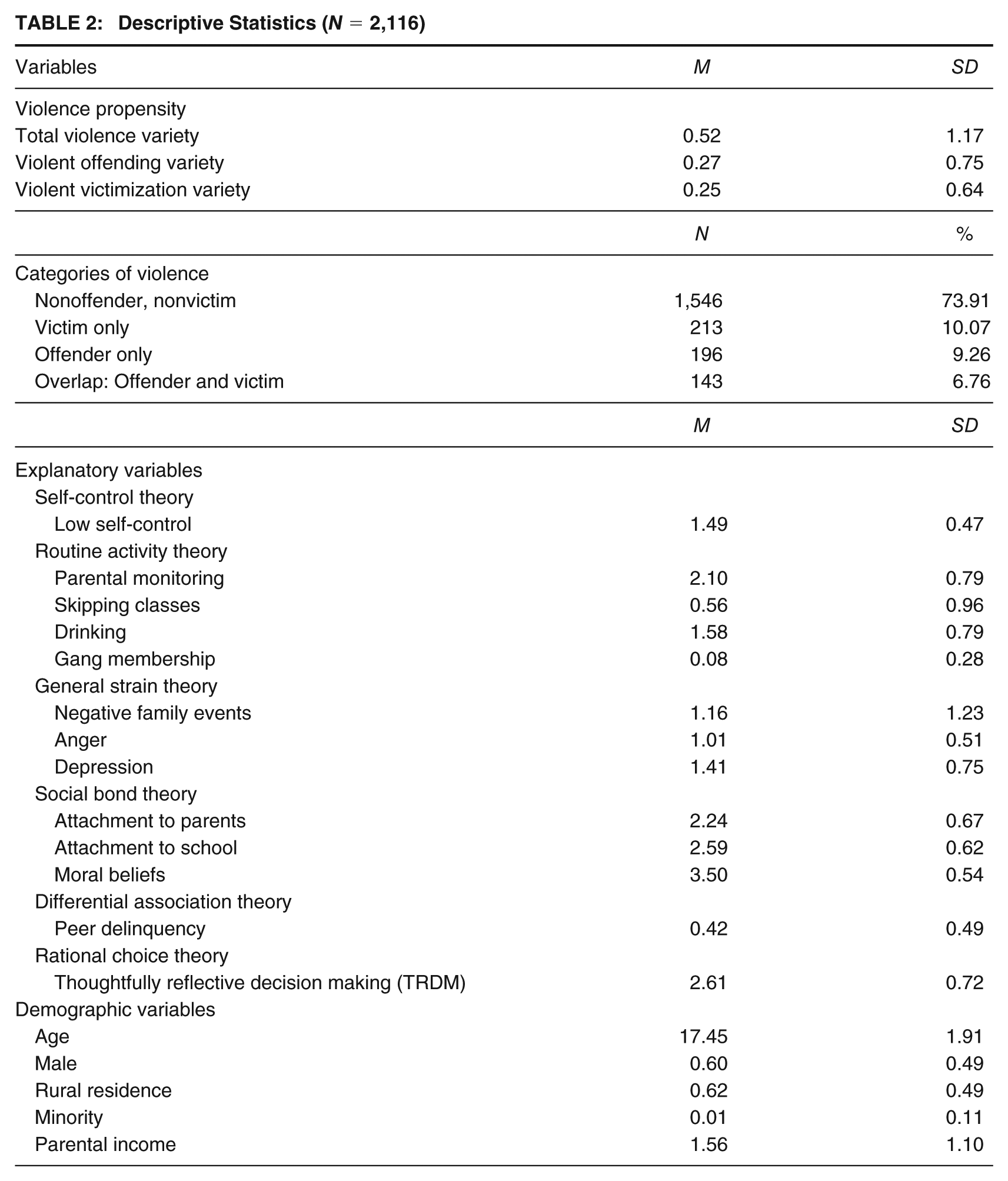
To reduce the likelihood that any identified effect concerning our explanatory variables is spurious, we incorporate a range of demographic variables that may predict the victim–offender overlap or individuals’ differential tendency toward offending versus victimization. 5 Specifically, we include age (in years), gender (1 = male, 0 = female), minority (1 = Hui, 0 = Han), residence (1 = rural residence, 0 = urban residence), and family income. Family income is the average of respondents’ father’s income and mother’s income, which is measured separately ranging from 1 (below RMB 500), which equals approximately US$80, to 7 (over RMB 5,000), which equals approximately US$800. Table 2 presents the means and standard deviations for all variables of this study.
Descriptive Statistics (N = 2,116)
Analytic Strategy
Our sample contains 2,116 youth and young adults who provided a valid response to all the items measuring violent offending or victimization. We used multiple imputation to address the missing data problem because it is “one of the most attractive methods for general-purpose handling of missing data in multivariate analysis” (Allison, 2000, p. 301). 6 We performed multiple imputation using Patrick Royston’s Imputation by Chained Equations (ICE) program, which is implemented in Stata (see Horton & Kleinman, 2007). The main advantage of using the ICE program is that it does not require the multivariate normal distribution assumption, which allows the program to impute different types of variables together, such as binary and categorical variables. We performed 10 imputations in total.
In this article, we use multilevel IRT modeling to assess “the extent to which people vary in the relative tendency to take the role of victim versus offender when involved in violent incidents,” and to relate our explanatory and demographic variables to the propensity for violence and role differentiation (Schreck et al., 2008, p. 873). 7 This approach is valuable because “it takes into account the wide variation across individuals in precision of estimates of the degree to which they incline toward offending or victimization” (Schreck et al., 2008, p. 886). Multilevel IRT model was performed in HLM 7 and to do so, we applied hierarchical logistic regression models, where offending and victimization items (Level 1) are nested within respondents (Level 2), to the 10 imputed data sets. We present the model estimates with robust standard errors.
As Schreck and colleagues (2008) have provided a detailed explanation of multilevel IRT modeling and its application to the victim–offender overlap, here we present a brief summary of this model. Again, as a multilevel model, offending and victimization items (Level 1) are nested within respondents (Level 2). The model takes the following form:




Our Level-1 outcome (Equation 1), the log odds of a “yes” response for student j to violent item i, is determined by three factors: a latent measure of overall violent encounters (β0j, which represents the combined risk both to offend and to be victimized), a latent measure of role differentiation (β1j, which represents the differential tendency toward either offender or victim roles), and violence item severity (β ij , which represents item parameters). We enter our explanatory variables and demographic variables in Equations 2 and 3 to determine their relationships with overall violent encounters and role differentiation. The final equation (Equation 4) is fixed to adjust for item base rates in the sample, and we report the item parameters in Table 1.
It bears mention that the index of role differentiation, Diff, is coded as a dummy variable with offending items coded 1 (and victimization items coded 0), which was group-mean centered so that offending items take on positive values and victimization items take on negative values. Thus, Diff represents the balance of offending to victimization. Its coefficient, β1j indicates role differentiation and reflects the difference between a respondent’s log odds of committing a violent act versus being a victim. Specifically, a positive and statistically significant coefficient in the role differentiation equation (Equation 3) would indicate a preponderance of offending over victimization, and a statistically significant and negative coefficient would suggest an increasing likelihood of being a victim. A nonsignificant coefficient of a variable would indicate that this variable explains offending and victimization similarly (see Schreck et al., 2008).
Results
We begin by discussing descriptive statistics of the offending and victimization variables. Review of Table 2 indicates that whereas 73.91% of the students in our sample were not involved in any violent encounter as an offender or a victim, 10.07% were violent victims only, 9.26% were violent offenders only, and 6.76% were both offenders and victims. These figures are considerably smaller compared with those reported by U.S. samples. For example, using the first two waves of the Add Health data, Shaffer and Ruback (2002) found that 19% reported violent victimization in Year 1, 15% in Year 2, and 9% in both years; 40% of juveniles reported violent offending in Year 1, 23% in Year 2, and 17% in both years; 15% of juveniles reported both offending and victimization in Year 1, 10% in Year 2, and 6% in both years. 8
Multilevel IRT Models
Prior to estimating models to assess the victim–offender overlap in our Chinese respondents, we conducted multicollinearity diagnostics to ensure that there was no harmful multicollinearity in our analysis. The results of variance inflation factors (VIF) and condition indices indicated that collinearity was not problematic. 9 Next, we assess whether individual differences in the tendency toward offending versus victimization are greater than what one would expect due to chance alone. Following Schreck and colleagues (2008), we divided the variance of role differentiation by the standard error from an unconditional model without explanatory variables at Level 2 to approximate a z test. The resulting value of 14.00 is statistically significant (p < .001), indicating that significant individual differences in the tendency toward offending versus victimization are observed in our sample. This is not surprising, because among those involved in violence, approximately 74.09% were either victims or offenders while 25.91% comprised the overlap.
Overall Violent Encounters
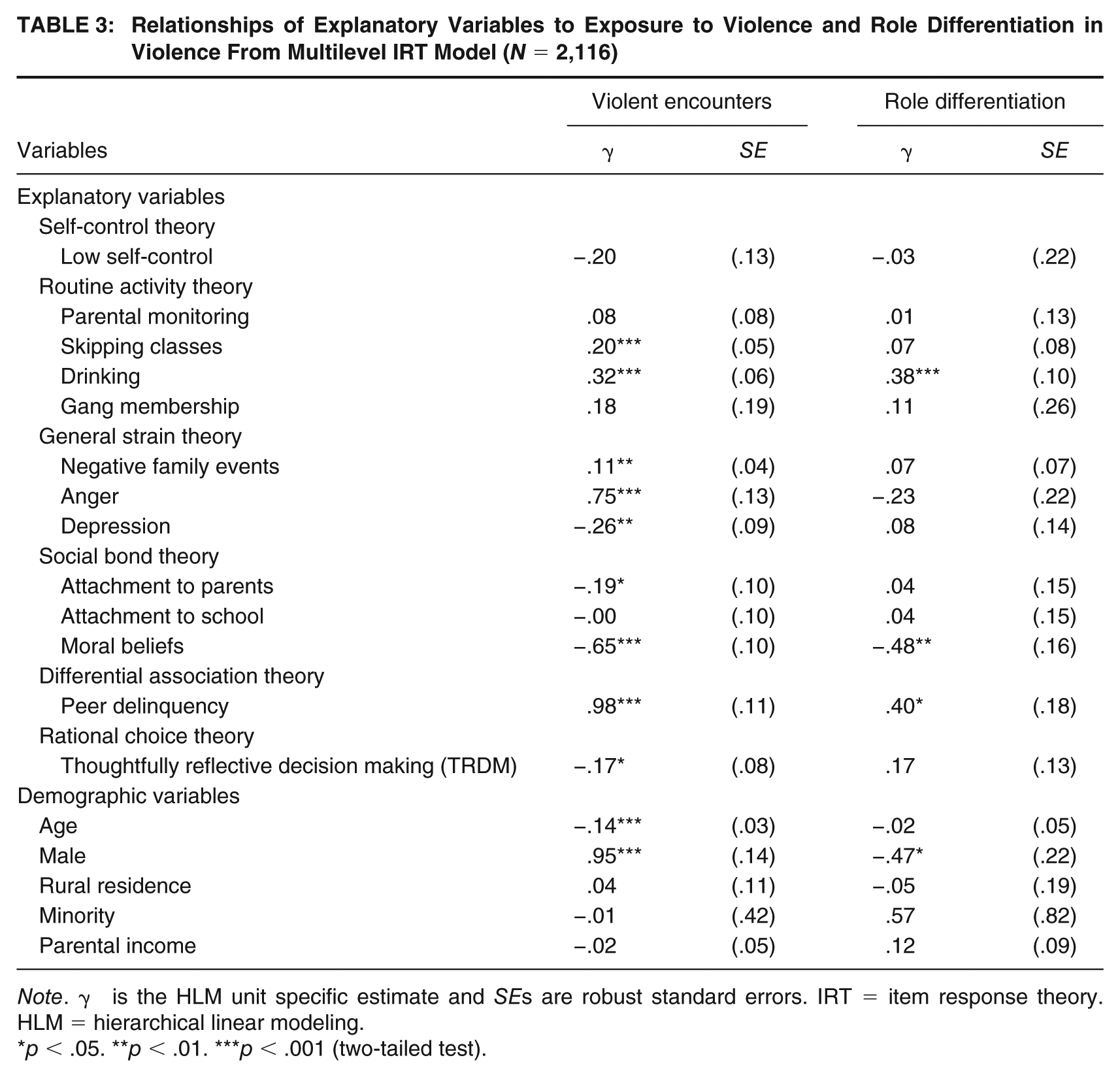
We proceed by adding Level-2 explanatory and demographic variables in our multilevel IRT model. Table 3 reports the relationships of our explanatory and demographic variables with both overall violent encounters and role differentiation. The coefficient estimates for the violent encounters model reflect the change in log odds of violence exposure associated with each unit change in an independent variable, with all the other variables controlled for in the multilevel IRT model (see Schreck et al., 2008). Inspection of the violent encounters model in Table 3 indicates that low self-control is not significantly related to total violent encounters. In addition, we find that two risky activities (i.e., skipping classes and drinking) significantly increase individuals’ overall likelihood to be exposed to violence. We also find that all three measures derived from general strain theory are significantly related to overall exposure to violence. Specifically, whereas negative family events and anger increase total violent encounters, depression is negatively associated with overall exposure to violence.
Relationships of Explanatory Variables to Exposure to Violence and Role Differentiation in Violence From Multilevel IRT Model (N = 2,116)
Note. γ is the HLM unit specific estimate and SEs are robust standard errors. IRT = item response theory. HLM = hierarchical linear modeling.
p < .05. **p < .01. ***p < .001 (two-tailed test).
In the meantime, attachment to parents and moral beliefs are significantly and negatively related to overall exposure to violence, suggesting that those who have a higher level of parental attachment and moral beliefs are less likely to be exposed to any violence. Furthermore, peer delinquency significantly increases overall violent encounters. We also find that TRDM—a measure capturing rational choice theory—reduces the likelihood of violence exposure. Finally, we find that age and male are significant predictors of overall violent encounters, with younger respondents and males associated with more violent encounters. In sum, our overall violent exposure model suggests that our variables capturing all theories, except self-control theory, can predict overall violent encounters among our Chinese respondents.
Role Differentiation
Given that there is significant individual variation in the differential tendency toward offending versus victimization, we next examine if our variables derived from six prominent criminological theories could explain this differential tendency. Specifically, the role differentiation model in Table 3 indicates the relationships of our explanatory variables to this differential tendency, after controlling for overall violent encounters and item severity for the offending and victimization items. Review of the role differentiation model in Table 3 suggests that several variables are significantly associated with a differential tendency toward offending versus victimization. Specifically, the coefficient of drinking on role differentiation is positive and statistically significant (γ = .38, SE = .10, p < .001), indicating that those who report drinking alcohol more frequently tend to have a greater preponderance of violent offending over victimization. Similarly, the coefficient of peer delinquency is positive and statistically significant (γ = .40, SE = .18, p = .025), suggesting that those who are associated with delinquent peers are more likely to offend than to be victimized. Furthermore, the coefficient of moral beliefs is negative and statistically significant (γ = −.48, SE = .16, p = .003), indicating that moral beliefs result in a preponderance of victimization over offending. Together with the finding that moral beliefs are significantly associated with reduced risk of violent encounters (overall violent encounters model), the finding of moral beliefs in the role differentiation model suggests that those with strong moral beliefs who nonetheless encounter violence are more likely to be victims than offenders. Finally, males are negatively and significantly related to role differentiation (γ = −.47, SE = .22, p = .036), indicating that being male is associated with a greater tendency toward victimization than offending. This finding, together with the positive effect of male on overall violent encounters (γ = .95, SE = .14, p < .001), suggests that those males who encounter violence are more likely to be victims than offenders. The remaining measures, however, do not significantly affect role differentiation.
Discussion and Conclusion
The goal of this article is to broaden the empirical base of the current literature on victim–offender overlap by applying six prominent criminological theories in a significantly different social and cultural context. To this end, we used data collected from over 2,000 youth and young adults in Changzhi, China and multilevel IRT modeling, and assessed a series of hypotheses. Specifically, we hypothesized that there would be a nontrivial overlap between violent offending and victimization among Chinese youth and young adults (Hypothesis 1) and a differential tendency toward violent offending versus victimization among Chinese youth and young adults (Hypothesis 2). We further hypothesized that variables that reflect self-control, routine activity, and general strain theories would be associated with overall violence and not with the differential tendency toward either offending or victimization (Hypothesis 3) and variables that reflect social bond, differential association, and rational choice theories would be associated with a greater tendency toward offending than victimization (Hypothesis 4). Finally, we hypothesized that personal moral beliefs would inhibit Chinese youth and young adults from violence (Hypothesis 5). Ultimately, this article makes important theoretical and methodological contributions to the victim–offender overlap research and crime research in China in general.
The main findings can be summarized as follows. First, we observed that 6.76% of our Chinese respondents were violent victims and offenders, which accounts for 25.91% of those who were exposed to any violence. In addition to observing the overlap between violent offending and victimization, we also found significant differentiation between offending and victimization among our Chinese respondents. Thus, we found support for Hypotheses 1 and 2. Second, we found that most of our theoretical constructs, except self-control, successfully predicted violent encounters overall. Furthermore, we found that three theoretically relevant variables were significantly related to role differentiation. Specifically, those respondents who were associated with more delinquent peers and drank more frequently tended to have a greater preponderance of violent offending over victimization. In addition, those with strong moral beliefs who nonetheless encountered violence were significantly more likely to report violent victimization than to report offending. Other variables, however, did not significantly affect the differential tendencies between violent offending and victimization. Overall, because self-control was not associated with overall violence and drinking, a routine activity we considered was associated with the differential tendency toward offending versus victimization, we only found partial support for Hypothesis 3—that is, variables that reflect self-control, routine activity, and general strain theories would be associated with overall violence and not with the differential tendency toward either offending or victimization. Moreover, since only peer delinquency, among all the variables that reflected social bond, differential association, and rational choice theories, was significantly related to a greater tendency toward offending than victimization, we only found partial support for Hypothesis 4 that argued that variables that reflect social bond, differential association, and rational choice theories would be associated with a greater tendency toward offending than victimization.
With regard to Hypothesis 5 that maintained that personal moral beliefs would inhibit Chinese youth and young adults from violence, we found that those with strong moral beliefs who were exposed to violence were more likely to report victimization than offending. Together with the finding that moral beliefs are significantly associated with reduced risk of violent encounters, the finding of moral beliefs in the role differentiation model suggests that those with strong moral beliefs who nonetheless encounter violence are more likely to be victims than offenders. This finding indicates that moral beliefs have an important violence-inhibiting effect, and those with high moral beliefs may be more vulnerable because they refrain from using violence as a result of their moral beliefs. Thus, we found support for Hypothesis 5 and the high value that Confucian philosophy placed on moral codes may explain the distinctive effect of moral beliefs in total violence and role differentiation.
We explain our findings by drawing their connections to Chinese society and culture. First, we found that low self-control was not significantly related to violent encounters overall or the role differentiation. Our ancillary analysis, using negative binomial regression, found that after we controlled for other explanatory and demographic variables, low self-control was not a significant predictor of violent offending, victimization, or overall violent encounters. This finding, consistent with prior research (e.g., Cheung & Cheung, 2008), suggests that self-control, an individual trait, may be less salient to individuals in collectivistic societies, such as China. That said, low self-control is arguably reflected in many of the variables used in this analysis. Skipping classes, for example, may be caused by a lot of factors and an individual who skips classes does not necessarily have low self-control. But skipping classes is more likely if one is in the habit of ignoring long-term consequences. Thus, low self-control may be best measured by a clustering of things potentially indicative of poor judgment. Consequently, the results for our self-control measure may not speak to self-control theory. Further research, perhaps using a behavioral self-control scale (see Marcus, 2003), is necessary before definitive conclusions can be drawn. 10
Second, despite cultural differences in the acceptability of alcohol consumption, the finding that drinking is related to a preponderance in offending over victimization is observed both in the United States (see Schreck et al., 2008) and China. In addition, using a U.S. sample and a Columbian sample, respectively, Mustaine and Tewksbury (2000) and Klevens et al. (2002) found that victim-offenders, compared with victims-only, were more likely to consume alcohol more frequently. Whereas alcohol use among adolescents is generally not tolerated and may be severely punished under some circumstances in the United States and some other countries, alcohol use in China, even excessive use in early adolescence, is traditionally accepted and even socially encouraged. As a further note, China has no enforceable legal drinking age and does not regulate when or where alcohol is sold (Tang et al., 2013). Given the strong cross-cultural evidence in favor of a positive and direct relationship between alcohol use and violent and aggressive behavior (e.g., Bernasco, Ruiter, Bruinsma, Pauwels, & Weerman, 2013), a culture that accepts alcohol use in early adolescence and easy access to alcohol in Chinese society may further make drinking more likely to be associated with a greater tendency toward offending than victimization in the Chinese context.
Third, we found that peer delinquency was significantly related to a preponderance of violent offending over victimization. The significant effect of peer delinquency in the Chinese context, not observed in the United States (see Schreck et al., 2008), may be partially due to the collectivistic orientation in Chinese society. Specifically, peers may play a larger role in societies that are more collectivistic in orientation (Greenberger, Chen, Beam, Whang, & Dong, 2000). In relation to the collectivistic orientation in Chinese society, the Chinese tend to make a clear distinction between in-groups and out-groups (Leung, 1988), and they are more likely to engage in behavior that may promote the well-being of their group (Hsu, 1970). This collectivistic orientation may also lead to a closer adherence to group norms (Leung & Fan, 1996). The strong group orientation in Chinese society and a close adherence to group norms suggest that crime may be more frequently committed by groups in Chinese society than in the West (Leung & Fan, 1996). In fact, Wei, Homel, Prichard, and Xu (2004) found that, although the Brisbane sample had much higher participation rates in most offending categories than the Shanghai sample, co-offending was more common in the Shanghai sample. Furthermore, peer influences may be especially greater in rapidly changing societies where traditional values are no longer sufficient for successful adaptation, such as China (Greenberger et al., 2000). Thus, peer delinquency is more likely to be associated with a greater tendency toward offending than victimization in the Chinese context.
Fourth, we found that males were associated with a greater tendency toward victimization. This finding may be largely due to the fact that there is a significant difference in the social involvement of females compared with males within the Chinese culture. Specifically, whereas Chinese girls tend to spend most of their time socializing with members of their family rather than their peers, Chinese boys are encouraged to associate with peers (Chen, Kaspar, Zhang, Wang, & Zheng, 2004). 11 In addition, Chinese families have a strong preference for boys to girls (Das Gupta et al., 2003). This preference for boys may motivate parents to invest more resources on boys than girls, such as more material support (Hannum, Kong, & Zhang, 2009), which may make boys more appealing targets for crime, including violent crime.
Overall, our findings suggest that theories of offending and victimization that do not take into account the importance of moral beliefs and peer delinquency run the risk of presenting an incomplete theoretical framework in the Chinese context. Specifically, moral beliefs may be a unique antecedent to violent victimization in the Chinese context, primarily due to the influence of Confucian philosophy that emphasizes moral codes. Importantly, featuring morality as its central variable, situational action theory (Wikström, 2006) argues that all human action is primarily a product of individual perceptions of action alternatives and choices, which is mainly affected by morality. Although this theory has been applied to explain offending (e.g., Antonaccio & Tittle, 2008), it has not been applied to explain victimization. We speculate that situational action theory may be a particularly prominent theory in explaining violent offending in Chinese society, and it may have strong potential to explain violent victimization because individuals with high morality may refrain from acting violently, making them more vulnerable. Furthermore, we identify peer delinquency as a particularly important antecedent to violent offending in Chinese society, at least in part due to its collectivistic orientation and its rapidly changing nature (Greenberger et al., 2000; Wei et al., 2004).
This study has several limitations. First, although we examine variables derived from six prominent criminological theories, this study does not provide a sufficient test of these theories because the significant coefficients associated with these variables are arguably showing differences in how well each theoretical construct is measured, not substantive differences between theories. That said, we believe that this article is still of interest in attempting to establish a basic set of distinct correlates for offending and victimization and to develop what will eventually become agreed-upon facts about what make offenders different from victims. Second, we collected data by using convenience samples of students from six schools in Changzhi, a Northern city in China, and our sample of students may not be representative of the youth and young adult population in China. For example, these students may have relatively low levels of victimization and offending compared with their counterparts who are not in school. Nevertheless, there are strengths in this study that counter the weaknesses associated with the use of convenience samples. For example, our research employed measures that tap into a range of criminological theories that are not currently available in any national probability samples in China. That said, future research with different samples may consider further examining the violent victim–offender overlap among Chinese youth and young adults. Third, the cross-sectional design of this study precludes us from establishing the sequence of victimization and offending and ascertaining the time order between our theoretically relevant variables and victimization and offending. Furthermore, the cross-sectional data would not allow us to examine if individuals’ differential tendency toward offending versus victimization is stable over time. Fourth, we do not have measures of neighborhood context or state anger that may affect individuals’ different tendency toward violent offending versus victimization. In the same vein, we are unable to examine other situationally relevant factors that may affect the victim–offender overlap and explain the differential tendency toward one role over the other.
Despite all the limitations, this is the first study of the overlap between violent offending and victimization and the application of multilevel IRT modeling using Chinese samples, and we have integrated a wide-ranging set of theoretical constructs to shed some light on the overlap and differentiation of violent offending and victimization among Chinese youth and young adults. Though significant, we should note that the focus of this study is to set up a baseline for future comparative research and for future research that explores common and distinct factors that will explain overlap and differentiation in China and other countries. For example, future research may want to explore the factor structures of some of the theoretical measures we used, such as low self-control and moral beliefs, to compare the findings using a sample of Chinese youth and young adults with those of primarily U.S. samples. Doing so will help to establish the consistency of our findings and the applicability of criminological theories on offending and victimization across different cultural contexts. After all, this study suggests that it is feasible to apply Western theories and multilevel IRT to investigate the victim–offender overlap in a different cultural setting, and it also underscores the need to identify cultural differences for any necessary theoretical adaptations.
Footnotes
Authors’ Note:
We want to thank Scott Decker, Mike Reisig, and Jillian Turanovic for their helpful comments and suggestions. We also thank the Editor and anonymous reviewers for their constructive feedback and insights.