



Abstract
Although the number of female governors has more than doubled over the past thirty years, few studies examine whether gender influences the policy interests of governors. To address this gap in the literature, we analyze whether gender affects the policy agendas of governors. Conducting a content analysis of state of the state speeches between 2006 and 2008, we examine whether gender influences the presence of social welfare policies on the policy agendas of governors. Even after controlling for political and situational factors, our results suggest that female governors devote more agenda attention to social welfare policy than their male colleagues.
The number of women in public office has considerably increased over the past thirty years. While in 1977 there were only two female governors, currently six states have female governors (Center for American Women and Politics 2012). Bev Perdue, North Carolina’s first female governor commented that “although I will go down in history as North Carolina’s first female governor, I want to make history as a governor who faced the challenges and made the right decisions to position North Carolina for a competitive global future” (Zulovich 2009). Some question whether Governor Perdue’s gender influences her policy priorities and decisions.
Research studying whether male and female public officials at the state level have different policy priorities tend to examine state legislatures (see, e.g., Thomas 1991; Barrett 1995; Taylor-Robinson and Heath 2003; Stucky, Miller, and Murphy 2008). Surprisingly, the existing literature has not evaluated whether differences exist in the policy priorities of male and female governors. In an attempt to fill this gap in the literature, this study addresses whether male and female governors differ in terms of the attention they pay to social welfare policy. Examining whether these differences are apparent provides an opportunity to gain a better understanding of the effect gender may have on the policy priorities of governors, and thus, state public policy.
To determine whether gender influences the presence of social welfare policies on the policy agendas of governors, we examine state of the state speeches across the fifty U.S. states between the years of 2006 and 2008. Our findings suggest that even after controlling for situational and political factors, female governors devote significantly more attention to social welfare issues than their male colleagues.
Defining Policy Agendas and Agenda Setting
To determine whether gender differences exist in terms of governors including social welfare issues on their policy agendas, it is essential to define and distinguish the concepts of “agenda” and “agenda setting.” We define the term agenda as “the list of subjects of problems to which governmental officials, and people outside of government closely associated with those officials, are paying some serious attention at any given time” (Kingdon 1984, 3). Agenda setting, in contrast is the “process through which issues attain the status of being seriously debated by politically relevant actors” (Sinclair 1986, 35).
After a governor assumes office, he or she confronts many domestic problems and issues requiring government action. Thus, a governor must begin to form a policy agenda and engage in agenda setting. However, the policy agenda space of a governor is not infinite; rather, the agenda space he or she can devote to any one issue is limited. A question that remains is to what extent do social welfare issues appear on a governor’s agenda? Do male and female governors devote different amounts of agenda space to social welfare issues?
Governors as Agenda Setters
To study state-level agenda setting, we could study a number of different state institutions. We chose to examine the governorship for specific theoretical and empirical reasons. First, governors have arguably become more politically powerful over the course of the last several decades because of the “devolution revolution” (Beyle 2004; Coffey 2006; DiLeo 2001; Herzik 1991; Van Assendelft 1997; Weber and Brace 1999) as well as institutional reforms granting governors important legislative powers such as the line item veto. Second, governors enjoy the power of the bully pulpit within their state. The potential of this informal power has only increased with the advent of modern technologies. Governors, speaking with one unified voice, can reach thousands, even millions, of citizens more quickly and effectively than any one legislator (Bernick and Wiggins 1991; Beyle 2004; DiLeo 2001; Gross 1991; Heidbreder 2012; Herzik 1991).
Finally, research suggests that gubernatorial initiatives matter. Legislatures react to gubernatorial power through legislation (Ferguson 2003) and budget approvals (Gosling 1985; Sharkansky 1968; Thompson 1987). State of the state speeches allow governors to comment on the successes and failures of their state over the course of the previous year, as well as lay out their policy agendas for the upcoming session. Thus, state legislatures, the media, and citizens look to their governor for guidance (Coffey 2006; DiLeo 2001; Herzik 1991).
Why Social Welfare?
We examine social welfare policy for several reasons. First, the “devolution revolution” provides state governments with a significant role in developing and implementing social welfare programs (Tweedie 2000). In addition, Poggione’s (2004) work suggests that female state legislators are more likely to vote liberally on social welfare issues than their male colleagues. Research on the “gender gap” in public opinion reveals that women are more likely to be liberal on social welfare issues and are more supportive of governmental programs aimed at helping individuals in need than men (see, e.g., Shapiro and Mahajan 1986). Since research reveals differences in the policy positions on social welfare issues of men and women, in both the electorate and the state legislatures, we may see differences emerge in terms of male and female governors’ agendas focusing on social welfare issues.
Socialization Experiences of Men and Women
Many believe that gender differences, such as male and female public officials having different policy priorities, may be a result of how the process of socialization differs between men and women. To illustrate one of the reasons we expect male and female governors to differ in terms of the attention they pay to social welfare policy, we provide a brief overview of the literature on gender socialization. Research on the socialization patterns of men and women posits that men and women’s life experiences differ because the two sexes encounter different “gender situations- and this process is circular and self-maintaining” (Bohan 1993, 14). Scholars suggest that the female socialization experience emphasizes a connection and responsibility to others, while the male socialization experience focuses on autonomy and independence (see e.g., Chodorow 1978).
Previous research on the “gender gap” in public opinion finds differences between men and women in ways that correspond with their different socialization experiences. For example, women tend to be more sympathetic toward the disadvantaged in society and more supportive of social welfare programs than men (see, e.g., Conover 1988). Differences may be based in part on how the female socialization experience emphasizes a connection and responsibility to others, while the male experience stresses autonomy. Thus, it is possible that female governors’ policy agendas place greater emphasis on social welfare policies than their male colleagues because of the different socialization patterns of men and women.
Differences in the Policy Priorities of Male and Female Legislators
Although a few studies find mixed results (Taylor-Robinson and Heath 2003; Swers 2005), much of the research on gender and the policy priorities of legislators suggest that differences do exist, at the local, state, and national levels (see, e.g., Saint-Germain 1989; Thomas and Welch 1991; Thomas 1992; Vega and Firestone 1995; Bratton and Haynie 1999; Beck 2001; Boles 2001; Swers 2002, 2005). Research finds that female legislators tend to be more concerned with issues that address the concerns of women, children, and families than their male colleagues (But, see, e.g., Vega and Firestone 1995; Reingold 2000). Thus, previous research certainly offers evidence that male and female legislators at times have different policy priorities. However, since there are important institutional differences between legislatures and governorships prior revealing differences between male and female legislators may not necessarily be applicable in terms of providing the expectation that gender influences the policy priorities of governors.
Female Executives
It is in executive office where female politicians may potentially have the most influence on public policy making. Interestingly, there is little research on female governors. Studies on gender and local executives reveal more similarities than differences, especially regarding policy priorities, perceptions of leadership, use of power, and budget priorities (Tolleson-Rinehart 2001; Weikart et al. 2006). However, Weikart et al. (2006) find that female mayors are more willing to modify the budget process while male mayors are more likely to seek greater control of the budget process. Although much of the prior research on women governors are biographical accounts of their experiences in office, this work provides some insight into whether gender influences gubernatorial behavior (see, e.g., Richards 1989; Kunin 1994; Beard 1996). For example, Kunin (1994) writes about many of her experiences being the first female governor of Vermont. She argues that women are concerned about certain public policies that men are not. In addition, Kunin (1994, 11) states that as governor she used a feminine perspective and felt as though she could “see things that more seasoned male politicians could not.” Kunin’s account of being governor suggests that it is possible that gender does influence the behavior of governors and possibly the policy priorities of governors.
Barth and Ferguson (2002) find support for their expectation that male and female governors differ in terms of gubernatorial personality, leadership style, and the exercise of power. In terms of leadership style, their findings reveal that female governors are more likely than their male colleagues to display an “empowerment” motive. Rather than exclusively using a “power over” motive (when an individual focuses on their own prestige and their ability to influence others), female governors’ leadership style at times emphasizes goals being achieved and the achievement transpiring in a way where all individuals feel included in the process. Interestingly, female governors are as likely as male governors to use a “power over” motive indicating that female executives “understand how to ‘play the game’ of politics,” particularly when working in a male-dominated political environment (Barth and Ferguson 2002, 76). Since differences are apparent in the behavior of male and female governors in terms of gubernatorial personality, leadership style, and the exercise of power, we may see that gender affects the policy priorities of governors.
Although the existing literature suggests that differences exist between male and female governors, prior research has not examined whether gender influences the policy decisions of governors. Our research is an attempt to address this gap in the literature by examining the policy priorities of male and female governors. Specifically, our study contributes to the existing literature by providing a better understanding of whether female governors mirror female legislators in terms of placing greater emphasis on an issue of concern to women—social welfare policy. We advance the following hypothesis drawn from the theoretical arguments found within the existing literature:
Hypothesis 1: Female governors devote more agenda attention to social welfare policies than male governors.
A limitation of our study is that it examines whether gender influences the amount of agenda attention given to social welfare policy across three years by analyzing the speeches of nine female governors (six Democrats and three Republicans). Thus, this study has limited generalizability. However, this research provides an initial assessment of whether gender influences the policy priorities of governors. It also develops a model by which to examine whether gender influences the decisions of governors. This is particularly relevant since it is likely that we will see more women elected to gubernatorial office. In addition, a result of the “devolution revolution” is that governors now play a greater role in developing and implementing public policy. Thus, studying whether gender influences gubernatorial attention to social welfare policy provides an initial glimpse at the potential influence female governors may have on policy making.
Data and Methods
In the analysis that follows, we examine whether gender influences the presence of social welfare policies on the agendas of governors by examining state of the state speeches across the fifty U.S. states between the years of 2006 and 2008. We chose to collect state of the state speech data over a three-year period of time to allow for some change in a state’s political and economic conditions, as well as to obtain an adequate number of speeches given by both men and women. Governors use state of the state speeches for two primary purposes. First, state of the state speeches highlight accomplishments of the past year. Governors also use these addresses to lay out their policy priorities for the upcoming governmental session. Coffey (2006, 89–90) suggests that state of the state speeches “are a direct statement by a governor of his or her most valued legislative goals and as such, they provide an excellent gauge of his or her . . . policy agendas.” By way of state of the state speeches, governors, send a signal to the legislature as well as to the general public that certain issues are important to the state (Coffey 2006; DiLeo 2001; Ferguson 2003; Heidbreder 2012; Herzik 1991; Van Assendelft 1997). From 2006 to 2008, forty-three states held annual state of the state addresses, while seven states held biennial addresses. Our data set includes 25 speeches from nine female governors (six Democrats and three Republicans) and 106 speeches from fifty-one male governors. In total, the data set includes 131 state of the state speeches. Our dependent variable takes the form of count data and is the number of sentences relating to social welfare policy in a governor’s state of the state speech. 1 To determine the extent to which gender affects the attention a governor pays to social welfare issues, we examine an array of political and socioeconomic variables which may influence the agendas of governors.
Independent Variables
First, we create a dummy variable that measures the governor’s sex (0 = male and 1 = female). It is possible that female governors may be concentrated in certain “types” of states. That is, there may not be variance in the political cultures and institutional structures of the states that female governors represent. If this is the case, it makes it difficult to untangle the true effects of gender on agenda attention. However, in our data set, female governors serve in sufficiently varied cultural (Gray 2004) and institutional settings (see, e.g., Beyle 2004).
The state politics literature suggests that party identification is an important predictor of social welfare policy (Avery and Peffley 2004; Barrileaux, Holbrook, and Langer 2002; Brown 1995; Fellowes and Rowe 2004). Thus, we create a dichotomous variable to measure the governor’s party identification (1 = Democratic Governor and 0 = otherwise). Governors may find that the most powerful demand for policy attention comes from within the party he or she identifies with (Coffey 2006; DiLeo 2001; Heidbreder 2012). Thus, we expect Democratic governors to devote more agenda space to social welfare policies than their Republican counterparts.
Past research reveals that partisan control of state legislatures is a fundamental determinant of policy adoption. As legislatures move from Republican to Democratic control, social welfare policy becomes more liberal (Avery and Peffley 2004; Brown 1995; Fellowes and Rowe 2004). From a practical standpoint, governors must be aware and even considerate of the preferences of the state legislature because they do most of the daily work on public policy formulation and adoption (Coffey 2006; DiLeo 2001; Heidbreder 2012). Therefore, our model includes an indicator of partisan control of the state legislature. We measure this variable as the percentage of the state legislature the Democratic Party controls, combining both lower and upper houses. For example, a score of “70” indicates that 70 percent of the legislative seats are under Democratic control. We expect governors facing Democratic legislatures will be more likely to devote attention to social welfare policy than governors who must work with a Republican-dominated legislature.
Citizen Ideology also serves as an indicator of political demand for certain policies. We utilize Berry et al.’s (1998) measure of citizen ideology in our model. 2 The measure of ideology ranges from a score of “0” indicating the most conservative citizenry to “100” indicating the most liberal citizenry. The state policy literature suggests that relationships exist between public preferences and the pursuit of public policy (Erickson, Wright, and McIver 1993). Following the same logic as the governor’s party identification and control of the state legislature, we expect governors of liberal states to be more likely to promote social welfare policy in their state of the state speeches than their peers in conservative states.
Demands for and constraints against public policy do not arise solely from the political arena. States often need or demand public policy because social or economic conditions require governmental attention. Thus, our model includes three measures of social or economic demand for social welfare policy. First, research focusing on state social welfare policy liberalism recognizes the importance of poverty on policy adoption (see, e.g., Dawson and Robinson 1963). We measure poverty as the percentage of the state living below the federal poverty level. States experiencing the social and economic ills of poverty recognize a need for the government to intervene and problem solve (Brown 1995; Soss et al. 2001). We expect this relationship to also exist in the agenda-setting process. That is, governors serving states with substantial poverty will devote more attention to social welfare policy.
Since social welfare agenda policies also include actions that aim at aiding a state’s elderly population, we include a control variable, elderly population which is the percentage of a state’s population that is age sixty-five or older. In part because the elderly comprise a significant proportion of a state’s population, governors ought to be sensitive to the needs of the elderly in their state. Thus, we expect a positive relationship between the percentage of a state’s elderly population and agenda attention to social welfare.
Scholars find a unique relationship between a state’s minority population and social welfare adoption. Recent research suggests that a negative relationship exists between the percentage of a state’s population that is African American and social welfare policy liberalism. Further, the backlash literature argues that politicians do not want their white constituency to view them as panderers to a minority population. Hence, studies find that politicians enact more restrictive welfare policy in states with large concentrations of African Americans to avoid a backlash from the majority race in their state (Brown 1995; Coffey 2006; Fellowes and Rowe 2004; Soss et al. 2001). We measure minority population as the proportion of a state’s population that is African American. We expect our model to add further support to the backlash literature. Specifically, we posit governors overseeing states with large African American populations will devote less time to social welfare policy than their peers. Finally, since our dependent variable is the total number of sentences a governor devotes to social welfare policy, we include a control variable measuring the total number of sentences in each state of the state address. This variable guarantees that policy mentions are not simply a function of gubernatorial talkativeness.
We employ negative binomial regression for analysis purposes. This is an appropriate methodology because of the distribution of the dependent variable. That is, our data suffer from overdispersion (when the variance of a variable is greater than its mean) and negative binomial regression corrects for overdispersion (for a complete discussion, see Long 1997; Long and Freese 2006). Since the individual governors state of the state speeches tend to be correlated with one another (because several governors in our data set gave multiple state of the state speeches), we estimate robust standard errors and cluster by the individual governor.
Results
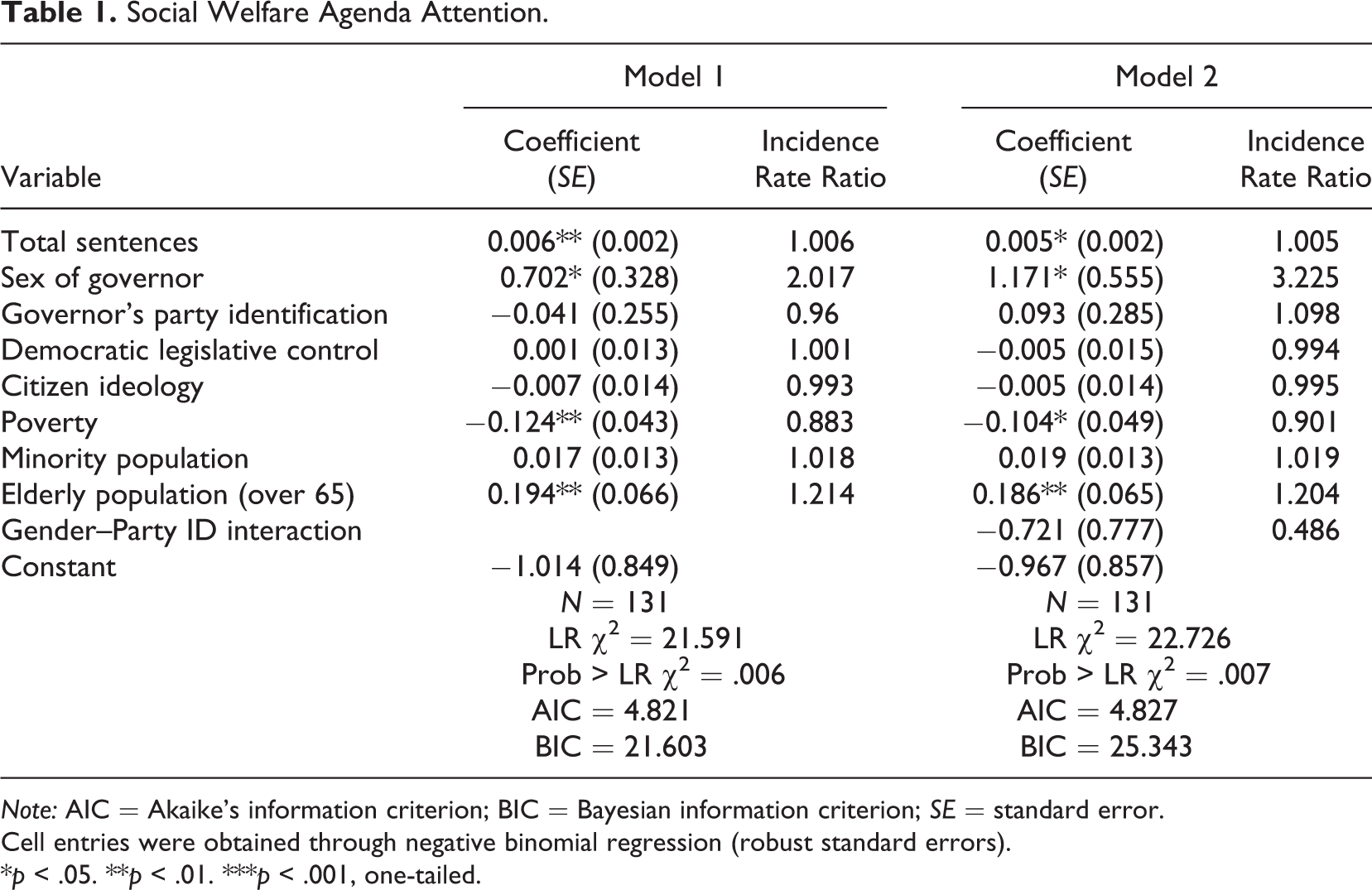
Table 1 displays the results of our two social welfare models. The first model examines whether differences are apparent in terms of the attention male and female governors pay to social welfare issues. The results confirm several of our expectations. Providing support for our hypothesis, the findings suggest that male and female governors have different policy priorities. Female governors, in general, spend more time discussing social welfare policies in their state of the state speeches. Specifically, female governors devote agenda space to social welfare policies at a rate 2.017 higher than their male colleagues, holding all other variables constant. It is possible that female governors focus more on social welfare policies than their male colleagues because women’s socialization experiences emphasize a connection and responsibility toward others. Thus, female governors may feel as though it is their responsibility to the community as the state executive to propose polices relating to social welfare.
Social Welfare Agenda Attention.
Note: AIC = Akaike’s information criterion; BIC = Bayesian information criterion; SE = standard error.
Cell entries were obtained through negative binomial regression (robust standard errors).
*p < .05. **p < .01. ***p < .001, one-tailed.
Gender, of course, is not the only variable affecting agenda attention to social welfare policy. State social and economic needs also influence agenda attention. Executives governing states with large elderly populations pay more attention to social welfare policy than governors in states with small elderly populations. Governors, thus, respond to their elderly population by dedicating attention to social welfare policy that may include items such as funding for long-term care facilities. Our findings are less clear in confirming or rejecting the backlash theories the policy outputs literature proposes (see, e.g., Fellowes and Rowe 2004). Specifically, poverty seems to decrease gubernatorial attention to social welfare issues. Substantively, governors may be trying to avoid the perception that they are helping or even pandering to the poor in this very visible speech. Surprisingly, the percentage of a state’s population that is African American does not significantly influence agenda attention to social welfare policy. 3
While the initial model does offer support for our hypothesis that gender influences the amount of attention a governor pays to social welfare policies, it is essential to address whether a governor’s partisanship is actually tempering this relationship. In particular, Democratic women may actually be the key element of the significant relationship between gender and agenda attention. In order to determine whether gender influences the extent to which governors devote agenda space to social welfare issues regardless of party affiliation, we include an interaction term between the governor’s sex and party identification. The second model includes this interaction term.
The most notable finding in the second model is the extent to which the governor’s sex-party identification interaction term does not significantly affect the amount of attention governors devote to social welfare policies. Our major concern was that female Democrats are influencing the relationship between gender and agenda attention. However, the insignificant interaction coefficient suggests that the relationship between gender and whether the governor focuses on social welfare policies is not conditional on the governor’s party identification. Substantively, female governors appear to be devoting more attention to social welfare policies and problems then male executives, regardless of their party identification. In fact, summary statistics suggest that Republican female governors devoted the largest amount of agenda space to social welfare policies. On average, Republican female governors devoted 8.25 sentences, or just over 3.8 percent of their speeches, to social welfare issues.
The fact that the interaction term does not reach statistical significance may be indicative of the fact that our model does not distinguish between liberal and conservative social welfare mentions. Each mention of social welfare policy could be liberal, conservative, or neutral. Therefore, our results suggest that women devote more attention to social welfare policy than men, but they do not indicate that women are more liberal than men. However, a cursory case study analysis demonstrates that Republican and Democratic women have at least some similar policy goals. For instance, in 2007, both Republican Governor Linda Lingle of Hawaii and Democratic Governor Janet Napolitano of Arizona made affordable housing and homelessness central policy concerns in their state of the state addresses. Governor Napolitano addresses this topic by focusing attention on the need for low-cost housing for Arizonans, particularly tribal populations. Similarly, Governor Lingle emphasizes the growing number of homeless native Hawaiians and calls for an increase in public support for new housing projects. While this is only one example, it demonstrates the agenda overlap between two politically different female governors.
Poverty, elderly population, and the total length of the state of the state speech continue to significantly influence gubernatorial agenda attention to social welfare policy. Once again, governors respond to social and economic demands for social welfare policy in a relatively complex manner. Governors of states experiencing high levels of poverty pay less attention to these social programs than their peers. On the other hand, as the elderly population increases by 1 percent, the rate at which governors devote agenda space to social welfare increases 1.204 times. These seemingly incompatible results may reflect the stigmas that appear to be part of the different types of social welfare policies.
Our results comport well with previous research on the policy priorities that suggest that female legislators tend to have different policy priorities than their male colleagues, irrespective of their party identification. The results tentatively suggest that male and female governors have different policy priorities. This is not a small finding. Governors run the risk of dubbing their states as “welfare magnets” by speaking out on these types of issues. Therefore, they must feel some societal or internal pressure to take on these relatively controversial topics in such a highly publicized speech.
Discussion
Over the past thirty years, the number of female governors has substantially increased (Center for American Women and Politics 2012). The rise of female-led state governments, however, does not match with an equally impressive increase in research on female governors. Although important research on gubernatorial personality, leadership styles, and perceptions of power examine the influence of gender (Barth and Ferguson 2002), it is unclear whether gender affects the behavior of governors, particularly whether differences emerge in the policy priorities of male and female governors.
The goal of our research is to address this gap in the state politics and policy literature by examining the influence of gender on gubernatorial agenda setting. Although scholars address whether gender affects the policy-making process at the national (see, e.g., Swers 2002), state (see, e.g., Kathlene 1995), and local levels (see, e.g., Boles 2001), we know much less about female governors (but, see Barth and Ferguson 2002). Consistent with much of the research on the influence of gender on the behavior of legislators, gender appears to affect the policy priorities of governors. Our research tentatively suggests that gender matters in terms of formulating gubernatorial agendas. Specifically, female governors devote more agenda space to social welfare policies than their male colleagues, regardless of party identification.
A question that still remains is whether the social welfare agendas of male and female governors differ. In other words, are there certain social welfare issues that are of greater importance to female governors? On a similar note, are female governors’ social welfare proposals more liberal than their male colleagues? Exploring in greater depth and over a longer period of time, the social welfare agendas of male and female governors will contribute to a greater understanding of the influence of gender in terms of gubernatorial decision making. In addition, it is possible that gender shapes gubernatorial policy agendas in issue areas other than social welfare.
Our analysis highlights the importance of studying gender and gubernatorial politics in the future. As more women continue to run for governor and win elections, it is essential to attempt to understand whether gender influences gubernatorial decision making. While our research may advance more questions than answers, it is an important first step in examining the role gender plays in this important stage of the policy process.
Footnotes
Declaration of Conflicting Interests
The authors declared no potential conflicts of interest with respect to the research, authorship, and/or publication of this article.
Funding
The authors received no financial support for the research, authorship, and/or publication of this article.