




Abstract
Among young women, hookups have been found to lead to varied emotional responses. The authors tested three hypotheses to disentangle these contradictory findings in a weekly diary study. A trait-level motives hypothesis suggests that trait-level motives moderate emotional responses to hookups. A motive satisfaction hypothesis suggests that emotional responses to hooking up depend on satisfaction within hookups. A dual-effects hypothesis proposes the co-occurrence of positive and negative emotional responses. In this study, 203 college women reported trait-level motives for hooking up (e.g., pleasure/fun, intimacy, coping). Next, 5 weekly surveys asked about recent hookup experiences. These responses were compared to the same women’s emotions on weeks they did not hook up, thereby controlling for selection bias. All three hypotheses were supported. Pleasure/fun motives predicted more positive and less negative emotions; satisfaction of pleasure, intimacy, and affirmation motives resulted in more positive and less negative emotions; and simultaneous positive and negative reactions were common.
Hooking up refers to sexual activity, ranging from kissing to intercourse, that occurs outside of a committed romantic relationship with no expectation of commitment (Garcia, Reiber, Massey, & Merriwether, 2012; Strokoff, Owen, & Fincham, 2015; Vrangalova, 2015). Studies indicate that hooking up is relatively common among young adults. For example, data collected from a range of college student populations suggest that between 40% and 80% of college students in North America have hooked up (e.g., Fielder, Carey, & Carey, 2013; Garcia et al., 2012), and studies of non-student young adults show similar percentages (Lyons, Manning, Giordano, & Longmore, 2013). Most research on hooking up has had one of two foci. Some studies have investigated the various psychosocial predictors of hooking up, such as individual differences (e.g., motivation or personality; Olmstead, Pasley, & Fincham, 2013) or alcohol or drug use (e.g., Johnson & Chen, 2015). A second focus has been the consequences of hooking up, such as emotional reactions (Strokoff et al., 2015), sexually transmitted infections (Fielder, Walsh, Carey, & Carey, 2014), or sexual pleasure and orgasm (Armstrong, England, & Fogarty, 2012).
Existing studies have documented a wide range of emotional reactions to hooking up from excitement and pleasure to regret and sadness (Garcia et al., 2012; Owen & Fincham, 2011; Strokoff et al., 2015). This has made it difficult for researchers and policy makers alike to gain a clear perspective on whether hooking up is harmful or beneficial. Our goal in this research was to adopt a motivational approach to disentangle these seemingly discrepant findings. We examined three possible explanations for the broad range of reactions to hooking up. A trait-level motives hypothesis suggests that trait-level sex motives explain differing emotional reactions to hooking up. A motive satisfaction hypothesis suggests that emotional reactions to hooking up depend on the extent to which these sexual interactions satisfy motives for engaging in hookups. A dual-effects hypothesis proposes that some people may have coexisting positive and negative emotional reactions to hooking up. In short, this research posits that to understand emotional reactions to hooking up, researchers must consider the motivational goals that lead people to engage in hookups as well as the degree to which motives are satisfied during actual interactions.
This study builds on previous investigations using a within-person weekly diary method that asked participants about their hookups in the preceding week across 5 consecutive weeks. Asking about hookups shortly after the hookup occurred reduces retrospective and recall biases and thus enhances the validity of our findings. Additionally, in contrast to most previous studies that used cross-sectional designs (although a few exceptions exist, e.g., Fielder et al., 2014; Vrangalova, 2015), a weekly diary method enabled us to disambiguate the within-person impact of hooking up from the cross-person individual differences that lead some people to hook up and others not to (Gable & Reis, 1999).
Emotional responses to hooking up
Past research on hooking up, primarily relying on cross-sectional methods, indicates that young adults are more likely to report positive than negative emotional reactions to hooking up. One study found that after hooking up, both men and women were more likely to feel happy, desirable, and excited than empty, confused, and disappointed (Owen & Fincham, 2011). Another study found that most participants (62%) experienced positive reactions to hooking up, reporting feelings such as happiness, hope, or contentment, while a minority (38%) reported mostly negative emotional reactions such as feeling disappointed, used, or confused (Strokoff et al., 2015).
Despite having mostly positive reactions to hooking up, women, when compared to men, are more likely to feel less positive and more negative emotions following hooking up. For example, Strokoff et al. (2015) found that a smaller percentage of women than men report mostly positive feelings after hooking up. Owen and Fincham (2011) found that women were more likely than men to report feeling empty, confused, and disappointed and were less likely to feel happiness, pleasure, and excitement. Women appear to be especially prone to feeling regret after hooking up. Even though regret is the most common negative response to hooking up for both men and women (e.g., Coats, Harrington, Beaubouef, & Locke, 2012; Eshbaugh & Gute, 2008; Fisher, Worth, Garcia, & Meredith, 2012; Galperin et al., 2013; Oswalt, Cameron, & Koob, 2005), numerous studies suggest that women are more likely than men to regret their hookup (Fisher et al., 2012; Garcia et al., 2012). For these reasons, we focused this study on women’s emotional reactions to hookups and the motivational predictors that might help disentangle these responses.
The trait-level motives hypothesis
We suggest that women’s reasons for hooking up might explain their varied and potentially conflicted emotional reactions. However, few studies have investigated motivational predictors of women’s hookups. In a recent notable exception, Vrangalova and Ong (2014) found that students (both women and men) with an unrestricted sociosexual orientation (i.e., positive attitudes toward and motivation to engage in casual sex) reported higher self-esteem and lower depression and anxiety after having hooked up, whereas people with restricted sociosexuality (negative attitudes toward and little interest in casual sex) did not gain these benefits. Vrangalova and Ong (2014) suggested that individuals with unrestricted sociosexuality benefit from casual sex because their behaviors are congruent with their goals and desires and enable them to experience casual sexual encounters authentically.
Our trait-level motives hypothesis is based on the approach-avoidance motivational theory proposed by Elliot, Gray, and others (e.g., Elliot, Gable, & Mapes, 2006; Gable, Reis, & Elliot, 2003; Gray, 1970), which describes how behavior is governed by two distinct motivational systems. Approach motivation responds to rewards and motivates behavior toward rewards, whereas avoidance motivation responds to threats and motivates behavior away from threats. A growing body of research demonstrates the utility of applying this framework to sexual behavior by considering the extent to which the goal of sex is the pursuit of rewards as opposed to the avoidance of aversive outcomes. For example, Cooper, Shapiro, and Powers (1998) examined sexual behavior in relation to trait-level sexual motives and found that people who have casual sex for approach reasons (e.g., because it feels good or to make an emotional connection) have more positive feelings about sex, have more frequent and satisfying sex, and are more likely to practice safer sex. In contrast, people who have casual sex for avoidance reasons (e.g., to cope with feeling lonely or to prevent a partner’s anger) have a greater number of casual sex partners, report less sexual satisfaction, are less likely to practice safer sex, and have a higher frequency of unplanned pregnancies. In the context of committed relationships, Muise, Impett, and Desmarais (2013) demonstrated that both sexual and relationship satisfaction are higher when people have sex for approach motives (e.g., to feel close to a partner) and lower when they have sex for avoidance motives (e.g., to prevent partner upset).
In the current study, we applied Cooper et al.’s (1998) approach-avoidance motivational framework to emotional responses to hooking up. According to their model, approach motives include having sex for pleasure and fun (which they termed enhancement motives) or to make an emotional connection with one’s partner (intimacy motives). Avoidance motives include having sex to affirm one’s self-worth or attractiveness (affirmation motives), to prevent upsetting or angering one’s partner (partner approval motives), to avoid negative judgment by one’s peers (peer approval motives), and to alleviate negative feelings (coping motives). In the current study, we hypothesized that trait-level approach motives for engaging in hookups would result in greater positive emotions, whereas trait-level avoidance motives for engaging in hookups would result in greater negative emotions.
The motive satisfaction hypothesis
Another potential source of variability in women’s emotional reactions to hooking up considers the functional role of emotions. Emotions arise from the perception of personally significant events, signal whether these events are beneficial or harmful, and motivate behavior toward or away from those events (Frijda, 1986). Accordingly, people who gain rewards from a hookup are likely to have positive emotional reactions afterward. For example, hookups have the potential to be sources of pleasure as well as intimate connection, even if that connection is fleeting. The possibility that emotional reactions to hookups reflect satisfaction derived from the hookup is suggested by Fisher et al. (2012), who found that college students were more likely to report feeling regret after experiencing “an uncommitted sexual encounter in which the sex was bad” than after experiencing “an uncommitted sexual encounter in which the sex was good.” The conclusions that can be drawn from this finding are somewhat limited because years could have passed between subjects’ hookups and the point at which they were asked to recall and report on their emotional reactions. In the current study, we extended Fisher and colleagues’ work by asking about subjects’ emotional reactions to hookups within days of the hookup.
To identify emotional reactions associated with a hookup, we developed measures based on Cooper et al.’s (1998) framework to tap satisfaction in six domains, corresponding to the six motive domains used to test our motives hypothesis: enhancement, intimacy, affirmation, partner approval, peer approval, and coping. Whereas our motives hypothesis examines only trait-level predictors, the motive satisfaction hypothesis considers the predictive value of both trait-level satisfaction with hookups and state-level satisfaction specific to a single hookup. We hypothesized that satisfaction in the motive domains would be associated with greater positive emotions and lesser negative emotions. We also investigated whether trait-level motives moderate the effects of motive satisfaction on emotional reactions to hooking up.
The dual-effects hypothesis
In addition to the possibility that emotional responses to hookups are influenced by trait-level sex motives and state-level satisfaction, we also explored the possibility that some women experience both positive and negative emotions after hooking up. Previous research supports the possibility that people may respond to a single event with both positive and negative emotions, with those conflicting emotions occurring either simultaneously or in close temporal proximity. Watson, Clark, and Tellegen (1988) and Watson and Tellegen (1985) found that even though positive and negative affect are correlated, they are independent systems, making it possible them to co-occur. More recent research and theorizing has described how emotions that are opposite in valence may be simultaneously experienced and blended, without either being diminished in intensity (Heavey, Lefforge, Lapping-Carr, & Hurlburt, 2017; Roseman, 2017).
We suggest that hooking up may be a prime candidate for simultaneous activation of both positively and negatively valenced emotions because hookups are rich with possibilities for both rewards and costs. Hookups have the potential to provide pleasure, emotional intimacy (even if only temporary), and the opportunity to begin a romantic relationship (however, slight) or to explore one’s sexuality. At the same time, there is the risk of sexually transmitted infections, unwanted pregnancy, disappointment, and coercion or assault. Aside from the rewards and risks that lie in hookups themselves, young people receive conflicting societal messages about what it means to hook up. For example, women are simultaneously told that hooking up may make them “sluts” (Crawford & Popp, 2003) and “empowered” (Peterson, 2010). Considering past work on coactivation of emotions and rewards and risks of hookups, we hypothesized that some women would report simultaneous positive and negative emotional responses to hookups.
Overview of the present study
After assessing trait-level motives in an initial survey, we used a weekly diary methodology in which, for 5 weeks in a row, participants were asked to report on their experiences with hooking up in the preceding week. This design offered two major advantages over prior work. First, because these reports were provided on Mondays, and we reasoned that hookups most likely occurred over the preceding weekend, this weekly diary likely enhanced validity by collecting detailed reports soon after the hookup, thus reducing recall bias.
Second, because prior studies are cross sectional, they compare responses of women who hooked up with responses of women who did not hook up, which conflates selection (individual differences that lead some women to hook up and others to avoid hooking up) with the effects of events (what happens when one hooks up or does not hook up). This design allowed us to contrast the same women’s responses on weeks they did hook up with their responses on the weeks they did not hook up, which separates individual differences from the effects of events (Gable & Reis, 1999).
Method
Participants
Female undergraduate students enrolled in psychology courses at the University of Rochester took part in the study for credit. The study was described as “A Study of Women’s Experiences with Hooking Up,” and participants were required to be 18 years of age or older, either single, dating casually, or in an open relationship, and “sexually active on at least a semiregular basis.” Mean age was 20.26 years, SD = 1.96 (range, 18–32). Participants were 59% White/Caucasian, 21% Asian, 9% Black/African American, 7% Hispanic/Latino, and 4% Other. Of the 264 women who participated, 61 did not hook up during the study, leaving 203 women in the analytic sample. Excluded women were significantly lower on enhancement motives (M = 3.18) than the retained sample (M = 3.74), t(262) = 3.69, p < .001, but did not differ on any other motives.
Initial survey measures
Sex motives
The Sex Motives Scale (Cooper et al., 1998) measures six different trait-level motives for having sex. We tailored the items to assess motives for hooking up, which we defined for participants as “a first-time sexual encounter with an individual you are not in a committed relationship with, where during the encounter genital contact occurred (i.e., manual, oral, vaginal, anal sex/intercourse).” Participants were asked to indicate their agreement with various “reasons why I might hook up.” Enhancement motives are aimed toward experiencing pleasure and fun (e.g., “Because it feels good,” “To satisfy my sexual needs”; 5 items, Cronbach’s α = .89). Intimacy motives aim at feeling close and connected to a sex partner (e.g., “To make emotional connection,” “To express love”; 5 items, α = .92). Self-affirmation motives aim to affirm self-worth (e.g., “To feel more self-confident,” “To prove my attractiveness”; 5 items, α = .88). Partner approval motives focus on avoiding negative outcomes with one’s partner (e.g., “Because I fear, this person won’t like me if I don’t have sex,” “Because this person may be angry if I don’t have sex”; 4 items; α = .88). Peer approval concerns avoiding negative outcomes with one’s social or peer group (e.g., “Because my friends are having sex,” “Because I worry that people will talk about me if I don’t have sex”; 5 items; α = .86). Coping motives seek to reduce negative emotions (e.g., “To cheer yourself up,” “To cope with feeling upset”; 5 items, α = .89). Responses used 5-point scales (1 = not at all true of me to 5 = extremely true of me). Table 1 reports means, standard deviations, and correlations among the motives.
Descriptive statistics for sex motives.
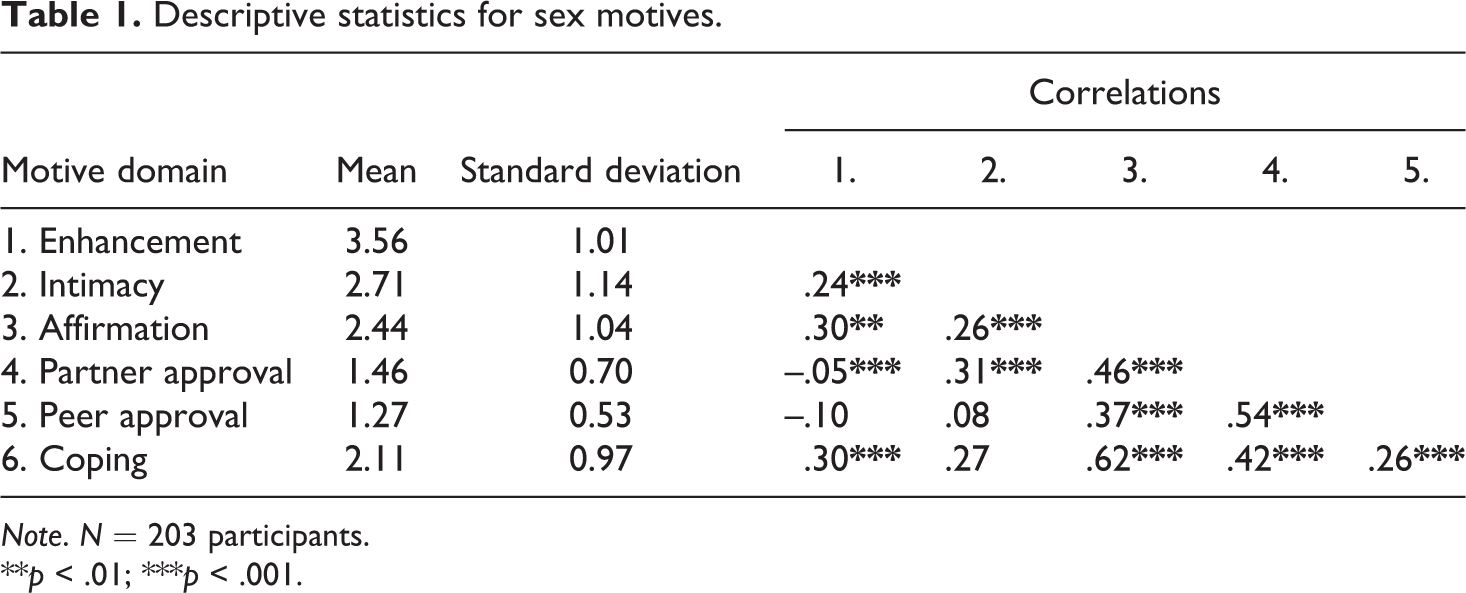
Note. N = 203 participants.
**p < .01; ***p < .001.
Weekly survey measures
The weekly surveys asked participants, “Did you have casual sex or hook up (where genital contact occurred) during the previous week?” If a participant reported having hooked up in the previous 7 days, she was asked to think about the hookup experience (or if she had more than one, the most recent one) and complete the following measures.
Satisfaction
Participants reported the extent to which hookups satisfied the six domains tapped by the Sex Motives Scale. Satisfaction regarding enhancement was measured with 5 items focused on experiences of pleasure and fun (e.g., “It felt good,” “It fulfilled my sexual needs”; across the 5 weekly reports, Cronbach’s α ranged from .87 to .92, M = .91). Satisfaction in terms of intimacy was addressed with 5 items tapping feelings of emotional closeness and connectedness with one’s hookup partner (e.g., “I was able to make an emotional connection,” “I was able to express love”; Cronbach’s α ranged from .92 to .94, M = .93). Satisfaction with self-affirming aspects of the hookup was measured with 5 items focused on affirming one’s self-worth (e.g., “I felt more self-confident,” “I felt attractive”; Cronbach’s α ranged from .81 to .87, M = .84). Items addressing partner approval focused on avoidance of negative outcomes with one’s hookup partner (e.g., “It lessened my fear that this person won’t like me if I don’t have sex,” “It prevented this person from getting angry at me for not having sex”; Cronbach’s α ranged from .88 to .93, M = .90). Five items asked about satisfaction with peer approval aspects of the hookup (e.g., “It made me feel like my friends who are having sex,” “It lessened my worry that others will tease me for not having sex”; Cronbach’s α ranged from .89 to .93, M = .91). Satisfaction regarding coping was tapped with 5 items focused on reduction of negative emotions (e.g., “It made me feel cheerful,” “It helped cope with feeling upset”; Cronbach’s α ranged from .87 to .92, M = .90). Responses were given using a 5-point scale (1 = not at all true to 5 = extremely true). See Table 2 for means, standard deviations, and correlations among satisfaction ratings across the six motive domains.
Descriptive statistics for satisfaction within hookups.
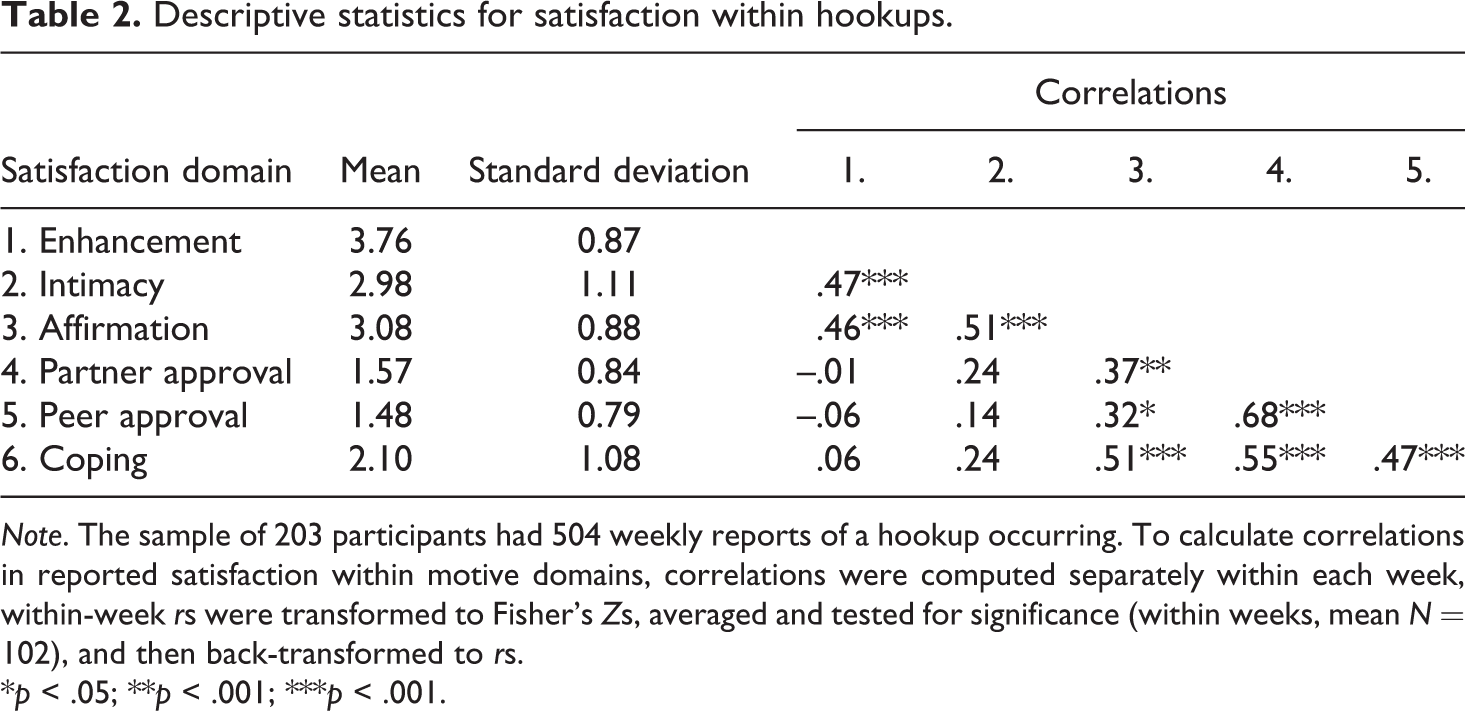
Note. The sample of 203 participants had 504 weekly reports of a hookup occurring. To calculate correlations in reported satisfaction within motive domains, correlations were computed separately within each week, within-week rs were transformed to Fisher’s Zs, averaged and tested for significance (within weeks, mean N = 102), and then back-transformed to rs.
*p < .05; **p < .001; ***p < .001.
Emotional responses to hooking up
Participants were asked to report how they felt about the hookup experience, “right now, at this moment” in terms of 14 positive emotions and 18 negative emotions, adapted from Watson and Tellegen’s (1985) revised Positive and Negative Affect Scale. The positive emotions were aroused, calm, contented, ecstatic, elated, energetic, enthusiastic, excited, happy, joyful, pleasant, proud, satisfied, and strong. The negative emotions were anxious, confused, discontented, dissatisfied, fearful, guilty, lonely, miserable, nervous, regret, sad, shameful, tense, uncertain, unhappy, unpleasant, weak, and worried. Responses used a 5-point scale (1 = not at all to 5 = extremely). If a participant did not hook up in the previous week, she was asked to describe how she felt about not having hooked up, “right now, at this moment,” using the same emotion terms. See Table S1 in Online Supplementary Materials for mean levels of emotions on weeks in which participants did and did not hook up.
Procedure
All measures were administered online. Participants first completed the survey assessing trait-level sex motives and demographics. Next, on 5 consecutive Mondays, participants were e-mailed links to weekly surveys that asked if they had hooked up in the preceding 7 days. Participants who had hooked up were directed to questions that assessed emotional responses to having hooked up; those who had not hooked up were directed to measures assessing emotions about not having hooked up. Anonymity was assured by linking responses across surveys via random subject numbers.
Factor structure of emotion outcomes
The emotion ratings were subjected to exploratory factor analysis to assess their dimensionality. Because participants rated the emotions up to 5 times (i.e., across the 5 weeks), multilevel exploratory factor analysis (MLEFA; Muthén & Muthén, 1998; Reise, Ventura, Nuechterlein, & Kim, 2005) was used to control for nonindependence. Intraclass correlations (ICCs; see Table S1 in Online Supplementary Materials) confirmed the nonindependence of the data, with all ICCs (range .41 to .58), suggesting that much of the variance was attributable to within-person consistencies across weeks. MLEFAs were conducted with Mplus (Version 7.4; Muthén & Muthén, 1998) using a maximum likelihood estimator with robust standard errors and a geomin rotation (oblique). In a first MLEFA, five factors emerged with eigenvalues greater than 1, and a five-factor solution was also indicated by the scree plot. Next, we requested a solution with only five factors, which yielded a coherent solution with four factors that, consistent with much emotion research, were distinguished according to valence and arousal of emotion (Barrett, 1998; Watson et al., 1988). A fifth dimension pointing to the emotions of shame, guilt, and regret also emerged, reflecting these as relatively common responses to hooking up (Fisher et al., 2012; Garcia et al., 2012). See Tables S2 and S3 in the Online Supplementary Materials for details about item factor loadings, eigenvalues, and correlations among the factors. These five factors are follows.
Low-arousal positive emotions
Positive emotions characterized by low arousal loaded onto a single factor. The highest loading items were contented, calm, and pleasant. On weeks in which participants hooked up, Cronbach’s α ranged from .85 to .90, M = .88; on nonhookup weeks, α ranged from .83 to .88, M = .85.
High-arousal positive emotions
Positive emotions characterized by high arousal loaded onto a single factor. The highest loading items were ecstatic, enthusiastic, and excited. On weeks in which participants hooked up, Cronbach’s α ranged from .93 to .95, M = .94; on nonhookup weeks, α ranged from .88 to .93, M = .91.
Low-arousal negative emotions
Negative emotions characterized by low arousal clustered onto a single factor. The highest loading items were dissatisfied, discontented, and lonely. On weeks in which participants hooked up, Cronbach’s α ranged from .92 to .96, M = .94; on nonhookup weeks, α ranged from .88 to .91, M = .90.
High-arousal negative emotions
High-arousal negative emotions clustered onto a single factor. The highest loading items were uncertain, nervous, and anxious. On weeks in which participants hooked up, Cronbach’s α ranged from .89 to .93, M = .94; on nonhookup weeks, α ranged from .85 to .91, M = .88.
Shame, guilt, and regret
Shame, guilt, and regret fell onto a factor distinct from the other negative emotions, which we will refer to as “remorse.” On weeks in which participants hooked up, Cronbach’s α ranged from .84 to .90, M = .86; on nonhookup weeks, α ranged from .56 to .76, M = .69.
Analytic approach
Because the weekly reports (Level 1) were nested within participants (Level 2), we analyzed the data with a multilevel random coefficients model using HLM 6.0 (Raudenbush, Bryk, & Congdon, 2004). Data at Level 1 were person-mean centered. All models controlled for age, race, and passage of time across the 5 weeks, by entering week as a Level-1 predictor (week 1 = 0, week 2 = 1, etc.). These controls did not meaningfully affect results and are not discussed further. See Online Supplementary Materials for details on all models.
Trait-level motives hypothesis
This hypothesis suggests that trait-level sex motives moderate the effect of hooking up on emotion outcomes. Model 1 tested this hypothesis by examining whether trait-level sex motives moderate the level-1 effects of hooking up on emotion outcomes. All six motives were entered into the model simultaneously to assess the unique contributions of each motive to emotional responses to hookups. Results of analyses that test each motive individually can be found in the Online Supplementary Materials.
Motive satisfaction hypothesis
This hypothesis asks whether emotion outcomes on weeks in which participants hooked up are attributable to satisfaction in the six motive domains. We tested this using Model 2, which accounted for two possible sources of variation in satisfaction: Within-person differences in satisfaction between hookups, and between-person differences in overall satisfaction averaged across hookups. To assess the contributions of individuals’ variation in satisfaction in their hookups across the 5 weeks, person-mean centered satisfaction in the six motive domains was entered into Level 1 of the HLM. To assess the influence of variation between individuals’ overall, mean level of satisfaction aggregated across all hookups, group-mean centered satisfaction in each of the six domains was entered at Level 2.
Dual-effects hypothesis
The hypothesis that some individuals have coexisting positive and negative emotional responses to hooking up was assessed with a multivariate multilevel model (Model 3), based on the approach described by Gleason, Iida, Shrout, and Bolger (2008), which is also called a multivariate repeated measures model (Raudenbush & Bryk, 2002). This approach models the effects of hooking up on two dependent variables simultaneously (e.g., low-arousal positive emotions and low-arousal negative emotions). The random effects of hooking up on the two dependent variables reflect the degree to which hooking up influences the two emotions within individuals. Plotting individuals’ slopes in pairwise combinations identifies the number of individuals for whom hooking up was associated with dual effects, that is, increases in both positive and negative emotions. Thus, we ran this model 6 times, once for each pairing of low-arousal positive emotion with the three negative emotion factors (low-arousal negative emotions, high-arousal negative emotions, and remorse) and for each pairing of high-arousal positive emotion with the three negative emotion factors. The equations used in these models are reported in the Online Supplemental Materials.
Results
Descriptive information
A total of 947 weekly reports was completed by the 203 participants, for an average of 4.67 reports per participant. Out of these, 504 (53.2%) were reports in which participants described having hooked up. Sixty (29.6%) of the 203 participants indicated having hooked up in only 1 weekly report, 49 (24.1%) hooked up in 2 weekly reports, 51 (25.1%) hooked up in 3 reports, 22 (10.8%) hooked up in 4 reports, and 21 (10.3%) hooked up in all 5 weekly reports. 1
Hypothesis tests
Main effects of hookups on emotions
Before considering our hypotheses, we examined main effects of hooking up on emotional responses, as shown in the top block of Table 3. On weeks in which participants reported having hooked up, compared to weeks in which they did not hook up, participants reported significantly higher levels of low-arousal positive emotions (M hookup = 3.13, M no-hookup = 2.10) and high-arousal positive emotions (M hookup = 2.76, M no-hookup = 1.54) and significantly lower levels of low-arousal negative emotions (M hookup = 1.41, M no-hookup = 1.64). However, hooking up was also associated with significantly higher levels of regret (M hookup = 1.53, M no-hookup = 1.28) and high-arousal negative emotions (M hookup = 1.67, M no-hookup = 1.51).
Hierarchical linear model results for main effects of hooking up and tests of the trait-level motives hypothesis.

Note. N = 203. Bs are unstandardized maximum likelihood estimates. Dummy variable for the effect of hookups was coded no hookup = 0, hookup = 1. Models control for passage of time, age, and race.
Trait-level motives hypothesis
Results for tests of the motives hypothesis are reported in the lower block of Table 3, with results for tests of simple slopes presented in Table 4. Below we summarize these findings.
Simple slopes for moderation of effects of hooking up by motives.
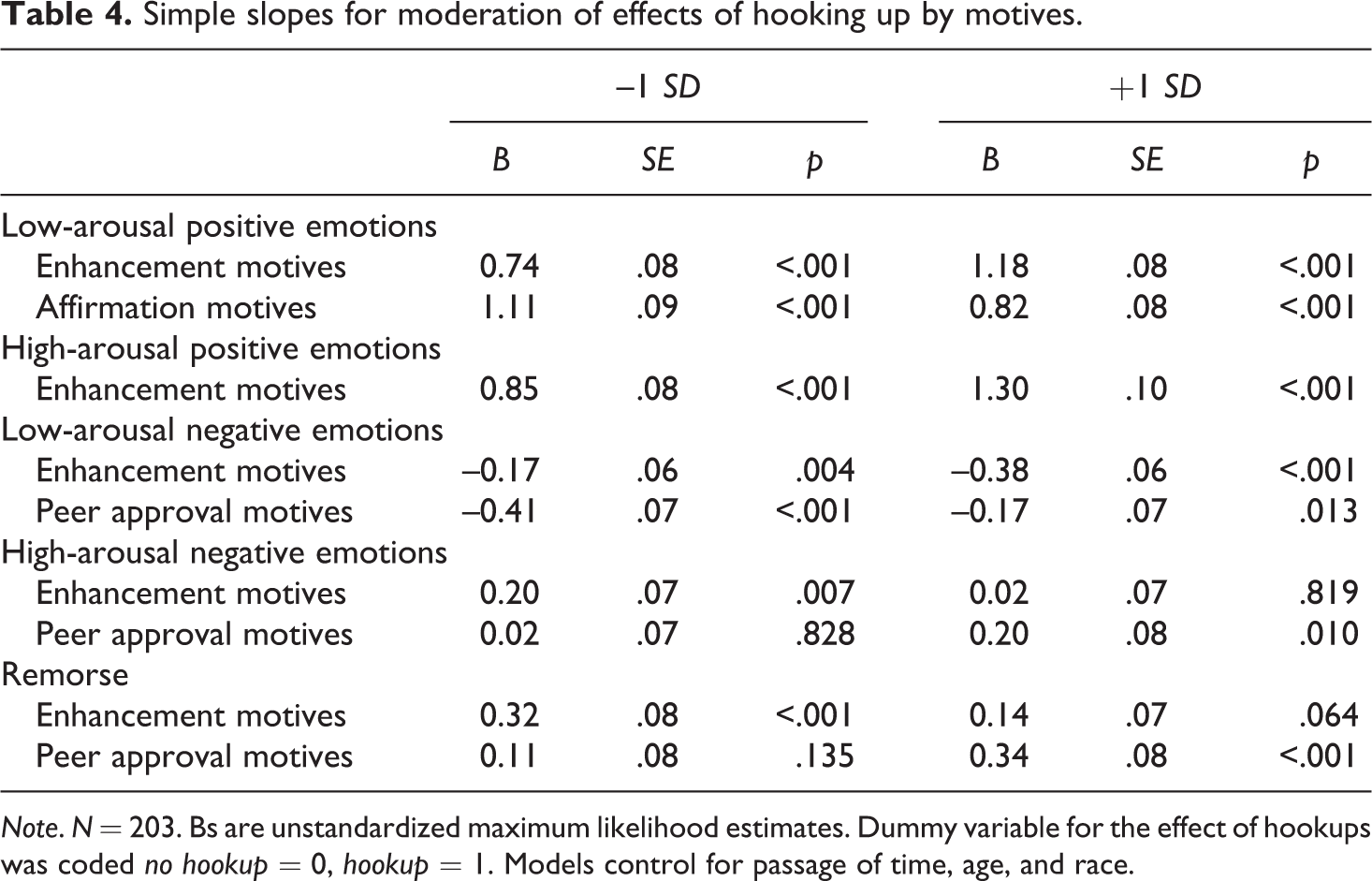
Note. N = 203. Bs are unstandardized maximum likelihood estimates. Dummy variable for the effect of hookups was coded no hookup = 0, hookup = 1. Models control for passage of time, age, and race.
Low-arousal positive emotions
Enhancement motives moderated the effect of hooking up on low-arousal positive emotions. Participants who were motivated to hook up to experience pleasure and fun reported a greater increase in low-arousal positive emotions after hooking up compared to participants low on these motives. Affirmation motives also moderated the effect of hooking up on low-arousal positive emotions such that participants who were motivated to hookup to affirm their sense of self-reported less of an increase in low-arousal positive emotions after hooking up compared to participants low on these motives. The other motives did not moderate the effect of hooking up on low-arousal positive emotions.
High-arousal positive emotions
Enhancement motives moderated the effect of hooking up on high-arousal positive emotions in a similar fashion as was found in low-arousal positive emotions. Participants who hooked up to experience pleasure and fun reported a greater increase in high-arousal positive emotions after hooking up compared to participants low on these motives. The other motives did not moderate the effect of hook ups on high-arousal positive emotions.
Low-arousal negative emotions
Enhancement motives moderated the effect of hooking up such that individuals high on these motives experienced a greater decrease in low-arousal negative emotions. In other words, participants who hooked up to experience the fun and pleasure experienced greater decreases in low-arousal negative emotions after hooking up than women who were not motivated to hook up for these reasons.
In contrast, participants with high peer approval motives were less likely to experience a decrease in low-arousal negative emotions after hooking up. In other words, for participants who hooked up to gain approval from their peers, the hookups were associated with a smaller decrease in low-arousal negative emotions compared to individuals low in those motives. The other motives were not significantly associated with the effect of hooking up on low-arousal negative emotions.
High-arousal negative emotions
The effect of hooking up on high-arousal negative emotions was moderated by the same motives that moderated the effect on low-arousal negative emotions and in the same fashion. Participants who hooked up for enhancement motives, that is, to experience fun and pleasure, experienced no significant change in high-arousal negative emotions after hooking up, but women low in enhancement motives experienced an increase in high-arousal negative emotions. In contrast, for participants who hooked up to gain approval from their peers, the hookups were associated with an increase in high-arousal negative emotions, but women low in those motives experienced no significant change in high-arousal negative emotions. The other motives were not significantly associated with the effect of hooking up on high-arousal negative emotions.
Remorse
The effect of hooking up on remorse was moderated by the same motives that moderated the effect on low- and high-arousal negative emotions and in the same fashion.
To summarize the moderating effects of motives emotional responses to hooking up, higher enhancement motives were associated with more low- and high-arousal positive emotions, less low- and high-arousal negative emotions, and less remorse. Peer approval motives were associated with more low- and high-arousal negative emotions and remorse, and affirmation motives were associated with less low-arousal positive emotions.
Motive satisfaction hypothesis
Table 5 reports results for tests of the satisfaction hypothesis.
HLM results for tests of the motive satisfaction hypothesis.

Note. Bs are unstandardized maximum likelihood estimates. Models control for passage of time, age, and race. N = 203.
Low- and high-arousal positive emotions
Satisfaction was associated with high- and low-arousal positive emotions in a similar fashion: On weeks when women felt their hookups were relatively more satisfying in the domains of enhancement, intimacy, and affirmation (i.e., within-person differences), they experienced significantly higher levels of low- and high-arousal positive emotions. On weeks when women felt their hookups were more satisfying in terms of coping, they experienced significantly lower levels of low- and high-arousal positive emotions. As for between-person differences, participants who reported more satisfaction in the domains of enhancement, intimacy, and affirmation across all of their hookups experienced significantly higher levels of low- and high-arousal positive emotions. No other domains of satisfaction yielded significant associations with low- or high-arousal positive emotions.
Low-arousal negative emotions
Hookups that participants reported being more satisfying in the domain of enhancement (i.e., within-person differences) were associated with significantly less low-arousal negative emotions. Hookups reported as more satisfying in terms of coping were associated with significantly higher levels of low-arousal negative emotions. As for between-person differences, participants who reported more enhancement satisfaction across all of their hookups experienced significantly less low-arousal negative emotions, and those who reported more coping or peer approval satisfaction experienced more low-arousal negative emotions. No other domains of satisfaction revealed significant effects.
High-arousal negative emotions
Hookups that were reported as being more satisfying in terms of partner approval (i.e., within-person differences) were associated with significantly greater high-arousal negative emotions. As for between-person differences, participants who reported more enhancement satisfaction across all hookups experienced significantly less high-arousal negative emotions, and those who reported more partner approval or coping satisfaction experienced significantly more high-arousal negative emotions. No other domains of satisfaction showed significant effects.
Remorse
Hookups that were more satisfying in terms of enhancement (i.e., within-person differences) were associated with significantly lower levels of remorse. As for between-person differences, participants who reported more enhancement or intimacy satisfaction across all hookups experienced significantly less remorse, and those who reported more partner approval, peer approval, or coping satisfaction experienced significantly more remorse. No other domains of satisfaction revealed significant effects.
We also examined whether trait-level motives moderated the effects of motive satisfaction on emotions; however, these moderation effects were few and sporadic and therefore are not discussed further. To explore why trait-level motives did not moderate emotional responses to having that motive domain satisfied, we calculated correlations between trait-level motives and the associated satisfaction domain, averaged across weeks in which participants had hooked up. These correlations were enhancement, r = .41, intimacy, r = .33, affirmation, r = .38, partner approval, r = .47, peer approval, r = .53, coping, r = .50. In other words, participants motivated to gain satisfaction in a particular domain were more likely to report satisfaction in that domain, but they were not more likely to report differential levels of emotional rewards associated with that satisfaction. Person-level associations between satisfaction and emotions aggregated across all hookups are reported in the Online Supplementary Materials (Tables S5 and S6).
Dual-effects hypothesis
To assess whether hooking up fosters coexisting positive and negative emotions in some individuals, we created six scatterplots, one for each pairing of low-arousal positive emotion with the three negative emotion factors (low-arousal negative emotions, high-arousal negative emotions, and remorse) and one for each pairing of high-arousal positive emotion with the three negative emotion factors (Model 3). Random effects of hooking up on positive emotions are plotted on the y-axis and the random effects of hooking up on negative emotions are plotted on the x-axes in Figures 1(a) to (f). Each point represents the estimated random effect of hooking up on two factors (one positive emotion and one negative emotion) for one individual. Points above the dotted grid line at y = 0 should be interpreted as individuals for whom hooking up results in increased positive emotions; points below the grid line represent individuals for whom hooking up results in decreased positive emotions. Points to the left and right of the grid line at x = 0 represent individuals for whom hooking up is associated with decreased or increased negative emotions, respectively.
Prior to assessing the dual-effects hypothesis, we inspected the correlation between the two emotion factors in each graph. The random effects of hooking up on low-arousal positive emotions were negatively correlated with the random effects of hooking up on low-arousal negative emotions (r = –.93, p < .001), as shown in Figure 1(a). In other words, women with larger increases in low-arousal positive emotion (relative to the sample mean slope) had smaller increases in low-arousal negative emotions (relative to the sample mean slope). The dual-effects hypothesis was tested by inspecting the distribution of participants across the four quadrants created by this analysis (following procedures developed by Gleason et al., 2008). Women in the upper right-hand quadrant experienced increased levels of both low-arousal positive emotions and low-arousal negative emotions after hooking up. There were 20 individuals (10% of the sample) in the upper right-hand quadrant, indicating that hooking up was associated with higher levels of both low-arousal positive emotions and low-arousal negative emotions for a small minority of the sample.
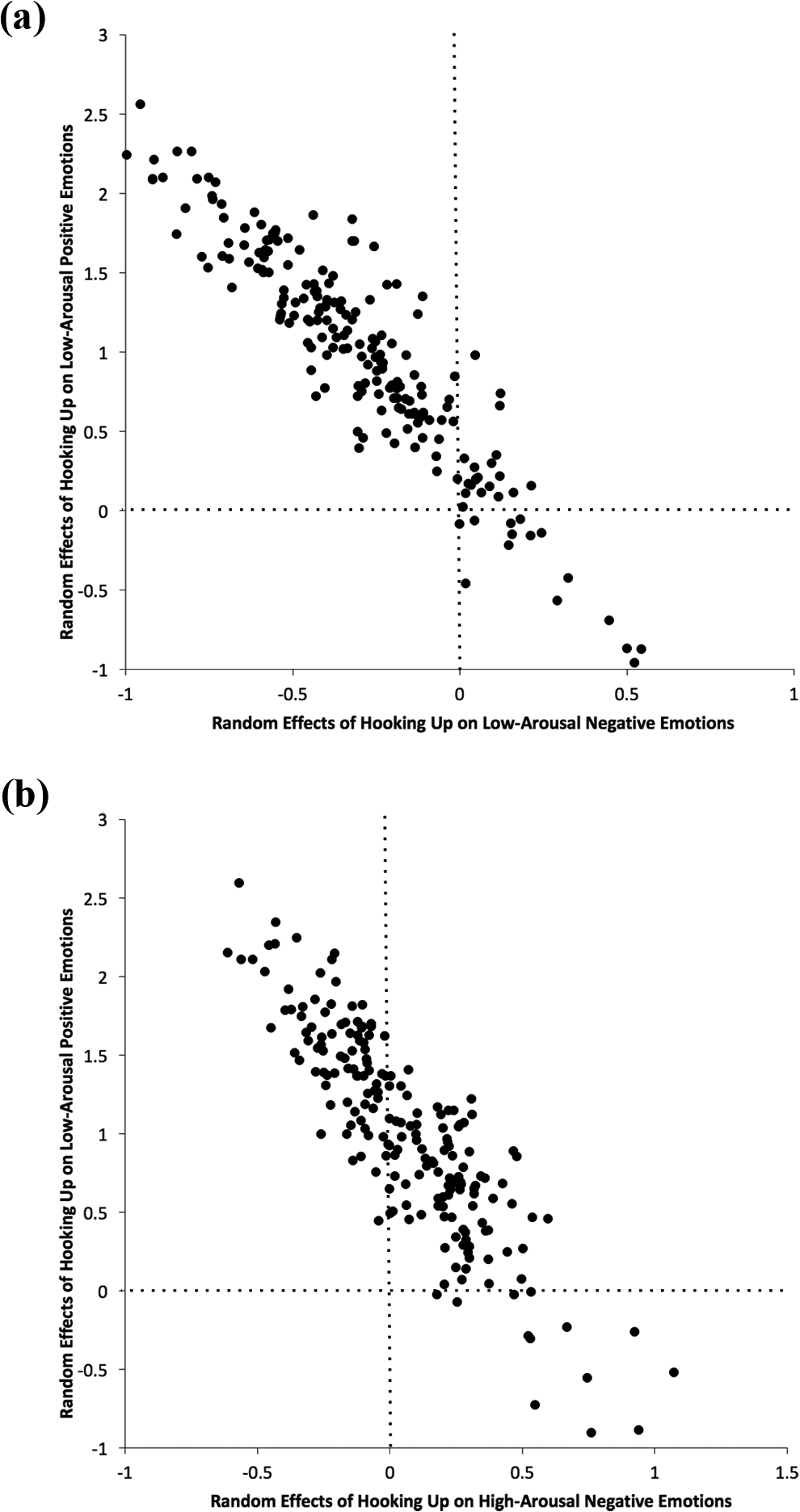
(a) Scatterplot of the random effects of hooking up on low-arousal positive emotions and hooking up on low-arousal negative emotions. Each point represents the estimated random effects of hooking up on these emotions for an individual. Points lying in the upper right-hand quadrant (N = 20, total N = 203) are individuals for whom hooking up increases both low-arousal positive emotions and low-arousal negative emotions. (b) Scatterplot of the random effects of hooking up on low-arousal positive emotions and hooking up on high-arousal negative emotions. Each point represents the estimated random effects of hooking up on these emotions for an individual. Points lying in the upper right-hand quadrant (N = 96, total N = 203) are individuals for whom hooking up increases both low-arousal positive emotions and high-arousal negative emotions. (c) Scatterplot of the random effects of hooking up on low-arousal positive emotions and hooking up on remorse. Each point represents the estimated random effects of hooking up on these emotions for an individual. Points lying in the upper right-hand quadrant (N = 128, total N = 203) are individuals for whom hooking up increases both low-arousal positive emotions and remorse. (d) Scatterplot of the random effects of hooking up on high-arousal positive emotions and hooking up on low-arousal negative emotions. Each point represents the estimated random effects of hooking up on these emotions for an individual. Points lying in the upper right-hand quadrant (N = 18, total N = 203) are individuals for whom hooking up increases both high-arousal positive emotions and low-arousal negative emotions. (e) Scatterplot of the random effects of hooking up on high-arousal positive emotions and hooking up on high-arousal negative emotions. Each point represents the estimated random effects of hooking up on these emotions for an individual. Points lying in the upper right-hand quadrant (N = 114, total N = 203) are individuals for whom hooking up increases both high-arousal positive emotions and high-arousal negative emotions. (f) Scatterplot of the random effects of hooking up on high-arousal positive emotions and hooking up on remorse. Each point represents the estimated random effects of hooking up on these emotions for an individual. Points lying in the upper right-hand quadrant (N = 145, total N = 203) are individuals for whom hooking up increases both high-arousal positive emotions and remorse.
The random effects of hooking up on low-arousal positive emotions and high-arousal negative emotions were also negatively correlated (Figure 1(b); r = –.89, p < .001). In other words, women with larger increases in low-arousal positive emotions had smaller increases in high-arousal negative emotions. Hooking up was associated with higher levels of both low-arousal positive emotions and high-arousal negative emotions for 96 individuals (47% of the sample).
The random effects of hooking up on low-arousal positive emotions and remorse were also negatively correlated (Figure 1(c); r = –.80, p < .001). In other words, women with larger increases in low-arousal positive emotions had smaller increases in remorse. Hooking up was associated with higher levels of both low-arousal positive emotions and remorse for most participants (128 individuals; 63% of the sample).
The random effects of hooking up on high-arousal positive emotions and low-arousal negative emotions were negatively correlated (Figure 1(d); r = –.84, p < .001), indicating that women with larger increases in high-arousal positive emotions had smaller increases in low-arousal negative emotions. Hooking up was associated with higher levels of both high-arousal positive emotions and low-arousal negative emotions for a small minority of participants (18 individuals; 9% of the sample).
The random effects of hooking up on high-arousal positive emotions and high-arousal negative emotions were negatively correlated (Figure 1(e); r = –.87, p < .001), indicating that women with larger increases in high-arousal positive emotions had smaller increases in high-arousal negative emotions. Hooking up was associated with higher levels of both high-arousal positive and high-arousal negative emotions for about half the sample (114 individuals; 56% of the sample).
The random effects of hooking up on high-arousal positive emotions and remorse were also negatively correlated (Figure 1(f); r = –.77, p < .001). In other words, women with larger increases in high-arousal positive emotions had smaller increases in remorse. Hooking up was associated with higher levels of both high-arousal positive emotions and remorse for a majority of the sample (145 individuals; 71% of the sample).
Discussion
We undertook this research with the broad idea that prior inconsistent findings about women’s emotional responses to hooking up might be clarified by considering motives: That the emotional impact of a hookup might depend on the trait-level motives for which women engage in hookups as well as the success of that interaction in fulfilling motives. Results generally supported these hypotheses. Women with higher trait-level enhancement motives (an approach motive) reported more positive emotions and less negative emotions after hooking up. On the other hand, women with a stronger trait-level peer approval motives (an avoidance motive) reported higher levels of all three negative emotion composites and more low-arousal positive emotions after hooking up. We were surprised that trait-level intimacy motivation, an approach motive, was unrelated to the emotional aftermath of hooking up. This may reflect the low likelihood of a meaningful, intimate connection in a hookup (although intimacy can occur, as indicated by the satisfaction-hypothesis results, and when it does, it is beneficial).
The motive satisfaction hypothesis was partially supported. Within-person results indicated that hookups that satisfied enhancement and intimacy motives led to broadly more positive and less negative emotions, as predicted. Interestingly, satisfaction of coping motives, whether considered at the within- or between-person level, was associated with more negative emotions. One possible explanation is that when women experience highly negative emotional states, the emotional respite offered by hookups is limited. These effects of hookup-to-hookup differences in satisfaction were found while controlling for between-person differences in satisfaction aggregated across all hookups. The most consistent between-person effects suggest that participants who typically reported more satisfaction in the domains of enhancement and intimacy experienced more positive and less negative or remorseful emotional reactions, whereas women who typically reported more satisfaction in the domains of peer approval and coping experienced more negative and remorseful emotional reactions. Interestingly, satisfaction of one avoidance motive—affirmation (validating one’s sense of worth or attractiveness)—was associated with more positive emotional outcomes whether differences in affirmation were considered at the within- or between-person level. This finding suggests that, at least in the short-term, affirmation, when fulfilled, is experienced favorably. Answering a central question of this study, greater feelings of remorse were associated with satisfaction in avoidance domains: partner approval, peer approval, and coping motives.
Putting these results together indicates that enhancement motives, whether at the trait-level or a feature of specific interactions, were consistently associated with the most favorable emotional outcomes. Hooking up for approval or coping motives generally led to worse outcomes. On the other hand, intimacy motives were unrelated to emotional outcomes, but hookups that satisfied intimacy motives were emotionally positive, suggesting that for this motive, the details of what transpires during a hookup may be most influential. At a general level, then, these results suggest that the impact of some motives may depend on the individual involved, whereas the impact of other motives may depend on the interaction itself and how it is experienced. Future research is needed to explore this intriguing distinction.
Although both trait-level motives and episodic motive satisfaction were both related to emotional outcomes of hookups, for the most part, the former did not moderate the impact of the latter; that is, satisfying a specific motive did not yield stronger emotional effects for participants with higher standing on that trait-level motive. One possible explanation is that the emotional rewards associated with the specifics of a hookup experience are sufficiently compelling in their own right to be relatively independent of the individual’s motivational profile. It is also possible that moderation would have been found had we assessed motives in the weekly diaries, pegged in this instance to that week’s hookup (We did not do so because of the substantial likelihood that after-the-fact recollection of motives would be substantially influenced by the hookup experience itself.) Future research is needed to consider this possibility.
Results for the dual-effects hypothesis are particularly pertinent to explaining inconsistencies in the prior literature. We found that 71% of participants simultaneously experienced increases in high-arousal positive emotion and remorse, while 63% simultaneously felt higher levels of low-arousal positive emotions and remorse. Thus, for a substantial majority of women, the short-term emotional aftermath of hooking up involves a mix of co-occurring positive affects and remorse. It seems likely that such mixtures have a variety of desirable and less desirable effects, suggesting that future research adopt a more nuanced perspective in examining the consequences of hookups and the predictors of conflicted emotional responses. The fact that the pairings of both types of positive emotions and low-arousal negative emotions were least likely to occur (10% and 9%, respectively, for low-arousal and high-arousal positive emotions), indicates that it is more difficult for these pairings to coexist. It would be fruitful in future research to investigate whether men show similarly mixed reactions to hookups and whether mixed emotions are also common responses to sex in committed relationships.
Strengths and limitations
A key advantage of this research rests on our use of within-person diary methods. Prior studies typically conflate dispositional effects (who is willing to hook up) with experiential effects (the impact of hooking up). By comparing the same women’s emotional reactions on weeks they did hookup with their emotions on nonhookup weeks, we were able to disambiguate these two very different types of explanations. Also, our diary method minimized recall and retrospection biases by asking participants to describe their experience shortly after they occurred.
Limitations include reliance on a college student sample, which may experience hookups differently than noncollege women or women of different ages do. Additionally, responding to a weekly diary asking about hookups might have altered our participants’ experience of hooking up and not hooking up, although it bears noting that empirical studies of reactivity in daily diary studies have typically shown relatively small if any, reactivity effects (Reis, Gable, & Maniaci, 2014). Further, the term “hookup” may encompass different types of casual sexual encounters, such as one-night stands with someone never seen again to sex with a “fuck buddy”—someone who might be seen again, but with no expectations of a committed relationship (Wentland & Reissing, 2014). This study did not explore emotional responses to these different types of hookups, which would be a promising future research direction. We also did not examine longer term effects of hooking up, which may differ in important ways from these short-term effects, as women reflect on and psychologically integrate their experience, or as subsequent interactions occur with their hookup partners. There also remains the question of causality: Do hookups influence emotions or do emotional states influence hookup behavior? The current study’s use of prospective diary methods lends credence to the causal influence of hookups on emotions, although the reverse (or bidirectional) explanation is also possible. Finally, it would also be valuable to examine men’s emotional experiences in hooking up, to see if they too have mixed emotional experiences, a pattern that the methods used in prior research may not have been able to detect.
Conclusion
Hooking up is common in young adults’ social lives, as they explore relationships and their own sexuality. Our results highlight the value of examining hookups from a motivational and interactional perspective, investigating how an individual’s reason for hooking up, as well as their success in fulfilling those motives, influence the emotional aftermath of hooking up. Our results also point out the folly of trying to characterize hookups as uniformly good or bad; rather, their impact, like many other aspects of relational life, can be simultaneously beneficial and problematic.
Supplemental Material
Supplemental Material, jspr-supplementary - Predicting women’s emotional responses to hooking up: Do motives matter?
Supplemental Material, jspr-supplementary for Predicting women’s emotional responses to hooking up: Do motives matter? by David C. de Jong, Katie N. Adams, and Harry T. Reis in Journal of Social and Personal Relationships
Footnotes
Funding
The author(s) received no financial support for the research, authorship, and/or publication of this article.
Supplemental material
Supplementary material for this article is available online
Note
References
Supplementary Material
Please find the following supplemental material available below.
For Open Access articles published under a Creative Commons License, all supplemental material carries the same license as the article it is associated with.
For non-Open Access articles published, all supplemental material carries a non-exclusive license, and permission requests for re-use of supplemental material or any part of supplemental material shall be sent directly to the copyright owner as specified in the copyright notice associated with the article.
