



Abstract
Enduring dynamics including attachment styles and changes in the nature of interactions during the course of marriage such as increased disillusionment and mounting conflict have been implicated in separate accounts of relationship dissatisfaction and dissolution. However, the viability of integrated accounts is not well understood, especially in collectivist, non-Western contexts. Toward elucidating this issue, we examined links between attachment style, facets of disillusionment versus emergent distress model features, and relationship satisfaction in married, mainland Chinese couples. Both partners in 404 heterosexual couples completed self-report measures of relationship satisfaction, attachment style, key features of the disillusionment perspective (passionate love, relationship aggrandizement, disillusionment), and emergent distress account (problems in conflict management). Dyadic and structural aspects of mediation were tested using the actor–partner interdependence model. Within each gender, associations between elevations in avoidant attachment and reduced relationship satisfaction were mediated by participant and partner experiences of disillusionment on one hand and conflict management difficulties on the other hand. Acceptable fits were observed for final attachment–disillusionment and attachment–emergent distress models. Together, the results suggested increases in relationship disillusionment and conflict are plausible pathways by which high levels of avoidant attachment increase risk for losses of relationship satisfaction within married Chinese couples.
Keywords
Given that marital satisfaction promotes well-being of individual partners and families (e.g., Cohen, Geron, & Farchi, 2009; Robles, Slatcher, Trombello, & McGinn, 2014), elucidating why some partners are unhappy in their relationships while others are deeply contented is a key issue in marital relationship research. Competing explanations of marital dissatisfaction have emphasized contributions of enduring personal dynamics such as dimensions of insecure attachment on one hand and changes in the course of marriage including gradual disillusionment with one’s relationship or emergent distress resulting from problems in communication and conflict management on the other hand. In this research, we tested integrated (1) attachment–disillusionment and (2) attachment–emergent distress models of marital satisfaction in couples from one understudied non-Western cultural context, mainland China.
From the perspective of enduring dynamics, factors that contribute to losses of marital satisfaction are stable and present at the beginning of the marriage (e.g., Williamson, Nguyen, Karney, & Bradbury, 2016). While there is no clear consensus about factors that best characterize enduring dynamics, researchers have viewed attachment styles as one relatively stable person influence on relationship satisfaction. For example, in their extension of attachment theory to adult romantic relationships, Hazan and Shaver (1987) contended that lovers often differ in their attachment style due to relatively stable “working models” of general expectations and beliefs they develop about themselves and lovers based on attachment histories. Typically, attachment studies have evaluated continuous anxious and avoidant dimensions (e.g., Fraley, Waller, & Brennan, 2000) from which three frequently observed attachment orientations are derived (e.g., Collins & Feeney, 2004b; Mikulincer & Shaver, 2007; Pietromonaco & Beck, 2015). Specifically, high levels of anxious attachment develop from inconsistent responsiveness and generate uncertainty that others are dependable or trustworthy. Anxiously attached lovers continually crave reassurance and closeness, worry their partners will abandon them, are jealous, and often view themselves as unworthy of love. High levels of avoidant attachment develop from neglect or consistent unresponsiveness, resulting in relationship disinterest, discomfort with closeness, emotional distance, and preferences for self-reliance. Finally, high secure attachment levels are cultivated from reliably responsive interactions characterized by perceived reciprocity in emotional closeness and intimacy with one’s partner; typically, securely attached people score low on anxiety and avoidance dimensions.
In general, high levels of anxious and avoidant attachment have consistent inverse correlations with women’s relationship satisfaction, while elevations in avoidant attachment are reliably linked to decreases in men’s relationship satisfaction (e.g., Campbell, Simpson, Boldry, & Kashy, 2005; Davila & Bradbury, 2001; Feeney, Noller, & Callan, 1994; Mikulincer & Shaver, 2007; Pietromonaco & Beck, 2015; Saavedra, Chapman, & Rogge, 2010; Timm & Keiley, 2011). In some cases, these associations extend across cultures. For example, Ho et al. (2012) found anxious and avoidant attachment scores were related to lower relationship satisfaction levels among dating couples in both the United States and Hong Kong.
Links between anxious and, especially, avoidant attachment levels and relationship dissatisfaction can be more pronounced as relationship durations increase (Hadden, Smith, & Webster, 2014). However, some theorists have argued that changes in the nature of marital interactions, rather than relationship duration per se, are more critical to marital quality. For example, disillusionment perspectives emphasize losses of relationship idealization, decreases in passion, and increases in disillusionment are an impetus for reduced marital satisfaction (e.g., Caughlin & Huston, 2006; Huston, Niehuis, & Smith, 2001; Miller, Niehuis, & Huston, 2006). In the erotic charge of courtship, partners tend to stress their own positive attributes and their partner’s good qualities while discounting each other’s faults. Passion and relationship idealization contribute to relationship bliss and a “delusive harmony” in early relationship stages. Unfortunately, passion fades as partners contend with mundane aspects of daily life, expectations are dashed as partner flaws are revealed, and idealized views become difficult to sustain. Accompanying these losses in positive expectations, disillusionment or disenchantment with one’s partner and relationship may increase (Huston, Caughlin et al., 2001).
Despite support for the premise that relationship disillusionment and losses of idealization gradually erode relationship satisfaction (e.g., Acker & Davis, 1992; Jowett, Lafrenière, & Vallerand, 2013; McNulty & Karney, 2004; McNulty, O’Mara, & Karney, 2008; Murray et al., 2011), couples differ in the extent to which this occurs. Related studies (Busby, Holman, & Niehuis, 2009; Crowell, Treboux, & Waters, 2002; Murray, Holmes, & Griffin, 2000) have found high levels of avoidant and anxious attachment predict decreases in partner idealization and positive relationship illusions. As such, insecure attachments may contribute to individual differences in disillusionment, while losses of idealization and passion coupled with increased disillusionment help to explain why insecurely attached partners are susceptible to reduced marital satisfaction.
In contrast to losses of positive or idealized relationship attributes emphasized in disillusionment accounts, the emergent distress perspective posits that relationship deteriorations mount over time from increased friction caused by previously overlooked problems (e.g., Clements, Cordova, Markman, & Laurenceau, 1997; Williamson et al., 2016). When partners lack interpersonal skills needed to resolve relationship conflicts and communication difficulties, antagonisms rise and grievances accumulate while relationship satisfaction erodes (Gottman, 2014). In this light, the degree to which relationship conflicts are successfully managed is a key determinant of relationship quality and sustenance (e.g., Lambert, Engh, Hasbun, & Holzer, 2012; Papp & Witt, 2010; Saavedra et al., 2010). Once again, however, highly anxious and/or avoidant attachment orientations have been tied to individual differences in conflict management deficits (e.g., minimizing problems, blaming the partner), reduced cooperation, and losses of emotional or instrumental support in couples (e.g., Busby et al., 2009; Collins & Feeney, 2004a; Kane et al., 2007; Rholes, Simpson, & Oriña, 1999). These changes serve as other plausible mediators of links between elevations on insecure attachment dimensions and reduced relationship satisfaction.
Evidence summarized above implies increases in disillusionment and, alternatively, problems managing marital conflicts are relationship course changes that contribute to marital satisfaction losses, though such changes are affected by individual variability in key enduring dynamics such as insecure attachment. As such, there may be utility in testing the extent to which integrated attachment–disillusionment and attachment–emergent distress models explain individual differences in marital satisfaction. Furthermore, because most associated studies have drawn samples from the United States and Europe, there is value in examining how well the linkages hypothesized above generalize to couples in highly populated, understudied cultural contexts wherein marriages differ in some respects from those in Western nations.
For example, Chan, Ng, and Hui (2010) have pointed out personal rather than parental preferences are now central to romantic partner choices in Chinese societies yet love relationships involve (1) less hedonic aspiration, more relational obligations, and mutual respect and (2) more psychological closeness and dependence than those in Western societies. To illustrate, comparatively stronger endorsements of selfless and friendship love styles among college students in Hong Kong (Wan, Luk, & Lai, 2000) may reflect effects of collectivism over individualism or hedonism. Past research also suggested that relationship idealization is relatively less common among Chinese couples compared to their counterparts in the United States (Jackson, Chen, Guo, & Gao, 2006; Rothbaum & Tsang, 1998). For example, Jackson, Chen, Guo, and Gao (2006) found that idealized conceptions of love (e.g., belief that couples “live happily ever after”) were common among U.S. couples and absent among mainland Chinese couples. These results suggest losses of idealization and increased disillusionment may be less relevant to marital satisfaction in Chinese couples, though recent work on dating couples implies low levels of partner aggrandizement are related to reduced personal relationship satisfaction (Liu, Wang, & Jackson, 2017). Other authors have argued “clingy and fickle” (Moore & Leung, 2001) or highly anxious romantic styles (e.g., Schmidt et al., 2004; Wang & Mallinckrodt, 2006) are more normative in Chinese couples because they allow partners to be more sensitive to relational expectations and demands. In this context, elevations in anxious attachment may have weaker links with relationship disillusionment, conflict management problems, and satisfaction in Chinese couples than high levels of avoidant attachment do. Finally, a recent meta-analysis indicated gender differences in relationship satisfaction are significantly smaller in nonclinical samples from China, Taiwan, and Japan than from other countries (Jackson, Miller, Oka, & Henry, 2014). Given such differences, testing these models in Chinese couples would illuminate implications of associated experiences for marital satisfaction across cultures.
Based on the preceding overview, this study assessed links between factors relevant to the enduring dynamics perspective (i.e., anxious and avoidant attachment dimensions), facets of alternative approaches that emphasize changes in the nature of marital relationship interactions, and relationship satisfaction in married Chinese couples. Specifically, we tested integrated attachment–disillusionment and attachment–emergent distress accounts using the actor–partner interdependence model (APIM) to clarify how partner experiences reflected each model of marital satisfaction. First, with respect to assessing the integrated attachment–disillusionment model, relations of scores on less secure attachment dimensions, especially avoidant attachment, with relationship dissatisfaction were expected to be mediated by experiences reflecting the disillusionment account (i.e., less relationship aggrandizement and passionate love, more disillusionment). Second, regarding the integrated attachment–emergent distress account, self-reported problems in managing conflicts related to agenda building, arguing, and negotiation were expected to mediate personal attachment–satisfaction relations. Within each model, we also explored how spouse scores on insecure attachment dimensions, particularly avoidant attachment, and relationship course influences reflecting disillusionment and emergent distress affected personal relationship satisfaction levels, though formal hypotheses were not generated.
Method
Participants and procedure
The final sample comprised 404 married Chinese heterosexual couples with an average age of 33.99 years (SD = 6.42, range: 21–59 years) and a mean marriage duration of 8.94 years (SD = 6.92, range: 5 weeks to 31 years). A substantial majority (99.30%) was of Han ethnicity, while the remaining volunteers were members of six ethnic minorities, most notably the Tujia (.40%), Hui (.20%), and Tibetan (.10%). In relation to education, 18% of respondents reported less than high school completion, 15% completed high school, and 67% reported post high school education or training.
Following approval from the Human Research Ethics Committee of the affiliated university, snowball recruiting via the campus electronic bulletin board system was used to enlist married couples for a relationship experiences study. Interested volunteers received two copies of a survey packet, each including a brief research description, an informed consent, and measures described below. We requested surveys be distributed to each partner in married couples that participants knew (e.g., parents, other relatives, friends). The first author also solicited married volunteers from her family’s extended social and employment networks to increase sample size and variability. Partners were asked to complete the survey independently and not share responses with one another. Upon completion, each person’s survey was placed in a sealed envelope and collated with the partner’s envelope before being mailed to the first author. Data collection occurred from September to December 2014. Participants received 10 Chinese Yuan as compensation.
English-language scales that had not been used previously in published research on Chinese samples were translated into Chinese and back-translated into English by two bilingual Mandarin–English speakers. Translators and the corresponding author discussed minor deviations from original scales and modified these by consensus to best approximate intended meanings. These scales were subjected to principal component analyses (PCAs) run separately for participating women and men. All PCAs resulted in interpretable, gender-equivalent solutions (all Kaiser-Meyer-Olkin [KMO] values > .80 and Bartlett’s test ps < .001) that replicated original scale structures, except where noted below.
Measures
Demographics
Demographics included age, gender, ethnicity, and relationship duration. Highest level of personal education (high school completion or less vs. post high school training/education) was also assessed.
Relationship Assessment Scale
The Relationship Assessment Scale (RAS) is a 7-item measure of relationship satisfaction/dissatisfaction with one’s partner (e.g., “How well does your partner meet your needs?”, “In general, how satisfied are you with your relationship?”) (Hendrick, 1988). Items were rated between 1 = unsatisfied and 5 = extremely satisfied; higher scores reflected more relationship satisfaction. Past research with mainland Chinese couples replicated the original RAS structure (Jackson et al., 2006). In this study, αs were .88 for men and.89 for women.
Disillusionment model measures
Relationship Disillusionment Scale (RDS)
The 11-item RDS assesses disenchantment and disappointment with one’s marriage and partner (e.g., “The relationship is not as enjoyable as I had expected it to be,” “I used to love spending time with my partner, but now it is starting to feel like a chore.”) (Niehuis, Reifman, & Lee, 2015). Items were rated between 1 = strong disagreement and 7 = strong agreement, with higher scores reflecting more disillusionment. PCA resulted in 11-item unidimensional solutions that explained 71.32% (men) and 71.44% (women) in PCA solutions. For men and women αs were .96.
Marital Aggrandizement Scale
The 18-item Marital Aggrandizement Scale (MAS) assesses partner and marriage idealization (O’Rourke & Cappeliez, 2002). Items (e.g., “My spouse and I understand each other perfectly”, “There is never a moment I do not feel in love with my spouse.”) were rated between 1 = strong disagreement and 7 = strong agreement; higher scores indicated more aggrandizement. PCAs in each gender resulted in equivalent, 14-item univariate solutions that explained 36.82% (men) and 35.54% (women) of the MAS variance. MAS αs were = .87 (men) and.89 (women).
Passionate Love Scale
The 15-item Passionate Love Scale (PLS) taps intense longing and physiological arousal in relation to one’s partner (Hatfield & Sprecher, 1986). Items (e.g., “My spouse can make me feel effervescent and bubbly,” “I take delight in studying the movements and angles of spouse’s body”) were rated from 1 (not at all true) to 9 (definitely true). Interpretable 15-item univariate solutions explained 64.50% (men) and 60.26% (women) of PLS variance. For men αs were .95 and for women αs were .96.
Emergent distress model measures
Kansas Marital Conflict Scale
The 27-item Kansas Marital Conflict Scale (KMCS) includes 11-item agenda building, 5-item arguing, and 11-item negotiation subscales said to assess early, middle, and later stage relationship conflicts, respectively (Eggeman, Moxley, & Schumm, 1985). Items from the agenda-building scale (e.g., “Does your partner seem more interested in justifying her/his own point of view rather than in understanding yours?”), arguing scale (e.g., “Are you able to clearly identify the specific things about which you disagree?”), and negotiation scale (e.g., “Do you end up with very little resolved after all?”) were rated between 1 (never) and 5 (almost always), with elevations reflecting more conflict. PCA resulted in structurally equivalent three component solutions for men and women but only partially replicated the original KMCS structure. Within each gender, the first component comprised 9 of 11 original agenda-building items and explained 38.60% (men) and 28.38% (women) of the subscale variance; other agenda-building items (7, 11) failed to load. The second component comprised all 5 arguing items and accounted for 11.90% (men) and 12.08% (women) of the scale variance. Finally, 8 of 11 “negotiation” items loaded on the third component, explaining 6.82% (men) and 6.42% (women) of the scale variance. Other items (19, 25, and 26) failed to load in PCAs. Subscale αs were acceptable for agenda building (for men α = .73, for women α = .76), arguing (for men α = .72, for women α = .78), and negotiation (for men α = .75, for women α = .72).
Enduring dynamics (attachment) perspective measures
Experiences in close relationships inventory
The 36-item experiences in close relationships inventory (ECR) was designed to assess avoidant attachment (e.g., “Just when my partner starts to get close to me I find myself pulling away”) and anxious attachment (e.g., “I worry that romantic partners won’t care about me as much as I care about them”) styles (Brenchnan, Clark, & Shaver, 1998). Items were rated between 1 = strongly disagree and 7 = strongly agree, with higher subscale scores reflecting more avoidant or anxious attachment. ECR reliability and validity evidence was reported as satisfactory in past China-based research (Li & Kato, 2006). In this sample, αs were acceptable for anxious (for men α = .81, for women α = .82) and avoidant (for men α = .77, for women α = .81) subscales.
Data analyses
Preliminary analyses included missing data analyses, the assessment of gender differences on the research measures, the examination of associations between demographics (i.e., age, education level, relationship duration) and other research measures, and calculations of intercorrelations between the main research measures. SPSS version 22.0 was used for these analyses.
Actor–partner interdependence mediation models (APIMM; Ledermann, Macho, & Kenny, 2011) were generated within structural equation models (SEMs) to examine hypothesized mediators (i.e., disillusionment and emergent distress model features on associations between attachment style and relationship satisfaction within the sample). SEMs were tested using the maximum likelihood method (Kline, 2015) in the Analysis of Moment Structures software (version 22). Bias-corrected confidence intervals were used with bootstrapping (5,000 samples) to obtain more powerful confidence interval limits for indirect effects (Preacher & Hayes, 2008).
Four indices assessed fits of hypothesized models. The adjusted goodness of fit index (AGFI) was assessed after adjusting for the number of parameters estimated in each model; AGFI values higher than .90 provide acceptable fits. The comparative fit index (CFI) assessed fits relative to other models; CFI values greater than .95 offer acceptable fits. Finally, root mean square error of approximation (RMSEA) and standardized root mean square residual (SRMR) were calculated; values lower than .08 and .05, respectively, suggest acceptable fits based on these indices (Hu & Bentler, 1999). No modification indices were added to improve the overall model fits.
Results
Preliminary analyses
In relation to missing data, case-wise deletion was performed on surveys of 40 couples because one or both partners failed to complete at least one full questionnaire. Responses of at least one partner in six other couples were detected as multivariate outliers and subsequently omitted from analyses. Otherwise, rates of missing data in the final sample (404 couples) were less than 5% on all individual scales. In these instances, missing values were imputed via the expectation-maximization method prior to calculating scale totals.
In the assessment of gender differences, there was no effect for education level, χ2(3, 803) = 1.54, p = .672, but husbands were older than wives were, (M = 34.51, SD = 6.46 vs. M = 33.46, SD = 6.34), t(806) = 2.34, p = .019. Therefore, age was a covariate in univariate analyses of gender differences on the main research measures. As shown in Table 1, husbands reported modestly more relationship satisfaction than wives did. However, no gender differences were found on measures of attachment, disillusionment, or emergent distress model features (Table 1).
Effects of gender on the main research measures.

*p < .05 (two-tailed).
Regarding bivariate correlations between demographics and the main research measures, among the wives, age was related to avoidant attachment (r = .11, p < .05), disillusionment (r = .19, p < .05), agenda building (r = .16, p < .001), arguing (r = .14, p < .001), negotiation (r = .11, p < .001), and relationship satisfaction (r = −.16, p < .001). Also, relationship duration was related to arguing (r = .11, p < .05), and relationship satisfaction (r = −.16, p < .001) and education was associated with arguing (r = −.13, p < .05). Among husbands, age was related to disillusionment (r = .12, p < .05), arguing (r = .11, p < .05), and relationship satisfaction (r = −.12, p < .05). In addition, relationship duration was related to disillusionment (r = .11, p < .05) and arguing (r = .16, p < .05) but not relationship satisfaction. Education was not associated with the main research measures. In line with similar published studies (e.g., Brassard, Lussier, & Shaver, 2009), demographic variables (e.g., relationship duration) were excluded from subsequent analyses because significant strengths of relation were modest and demographic correlates varied considerably between spouses.
Concerning intercorrelations between the main research measures, anxious attachment was not associated with relationship satisfaction among wives (r = −.05, p = .34) or husbands (r = −.03, p = .51) and was excluded from SEM analyses. Intercorrelations of responses on measures of attachment–disillusionment model features and attachment–emergent distress model features are presented in Tables 2 and 3, respectively. All correlations within each model were highly significant (p < .001). Spouse scores on each measure were moderately related and ranged from roughly r = .50 to r = .70, suggesting considerable congruence between spouse perceptions of specific relational experiences.
Intercorrelations of spouse responses on measures of integrated attachment–disillusionment model features.
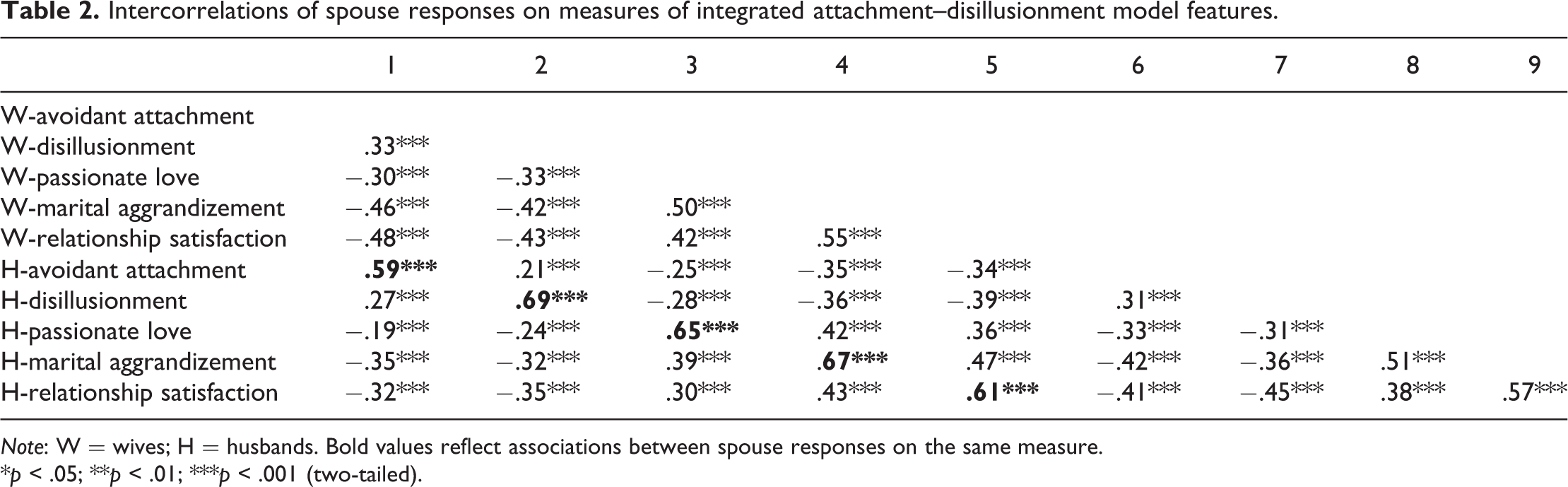
Note: W = wives; H = husbands. Bold values reflect associations between spouse responses on the same measure.
*p < .05; **p < .01; ***p < .001 (two-tailed).
Intercorrelations of spouse responses on measures of integrated attachment–emergent distress model features.

Note: W = wives; H = husbands. Bold values reflect associations between spouse responses on the same measure.
*p < .05; **p < .01; ***p < .001 (two-tailed).
Main analyses
Test of integrated avoidant attachment–disillusionment model
Actor effects
APIM results for spouse responses suggested acceptable overall fits for the final integrated avoidant attachment–disillusionment model (see Figure 1): χ2(7) = 2.94, p = .891; RMSEA = .000; CFI = 1.000; SRMR = .009. In the wives’ segment of the model (Figure 1, upper half), avoidant attachment predicted increased disillusionment which, in turn, predicted less relationship satisfaction. Higher avoidant attachment scores were also related to lower passionate love and marital aggrandizement scores among wives which, in turn, predicted reduced relationship satisfaction. This pattern was largely replicated in the husbands’ segment of the model (Figure 1, lower half), though the passionate love–relationship satisfaction association was not significant. Taken together, these results reflected substantial similarity in wives’ and husbands’ self-reported intensities of avoidant attachment and disillusionment experiences.
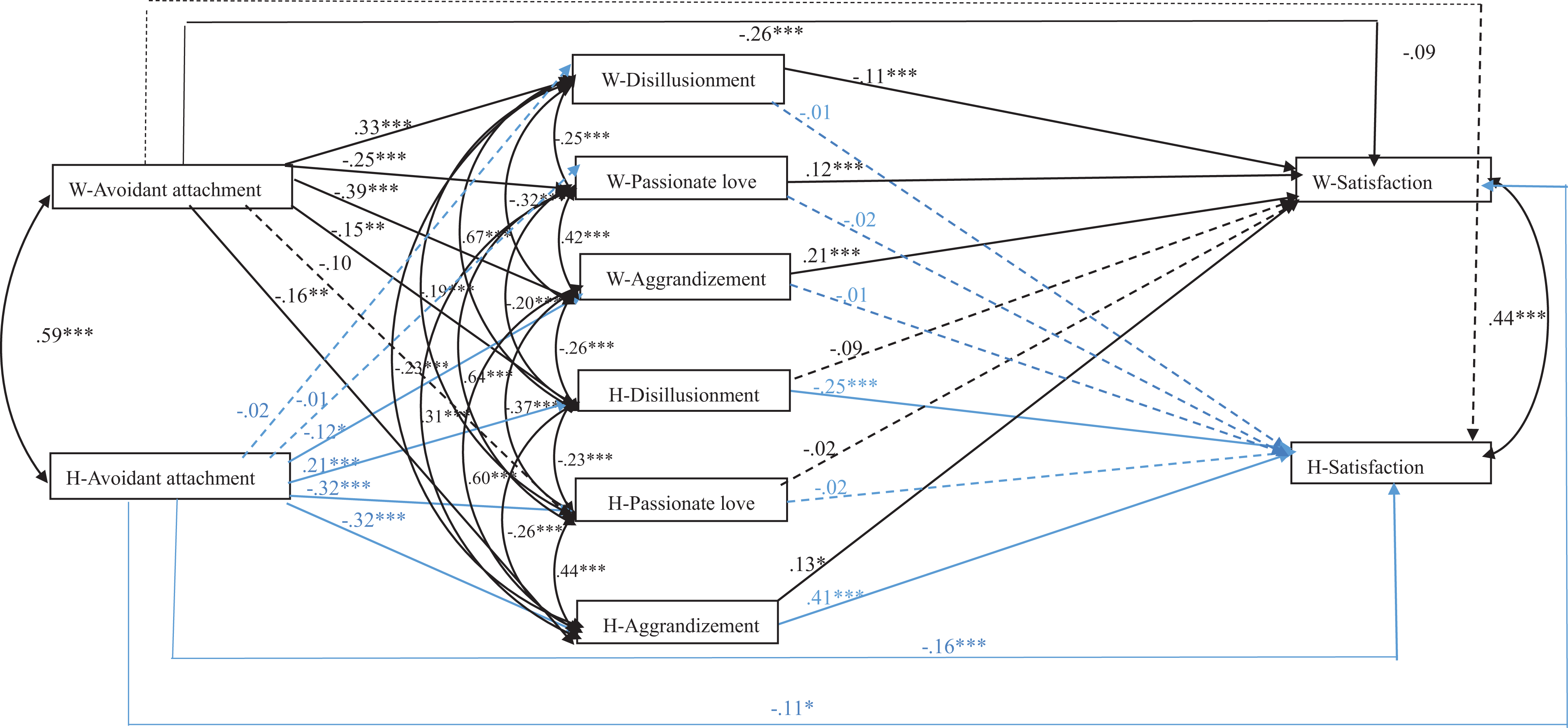
SEM of integrated avoidant attachment–disillusionment model of marital satisfaction. Note: W = paths to wife satisfaction in black; H = paths to husband satisfaction in blue. *p < .05; **p < .01; ***p < .001. SEM: structural equation model.
Partner effects
Turning to dyadic aspects of this model (Figure 1), different patterns emerged for wives versus husbands. Elevations in avoidant attachment among husbands predicted reduced relationship satisfaction among wives but high levels of avoidant attachment among wives were not related to husband’s relationship satisfaction levels. Moreover, high avoidant attachment scores of husbands were linked to reductions in wives’ aggrandizement of their partners but were not related to wives’ experiences of relationship disillusionment or passionate love. Higher avoidant attachment scores of wives corresponded to more disillusionment and less aggrandizement of one’s spouse among husbands. Finally, lower partner aggrandizement scores of husbands predicted reduced relationship satisfaction among wives. In contrast, wives’ responses on measures of disillusionment model features were not related to husbands’ relationship satisfaction levels.
Indirect effects
Disillusionment model features also mediated associations between avoidant attachment and relationship satisfaction at individual (actor) and dyadic (partner) levels (see Figure 1). Using bootstrapping estimates, every possible indirect effect was tested for significance and decomposed into an actor effect (running through participants’ own disillusionment experiences) and a partner effect (running through partners’ disillusionment experiences). As shown in Table 4, all indirect effects were significant except links of husbands’ avoidant attachment scores with personal relationship satisfaction as a function of wife levels of disillusionment and passionate love. Otherwise, wife and husband levels of avoidant attachment indirectly contributed to their own and their partner’s relationship satisfaction levels in paths reflecting personal experiences of disillusionment model features.
Dyadic indirect effects of avoidant attachment scores on relationship satisfaction of Chinese spouses.

Note: W = wives; H = husbands.
Test of integrated avoidant attachment–emergent distress model
Actor effects
APIM results for the integrated avoidant attachment–emergent distress model reflected adequate overall fits, χ2(6) = .624, p = .996; RMSEA = .000; CFI = 1.000; SRMR = .004. Figure 2 presents the strength of each path in the model. For wives (Figure 2, upper half), elevations in avoidant attachment were related to more difficulties on all three conflict tactic indices as well as less personal relationship satisfaction. However, agenda building was the only conflict measure to have a unique association with wives’ relationship satisfaction.
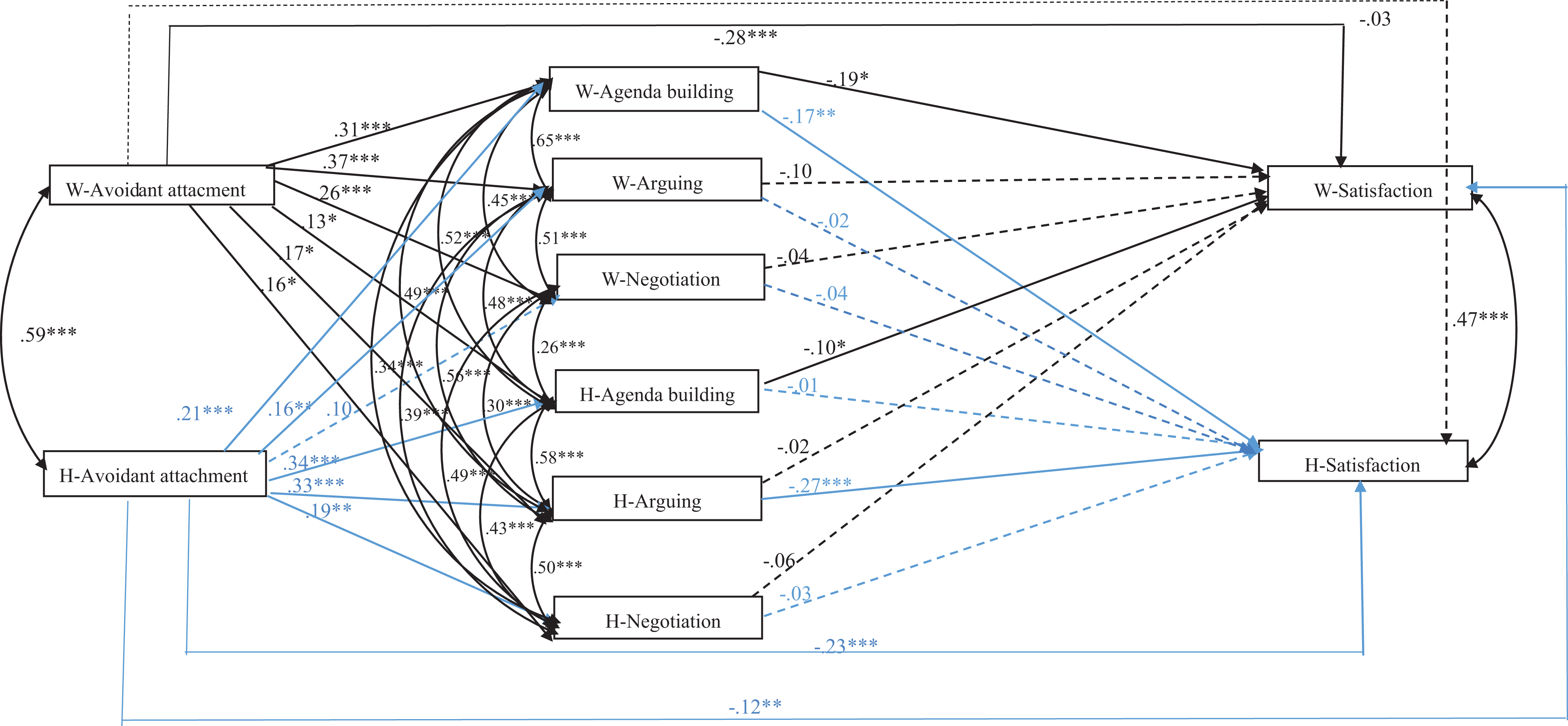
SEM of integrated avoidant attachment–emergent distress model of marital satisfaction. Note: W = paths to wife satisfaction in black; H = paths to husband satisfaction in blue. *p < .05; **p < .01; ***p < .001. SEM: structural equation model.
Among husbands, relations between attachment–emergent distress model experiences were somewhat different (Figure 2, lower half). Higher avoidant attachment scores of husbands corresponded to elevations in their own reported agenda building, arguing, and negotiation levels in addition to decreased personal relationship satisfaction. However, arguing was the only conflict tactic to have a significant link with personal relationship satisfaction.
Partner effects
Regarding dyadic experiences (Figure 2), spouse responses had different effects on personal satisfaction levels of wives versus husbands. Elevations in husbands’ avoidant attachment predicted significantly more problems related to agenda building and arguing as well as reduced relationship satisfaction among wives. Husband difficulties related to agenda building but not arguing or negotiation also corresponded to modestly reduced relationship satisfaction among wives.
Higher avoidant attachment scores of wives corresponded to husband reports of more problems related to arguing, agenda building, and negotiation in managing conflicts but were not related to husbands’ relationship satisfaction levels. Wives’ increased use of agenda building, but not arguing or negotiation, predicted modestly less relationship satisfaction among husbands.
Indirect effects
Emergent distress model features also mediated attachment–satisfaction relations at individual (actor) and dyadic (partner) levels (see Figure 2). Table 4 indicates all indirect effects were significant except for the impact of husbands’ avoidant attachment scores on their personal relationship satisfaction via conflict negotiation. Otherwise, higher wife and husband avoidant attachment scores indirectly predicted lower personal and spouse relationship satisfaction levels in paths running through personal experiences of conflict management.
Discussion
In this study, we tested integrated models of marital satisfaction featuring (1) relatively enduring person dynamics (insecure attachment dimensions) as well as (2) interaction experiences (disillusionment vs. conflict management difficulties) hypothesized to change during the course of marriages using the actor–partner interdependence model. In line with other China-based research suggesting anxious attachments are more normative in Chinese couples (Moore & Leung, 2001; Schmidt et al., 2004; Wang & Mallinckrodt, 2006), anxious attachment scores were not related to relationship satisfaction in either partner and were, therefore, not included in SEMs of mediating effects. Conversely, associations of elevations in avoidant attachment with relationship satisfaction decreases were significant within each gender and subjected to SEM. Overall results indicated that integrated “avoidant attachment–disillusionment” and “avoidant attachment–emergent distress” models provided acceptable fits for the data. Within each model, more avoidantly attached participants reported more negative relationship perceptions (i.e., either disillusionment or difficulties managing conflicts) which were related, in turn, to lower marital satisfaction levels. Specific findings and implications related to each model are elaborated below.
Regarding the attachment–disillusionment model, avoidantly attached spouses of each gender reported less marital aggrandizement, reduced passion, and more disillusionment than did less avoidantly attached cohorts. These findings align with evidence from Western samples linking avoidant attachment to reduced idealization of one’s partner and fewer positive relationship illusions (Busby et al., 2009; Crowell et al., 2002; Murray et al., 2000) as well as research linking degree of avoidant attachment to disillusionment in dating Chinese women and men (Liu et al., 2017). With the exception of passionate love levels among men, avoidant attachment scores and responses on disillusionment model measures correlated with relationship satisfaction in each gender. The overall pattern underlines how losses of idealization and growing disillusionment are not inevitable aspects of marriage among Chinese couples. Instead, individual differences in avoidant attachment tendencies influence the extent to which disillusionment is experienced. Furthermore, partial mediation of attachment–satisfaction associations within each gender suggested that more highly avoidant partners experienced comparatively less marital satisfaction, in part, because of decreases in aggrandizement or idealization and increases in disillusionment regarding their partner.
Use of the APIM also highlighted possible repercussions of partner attachment and disillusionment experiences on personal marital satisfaction levels. Notable gender differences emerged from these data. For women, having a husband who reported higher avoidant attachment scores and/or less partner aggrandizement was related to less personal relationship satisfaction. In contrast, men’s marital satisfaction levels were not related to spouse’s experiences of avoidant attachment or disillusionment with the relationship. This pattern dovetails, in part, with that of Brassard, Lussier, and Shaver (2009) who found partner avoidance was related to more reported relationship conflict among women in heterosexual French-Canadian couples. These authors and others (e.g., Jackson, 2006; Taylor, 2002) have speculated that women are comparatively more concerned with maintaining closeness and intimacy and are, therefore, more attuned to their partner’s avoidance.
With respect to the integrated attachment–emergent distress model, highly avoidant partners of each gender experienced more conflict management problems reflecting difficulties in listening to and understanding spouse points of view (i.e., agenda building), arguing, and negotiating to reach mutually agreeable compromises in resolving conflicts (Eggeman et al., 1985). Numerous authors have noted persons with elevations in avoidant attachment evade discussions of relational problems, hence increasing the likelihood of unresolved conflicts and lingering resentments, irritation, or anger (e.g., Feeney & Noller, 1990; Shaver & Brennan, 1992; Scharfe & Bartholomew, 1995). Aside from elevated avoidant attachment scores, specific conflict difficulties partially mediated personal attachment–satisfaction relations within each gender. Among women and men, respectively, conflict experiences related to agenda building (i.e., listening to and understanding their partner’s perspective) and arguing had unique associations with relationship satisfaction. These results suggest divergent facets of conflict management are more pertinent to relationship satisfaction among married Chinese women versus Chinese men. Nonetheless, replications are needed to support this claim in light of noticeably different patterns of conflict management–satisfaction linkages observed in China-based dating counterparts (Liu et al., 2017).
Regarding links between partner responses and personal marital satisfaction, women whose husbands scored higher on avoidant attachment and/or reported more difficulty listening to and understanding their wives’ perspective (i.e., agenda-building problems) tended to report less relationship satisfaction. In line with the attachment–disillusionment model, men’s relationship satisfaction was not related to spouse levels of avoidant attachment. However, paralleling results for women, men whose spouses reported more difficulties with agenda building were less satisfied with marriage. In large part, KMCS agenda-building items reflect the capacity to empathize with or understand one’s partner. A recent meta-analysis of 21 studies indicated empathic accuracy, especially in relation to the partner’s negative emotions, had a small, significant overall association with relationship satisfaction in each gender (Sened et al., 2017). Empathy may contribute to satisfaction as a result of diffusing negative effects of stressful experiences on couple relationships (e.g., Busby & Gardner, 2008). This evidence in tandem with correspondence between partner agenda-building scores and marital satisfaction of both spouses in this study implies spouse understandings of one another should be a focus of assessment and interventions to improve satisfaction of married Chinese couples.
Taken together, mediation of attachment avoidance–satisfaction relations within each integrated model suggested that losses of generally positive experiences (e.g., passion toward and aggrandizement of one’s partner) and increases in generally negative experiences (e.g., conflict difficulties) partially explain why more highly avoidant marital partners typically experience less relationship satisfaction. In addition, however, satisfied spouses tended to have partners who were also satisfied with their relationship. This finding is consistent with evidence of more highly similar satisfaction levels of partners in couples from Asian nations (Jackson et al., 2014) and underscored substantial reciprocity in overall appraisals of marriage between partners in this sample.
Strengths, limitations, and future research
A key strength of this study was the evaluation of married couples from an understudied cultural setting rather than a narrowly defined, overstudied segment of the population (i.e., undergraduate students). As well, the assessment of each partner and use of APIM highlighted complex links between self-perceptions as well as partner perceptions on personal relationship satisfaction levels. Finally, within gender PCAs of scales that had not been used in Chinese samples largely supported the equivalence of construct structures in a Chinese context.
Possible strengths aside, two limitations warrant some discussion. First, due to the cross-sectional design and lack of random assignment to different conditions, causal effects of avoidant attachment scores, disillusionment, and conflict on relationship satisfaction could not be determined. Similarly, directions of causality could not be demonstrated within the current design. For example, despite conceptual bases for testing avoidant attachment as an enduring person precursor to experiences of disillusionment and conflict, it is plausible that these negative relationship experiences also contribute to disengagement and/or increased avoidance of one’s partner. Given these caveats, SEMs generated here must be viewed ultimately as correlational and hypothetical in nature. Extensions that involve experimental manipulations of disillusionment or conflict model features may elucidate causal effects more clearly and longitudinal designs can clarify the status of attachment dimensions, disillusionment, and conflict as risk factors for losses of marital satisfaction over time. Second, because the sample was not randomly selected and comprised proportionately more highly educated couples and fewer older couples, findings may not generalize to the general Chinese population, underrepresented groups (e.g., less educated, older) or couples in dating and/or cohabiting relationships. Extensions to other population segments should proceed in a piecemeal manner.
Conclusions
In conclusion, this research examined links between features of theories that emphasize relatively stable person attributes (i.e., insecure attachment dimensions) and those that highlight changes in the nature of interactions over the course of marriage (increases in disillusionment or emergent distress) as key influences on marital satisfaction in married Chinese couples. Acceptable fits of integrated “avoidant attachment–disillusionment” and “avoidant attachment–emergent distress” models pointed to the possible utility of considering possibly stable characteristics that each partner brings into marriage in concert with experiences that often change during the course of marriage as a general framework for understanding marital satisfaction. Further consideration of these integrated models and alternatives in extensions may clarify experiences critical to determining whether marriages are distressed or resilient and the identification of couples who might benefit from intervention support versus couples who might serve as models for healthy relationships.
Footnotes
Funding
The author(s) disclosed receipt of the following financial support for the research, authorship, and/or publication of this article: This research was supported by grants from the National Natural Science Foundation of China (# 31371037, # 31671142) and a 100 Persons Fellowship to the corresponding author.