



Abstract
For many young women, college is a time of major changes in sexual behavior and attitudes, driven in part by their social environment. Yet little is known about how young women actually talk about sex day-to-day. To understand daily sexual communication, 96 U.S. college students who identify as women kept a sexual communication diary for 7 days, generating 1,211 records. A content analysis revealed that women talked about sex an average of 13 times per week. Most conversations were with friends, face-to-face, and mostly about previous sexual encounters, dating, and potential sexual activity. The underlying function of most conversations was exchanging opinions, recapping, and gossiping. Sex appears to be a somewhat regularly discussed topic for college women and a way of socializing and exploring attitudes. The results have important implications for health promotion efforts targeted at college women.
Keywords
Introduction
The transition to college is a time when many young people explore new sexual behaviors and attitudes. Many students become more permissive about sexuality (Garcia et al., 2012; Lefkowitz, Gillen, et al., 2004), and casual sexual encounters increase while in college (Roberson et al., 2015), with half or more of students engaging in casual sexual encounters (Owen et al., 2010; Paul & Hayes, 2002; Paul et al., 2000) and many describing it as the norm (Hamilton & Armstrong, 2009). Interpersonal communication about sex plays a major role in young people’s sexual beliefs, attitudes, and behaviors (Busse et al., 2010; Gause et al., 2018; Zelin et al., 2015), yet there is little information about how college students, particularly those who identify as women, actually talk about sex on a day-to-day basis.
Some studies have explored who college students tend to communicate with when talking about sex. Lefkowitz and Espinosa-Hernandez (2007) found that the transition to college sees young people talking more to peers than to parents. Researchers have also found that there is little communication with partners during casual sexual encounters (Lehmiller et al., 2012.; Paul & Hayes, 2002), but Paul and Hayes found that people often talk to their friends about these encounters after they occur. However, talk about sex is highly gendered. In general, women talk with their women friends about sex more than men do (Busse et al., 2010; Lefkowitz & Espinosa-Hernandez, 2007; Trinh & Ward, 2016), and with more intimacy (Norona et al., 2013). Yet women are expected to adhere to conservative scripts about sex (Fugère et al., 2008; Hamilton & Armstrong, 2009). Many women report that they expect to learn about sex from their peers and partners during college (Hamilton & Armstrong, 2009), but what they actually talk about on a daily basis remains unknown.
Interpersonal sexual communication during late adolescence is connected to many aspects of sexual attitudes and behaviors. This communication is crucial to identity exploration, social support, and information gathering (Muise et al., 2010; Pariera, 2018). Sexual communication with peers has been associated with peer pressure and problematic sexual norm perceptions (Busse et al., 2010; Holman & Sillars, 2012; Norris et al., 2015; Pariera, 2018), but it has also been associated with higher sexual self-efficacy and positive attitudes about sex and safer sex, particularly for women (Lefkowitz, Boone, & Shearer, 2004; Lefkowitz & Espinosa-Hernandez, 2007; Pariera, 2018). Young people whose peers care about their sexual well-being tend to engage in less risky behavior than those who do not have such peer support (Wetherill et al., 2010). Sexual communication with sexual partners is positively associated with safer sex behaviors (Noar et al., 2006) and sexual satisfaction (Frederick et al., 2017). Because interpersonal sexual communication plays such a crucial role in sexual development, a fuller understanding of who women talk to about sex, what they talk about, and the purposes of these conversations is needed.
Some studies have explored the frequency and functions of sex-related conversations. For example, college students tend to talk about hooking up, dating, and positive aspects of sexuality, but less so about sexual risks (DiIorio et al., 2000; Lefkowitz, Boone, & Shearer, 2004; Levin et al., 2012; Noar et al., 2006; Paul & Hayes, 2002). One study found that conversations about sex can help individuals evaluate their sexual identity, and garner validation and support (Morgan & Korobov, 2012), while another found that women tend to talk to provide support and normalization about sex (Pariera, 2018). Montemurro et al. (2015) found that women were uncomfortable talking with friends about sex unless they saw the conversation as a way to bond or as a means of support. Sex-related talk between friends also focuses on advice-giving (Pariera, 2018; Yeo & Chu, 2017), suggesting that friends may be important information resources. Generating and reinforcing group norms may be another common function, with one study finding gossip about sexual reputation was a common occurrence (Massar et al., 2012).
Understanding which topics college women are discussing on a day-to-day basis, with whom, and why, could help inform interventions aimed at increasing beneficial sexual communication, and increasing sexual health and well-being among people who identify as women. One of the most effective ways to understand daily behaviors is through the use of diaries, which tend to result in higher reports of risky or taboo behavior (Fisher & Lee, 2014). Using a diary method, this study will explore sexual communication among college women in the U.S., particularly, characteristics of day-to-day sexual communication (length of conversation, tone, medium, and relationship between interlocutors), the sexual topics discussed, and the functions of sexual communication.
Method
Participants and procedures
Participants were students from a large mid-Atlantic university who completed the diary as part of a required assignment in an elective sociology or communication class, in accordance with institutional review board policies. Students were informed that only the instructor could view the diaries on Blackboard, but that their name would be stripped from their diaries and analyzed in a separate file, to ensure confidentiality. Participants came from a variety of majors and grades. Because the number of men was low (12%), only women’s data were used for this study: 104 self-identified women were enrolled in the courses, all of whom completed the assignment, and 96 agreed to participate in the study. Of 672 possible daily diaries, only 3 days were missing from three different individuals. Participants were 74.3% White, 14.4% Black/African American and 11.3% Asian/Asian American. They were not asked to report their sexual orientation, but five (5.2%) referred explicitly to either same-sex encounters or referred to themselves as lesbian or bisexual in their diaries. All participants were 19–21 years old.
Participants selected any 7-day period within a 1 month time frame to keep their diary. Participants had to submit their diary via Blackboard, once per day, 7 days in a row, even if they had no sexual communication that day. Participants received detailed in-person instructions from the principal investigator on keeping the diary and were able to ask questions before starting. Some of the course content related to sexuality, specifically family sexual communication, but for the diary assignment sexual communication was defined as any verbal or text-based communication related to sex, including, but not exclusive to sexual health, sexual behaviors, and social issues related to sex.
The diary was a spreadsheet with seven forced-choice questions: date, time of day (morning, afternoon, evening, late night), conversation length in minutes, number of people in the conversation, tone (humorous, casual, or serious, which are categories used in other studies about tone of sexual messages; Pariera et al., 2014), medium (if not face-to-face participants selected the medium: phone call, text/SMS, or a write-in option), and relationship with the interlocutor. Participants could only select one response for each forced-choice question and were instructed to provide the response that best fit the conversation. Participants were then asked in an open-ended question to describe the conversation in detail. They were also asked to describe what they saw as the primary function or purpose of the conversation. Participants were told that if a conversation shifted substantially (such as an entirely new sexual topic and new interlocutors), they should code it as a new conversation. Participants were told to include as little or as much detail as they were comfortable with.
Content analysis
To determine topic and function of the conversation, inductive content analyses were completed. Responses from the open-ended question about topic and function were analyzed by two coders using Strauss’s method of content analysis (Strauss, 1987). Each response was analyzed to create preliminary codes during the open-coding process. During axial coding, overlap and linkages between emerging themes were identified. A final codebook was created, and responses were then analyzed for representations of the final codes. An additional credibility check, as recommended by Butterfield et al. (2005), was conducted by asking an outside judge to review the codebook and code a random selection of 12 diary entries. The independent judge placed all 12 codes into the same categories as the authors.
The research assistant coded all the conversations, and the principal investigator double-coded 35%. Inter-rater reliability was high, with reliability for general topic α K = .90, and for function α K = .87. Participants indicated the medium of their conversation if it was not face-to-face, but the coder also added this information during coding if the participant had not done so. Each diary entry was given one code only for topic and for function, and the coder selected the predominant code. Topics were coded regardless of who the conversation was about. Entries that were not about sex were excluded. For example, an entry about menstruating was not included, but an entry about having sex while menstruating was included. Entries related to talking about the diary itself were also excluded. Topics that were found in fewer than 2% of entries were coded as “other,” which included, for example, sex work, how animals have sex, school sex education, and sexy clothing. Some items were coded as “not enough information,” such as “sister brought up something sexual” and “we talked about a specific issue.”
Results
Participants provided 1,211 diary entries, with an average of 13 instances of sexual communication per week per person (with a range of 5–31). Most diary entries were one to three sentences long and participants wrote an average of 29 words. The average duration of conversations was 15.82 min (SD = 20.51), ranging from 1 min to 120 min. The majority of conversations were with one other person (59.8%). Regarding tone of conversations, almost half were casual (46.3%), followed by serious (24.2%) and humorous (22.4%). The vast majority (88.0%) of conversations were face-to-face. Most took place between friends (63.1%), followed by roommates (12.9%), and sexual partners (7.5%). Participants were not asked about their sexual activity, but 70 participants indicated in their diaries that they had a sexual partner during the week they kept the diary, 37 of which reported sexual communication with their partner. See Table 1 for all percentages and means.
Characteristics of daily sexual communication (N = 1,211).

Note. Percentages do not add to 100 due to rounding or insufficient data provided by participants.
Participants discussed a wide variety of topics (see Table 2). The most common was previous sexual encounters, for example “my best friend and I were talking about her weekend and who she ‘hooked up’ with” and “we talked about hookups from this past weekend.” This code only included specific encounters that had occurred, rather than generalized conversations about sexual encounters, or future sexual encounters. The second most common topic was dating and relationships. This included conversations about sex-related issues specific to a dating or relationship context (“talked about sex in relationships versus when single” “talked about how her boyfriend is only with her for sex”). Potential sexual activity was the third most commonly discussed topic, which included any conversation related to future sexual encounters, such as planning ahead for sex, or seeking a sexual encounter (e.g., “…trying to get advice with how to pick up a girl he wanted to sleep with” and “we planned ahead for our ‘alone time’”). The fourth most common topic was sexual desires and likes, such as “we talked about what we like in bed” and “we talked about sexual fantasies.” The fifth most common topic was sex in the media, which included conversations about sexual content in mass media, for example, “talked about sex on a TV show” and “talked about sex on The Bachelor.” The sixth most common was birth control, which included, for example, “talked about free birth control at the health center” and “complained about IUD side effects.” Talk about sex talk itself was the seventh most common topic (e.g., “I talked about how it’s easier to talk about sex with my girl friends” and “talked about why people don’t talk about sex”). The next most common topic was bodies, which included discussions about body parts in sexual contexts (e.g., “explained sexual anatomy to my niece” and “talked about our vaginas”). The next topic was sexual harassment/assault, which included items such as “talked about a friend who was threatened with sexual assault” and “talked about sexual harassment policy at work.” No participants disclosed being sexually assaulted in the diaries. Finally, participants talked about sex lives in generalized terms. This included comments about how one’s sex life is going overall, such as “evaluation of her sex life” and “a friend opened up about his sex life.” It is possible these conversations were about more specific topics but the participant only reported it in general terms.
Sex-related topics discussed by participants (N = 1,211).

Note. Percentages do not add to 100 due to rounding.
Regarding the function of conversations, 10 codes were identified (see Table 3), with the most common being sharing views and opinions. This included exchanges between the speakers focused on personal or general opinions about sex, for example, “we talked about how guys feel about having sex with girls on their period” and “we shared our opinions about hookup culture.” The second most common function was recapping, which included any retelling of a specific sexual encounter between one of the interlocutors, for example, “telling me about her sexual experiences over the weekend” and “talked about how my experience the night before had gone.” Gossiping was coded as any conversation about the sexual encounters of people not in the conversation, for example, “…talked about concerns of sexual promiscuity from one of our friends” and “talked about people we work with and who they hooked up with.” The fourth most common function was exchanging advice, which included advice-giving between interlocutors, for example, “I tried to give a friend advice about whether to engage in sexual activity” and “gave my friend advice about getting out there.” The fifth most common function was making each other laugh. Conversations were coded as making someone laugh if there was any mention of intentionally joking about something for the benefit of one of the interlocutors. Examples include “my friends and I joked about masturbation” and “we made ‘that’s what she said’ jokes.” The sixth most common was educating. This included times when the key purpose was to exchange sex-related knowledge between the speakers, such as “I shared some information I learned about non-marital sex” and “I gave her information about birth control.” The next most common function was flirting. This was coded any time someone indicated sexual flirting had taken place either on their part, or on the part of the person they were interacting with (e.g., “made plans and started flirting” and “flirted at a party”). The next most common was initiating sex. Participants described exchanges with sexual partners, such as “he straight up asked me to have sex with him” and “asked if she wanted to ‘do stuff’ which is code for sex.” Similarly, some conversations were about planning ahead for sex, either in conversation with a partner (e.g., “brought up our [sex-related] plans for later”) or with a friend (e.g., “asked when she can bring a guy to the room”). All other functions occurred less than 2% of the time.
Functions of sexual communication (N = 1,211).
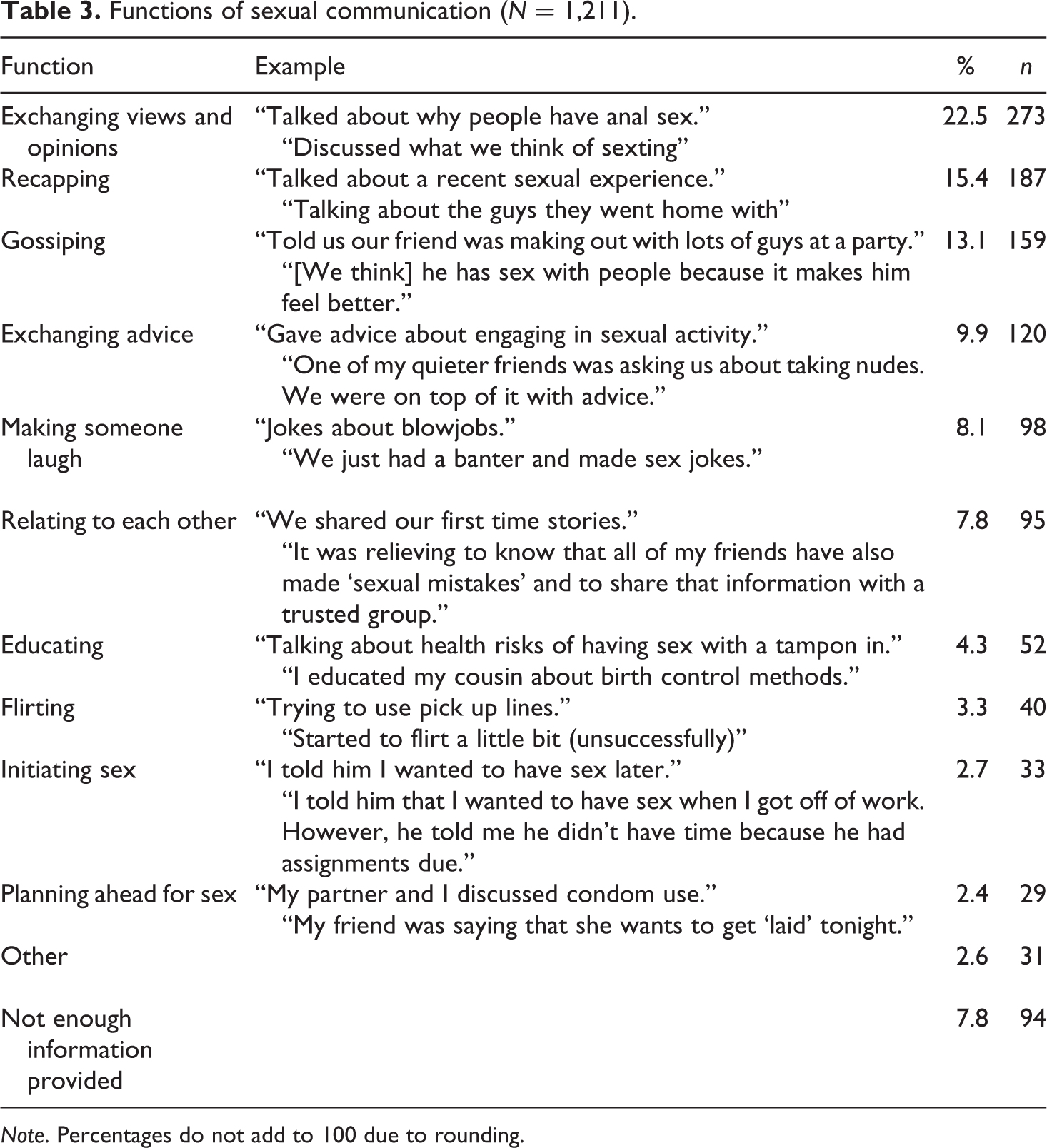
Note. Percentages do not add to 100 due to rounding.
Although not an original research question, we decided to examine cross-tabs across all topics and functions to determine if there were any proportions over 10%. The idea was to better understand if any patterns emerged across topics and functions. Almost half (46.5%) of recapping conversations were about sexual encounters. For sharing opinions, 11.7% were about sex in the media. For gossiping, 19.4% were about sexual encounters, and 16.3% of gossip conversations were about dating and relationships.
Discussion
This study describes day-to-day sexual communication among college students in the U.S. who identify as women. These young women are talking about sex regularly and at length, with every person talking about sex 5 or more times per week. Three quarters of conversations were casual or humorous, suggesting that sexual communication is generally kept light, and serious discussions about sex are the exception not the norm. While using humor may make it easier to talk about taboo subjects (Campo et al., 2013), it can also make messages seem less serious and easier to dismiss (Nabi et al., 2007). This finding suggests that messages aimed at college women about sexual health may be better received if they are casual, rather than serious (see Ranney et al., 2014).
The majority of sexual communication was with friends. This has important implications for health promotion efforts targeted at college students, particularly women. Because women talk often to their peers about sex, peers may be an effective vehicle for transmitting sexual health campaign messages. Studies have shown peer sex education to be an effective way to improve sexual well-being (Ochieng, 2003; Pearlman et al., 2002). Peer sex education has been effective at increasing STI prevention (Caron et al., 2004; Layzer et al., 2014), and unplanned pregnancy prevention (Roberts-Dobie et al., 2018). Peer sexual communication may also be a viable source for encouraging this. Because young women are talking often with their friends about sex, peer educators might be well-positioned to encourage communication with sexual partners. Training peer educators has been shown to be effective for encouraging sexual wellness and decreasing sexual risk (Caron et al., 2004; Layzer et al., 2014; Roberts-Dobie et al., 2018). Peer sexual communication may be a highly viable source for disseminating sexual health information and sexual communication skills. Future studies must continue to explore if and how peer educators influence sexual behaviors and attitudes.
The fact that most conversations were with friends is also consistent with past research about the importance of peers as a source of disclosure during college (Aldeis & Afifi, 2013). The findings align with past research that women talk frequently to friends about sex during the college years (Lefkowitz, Boone, & Shearer, 2004; Lefkowitz & Espinosa-Hernandez, 2007), and that friends are an important source of expressive support on sex-related topics (Pariera, 2018). While we did not collect data about the sexual relationships our participants had, it may be that women are more inclined to talk to friends about sex than they are to partners, but future diary studies should collect detailed relationship information to test this.
The findings also show that talking about sex is a way of socializing and exploring personal attitudes. Women talked to exchange opinions, recap, gossip, relate, exchange advice, and make each other laugh, which is consistent with past research. They also talked about many private issues, such as specific sexual encounters, potential sexual encounters, and desires. These findings show that young women may be trying to make sense of new sexual experiences and determine their attitudes about sex, and they are turning to their peers to organize and interpret those ideas (Garcia et al., 2012; Lefkowitz, Boone, & Shearer, 2004). Research also shows that gossip plays an important role in group norms and social control (Merry, 1984), so people may be talking about others to gauge what is acceptable or not (Massar et al., 2012). Future research on sex-related gossip may further illuminate gossip’s role in establishing norms. The findings also support past research that much peer communication about sex is focused on advice-giving (Pariera, 2018; Yeo & Chu, 2017), again highlighting the importance of peers as referents and confidants. This may be beneficial, as sexual communication with peers is negatively associated with expectations that future sexual activity would be stigmatized among peers (Ragsdale et al., 2014). On the other hand, the high proportion of recapping and gossiping about sexual encounters may be problematic as students who talk frequently with friends about hookups tend to overestimate how much people hookup and tend to hookup more themselves (Holman & Sillars, 2012). However, peer influence is just one of many factors that predict sexual behavior, and more experimental research is needed to understand how peer communication influences sexual behaviors.
Another noteworthy finding is that college women talked often about sex in the media. This is not surprising given the high prevalence of sex on television (Kunkel et al., 2005). This is important as exposure to sexual media is also a major contributor to college students’ sexual attitudes (Aubrey et al., 2003). This also suggests that television and movies may be a point of entry for sexual communication interventions. For example, television media may be an important way to generate scripts for effective sexual communication, and a useful tool for prompting conversations about important topics that are not often discussed by young people (see Moyer-Gusé et al., 2011). Birth control was also relatively common as a topic. This is consistent with prior research showing that peers are a common source of information about birth control (Jones et al., 2011; Rittenour & Booth-Butterfield, 2006). Peers may be a valuable source in generating awareness of birth control options among women who can become pregnant. Indeed, educating was a common function of these conversations, and other research shows women talk often to each other about birth control well into adulthood (Pariera, 2018).
Limitations
There are some limitations to the interpretation of this study, namely that the sample is not generalizable. Our study was conducted only with college women in the U.S., so more research is needed on representative populations to generalize these findings. More research is also needed on sexual and gender minorities to provide a fuller picture of the role of sexual communication in everyone’s day-to-day lives. Even among people who identify as women, the topics and functions of sexual communication may differ both within and across groups with different gender identities, sexual and romantic orientations, and other dimensions of identity. Also, as with any diary study, we are not able to capture all the nuances and meanings of sex-related talk. While the participant responses and codes were limited to one per conversation, conversations may have shifted in tone and function in ways that our study did not capture. It is also important to keep in mind that because the diary was part of an assignment there was not full anonymity, therefore participants may not have disclosed as much in their diary as they would had it been totally anonymous. In fact, a fairly large proportion of responses were too vague to code. Participants were told their diaries would be stripped from their names, and many participants were generally forthcoming about a number of taboo topics, however, a replication of this study with total anonymity would reveal additional insights into these conversations. Another limitation is that we did not solicit reports of nonverbal communication. Nonverbal communication is especially integral to sexual relationships and it may be that sexually active participants in the study accomplished communication goals with their partners this way.
Conclusion
Communication about sex is an important aspect of sexuality, and college women are talking about sex with frequency and breadth. Our study provides a better understanding of how young women talk about sex, which is crucial to developing educational materials and interventions aimed at improving their sexual health and well-being. Continuing to examine the characteristics of these conversations will lead to a better understanding of the concerns and expectations young women have about sexuality, and how information and norms about sexuality are spread interpersonally.
Footnotes
Authors’ Note
The study was approved by Institutional Review and participants provided informed consent. This research was presented at the 2020 Kentucky Conference on Health Communication.
Funding
The author(s) received no financial support for the research, authorship, and/or publication of this article.
Open research statement
As part of IARR’s encouragement of open research practices, the authors have provided the following information: This research was not pre-registered. The data used in the research are available. The data can be obtained by emailing:  . The materials used in the research are available. The materials can be obtained by emailing: klp@gwu.edu.