



Abstract
In this article, we review the recent expansion within the sales education literature from five primary journals and the business literature at large. The five primary journals are the Journal of Marketing Education, Marketing Education Review, Journal for the Advancement of Marketing Education, Journal of Education for Business, and the Journal of Personal Selling & Sales Management. Of the 119 identified articles published in the past 15 years, experiential learning, career development, and assessment were the three most prominent topics. Of these, 69% were published after the Cummins et al. review article “A Critical Review of the Literature for Sales Educator,” which was published in Journal of Marketing Education as a means of expanding sales education research. Future research opportunities in sales education are offered with suggested hypotheses for investigation. A reference table of classroom innovations is provided as an easy guide to instructors seeking vetted pedagogical enhancements.
From the viewpoint of recruiters, acquiring and maintaining a high-quality and committed sales force has traditionally been one of their most critical areas of need (Spiller et al., 2020). In response, universities have increasingly offering curricula designed to attract, maintain, and graduate professionally trained sales students (Chakar et al., 2020). As evidence, the number of higher education institutions offering at least one sales course grew from 44 in 2003, to 157 in 2019 (Rocco & Hoffmeister, 2020). Over this same period, the number of member schools in the University Sales Center Alliance (USCA) increased from 9 in 2002 to 53 in 2020 (https://www.universitysalescenteralliance.org/). Although research is scant, how Covid-19 will affect sales and marketing education is uncertain (Mitchell et al., 2020).
Despite the growth in sales education, the topic has received relatively little attention in the marketing and business education literature (Scott & Beuk, 2020; Inks & Avila, 2018). In their review of topical coverage of the marketing education literature in the Journal of Marketing Education (JME) from its inception in 1979 to 2012, Gray et al. (2012) noted that only 27 of over 800 articles were devoted primarily to sales education. Responding to this deficiency in the sales education literature, JME published an article by Cummins et al. (2013) titled “A Critical Review of the Literature for Sales Educators.” This article served as a call for a JME Special Issue on Sales Education and Training co-edited by Andrea Dixon and Jimmy Peltier (Volume 36 Issue 2, August 2014) that outlined four key research areas needing further investigation: (a) pedagogical tools, (b) framework for marketing curriculum, (c) research with a student population, and (d) cross-functional partnerships. In that special issue, a total of 10 sales education articles were published, an increase of almost 40% over the previous 35 years of JME’s existence. Since that time, JME has added an associate editor to manage the sales education track and a $1,000 award for Best Sales Education Paper of the Year sponsored by the USCA. Also, two special issues on sales education were published by the Journal of the Advancement of Marketing Education (Volume 24 and 26, Fall 2016 and Spring 2018), and Marketing Education Review has seen a steady increase in sales-related articles.
While interest in sales research has grown relative to JME’s first 34 years in existence, researchers have only tapped the surface of how to improve sales education and enhance student interest in sales as a career (Deeter-Schmelz & Peltier, 2019; Hammond, 2020; Nielson & Cummins, 2019). To address this issue, JME released a second Special Issue on Sales Education and Training 2.0. Four specific topical areas were noted as being particularly important: (a) framework for marketing curriculum, (b) information technology, (c) career development, and (d) diversity. As the lead article in the special issue, this invited article offers an agenda for studying emerging trends in sales education and clarifying future research needs.
In this article, we review the sales education literature from 2005 to 2019. We contribute to the sales education literature in several ways. First, we extend Cummins et al. (2013) by expanding the number of journals considered, resulting in a 67% increase in the sample compared with the prior review. We also document the rise in sales education articles over the past 15 years. This period coincides with an uptake in sales education publishing and allows for an essential update from the 2013 review of the literature (Cummins et al., 2013). We present the types and frequency of conceptual and empirical sales education articles receiving research attention (see Tables 1 to 3).
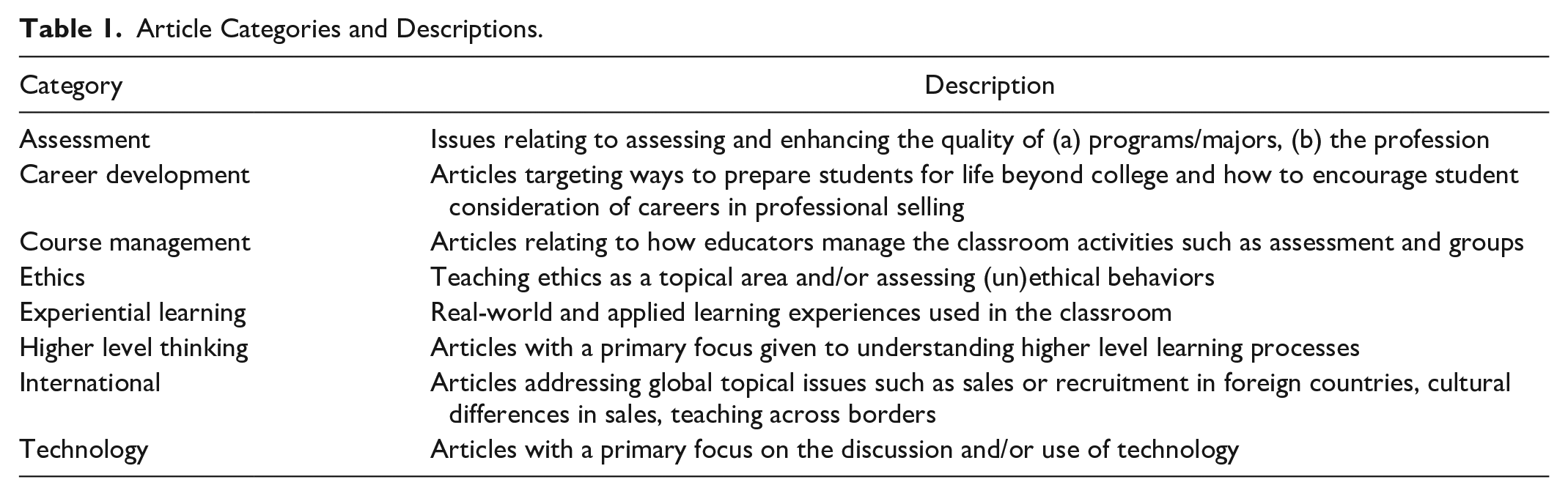
Article Categories and Descriptions.
Categories, Subcategories, and Topics.

Number and Percentage of Articles by Category and Journal.
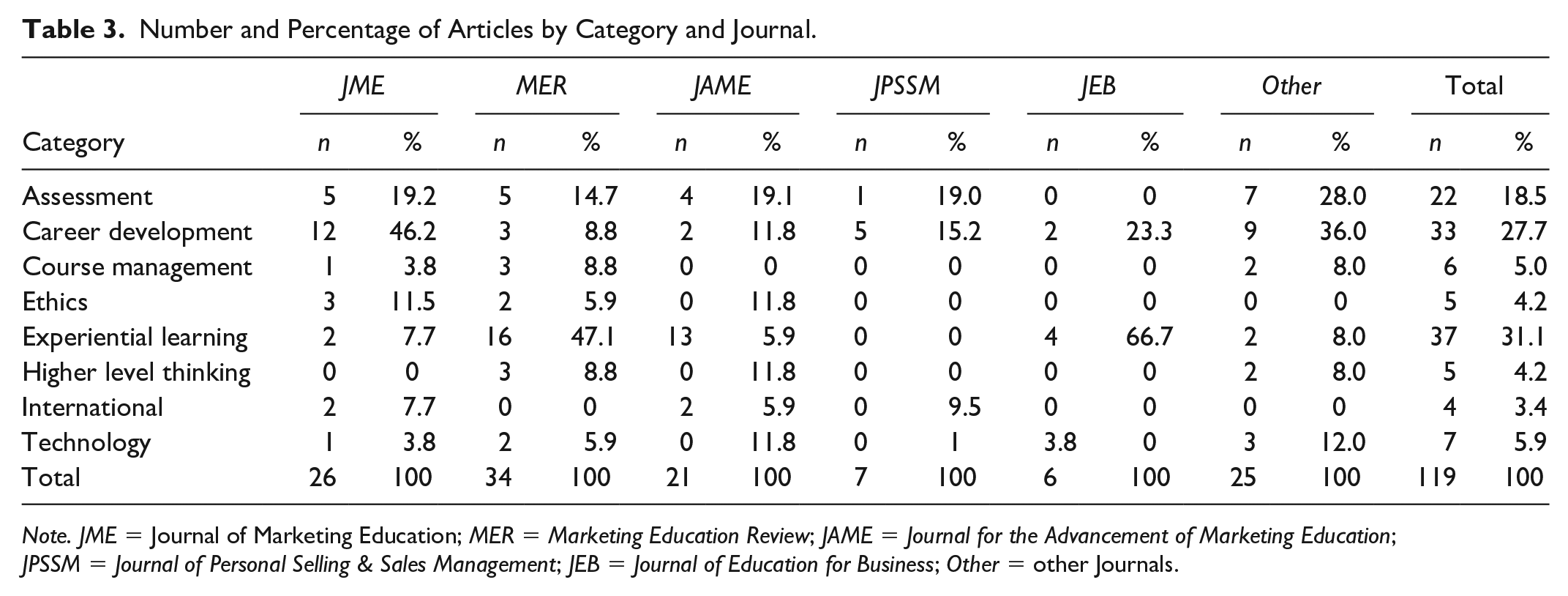
Note. JME = Journal of Marketing Education; MER = Marketing Education Review; JAME = Journal for the Advancement of Marketing Education; JPSSM = Journal of Personal Selling & Sales Management; JEB = Journal of Education for Business; Other = other Journals.
Second, responding to calls for research that offer insights for improving classroom and online learning experiences (Inks et al., 2020; Lee & Heinze, 2020), our review details important class topics, learning exercises, and relevant research findings. We thus provide an extensive set of classroom implementable research for instructor reference and academic inquiry (see Table 4). Last, we offer concluding thoughts on where sales education is going, future research opportunities, and what instructors (and businesses) can do to prepare the next generation of sales graduates (Chakar et al., 2020; Hammond, 2020; Spiller et al., 2020). How the COVID-19 pandemic will affect sales education is especially intriguing.
Classroom Implementable Research for Instructor Reference.

Note. JEB = Journal for Business Education; MER = Marketing Education Review; JME = Journal for Marketing Education; JAME = Journal for the Advancement of Marketing Education; JGSMS = Journal of Global Scholars of Marketing Science; AJBE = American Journal of Business Education; JTSE = Journal of Technology and Science Education; A = advanced sales, I = introduction to sales, M = sales management, N = negotiation, P = principles of marketing.
Method
Journal Selection
Five primary journals were searched for articles relating to sales education. The JME and Marketing Education Review were selected given their prominent status in the marketing education literature. The Journal for the Advancement of Marketing Education was chosen because of its recent special issues dedicated to sales education. The Journal of Education for Business was included because of its cross-disciplinary focus on business education. The Journal of Personal Selling & Sales Management was selected due to its position as the most prominent sales journal and its previous publication of education papers. All articles published from 2005 to 2019 in these journals were considered. This period coincides with an uptake in sales education publishing and allows for an essential update from the 2013 review of the literature (Cummins et al., 2013). Indeed, 67% of the sample was not included in the prior analysis. Articles deemed relevant to sales education were saved to a data file. Last, an expanded literature review was conducted using “sales education” as the key search term, which yielded 119 total articles spanning 15 years. Software reviews, introductions to special issues, editor notes, and book reviews were excluded.
Categorization and Coding
Our first challenge was to develop a rubric for categorizing the identified sales articles. First, a data file was prepared that included each article, journal, author(s), and title. Each article was then coded for scope, focus, method, findings, and class setting (if applicable) by two authors. Based on Gray et al. (2012) and Cummins et al. (2013), each article was coded for the primary, secondary, and tertiary topics. At this point, the topic codes were reviewed and discussed by the coders. The initial codes provided a starting point for identifying content patterns across the articles. Several rounds of discussions resulted in replication of eight of the nine categories developed by Gray et al. (2012) in a review of the broader marketing literature and utilized by Cummins et al. (2013) in a review of the sales education literature: assessment, career development, course management, ethics, experiential learning, higher level thinking, international, and technology. The omitted code (marketing mix) accounted for only two articles (0.09%) in the prior sales literature review.
The eight categories were found to represent the variety of initial topic codes and allowed for both a comparison of sales education literature to the previous review (Cummins et al., 2013) and the broader marketing education literature (Gray et al., 2012). As a final check, each article was recoded into one of the final eight categories without the aid of the initial topic codes. Limited discussion was needed to resolve categorization conflicts (e.g., a paper discussing a role play useful in preparing students for interviews could be viewed as either experiential learning or career development). Table 1 presents the final categories, along with a description of each. Table 2 classifies subcategories and provides exemplars. As an important note, Table 1 lists the primary topic. In some cases, an article would have a secondary topic. As an example, an article categorized as “career development” could have an international component as well.
Discussion of General Results
Journal Counts
As would be expected, the two primary marketing education journals, Marketing Education Review (34 articles) and the JME (26), have published the highest number of sales education articles (Table 3). A close third is the Journal for the Advancement of Marketing Education (22 articles). The rise in these numbers is primarily due to special issues targeted toward sales education, or in the case of Journal for the Advancement of Marketing Education, annual teaching innovation issues that have significantly increased the number of sales-focused papers published. Sales education article totals over the past 15 years for these three journals (82 total articles) exceed total counts from JME inception through 2012 (74 total articles). The Journal of Personal Selling & Sales Management has published seven sales education articles, followed by five for the Journal of Education for Business. The remaining 25 articles were from 18 different journals. Again, we observe an increase in the attention toward sales education from the prior review with a more diverse set of journals publishing sales education articles.
Category Counts and Percentages
There is clear evidence that the number of sales education articles is trending upward. Based on Cummins et al. (2013) and this article’s data set, there were 9 sales articles before 1980, 31 during the 1990s, 43 during the 2000s, and 79 during the 2010s. Within the 2005-2019 timeframe, 69% of the sales education articles were published post Cummins et al. (2013), the majority of which cited the JME review piece (cited 90 times). The three largest categories accounted for 77.3% of the articles identified in this review. Experiential learning represented 31.1% of the total, followed by 27.7% for career development, and 18.5% for assessment. Although the ordering was different, these three categories were also the top three found by Cummins et al. (2013) in their prior review of the sales literature. The remaining categorical coverage rankings of sales education articles in order were technology (5.9%), course management (5%), higher level thinking and ethics (both at 4.2%), and international (3.4%). In the following sections, we review the coverage of each of these categories and offer future research needs.
Experiential Learning
In this updated data set, the most significant number of articles explored real-world and applied learning with 31.1% of total publications. This finding is a similar percentage to the prior review (29.9%) and reflects a commitment by journals to publish special issues specifically describing classroom innovations by sales educators. Specific advances in this area include timesaving and quality enhancing approaches to enacting experiential learning, course-specific exercises, new simulations and projects based on real-world clients and products, and greater study of the outcomes of role-play-based learning. These articles offer approaches and specific directions for all standard sales courses, including introduction to selling, advanced sales, sales management, and negotiation. Below, we highlight a few recent articles representing this category.
Using Experiential Learning
Innovations for making experiential learning better and easier to implement were found in the literature. For example, Muncy (2014) reviewed 15,000 blog posts by students to show that online journals can be used to improve reflection and learning. Peer coaching was the target of a study by Rocco and Whalen (2016) that utilized prior course students as sales managers and trainers in introductory experiential classes. The technique raised overall sales performance and satisfaction while reducing classroom management for faculty.
Course-Specific Exercises
While many experientially oriented papers offer suggestions for improving sales skills at large, some are targeted at specific courses. Most commonly, these are negotiations and sales management courses. Lee’s (2016) work describing the “sales marketplace” is a good example. The active learning exercise incorporates the presence of multiple buyers/sellers, the role of location, the dynamics of fluctuating market price, and the influential function of competitors as critical components of the negotiation. O’Reilly (2015) and Jones et al. (2016) each offer exercises for sales management courses; the former focuses on teaching soft/people and hard/analytical skills and the latter on using behavioral assessments in hiring.
Simulations
Simulation-based studies continue to focus on sales management and negotiation courses. For example, Billups and Poddar (2018) use a simulation to teach sales management students’ resumé preparation and selection, while Henry et al. (2019) utilized a simulation to teach negotiation to nonsales students.
Projects
Growth in the publication of sales project-related articles is evident in the sample. Present in the literature are both “selling” projects where students sell, and those where students complete other nonselling tasks. The sales-based projects are varied with sales accruing to the university (J. A. Young & Hawes, 2013), nonprofits (Chapman et al., 2016; Lastner et al., 2016) and commercial entities (Bussière, 2017). In aggregate, these publications describe experiential projects where students engage in the sales process by calling on actual prospects with defined sales goals.
Sales projects calling on students to complete tasks other than closing a sale are also present in the literature. These “nonsales” projects develop crucial sales skills, but the end-goal is not to close a sale. Examples include presenting sales course content while developing presentation skills through a Pecha Kucha project (McDonald & Derby, 2015), a negotiation project where students select a real-world scenario (Nielson & Border, 2016), and a storytelling project where students craft a persuasive story for University marketing use (Spiller, 2018). Fischbach et al. (2018) present a project that combines sales, branding, and digital marketing. Titled the “Sales Rock” project, it calls on students to create a brand concept and then create social and digital sales support material.
Role Plays
By far the largest subcategory within experiential learning, role plays continue to be a focus of both sales educators and sales education researchers. Among the papers published recently in this area are tools for Assessment and evaluation of experiential learning activities. One example is Magnotta’s (2018) learning module intended to prepare sales students to be successful at inside sales. Often a sales students’ first role, the paper demonstrates a means to enhance student perceptions and capabilities related to inside sales. Additionally, Fleming and Hawes (2016) describe the transfer of a practitioner negotiation planning tool called the Negotiation Scorecard to classroom use to enhance learning.
Other papers in this area aim to develop sales-relevant skills. The Sales Theater is deployed by Julkunen et al. and presented by authors Whalen and Coker (2017) to introduce the sales process and develop interpersonal communication skills. It consists of interactive lectures and role-play exercises with students acting as buyers, sellers, and observers with structured debriefings. Baker and Delpechitre (2016) meld role-plays and cross-cultural awareness training and show that each can be used to enhance the other.
In a 2013 article, Kettula and Berghäll investigate the potential and drawbacks of using classroom role-playing to develop work skills outside of the workplace. While small, their study suggests that drama-filled role plays can mirror real-life situations closely. This method can produce anxiety in participants. The study should cause all sales educators to consider the relative value of creating a safe educational environment allowing students to explore careers and exposing students to realistic sales encounters rift with risk and reward calculations.
Future Research Needs
Exposing students to experiential learning activities is, in many ways, the most critical curricular approach sought by recruiting firms (Spiller et al., 2020). Surprisingly, while there were 37 sales articles categorized primarily as experiential learning in our data set (31.1%), only two designated primarily as experiential learning were published in JME, the lowest relative to the journals examined. Given the importance of experiential learning in sales education, we strongly advocate for additional research across all journals, but particularly within JME. Perhaps most needed is research investigating the effective development, implementation, and assessment of sales role-plays. Because JME has a strong focus on developing and testing theory, research that expands the conceptual boundaries of role-plays and that explain student success is especially needed. Importantly, the COVID-19 pandemic forced most sales competitions to go virtual. Research exploring how to implement virtual role-plays successfully offers considerable value. In this special issue, Inks et al. (2020) provide insights into how to create, run, and assess sales competitions, and discuss similarities and differences of face-to-face and virtual role-plays.
Career Development
Overall, 27.7% of articles targeted ways to prepare students for life beyond college and how to encourage student consideration of careers in professional selling; 7 percentage points greater than the prior data set. Of interest, this category is the largest within JME, and JME has more career development articles than any other journal investigated. Across journals, career development has focused primarily on the preparation of students for a career in sales, the recruitment of sales students into the workforce, and the perception of sales and student intent to pursue a sales career.
Career Preparation
The preparation of salespeople for the work world is the overarching goal of sales education. Recent work has illuminated the success of this goal, including a 2014 work, where the impact of sales center education on first-year salesperson performance was investigated among 96 former students (Bolander et al., 2014). This study found collegiate sales education is a significant contributor to first-year sales performance; however, the results of specific sales behaviors taught and those used in day-to-day selling were mixed. Rodriguez et al. (2015) linked self-efficacy and sales knowledge to sales success in a study of more than 500 students across 20 colleges and universities. Other work explores specific means for preparing students for career success, including how learning the sales process can improve a student’s professional network (Butler, 2012) and person-job fit (Allen et al., 2017). A few works explore student motivation. One finds that motivation and ability in sales have a substitution effect (Mani et al., 2016), while another suggests that student belief in the inherent or learned nature of sales skills affects motivation and behaviors; and should thus be considered by recruiters, trainers, and sales managers (Novell et al., 2016).
Recruitment
This new subcategory demonstrates the growth not only of the sales pedagogy literature but also of the increase in industry recruiting from sales programs. These articles explored the recruitment of students by sales firms proposing a two-part sales student recruitment process (Agnihotri et al., 2014) and exploring student perceptions of interview factors (Allen et al., 2014), suggesting that scholars view competition among recruiting firms for sales student talent as a persistent reality. Weeks and Fournier (2010) further investigate recruitment success through person-job fit and find that recruiting strategies aimed at reducing role stress for future salespeople is a viable approach.
Perception of Sales and Selling
A sizable increase in the articles related to the perception of sales as a career path is evident in the sample. Recent articles survey student populations across the globe to explore the impact on student intent to pursue a sales career based on student traits including culture across seven nations (Fournier et al., 2014; Karakaya et al., 2014), school major (Deeter-Schmelz et al., 2018) and ethical control (Bush et al., 2014). The literature also investigates the impact of classroom interventions on student perception of sales. Examples include the effects of taking a sales course (Harris et al., 2014), exposure to professional salespeople within the classroom (Cummins et al., 2015), exposure to online teaching modules (Paden et al., 2016), and the role of sales faculty as knowledge brokers between students and recruiters when considering a sales career (Weeks et al., 2014).
Research Needs
Cummins et al. (2013) noted a need to understand how students choose between the many roles and paths offered by a sales career. The authors called for an increased focus on studying the effectiveness of sales courses and programs, along with increasing the understanding of the relative contribution of curricular versus extracurricular activities to student development. Because these topics have as yet not been adequately addressed to date, we again encourage conceptual and empirical research seeking to answer these questions. While there is a growing body of research examining how educators may positively affect students’ intention to pursue a sales career, missing is research that examines wide-ranging theoretical constructs and learning contexts useful for reducing the supply–demand recruitment gap. In this special issue, Scott & Beuk (2020) examine the intent to pursue a sales career from the perspective of engineering versus business students. Research examining ways to enhance intentions to pursue sales and selling in other fields is also warranted. Last, because comprehensive sales education practices are not just about preparing students to be effective salespeople, research that explores career-building skills and practices is needed, including managing a sales force, sales leadership, student onboarding, and a host of other social and interpersonal learning areas.
Assessment
In this updated data set, 18.5% of the total publications explored assessment. These articles focused primarily on the assessment of sales program quality and assessing efforts to grow enrollment in university sales programs.
Sales Programs
A growth in articles targeting understanding and measuring university sales programs as a whole and individually is seen in the data set. Much of this additional research focuses on the state of the undergraduate sales curriculum with case studies, surveys of formats and methods used in sales education, calls for specific sales curricular additions, and reviews of sales pedagogy research. An example of work targeting sales programs as a whole is Deeter-Schmelz and Kennedy’s (2011) survey of 209 chairs and faculty assessing the methods used in sales education. The paper reported on the use of role-plays and video-taping, the formats for delivery including face-to-face, web-enhanced, online-only, and hybrid; and eight issues facing sales education including a lack of faculty, resources, and technology as well as a lack of interest from faculty, students, and universities. Additionally, authors have conducted content analyses of sales syllabi to understand the common themes, topics, and pedagogy in advanced sales courses and provide suggestions for faculty teaching this course (Loe & Inks, 2014). Other work published outside of sales explores how common sales education is within the sports management curriculum (Shreffler et al., 2018) and the prevalence of a sports sales course (Pierce, 2019).
Other works use case studies and empirical assessments of developed pedagogical tools to explore specific sales programs and how innovations can be translated across sales education. Authors explore how to design particular sales courses (Jaskari & Jaskari, 2016; Tyler & Hair, 2007), deliver sales in an online format (Rippé et al., 2016), designing a comprehensive sales education in one 9-credit-hour course (Lilly & Stanley, 2016), and the usefulness, adoption, and learning outcomes of case studies, simulations, and lectures in sales education (Beuk, 2016).
Enrollment Growth
The data set reveals a subset of articles assessing student attitudes toward sales and assessing efforts to grow enrollment in university sales programs. These articles primarily survey the undergraduate student population. For example, Rippé et al. (2018) survey online and in-person sales students to assess the value of using sales steps to impact sales enrollment growth; and Nielson and Cummins (2019) survey students to show that high-quality classroom presentations, in contrast to average or low-quality presentations by recruiting firms, improve intent to pursue specific sales employment. Also present in the literature are surveys of high school students assessing the messaging that can best drive intent to pursue sales enrollment (Inks & Avila, 2018).
Research Needs
Sales education is relatively new compared with other marketing mix components. As a consequence, research is needed at all levels to understand better how sales programs can and should be assessed. In the current special issue, three articles offer insight into curricular assessment and offer future research needs. Spiller et al. (2020) encourage research that explores pedagogical choices, teaching practices, and perspectives on the curriculum to help universities enhance or launch a sales program. Chakar et al. (2020) argue that research is needed that investigates the activities of sales center directors and gain deeper insights into thought leadership. Last, Hammond (2020) argues that only limited research exists that presents theory-based and practical methods to introduce sales concepts to students. Conceptual and empirical research is thus needed for assessing the entire curriculum, from introductory to advanced sales classes. Other areas with scant research attention include the role that corporate partners play in program development and delivery, how to expand sales education to nonmarketing and nonbusiness majors, identifying needed sales and selling skills, and how programs perform relative to recruiter needs. Last, research is scant that investigates how different psychosocial constructs, and variation that exists across students, impact motivation, learning ability, and performance.
Technology
The use or discussion of sales technology in the classroom continues to be an understudied area with only seven articles (5.9%) in the past 15 years. Despite a lack of research, we divide the literature into two categories and call for further work in this area to better represent both the possible and current integration of technology into the classroom and link technology inclusion to student development and career success. We note that the definition of technology should be inclusive, incorporating both technologies used in professional selling, such as customer relationship management (CRM), sales force automation, and virtual reality; but also technologies used to enhance classroom learning of sales skills such as recording software and hardware and technology allowing for virtual or inside sales encounters.
Integration Into the Classroom
Few recent articles describe how technology relevant to sales can be integrated into the classroom. Among the exceptions is a 2018 study by Jelinek that presents a role play and two coordinating slide decks that aim to increase the incorporation of sales force automation into the sales curriculum, helping students understand what it is, why it is essential, and when it should be used. Also, of note is a study of virtual reality that suggests its use can improve product understanding and should be used in sales education (Górski et al., 2015).
Professional Development
Limited studies explore the impact of exposure to sales technology in the classroom on student development and job performance. One exception is Harrison and Ajjan’s (2019) study of CRM technologies in marketing education and practice. These authors found that students’ who have experience with advanced CRM technologies are more competitive in the job market. A study of social media selling resulted in a similar result: businesses should recruit social media savvy students to boost sales (Levin et al., 2012).
Research Needs
Business technology is ubiquitous. It is thus surprising that so little research has been conducted on technology in sales education curricula. This lack of research is problematic since technological advances are expected to shape both the sales profession and sales professionals dramatically (Singh et al., 2019). In addition to the Inks et al. (2020) article in this special issue that examines virtual role-plays, Lee and Heinze (2020) investigate how technology-based sales support materials affect the personal selling process. The possibilities for research are almost limitless; and include such learning areas as social selling, artificial intelligence (AI), and the sales process, the use of mobile platforms, technology, and sales force management, analytics, technology-based assignments, and projects, virtual collaboration. Last, the COVID-19 pandemic has placed great emphasis on using technology in place of face-to-face selling. Due to this reality, many businesses are increasing their comfort with and use of virtual selling. Thus, we strongly recommend research that explores all aspects of this selling technology.
Course Management
Consistent with the prior review, works related to how educators manage the classroom activities such as assessment and groups were limited, representing 5% of the total published articles. Of the recent articles, one describes the results of a pilot teaching pedagogy that combines case studies with guest speakers that are shown to improve understanding of sales and the students’ professional networks (Robledo et al., 2014). This finding is related to Bobot’s (2010) work comparing the use of case studies alone versus case studies coupled with simulations; however, this earlier work found no significant difference in learning outcomes between the two teaching methods. An exciting experiment across subject areas by Seevers et al. (2014) explores the impact of student feedback format. In their experiment, student feedback mode (private/public) and valence (positive/negative) are manipulated, and the authors find that these factors impact student motivation, fairness, and satisfaction. Studies such as this can have a significant impact on sales classrooms where learning and feedback are often experienced collectively among peers, faculty, and visiting professionals.
Research Needs
The number of sales courses at a given university can be quite extensive, including beginning sales, sales management, sales negotiation, sales force technology, business to business marketing, sales analytics, sales leadership, advanced sales, sales practicum, among others. These courses differ considerably in terms of course objectives, learning activities, level of interactions, the role of teams, guest speakers, along with a large number of possible class management issues. Research seeking how to effectively manage this diverse course array will help advance the field. In contrast, many programs offer a certificate or other recognition for students who have taken only a subset of sales courses. It would be interesting to investigate what is the minimum amount of role-play experience required for student success post-graduation. Should programs focus on experiential role-playing throughout the program? Or should the focus of specialty courses be on information related to technology, theory, management, and other nonselling processes?
Ethics
About 4% of articles in the sample were primarily related to the study of teaching ethics or assessing ethical behavior within sales. This result is consistent with the prevalence of ethics as a topic in the prior review; however, it is essential to note that only one of these works was not included in the previous study. Thus, there has been a decrease in recent work related to teaching and assessing sales ethics among sales students. The recent work by Castleberry (2014) describes an ethical simulation for use in sales classes.
Research Needs
Given this shortage, and the fact that perceptions of sales ethics are a crucial predictor of intent to pursue a sales career (Peltier et al., 2014), research is needed on how educators can best educate students of ethical behaviors and the consequences of unethical practices, appropriate learning exercises, ethics role-plays, management of ethical policies and sales force practices, and an array of interventions to increase ethicality.
Higher Level Thinking
This category of articles, while small at 4.2%, is an important link between the practical classroom-relevant components of pedagogical sales research and learning theories that underpin the discipline. These recent articles’ primary focus is understanding higher-level learning processes within sales. Examples include work that shows sales classes with experiential components can raise critical thinking skills in both online and in-person formats (Alvarez et al., 2015). Koponen and Julkunen (2015) apply situated learning theory and drama education techniques to sales training, showing the combination can be utilized to improve communication skills. The impact of sales student customer orientation is the focus of a 2018 work showing such an orientation can improve role-play performance when coupled with questioning skills (Arndt et al., 2018). Recent work in the classroom by Larson and Mullen and published by Whalen and Coker (2017) led to a publication describing how design thinking could be moved from the art world to sales to improve students’ ability to think like a customer and present compelling features and benefits. Similarly, the challenger sale is introduced by Inks et al. (2019) to evolve past relationship selling and keep current with practitioner sales approaches.
Research Needs
Critical thinking in sales education is in its infancy. Key areas of research needs include identifying higher and lower critical sales skills, critical thinking in the selling process, self-reported and employer views of sales student’s critical thinking abilities, and how to improve students’ sales-related critical thinking skills. Given the large number of sales courses that exist, research linked to critical thinking and sales analytics, sales force management, beginning and advanced sales classes, business-to-business marketing, sales internships, among others, offers considerable value to sales educators.
International
The international category encompasses articles addressing global topical issues such as sales or recruitment in foreign countries, cultural differences in sales, teaching across borders, and accounts for 3.4% of the sample. Recent examples within the literature focus on the importance of cultural intelligence. Rodriguez and Boyer (2018) outline an exercise to be used in the classroom where students describe differences in the sales process based on culture. Students then revise a role play to accommodate for these cultural differences. Relatedly, Herlache et al. (2018) present a negotiation exercise between students of different cultures that increased student knowledge of sales and negotiations while simultaneously improving attitudes toward, and confidence in, international collaboration and intent to pursue sales. Delpechitre and Baker (2017) show that students with higher cultural intelligence can adapt their selling behaviors to perform at a higher level during role-plays. Karakaya et al. (2011) evaluated the intent to pursue a sales career using a cross-national sample. Last, Lee et al. (2018) presented an international study of culture and sales ethics.
Research Needs
Sales education in an international context has received relatively little attention in the literature. As such, the range of topical coverage relevant to sales education is broad and could intersect with any of the needs in the preceding areas. We especially encourage research through an international lens that focuses on areas such as cultural differences, effective selling methods, motivating and supervising the sales force, cross-cultural teams, and any in a range of psych-social theories.
Classroom Applicable Articles
Of perhaps the most interesting to current or future sales instructors is the increase in articles describing pedagogical innovations ready for classroom implementation. A large part of the influx of work in sales education has focused on defining new approaches to teaching, grading, providing feedback, and otherwise orchestrating experiential content in the classroom and online. These authors have provided a wealth of experience along with actionable steps for fellow educators who are looking to start or improve sales-based curriculums. Because of the influx of these “classroom ready” articles, we thought it pertinent to offer a reference table (Table 4) based on the article’s (a) targeted class (principles of marketing, introduction to sales, advanced sales, sales management, negotiation); (b) topic (e.g., CRM, cultural intelligence, inside sales, nonverbal signals, etc.); (c) resulting class input if implemented (e.g., video module, online resource, role play, grading rubric, project, game, simulation, etc.), and finally, a few sentences (d) describing the course innovation and the article’s findings related to the use of the innovation in the course. In the spirit of the scholarship of teaching and learning paradigm, our goal in Table 4 is to provide current and future sales educators a reference guide to quickly ascertain what content has been studied and may be right for improving their own sales courses and curriculum.
Discussion and Conclusion
The JME Special Issue in which this article is published (Sales Education and Training 2.0, 2020, 42[3]), sought conceptual and empirical research on sales education and training. As a gateway to this special issue, this article revisited the sales and marketing literature first summarized by Gray et al. (2012) and Cummins et al. (2013) to assess trends in sales education research and how the literature has evolved in the past 15 years. Our study differed from Cummins et al. (2013) in that we expanded the number of journals investigated while exploring how the sales education and training literature has evolved and grown (Tables 1 to 3). As a guide for sales educators, we also highlighted where insights gleaned from specific articles could be brought into the sales classroom (Table 4).
We are happy to report that sales education and training has received increased research attention in the literature. Coverage has increased substantially over the past 15 years, and specifically since Cummins et al. (2013), which reported findings through 2013. Of the 119 articles coded in our review, approximately 69% appeared after the 2013 review piece was published in JME. Sales education is essential. The severe supply–demand shortage for trained sales graduates, coupled with the high likelihood of marketing majors beginning their career in sales, support this perspective. Although we noted key future research needs in each section, we close with a few that are closely related to the evolving needs of the professional selling community.
Artificial Intelligence
One technology lacking in the literature is AI. By facilitating supervised and unsupervised learning, AI has the potential to revolutionize sales training and education (Singh et al., 2019; Syam & Sharma, 2018). How AI affects the selling process, and how educators should prepare students to sell in an AI world is of particular importance.
Social Selling
Agnihotri et al. (2012) identify social selling as a salesperson’s use of social media technologies (e.g., LinkedIn, Facebook, Twitter, and Instagram) to generate electronic content and networks. In that few studies have examined social selling in sales education, research exploring the role of social networks and platforms in sales and selling is a high priority.
Effective Experiential Learning Exercises Using Both Practical and Critical Thinking
Research is needed that investigates the practical benefits of experiential learning exercises on role-play performance, communication skills, and to a lesser extent, critical thinking skills such as cultural competency/intelligence, design thinking, and adaptive selling.
Best Practices for Sales Competitions
Our review found that although there was quality work that showed how to manage role-plays within a program, there were fewer research directives that measure the quality or process of an effective sales competition.
Integration of Sales Coverage Into Other Marketing Courses
While the integration of courses exists, there is little to no research that shows these efforts. This lack of research is a clear path for future initiatives as other programs around campus include sales topics in their curriculum.
Direct Measures of Learning
There continues to be a shortage of articles utilizing direct measures of learning in marketing education journals in general and sales education specifically. More empirical research is needed that assesses direct measures, intervention testing, and related areas that measure student performance, including impact on grade, sales competition performance, number of leads generated, simulation scores, and others.
Managing Sales Centers and Sales Programs
The growth of sales programs and university sales centers has been dramatic. For many marketing programs, these are new initiatives, and as such, educators and administrators have little understanding of what is needed to be successful. Conceptual, empirical, and practical reach is thus necessary to reduce uncertainty and to deliver superior sales education and training that benefit students, programs, and the business community.
Impact of COVID-19 Pandemic on Sales Education
The roles and practices for salespeople post COVID-19 are uncertain. What is certain is that COVID-19 has and will continue to have a profound impact on students, educators, educational institutions, and sales practitioners. As a consequence, conceptual and empirical research is needed to explore and understand what a post-COVID-19 evolution may mean for sales education. All marketing students will benefit from learning how to communicate virtually, employ technology, and work as part of virtual teams. Advanced sales/sales management classes might look at topics such as managing and motivating virtual sales teams. What innovations might be necessary for the classroom or within sales pedagogy to prepare students for heavily virtual work environments? At this nascent stage of research, the possibilities are endless (Mitchell et al., 2020).
Footnotes
Declaration of Conflicting Interests
The author(s) declared no potential conflicts of interest with respect to the research, authorship, and/or publication of this article.
Funding
The author(s) received no financial support for the research, authorship, and/or publication of this article.
