



Abstract
While the significance of social capital to the well-being of black South African grandmothers raising grandchildren has been well documented, few studies have systemically investigated the sources, types, and patterns of use of social capital in this population. The aim of the current qualitative study is to use the social capital framework to explore how 75 grandmothers accessed and utilized available social capital (i.e., bridging, bonding, and linking) to enhance their own and their families’ well-being. Results from a thematic analysis revealed an inside-out pattern of social capital; bonding and bridging social capital were the most significant sources of immediate support for grandmothers, with relatives providing emotional and instrumental support and neighbors and friends mainly providing informational support. Linking capital (i.e., government and community leaders) helped grandmothers access public resources. Implications for policy and practice are addressed.
Keywords
In South Africa, a significant number of black grandmothers have been responsible for raising their grandchildren (Chazan, 2014). Estimates over the last 10 years report that 70% of all South African children lived in homes with a nonparental relative, and 20% of children lived in homes where neither parent was present (Child Trends, 2013 in Dolbin-MacNab & Yancura, 2016). Parents may be absent due to labor migration, which has continued despite the end of apartheid policies that pushed black citizens outside economic districts (Collinson et al., 2009). In addition, unemployment in the country has been very high (25.4%; The World Factbook, 2018), further contributing to intergenerational dependence and older adults raising their grandchildren. Finally, poor health associated with high prevalence of HIV/AIDS (20.4% South Africa adult prevalence rate; The World Factbook, 2018) has further contributed to high rates of orphaned children dependent on other relatives, namely grandmothers (Govender et al., 2012). This study focused on those grandmothers who were fully responsible for their co-residing grandchildren, often without parents in the home.
Customarily, older women have been expected to provide care to children as their primary contribution to their families (Freeman & Nkomo, 2006), and many black South African grandmothers have assumed primary responsibility for their grandchildren’s care. Owing to the availability of government grants for caregivers of orphaned children and old age pensions, becoming the dependent of an older relative is the most tenable situation for many children in under-resourced families (Schatz & Ogunmefun, 2007). Although inadequate for the recipients’ needs (Delaney et al., 2008), these grants have been the majority or sole source of family income. Within this context, these grandmothers have experienced both positive and negative outcomes from raising their grandchildren (e.g., Casale, 2011). These matriarchs have reported feelings of pride in their custodial responsibilities, namely their role in stabilizing their families (Casale, 2011). They have also reported that raising their grandchildren increased their affection for the children and their overall feelings of happiness and satisfaction (Dolbin-MacNab et al., 2016). South African children also benefit from their grandparents raising them. For example, Schrijner and Smits (2018) observed that children living with their grandmothers in Sub-Saharan Africa were less likely to exhibit stunted growth. Moreover, the government pensions received by South African grandmothers had positive height and weight effects on young girls under their grandmothers’ care (Duflo, 2003).
The negative impacts of raising grandchildren include the development or worsening of grandmothers’ physical, financial, emotional, and psychological problems (Chazan, 2014). In addition, they face bureaucratic challenges related to accessing social services, abandonment by relatives, emotional stress from raising children with behavioral problems, and interfamilial conflicts (Hlabyago & Ogunbanjo, 2009). Unfortunately, many of these custodial grandmothers often cannot address their health and financial challenges due to time and logistic constraints (Nyasani et al., 2009).
Despite adversity, these grandmothers have persevered and the support received from agents within their social networks and government (Casale, 2011; Dolbin-MacNab et al., 2016) has largely shaped their experiences. For example, despite emotional, physical, and material challenges, prayer and faith have ensured the survival of their families, along with family connectedness, and instrumental and emotional support from neighbors (Dolbin-MacNab et al., 2016). Formal supports have also proved critical in helping this demographic navigate the challenges of raising grandchildren. Formal supports commonly available to custodial grandparents include means-tested grants for child support and foster care grants if the grandparent is legally responsible for the child (Delaney et al., 2008). School age children also benefit from education and school nutrition programs. Old age pensions provided to adults 60 years and older have supplemented income for some grandparents. However, many who are eligible for these resources have been unaware of their existence (Delaney et al., 2008). Others who lack financial resources did not meet the threshold for government assistance (Delaney et al., 2008). Despite the availability of both formal and informal supports, more information is needed about how grandmothers utilize these supports to meet their needs and those of their grandchildren.
Through the lens of social capital, we can conceptualize how black grandmothers utilize available support to raise their grandchildren (Szreter & Woolcock, 2004). While social capital has been linked to better health (Poortinga, 2006) and general well-being (Cramm et al., 2012), scholars have debated how to define and measure it (Kawachi et al., 2004; Szreter & Woolcock, 2004). Most definitions include the domains of social networks, trust, and reciprocity (Ferlander, 2007). Defined as the resources available to individuals through their social networks, social capital is a social network domain that was the basis for this study. Szreter and Woolcock (2004) conceptualized social capital in terms of bonding, bridging, and linking capital. Bonding social capital refers to relationships among individuals in society who are similar in one or more ways (e.g., family and neighbors). Bridging social capital refers to “outward looking” relationships between people who do not share demonstrable characteristics (such as race or class). Linking social capital represents interactions between institutions and individuals in power (e.g., to access jobs and access to services). Szreter and Woolcock (2004) explained that all three forms of social capital contribute to individuals’ well-being because they account for social cohesion and support, solidarity, and the ability to mobilize and leverage institutional power. The advantages of social capital may be realized through companionship or emotional (e.g., caring and empathizing), informational (e.g., providing information related to health resources), and instrumental (e.g., providing monetary support) support (Cohen & Wills, 1985).
The existing literature suggests that black South African custodial grandmothers have numerous formal and informal supports available to help meet their needs and those of their grandchildren (e.g., Delaney et al., 2008; Dolbin-MacNab et al., 2016). Few studies, however, have systemically investigated the sources, types, and patterns of use of social capital among these caregivers. Therefore, this analysis explores how custodial grandmothers access and utilize three forms of social capital (i.e., bonding, bridging, and linking; Szreter & Woolcock, 2004) to ensure their own and their families’ well-being. This is drawn on data from a larger study of their needs and experiences.
Method
Participants
As part of the larger study, we recruited a purposive sample of 75 black South African custodial grandmothers from two luncheon clubs that provide programming for older adults living in Mahikeng, the capital of South Africa’s Northwest Province, and the surrounding rural areas. To recruit participants, leaders of the two luncheon clubs made announcements outlining the study details in advance of the scheduled data collection sessions. On the scheduled date, 89 grandparents volunteered to participate in the study; however, 14 grandparents were excluded from participation because they were not raising their grandchildren on a full-time basis or were minimally involved in the daily care of their grandchildren.
Demographically, the grandmothers all identified as black Africans and averaged 66 years old, ranging from 38 to 85 years old. Most lived in rural settings (n = 42; 56%), with the rest living in villages or towns. They reported numerous reasons for raising their grandchildren, including parental unemployment (n = 30; 40%), death (n = 25; 33%), and relocation for work (n = 20; 27%). They were raising one or more grandchildren for an average of 15 years and, at the time of their participation, were raising an average of three grandchildren (Range: 1–10). The vast majority of grandmothers (n = 74; 99%) were receiving at least one type of government grant, including old age pensions (n = 53; 71%), child care support grants (n = 47; 63%), and/or foster child grants (n = 9; 12%). See Table 1 for additional information about the participants’ demographic characteristics.
Demographic Characteristics of Study Participants (N = 75).
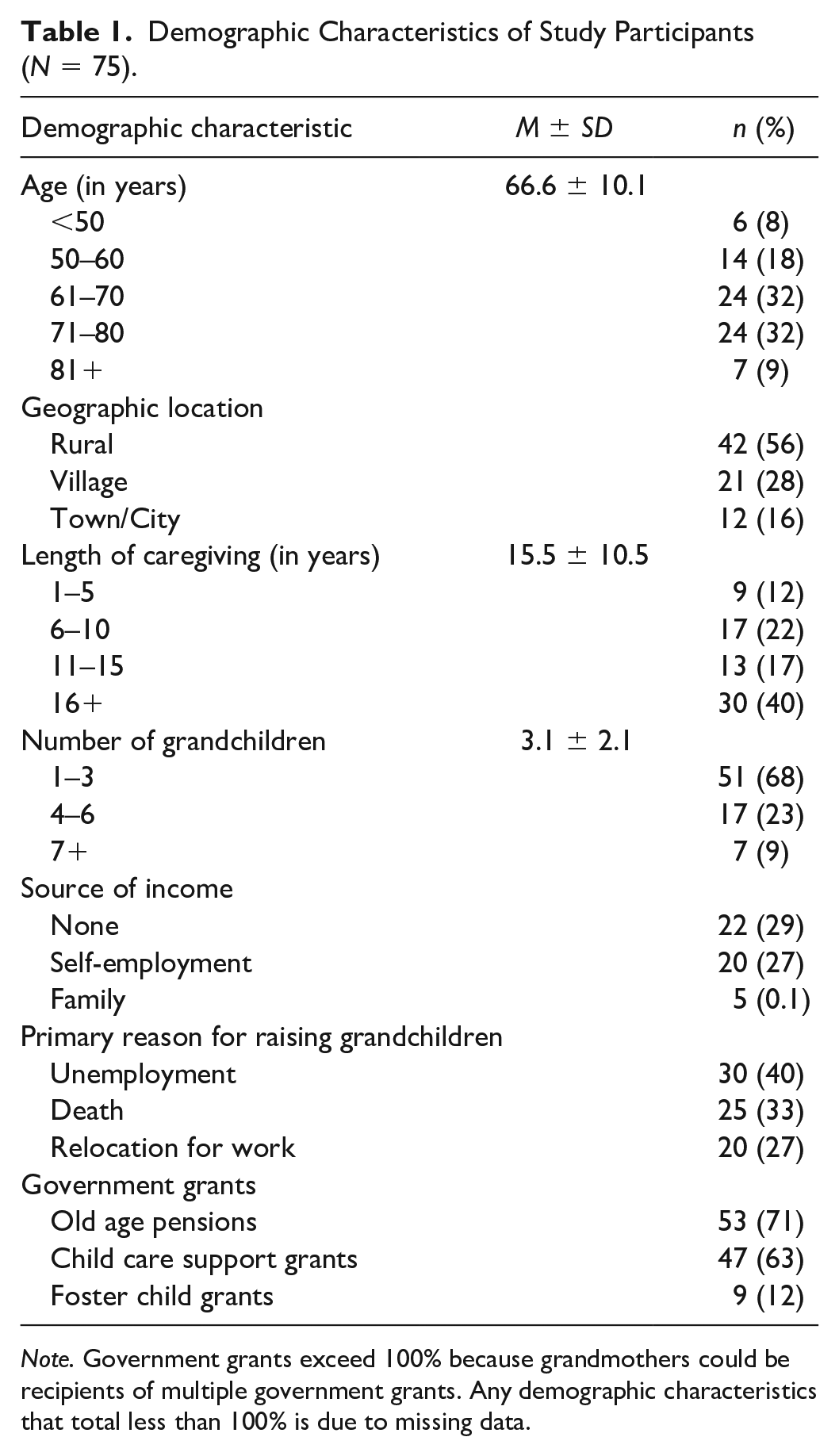
Note. Government grants exceed 100% because grandmothers could be recipients of multiple government grants. Any demographic characteristics that total less than 100% is due to missing data.
Procedure
Upon receiving Institutional Review Board authorization, the researchers obtained study approval from the luncheon club leadership. In consultation with key community partners, we developed data collection procedures and scheduled data collection sessions during the luncheon clubs’ usual meeting times. On the day of data collection, we informed the grandmothers in attendance about the study and that they could volunteer to participate. Two-person teams of trained South African and American college student researchers collected data in Setswana (n = 25; 33%) or English (n = 50; 67%), per the participants’ preference. Research teams’ training involved extensive instruction and practice with obtaining consent, effective interviewing techniques, research ethics, and transcribing participant responses in a detailed and accurate manner, as audio or video recording of the interviews was not possible (Patton, 2002).
First, the research teams read the informed consent document to the grandmothers, who then gave their verbal and written consent for participation. After the consent process, the participants completed the structured interview in semiprivate rooms at the luncheon clubs. We could not close rooms off completely as some lacked doors, but ambient noise provided some privacy. Interviews lasted between 20 and 30 minutes to accommodate the number of interested participants, the availability of the luncheon club space, and to reduce participant burden. We did not compensate the participants, as the key community partners deemed this potentially coercive.
After the interviews, the research teams combined their interview notes to create a complete transcription of each interview. Consensus resolved any discrepancies in the transcriptions, which were minimal. Pairs of bilingual local researchers translated Setswana interviews into English then back-translated to ensure accuracy of the transcriptions.
Interview Protocol
The structured interview protocol for the larger study consisted of a series of demographic and open-ended questions. We developed this protocol in consultation with South African university and community partners to assure that the interview questions were culturally appropriate and understandable by the study participants. A bilingual South African university partner translated the interview into Setswana and community partners then reviewed it for accuracy.
The first section of the interview protocol focused on demographic data including the guardian’s age, living arrangements, number of grandchildren under their care, and length of caregiving. Household questions covered sources of income, whether they received government grants, and household composition. The second section of the interview covered their challenges, needs, and sources of strength and resilience while raising their grandchildren. Specific to this particular study, the third part of the interview protocol focused on how and where custodial grandmothers sought assistance for various types of personal and family challenges. Example interview questions included, “What types of services or supports would be helpful to you?” and “When you need help with a problem, where and to whom do you usually go for help? How helpful are they?” Specifically, the study examined where they would go for help with financial, legal, medical, psychological, child behavior, educational, social, and family problems.
Data Analysis
Thematic analysis (Braun & Clarke, 2014) guided the data analysis process. The first and second authors began the analysis by reading and rereading the interview transcripts multiple times. They noted significant ideas or meaning units related to the types of assistance that grandmothers needed, and where they went for that assistance in response to personal and family challenges. After this process, we organized the emerging codes into specific themes. With these themes identified, we added bonding, bridging, and linking capital (Szreter & Woolcock, 2004) as sensitizing concepts. We organized all the inductively derived themes into higher-order groupings based on our guiding theoretical framework, namely in accordance with the concepts of bonding, bridging, and linking capital (Szreter & Woolcock, 2004).
Throughout the data analysis process, we utilized several strategies to ensure trustworthiness (Polit & Beck, 2014). First, we enhanced the credibility and confirmability of the analysis using two coders (Creswell & Poth, 2018). The coders resolved any coding discrepancies, which were minimal, via collaborative discussion and consensus building. Using peer debriefing with the third author, we considered multiple interpretations of the data, and further enhanced the credibility of the analysis. As we prepared transcripts, our university and community partners indicated that the larger study findings reflected their experience with custodial grandmothers in the community. This provides evidence for the transferability of study findings (Creswell & Poth, 2018).
Results
Findings suggest that all grandmothers use at least one of the three (i.e., bonding, bridging, and linking) types of social capital (Szreter & Woolcock, 2004) to ensure their and their family’s well-being. Bonding (i.e., nuclear and extended kinship ties, friends, and neighbors) and bridging (i.e., clergy, church members, social club leaders, and members) capital is most frequently used. The emotional and instrumental support thus provided is critical to their ability to meet their and their grandchildren’s basic survival needs. Linking capital (i.e., professionals and public institutions) is also a crucial source of instrumental and informational support for their legal, educational, financial, and health challenges. However, such support is often unreliable and inadequate. In terms of how they access and use their social capital, grandmothers described an inside-out pattern; they preferred seeking assistance from close relatives first before reaching out to neighbors, community leaders, and government officials.
Bonding Social Capital
Family members
Seventy-three (97%) grandmothers reported receiving instrumental (i.e., financial) and/or emotional support from family members. In this way, close relatives (e.g., husbands, sons, daughters, grandchildren’s fathers, etc.) were pivotal contributors to their financial, social, physical, and psychological well-being. In terms of instrumental support, for example, when asked about her source of income, one grandmother explained that her children sent money each month for household spending. Relatives often pooled resources, including money, food, and clothing, to assist them. Through a collective family effort, relatives also paid for larger, periodic expenses such as health care and children’s school fees. That said, they also recognized that, due to unemployment or low paying jobs, not all relatives had the financial means to help. In one grandmother’s words, “if it were possible to ask for help, I would. But it is not possible because everyone needs money . . .”
Although receipt of instrumental support from family members was critical for grandmothers’ basic survival needs approximately a third (n = 24; 32%) of the participants preferred financial independence, if possible. These older adult guardians, motivated by their pride and a desire for self-sufficiency, strived to pay their own expenses and only asked for help from relatives during financial emergencies. In addition, some relatives expected them to repay borrowed money, which further incentivized their financial independence. When asked about whom she approached for help, one grandmother explained, “[I] try to solve it myself . . . when desperate, I go to my brother to lend me money, but I must repay it.” For many of this demographic, repayment of loans is difficult, if not impossible.
Beyond instrumental support, family members also provided emotional support. Relatives often visited (or called) to check on their welfare and that of their grandchildren. During such visits, grandmothers talked about the challenges of raising their grandchildren and brainstormed potential solutions. One observed that such discussions allowed her mind to “cool off.” Others indicated that they also prayed with their relatives during stressful times and that this helped them cope.
Friends and neighbors
Some grandmothers (n = 19; 25%) explained that close friends and neighbors filled in where family members were unable to provide support. Friends and neighbors provided informational and emotional support when they felt overwhelmed by their parenting responsibilities or needed assistance with specific problems. For example, grandmothers often turned to friends and neighbors for advice on school procedures, health concerns, handling family conflicts, managing child behavioral problems, and accessing government welfare grants.
In times of need, friends, and neighbors also provided instrumental support to the grandmothers. This often took the form of exchanging goods and services. Some of them worked on neighbors’ farms in exchange for farm produce or school supplies for their grandchildren. They also traded basic goods and household necessities in a reciprocal manner. For example, one grandmother shared, “[There’s] not always enough food and soap. We have to get support from neighbors or borrow to give back later.” In rare and emergency cases, grandmothers sometimes asked friends or neighbors for small financial loans. One grandmother went to the “neighbors and borrowed money to buy anything” she ran out of. Such loans address immediate family needs such as food, electricity, medicine, and clothes. Thus, while friends and neighbors primarily offered informational and emotional support, in times of emergency they could be called on for urgent instrumental support.
Informal self-help groups
Some (n = 28; 37%) banded together with other custodial grandmothers to form self-help groups. One explained, “I have made a club of 22 grannies in my neighborhood. When we have something, we get together and we pray and offer up what we have. We even go together to see the municipal counselor.” These informal self-help groups provided grandmothers with various types of support. Some provided instrumental support, such as microloans to members who then paid the money back when they could. Other groups “came together to raise funds to buy groceries” to share among the members. Providing each other with emotional support and companionship was also central to the groups. “Going out for tea” was common practice, at which time they exchanged parenting ideas, planned school visits, and discussed personal problems. To these grandmothers, such informal self-help groups enhanced reciprocity within the community and the practice of supporting one another in the face of limited resources.
Luncheon club peers
All (N = 75; 100%) grandmothers benefited from weekly lunches and social activities organized at a local community space. We identified two significant benefits. First, lunch meetings provided companionship and informational support. One explained how meeting attendance benefited her well-being: “Coming together with other peer groups keeps away lonely feelings. Workshops are also provided to help cope with old age.” Participation in the luncheon clubs also provided them with emotional support that helped alleviate mental health and social problems related to raising their grandchildren. When asked how she deals with her grandchild’s school and behavioral problems, one participant explained that she “talks to the other grandmothers at the luncheon about how to handle different needs of the children.”
Bridging Social Capital
Spiritual leaders and church members
Pastors and church members provided instrumental and emotional support to the grandmothers (n = 15; 20%). Prayer was the most essential and common type of support offered. To illustrate, when asked how she dealt with her grandchild’s behavioral problems, one participant articulated that she asked the Catholic priest to pray and visit with the family. Spiritual leaders provided additional emotional and informational support by intervening when grandmothers experienced conflict with their grandchildren. Relatedly, participants relied on spiritual leaders for counsel related to family conflict. Beyond the support offered through prayer and counsel, a handful of poorer grandmothers also received instrumental support from spiritual leaders and church members in the form of school supplies and money for their grandchildren’s gifts.
School principals
School principals primarily provided emotional and informational support by assisting grandmothers with difficulties related to their grandchildren’s academic performance and behavioral problems at school. Almost all participants mentioned (n = 71; 95%) discussing their concerns and possible solutions with the school principals. They described having resolution meetings, pursuing opportunities for remedial work for their grandchildren, and obtaining counseling to address behavioral matters. Outside of school-related issues, two grandmothers also received instrumental support from school principals. For instance, one stated that she went to the school principal for everything, even borrowing money for a grandchild’s funeral.
Linking Social Capital
Government assistance
Government-funded child support grants (n = 46; 62%), foster child grants (n = 9; 12%), and old age pensions (n = 53; 71%) were significant sources of instrumental (i.e., financial) support. For example, one grandmother stated that child support grants were instrumental in “assisting with uniforms and other education expenses.” Generally, participants expressed satisfaction with the grants, as illustrated by one who said, “Any grant from the government helps. The child care grant helps to meet our needs.” However, a few grandmothers (n = 7; 9%) observed that government grants were insufficient. One even explained that, “money from child care grants was not enough” to meet their needs and suggested that the grants should be supplemented with “food parcels.”
They also used their old age pensions as a means of financially supporting their families. However, they frequently commented that the amounts of pensions was insufficient: Pension money is not enough to raise a child and other needs the kids have. If parents are not working, I am fully responsible for child’s needs. Other people feel that pension should be enough—they assume the pension is only for me.
While grants and pensions were critical sources of financial support, the application process was cumbersome. One participant expressed her frustrations because the application process required “multiple papers” and each time she returned, “they need(ed) more from her.” Despite needing assistance, she eventually abandoned her attempt to secure grants for which she was eligible.
Public workers
Public workers, including social workers and government officials, are an integral part of the demographic’s social capital. For example, social workers provided informational support by helping grandmothers file paperwork for government assistance and by providing health information and parenting advice. They also provided critical emotional support, by meeting with them to discuss their mental health issues and find solutions. Some participants (n = 10; 13%) also relied on government officials such as village chiefs, mayors, and police for informational assistance, keeping them informed on government policies and their legal rights. Grandmothers also presented policy grievances to their local government officials, as illustrated by one who complained, “I don’t know why people don’t help us. . .”
Discussion
This study employed a social capital framework (Szreter & Woolcock, 2004) to explore how black South African grandmothers accessed and used various types of social capital (i.e., bridging, bonding, and linking) to meet their and their family’s needs. Previous studies of this demographic reveal that grandmothers access a variety of personal and community resources to help meet their needs and those of their grandchildren (Casale, 2011; Dolbin-MacNab et al., 2016; Nyasani et al., 2009), fostering survival amid severe personal and socio-economic challenges. What was less clear, however, were the sources, types, and patterns of social capital utilization among these caregivers. Our findings offer evidence that grandmothers obtain companionship as well as instrumental, emotional, and informational support via each of the types social capital and that these supports helped ensure family survival and enhanced their well-being.
Specifically, our findings illustrate that grandmothers strategically use all three types of social capital (i.e., bonding, bridging, and linking) to manage varied challenges associated with raising their grandchildren. The types of challenges and support needs often dictate where and when they sought help. Our findings revealed that these matriarchs use the various types of social capital in an “inside-out” pattern. This means that they often start with the bonding capital (i.e., assistance provided by relatives, friends, and neighbors) before tapping into bridging (i.e., support from principals and church leaders) and linking capital (i.e., help from government representatives, public health officials, and leaders from other public entities). However, this pattern is sometimes altered out of pride or a desire be self-sufficient, and when grandmothers realize that relatives and family members might not been in a position to help, especially in terms of instrumental support (e.g., financial resources, goods, etc.). In these situations, grandmothers might first access support via sources of bridging and linking capital. By identifying this pattern, this study extends our previous work (Dolbin-MacNab et al., 2016) by highlighting how this demographic strategically uses its social capital to meet daily needs.
Bonding capital is their most frequently used form of social capital. Family, friends, and neighbors are critical providers of emotional and instrumental supports, which is consistent with studies revealing that Sub-Saharan African grandmothers with scarce government support are forced to rely on informal sources of assistance and support when raising their grandchildren (Freeman & Nkomo, 2006; Govender et al., 2012). Participants in our study describe bonding capital as an easily accessible way to meet their basic survival needs, though poverty among friends and relatives often reduces the amount of available instrumental support. Nonetheless, sources of bonding capital continue to be critical in terms of providing them with emotional support related to the challenges of raising their grandchildren, which further enhances their sense of well-being.
Bridging capital also helps grandmothers provide for their grandchildren, especially when relatives are unavailable or when the issue requires a certain degree of expertise (i.e., informational support) to find solutions. School principals could help address children’s behavioral and academic problems, given their expertise and daily contact with them. Interestingly, our data also reveal that some principals also provide grandmothers with instrumental support in the form of loans. Principals going beyond the scope of their responsibilities have proven to be critical for the development of poor black South African students (Theron & Theron, 2014). Similarly, spiritual leaders are also integral sources of emotional support, as they help grandmothers cope with the stress of raising their grandchildren. For participants in this study, the reliance on school principals and spiritual leaders aligns with bonding capital literature indicating that socioeconomically disadvantaged groups often reach out for help from individuals or groups with more power than themselves (Lin et al., 2001).
Grandmothers conceptualize linking capital as a critical means for addressing legal, educational, financial, and health challenges. The informational and emotional support from social workers and instrumental support from government grants are critical to their survival and well-being, but the financial resources associated with the grants are frequently inadequate. These findings confirm previous research suggesting that government grants, while designed to be helpful, often involve complex enrollment procedures and are fraught with misinformation (Hlabyago & Ogunbanjo, 2009). As such, grandmothers seem to prefer seeking financial help from their relatives first. Conceptually in line with the social capital literature, such practices may result in grandmothers underutilizing available linking and bridging capital (Kawachi et al., 2012).
Limitations
While this study contributes to the understanding of how black South African grandmothers access and utilize social capital to meet their and their grandchildren’s needs, it has some limitations. First, it should be noted that the participants are members of two local luncheon clubs. As such, it is possible that they possess greater social capital than those who did not participate in the luncheon clubs. For example, the participants may have greater access to child care or more well-developed social networks than those who do not participate in the luncheon clubs. Second, even with trained local researchers collecting the data, some meaning may have been lost when translating the interviews from Setswana to English. Third, the brief nature of the interviews limits our capacity for higher-order data analyses related to factors that shaped the participants’ utilization of social capital. These limitations notwithstanding, our data allow for pattern identification in grandmothers’ utilization of social capital.
Implications and Future Directions
Our findings offer implications for research and guidance for practitioners who seek to alleviate the challenges experienced by black South African grandmothers when raising their grandchildren. In terms of future research, investigators should explore how various types of social capital influence grandmothers’ psychosocial well-being. For example, given the prominence of bonding social capital, and systematic data collection, using standardized measures of well-being and following participants longitudinally, would allow explanatory analyses linking utilization of bonding social capital with the mental and physical health of custodial grandmothers.
Regarding implications for policy and practice, initiatives to mitigate the vulnerability of grandmothers should target agents within their bonding, bridging, and linking networks. For instance, local governments making small investments in social worker–led parenting and mental health workshops via local peer groups could strengthen and amplify peer-to-peer support, thereby increasing access to valuable parenting and health information. Alternatively, training initiatives can provide local leaders (such as spiritual leaders and school principals) with counseling skills to better support grandmothers. Supplements to government grants or the addition of food parcels for grandmothers would help address grandmothers’ basic needs. Furthermore, simplifying the grants application process could result in enrollment of a greater proportion of the targeted beneficiaries. Although inherently informal, the formation of self-help groups may also be promoted by health professionals and government officials who could offer ideas for collective resource exchange and mutual support.
Conclusion
In sum, our study reveals that the social capital framework (Szreter & Woolcock, 2004) offers a useful tool for understanding the source, types, and patterns of social support used by black South African grandmothers when raising their grandchildren. We provide examples of how grandmothers skillfully use and sequence bridging, bonding, and linking social capital to meet their needs and those of their grandchildren. In particular, they are intentional in terms of using supports in their immediate surroundings (i.e., bonding capital) before looking for support elsewhere. Findings highlight research, policy, and practice implications for this and similar settings around the world where grandmothers accept responsibility for raising children with limited personal, familial, and public resources. Even small changes that grow and ease access to bridging, bonding, and linking capital may further benefit custodial grandmothers and their grandchildren.
Footnotes
Acknowledgements
The authors would like to acknowledge the data collection assistance of Julia Aloe, Alexis Cunningham, Britanee Hodson, Katie Lewis, Katlego Lobelo, Kedibone Mokhuane, Tebogo Israel Mowday, Kagola Obakeng, Mutle Onalenna, Miriam Piilonen, Donald Seleke, Leigh Serroka, Aletta Shabele, Kathryn Shaw, Kelly Skahan, Anjelica Smith, Sarah Terrell, Sarah Tianti, Kutlwano Tigele, Nosizwe Tshabalala, Phutiyagae Tshepo and Monokwe Yvonne. They also convey their heartfelt appreciation for the valuable insights of Innocentia Saane, and the support of the luncheon club management committees. Finally, they extend their gratitude to the grandmothers who were so willing to talk with them and share their stories.
Declaration of Conflicting Interests
The author(s) declared no potential conflicts of interest with respect to the research, authorship, and/or publication of this article.
Funding
The author(s) disclosed receipt of the following financial support for the research, authorship, and/or publication of this article: This study was funded by the Center for Gerontology at Virginia Tech. The financial supporter did not participate in the design and execution of the study, nor the process of writing this paper.
Ethical Approval
This study was approved by the Institutional Review Board at Virginia Polytechnic Institute and State University (VT-IRB-12-537) and Research Ethics Committee of the North-West University, Mafikeng Campus (NWU-00119-14-s9).
HIPAA Identifiers
No individually identifiable health information was used in this paper.
