



Abstract
Intimate partner violence (IPV) often includes economic abuse as one tactic commonly used by an abuser; unfortunately, there is a lack of empirical understanding of economic abuse. Additionally, research is limited on the predictors of economic self-sufficiency in the lives of women experiencing IPV. This paper furthers our knowledge about economic abuse and its relationship with economic self-sufficiency by presenting the results from an exploratory study with IPV survivors participating in a financial literacy program. Of the 120 individuals who participated in the first wave, 94% experienced some form of economic abuse, which also correlated highly with other forms of IPV. Seventy-nine percent experienced some form of economic control, 79% experienced economic exploitative behaviors, and 78% experienced employment sabotage. MANOVA results also indicated that economic control differed significantly based on education with those with a high school education experiencing higher rates than those with less than high school education or those with some college. Finally, results from the OLS regressions indicated that experiencing any form of economic abuse as well as economic control significantly predicted a decrease in economic self sufficiency. Implications suggest that advocates should assess for economic abuse when working with survivors and should be prepared to offer financial tools to increase survivors’ economic self-sufficiency. Policymakers should understand the ramifications of economic abuse and create policies that support survivors and prohibit economic abuse. Finally, more research is needed to fully understand economic abuse and its impact on survivors and their economic self-sufficiency.
Intimate partner violence (IPV) often includes economic abuse as one of the tactics commonly used by an abuser to control his 1 partner (Tjaden & Thoennes, 1998). Unfortunately, economic abuse remains largely misunderstood in our society, as demonstrated by a recent poll of households in the United States where very few individuals even connected the term “economic abuse” with IPV, linking it instead to the recent Wall Street financial crisis (www.clicktoempower.org). Indeed, most researchers focus on physical IPV with some attention to emotional abuse; it has only been in the past few years that researchers have hypothesized how to measure economic abuse as a separate construct (Adams, Sullivan, Bybee, & Greeson, 2008; Outlaw, 2009). In addition, research is limited on the predictors of economic self-sufficiency in the lives of women experiencing IPV. Hence, the purpose of this article is to present findings from an exploratory study that sought to learn more about the prevalence and role of economic abuse in the lives of IPV survivors as well as its relationship to psychological and physical abuse. We begin by defining economic abuse by presenting the existing, albeit limited, literature on the consequences of economic abuse; briefly explore economic self-sufficiency; and discuss a rationale for addressing economic abuse. Results from this study are then presented followed by a discussion of its implications for future research and practice directions.
What is Economic Abuse?
For years, researchers have relied on multifaceted theories to fully grasp and define IPV. Coercive control theory (Stark, 2007) suggests that an abuser is one who attempts to establish power and control over his partner in a methodical and insidious manner using a variety of tactics to maintain such control. These tactics may include the use of physical or sexual violence through threats, use of force, or other physically or sexually violent acts. In addition, an abuser often uses emotional or psychological abuse to belittle, demean, isolate, and humiliate his partner with the goal of forcing her to become dependent on him and him alone. Over time, according to marital dependency theory (Vyas & Watts, 2009) and the interdependence theory (Rusbult & Van Lange, 2003), women who become or are forced to become dependent, especially economically dependent, are at greater risk of being mistreated or exploited and are less likely to leave the abusive relationship (Bornstein, 2006; Strube, 1988). Hence, by making his partner economically dependent, the abuser controls her ability to become self-sufficient. This is accomplished by maintaining complete control over her money and other economic resources by making all financial decisions, reducing her ability to acquire, use, and maintain money, and/or forcing her to rely on him for all of her financial needs (Adams et al., 2008; Fawole, 2008).
Most of what is known about the prevalence of economic abuse comes from one or two questions included in larger studies that focus on physical or emotional IPV. For example, in one recent study that focused on identifying nonphysical abuse experiences using a secondary analysis of the National Violence Against Women Survey (NVAWS), results indicate that economic abuse was a rare phenomenon, occurring even less than physical abuse (Outlaw, 2009). The results also indicate that women experienced more economic abuse and physical abuse than men; additionally, the risk of experiencing physical abuse among those who also experienced economic abuse was 4.68 times greater than those who did not experience economic abuse. Unfortunately, the NVAWS only had one question on economic abuse, making the results from this study suspect.
In spite of our limited research on the prevalence of economic abuse, advocates have long known about the impact of economic abuse on survivors. From the research, most of what is known about economic controlling tactics used by abusers that affect women’s economic self-sufficiency comes from studies with welfare recipients, women living in poverty, those who are homeless, or women participating support groups for IPV survivors (Brandwein & Filiano, 2000; Brush, 2000; Moe & Bell, 2004; Raphael, 1996). Such research focused on identifying how such abusive tactics affect survivor’s work and self-sufficiency. For example, from several studies initiated after welfare reform, between 16% and 59% of women reported that their partner discouraged or prevented them from working (Allard, 1997; Sable, Libbus, Huneke, & Anger, 1999; Shepard & Pence, 1988). For those that do work, 35% to 56% reported they were harassed by their partners at their place of employment; 55% to 85% reported they were late, left early, or missed work completely as a result of abuse; 44% to 60% reported they were reprimanded at work for behaviors related to their abuse; and 24% to 52% reported they lost their job as a result of the abuse (Browne & Bassuk, 1997; Brush, 2003; General Accounting Office [GAO], 1999). Unfortunately, none of these studies were national in scope and instead, relied on convenience samples. However, these studies and more recent ones indicate that attempts at working and becoming self-sufficient have been correlated to an escalation in the intensity and frequency of abuse (Brush, 2003, 2004; Moe & Bell, 2004; Raphael, 2000; Riger, Ahrens, & Blickenstaff, 2000; Riger & Staggs, 2005). Other economic abuse tactics identified by researchers include running up credit or debt for the survivor, excessive gambling, or purposefully ruining credit scores with the intent of keeping her solely dependent on him for economic resources (Adams et al., 2008; Raphael, 1999; Tolman & Rosen, 2001). Finally, an abuser may use institutional barriers to reinforce his economic control and exploitation over his partner by relying on lower wages, fewer economic opportunities, and social welfare policies that hinder women, especially for those women with little to no economic security (Abramovitz, 1996; Moe & Bell, 2004; Sanders, Weaver, & Schnabel, 2007). Such experiences of abuse contributed “to their financial instability, poverty, and, for many, subjugation to the government’s ever-watchful eye under welfare” (Moe & Bell, 2004, p. 50). It is no wonder that economic concerns are among the top reasons survivors cite as to why leaving the abuser is so difficult (Sanders & Schnabel, 2006; Strube, 1988; Turner & Shapiro, 1986; Zorza, 1991).
Defining Economic Self-Sufficiency
Most researchers and practitioners who study welfare reform define economic self-sufficiency as the ability to maintain long-term employment with wages that keep individuals out of poverty (Alfred, 2005) and off of welfare rolls (Gowdy & Pearlmutter, 1993). This definition is viewed as restrictive and does not include the voices of women and their experiences of feeling economically self-sufficient (Gowdy & Pearlmutter, 1993). On the path toward economic self-sufficiency, women may encounter many barriers including poor labor market conditions such as a low wage market, high unemployment, and lack of jobs (Alfred, 2005; Danziger et al., 2000). Other barriers can be found as part of the cultural practices of workplace organizations such as the lack of employer support, inadequate training, mentoring, and coaching, and workplace discrimination (Alfred, 2005). Race and class can also present challenges for women seeking economic self-sufficiency due to perceived or actual experiences of racism and lack of sustainable living wages (Edin & Harris, 1999). Other barriers at the sociocultural level may include inadequate or unstable housing, or problems with access to child care or transportation (Alfred, 2005; Danziger et al., 2000; Handler, 1999). Finally, women may face personal barriers to economic self-sufficiency including the fear of change or failure, mental or physical health problems, the lack of social or financial capital, substance abuse, or IPV (Alfred, 2005; Danziger et al., 2000). While these studies cited focused primarily on welfare recipients who were struggling to achieve economic self-sufficiency, it is clear that economic abuse will only exacerbate these barriers, therefore making it more difficult for survivors to achieve economic self-sufficiency.
Societal gender roles may present barriers to women’s economic self-sufficiency as well. Finances are a gendered arena in our culture, with men typically socialized to take charge of money. Women face greater challenges managing their finances due to social conditioning that enforces women’s beliefs of their inability to manage money, resulting in a reliance on men to manage such complex skills (Anthes & Most, 2000). Such conditioning may vary depending on ethnicity or immigration or acculturation status; regardless, women, including those from ethnically diverse communities, are at the greatest risk of experiencing financial challenges and poor economic self-sufficiency (Johnson & Sherraden, 2007).
Hence IPV survivors may be at risk of experiencing economic abuse as well as face challenges achieving economic self-sufficiency. Usually, advocates who work with IPV survivors are only able to provide short-term, crisis-oriented services with a focus on helping them leave dangerous relationships, offering only limited help for restoring longer term career and educational opportunities (Chronister & McWhirter, 2003; VonDeLinde & Correia, 2005). However, economic advocacy is often considered a long-term service and, hence, becomes a challenge for advocacy organizations who may not be equipped to provide this service (VonDeLinde & Correia, 2005).
This article furthers our knowledge about economic abuse and its relationship with economic self-sufficiency by presenting the results from an exploratory study with IPV survivors participating in a financial literacy program. The research questions guiding this study include the following:
Research Question 1: What are the economic abuse experiences of a diverse group of IPV survivors participating in this financial literacy program?
Research Question 2: Is there a relationship between economic abuse and other forms of IPV?
Research Question 3: Are there differences in experiences of economic abuse according to demographic variables such as age, income, ethnicity, and education?
Research Question 4: Does economic abuse predict a decrease in economic self-sufficiency?
Method
This study is part of a longitudinal, exploratory study examining the impact of a financial literacy program with survivors of IPV. This program, entitled Moving Ahead through Financial Management, was created by The Allstate Foundation in partnership with the National Network to End Domestic Violence and was implemented across the United States in a number of shelter and advocacy organizations. The purpose of this financial literacy program is to give tools to advocates to help strengthen the economic self-sufficiency of survivors of violence. The curriculum is designed to help survivors gain an understanding of economic abuse and its impact, increase their knowledge of financial matters, enhance their confidence in managing their finances, and obtain tools and resources to rebuild their financial lives. Women were interviewed on three separate occasions over a period of 11 months. This article focuses on the economic abuse experiences of those who participated in this financial literacy program and responded to the study during the first round of data collected during the summer of 2008.
Participants
All of the participants were recruited through flyers distributed by advocates in domestic violence programs who facilitated groups and/or individual sessions utilizing the Moving Ahead through Financial Management curriculum. The 15 sites across 10 states had recently received financial support to implement this curriculum from The Allstate Foundation. Individuals at each site were invited to participate in the evaluation if they (a) were 18 years or older and (b) had attended at least one individual or group session during which the economic empowerment curriculum information had been shared. Participants were also recipients of a variety of supportive services typically available from domestic violence organizations including temporary shelter, transitional living, and nonresidential services.
One hundred twenty-one survivors of IPV participated in the first wave of this study (120 female, 1 male). The data collected from the lone male participant were removed leaving a total of 120 participants. Ages ranged from 18 years to 73, with a mean age of 39 (SD = 11.5). More than half the participants were White (55%), 20% were African American, 18% were Latina or Hispanic, and almost 8% identified as biracial, Native American, or some other racial identity. Almost half of the participants (49%) reported an annual income between US$0 and US$10,000, and a little more than a quarter of the participants (26%) earned an income between US$15,001 and US$25,000, whereas only 4% made more than US$35,000 a year. Most respondents had either completed high school (31%) or had some college education (38%).
Data Collection
Individuals interested in participating in the study completed an information sheet that requested personal contact information. These sheets were then collected by the advocates in each domestic violence agency and mailed to the research team using a self-addressed stamped envelope. The research team members had multiple years of experience working with survivors and were trained on the research protocol. Based on their experience, the team was acutely aware of the safety concerns of the survivors and took precautions to ensure all contact with survivors was conducted in a safe and sensitive manner. The research team called each potential participant to schedule a face-to-face interview or relied on advocates to assist in scheduling the interviews. Interviews lasted approximately 1hr and were conducted at various locations including, the domestic violence agencies themselves, libraries, and work readiness program offices. The survey was made available to the participants in both paper and online format through Zoomerang©, a web-based survey tool. The participants were given a choice of how they wanted to complete the survey. They were asked if they preferred completing the survey using a paper copy or the computer program. The majority of participants completed the survey using paper and pencil. All of the participants signed IRB approved consent forms prior to beginning the interview. A US$25 gift card was provided for participation in the evaluation, with additional incentives of US$35 and US$50 promised for subsequent interviews.
Measurements
The survey instrument was comprised of several validated or revised scales that measured economic abuse and other forms of IPV, and economic self-sufficiency. A community team comprised of representatives from The Allstate Foundation and NNEDV reviewed the instrument prior to its implementation.
Economic abuse
The Scale of Economic Abuse (SEA; Adams et al., 2008) identified the frequency of economic abuse the participants experienced in their relationships. Participants were asked to rate how often a partner had exhibited financially abusive behaviors in the last year or, if they were no longer with the partner, within the last year of their relationship. Participants indicated the frequency of these abusive activities using a 5-point scale with answers ranging from 1 (never) to 5 (quite often). The SEA is separated into two subscales to represent different types of financially abusive behaviors including (a) the Economic Control subscale (17 items) and (b) the Economic Exploitation subscale (11 items; Adams et al., 2008). Each subscale in this study demonstrated high internal reliability (Economic Control, α = 94; and Economic Exploitation, α = .92).
Because the SEA is a new scale and relatively untested, we determined that an exploratory factor analysis utilizing principal axis factoring should be conducted prior to using the two existing subscales in our analyses. From the EFA, the 28 items were reduced to 12 items comprising three factors named Economic Control (5 items), Employment Sabotage (4 items), and Economic Exploitation (3 items). The combined three factors accounted for 65.79 % of the total variance of economic abuse. Cronbach’s alpha indicated good internal consistency reliability for the 12-item SEA (α =.90) and its subscales, Economic Control (α =.88), Employment Sabotage (α =.86); and Economic Exploitation (α =.90).
Intimate partner violence
Intimate partner violence was assessed using a modified version of the Abusive Behavior Index (ABI; Shepard & Campbell, 1992). The original ABI includes 30 items and two subscales, Physical Abuse (10 items) and Psychological Abuse (20 items). For the current study, one item from the physical and four items from the psychological subscales were eliminated by the research team and community partners to eliminate items that were redundant and already captured in the economic abuse scale. Participants were asked to indicate how often a partner had committed specific abusive acts over the last year, or if they were no longer with the partner within the last year of their relationship. The survey used a 5-point scale with answers ranging from 1 (never) to 5 (very often). The ABI has exhibited good reliability and construct validity in previous studies (Shepard & Campbell, 1992). Both subscales demonstrated good internal reliability in the current sample (Physical Abuse, α = .91; and Psychological Abuse, α = .93).
Economic self-sufficiency
The Women’s Employment Network (WEN) Economic Self-Sufficiency Survey (Gowdy & Pearlmutter, 1993) is a 15-item scale that asks participants to indicate how often they have been able to accomplish financially related tasks over a period of time. An example includes “My current financial situation allows me to pay my own way without borrowing from family or friends.” Participants were asked to respond to these items based on their economic situation over the 30 days prior to the interview. Participants rated their level of financial self-sufficiency using a 5-point scale with answers ranging from 1 (no, not at all) to 5 (yes, all of the time) with possible scores ranging from 15 to 75. A mean composite was determined with a higher mean indicating a higher level of economic self-sufficiency and a greater knowledge and ability to accomplish financial tasks. One of the items was eliminated (afford decent child care) for this study because many respondents reported they either did not have children or did not have to pay for this type of care. The measure has shown a high level of reliability with a Cronbach’s alpha of .89. Internal reliability was also high with this sample at .93.
Demographics
Several demographic questions were also included in the interview such as age, gender, ethnicity, level of income, and education.
Data analysis
All data were imported from an Excel spreadsheet created by Zoomerang© and imported into SPSS 16.0. The data were then cleaned and spot checked to identify any discrepancy. Missing data were reviewed using SPSS Missing Value Analysis. Missing values were less than 3.5% across all variables. Little’s chi-square indicated that the missing variables were Missing at Random (MAR) and pairwise deletion was utilized. Descriptive statistics were run to determine the prevalence of economic abuse in the sample.
Correlations were used to test the relationship between economic abuse and other forms of IPV (psychological and physical). A MANOVA was conducted to test whether economic abuse experiences varied by demographics: age, ethnicity, income, and education. Finally, Ordinary Least Squares (OLS) regressions were run to determine if economic abuse predicted a decrease in economic self-sufficiency, controlling for age, income, ethnicity, and education. For the regression, the SEA was converted into a categorical variable (ever or never experienced economic abuse) along with each of its three factors (ever or never experienced control, sabotage, or exploitation). The use of dichotomous variables for the regression analyses was decided, considering the atypical study population recruited from domestic violence organizations. Since variations of economic abuse experienced by this study population may differ from those experienced by the general population, for example, it cannot be said that one unit difference in an economic abuse scale in this study population has the same meaning with that in the general population in predicting outcomes. Thus the use of dichotomous economic abuse variables would be conceptually valid in predicting economic self-efficiency for this particular sample. A regression was run with the SEA first, and then run with the three factors or subscales.
Results
Of the 120 individuals who participated in the study, 94.2% experienced some form of economic abuse in their current relationship or, if no longer with the abusive partner, within the last year of their relationship. Seventy-nine percent experienced some form of economic control, 79% experienced economic exploitative behaviors, and 78% experienced employment sabotage. Examples of economic exploitation tactics used by abusers as reported by participants included paying bills late (71%) or spending money needed for rent or bills (69%). Economic controlling behaviors most often experienced by the respondents included the following: partner demanded to know how money was spent (88%), and partner made important financial decisions without talking to them about it first (83%). Employment sabotage tactics experienced the most included having a partner do things to keep them from going to work (68%) and demanding that they quit their job (59%). Descriptive statistics including the means and percentages for the modified SEA are provided in Table 1.
Means and Percentages for the Modified Scale of Economic Abuse
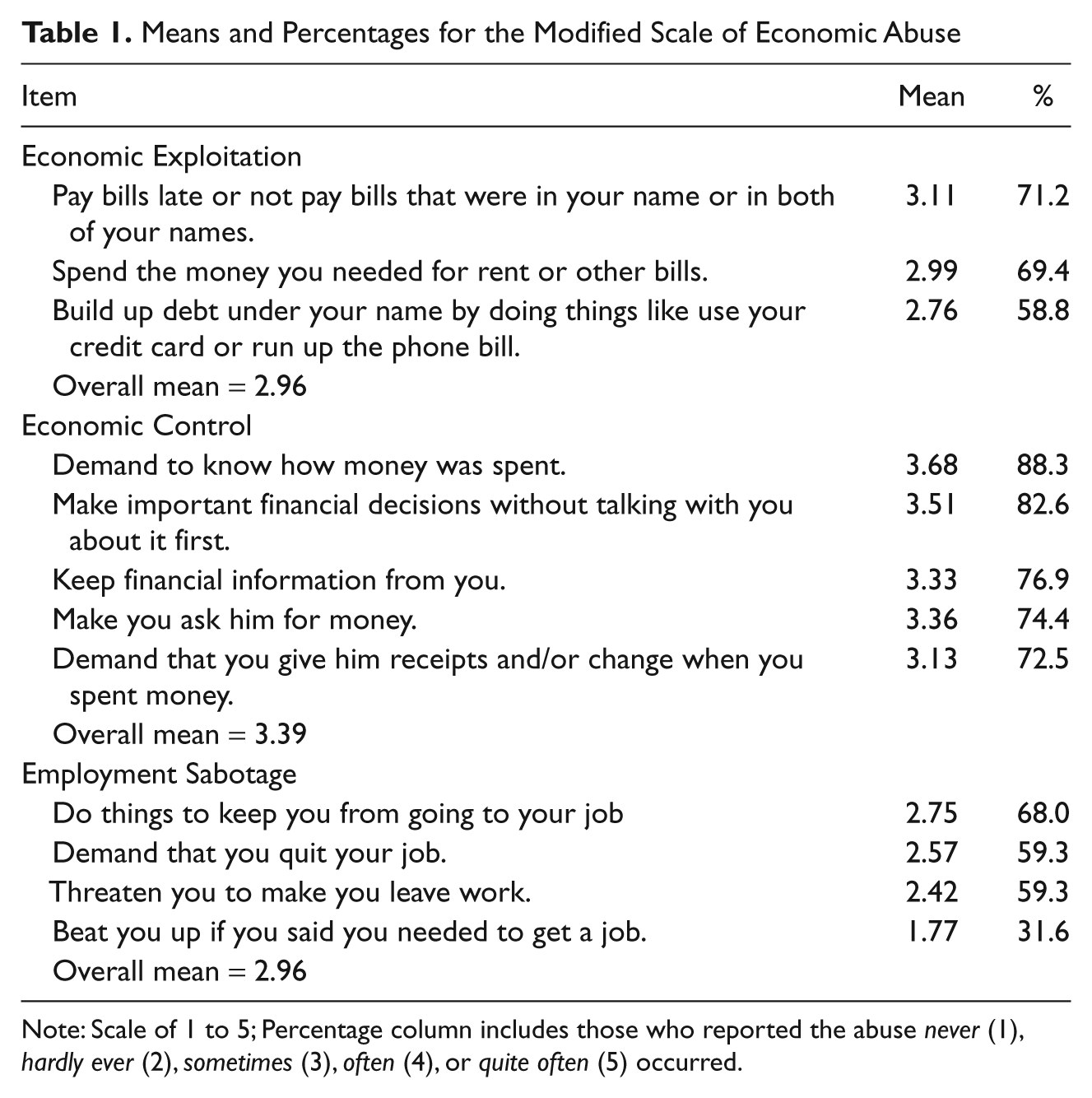
Note: Scale of 1 to 5; Percentage column includes those who reported the abuse never (1), hardly ever (2), sometimes (3), often (4), or quite often (5) occurred.
Correlations were run to test the relationship between the entire modified SEA and its three factors (Economic Control, Employment Sabotage, and Economic Exploitation) with other forms of IPV (Please see Table 2). Correlation analysis revealed that the modified total SEA was significantly and positively correlated with the total ABI and its subscales (physical and psychological IPV). Correlations between the three economic abuse factors and the other forms of IPV were also significant, ranging from .34 to .73. Hence participants who experienced physical and psychological abuse more frequently were also subject to more monitoring and restrictions related to the use of financial resources. In addition, the more frequent the abuser physically and psychologically abused a participant, the more the survivor was restricted from acquiring financial resources, by limiting opportunities. Finally, participants who experienced more frequent rates of physical and psychological abuse were prevented from maintaining their resources through the economic exploitation by their partner.
Correlations: Modified SEA, ABI, and Factors
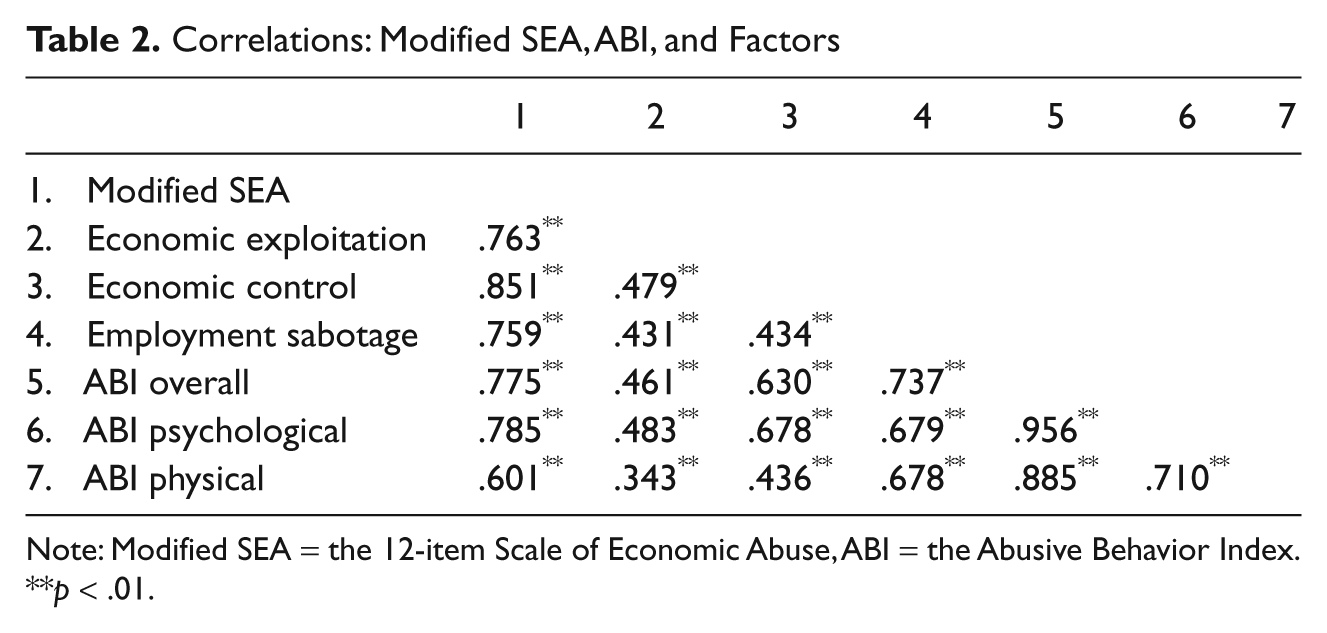
Note: Modified SEA = the 12-item Scale of Economic Abuse, ABI = the Abusive Behavior Index.
p < .01.
Multivariate Analyses of Variance was conducted to test whether economic abuse experiences varied by demographics, including age, ethnicity, income, and education. A significant difference was found between economic control based on education level, Wilks’s Lambda = .692, F(6, 92) = 3.10, p =.008, multivariate η2 = .17. Economic control marginally but significantly differed only minimally based on education, F(2, 60) = 3.08, p < .10. Tukey’s post hoc comparisons of the three education groups (some college or higher, high school, and less than high school) indicated that participants with high school education (M = 3.61) experienced higher rates of economic control than those with less than high school education (M = 3.45) and those with some college or more (M = 3.25). There were no significant main effects of income, age, and ethnicity.
Economic Self-Sufficiency
Two Ordinary Least Squares (OLS) multiple regressions were conducted to examine whether the modified total SEA and its factors would predict participants’ level of economic self-sufficiency while controlling for demographic characteristics (age, race, length of service, and income). The SEA, controlling for demographic characteristics, was found to be a significant predictor (B = −.85, p = .032) of economic self-sufficiency. Experiencing any form of economic abuse, compared to no economic abuse experienced, predicted .85 score decrease in economic self-sufficiency as measured by a 5-point Likert-type scale. Income and education were also significant predictors of economic self-sufficiency. The overall model significantly predicted economic self-sufficiency, F(12, 97) = 2.62, p = .005, with 16% of the variance explained by the model (adjusted R2 = .16). The detailed results are presented in Table 3.
OLS Regression for Economic Self-Sufficiency With the Modified SEA
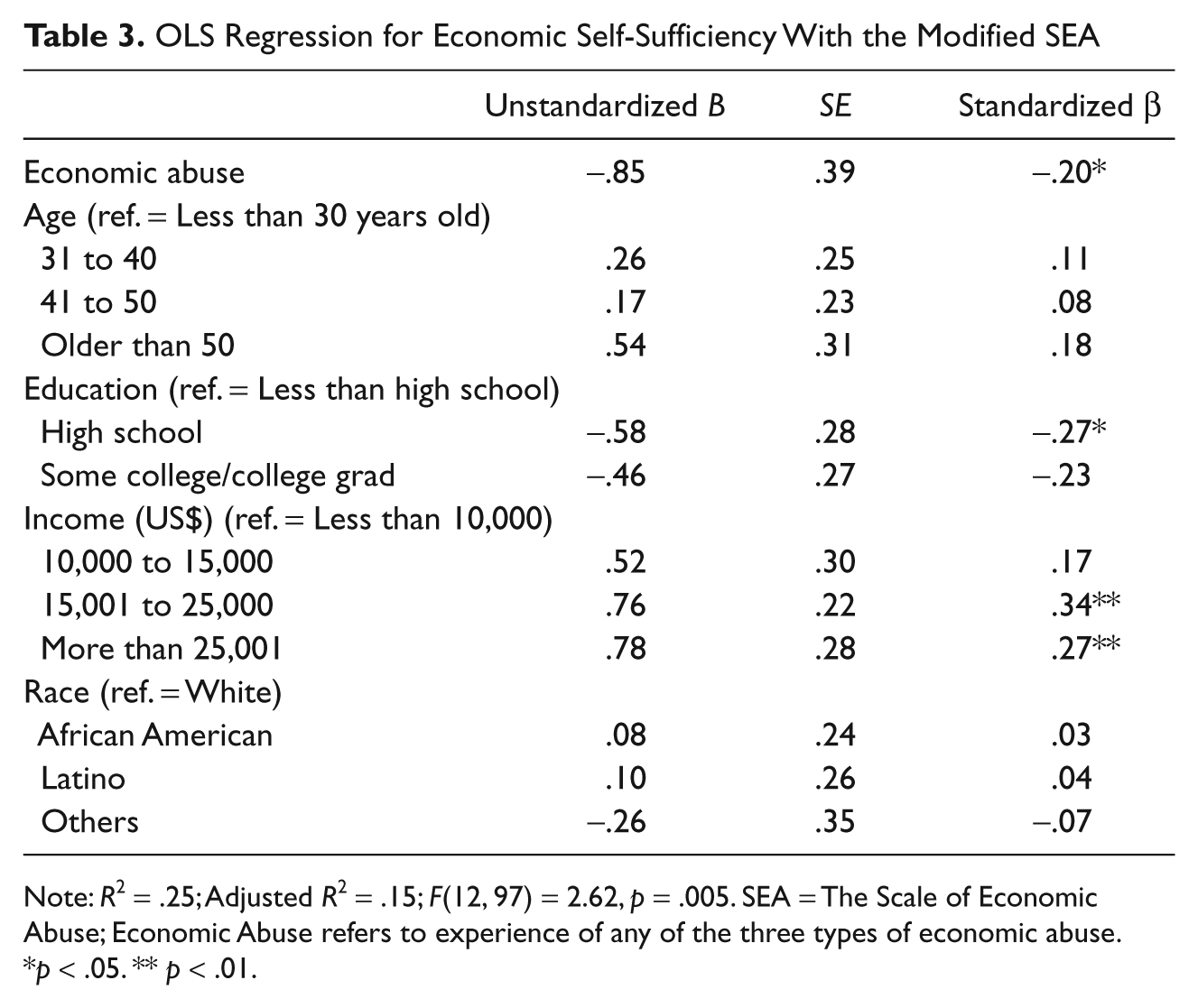
Note: R2 = .25; Adjusted R2 = .15; F(12, 97) = 2.62, p = .005. SEA = The Scale of Economic Abuse; Economic Abuse refers to experience of any of the three types of economic abuse.
p < .05. ** p < .01.
Economic Control, controlling for the other forms of economic abuse and demographic characteristics, was also found to be a significant predictor (B = −1.04, p = .018) of economic self-sufficiency. Experiencing economic control, compared to the counterpart, predicted 1.04 score decrease in the levels of economic self-sufficiency. Income was also a significant predictor of economic self-sufficiency. For example, compared to making less than US$10,000 annually, having an income between US$15,001 and US$25,000 was associated with .76 score increase (B = .76, p = .001) and having an income more than US$25,000 was associated with .80 score increase in economic self-sufficiency levels (B = .80, p = .006). The overall model significantly predicted economic self-sufficiency, F(14, 95) = 2.47, p = .005, adjusted R2 = .16. The detailed results are presented in Table 4.
OLS Regression for Economic Self-Sufficiency With the 3 Subscales of the SEA
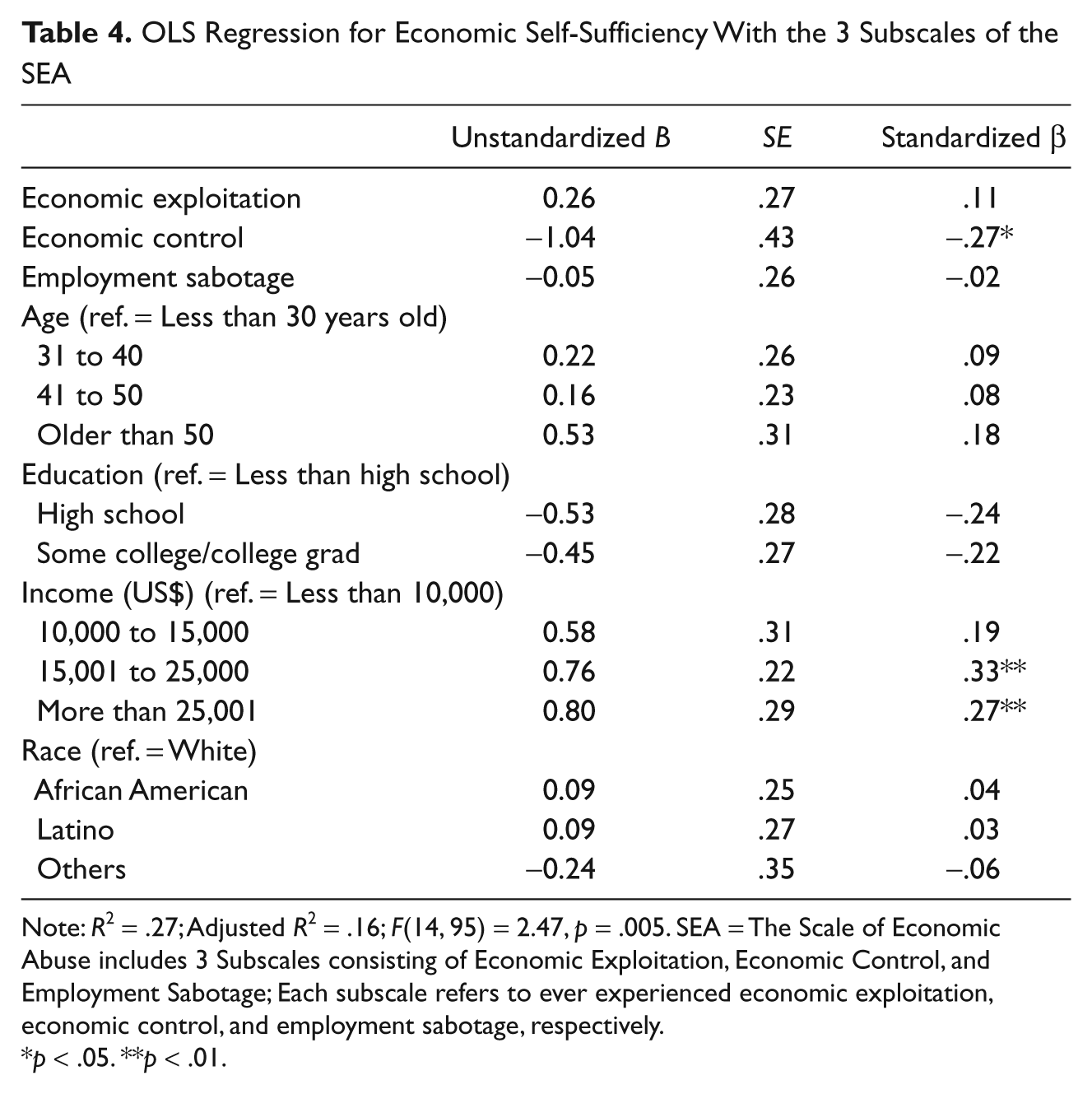
Note: R2 = .27; Adjusted R2 = .16; F(14, 95) = 2.47, p = .005. SEA = The Scale of Economic Abuse includes 3 Subscales consisting of Economic Exploitation, Economic Control, and Employment Sabotage; Each subscale refers to ever experienced economic exploitation, economic control, and employment sabotage, respectively.
p < .05. **p < .01.
Discussion
The results from this research provides us an exploratory understanding of economic abuse, its relationship with other forms of IPV, and its relationship with outcomes such as economic self-sufficiency. Almost all (94%) of the participants in this study experienced some form of economic abuse including economic controlling and exploitative abuse as well as sabotage to their work efforts. Such abusive tactics may propel survivors toward poverty, if not trapped already by poverty. The combination of abuse and poverty may force women to remain in their abusive relationships as well as keep their focus on basic economic survival (Raphael, 2000). Hence, such an overwhelming experience of economic abuse in this sample suggests that this abusive tactic needs to be recognized by practitioners in the field and included during the assessment of and response to IPV. Understanding that these behaviors are experienced by survivors will inform advocates on how best to enhance survivors’ economic self-sufficiency. Providing information on economic abuse and promoting economic justice as part of their advocacy will provide survivors with a greater understanding of how abusers control them economically. This knowledge may be a key in the prevention of future abusive relationships and intervention through identification in current relationships.
The multivariate analysis of variance (MANOVA) results show that there are marginally significant group differences between participants with no high school education, high school education, and college education in terms of economic control, such that those with high school education reported the highest level of economic control, and those with college education reported the least level of economic control. This may be because individuals with no high school education have fewer individual or family resources that can be controlled than individuals with high school education who are more likely to be employed, or employed at a higher pay. It is perhaps that the manifestation of the abuse is different for those without high school education, as they may not have a bank account, or any kind of wealth or property that can be confiscated, stolen, or otherwise used against them. The finding that individuals with a college education reported the least amount of economic control is aligned with the literature that suggests that higher education is a protective factor of domestic violence (Anderson, 1997; Gelles, 1993; Straus, Gelles, & Steinmetz, 1980); however, further research with nationally representative samples should be conducted to verify the veracity of these findings.
The modified SEA and its three factors were found to be significantly and positively related to the total modified ABI scale and both psychological and physical IPV. This finding emphasizes that abusers utilize multiple forms of abuse. By recruiting participants from domestic violence service providers, the expectation is that this sample would experience all forms of IPV; what is still unknown is whether survivors who have not turned to domestic violence organizations experience similar or different forms of IPV including economic abuse. More research is needed with additional samples of women not from domestic violence providers, to fully establish the relationship between these different types of abuse, including whether one type predicts another.
The study also provided information about how economic abuse relates to economic self-sufficiency. Economic control predicted a decrease in levels of self-sufficiency, which would be expected since having a partner control financial decisions by preventing access and participation would indeed decrease a survivor’s ability to reach economic self-sufficiency. The challenge then is to learn more about what specific services, materials, and resources will best empower survivors to reclaim control over their finances and ultimately reach economic self-sufficiency.
Curiously, race or ethnicity was not related to economic self-sufficiency, a result that contradicts other findings (Edin & Harris, 1999; Johnson & Sherraden, 2007). More research is needed to fully understand the role of race or ethnicity and the relationship with economic self-sufficiency among survivors of violence.
Several limitations must be considered when reviewing these results. This was a convenience sample of survivors receiving services from domestic violence service providers and participating in a financial literacy program. Hence, the results cannot be generalized to a larger population of survivors but only to those who participated in the study. Regardless, the results encourage more attention to economic abuse and economic self-sufficiency and will hopefully spur more research.
Implications
The experiences of these survivors provide us with an exploratory look at economic abuse as well as more information about other forms of IPV. Based on the strong correlations between economic abuse and other forms of IPV, advocates should assess for such abuse when working with survivors. Educating survivors about economic abuse tactics including those that are controlling, exploitative, or employment sabotage activities should be part of economic advocacy efforts of advocates. Advocates should also be prepared to offer financial tools and strategies in an effort to increase survivors’ economic self-sufficiency.
There is a pressing need for greater awareness of economic abuse not only at the service provision level but at the policy level. Problem recognition is the first step toward finding a solution, and advocates and researchers should help policy makers understand the ramifications of this problem and together form ways in which this can be alleviated. State and federal policies designed to support survivors can be expanded to acknowledge and prohibit economic abuse as well as allocate funding to support programs such as financial literacy curricula.
Finally, much more research is needed to fully detail our understanding of economic abuse in the lives of survivors and how such abuse hinders their ability to become free from further abuse. Included with this research should be an examination of the helpfulness and impact of participating in financial literacy programs.
Footnotes
Acknowledgements
The authors would like to acknowledge their collaboration with Rene Renick and Kim Pentico from the National Network to End Domestic Violence and their partnership with The Allstate Foundation in creating and implementing this financial literacy curriculum.
Points of view in this document are those of the authors and do not necessarily represent the official position or policies of The Allstate Foundation.
The authors declared no potential conflicts of interest with respect to the research, authorship, and/or publication of this article.
The authors disclosed receipt of the following financial support for the research, authorship, and/or publication of this article: This project was supported by The Allstate Foundation, Economics Against Abuse Program.