



Abstract
This study examines Merton’s Classical Strain Theory (1938) as a causative factor in intimate partner violence among college students. We theorize that college students experience general life strain and cumulative strain as they pursue the goal of a college degree. We test this strain on the likelihood of using intimate partner violence. Strain due to unrealistic expectations of intimate partnership and economic strain are also examined. The analysis examines the following causative factors representing strain: 1) the College Undergraduate Stress Scale (Renner & Mackin, 1998); 2) cumulative academic strain measured by college classification; 3) cumulative intimate partner strain measured as the length of time in the relationship; 4) academic strain measured by number of hours studied weekly, and 5) economic strain measured by number of hours worked weekly. Additionally, we examine the extent to which gender and race/ethnicity differentially affect intimate partner in the context of these measures of strain. The Conflict Tactics Scales II (Straus et al, 1996) are used to measure dating violence and include indicators for sexual coercion, physical aggression, injury, and psychological aggression. Data were collected from 142 students in lower-division classes from Texas Tech University. Results show that general strain and cumulative intimate partner strain increase the use of dating violence among college students. The longer dating partners are in a relationship, the higher the chances of psychological aggression, physical assault, and sexual coercion. Converse to our expectations, time spent working reduces psychological aggression due to reducing time spent together rather than reflecting economic strain.
Violence between dating partners is a consistently appearing social problem among college students with reported rates as high as 82% of students reporting using sexually coercive behaviors and 21% of students reporting using physically coercive behaviors (Jenkins & Aube, 2002; Russell & Oswald, 2002). Straus found that among students at 31 universities around the world, an average of 29% of respondents had used some form of physical violence against their partners, with these percentages ranging from a low of 17% to a high of 45%. Though much of this violence could be defined as “minor” assault (e.g., slapping), approximately 10% of the violence was “severe” (e.g., choking; Straus, 2004). Given that these any level of violence among college students is of great concern, it is important to better understand causes of dating violence. To this end, we examine Merton’s (1938) classical strain theory as a causative factor in intimate partner violence among college students.
The risk factors of family history, peer influences, personal beliefs, alcohol use and abuse, and psychological factors for intimate partner violence have been studied extensively. Higher levels of frequent alcohol consumption and the stronger the belief that date rape is a myth have been shown to increase use of intimate partner violence (Lee, Busch, Kim, & Hyunsung, 2007; Loiselle & Fuqua, 2007; Lysova & Hines, 2008). Research on the intergenerational transmission of violence has found that parenting and the psychological effects of early abuse increase the likelihood of dating violence (Gover, Kaukinen, & Fox, 2008; Rapoza & Baker, 2008; Simons, Burt, & Simons, 2008).
This study focuses on academic demands and expectations that have been found to be a consistent cause of stress among college students (Aldwin & Greenberger, 1987; Schafer, 1996; Tennant, 2002; Wright, 1967) but have not been researched as a causative factor in dating violence. We examine Merton’s (1938) strain theory as a causative factor in dating violence and propose that the strain of achieving a highly valued social and personal goal, such as a college degree, will increase the likelihood of violence in interpersonal relationships among college students.
Strain and Intimate Partner Violence
Merton’s (1938) strain theory proposes that a person unable to meet cultural expectations due to forces outside of his or her control will be more likely to commit a crime than someone who could meet cultural expectations within normal bounds. Strain is experienced by all persons as they strive to meet cultural expectations, thereby requiring continuous management and adaptation to strain. Merton offers several modes of adaption to strain one of which is innovative behavior that socially rejects approved ways to achieve a socially approved cultural goal. We maintain that violence is a form of innovation where a person uses force in an attempt to achieve goal fulfillment. The violence can be directed at the perceived source of uncontrollable circumstances or displaced onto a vulnerable target that would be unable or unlikely to reciprocate the violence in an attempt to maintain or regain control of his or her own circumstances. Either way, violence is an innovative attempt to manage strain in the course of attaining a socially desirable goal.
In addition, Merton (1938) argues that the primary U.S. cultural goal is economics, which makes the achievement of economic wealth a highly valued cultural expectation. Whereas earning a college degree is a highly valued cultural expectation per se, it is also requisite to gaining a high-paying job that would fulfill the expectation of economic wealth. Consequently, the pressure to fulfill the expectation of earning a college degree is great and persons striving to meet this expectation experience a good amount of strain.
Some theoretical works on understanding and preventing violence have found a causal connection strain and violence. Levin and Madfis (2009) found that strain is cumulative and that a combination of long-term “chronic” strain (e.g., inability to do well in school) and sharper “acute” or “catastrophic” strain (losing a job/loved one) work together to create a situation where mass murder is more likely. This would apply to other types of violence, including dating violence, where cumulative strain would increase the likelihood of intimate partner violence as an attempt to gain control over real or perceived chronic, uncontrollable circumstances. Strain is inherent in intimate partnerships as partners attempt to understand, fulfill, and negotiate the potentially unrealistic cultural expectations of intimacy and dependency (Smithey & Straus, 2003). Moreover, the more committed the partners become to the relationship, the more the partners become constrained by the other. This produces a higher degree of intimate partner cumulative strain, and, as Gelles’s and Straus’s (1979) “time as risk” theory suggests, the more time a person spends interacting with family members, the greater the chance of intrafamilial violence due to interpersonal exposure and the constraint of negotiated resources and activities.
A primary source of strain among college students is academic expectations. Galambos, Dalton, and Maggs (2009) found that academic classification, that is, freshmen, sophomore, junior, or senior, and time spent studying effect stress levels. Studying college freshmen, they found that the time spent studying and worrying over exam results in less sleep and more stress. We assert further that students also experience cumulative strain as they advance academically. The pressure to meet schedules and deadlines increases as students move into upper-division classification.
Research on gender and strain has shown that women are less likely to commit crimes because, from a strain perspective, they respond differently to stressors than men (Broidy & Agnew, 1997). Men are more likely to become angry and seek to correct perceived imbalances with violence or aggression, whereas women are more likely to turn that stress inwards and respond with depression and other self-blaming emotions such as shame or guilt. Brody and Agnew explain further that cultural goals are gendered also—that men and women hold different cultural goals. Men value economic success more than women do. Women value interpersonal relationship success more than men do. As such, it is reasonable to expect that women will show lower levels of perpetrating dating violence than men.
Sample and Procedure
Given the theoretical emphasis on earning a college degree as a high, strain-producing cultural expectation, the examination of college students is an appropriate target sample for this study. Self-administered questionnaires were distributed to 150 students in Texas. A total of 145 questionnaires were returned, yielding a 97% response rate. The mean age is 22.06 years, with a standard deviation of 3.55. The sample is 5% freshman, 15% sophomores, 35% juniors, and 45% seniors, 51% female, and 49% male. Racial diversity is relatively low, with approximately 10.5% African American respondents, 15.3% Mexican American, 62.5% Anglo American, and 11.7% Other race/ethnicity. Respondents were given these race/ethnic categories as a response set but were also given the option to describe their race/ethnicity if none of the categories represented their race/ethnic identity. The gender and race/ethnic sample characteristics are reflective of the university demographics.
Measures and Descriptive Statistics
Dependent variables
The Revised CTS II subscales of psychological aggression, physical assault, sexual coercion, and injury are used to measure perpetration of violence (Straus, Hamby, Boney-McCoy, & Sugarman, 1996). This study focuses on perpetration; therefore, the victimization measures in the CTS II subscales are not used.
The descriptive statistics for this study show that the most commonly used form of violence reported by the respondents is psychological aggression (79%), with respondents reporting at least one incidence of insulting or swearing at their partner or stomping out of the house or yard. The prevalence of physical assault is much lower, with 15% of respondents reporting this type of violence. In the cases of sexual coercion, there is a slight tendency (20%) to demand sex when the partner did not want to have it but not to use physical force. Finally, injury rates are the lowest among the types of violence, with 9% of respondents reporting something such as a bruise, sprain, or small cut. Broken bones or injuries requiring medical attention are the least likely to occur.
Overall, the sample has low rates of incidence. Psychological aggression has a low rate of occurrence (M = 6.60), physical assault (M = 1.19), and sexual coercion (M = 1.51) have a very low rates of occurrence, and injury is the least occurring type of violence (M = 0.39). To summarize, in this study participants are more likely to show psychological aggression than any other form of intimate partner violence. The prevalence and incidence for the other types of violence are lower, though any amount of intimate violence among youth is of concern. Data on the means and standard deviations for these scales are given in Table 1.
Conflict Tactics II Subscale Indicators and Descriptive Statistics

Independent variables
Strain is measured with the Renner and Mackin’s (1998) College Undergraduate Stress Scale (CUSS). The CUSS asks the respondent to check any events that he or she has recently experienced. These events range from general life stress events such as “Being raped” or “Contracting an STD” to college-specific events such as “Failed a test.” There are 51 events, and each is given a weighted numeric value, with “Being raped” being given the maximum value of 100 and “Attending an athletic event” given the lowest value of 20. In order to retain the established validity of the CUSS, all 51 items were retained though 2 items, being raped, and getting into a physical fight, potentially involve dating violence. Only 4% of the sample reported being raped, and 14% reported getting into a physical fight. For the purpose of this study, every student is assigned a minimum stress value of 58. This is in accordance with the item “Starting a new semester” on the CUSS in order to establish a baseline since all respondents were currently enrolled in college. For the sample in this study, the average level of stress is 1141.5 with a standard deviation of 587. The sample range is 2814 points, with a high of 2872 and a low of 58. The interquartile range is 915. In addition to the CUSS, academic strain is measured as the number of hours spent studying each week. The average for this variable is 10 hr per week and ranges 0 to 70, with a standard deviation of 9.24.
Academic cumulative strain is measured by student classification, and the sample consists of 5% freshman, 15% sophomores, 35% juniors, and 45% seniors. Intimate partner cumulative strain is measured as time spent in the relationship that varies from less than 1 month to 240 months with an average length of time of 11.8 months.
Control variables
One third of the sample has a job; 89% of the respondents report varying levels of income. The lowest income reported per month with a mean of US$752 and a standard deviation of US$658 per month. This variable does not directly address the strain of working paid labor for support but does reflect the amount of strain associated with economic resources. Among the respondents with a job, the average time spent working per week is 26 hr with a range of 10 to 60 hr. Due to low variation, race/ethnicity is dichotomized into nonminority (defined as non-Hispanic White) and minority with 38% of the sample being minority.
Bivariate Analysis
Of the variables examined in this study, two are related to dating violence at the bivariate level (Table 2). Life stress has a significantly weak relationship to psychological aggression. The amount of time spent in the relationship has a stronger effect than life stress on psychological aggression and has a weak effect on physical assault and sexual coercion.
Bivariate Regressions: Conflict Tactics Subscales on Life Stress Length of Relationship

p ≤ .05. **p ≤ .01. ***p ≤ .001.
Multivariate Analysis
Psychological aggression. The multivariate regression shows the research and control variables explain 14% of the variance in psychological aggression. The conditional effects of life stress, number of months in the relationship, and the number of hours worked to earn income effect the prevalence of psychological aggression (Table 3). Life stress is a significant but weak predictor of psychological aggression. Length of the relationship has a small, positive effect on psychological aggression meaning that having experienced recent life stress and being in a relationship longer increase the likelihood of a student using psychological aggression. An increase in time spent working to earn income reduces psychological aggression.
Physical assault, sexual coercion, and injury. Time spent in the relationship has a significant, positive effect upon a student’s likelihood of committing physical assault or of using sexual coercion. None of the independent variables had an effect on a person’s likelihood of causing injury. This may be due to the low variance of injury reported.
Multivariate Regression of Dating Violence on Life Stress, Relationship Length, Classification, Hours Studied, Hours Worked, Income, Gender, and Minority Status
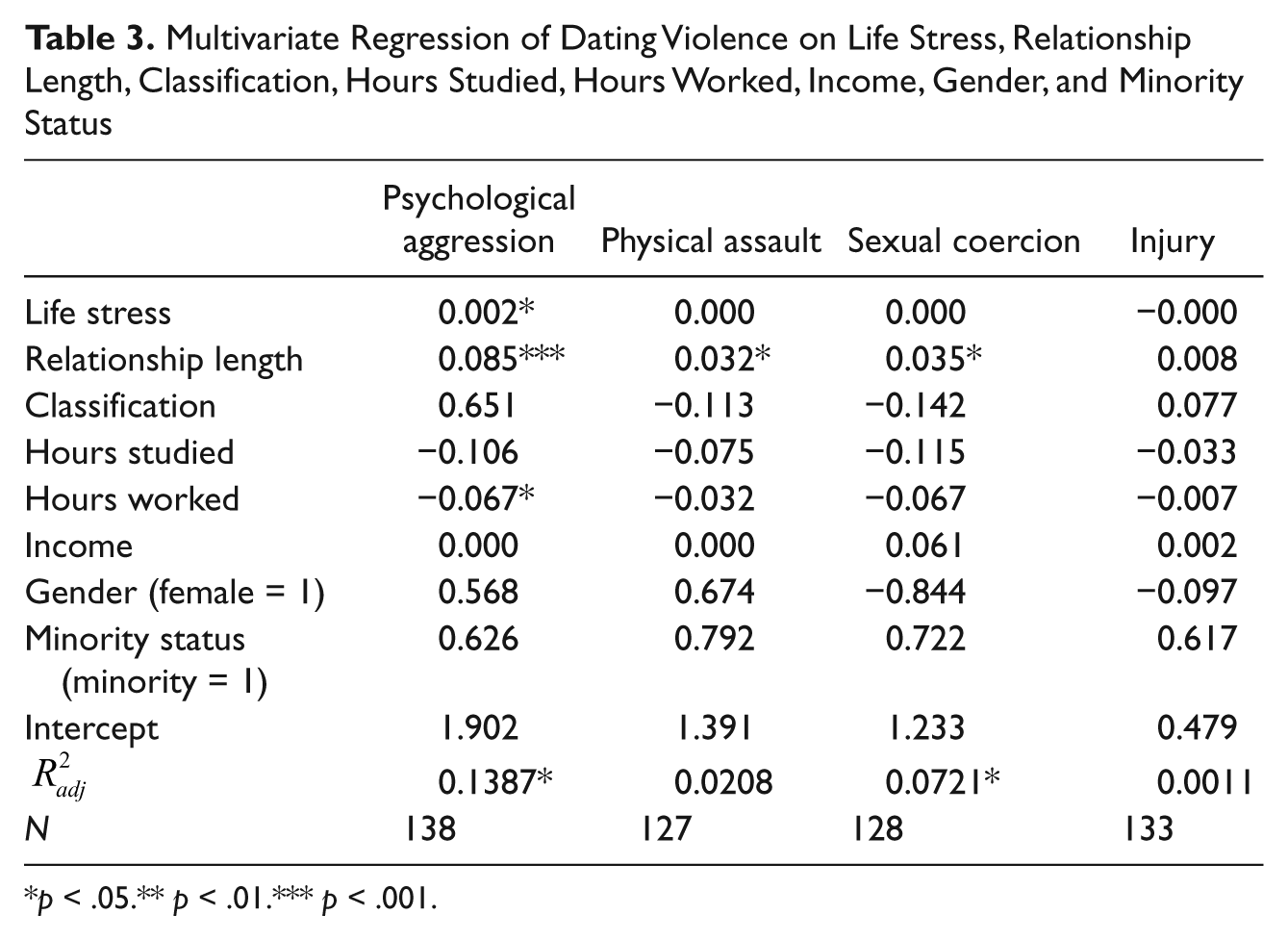
p < .05.** p < .01.*** p < .001.
Discussion
General strain and cumulative intimate partner strain increase the use of dating violence among college students. The longer dating partners are in a relationship, the higher the chances of psychological aggression, physical assault, and sexual coercion. Activities that reduce time spent together, such as working, reduce the chances of psychological aggression. Academic strain and cumulative academic strain increase the likelihood of any of the four types of intimate partner violence studied. The rates of intimate partner violence are statistically different for gender or race/ethnicity.
General strain
That life stress or general strain has a weak, positive effect on the likelihood of a person using psychological aggression. This supports the work by Merton (1938) who posited that strain as a result of a difference between working toward achieving socially valued goals and the fulfillment of the goals may lead to innovative behavior such as violence. Wright (1967) found that stress lead to more difficulty adjusting to college life suggesting that such an adjustment may include use of violence in intimate relationships.
Intimate partner cumulative strain
The strongest and prevalent predictor in this study is intimate partner cumulative strain. The length of the relationship is a significant predictor for three of the types of violence examined in this study. This finding supports time-as-risk (Gelles & Straus, 1979) concept and indicates that the amount of time and the constraints of negotiated activities increase the likelihood of intimate partner violence. Our results suggest that the unique characteristics of the intimate relationship are compounded as the strain experienced accumulates. As one person gains more knowledge about the other and becomes more familiar within the relationship, he or she becomes better able to do emotional harm to his or her dating partner by use of psychological aggression and may resort to physical harm through minor assault as innovative ways to reduce the strain.
Length of time in the relationship also increases the likelihood of becoming sexually coercive. Cumulative intimate strain may reduce willingness of sexual activity by one partner. The measure of sexual coercion includes a range of behaviors from insisting on sexual activity without using physical force to physically forcing one’s partner into sexual activity. The act of acquiescing by one’s partner to pressure for sexual activity may be viewed by the aggressor as a form of gaining control to meet this expected behavior of intimacy. When this fails, the aggressor may use of force to gain compliance to alleviate the strain of unfulfilled intimate expectations. Both outcomes leave the aggressor with a sense of having won the negotiation of activity and having met the expectation of sexual activity among intimates.
Hours worked
The number of hours worked reduces psychological aggression but has no effect on the other types of violence. The effect on psychological aggression suggests that the reduction in strain from economic need and a reduction in the time spent with an intimate partner would reduce this form of violence. These outcomes suggest that employment reduces both general and cumulative strain. Rather than increasing stress, as was predicted, spending time working appears to have had a slight mediating effect by removing the potential perpetrator from the relationship for a period of time.
Academic strain
We expected a positive relationship between the hours studied each week and increased reports of the types of intimate violence studied. The results show no effect and the small coefficient indicates there may be a negative relationship. It is possible that hours studying has a similar effect to hours working where reduced interaction decreases the potential for violence.
Cumulative academic strain
Classification, as a of measure strain, is based on literature that implied that freshmen might experience more stress than upper-class men or be less able to cope with academic stressors (Dyson & Renk, 2006; Galambos et al., 2009). There may be several reasons why the results did not reflect this. First, there were relatively few freshmen or sophomores within this sample because the classes sampled were largely junior- or senior-level courses, and the sample population reflects this. Consequently, there may be insufficient variation to determine whether there is a relationship between classification, stress, and intimate partner violence since 80% of the sample is upper-division students. Second, though freshmen may experience more stress or have more difficulty coping with stress, they may also be less likely to have been in a long-term dating relationship, since they are new to the college community. Expecting freshmen to have a greater rate of perpetration of intimate partner violence than upper-class men who likely had been in their relationships longer contradicts time as risk theory, which assumes that longer amounts of time spent in a dating relationship equate to more time at risk of experiencing intimate partner violence. In addition, freshmen are more likely than upper-class men to live on campus with roommates with whom they are not in a relationship as opposed to off-campus cohabitation with an intimate partner. From this perspective, they have fewer opportunities to commit an act of intimate partner violence.
Injury
None of the measures of strain in this study effect the perpetration of intimate partner violence. Strain does not appear to be a sufficient causative in this regard. Further research is needed to determine whether strain is causative and the context under which it may provoke serious intimate partner violence. The sample population (college students) may represent a group of people who are unlikely to resort to serious violence leading to injury as a means of gaining control of a situation as they experience the success of achieving cultural expectations and as they mature.
Limitations of the study
A larger sample may improve the ability to model the variables with more stable regression coefficients and sufficient variation in the dependent variable, especially the subscales that measure serious physical violence. Also, a stratified selection by classification would produce greater variation for the measure of cumulative academic strain.
This study found support for strain theory for predicting IPV among college students. The full potential for understanding strain as a causative factor needs to be examined as part of an integrated model of violence wherein strain created through life and academic stress is one of several variables used to explain and predict IPV among college students.
Footnotes
The authors declared no potential conflicts of interest with respect to the research, authorship, and/or publication of this article.
The authors received no financial support for the research, authorship, and/or publication of this article.