




Abstract
Intimate partner violence (IPV) is a widespread crime that victimizes over 4-million women per year in the United States and results in significant monetary cost and unmeasured physical and psychological consequences for victims. Specialized IPV offender treatment programs demonstrate limited effectiveness, which may be due to an insufficient understanding of the factors that differentiate between IPV perpetrators and non-IPV violent offenders. In this study, we utilized classification and regression tree (CART) analysis to identify combinations of factors that best discriminate IPV perpetrators from non-IPV violent offenders. We also compared cognitive abilities between IPV perpetrators and non-IPV violent offenders using standardized neurocognitive tests. CART analysis presented two pathways for identifying offenders as IPV perpetrators: (a) extensive nonviolent criminal history and (b) moderate-to-severe expression of interpersonal traits of psychopathy without attentional deficits. In addition, a third pathway identified non-IPV violent offenders: (c) low levels of interpersonal psychopathic traits and no history of neurodevelopmental diagnosis. IPV perpetrators demonstrated intact cognition relative to test norms, and study groups did not significantly differ on cognitive performance. These findings suggest that individuals with multiple arrests for nonviolent crime or individuals with interpersonal traits of psychopathy without attentional difficulties may be at enhanced risk for IPV perpetration.
Introduction
According to a report published by the World Health Organization, violence against women “has reached epidemic proportions in many societies” (World Health Organization, 2005). In the United States alone, over 4-million women are physically assaulted by an intimate partner every year, and approximately one third of all women report having experienced intimate partner violence (IPV) in their lifetime (Smith et al., 2017).
Beyond being a common crime, IPV results in physical and psychological difficulties for victims and significant monetary costs to societies. It is well documented that IPV is associated with subsequent injury, trauma, and death for victims from IPV-related injuries (Kernic et al., 2000; Plichta, 2004; Rennison & Welchans, 2000). Compared with women who never experienced IPV, victims report elevated rates of physical and mental health problems and are more likely to utilize health care services (Plichta, 2004; Smith et al., 2017). In the United States, IPV costs $5.8 billion per year in health services in addition to the costs of IPV-related absences from work (Centers for Disease Control and Prevention [CDC], 2003). Given its widespread prevalence, as well as the high physical, psychological, and monetary costs associated with IPV, systematic study of IPV perpetrators is imperative to enhance prevention efforts and optimize treatment for known offenders.
Current treatment methods for IPV include cognitive behavioral therapy (CBT) or a feminist approach (typically based on the Duluth model; Babcock et al., 2004; Pence & Paymar, 1993). However, these treatment programs have had limited effectiveness in curbing reoffending (Babcock et al., 2004; Day et al., 2009). One reason for this may be an insufficient understanding of the factors that differentiate between IPV perpetrators and generally violent offenders, which precludes the development of tailored programs for IPV offenders. There is some indication from prior research that IPV perpetrators may represent a distinct criminological group from non-IPV violent offenders, though findings in this area have been mixed. Some studies have found that IPV perpetrators and non-IPV violent offenders differ on several demographic and childhood variables, with IPV perpetrators demonstrating higher levels of education but also higher rates of learning disability (Olson & Stalans, 2001; Stewart & Power, 2014). Other studies have found that the groups also differ on psychiatric and substance use variables in that IPV perpetrators are more likely to have histories of childhood abuse and mental health treatment, have higher levels of psychopathic personality traits and depression, and use more illegal substances than non-IPV violent offenders (Felson & Lane, 2010; Stewart & Power, 2014; Theobald et al., 2016). Finally, one study found IPV perpetrators to have more extensive criminal histories than non-IPV violent offenders (Stewart & Power, 2014). In contrast, other studies found no statistically significant differences between IPV perpetrators and non-IPV violent offenders in demographic, life history, psychiatric, substance use, and criminological variables (Mowat-Leger, 2003; Olson & Stalans, 2001).
Prior research has suggested that cognitive ability is another factor that may distinguish IPV perpetrators from non-IPV violent offenders (Hanlon et al., 2015). One study compared executive functioning in incarcerated IPV perpetrators and other (violent and nonviolent) offenders, and found reduced mental flexibility, but better response inhibition in the IPV group (Bueso-Izquierdo et al., 2016). Several other studies compared community-based samples of IPV perpetrators to noncriminal controls and found that IPV perpetrators performed more poorly on measures of attention, working memory, executive functions, and verbal skills (Cohen et al., 2003; Holtzworth-Munroe et al., 2000; Teichner et al., 2001). However, no prior research to our knowledge has directly compared IPV and non-IPV violent offenders on performance-based cognitive measures.
Prior studies have linked several other individual characteristics with IPV. Specifically, a significantly higher proportion of IPV perpetrators have low socioeconomic status compared with nonviolent community controls (Reichel, 2017). In terms of neurologic characteristics, several studies have found that IPV perpetrators exhibit elevated rates of head injury compared with samples of healthy controls (Rosenbaum & Hoge, 1989; Rosenbaum et al., 1994). However, to our knowledge, no prior studies have directly compared IPV perpetrators to non-IPV violent offenders on these variables.
In summary, there is preliminary indication from prior research that IPV perpetrators as a group may differ from non-IPV violent offenders on certain life history characteristics, as well as in cognitive ability. However, findings remain mixed and suffer from poor replicability. The variability in findings may be explained by two factors. First, many studies have utilized nonviolent or mixed violent/nonviolent offender control groups, which makes it difficult to parse individual differences unique to IPV perpetrators from those of violent offenders in general. Also, some studies that did utilize violent offenders as controls used the index offense to classify group membership. Group assignment based on the index offense without regard to prior offenses can result in contamination of the comparison group by including offenders with prior histories of IPV. Second, prior studies have utilized linear models to differentiate between offender groups, which assume that all variables contribute to the distinction between groups in an equally additive fashion despite the well-accepted notion that individual differences do not always contribute to real-world behavioral outcomes in an equally additive fashion (Steadman et al., 2000).
The Current Study
The primary goal of this study was to identify a set of demographic, developmental, psychiatric, neurologic, substance use, criminological, and cognitive ability variables unique to IPV perpetrators, while addressing the methodological limitations of prior research. We classified group membership based on any history of IPV as opposed to focusing solely on the index offense to ensure that the comparison group included only offenders with histories of violent crime other than IPV. To avoid the reliance on linear models to assess group differences, we utilized Classification and Regression Tree (CART) analysis—a statistical learning technique designed to build more accurate models for real world classification of human behavior (Steadman et al., 2000). Several prior studies have utilized both CART and logistic regression to predict IPV reoffending and have found that CART models outperform logistic regression models in predicting reoffending (Brewer, 2012; Neuilly et al., 2011; Sledjeski et al., 2008). No prior study to our knowledge has utilized CART to determine the combination of variables that best differentiates between IPV and non-IPV violent offenders.
Three sets of analyses were carried out to accomplish study goals. First, we examined cognitive performance of IPV offenders relative to published test norms. Based on prior research, we hypothesized that incarcerated IPV perpetrators should score in the impaired range on measures of attention, working memory, executive functions, and verbal skills (Cohen et al., 2003; Holtzworth-Munroe et al., 2000; Teichner et al., 2001). Second, we compared the cognitive profile of IPV perpetrators to that of non-IPV violent offenders using independent t-tests or Wilcoxon Rank–Sum tests. Based on findings from prior research, we hypothesized that IPV perpetrators would demonstrate poorer mental flexibility than non-IPV violent offenders (Bueso-Izquierdo et al., 2016). Third, we utilized a statistical learning model, a CART analysis, to identify the combination of life history and cognitive variables that best discriminate between IPV perpetrators and non-IPV violent offenders. We included demographic, psychiatric, substance use, neurologic, and criminological variables that may differentiate between IPV perpetrators and generally violent offenders in the model (Felson & Lane, 2010; Olson & Stalans, 2001; Stewart & Power, 2014; Theobald et al., 2016). We did not have a priori hypotheses regarding the combination of variables that best discriminate between groups as this analysis was exploratory in nature.
Method
Participants and Procedures
Participants were 57 males with prior histories of IPV and 42 males with prior histories of only non-IPV violent crimes, aged 18 or older. All participants were inmates at a county jail near a major Midwestern city. Inclusion criteria were the following: (a) no history of stroke, brain tumor, or epilepsy; (b) no active psychiatric symptoms; and (c) English as first and primary language. Participants were chosen from a larger, randomly selected pool of inmates who had previously completed a baseline interview including a psychopathy assessment. Following the administration of written consent, participants completed a life history interview and a battery of neuropsychological tests administered by a trained graduate student. History of violent crime was collected from official files and life history interviews. For the file review, we recorded the number of charges and convictions for any violent crime from participants’ pretrial investigation files. Crimes were classified as violent using the Illinois criminal code definition (“Illinois Criminal Code,” 2012) and included kidnapping, sex offenses, bodily harm, intimate partner violence, robbery, burglary, aggravated arson, deadly weapons, and mob action. In addition to collecting arrest and conviction data, we asked each participant how many times he engaged in any of the above crimes, to account for violent offenses that did not result in a criminal charge or conviction. All participants were also asked if they ever physically attacked or made a death threat involving a weapon to a female partner to aid in determining group status. To control for reporter bias, participants were provided with simplified written definitions for each violent crime, per the Illinois criminal code.
Participants were classified as IPV offenders if they were ever charged with or convicted of an intimate partner violence offense per criminal records or if they self-reported a physical incident involving a current spouse, current nonmarital partner, former marital partner, or former nonmarital partner during the life history interview. This definition of IPV is empirically validated and used in criminology research and by the Federal Bureau of Investigation (FBI; Saltzman et al., 1999; United States Department of Justice [DOJ], 2017). Participants were classified as non-IPV violent offenders if they had a history of a violent crime other than IPV either by criminal record review or self-report. The institutional review board at Northwestern University Feinberg School of Medicine approved the study procedures, and all participants provided written informed consent.
Measures
The life history interview was designed to collect information regarding the demographic, developmental, psychiatric, neurologic, and criminological variables which have demonstrated significant associations with violence in the literature (see Table 1 for the complete list).
Demographic, Childhood, Psychiatric, Neurologic, Alcohol Use, and Criminal Characteristics of IPV Perpetrators and Non-IPV Violent Offenders.

Note. PCL-R = Psychopathy Checklist–Revised; IPV = intimate partner violence; TBI = traumatic brain injury; ADHD = attention-deficit/hyperactivity disorder.
+p < .10. *p < .05. **p < .01.
Parental socioeconomic status rating
was calculated using Hollingshead’s two-factor model which uses a combination of educational and occupational achievement to arrive at a numerical rating of social status (Hollingshead & Redlich, 1958), with greater values indicating higher status.
Psychiatric history and alcohol use disorder
Diagnoses of schizophrenia, alcohol use disorder, conduct disorder, and antisocial personality disorder were rated according to Diagnostic and Statistical Manual of Mental Disorders (5th ed.; DSM-5; American Psychiatric Association, 2013) criteria. Participants were also asked if they had been diagnosed with a neurodevelopmental disorder including intellectual disability, attention deficit hyperactivity disorder, and learning disability.
Psychopathy
The Psychopathy Checklist–Revised (PCL-R; Hare, 1991) includes 20 items each rated on an ordinal scale (0–2), and is the most extensively validated clinical measure of psychopathic personality traits in institutionalized samples. Item ratings were made on the basis of a semi-structured interview and review of institutional files. The measure yields a total score and four facet scores measuring the interpersonal (e.g., glibness, conning), affective (e.g., shallow affect, lack of empathy), lifestyle (e.g., impulsivity, irresponsibility), and antisocial (e.g., serious juvenile delinquency, criminal versatility) features of psychopathy (Hare, 1991). Psychopathy ratings were made by clinical psychology graduate students who received extensive training in PCL-R assessment. Inter-rater reliability for PCL-R scores was high (average intraclass r = .83, one-way random effects model, n = 12 pairs of raters).
Traumatic brain injury (TBI)
We rated the number and severity of head injuries from the life history interview. Each head injury was classified as mild, moderate, or severe in accordance with DSM-5 criteria.
Cognitive assessments
As presented in Figure 1, participants completed a comprehensive battery of neuropsychological measures used to assess performance in five cognitive domains (Delis et al., 1987; Reitan, 1958; Strauss et al., 2006; Wechsler, 2008; Wilkinson, 2006). Per clinical guidelines (Lezak et al., 2012), we used age-adjusted standardized test scores to measure cognitive ability. To ease comparison between tests, we linearly transformed all original standardized test scores to z-scores (M = 0, SD = 1) and calculated the mean z-score for each cognitive test. To calculate domain scores, we averaged the z-scores for the tests within each domain. Mean scores were characterized as impaired if z < –1.33, according to established practice guidelines (Lezak et al., 2012). To screen for adequate test taking effort, we used two embedded measures of performance validity: Forced Choice Recognition on the California Verbal Learning Test-II (CVLT-II; Delis et al., 1987) and the Reliable Digit Span on the Wechsler Adult Intelligence Scale–Fourth Edition (WAIS-IV; Wechsler, 2008).
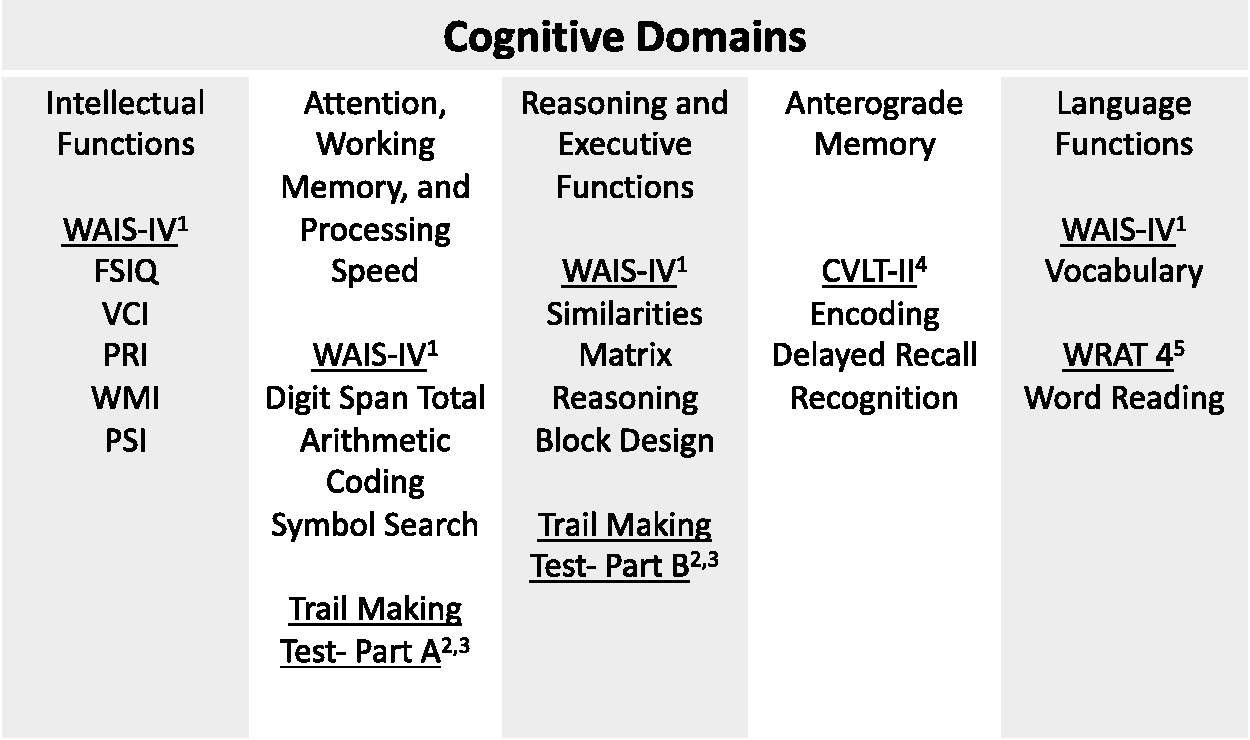
Cognitive assessment battery.
Statistical Analyses
We approached the question of variables that differentiate between IPV perpetrators and non-IPV violent offenders comprehensively by conducting both bivariate analyses and a statistical learning model, CART. First, we examined between-group differences using t-tests or, when assumptions of t-tests were violated, using Wilcoxon Rank–Sum tests and the corresponding effect size statistics. In addition, we used CART analysis from the Recursive Partitioning and Regression Trees script in R to identify the combination of independent variables that best differentiated between IPV perpetrators and non-IPV violent offenders (Therneau et al., 2015). CART analysis grows a tree by utilizing Bayesian statistics to split the predictor variables into nodes that maximize homogeneity among the data (Breiman et al., 1984). When further splitting of the data can no longer be justified by the increase in the variance explained, the CART analysis produces a terminal node, which predicts the outcome variable. The major limitation of CART analysis is that a single CART tree can be unstable (Breiman, 1996). To minimize this instability, we followed up the CART analysis by growing a random forest to evaluate how the model performed on different subsets of the data through Out-of-the-Bag sampling for each tree grown (Breiman, 2001). See Berk (2008) for additional technical details on the random forest method. For analyses, we used multiple imputation to compute missing values in the data (Rubin, 1987). Multiple imputation is recommended over alternative methods, because it utilizes data distributions to estimate missing values (Vaden et al., 2012).
Results
Descriptive Characteristics of IPV Perpetrators Compared With Non-IPV Violent Offenders
As shown in Table 1, overall the sample was comprised of young, primarily African American men who had partial high school education and history of conduct disorder. IPV perpetrators had significantly more children (W = 760.0, p < .01, r = –0.32) and were more likely to have been in at least one marital-type relationship (Fisher’s exact p = .01, p < .05, Cohen’s w = 0.27) than non-IPV violent offenders. In addition, IPV perpetrators demonstrated significantly higher overall psychopathy scores (W = 850.0, p < .05, r = –0.25), and higher interpersonal facet scores (W = 827.00, p < .01, r = –0.27) but the groups did not significantly differ on levels of the affective, lifestyle, or antisocial traits of psychopathy. Finally, IPV perpetrators committed significantly more non-violent crimes than non-IPV violent offenders (W = 784.0, r = –0.29, p < .01). All between-groups effect sizes were small with the exception of number of children which was associated with a medium effect size. IPV perpetrators and non-IPV violent offenders did not significantly differ on any additional characteristics (see Table 1).
Cognitive Profiles of IPV Perpetrators and Non-IPV Violent Offenders
All participants demonstrated sufficient test taking effort on embedded indices of performance validity. As presented in Figure 2, both groups performed in the low average range across all tests compared with published normative data. The mean overall intelligence quotient was 84.14 for the IPV group, and 85.74 for non-IPV violent offenders—a nonsignificant difference. As presented in Table 2 and Figure 2, there were no significant differences in cognitive performance between IPV perpetrators and non-IPV violent offenders across measures in any cognitive domain.
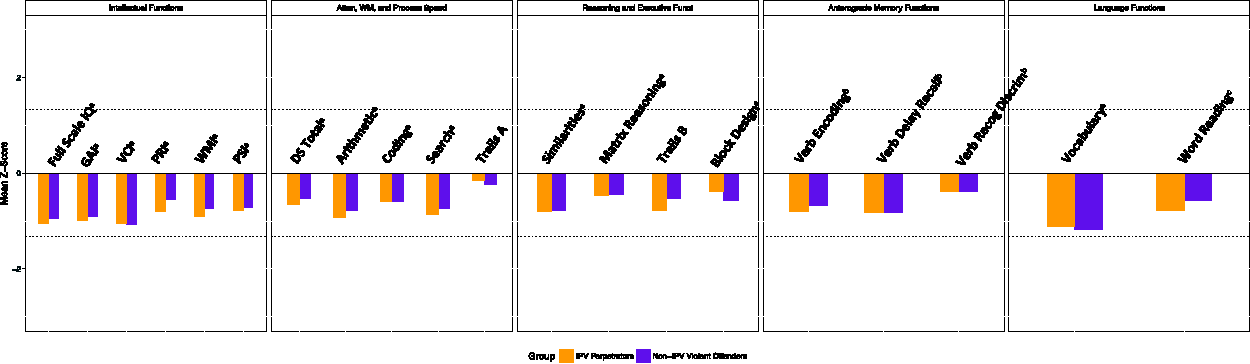
Intimate partner violence perpetrators versus non-IPV violent offenders: cognitive test performance.
Cognitive Test Performance: Differences Between IPV Perpetrators and Non-IPV Violent Offenders.
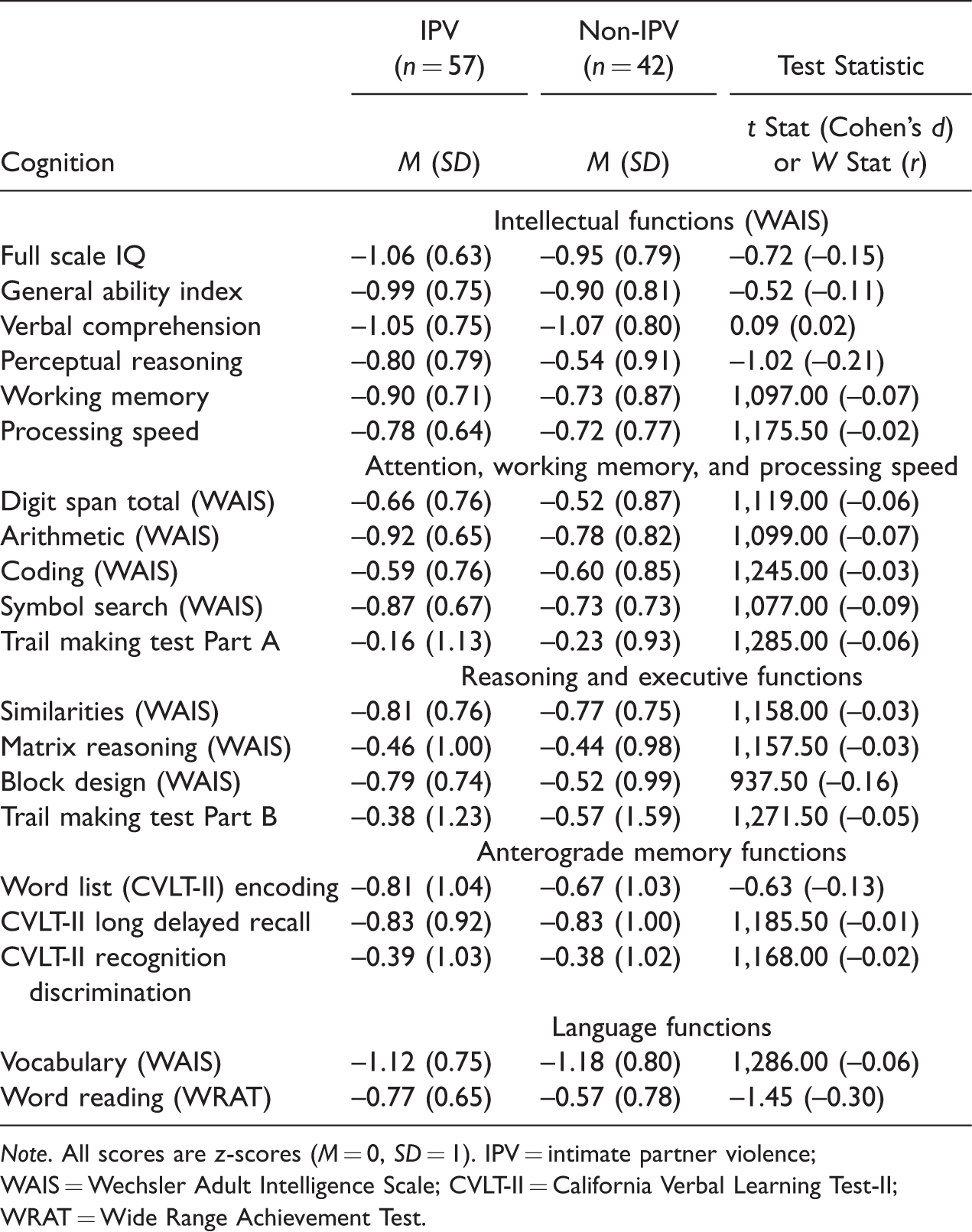
Note. All scores are z-scores (M = 0, SD = 1). IPV = intimate partner violence; WAIS = Wechsler Adult Intelligence Scale; CVLT-II = California Verbal Learning Test-II; WRAT = Wide Range Achievement Test.
Combination of Factors That Differentiate IPV Perpetrators From Non-IPV Violent Offenders
As presented in Figure 3, the combination of variables and the cut-points that best differentiated between IPV perpetrators and non-IPV violent offenders were identified via CART analysis. In terms of clinical utilization, the tree presented two pathways for identifying offenders as IPV perpetrators. First, offenders with an extensive history of nonviolent charges or convictions (greater than 42 nonviolent crimes) were likely to be IPV perpetrators. Second, for offenders who do not have an extensive history of nonviolent crime, IPV perpetration was likely when an offender presented with a combination of medium to high levels of interpersonal traits of psychopathy (greater than 5.2 on interpersonal facet of the PCL-R) and low average or higher scores on the attention, working memory, and processing speed domain (scores greater than z = –0.86). As shown in Figure 4, the individual tree predicted classification groups in the current sample fairly well with a misclassification rate of 19.2%. Errors were biased toward false positives. Area under the curve (AUC) for the individual tree was strong (AUC = 0.85).
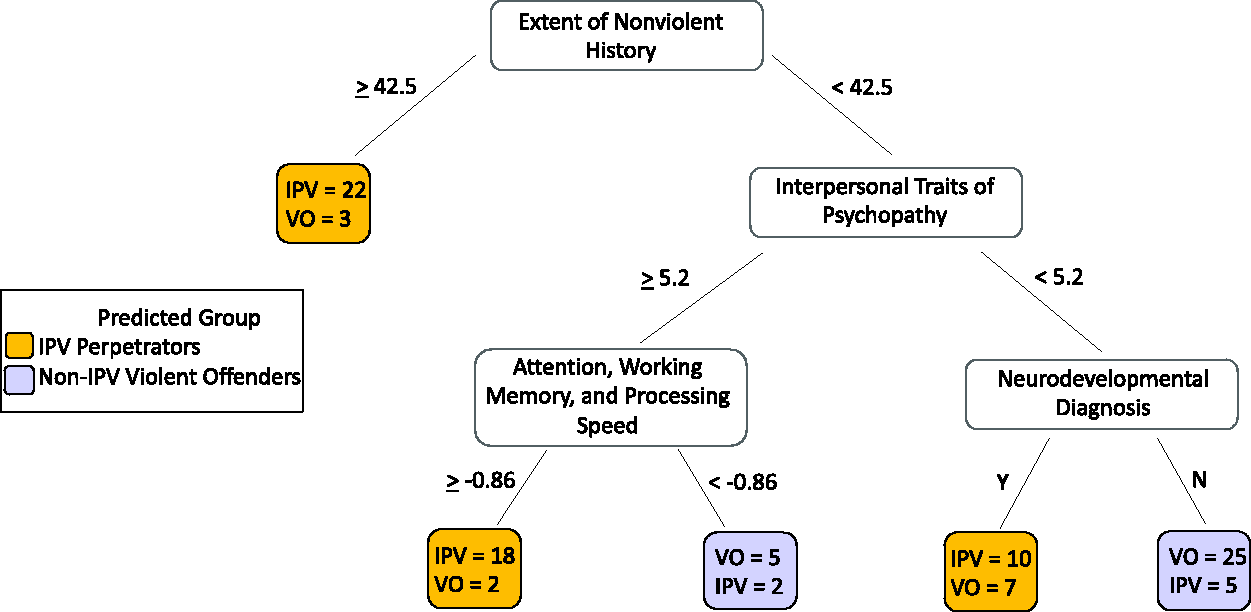
Classification analysis and regression tree for IPV perpetrators and non-IPV violent offenders.
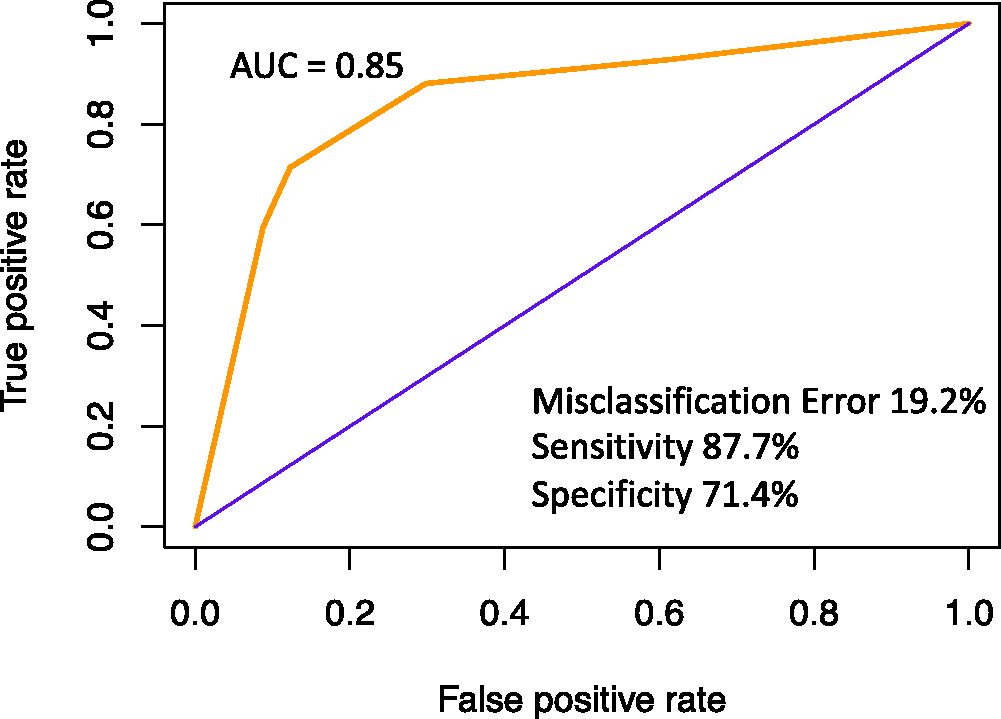
Classification statistics and receiver operating characteristic curve for single classification analysis and regression tree.
Figure 5 depicts results from a random forest with 2,000 trees that help identify the most important variables in predicting classification group. Excluding scores on the interpersonal facet of psychopathy resulted in the largest mean decrease in model accuracy, followed by excluding the number of nonviolent crimes, then scores on the attention, working memory, and processing speed cognitive domain, and finally neurodevelopmental diagnosis. As shown in Figure 5, the average tree in the random forest also predicted classification groups in various subsets of the data fairly well with a misclassification rate of 28.3%. For the random forest tree, errors were fairly evenly split between false positives and negatives. The AUC for the random forest was still good (AUC = 0.74).

Predictor accuracy contributions toward group status via random forest (2,000 trees) and classification statistics and receiver operating characteristic (ROC) curve.
Discussion
This study used a combination of group comparisons and Bayesian statistics (i.e., CART analysis) to investigate which life history and cognitive variables differentiated IPV perpetrators from non-IPV violent offenders. In addition, this study was the first to compare cognitive profiles between these two groups of offenders.
Differentiating IPV Perpetrators From Non-IPV Violent Offenders
According to the CART analysis, IPV perpetrators were distinguishable from non-IPV violent offenders in the current sample with high accuracy. Specifically, the CART analysis predicted IPV perpetrator status through two pathways: (a) the participant had extensive nonviolent criminal history and (b) the participant did not have extensive nonviolent criminal history but had medium to high levels of interpersonal traits of psychopathy and at least low average scores on the attention, working memory, and processing speed domain. The random forest analysis indicated that interpersonal traits of psychopathy and extent of nonviolent history contributed the largest amounts of accuracy to the model. Attention, working memory, and processing speed and neurodevelopmental diagnosis contributed relatively small amounts of accuracy to the model. In addition, random forest analysis indicated that the variables in the CART tree in this study continued to accurately differentiate between IPV perpetrators and non-IPV violent offenders in various subsets of the data.
Currently, the literature provides conflicting findings regarding whether IPV perpetrators represent a distinct criminological group from non-IPV violent offenders (Felson & Lane, 2010; Mowat-Leger, 2003; Olson & Stalans, 2001; Stewart & Power, 2014; Theobald et al., 2016). Through CART, this study provides evidence that IPV perpetrators are distinct from non-IPV violent offenders. Viewing IPV perpetrators as a distinct criminological group from non-IPV violent offenders has important implications for assessment of IPV risk. The tree from this study suggests that certain combinations of historical and cognitive characteristics, including an extensive (nonviolent) criminal career, the interpersonal features of psychopathy, and the absence of measurable attentional impairment may place an individual at risk of committing IPV as opposed to another violent crime. These findings replicate the previously reported associations between IPV and psychopathic personality traits (Harris et al., 2011; Holtzworth-Munroe & Stuart, 1994) and suggest that the impersonal traits of psychopathy such as glibness, grandiosity, deceitfulness, and manipulativeness may be particularly important to identifying IPV offenders. Research suggests that individuals with high scores on the interpersonal trait of psychopathy exhibit decreased physiological fear responses to stimuli, including interpersonal stressors (Babcock et al., 2005; Benning et al., 2005). This decreased fear response regarding interpersonal stressors may increase an individual’s likelihood of specifically committing IPV. This study did not measure IPV as an index crime which limits our ability to comment on directionality of our findings; however, research suggests that interpersonal traits of psychopathy are stable across the lifespan (Harpur & Hare, 1994; Lynam et al., 2009). Therefore, these traits were likely present prior to IPV perpetration and may represent a prospective risk factor for IPV. Future longitudinal studies should investigate whether the combinations of variables identified in this study represent prospective risk pathways specific to IPV.
Cognition in Incarcerated IPV Perpetrators
As a group, the current sample of incarcerated IPV perpetrators performed in the low average range across all cognitive domains and did not demonstrate impairment on any task when referenced against test norms. In addition, incarcerated IPV perpetrators and non-IPV violent offenders did not significantly differ on cognitive performance. Although there are no prior studies that have directly compared groups of IPV and non-IPV violent offenders on neurocognitive function, this finding appears to conflict with one prior study reporting differences between IPV perpetrators and other offenders on measures of executive functioning (Bueso-Izquierdo et al., 2016). However, that study included both violent and non-violent offenders in the non-IPV group, which may have inflated the magnitude of group differences. Clearly, further research comparing cognition in incarcerated IPV perpetrators and other types of offenders is warranted.
That mean intellectual ability of IPV offenders in our sample fell within the low average range relative to published test norms is consistent with intelligence quotient (IQ) estimates reported for incarcerated samples in general (Zamora, 2001). Relatively preserved cognitive ability in incarcerated IPV perpetrators means that, on average, they possess the intellectual capacity to engage in and respond to educational and cognitive restructuring programs as well as other inmates and that the poor treatment outcomes commonly reported for this population (Babcock et al., 2004; Day et al., 2009; Olver et al., 2011) are not due to a cognitive deficit.
Limitations
This study has several limitations. First, this study was based on a small sample of male inmates from one jail in the United States, limiting generalizability to the total population of incarcerated IPV perpetrators. Second, we relied solely on self-report information for many of the life history variables, so participants may have under or over-reported frequency regarding these variables. However, comparison between groups is thought to be accurate. In addition, we only focused on incidents of physical violence toward an intimate partner, but other forms of intimate partner violence exist, including sexual violence and psychological violence. The IPV and non-IPV violent offender groups were based on total history of offending as opposed to offense immediately prior to incarceration. Because of this, we cannot comment on the directionality of our findings, and we did not examine variables specific to relationship functioning, as these variables may have changed over time. Future prospective studies should examine whether relationship functioning variables also differentiate between these two groups.
Conclusion
This study identified combinations of factors that distinguished IPV perpetrators from other violent offenders and established a cognitive profile for incarcerated IPV perpetrators. CART analysis differentiated IPV perpetrators from non-IPV violent offenders with strong accuracy. The most important factors in differentiating between the two groups were interpersonal traits of psychopathy and the extent of an individual’s nonviolent history. Diagnosis of neurodevelopmental disorder and scores on performance-based measures of attention, working memory, and processing speed also contributed toward this differentiation. Follow-up analysis indicated that this model accurately differentiated between these two groups in various subsets of the data. In terms of cognition, bivariate analyses indicated that IPV perpetrators exhibited low average cognitive performance across cognitive domains relative to test norms and did not significantly differ from non-IPV violent offenders. Better understanding of the differences between IPV perpetrators and non-IPV violent offenders can help us identify risk factors specific to IPV and enable earlier enrollment in IPV treatment programs for high risk individuals. Specifically, individuals with extensive arrest history for nonviolent crime may be at enhanced risk for IPV perpetration. In those with less extensive histories of nonviolent offending, the combination of prominent interpersonal traits of psychopathy and preserved attentional functioning may confer increased risk.
Footnotes
Declaration of Conflicting Interests
The author(s) declared no potential conflicts of interest with respect to the research, authorship, and/or publication of this article.
Funding
The author(s) received no financial support for the research, authorship, and/or publication of this article.
