



Abstract
Emerging adulthood (EA) is a time of self-exploration as new opportunities for independence and autonomy arise. Yet, for some youth, this may also contribute to instability, uncertainty, and anxiety. Consequently, evidence suggests that rates of exposure to various forms of violence increase in EA. This study examined changes in experiences of bullying and sexual violence (SV) victimization among a sample of post-high school emerging adults who were exposed to a primary prevention program, Sources of Strength (Sources). We also examined whether Sources skills (e.g., healthy coping and help-seeking) buffer against these experiences. Participants were 102 emerging adults (73.5% identifying as female, 36.3% as Latinx, and 22.6% as LGBQ), who completed surveys at three time points: 1 month prior to graduation and at 6- and 12-months post-graduation. Results suggest that as youth transition into emerging adulthood, experiences of bullying victimization were relatively low and slightly decreased whereas experiences of SV were also relatively low, but stable over time. Notably, bullying victimization was lower when female-identifying participants, relative to males, had higher levels of healthy coping. In addition, SV victimization for participants identifying as non-white was higher at lower levels of coping than those identifying as white; however, at higher levels of coping, non-white participants reported lower rates of SV victimization, while rates were relatively stable for white participants at high and low levels of coping. These findings provide some support for the Sources program model where engaging in healthy coping may protect young women from bullying exposure and buffer against SV victimization for racial and ethnic minoritized young adults. Implications for violence prevention are discussed.
Examining the Post-High School Effects of a Primary Prevention Program on Exposure to Bullying and Sexual Violence among Emerging Adults
Graduation from high school marks a dramatic developmental shift where many youth leave home for the first time. This period of emerging adulthood (EA) is a time of self-exploration as new opportunities for independence and autonomy arise; for some emerging adults (EAs) this may also contribute to instability, uncertainty, and anxiety (Arnett, 2015). Research has found that rates of violence exposure either increase (e.g., sexual harassment and victimization; Clodfelter et al., 2010; Fisher et al., 2000) or remain stable (e.g., bullying; Lund & Ross, 2017) in EA, compared to adolescence, and it may depend on the type of victimization experienced. For example, approximately 20–25% of college students report exposure to verbal, relational, or physical bullying and 10–15% report exposure to cyberbullying (Lund & Ross, 2017); rates that are similar to adolescent samples (Wang et al., 2009). Evidence suggests sexual victimization, especially for young women, may peak in college (Fisher et al., 2000). These studies support the notion that prevention efforts in high school are important for promoting successful transitions to adulthood.
Although several notable examples exist (e.g., Communities that Care; Fagan et al., 2018), few studies have investigated post-high school impacts of primary prevention programs. While prevention programs may equip youth with skills for EA, little is known about their long-term effects on exposure to violence (Hoyt et al., 2012; Masten et al., 2006), and the application of learned skills, including help-seeking and healthy coping, to offset such adversity. Help-seeking has been found to buffer the effects of violence exposure on negative outcomes in EA (e.g., depression and anxiety; Hemphill et al., 2015). Healthy coping strategies have also been found buffer risk for negative adjustment difficulties, like depression (Sugimura et al., 2014), among young people. Yet, it is possible healthy coping and help-seeking may directly reduce victimization exposure by helping young people mange stressful situations and their reactions to such stressors, thereby reducing the risk of experiencing victimization. In other words, engaging inter- and intra-personal resources (e.g., parent or peer support, effective problem solving, and stress management skills) may decrease young peoples’ vulnerability to victimization (Gruber & Fineran, 2016).
Indeed, prior research suggests that the strategies young people employ to cope with stressful events, including peer victimization, may impact their risk for subsequent victimization (Frisén et al., 2012; Kochenderfer-Ladd, 2004). One framework from which to better understand the role of healthy coping and help-seeking in buffering risk for a range of adjustment difficulties, including exposure to peer victimization is the avoidance/approach response; young people can respond to stressful situations in two ways: employing either avoidance or approach strategies (Causey & Dubow, 1992; Roth & Cohen, 1986). Approach strategies have been shown to reduce risk among young people as these strategies include direct efforts to resolve the stressor emotionally, cognitively, and/or behaviorally (Causey & Dubow, 1992; Roth & Cohen, 1986). A common approach strategy is seeking help from friends, parents, or other adults to garner support, guidance, or advice following a stressful event. In addition, young people may employ healthy coping strategies (e.g., problem solving and stress management via healthy activities) in response to distressing situations. This evidence suggests that building help-seeking and healthy coping skills may be important to prevent and/or reduce violence exposure in EA. This study examines post-high school changes in bullying and sexual violence victimization among a sample of EAs who were exposed to a primary prevention program, Sources of Strength (Sources; Sources, 2020), while in high school that explicitly builds healthy coping and help-seeking skills. Thus, we also examine whether Sources skills (e.g., healthy coping and help-seeking) buffer against these experiences.
Bullying and Sexual Violence Victimization
Bullying is characterized by the use of power over others with the intent to harm and the use of repetitive acts of aggression to cause distress and induce control (Schoeler et al., 2018). Bullying is exhibited along a continuum of intentional and repeated physical and relational acts of aggression (Olweus, 1993). Exposure to bullying can lead to a range of negative consequences, including internalizing and externalizing problems (i.e., depression, anxiety, and suicidality; Copeland et al., 2013) and academic challenges (Schoeler et al., 2018). Specifically, emerging adults continue to be at risk for bullying victimization; evidence suggests rates of exposure remain stable from adolescence to early adulthood (Lund & Ross, 2017), which can contribute to cumulative stress and adjustment difficulties in EA (Holt et al., 2014; Reid et al., 2016). Nevertheless, research reveals the strong impact of protective factors in attenuating risks from bullying exposure; perceived social support is a protective factor linked to effective stress management (Reid et al., 2016) and parental and peer support and effective stress management can directly reduce bullying victimization (Baldry & Farrington, 2005; Polan et al., 2013).
Research shows gender and racial/ethnic differences in bullying victimization experiences. Findings on gender disparities reveal that during adolescence, boys experience more physical victimization than girls, whereas girls experience higher relational victimization than boys (Schoeler et al., 2018). However, gender differences in relational victimization are less pronounced in EA. While females report similar rates when transitioning to higher education or the workforce (Schoeler et al., 2018), relational victimization has been found to increase for young men (Leadbeater et al., 2014). In addition, racial and ethnic minoritized students are at an elevated risk for bullying victimization during adolescence, especially when representing the minority of the overall school population (Peguero et al., 2015; Peguero & Williams, 2013). Studies have found that Latinx and Black/African American youth experience higher levels of bullying relative to White youth (Gage et al., 2021), and Asian Americans have the lowest levels compared to the other groups. When considering violent and property victimization at school, Latinx and Asian Americans report lower levels while Black/African Americans report higher levels relative to White youth (Peguero et al., 2015). Notably, high levels of family cohesion and support can attenuate stress associated with bullying victimization among Latinx youth (Forster et al., 2013). Thus, it is critical to study the buffering effects of protective factors on bullying victimization by gender and racial/ethnic identity.
Sexual violence victimization (SV) includes attempted or completed rape, non-penetrative unwanted sexual contact, and other non-contact stalking including sexual coercion, sexual harassment, and intimate partner violence (Basile & Smith, 2011; Breiding et al., 2014). SV can result in physical injury, rape-induced pregnancy, physical symptoms/illness, and psychological and psychiatric outcomes through the life course (Basile & Smith, 2011; Chen et al., 2010). Approximately 44% of female-identifying and 23% of male-identifying individuals experience any form of SV in their lifetime, with a majority experiencing SV before the age of 25 (Breiding et al., 2014), and higher rates for LGBTQIA-identifying individuals (Johnson et al., 2016).
There is an elevated risk for SV victimization among EAs (Tjaden & Thoennes, 2006). Furthermore, SV disproportionately impacts females and non-white racial and ethnic groups (Black et al., 2011); multiracial, American Indian, and Alaska Native females repeatedly experience higher levels of SV than other groups (Breiding et al., 2014). However, some research on adolescents reveals that parental and teacher support can buffer against sexual harassment, a common form of SV (Doty et al., 2017). Additionally, close family ties and parental support is particularly protective against SV for young Latina women (Sabina et al., 2014). This evidence calls for prevention programs to counter the risk for violence exposure and resulting mental health challenges by providing needed support before and during EA.
Emerging Adulthood
Emerging adulthood is a developmental stage between the ages of 18 and 25 that is often characterized by dichotomies such as risk and opportunity, or optimism and instability (Arnett, 2015). The developmental designation of EA materialized in response to shifting milestones whereby key indicators of young adulthood (e.g., committed relationships, long-term employment, and parenthood) are delayed. This unique opportunity for self-exploration, identity formation, and independence fosters a feeling of being “in-between” adolescence and adulthood. As such, EA is a period of instability in which one’s overall risk tends to be elevated; there is increased health risk behavior such as substance abuse and involvement in violence and crime (Arnett, 2005; Clodfelter et al., 2010), and internalizing problems such depression and anxiety peak during this period.
Successful navigation of EA may be dependent on the level of tolerance versus aversion of ambiguity (Xu & Adams, 2020) and psychological flexibility (Kashdan et al., 2020) to identify and pursue one’s goals despite distress. However, perceived social support, higher levels of parental support, and a strong network of positive relationships (Chu et al., 2010; Reid et al., 2016) can reduce risk for externalizing and internalizing challenges during EA, especially for racial and ethnic minoritized young people (Forster et al., 2013). This suggests that interventions designed to promote these healthy skills may be particularly useful. Nevertheless, this time can mark an increase in exposure to SV, particularly for those with known vulnerabilities (e.g., mental health issues; Schoeler et al., 2018) and rates of bullying victimization can remain stable (Lund & Ross, 2017; Leadbtetter et al., 2014). As such, prevention programming in high school may be a critical strategy for supporting successful transitions to EA, specifically programs that target key developmental skills, such as help-seeking and healthy coping (Hoyt et al., 2012; Masten et al., 2006).
Sources of Strength Intervention Model
Sources is a high school-based primary prevention program with empirically driven components to prepare students for stressful or difficult situations by fostering healthy and prosocial coping. Specifically, the model seeks to build eight sources of strength in youths’ lives, including positive peer relationships, family support, healthy coping, adult mentors, generosity, spirituality, and mental health. Sources involves training school staff as “trusted adults” who then mentor key student opinion leaders (Peer Leaders) in their planning of prevention activities (e.g., message campaigns, classroom and assembly presentations, and peer-to-peer discussions). Informed by Diffusion of Innovations Theory (Rogers, 2003), these activities seek to modify student perceptions about normative behaviors and encourage the identification and use of model resources for support and coping. Programs that focus on diffusion of positive norms have been found to significantly reduce isolation and distress that subsequently reduce vulnerabilities to violence and mental health issues (Hall-Lande et al., 2007; Mo et al., 2018: Wolfe et al., 2014). Multiple evaluation studies on Sources reveal significant impacts on suicidal behavior, and significant increases in the use of interpersonal resources such as help-seeking and healthy coping during times of distress (Petrova et al., 2015; Wyman et al., 2010, 2019).
A shared risk and protective factors framework: Shared dynamic risk and protective factors are present across multiple outcome domains such as suicidality and violence prevention. Central to many effective youth violence prevention programs is addressing co-occurring individual, interpersonal, and community level risk factors, and bolstering interpersonal protective factors, such as building help-seeking skills and coping mechanisms (Casey & Lindhorst, 2009; Lubell & Vetter, 2006). This shared risk and protective factors framework is consistent with the Sources program model. For example, the model includes the use of trained adults at school and infuses help-seeking, healthy coping, and norm changes through peer and other social connectedness, which have been shown to reduce risk for both violence exposure and suicidality (DeGue et al., 2013; Vivolo et al., 2011). Additionally, spirituality, emotional intelligence, and social support are critical, as they have been associated with resilience when faced with life stressors (Howell & Miller-Graff, 2014).
Given violence and suicide share similar risk and protective factors, Sources is posited to reduce SV and bullying victimization by strengthening aforementioned ecological and individual protective factors. By increasing help-seeking and healthy coping, students’ vulnerability to victimization can decrease (Gruber & Fineran, 2016). A randomized clinical trial (RCT) of Sources in 2017–2019 evaluated effects on bullying and SV with results revealing promising effects on protective factors known to reduce violence (Yoder et al., 2020). The shared risk and protective factors approach can evaluate “crossover” effects of preventive interventions (Reider & Sims, 2016) to identify common prevention pathways to multiple health behavior problems. Yet, no Sources evaluation study has investigated the longer term effects on violence exposure in post-high school contexts during the transition into EA.
The Present Study
Given that violence exposure remains a risk for young people during EA, high school-based prevention programming may be key for promoting successful post-high school transitions. The purpose of this study was to examine changes in experiences of bullying and SV among a sample of post-high school emerging adults who were exposed to Sources while in high school. We hypothesized that EAs would experience increases in SV given evidence that this form of violence may increase during this transition; we expected rates of bullying victimization to remain stable. We also investigated whether changes in exposure to these forms of violence were associated with informal (e.g., family, friends, or teachers) and formal (e.g., mental health providers or physicians) help-seeking and healthy coping behaviors and if there was a moderating effect of gender identity, race/ethnicity, and sexual orientation. We expected that SV and bullying victimization would be negatively associated with help-seeking and healthy coping as these are theorized to reduce risk for subsequent victimization.
Method
Study Procedures and Design
The present study builds upon an RCT of Sources in 20 high schools in a large Western state. A purposeful sampling strategy was employed in the RCT where schools (N = 20) (urban and rural) and students (n = 6396; 54% white, 51% female) were stratified using probability-proportional-to-size sampling techniques to ensure representativeness. Considering this stratification, all graduating seniors (age 18 and older) in four intervention high schools were recruited to participate in this post-high school follow-up study, such that two rural and two urban schools with diverse student populations were targeted. Approximately 400 of these students were expected to graduate in May 2019, of which 25% were recruited into the study.
Study participation consisted of completing three surveys, 1 month prior to graduation (T1), at 6 months (T2), and at 12 months (T3) post-graduation. Shortly before graduation, an initial online Qualtrics survey was sent to graduating seniors in the target high schools. At T1, students were asked to consent to their participation in the study via an online information statement. Each follow-up survey link was sent via text or email correspondence to the contact information provided by students in the initial survey. T2 occurred in fall 2019 and T3 occurred in spring 2020. Students received a small incentive for each survey administration, which increased in value over time ($10 at T1; $30 at T2; and $50 at T3).
Sample
The sample for this study included 102 emerging adults (73.5% identifying as female, 36.3% as Latinx/45.1% as White, and 22.6% as LGBQ); there was a 95% retention rate over the course of the study. No students identified as transgender. All students were exposed to Sources during high school, with most students (n = 80) being in the general student population. There were 22 (28.6%) respondents that reported being a Peer Leader for Sources in high school. The average age was 18.61 (SD = 0.80, Min = 18 years old, Max = 21 years old) at T3. Approximately 82% of the sample reported being enrolled at a 2- or 4-year college and 17.6% were working full-time (more than 30 h a week) while 28.6% were working part-time (less than 30 h a week) at T3. Slightly over 70% of the sample still lived in their hometowns, while 17.4% lived within a few hours’ drive from their hometowns and 8.7% lived out of state at T3, suggesting that many participants may have had stable support networks at 12 months post-graduation.
Measures
At the beginning of the survey at each time point, participants reported their birthdate (to calculate age at each time point), gender identity, sexual orientation, and race/ethnicity in addition to information about their location, current school enrollment, and whether they were working full- or part-time at each time point. Gender identity was coded as male and female (reference). Sexual orientation was coded as straight (reference) and other sexuality. Race/ethnicity was coded as Latinx, Other Race (a category that combined Black/African American, Asian American, and multiracial EAs), and White (reference). The total number of EAs identifying as Black/African American (n = 3), Asian American (n = 7), and multiracial (n=11) were too small to model these racial groups separately.
Sexual violence victimization: The American Association of University Women [AAUW] Sexual Harassment Survey (AAUW, 2011) was used to measure the frequency with which EAs experienced sexually violent behaviors in the past 6 months at each time point. Thirteen items were rated on a 5-point Likert-type scale ranging from 1 = Never to 5 = 7 or more times. The items assessed non-physical behaviors including making unwanted sexual jokes or comments as well as physical behaviors such as unwanted sexual contact. The measure has previously demonstrated internal consistency and concurrent validity previously (Espelage & Holt, 2001). Cronbach’s alpha coefficients in the present study were 0.93 at T1, 0.85 at T2, and 0.80 at T3. The mean SV for each individual was computed and used for the analysis.
Bullying victimization: The 9-item University of Illinois Bully Scale (Espelage & Holt, 2001) was used to assess the frequency with which participants were exposed to bullying behaviors. Items assessed verbal (e.g., “In a group, someone teased me to hurt my feelings”), physical (e.g., “Someone threatened to hurt or hit me”), and relational (e.g., “Someone spread rumors about me”) behaviors and asked participants to report how frequently they had experienced these in the last 30 days (on a 5-point Likert-type scale ranging from 1=Never to 5=7 or more times). Cronbach’s alpha coefficients were 0.84 at T1, 0.89 at T2, and 0.78 at T3. Prior studies have demonstrated adequate scale psychometric properties (e.g., Espelage & Holt, 2001; Shujja & Atta, 2011). Mean bullying victimization scores were used for the analysis.
Informal and formal help-seeking behaviors: A 21-item scale was used to assess help-seeking behaviors (Pham et al., 2014). Based on recommendations by Pham et al., two subscales were created for informal and formal sources of support. Informal sources included parents/guardians, relative/other family, teachers, and friends whereas formal sources included mental health providers, help lines, and doctors/physicians with three items measuring each source of support. Study participants were asked to report how often over the past month (on a 4-point Likert-type scale ranging from 1=Never to 4=Often) they 1) asked this source for help; 2) talked to this source about a personal problem; and 3) talked to this source about a problem at school/work. Cronbach’s alpha coefficients were 0.90 at T1, 0.87 at T2, and 0.87 at T3 for the informal subscale. Cronbach’s alpha coefficients were 0.94 at T1, 0.96 at T2, and 0.92 at T3 for the formal subscale. Separate mean scores for informal and formal help-seeking were computed for each individual and used for the analysis.
Healthy coping: The Coping Resources scale (Wyman et al., 2010) was developed to evaluate Sources. On this 8-item scale assessing each source of strength, students rated the degree to which they engaged each source in the last 6 months. Sample items included: “I had positive, caring friends,” “I was active in healthy activities, hobbies, etc.,” “I took time to be generous and helpful to others,” and “I got any medical services I needed.” Students rated how much they agreed with these statements on a 5-point Likert-type scale ranging from 1=Strongly Disagree to 5=Strongly Agree. Higher sum scores on this scale reflected greater perceived use and presence of intra- and inter-personal resources. Cronbach’s alpha coefficients were 0.85 at T1, 0.81 at T2, and 0.81 at T3. Prior evidence notes adequate reliability and validity of this scale (Wyman et al., 2010). The sum of the coping items was used for analyses.
Data Analysis
The present study investigated how exposure to bullying victimization and SV exposure changed over time and whether these changes were associated with informal and formal help-seeking and healthy coping behaviors. Univariate analyses comparing bullying and SV at each time point between ethnicity, sexual orientation, and gender identity were conducted using non-parametric Wilcoxon Rank Sum tests or Kruskal Wallis Tests as appropriate due to the skewed nature of the data. A linear mixed effects model was used for each of the dependent variables. Independent variables, including both informal and formal help-seeking and healthy coping, were centered at each time point to reduce the impacts of potential multicollinearity. Fixed effects in the models included time, time invariant factors such as ethnicity, sexual orientation, peer leader status, and gender identity, and time-varying predictors of informal help-seeking, formal help-seeking, and healthy coping. The interaction (multiplicative term at each time point) between each of informal and formal help-seeking, healthy coping and the time invariant factors (e.g., informal help-seeking by gender interaction), and time (e.g., informal help-seeking by time interaction) were also included in the model. Significant interactions were explored using simple effect tests by considering the mean outcome at the minimum, first and third quartiles, and maximum centered scores of help-seeking or healthy coping, holding the other variables constant at their means (zero for centered scores) or reference values. Tukey’s adjustment was used for follow-up comparisons. A significance level of 0.05 was used for all tests of significance. SAS PROC MIXED (v9.4) was used for all statistical analyses. For the SV, a marginal model was fit to account for covariance among residuals from a single individual. Models with random effects for participants and informal and formal help-seeking and healthy coping did not converge or produced warnings so were excluded from the model. An unstructured covariance structure was selected using Akaike’s Corrected Information Criteria (AICC). For the bullying, a mixed effects model with an AR (1) structure for the covariance among residuals from a single individual was selected using AICC. Random effects included the intercept and slope for informal and formal help-seeking and healthy coping.
Results
Descriptive Results
Overall, mean scores indicated relatively low rates of exposure to bullying (M = 1.36, 1.30, 1.22 T1–T3); however, some participants reported higher levels of exposure as evidenced by the range at each time point (Range 1–3.22, Range 1–3.56, Range 1–2.67 T1–T3). Similarly, low rates of SV were reported on average (M = 1.12, 1.10, 1.10 T1–T3) with some students reporting higher levels over time (Range 1–3.00, Range 1–2.38, Range 1–2.15 T1–T3). Relatively high levels of healthy coping (M = 31.81, 31.19, 31.27 T1–T3). Rates of informal help-seeking (M = 2.37, 2.36, 2.35 T1–T3) were higher than formal help-seeking (M = 1.26, 1.23, 1.23 T1–T3), with help-seeking relatively stable across time. There were few differences in victimization rates by race/ethnicity, sexual orientation, and gender identity. SV differed between male- and female-identifying participants at each time (T1 p = 0.01, T2 p. = 0.03, T3 p = 0.03) with females reporting higher rates of victimization. However, no gender differences were found for bullying over time. SV only differed by race/ethnicity at T1 (p = 0.04) with “Other races” reporting higher rates, and by sexual orientation at T2 (p = 0.03) with young adults identifying as non-straight reporting higher rates. Again, no differences were found for bullying.
Sexual Violence Model Results
Mixed Effects Model Results.


Coping by Race/Ethnicity Interaction for SV Victimization.
Bullying Victimization Model Results
The average bullying victimization score was also similar across the three time points again indicating stability in rates of exposure over time (Table 1). There was a coping by gender interaction effect on the bullying score (p = 0.021). At the lowest value of coping, females had higher average levels of bullying than males (LSM = −0.997, SE = 0.433, padj = 0.0241) but at higher levels of coping, females had lower levels of average bullying (Q3 LSM = 0.213, SE = 0.138, padj = 0.128; see Figure 2). There was evidence that the average bullying score at T1 was higher than the average bullying score at T3 (LSM Δ = 0.149, SE = 0.051, p. = 0.005), but the average bullying score at T2 did not differ from that at T3 (LSM Δ. = 0.077, SE = 0.056, p = 0.177). No other predictors or interaction terms were significant in the model. Coping by Gender Interaction for Bullying Victimization.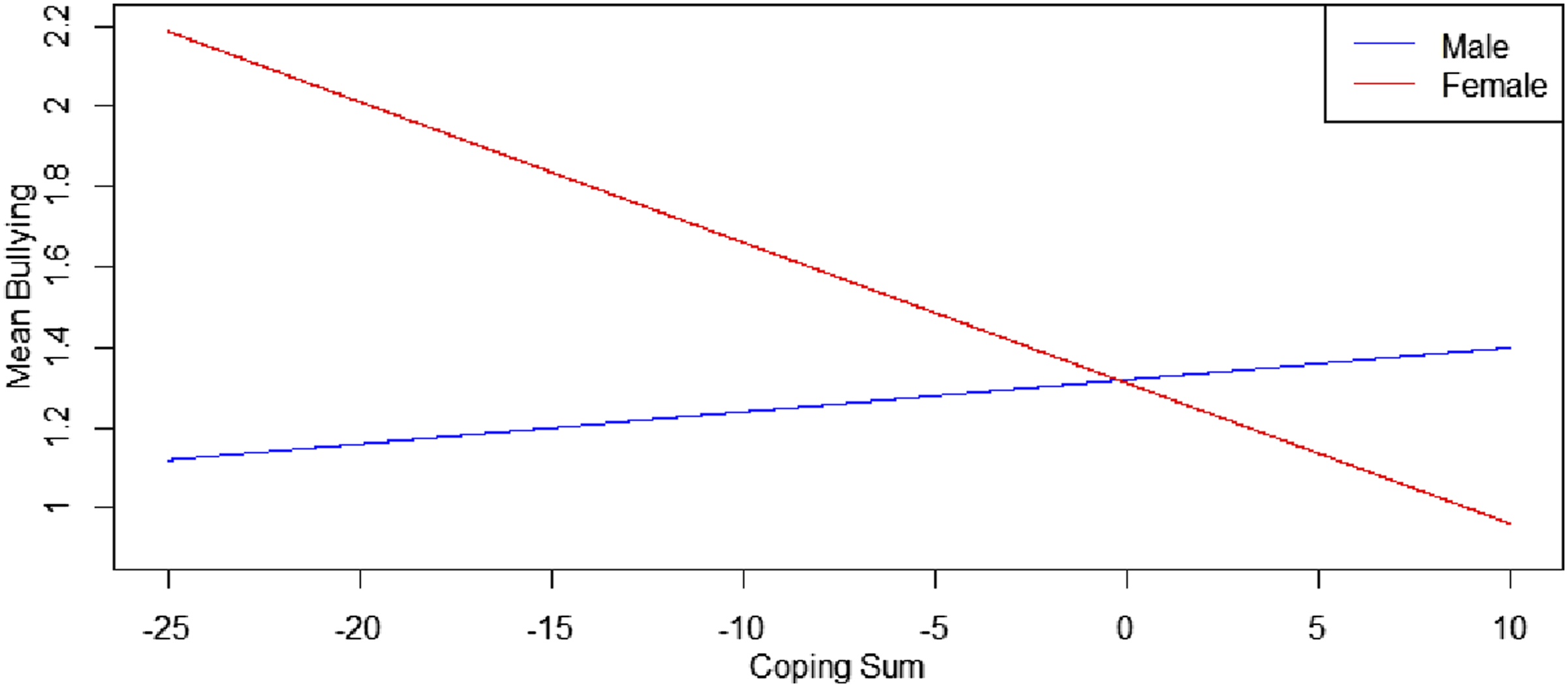
Discussion
The results from this study suggest that as youth transition into EA, experiences of bullying victimization were relatively low and slightly decreased, whereas experiences of SV were also relatively low, but stable over time. While somewhat surprising, these findings can be understood in the larger context of EA experiences. For example, there is evidence of a discontinuity in bullying victimization among a proportion of youth as they move through middle and high school settings (Brendgen & Poulin, 2018; Goldbaum et al., 2003), perhaps explained in part by changes in social norms as youth age (Boivin et al., 2010). Research suggests bullying exposure during EA may be stable but can vary by the form of victimization (Lund & Ross, 2017). Distinguishing the form of bullying may have revealed different patterns over time in the present study. However, bullying victimization was lower when female-identifying participants, relative to males, had higher levels of healthy coping. These results suggest that healthy coping may play a role in reducing risk for victimization as these strategies may help young people mange stressful situations and their reactions to such stressors. Thus, engaging these kinds of inter- and intra-personal resources (e.g., parent or peer support, effective problem solving, and stress management skills) may decrease young peoples’ vulnerability to victimization (Gruber & Fineran, 2016). Prior research notes that adaptive coping or approach strategies that engage these inter- and intra-personal resources (Causey & Dubow, 1992; Roth & Cohen, 1986), impact young people’s risk for experiencing peer victimization (Frisén et al., 2012; Kochenderfer-Ladd, 2004). Perhaps interventions, like Sources, designed to promote these healthy coping skills may be particularly useful for young women. Further, it is possible that female-identifying EAs may rely on these relationally-based coping skills more than male-identifying EAs during this period of transition given gender differences found in seeking social support following violence exposure in prior studies (Duru & Balkis, 2018; Rueger et al., 2010).
In regards to SV, while youth between the ages of 18–24 have higher rates of SV relative to other age groups (Sinozich & Langton, 2014), research finds a high proportion of youth have low victimization experiences and their developmental trajectories remain stable throughout adolescence (Orpinas et al., 2012) and EA (Swartout et al., 2012). Thus, our sample may make up the high proportion of youth with low and stable trajectories, potentially informing the use of a latent class growth analyses to better determine differential classes within each trajectory. The SV results may point to the low levels of disclosures in EA; research shows that only 11% of rapes are reported among college age students (Kilpatrick et al., 2007). The high underreporting can support robust sampling and measurement approaches to glean reliable reports.
Our findings also suggest that the use of healthy coping behaviors to offset experiences of SV were differentially experienced by female-identifying participants who reported higher levels of victimization over time than male-identifying participants. We also found that SV for participants identifying as non-white (with a large number identifying as Latinx) was higher at lower levels of coping than those identifying as White. However, at higher levels of coping, non-white participants reported lower rates of SV while rates were relatively stable for White participants at high and low levels of coping. Research shows that a greater proportion of non-white individuals (multiracial, American Indian, African American, or Latinx) experience sexual assault at higher levels (Black et al., 2011; Breiding et al., 2014). Perhaps the use of healthy coping, a Sources intervention skill, may be used to overcome SV among non-white EAs. This is an important finding given that minoritized young adults may experience intensified effects of SV due to experiences of racial discrimination and often face higher risk of exposure to traumatic experiences and have trauma exposures that are vastly different in kind than their White counterparts including inequities, discrimination, segregation, or race-based stereotypes (McLaughlin et al., 2019). Therefore, healthy coping for SV is a Sources skillset that may be important for minoritized EAs, particularly for young Latina women, as prior research suggests that bolstering familial support is critical for reducing SV risk (Sabina et al., 2014).
Limitations
Several limitations are important to note. First, the sample is relatively small and is from one geographic region; findings may not be generalizable to EAs in other geographic areas. Relatedly, due to the small number of participants identifying as LGBQ and racial and ethnic minoritized young adults, we dichotomized sexuality (identifying as straight/non-straight) and combined multiple racial categories. This limits the ability to examine differences by sexuality and race/ethnicity, but doing so is critical in future studies, as risk is higher for minoritized EAs. Next, this study did not capture victimization experiences prior to late adolescence, yet early victimization is a known risk factor for subsequent victimization (Finkelhor et al., 2007) and may influence victimization in EA. The present study did not capture exposure to dating violence. This is an important research consideration as dating violence is common during EA (Breiding et al., 2014). Other known vulnerabilities, like mental health issues (Schoeler et al., 2018) that can increase risk for violence exposure in EA, were not modeled in the present study. Further, the healthy coping measure was created specifically to evaluate Sources. Although demonstrating adequate reliability and validity, more robust measures of each of these protective mechanisms would reveal a more nuanced understanding of how EAs leverage these resources in times of distress. Last, it is critical to note that the final wave of data collection occurred in April 2020 as the COVID-19 pandemic initially unfolded in the United States. It is possible that sample participants experienced greater mental health concerns during the stay-at-home orders at this time; however, this may have contributed to lower rates of bullying and SV exposure as participants were likely at home and isolated from peers.
Implications for Violence Prevention
Despite these limitations, the present study findings suggest that preventative interventions in high school may support successful post-high school transitions, which is consistent with prior evidence that prevention efforts must begin prior to EA to be effective (Basile, 2015). Although a slight decrease in bullying victimization was found and SV remained relatively stable during the transition to EA, these findings appear to provide some preliminary support that Sources may offset the increase in violence exposure that can occur during this developmental time period. These findings support high school-based prevention programs with shared risk and protective factor frameworks and may inform supplemental post-high school intervention boosters. Sources can consider expanding and continuing intervention offerings to EAs who have received the high school program. In this way, the effects of the intervention can be further sustained and may contribute to longer term and larger effects on violence reductions for young adults. However, ongoing post-high school evaluations of Sources are needed to confirm these trends. In particular, more robust measures of the targeted protective factors would clarify how Sources skills may be leveraged in EA to minimize risk for violence exposure.
Footnotes
Declaration of Conflicting Interests
The author(s) declared no potential conflicts of interest with respect to the research, authorship, and/or publication of this article.
Funding
The author(s) disclosed receipt of the following financial support for the research, authorship, and/or publication of this article: This study is supported by Spencer Foundation (5341588).
