



Abstract
All three authors share equal authorship in this paper.
Emotion perception has a vital influence on social interaction. Previous studies discussed mainly the relationship between facial emotion perception and aggressive behavior from the perspective of hostile attributional bias and the impaired violence inhibition mechanism. The present study aims to provide new evidence of different emotion perception patterns between the violent and non-violent criminal samples through a new indicator of the facial emotion recognition test, Facial Emotion Perception Tendency (FEPT), calculated by counting the times a participant recognizes a set of emotional stimuli as a particular specific emotion, and to further examine the association between aggressive behaviors and FEPT. 101 violent and 171 non-violent offenders, as well as 81 non-offending control participants, were recruited to complete the emotion recognition task with morphed stimuli (Study 1). We further recruited 62 non-offending healthy male participants to finish the Buss -Perry Aggression Questionnaire (BPAQ) after the emotion recognition task in Study 2. Both non-violent and violent offenders were significantly lower in overall accuracy of emotion recognition and disgust FEPT, but higher in happy FEPT, than non-offending healthy controls. Non-violent offenders had significantly lower fear FEPT than violent offenders, and had higher anger FEPT than non-offending controls. The results also revealed that the level of physical aggression was positively correlated with fear FEPT, while negatively correlated with anger FEPT. The current study demonstrated that FEPT was associated with aggressive behavior and implies the importance of improving the emotion decoding ability of offenders. Also, the concept “FEPT” proposed in this study is of significance for further exploration of how individuals’ tendency to perceiving a particular emotion can be correlated with social behaviors.
Introduction
Accurate recognition of emotions through facial expressions is of great significance to the social function of individuals. Ample studies have suggested that deficiencies in recognizing facial emotion expressions can be associated with social maladaptation and psychopathic personality traits, such as social anxiety (Staugaard, 2010), depression, bipolar disorder (Derntl, et al, 2009), and schizophrenia (Chan, Li, Cheung, & Gong, 2010).
Particularly, deficits in recognizing facial emotion expressions are theorized to be related also to inappropriate aggressive behaviors during interpersonal situations in several theoretical models. For example, the general aggression model (GAM) suggests that the final aggressive behavioral outcomes are determined by input variables through the present internal state, which includes cognitive, affective, and arousal that people create (Anderson & Bushman, 2002). Within which, facial emotion expressions are often conceptualized as situational input variables that convey emotional intentions of senders, which will in turn prime related cognitive knowledge, arouse relevant effects, and thus trigger corresponding aggressive behaviors (Keltner, 2003). Thus, the impaired ability to correctly recognize facial emotion expressions from senders in interpersonal situations may result in inappropriate aggressive behaviors.
In a similar vein, the social information processing theory (SIPT) takes a further step and suggests that inappropriate aggressive behaviors are triggered by social cluses, and facial emotion expressions specifically in this context, that individuals selectively perceive and interpret according to their previous experience and cognitive schema, where the perception and interpretation are often biased. For example, research in hostile attribution bias showed that the tendency to perceive hostile facial cues in ambiguous interpersonal situations is associated with inappropriate aggressive behaviors (Crick & Dodge, 1994; Schönenberg & Jusyte, 2014). In this sense, both the GAM and SIPT suggest that, for individuals conducting antisocial aggressive behaviors, they initially misinterpret others’ facial emotion expressions and are subsequently triggered to conduct their undesired behaviors.
Taking a different perspective from the above two models, the violence inhibition mechanism (VIM) model suggests that accurate recognition of distress facial emotion expressions (e.g., sad or frightened faces) is a prerequisite for arousing empathy that can suppress antisocial behaviors (Lui et al., 2016). However, for people with facial emotion recognition deficits, this mechanism of suppressing attacks is ineffective. For example, compared with their healthy counterparts, violent criminals have lower accuracy in recognizing fear and thus lack affective empathy (Seidel et al., 2013). Neuroscience evidence also reveals that people with amygdala dysfunction have difficulties in recognizing fear emotion and fail to suppress their violent behavior (Glenn et al., 2009).
Although the above theories have provided fundamental mechanisms for the associations between deficits in recognizing facial emotion expressions and inappropriate aggressive behaviors, empirical studies demonstrated great complexity on how they are related. For example, domestic violence offenders were found to have lower hit rates than healthy controls in recognizing sadness and fear (Nyline et al., 2018). In comparison, reactive violent offenders were found to had worse performance in recognizing sadness and disgust, compared to proactive violent offenders and healthy controls in the same study. In addition, Marsh & Blair (2008) demonstrated that antisocial populations had deficits in fear facial emotion recognition through a meta-analysis; while Schönenberg et al. (2013) found that aggressive individuals with antisocial personality disorder (ASPD) had problems in identifying threat-related angry facial affect, but not in identifying fear and happy emotions, via a cross-sectional survey study.
Given such complexity on how deficits in recognizing facial emotion expressions can be related to inappropriate aggressive behaviors, the methods that can accurately measure the pattern of facial emotion perception is of vital importance. To better describe the perception tendency of a particular emotion, in this study we propose a new indicator, named Facial Emotion Perception Tendency (FEPT) for the facial emotion recognition test. The calculation of the FEPT score is to count the times a participant recognizes a set of emotional stimuli as a particular specific emotion. For example, the FEPT score for disgust is 15 if the participant chooses to interpret 15 emotion stimuli as disgust. If a participant’s FEPT score for angry is the highest among those of the other five basic emotions, it indicates that the participant has the strongest tendency to recognize other facial emotion expressions as angry.
FEPT reflects the “sum” of emotion perception in the social environment rather than indicating the number of wrongly interpreted emotion as the hit rate and accuracy rate did. Although correct hits and accuracy rate are more widely used in the literature (Robinson et al., 2012; Gillespie et al., 2015; Philipp-Wiegmann, Rosler, Retz-Junginger, & Retz, 2017; SchöNenberg et al., 2016), these indicators only measure the level of misinterpretation of emotion cues. However, in theory, it is not the frequency that an emotion cue is not correctly interpreted but the tendency to perceive a certain emotion that triggers specific behavioral tendency. For example, it is the times of misinterpreted other emotions as anger and the times of correctly recognized anger that together decide the extent of defensive behavioral tendency. Therefore, FEPT should be a better indicator of the underlying patterns of facial emotion perception that are associated with inappropriate aggressive behaviors or antisocial behaviors in general.
This study aims to examine the FEPT of the six basic emotions specifically for violent and non-violent offenders. The six basic emotions, including anger, disgust, fear, happiness, sadness, and surprise are universally recognized in different cultures. A significant body of evidence indicates that each of these basic emotions has its unique facial emotion expression and neural mechanism, and there is also cross-cultural consistency (Ekman, 1971; Ekman, 1992; Elfenbein & Ambady, 2002). In addition, thus far, though limited studies have found that violent and non-violent offenders have deficits in facial emotion recognition abilities compared to controls (Hoaken et al., 2007; SchöNenberg et al., 2016), none of these studies has investigated whether and how the violent and non-violent offenders perceive the basic emotions differently in terms of FEPT. In other words, the underlying mechanism of how FEPT of the basic emotions influences the decision of conducting violent behaviors is unclear.
The objective of this study has two folds: (a) to compare FEPTs of the basic emotions between non-violent offenders, violent offenders, and healthy control group (Study 1), and (b) to investigate how FEPTs are correlated with aggressive behaviors (Study 2).
Study 1
Method
Participants.
To ensure that the facial emotion recognition ability is not paralyzed and the successful completion of the Facial Emotion Recognition Task, this study excluded the offenders with: (a) a history of drug abuse, (b) mental diseases (e.g., schizophrenia), and (c) illiteracy. Since the purpose of this study is to examine the association between offense types and facial emotion perception tendency, we also excluded offenders with no face-to-face interactions with victims (e.g., credit card fraud). According to these exclusion criteria, 272 convicted male prisoners, consisting of 101 violent offenders (31 robbers and 70 assaults) and 171 non-violent offenders (80 frauds and 91 thefts), were identified and participated in the experiment. All criminal offenders were recruited from and tested at a prison in Guangdong Province, China. The average age of the non-violent offender sample was 29.76 years (SD = 7.33), with a range of 18–52 years. The violent offender had an average age of 28.00 years (SD = 7.55), with a range of 18–52 years. Eighty-one non-offending healthy control participants with an average age of 24.70 years (SD = 4.01) ranging from 20 to 38 years were recruited via online advertisement and participated in the study in exchange for monetary compensation. All offenders and healthy controls were asked to complete the Facial Emotion Recognition Task. The sample size has been justified by the G*power (3.1.97 version) statistical calculator. There is no sample diversity in race and gender, and all participants are male Asian Chinese.
Facial emotion recognition task.
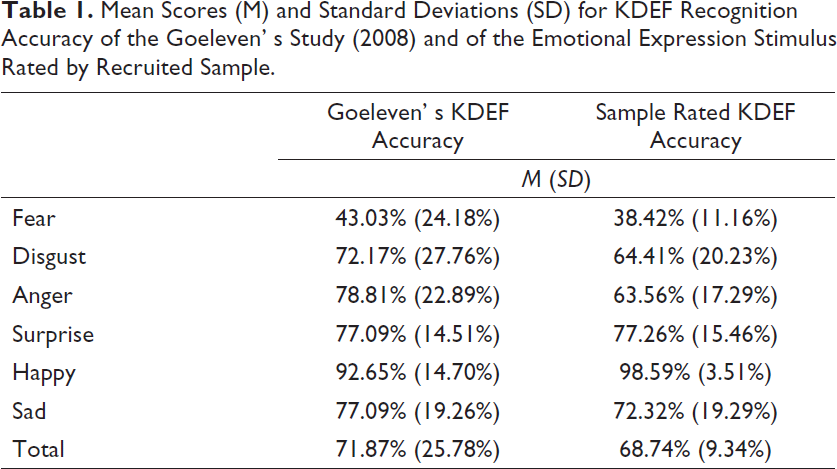
A series of 72 pictures displaying facial emotion expressions drawn from Karolinska Directed Emotional Faces (KDEF) comprised the emotion recognition stimuli that were presented to participants. The KDEF facial affect battery has been proved to be a valid set of affective facial pictures and has been widely used (Goeleven et al., 2008). Considering the cultural factors that may influence emotion recognition (Jack, 2013), we select 72 photographs of the faces of 12 people (6 females, 6 males) based on the recognition accuracy ratings of the facial emotion expressions (as shown in Table 1). These photographs were evaluated by 94 healthy non-offending participants (59 females; Mage: 26.90, SDage = 6.85; age range: 20–55). Compared with the accuracy ratings shown in the previous KDEF validity research (Goeleven et al., 2008), the validity of 72 KDEF pictures we selected is acceptable.
Mean Scores (M) and Standard Deviations (SD) for KDEF Recognition Accuracy of the Goeleven’ s Study (2008) and of the Emotional Expression Stimulus Rated by Recruited Sample.
These stimuli were presented in the middle of a color screen, via a windows-based computer program. Each picture showed one type of 6 basic emotions (happiness, surprise, fear, sadness, disgust, and anger), giving a total of 72 photographs. Participants were presented with morphed stimuli which were video sequences of a neutral face (0% intensity) changed into a full expression (100% intensity) of one of the six basic emotions. The size of each facial animation stimulus is 570 by 770 pixels (see pictures of stimulus in Supplementary Materials). Each picture was presented for 3,000 ms, after which the morphing sequence immediately stopped and the face disappeared. All participants were asked to decide which of the six emotions (happiness, surprise, fear, sadness, disgust, or anger) best described the facial emotion expression shown. The six boxes containing the names of six emotions were shown at the bottom of the screen. The program (JAVA based) was designed to randomize the presentation of the emotional faces and record responses of each trail.
Procedure.
After participants provided written informed consent, they were given a verbal explanation that instructs them to press one of the six boxes with the mouse as soon as they were able to identify the morphing emotion stimuli. To ensure that participants were familiar with the procedure and the requirement, they were asked to complete two pretests of the Facial Emotion Recognition Task before the formal task started.
Ethical approval.
Ethical approval for this study was granted by the Committee for Ethical Review of the Department of Psychology, Sun Yat-sen University. All procedures required by the Ethics Committees were followed to ensure participants could provide fully informed consent.
Results
The violent offenders, non-violent offenders, and control groups were significantly different in overall recognition accuracy (F(2,288.18) = 61.90, p < .001,
As for the Emotion Perception Tendency (FEPT) for each emotion, there were significant differences in fear (F (2, 350) = 3.76, p = .024,
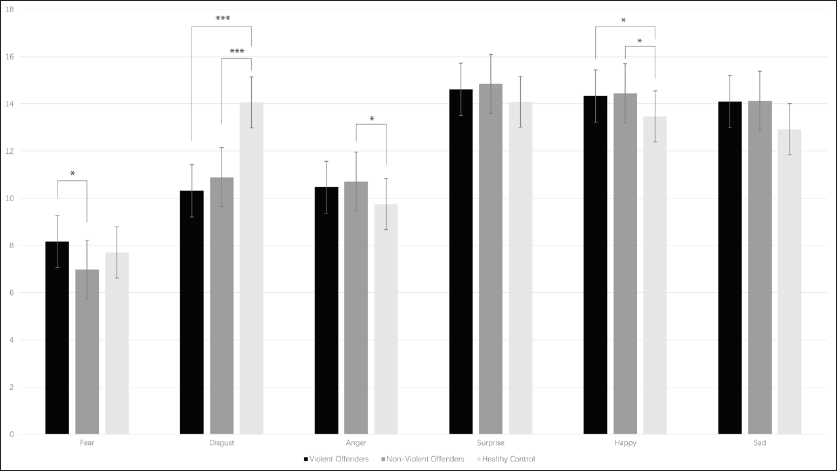
Note. (*p < .05, ***p < .001)
Means and Standard Errors of Raw Emotion Perceptual Tendency (EPT) Data.
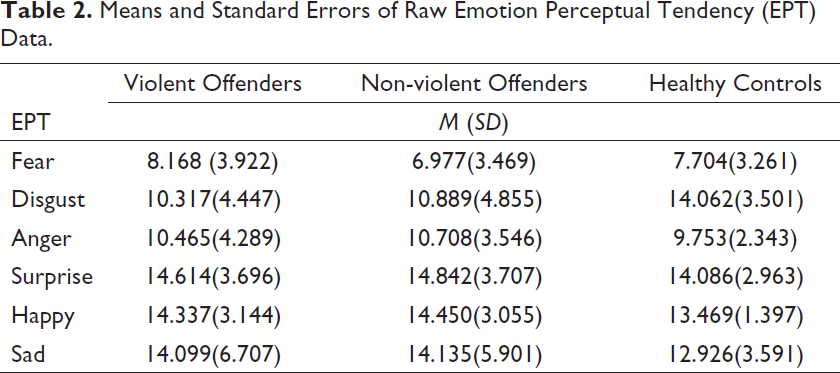
For fear, the post hoc analysis showed that violent offenders (Mviolent = 8.17, SDviolent = 3.92; p = .008, 95% CI [.31,2.07])had significantly higher fear FEPT than the non-violent offenders (Mnon-violent = 6.98, SDnon-violent = 3.47), but showed no differences from non-offending controls (p = .382). Also, no group differences existed between non-violent offenders and non-offending controls (p = .131).
For disgust, both the violent offenders (Mviolent = 10.32, SDviolent = 4.45; p < .001, 95% CI [1.99,4.36]) and non-violent offenders (Mnon-violent = 10.89, SDnon-violent = 4.86; p < .001, 95% CI [2.44,5.05]) showed significantly lower disgust FEPT than the non-offending controls (Mnon-offenders = 14.06, SDnon-offenders = 3.50), while there was no group difference between non-violent offenders and violent offenders (p = .308).
Likewise, for happy, both the violent offenders (Mviolent = 14.34, SDviolent = 3.144; p = .038, 95% CI [.05,1.69]) and non-violent offenders(Mnon-violent = 14.45, SDnon-violent = 3.06; p = .010, 95% CI [.24,1.72]) showed significantly higher happy FEPT than non-offending controls (Mnon-offenders = 13.47, SDnon-offenders = 1.40), while there was no group difference between non-violent offenders and violent offenders (p = .746).
In line with previous research, the results of Study 1 showed that both violent and non-violent offenders had deficits in facial emotion expression perception. More importantly, offender populations had different facial emotion perception tendency in fear, disgust, and happy from non-offending healthy controls. In Study 2, we further investigated how such tendencies could be associated with violent and non-violent antisocial behaviors among non-offending health participants.
Study 2
Method
Participants.
In this study, although we recruited 69 non-offending healthy males via online advertisement and offered them monetary compensation, 4 participants did not complete the Facial Affect Recognition Task, 3 participants did not complete the Buss–Perry Aggression Questionnaire (BPAQ), leaving 62 non-offending datasets. The non-offending sample has an average age of 22 years (SD = 2.50) and a range of 18–31 years. There is no sample diversity in race and gender, and all participants are male Asian Chinese.
The Buss–Perry Aggression Questionnaire.
The BPAQ is a 29-item validated self-report questionnaire that assesses overall aggression tendency (Buss & Perry, 1992). Previous research has demonstrated that the BPAQ shows internal consistency and stability over time and is a useful measure for delineating the personality trait of aggression (Gerevich et al., 2007; Harris, 1997). The reliability and validity of the BPAQ have been supported (e.g., Collani & Werner, 2005; Vitoratou et al., 2009). The BPAQ is scored on a 1–5 Likert scale (1 = Disagree Strongly, 5 = Agree Strongly), and has been applied to the offender population (Diamond & Magaletta, 2006; Williams et al., 1996). We applied the revised 22-item Buss–Perry Aggression Questionnaire-Chinese Version (BPAQ-CV) with high reliability and validity (GFI = .92, AGFI = .90, CFI = .90, RMSEA = .06) to this study (Lv et al., 2013). The revised BPAQ-CV consists of 4 dimensions, including “physical aggression,” “impulsiveness,” “anger,” and “hostility.”
Procedure.
The aim and requirements of the study were first explained to participants. After participants provided their written consent, they were instructed to finish the Facial Emotion Recognition Task as mentioned in Study 1. After a 10-minutes break, participants completed the BPAQ-CV on their smartphones without disturbance of other applications.
Results
The Emotion Percept Tendency for each emotion were: MFear = 7.11, SDFear = 3.03; MAnger = 9.48, SDAnger = 2.72; MDisgust = 14.74, SDDisgust = 4.47; MHappy = 13.57, SDHappy = 2.06; MSad = 11.69, SDSad = 4.15; MSurprise = 15.40, SDSurprise = 3.19.
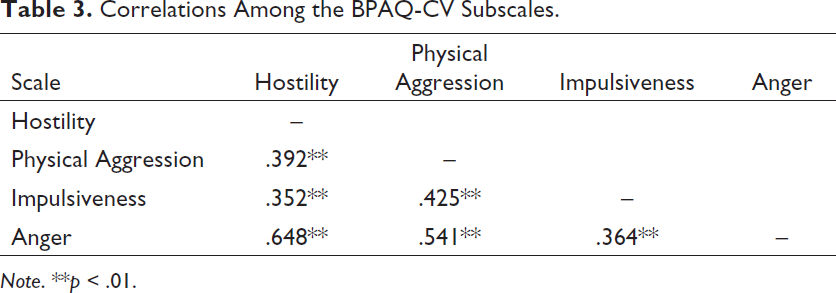
The Cronbach’s alpha for the overall BPAQ-CV scale was .85 (.73 for the “Hostility” subscale, .69 for the “Physical Aggression” subscale, .48 for the “Impulsiveness” subscale, and .696 for the “Anger” subscale). The correlations among the BPAQ-CV subscales were shown in Table 3, showing that all four subscales were significantly and positively correlated with each other.
Correlations Among the BPAQ-CV Subscales.
Note. **p < .01.
The correlations between the BPAQ-CV subscales and the FEPT were shown in Table 4. The subscale “Physical Aggression” was positively correlated with the fear FEPT (r = .26, p = .043, 95% CI [–.01, .49]), while negatively correlated with the anger FEPT (r = −.27, p = .034, 95% CI [−.50, .02]). We found no correlation between the other three BPAQ-CV subscales (i.e., “impulsiveness,” “anger,” and “hostility”) and FEPT. Since the “impulsiveness” subscale possesses quite low reliability, we regarded the significant correlation result of this subscale with the surprise FEPT as unwarranted.
Correlations Between the BPAQ-CV Scale and the Emotion Perceptual Tendency (EPT).
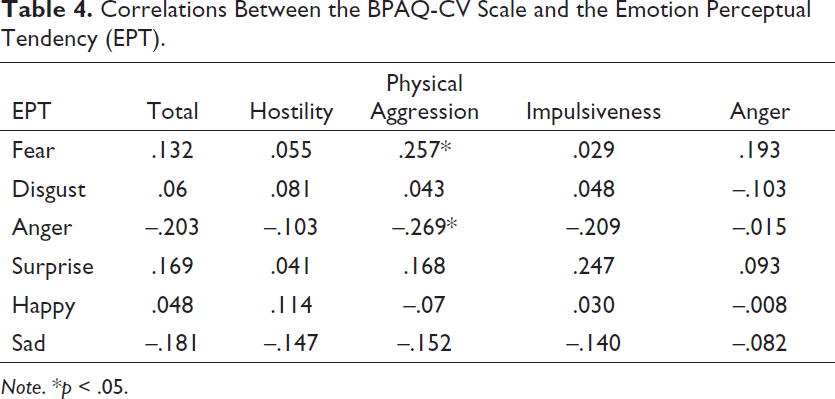
Note. *p < .05.
General Discussion
In this study, we first investigated whether violent and non-violent offenders had different basic emotion perception tendency (Study 1), and then examined the association between basic emotion perception tendency and aggressive behaviors (Study 2). Consistent with previous findings, our results revealed that both non-violent offenders and violent offenders had worse performance in overall emotion recognition accuracy than non-offending controls. More importantly, by using the new indicator FEPT, we were able to demonstrate new evidence of differential emotion perception patterns between violent offenders, non-violent offenders, and non-offending controls. Particularly, both non-violent offenders and violent offenders had lower disgust FEPT but higher happy FEPT than controls. Also, non-violent offenders had significantly lower fear emotion perception tendency than violent offenders but higher anger emotion perception tendency than healthy controls. Further, the level of physical aggression is positively correlated with fear emotion perception tendency, while negatively correlated with anger emotion perception tendency. These results obtained in Study 1 and Study 2 indicate that the decision of conducting violent or non-violent antisocial behaviors depends on the level of hostile and distress social cues perception. In specific, the hostile cues (e.g., anger emotion) elicit behavioral avoidance, while distress cues (e.g., fear emotion) elicit behavioral approach from perceivers.
Our findings support that higher callous/unemotional traits or the acute perception (i.e., high accuracy and short reaction time) of fear emotion are associated with violent behavior (Diaz et al., 2016; Woodworth & Waschbusch, 2008). One plausible explanation for this result is that fear emotion, like the infant’s faces, conveys vulnerable social signals (Hammer & Marsh, 2015). Since the fear emotion represents submissive to the dominance of threatening individuals and can protect the loser from further attack (ÖHman, 1986), high FEPT of fear may boost the confidence of the perceiver to conduct aggressive behaviors. Therefore, under the intense and conflicting situation, perceivers of such vulnerability may be promoted to conduct the attack-based behavioral approach with positive expectation.
Study 1 showed that non-violent offenders had significantly higher anger FEPT than the controls (p = .031). It is generally acknowledged that anger conveys hostility and triggers avoidance behavior. For the receivers, perceiving other people’s angry facial expressions would induce their guilty and disapproval of actions (Giner-Sorolla & Espinosa, 2011). As such, the finding infers that non-violent offenders with higher anger FEPT adopt defensive strategies and tend to avoid possible conflicts by indirect contact with victims (e.g., theft) or seemingly friendly conversation (e.g., fraud).
Compared with healthy non-offending controls, both violent and non-violent offenders perceived significantly less disgust emotion in the emotion recognition task. These findings imply that low disgust FEPT is associated with offending behaviors. A significant body of research has shown that disgust is related to social morality. Specifically, disgust results from moral violations intensify moral judgment (Pizarro et al., 2011), and correlates to shame emotion (Giner-Sorolla & Espinosa, 2011). Undoubtedly, criminal behaviors violate the social norm. However, the inappropriateness of immoral violations can be realized by healthy controls but not by violent and non-violent offenders with significantly lower disgust FEPT. In other words, the low perception tendency of disgust inhibits self-reflection and perceived disapproval for both violent and non-violent offenders.
Interestingly, this study found that both violent and non-violent offenders had significantly higher happy FEPT than the healthy controls. To the best of our knowledge, though few studies have reported that offenders may have deficits in recognizing happy facial emotion expressions (Dolan & Fullam, 2006; Larkin et al., 2002), none of them reported how the tendency to perceive happy emotion could be related to offending behaviors. We postulated that the high happy FEPT of both violent and non-violent offenders may encourage them to approach and harm the victims. Such misinterpretation of social cues would reduce the perceived severity of their inappropriate conduct. More studies are needed to examine the association between happy emotion perception and antisocial behaviors and the underlying mechanisms.
Through the proposed new indicator of FEPT, we were able to demonstrate detailed associations between emotion perception tendency and violent behaviors. We believe that FEPT would be more applicable in describing how emotions are decoded and interpreted by people during interpersonal interactions. Future studies could consider the implication of this indicator in related research.
To conclude, this study is the first to explore how violent and non-violent offenders differ in their facial emotion expression perception tendency. The findings of our study emphasize that further efforts should be paid to improve the general emotion decoding ability of offenders. It is also crucial to develop appropriate treatment programs based on the different emotion perceptual tendencies of violent and non-violent offenders. Previous studies have proved that through “feedback-based training” and “visual adaptation” training programs, the misperception of anger and social maladaptation can be reduced (Penton-Voak et al., 2013).
In addition to developing treatment programs for convicted criminals, it is also of importance to prevent antisocial behavior in advance. Since children with emotion decoding deficits conduct antisocial behaviors (Bowen & Dixon, 2010), early detection and training-based interventions for children with emotional perception tendency deficits can reduce or prevent their maladapted behaviors after entering school and society.
Limitations
Although this article’s findings showed meaningful differences between violent and non-violent offenders in facial emotion perception tendency, some limitations should be noted. First, due to the long timespan of data collection, the offenders who participated in Study 1 could not be traced to complete the BPAQ-CV scale in Study 2. All participants we recruited in Study 2 have an undergraduate or graduate education background and have no criminal record. The results of Study 2 may be more convincing if participants have indeed conducted aggressive behaviors. Second, all participants of Studies 1 and 2 are male, and females may perform better than males in emotion recognition (Gross & Levenson, 1995). Therefore, to what extent the results of this study with male adult offenders can be generalized to their female counterparts remains unknown. Moreover, participants in our studies were East Asian adults, limiting the ability of the current results to be generalized to samples of other races and nationalities. Further research could investigate whether there is any sex or race difference in the association between emotion perception tendency and aggressive behaviors.
Finally, we employed the KDEF picture set consisting of Caucasian rather than Asian faces as the emotional stimuli due to the lack of valid measurement in Chinese faces. However, though our participants were Asian Chinese adults, the other-race effect (i.e., lower emotion recognition accuracy due to limited exposure to other-race faces) may not make an impact on the results of this study because the healthy participants and offenders have a similar degree of exposure to Caucasian faces. First, the offenders who participated in this study were either gathered for short term (1–2 months) reeducation after the sentence and would be transferred to other prisons or were issued with a less-than-five-year sentence. Therefore, both violent and non-violent participants have not been isolated from society for long periods. Second, most native Chinese people are exposed to Caucasian faces through mass media, which are also accessible to the prisoners. Every day, the prisoners are strictly organized to watch some television programs like the daily news. Additionally, previous studies have provided a new perspective to the other-race-effect that it is the acculturation, rather than the exposure, that enhances the ability to recognize facial emotion expression under cross-cultural context (Prado et al., 2014). This result suggests that the length of incarceration of prisoners may exert limited influence on the results of this study. We suggest that the appropriate Asian facial emotion expression materials can be employed in future studies if applicable.
Supplemental Material
Supplemental material for this article is available online.
Supplemental Material for Facial Emotion Perceptual Tendency in Violent and Non-violent Offenders by Yun Zeng, Xilin Liu, Lehua Cheng, in Journal of Interpersonal Violence
Footnotes
Acknowledgments
The authors wish to thank Peisheng He for data collection.
Declaration of Conflicting Interests
Funding
The author(s) received no financial support for the research, authorship, and/or publication of this article.

Author Biographies
References
Supplementary Material
Please find the following supplemental material available below.
For Open Access articles published under a Creative Commons License, all supplemental material carries the same license as the article it is associated with.
For non-Open Access articles published, all supplemental material carries a non-exclusive license, and permission requests for re-use of supplemental material or any part of supplemental material shall be sent directly to the copyright owner as specified in the copyright notice associated with the article.
