



Abstract
Numerous studies have attempted to explain prosocial behaviors. Most of these studies focus on individual and contextual factors. Although existing data on the national level have demonstrated significant differences between countries in the frequency of prosocial behaviors, the reasons for these differences have rarely been explored. We hypothesize that Hofstede’s national culture perspective can explain this variance. We applied five societal culture structures to explaining cross-national variations: individualism (IND)–collectivism, power distance (PD), uncertainty avoidance (UA), masculinity, and future orientation (FO). Analysis of data from 66 countries supported our hypotheses: IND correlated positively and PD correlated negatively with prosocial behaviors. Contrary to our hypothesis, UA and FO correlated negatively with prosocial behaviors. Furthermore, PD and UA interact with IND in prediction of prosocial behaviors. We further explored the effect of the cultural dimensions on specific prosocial behaviors separately and found which of them are related to the cultural dimensions.
Prosocial Behaviors
Over the last 50 years, scholars have been attempting to understand what makes certain people act prosocially. 1 Although there are varieties of prosocial behaviors (Jones, 2006), our definition refers to three key dimensions: donating to charities, volunteering for organizations, and helping strangers. These are the three pillars of individual voluntary action (Putnam, 2000; Verba, Schlozman, & Brady, 1995). A small portion of the recent research on this topic has added individual behaviors, such as participating in election, active political involvement, advocacy, and using one’s finances to purchase only items in line with one’s social or economic preferences (monitorial behavior). However, these behaviors are less commonly studied and are viewed as complementary to the three pillars of voluntary action (Dalton, 2008; Hustinx, Meijs, Cnaan, & Handy, 2012; Schudson, 1998, 2006).
It is agreed that people with higher social and economic status tend to volunteer and donate more (Wilson, 2000). David Horton Smith (1994) conceptualized this phenomenon as the “dominant status model.” This does not imply that helping, donating, and/or volunteering are exclusively carried out by the rich, educated, and those of higher socioeconomic status. However, such individuals do have higher rates of volunteering and donations, and they also tend to hold more prestigious and meaningful positions in the many formal organizations that employ volunteers. Wilson and Musick (1999) referred to these findings as a “resource model,” based on three premises: (a) productive work requiring human capital, (b) collective behavior requiring social capital, and (c) ethically motivated work requiring cultural capital. From a “surplus perspective,” one can assume that people with more of these resources will be more willing to give than those with fewer resources, who have less economic and social security. People with higher education and socioeconomic status tend to join groups and organizations. These groups provide connections, thereby helping to maintain status and networks.
In addition to socioeconomic status, religion and religious participation are assumed to enhance prosocial behaviors. A body of literature relating to the role of religion in prosocial behavior suggests that religious people, especially those who attend places of worship, do more voluntary work within and beyond their congregations, donate more, and help the needy more than nonbelievers and nonattenders (Bekkers & Wiepking, 2011b; Musick, Wilson, & Bynum, 2000; Putnam & Campbell, 2010; Ruiter & De Graaf, 2006).
Numerous other explanations were provided as to why some people act more generously with their time, money, and approach to strangers than others. These concepts include parental modeling, family structure, having children, age, cohort, role identity, empathy, altruism, attitudes, norms, trust, ability to influence, solicitation, awareness of need, response to disaster or crisis, the warm glow, and many others (Bekkers & Wiepking, 2011a; Lee, Piliavin, & Call, 1999; Sargeant & Woodliffe, 2007; J. R. Smith & McSweeney, 2007). However, with regard to most prosocial behaviors, most notably donating and volunteering, there is still a lot to learn.
Regarding donations, Bekkers and Wiepking (2011a) noted that “a strong tendency in the past 30 years towards specialization among scientists in different disciplines has created the undesirable situation that scholars usually know little about insights gathered in other disciplines” (p. 925), and indeed, knowledge from different disciplines and different lines of inquiry may shed new light on prosocial behaviors. Furthermore, regarding volunteering, Musick and Wilson (2008) have acknowledged that we know a lot about who volunteers, what organizations they volunteer for, and why they volunteer, but this knowledge is limited to individual characteristics. We know very little about cross-national differences (see also Wilson, 2012). Similarly, D. H. Smith (1994) and Wilson (2000), in their respective overview articles, suggested that there is a paucity of research on the impact of the national context on individual volunteering. In a theoretical analysis of volunteering using a cross-disciplinary approach, Hustinx, Cnaan, and Handy (2010) noted that “The complex question of how the larger socio-cultural context or macrosystem impacts individual volunteering has received the least attention among scholars in the field” (p. 16).
This is also true about other prosocial behaviors. Studying prosocial behaviors from a societal or cross-national perspective using other untapped disciplinary perspectives is one of the least developed aspects of voluntary action research. Hodgkinson (2003) contended that “future research would greatly benefit from a stronger theoretical base to explain differences in rates of volunteering across nations” (p. 52). Ruiter and De Graaf (2006) concluded, “Up until now, international comparative research on voluntary association involvement (studying either memberships or volunteering, and sometimes both) has focused mainly on political and economic factors” (p. 192).
Two questions thus emerge. First, are there relevant cross-national variations in prosocial behaviors? A broad consensus exists that “volunteerism cannot flourish in societies where there is no civil society, where opportunities for free association and free discussion are limited” (Musick & Wilson, 2008, p. 344). This is also true with regard to donations (Bekkers & Wiepking, 2011b), but even in societies where volunteering and donations are normative, their rates fluctuate strongly (Inglehart, 2003). The second question focuses on explaining national differences in prosocial behaviors above and beyond individual-level determinants, against a background of historically evolved divergences in the political (stability, level of democracy, welfare-state regimes), economic (national), and cultural (values, religion) characteristics of nations (Hodgkinson, 2003; Inglehart, 2003; Ruiter & De Graaf, 2006; Salamon & Sokolowski, 2003; Schofer & Fourcade-Gourinchas, 2001).
Thus, understanding prosocial behaviors from a societal perspective is rarely applied and can give rise to important theoretical and practical implications for the field of voluntary action research. We posit that an important aspect of cross-national variations in volunteering and other prosocial behaviors derives from societal culture (Hofstede, 1980). This line of investigation that links national culture, organizational-psychology constructs, and prosocial behaviors is innovative, and therefore requires explication.
Societal Culture
It is generally accepted that every individual is nested in a particular culture and is inevitably influenced by that culture (Hofstede & Peterson, 2000; House & Javidan, 2004). It is important to distinguish between organizational and societal culture because some studies of prosocial behaviors explain the impact of organizational culture on such behaviors, whereas our study focuses on the impact of societal culture on prosocial behaviors. In culture studies, society and social organizations have been regarded as separate units of analysis (Hofstede & Peterson, 2000). Hofstede, Neuijen, Ohayv, and Sanders (1990) suggested the distinction by addressing national cultures as values and organizational cultures as practices.
The distinction can also be explained if we define organizational culture as a pattern of shared basic organizational assumptions of organization members when solving problems of external adaptation and internal integration. These solutions are considered as valid, to be imparted to new members as the correct way to deal with such problems (Schein, 1983, 1985). Our focus is based on previous research (Hofstede, 1980; House et al., 1999) that revealed the strong impact of national culture on behavior, above and beyond organizational or environmental factors (see also Gelfand, Erez, & Aycan, 2007; Hofstede & Peterson, 2000).
Hofstede et al. (1990) reviewed recurring characteristics of culture as “(1) holistic, (2) historically determined, (3) related to anthropological concepts, (4) socially constructed, (5) soft, and difficult to change.” (p. 286) Together, they form the influential phenomenon known as societal culture.
When operationalizing and measuring societal culture, studies most often focus on the structures and dimensions of individualism (IND), power distance (PD), uncertainty avoidance (UA), masculinity versus femininity (MF), and future orientation (FO; Hofstede, Hofstede, & Minkov, 2010; Javidan, House, & Dorfman, 2004). Each of these represents a continuum along which an organization or society is situated. In fact, studies have shown that cultural dimensions may explain related behaviors. For example, research has indicated a relationship between IND/collectivism and volunteering in an organization (Parboteeah, Cullen, & Lim, 2004) and charitable giving (Kemmelmeier, Jambor, & Letner, 2006), and Chandrakumara, Glynn, Gunathilake, and Senevirathne (2010) found that MF predicted citizenship performance. Furthermore, branches of the same organizations in different countries or cultures conform, to a large extent, to the mores of the country, rather than to those of the multinational corporation (Hofstede et al., 2010; Javidan et al., 2004).
To the best of our knowledge, there have been no systematic attempts to harness national cultures to prosocial behaviors. This article is intended to assess how some dimensions of societal culture explain levels of prosocial behaviors independent of and/or in conjunction with traditional national variables.
IND Versus Collectivism
According to Hofstede (1980; Gelfand, Bhawuk, Nishii, & Bechhtold, 2004; Hofstede et al., 2010), as regards IND of national culture, focus is on the individual. Self-actualization and personal growth are more important than loyalty to reference groups, and tradition is less of a behavior guide. In individualist societies, people solve their own problems and earn money to meet their needs, rather than relying on the state or other organizations. Collectivism obviously emphasizes interdependence. People are not isolated, self-contained beings, but are linked, committed to the same group or society, and live collaboratively.
One might thus assume that societies high on IND would be low on prosocial behaviors. The ideology of IND derives from individuals’ self-interest (Gelfand, Triandis, & Chan, 1996), narcissism (Lasch, 1978), and indifference to, suspicion of, or even antagonism toward their government and its institutions (Bellah, Madsen, Sullivan, Swidler, & Tipron, 1985).
The United States is characterized by high-level IND but is also very high on most prosocial issues (Wuthnow, 1991). Kemmelmeier et al. (2006) studied regional variations in prosocial behaviors in the United States. They found IND to be positively related to charitable giving and volunteerism, and that both were more likely to occur in more individualist states. Evidently, prosocial action occurs for a number of reasons, including not only the expected altruism but also selfishness (e.g., Batson, 1994; Dovidio, Piliavin, Schroeder, & Penner, 2006; Oliner, 2002; Schroeder, Penner, Dovidio, & Piliavin, 1995; van de Vliert, Huang, & Levine, 2004). In other words, individuals behave in a prosocial manner because it serves their own purposes and should be more inclined to such self-serving behavior in individualistic cultures. Welzel (2010) used the World Values Survey to prove that self-expression values, which are the marks of IND, are civic because they are associated with altruism and strong social capital that are often seen as essential for any civil society. Similarly, Allik and Realo (2004) found, when analyzing U.S. states and 42 different countries, that social capital was higher in more individualistic societies. They concluded that “These results support Durkheim’s view that when individuals become more autonomous and seemingly liberated from social bonds, they actually become even more dependent on society” (p. 29).
Finkelstein (2010, 2011) found that, among Americans, IND and collectivism did not explain levels of volunteering but did explain the sources of motivation to volunteer (why individuals volunteer). It is possible that the relatively low variability of IND they found is the reason for the lack of association between IND and volunteering. We found only one study that applied the IND–collectivism variable from a cross-national perspective (Parboteeah et al., 2004). The authors, however, used a different measure than that proposed by Hofstede et al. (2010), and found positive relationships between formal volunteering (acts of random generosity and helping neighbors and relatives were excluded) and collectivism. These conflicting results require further research. There is a large body of literature linking prosocial behavior with collectivism. However, recent literature focusing on the individual level suggests that IND may support prosocial behaviors. As we propose linking IND as a national culture with prosocial behaviors, we suggest that in societies that promote IND, more of their members will demonstrate prosocial behaviors. We hypothesize the following:
PD
Why do less powerful members of society expect and accept that power is distributed unequally (Hofstede & Hofstede, 2005)? In countries with low PD, the prevailing belief is that inequality of treatment, rights, and privileges across individuals is perceived as unjustified. In countries with high PD, such inequalities and power differentials are accepted and institutionalized, and the prevailing belief is that higher status members can and should retain their power and advantages, that is, such societies accept the notions of “winner takes all” and “social Darwinism”—that those at the top are there for justified reasons and that this imbalance is good for society. A PD index shows very high scores for Latin and Asian countries, African areas, and the Arab world. Western European countries have lower PD. In high PD societies, PD is sustained and highlighted through use of titles—Mr. President, boss, teacher, professor—rather than use of first names. Those in power are expected to look after those beneath them, and employees are subordinates who must be closely supervised. Subordinates’ initiative is frowned upon (Gelfand, Bhawuk, et al., 2004; Hofstede, 1980; Hofstede et al., 2010).
We found no study that applied PD to prosocial behavior. It can be assumed that in high PD countries many members of society will see little reason to work for change. Elitist prosocial behavior will not be on a large scale, and because subordinate initiatives are not encouraged there will be little incentive to volunteer. Fock, Hui, Au, and Bond (2013) found that in countries with high PD, most empowerment interventions are unsuccessful—people of low social status do not expect the social order to change and are not interested in working for change. Kemmelmeier et al. (2006) suggested that “volunteering offers individuals an escape from personal problems and even allows them to assuage feelings of guilt about social inequality” (p. 328). This, however, is limited to the affluent minority, and suggests low levels of prosocial behaviors where PD is high. Members of different status groups do not interact with each other, so that prosocial behavior is not socially encouraged, but is often a question of noblesse oblige. Ringov and Zollo (2007) found that corporate social responsibility in countries with high PD is associated with lower levels of social and environmental performance. Onder (2011) found that “Although the explanation is not apparent, we can say that countries with dominant cultures that tolerate high power distance have more nonprofit activity” (p. 82).
When PD is high, prosocial behavior activity often originates among the elite for their own benefit. We therefore hypothesize the following:
UA
UA concerns tolerance for uncertainty and ambiguity (Hofstede & Hofstede, 2005) and indicates to what extent a society’s members feel uncomfortable or comfortable in unstructured situations, that is, the preference for laws and regulations and predictable administration over ambiguity and risk. Such societies tend to minimize unknown and unusual circumstances, to be guided by planning, and to implement rules, laws, and regulations. In this respect, in most cross-national studies, Greece (low) and Singapore (high) are polarized. Low UA societies are tolerant of others’ opinions; rules are few and flexible, and varied philosophic and religious beliefs coexist.
No study was found that directly applied UA to a prosocial behavior. We suggest that in high UA societies the government is expected to create mechanisms that care for the needy to decrease uncertainty caused by individual and organizational prosocial acts. Indeed, individuals who try to be prosocial may even increase uncertainty. Png (2008) suggested positive relationship between UA and prosocial behavior, focusing on specific prosocial behavior, for example, blood donation, but found no significant connection between blood donation and UA. Ringov and Zollo (2007) found that corporate social responsibility is not associated with UA. In a study of the number of nonprofit organizations in a given country, Onder (2011) found “high uncertainty avoidance leading to a prevalence of nonprofit activities, although it is not statistically significant” (p. 82).
We therefore hypothesize the following:
FO
FO or long-term orientation is how individuals engage in future-oriented behavior such as planning, investing for the future, and delaying gratification. In some countries 5-year plans are normative, in others there is little investment in planning and long-term goals. Chandrakumara et al. (2010) found that FO is positively correlated with citizenship performance in Sri Lanka. Van Lange and his colleagues (Van Lange & Joireman, 2008; Van Lange, Klapwijk, & Van Munster, 2011) argued that generosity and prosocial behaviors are affected by a society’s short- or long-term orientation. In societies with long-term orientation, people expect to have more interaction with others in the future and are consequently more willing to help others. We hypothesize the following:
MF
The masculine–feminine domain is the degree to which masculine-associated behaviors predominate in a national culture, with special reference to behaviors such as focus on success, competition, performance, and on work rather than leisure. We assumed that, in feminine cultures, individuals would more willingly perform social acts, basing our assumption on the literature concerning gender roles, in which service-based professions are known to be feminine. For example, Musick and Wilson (2008) found that women volunteer far more frequently than men and attributed this to women being more disposed, or feeling more obliged to care, and because society expects it of them. In their words, “Women do most of the care work because, in a patriarchic society, women are required to do most of the ‘dirty work’” (p. 171). Consequently, we expect that where masculinity is the norm, levels of volunteering, donating, and helping strangers will be low. Furthermore, Chandrakumara et al. (2010) found that MF is negatively correlated with citizenship performance in Sri Lanka. We therefore hypothesize the following:
However, these dimensions are interdependent, and can be expected to interact in prediction of prosocial behaviors. We suggest that prosocial behavior based on individualistic characteristics depend on PD, FO, masculinity, and UA. Thus, a positive relationship between the individualistic dimensions of culture and prosocial behavior should be stronger in societies with lower levels of those dimensions. Relating to the interaction between the individualistic dimension and FO, Van Lange and his colleagues (2011) . . . found evidence for the idea that the mere anticipation of repeated (versus single-trial) interaction promoted cooperation, but more so in those who pursue primarily individualistic, self-interested goals than in those who are more prone to pursue prosocial goals. (p. 847)
Additional hypotheses, therefore, are as follows:
Method
Data for the study were drawn from several sources and merged according to country. We selected countries for which valid scores on all variables were available. At the country level, prosocial behavior scores were drawn from the Gallup Poll of samples from 132 countries (2006). National culture scores were available for only 66 countries, and our sample is composed of these countries, for which we had both prosocial data and national cultural data. We analyzed all information on these 66 countries (in-country averages) representing geographic regions worldwide.
Dependent Variables
The Gallup survey focused on three prosocial behaviors based on three questions: Have you volunteered for an organization in the last month? Have you given money to charity in the last month? and Have you helped a stranger in the last month? For each item, a percentage of the total sample, of people reporting such behavior was calculated. Averages of the three percentages were used to measure prosocial behavior in general, and for analysis of each of the three behaviors individually. Note that this definition is very broad and may include behaviors that the population researched perceived positively, but which other groups may perceive negatively. For example, a participant may report giving money to charity, but the organization receiving the donation is known to support terrorism.
Independent Variables
On the country level, scores for three culture dimensions were drawn from Hofstede et al. (2010). 2 Each dimension comprises four items and a 5-point scale available at Hofstede’s website. We include examples of two items from each dimension that highlight the nature of that dimension (It should be noted, however, that the scores are based on the full scale): (a) IND—participants were asked to evaluate the personal importance of each item: “having sufficient time for your personal or home life,” “having a job respected by your family and friends”; (b) PD—participants were asked, “How often, in your experience, are subordinates afraid to contradict their boss (or students their teacher?)” and the extent of their agreement that “An organization in which some subordinates have two bosses should be avoided at all costs”; (c) UA participants assessed the extent to which they agree that “One can be a good manager without having an answer to every question a subordinate raises about his or her work” and “Company or organization rules should not be broken—even if the employee thinks breaking a rule would be in the organization’s best interest”; (d) Masculinity—participants were asked to assess the importance of each item for them: “chances for promotion,” “pleasant people to work with”; (e) FO—the extent to which participants agreed that “persistent effort is the surest way to achieve results” and “We should honor our heroes from the past.”
Control Variables
Using data from 66 countries limited the use of meaningful and available control variables for each studied country. We thus controlled for only two variables: (a) Religious heterogeneity was based on fractionalization data (Alesina, Devleeschauwer, Easterly, Kurlat, & Wacziarg, 2003), based on Uslander’s (2002) premise that, in religiously diverse societies, people tend to volunteer, usually to help their own group members. While most of the literature regarding the relationship between prosocial behaviors and religion focuses on congregational attendance, others (cf. James, 1989) contend that religious diversity is a better explanatory variable for formation of nonprofit organizations, volunteering, and donating. It also indicates more prosocial behavior in that where voluntary organizations abound, the volunteer response to disaster is likely to be more robust (Beyerlein & Sikkink, 2008).
Diversity is related to potential competition between religious groups—if they feel threatened, members are motivated to be more committed to volunteering and donating. Thus, in regard to communities, Grønbjerg and Paarlberg (2001) found that all variables, including religious diversity and church adherence, were significantly related to at least one of the four nonprofit dependent variables. Hence, for comparing countries we used religious diversity as a control variable.
Indices are based on population data from the Encyclopaedia Britannica (2001). The measure derives from Alesina et al. (2003) and is calculated as 1 minus the Herfindahl–Hirschman index of the composition of religious affiliations in a population, that is, the probability that two members of a population, chosen at random, do not share the same religious affiliation. (b) The Human Development Index (HDI) ranks countries by standards of living and quality of life, and calculates three dimensions: life expectancy (calculated from analysis of actuarial tables), education (calculated from mean years and expected years of schooling), and standard of living (calculation of personal expenditure, gross private investment, government expenditures, net income from foreign assets, and gross export of goods and services). Numerous studies have documented that people of higher economic status are more likely to volunteer (Musick & Wilson, 2008), but few studies focus on the national level of economic development. Cole, Mailath, and Postlewaite (1992) noted that “The interaction between the organization of a society and its economic performance was once considered perhaps the fundamental question of political economy” (p. 1095). Most notable in this regard is Putnam’s study of social capital and economic development in North Italy. Sabatini (2008) found that bonding social capital (e.g., strong family ties) is not correlated with economic development but bridging social capital (e.g., weak informal ties) is. Parboteeah et al. (2004) found that a country’s wealth is associated with levels of volunteering, indicating that it is an important control variable. Several other studies have shown that economic deprivation at neighborhood and city levels lowers the rate of volunteering (Letki, 2008).
We tested whether economic development is a control variable for the relationship between national culture and prosocial behaviors, and for testing moderation we centered all the independent variables. For multicolinearity, we calculated the variance inflation factor (VIF) between IND and each moderating variable and found accepted levels for all analyses, ranging from 1.00 (IND and masculinity) to 1.65 (IND and PD).
Results
Descriptive statistics and correlations between variables are presented in Table 1. IND was correlated with PD and UA, which did not correlate significantly (r = .24, ns).
Means, Standard Deviations, and Correlations (N = 66).
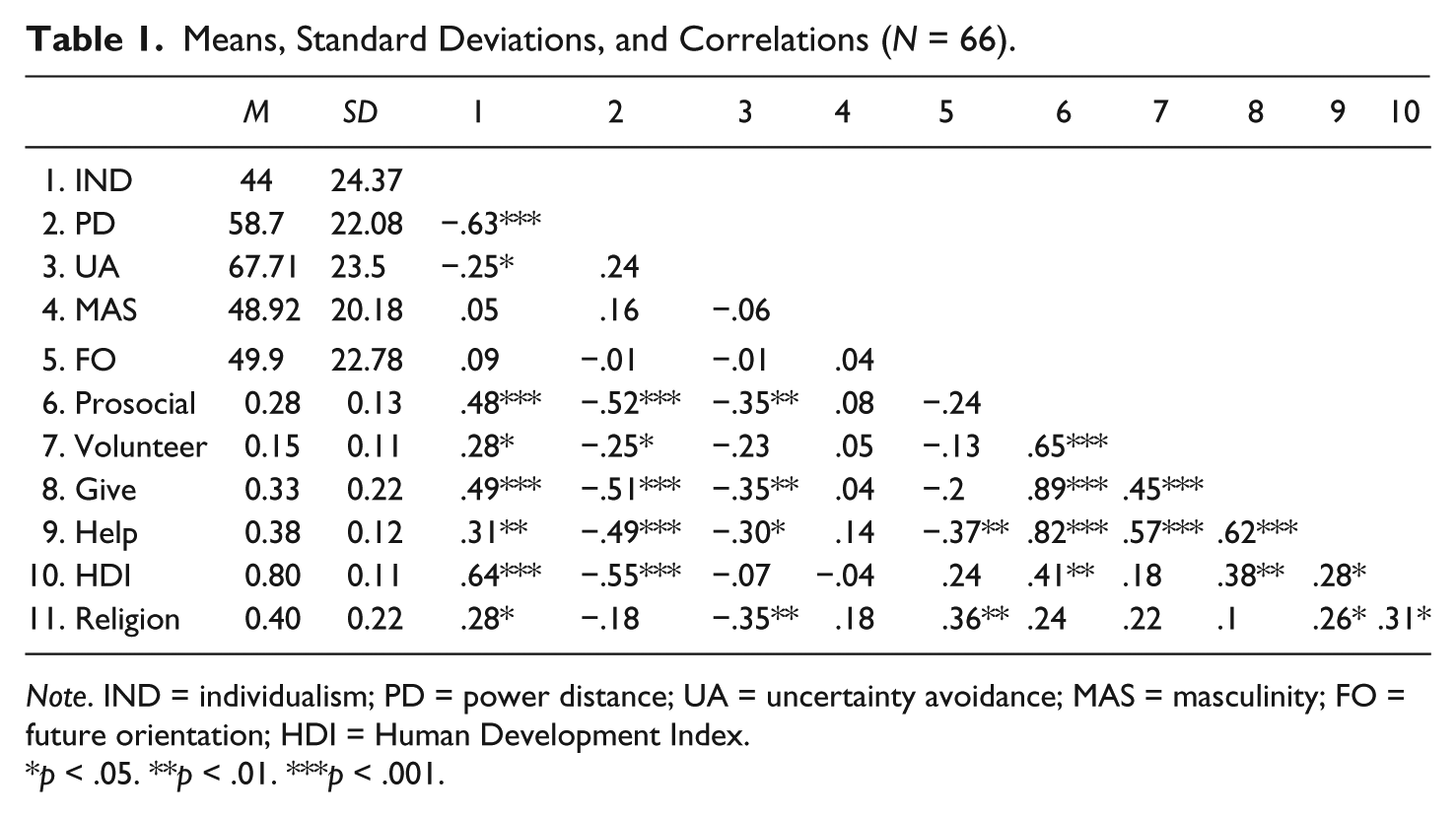
Note. IND = individualism; PD = power distance; UA = uncertainty avoidance; MAS = masculinity; FO = future orientation; HDI = Human Development Index.
p < .05. **p < .01. ***p < .001.
To test our first three hypotheses, we conducted multiple regression analyses controlling for religion and human development. Supporting Hypothesis 1, we found that IND is positively associated with the mean of prosocial behaviors (Table 2). We also explored prosocial behaviors as related to IND and found that IND significantly predicted giving money to charity but did not predict volunteering or helping strangers (Table 2). Religion and the HDI did not contribute significantly to the regression.
Regression Analysis of the Relationship Between Individualism and Prosocial Behaviors (N = 66).
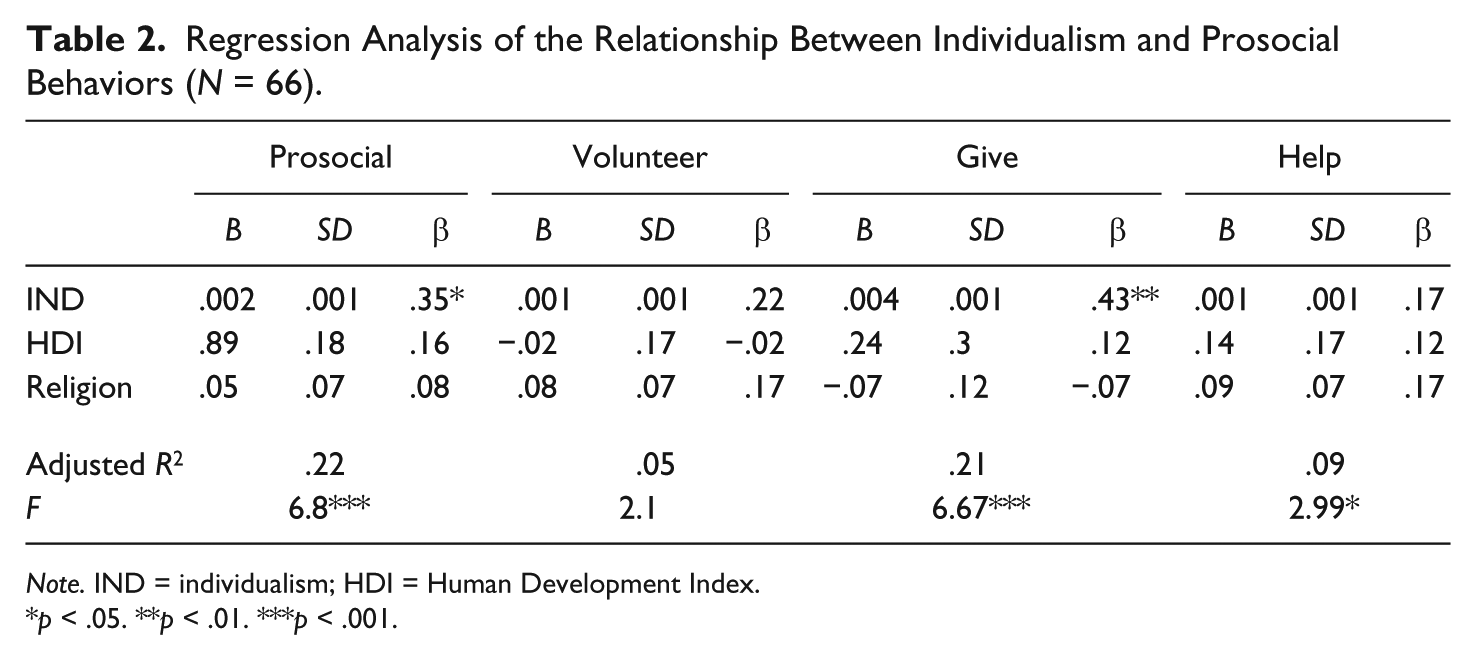
Note. IND = individualism; HDI = Human Development Index.
p < .05. **p < .01. ***p < .001.
Supporting Hypothesis 2, PD was negatively related to the mean of prosocial behaviors (Table 3). Exploration of which behaviors were related to PD revealed that in countries with high PD, individuals give less money to charity and help fewer strangers, but do not volunteer less than those in low PD countries. Religion and HDI did not contribute significantly to the regression.
Regression Analysis Testing the Relationship Between Power Distance and Prosocial Behavior (N = 66).
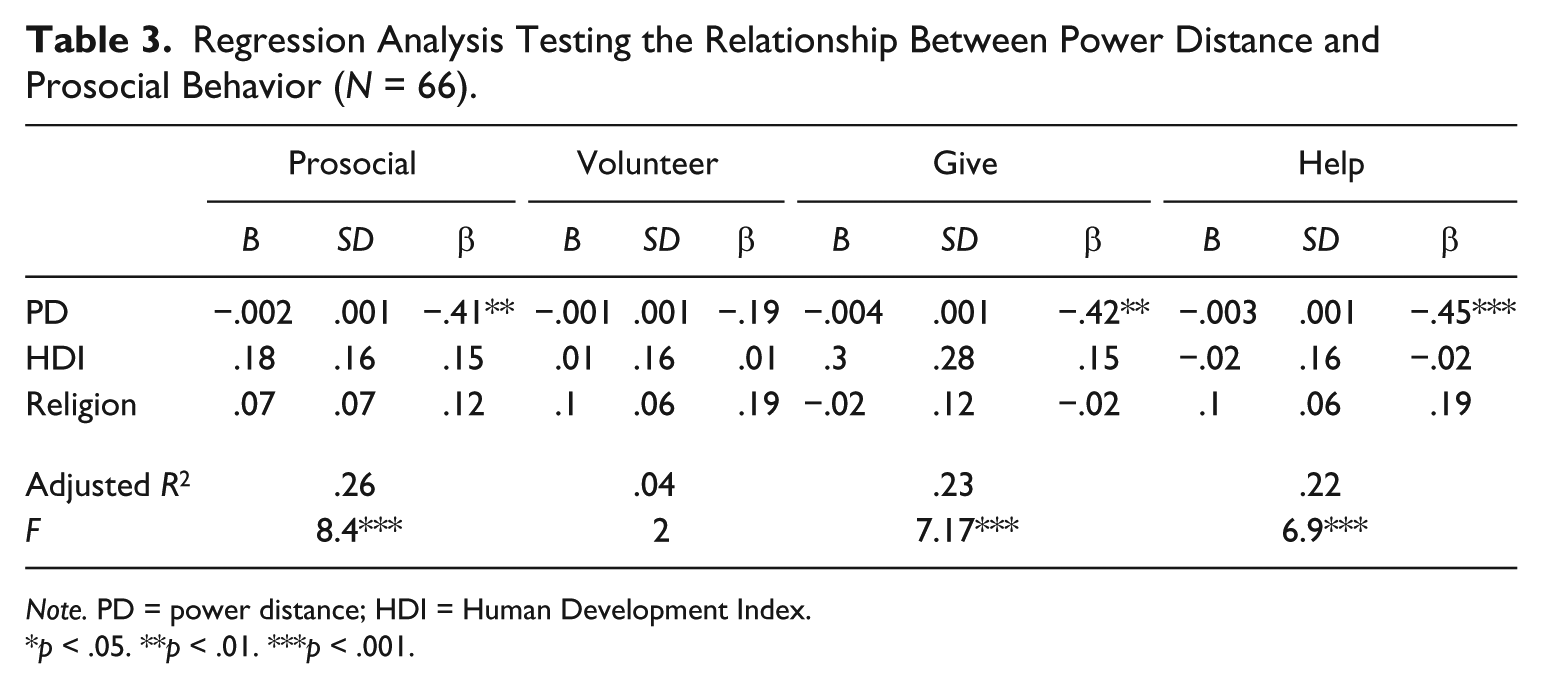
Note. PD = power distance; HDI = Human Development Index.
p < .05. **p < .01. ***p < .001.
Contrary to Hypothesis 3, UA was negatively related to the mean prosocial score (Table 4). Among the prosocial behaviors, UA predicted both volunteering and giving money to charity, but not helping strangers. HDI did not contribute significantly to the regression. Religion, however, was significantly correlated with the aggregate of prosocial behaviors and with giving money.
Regression Analysis of the Relationship Between Uncertainty Avoidance and Prosocial Behavior (N = 66).
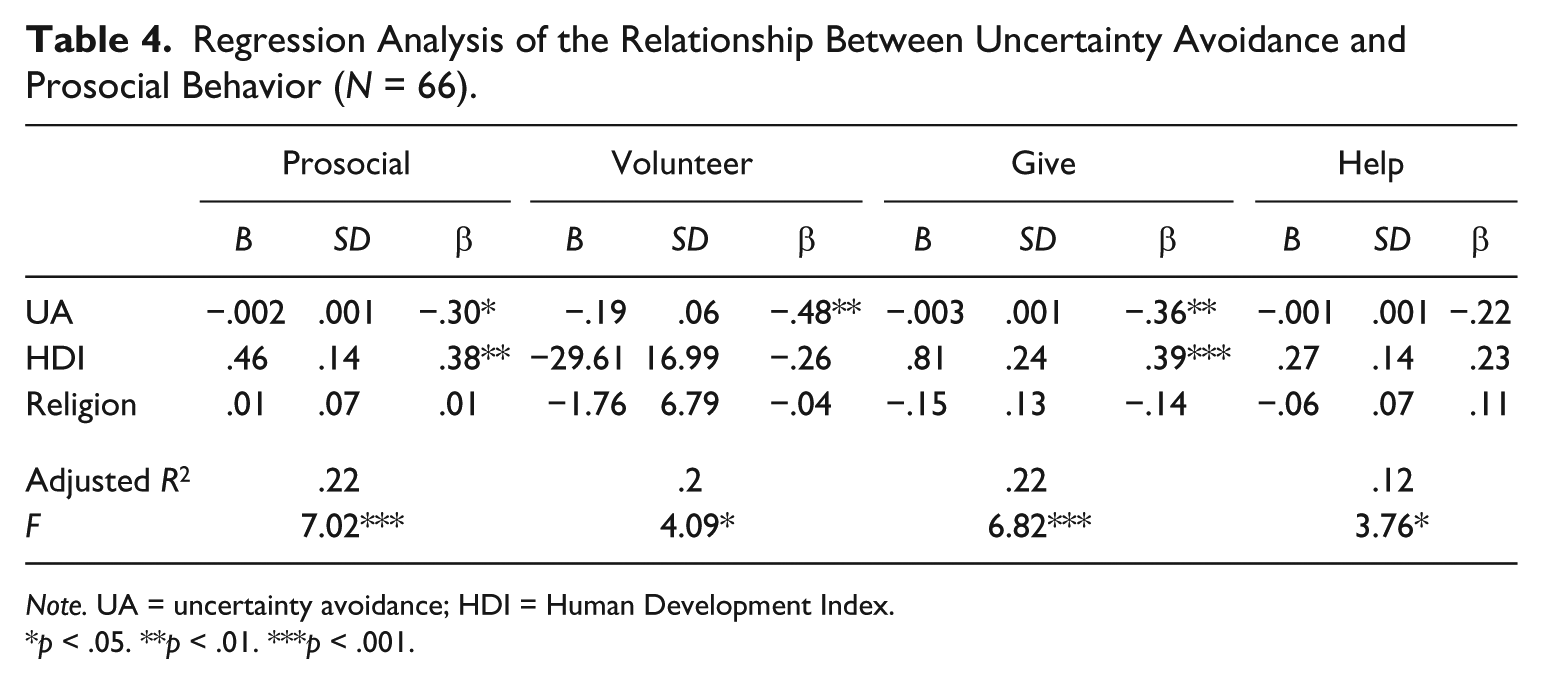
Note. UA = uncertainty avoidance; HDI = Human Development Index.
p < .05. **p < .01. ***p < .001.
Hypothesis 4 was not supported. Masculinity was not related to prosocial behavior (β = .08, ns), after controlling for HDI (β = .38, p < .01) and religion (β = .11, ns; Adjusted R2 = .15, F = 4.56, p < .01). Nor is masculinity related to volunteering, helping strangers, or giving money to charity.
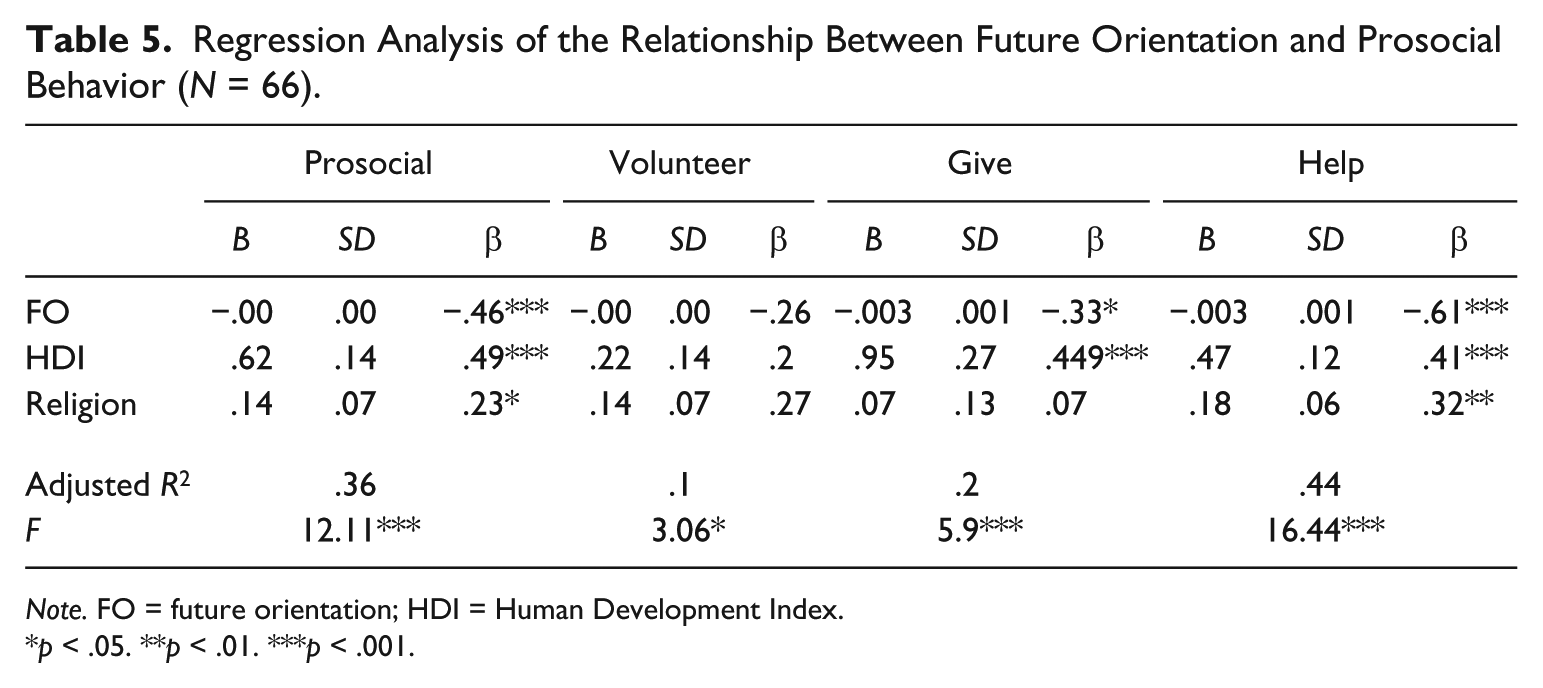
Hypothesis 5 was also not supported. FO was negatively correlated to prosocial behavior (Table 5). However, FO predicted helping strangers and giving money to charity, but not volunteering. Religion did not contribute significantly to the regression, except in regard to helping strangers). HDI was significantly correlated with aggregated prosocial behaviors, giving money, and helping strangers.
Regression Analysis of the Relationship Between Future Orientation and Prosocial Behavior (N = 66).
Note. FO = future orientation; HDI = Human Development Index.
p < .05. **p < .01. ***p < .001.
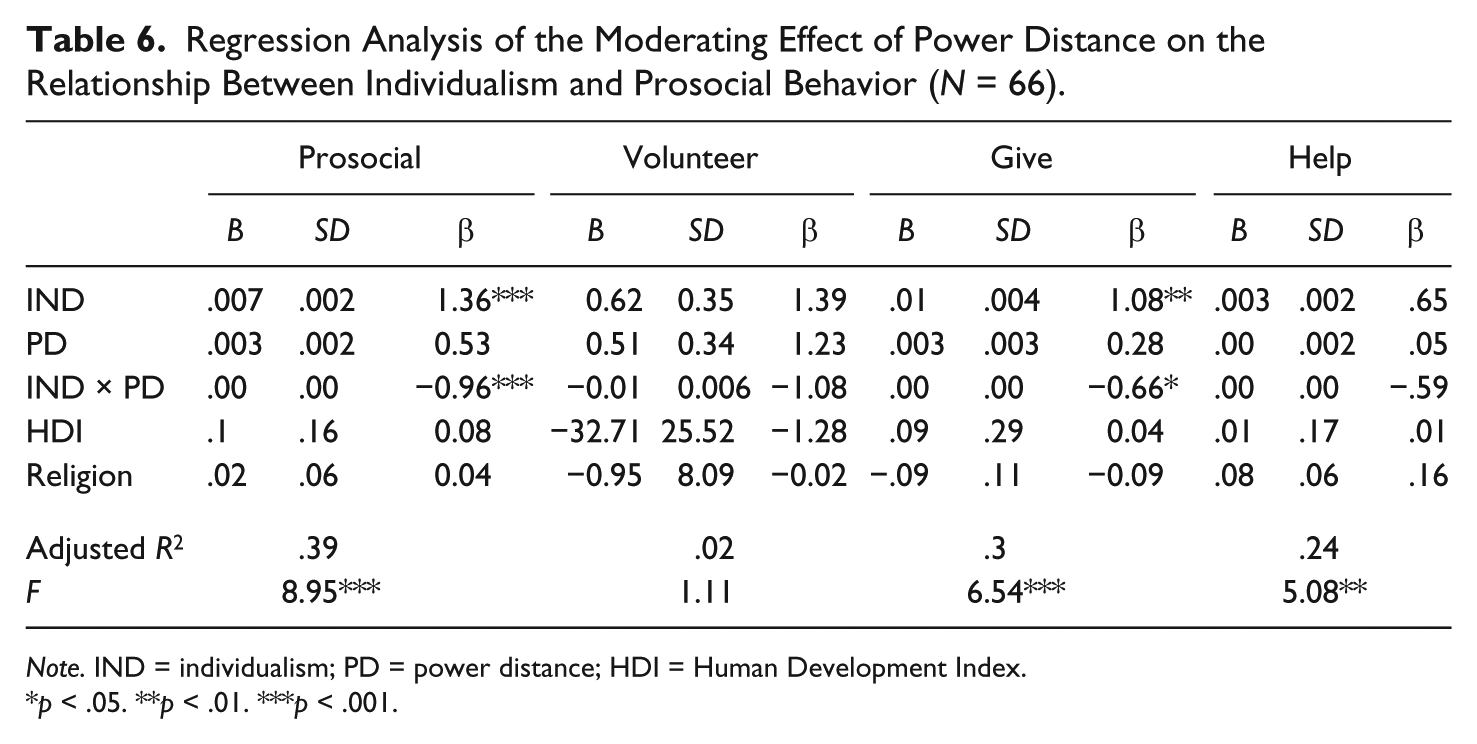
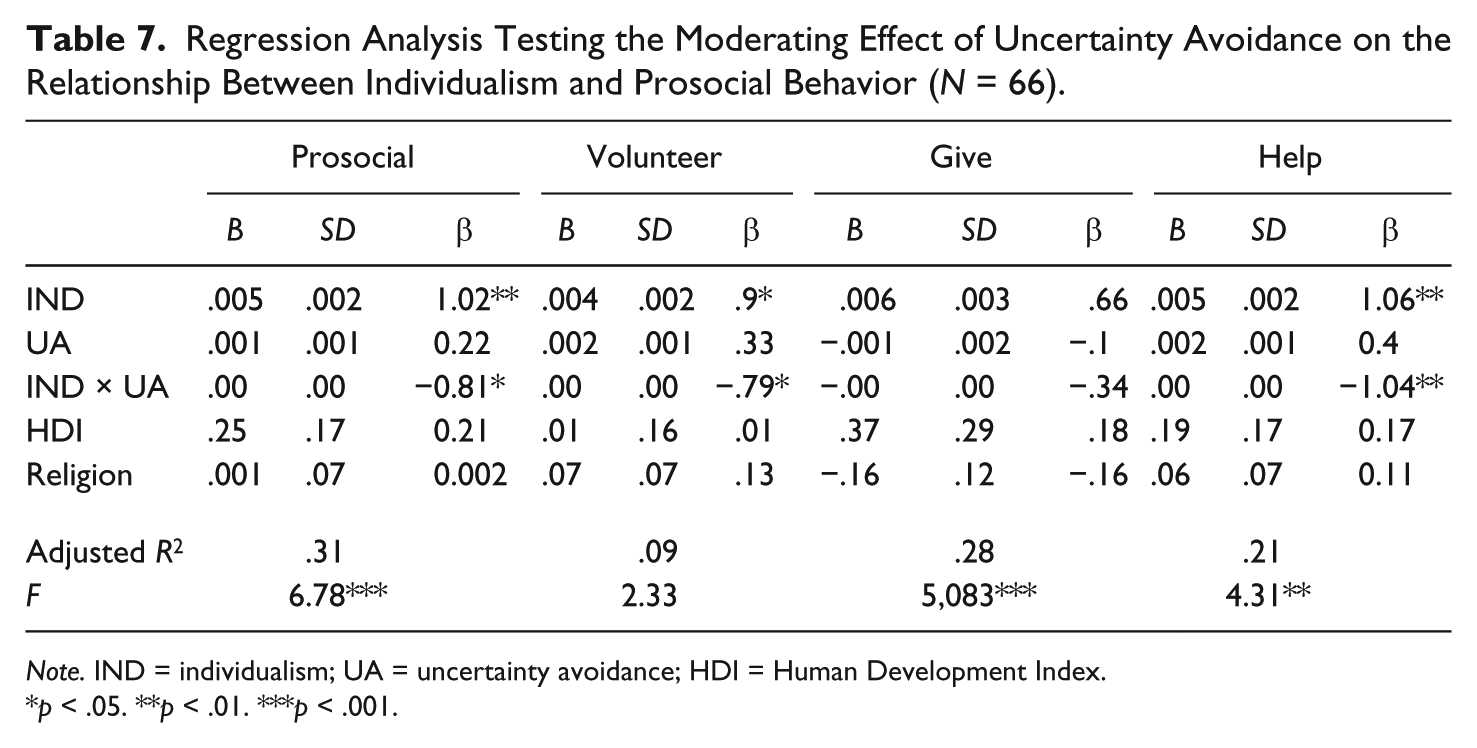
To test the moderating effects of PD (Hypothesis 6a), UA (Hypothesis 6b), masculinity (Hypothesis 6c), and FO (Hypothesis 6d) on the relationship between IND and prosocial behaviors, we conducted multiple regression analysis, adding an interaction variable according to Baron and Kenny (1986). We found that PD moderated the relationship between IND and prosocial behavior (Table 6). The shape of the interaction is presented in Figure 1. Supporting Hypothesis 6a, the relationship between IND and prosocial behavior is stronger in conditions of low PD than high PD. As seen in Table 6, we found evidence for the moderating role of PD only in the relationship between IND and giving money to charity. Supporting Hypothesis 6b, UA moderated the relationship between IND and prosocial behaviors (Table 7). However, the shape of the interaction was different than expected, in line with our finding in Hypothesis 3—In low UA cultures, the relationship was stronger than in high UA (Figure 2). Exploration of specific prosocial behaviors revealed that UA moderated the relationship between IND and volunteering and helping. In both cases, religion and HDI did not contribute significantly to the regression. We found no support for Hypothesis 6c and Hypothesis 6d. IND did not interact with masculinity (β of the interaction = .314, ns; R2 = .2, F = 4.26**), and IND did not interact with FO (β of the interaction = .01, ns; R2 = .43, F = 9.87). Furthermore, IND did not interact with masculinity/FO for all three prosocial behaviors.
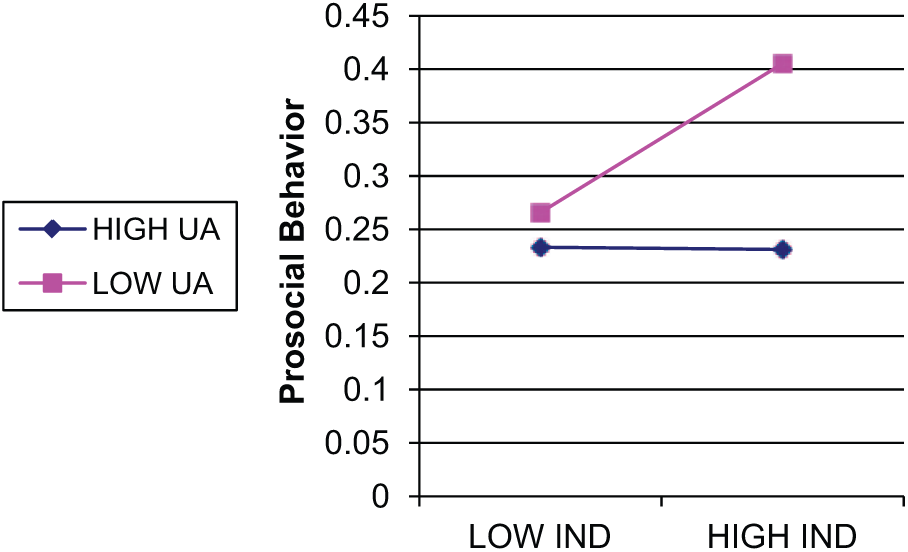
Moderating effect of power distance on the relationship between individualism and prosocial behavior.
Regression Analysis of the Moderating Effect of Power Distance on the Relationship Between Individualism and Prosocial Behavior (N = 66).
Note. IND = individualism; PD = power distance; HDI = Human Development Index.
p < .05. **p < .01. ***p < .001.
Regression Analysis Testing the Moderating Effect of Uncertainty Avoidance on the Relationship Between Individualism and Prosocial Behavior (N = 66).
Note. IND = individualism; UA = uncertainty avoidance; HDI = Human Development Index.
p < .05. **p < .01. ***p < .001.
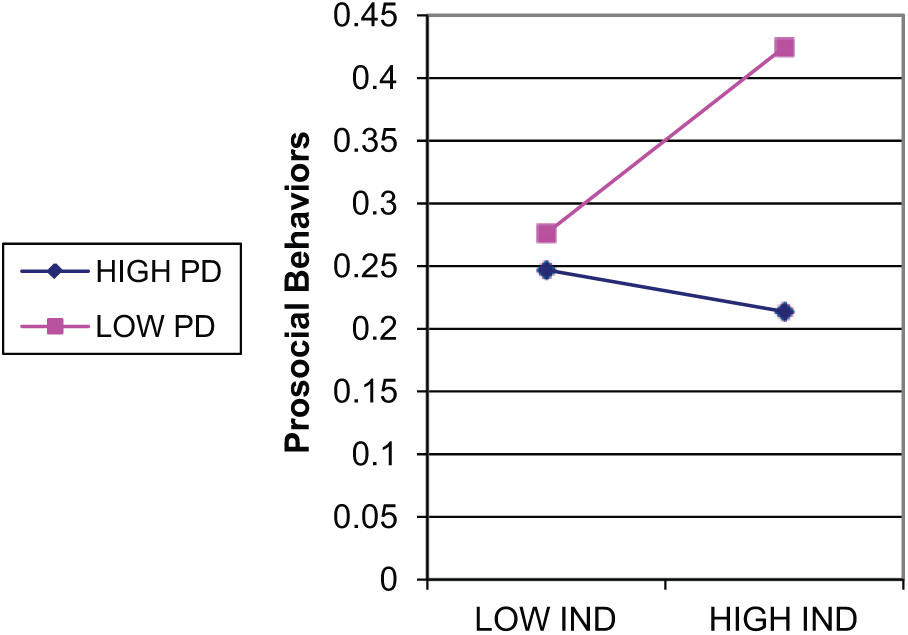
Moderating effect of uncertainty avoidance on the relationship between individualism and prosocial behavior.
Conclusion and Discussion
This study examined a novel theoretical framework—societal culture—to explain three prosocial behaviors and overall prosocial behavior in 66 countries. It provides new insights and identifies how different aspects of societal culture interact in predicting prosocial behaviors. As far as we know, this study is the first into this domain. We recognize that it has some limitations, but we hope that our investigation will prompt others to expand the study of cross-cultural differences in prosocial behavior. There are major questions that must be addressed to make progress in this important new domain.
Two hypotheses predicting direct relationships between cultural dimensions and prosocial behavior were supported. Societies in which IND is stressed, and where there is less PD, have higher rates of prosocial behavior. However, when exploring the three prosocial behaviors separately, we found that only some of them correlate with the cultural dimension and that different prosocial behaviors are correlated with each culture. The exception is donating money, which is common to all of them.
Our results endorse theories linking IND with capitalism. Individualist societies enhance capitalism and promote disparities of income, so that the rich are expected to support the needy. In collectivist societies, it is assumed that what needs to be done should be supplied by collective mechanisms, usually by the state. Our findings indicate that IND did not predict volunteering or helping strangers. This supports our conviction that the three types of prosocial behavior are different in nature and differently motivated.
Bruce (2002) considered IND as a key element of his “secularization paradigm.” IND has distanced people from tradition and, as Halman and Draulans (2006) wrote, “The individual has become the main point of reference in the shaping of values, attitudes and beliefs” (p. 265). Postmodernism increasingly emphasizes individual autonomy and self-expression (Inglehart & Welzel, 2005), resulting in individualization of attitudes to values, organizations, and social interaction (which does not mean that personal identity is constructed in social isolation). In 1991, Taylor wrote, “the development of an ideal of inwardly generated identity gives new and crucial importance to recognition. My own identity crucially depends on my dialogical relations with others” (pp. 47-48). Chosen rather than imposed affiliations become the norm, and prosocial behaviors may be fostered in such contexts.
Vermeersch (2004) argued that prosocial behavior is individualistic because it offers choices of where, when, and how much to give. For Inglehart (2003), the accent on self-expression “is conducive to higher levels of civic activism” (p. 57). However, these relationships have not been studied as part of a national culture. Our findings support the reasoning that individualist societies give rise to higher levels of prosocial behaviors than collectivist societies.
In some collectivistic cultures, citizens pay a relatively high level of tax, and this may influence the decision to donate or to act in a prosocial manner. There is ample literature that links tax incentives (tax deductions and estate exemptions) to increased charitable giving (Greene & McClelland, 2001; Salamon, 1999). Within a country, government spending has a low impact on voluntary contribution. Steinberg (1985, 1991) found that crowding out (refers to condition in which increased public sector spending replaces private sector spending) is insignificant and donations cannot adequately replace government spending. Accordingly, government spending may have little impact on donation. However, national history and culture may explain the relationship between state and individual responsibility. This issue was best captured by Salamon and his colleagues (Salamon & Anheier, 1998; Salamon, Sokolowski, & List, 2003) in their formulation of the social origin theory, and their finding that the relationships between taxes and services are valid only for industrial democracies. In other words, in the European American context the relationships between taxes and services may hold true, but, when other countries are included (as in this study), the relationship disappears.
PD can also explain helping strangers apart from donating money. In informal societies, helping a stranger is like helping someone you know. A culture of large social power differences in society expects hierarchical work patterns. In societies with small power differences, the system will be decentralized. A society without status distinctions enables better cooperation among volunteers and employees in an organization. Volunteers can utilize the national ethos of IND. In societies with high PD, high-status individuals are less likely to volunteer to avoid contact with individuals of lower status. They may prefer donating money to lower status groups and helping those closer to them in status.
Contrary to our hypothesis, we found that UA was negatively correlated with prosocial behaviors. This may be explained by research on cultural tightness/looseness, which refers to the degree to which norms are clearly defined and reliably imposed in cultural systems (Chan, Gelfand, Triandis, & Tzeng, 1996). Gelfand, Lim, and Raver (2004) suggested that tight cultural systems generally have many clear social norms in which there is a limited range of expected and acceptable behavior across social situations, and there is little individual discretion in deciding how to behave. According to Hofstede (1980), the dimension of UA may provide an operationalization for the concept of cultural tightness. Perhaps countries with low UA that have loose cultures allow for flexibility and risk taking based on accepting behaviors and the discretion of members of the society. In loose societies, where people live with uncertainty and government is weak, helping the needy is likely to be done by volunteers rather than by official services. Reliance on volunteers often requires willingness and ability to cope with unstable situations, while volunteering requires the exercise of flexibility and risk taking. However, UA did not predict helping strangers, which is a less organized prosocial behavior than donating money or volunteering that are frequently based on nonprofit organizations. Perhaps helping strangers is a prosocial behavior that does not affect social structure and therefore does not increase uncertainty.
Surprisingly, FO was negatively correlated with prosocial behaviors. It seems that, in cultures that do not emphasize long-term orientation, individuals are more likely to act in a prosocial manner than in cultures that stress long-term planning, possibly because prosocial behaviors tend to be spontaneous rather than calculated. This is especially true for two behaviors significantly related to FO, that is, helping strangers and donating money. Volunteering (not related to FO) is, by definition, less spontaneous, demanding investment of time and scheduling of activities that require planning.
Thus, volunteering is only explained (negatively) by high UA. Masculinity did not explain any prosocial behavior, suggesting that the differences between cultures that are gender based are less influential with regard to generosity, that is, even in masculine societies helping the needy is an act of citizenship rather than a woman’s role.
Relationships between IND and prosocial behaviors were moderated by PD and UA. In countries with low PD and UA, IND is very strongly associated with prosocial behavior, that is, they serve as boundary conditions for the relationship. These boundary conditions may be specific to prosocial behaviors of relationships between status groups, thereby increasing uncertainty; but there are also behaviors that threaten social stability to which such boundary conditions may be applicable. For example, participation in public events may necessitate relationships between individuals of different status, so that some of those belonging to high PD and UA cultures may be more restricted in their participation.
Limitations
Some limitations need to be acknowledged: This study is based on aggregation of existing national data, that is, individuals were sampled according to the independent variables (cultural dimensions) and the dependent variable (prosocial behavior). IND and PD were highly correlated (r = .63, p < .001); therefore, there is possible multicolinearity between them. However, only weak correlations were found between PD and UA, and UA and IND.
The finding that an individualist national culture contributes to prosocial behavior is not consistent with the accepted notion that such societies are closed in their own small world. Examination is needed of how individualist societies, even more than collective societies, motivate members to higher levels of prosocial involvement. The research findings do not align with the prevailing view that the collective is a mechanism that promotes involvement and volunteering.
At the national level of analysis, three cultural dimensions explain prosocial behaviors (which we mainly analyzed at the individual level). Future studies should adopt a multilevel approach to studying how national culture affects the relationship between individual variables such as religion, status, and so forth, and prosocial behavior. Furthermore, it is possible that by adding the organizational level to the analysis, more variance of prosocial behaviors could be explained.
Applications
While our findings require additional study and validation, the notion that helping others is not predicated on collectivism is important for policy makers. In an era of limited resources, many organizations and governments appeal to residents to be civically active and volunteer and/or donate to sustain the quality of life. Regions and countries that are high on IND and are interested in higher level of civic engagement are not required to enhance collectivism, but rather to promote civic engagement as an individual responsibility and personal choice. Regions and countries that are high on collectivism and are interested in higher levels of civic engagement should consider appealing to individuals and their needs rather than relying on the collective ethos of the place. When recruiting donors and volunteers, benefits to the individual should be emphasized over collective responsibility. In addition, recognition of the individual as a donor or volunteer will probably sustain civic engagement better than collective messages.
Our findings are particularly germane to nonprofit organizations because many of them are global organizations, functioning in a variety of cultures and social groups. The global organization that has difficulties in eliciting volunteers and donation in one country may have fewer problems in another country. Understanding the national culture may enable nonprofit organizations (NPOs) to plan their volunteer and donation expectations and recruitment more strategically. Volunteers from individualist cultures may be more easily recruited, whereas those from high PD cultures will volunteer less, especially for activities that demand interaction with lower social groups. Our results point to specific prosocial behaviors that may be problematic. We suggest that nonprofit and for–profit organizations endeavoring to promote prosocial behaviors should rely on those that are better aligned with the cultural values of the specific country in which they are located.
We provide two graphic figures that present the values of the 66 countries participating in this study. As can be seen in Figure 3, there is a negative relationship between PD and IND. Countries with high IND tend to have low PD. For example, on this end we see the North American cultures (United States, Canada) and some European cultures like Denmark and Sweden. On the contrary, we can see cultures from Central and South America such as Ecuador, Guatemala, and Panama that are low on IND and high on PD. Figure 4 demonstrates more dispersion in the relationship between IND and UA. For example, Central and South American cultures like Jamaica and Chile are low on both of these dimensions. On the other side of the figure, there are also cultures that are high on both of these dimensions, for example, Western European cultures like Belgium, France, and Italy; cultures that seem to be high on IND but low on UA, like north American cultures (United States and Canada); and cultures that are low on IND and high on UA like Southern and Central American cultures (e.g., Guatemala and Ecuador).
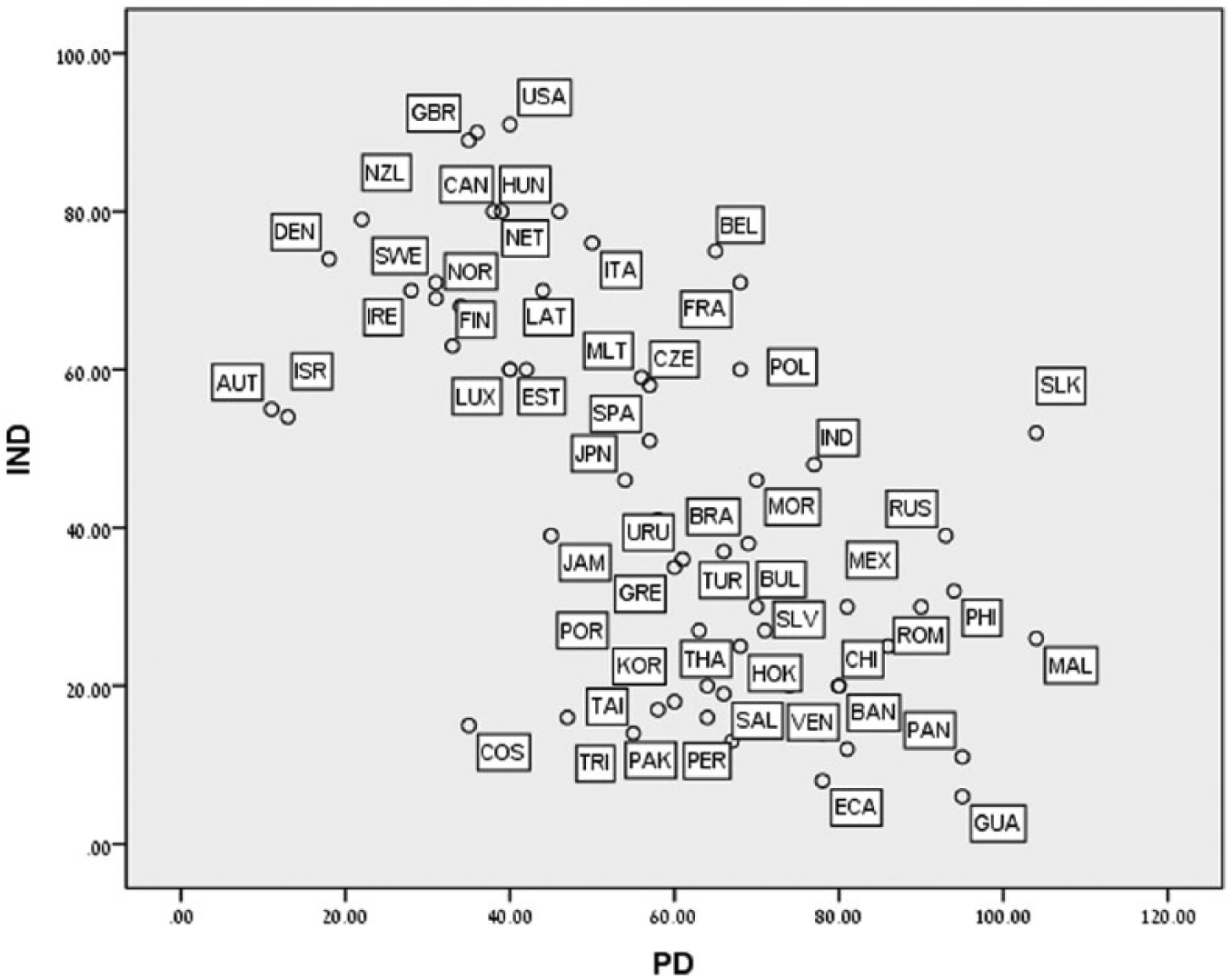
Graphical presentation of the scores of each country in individualism and power distance.
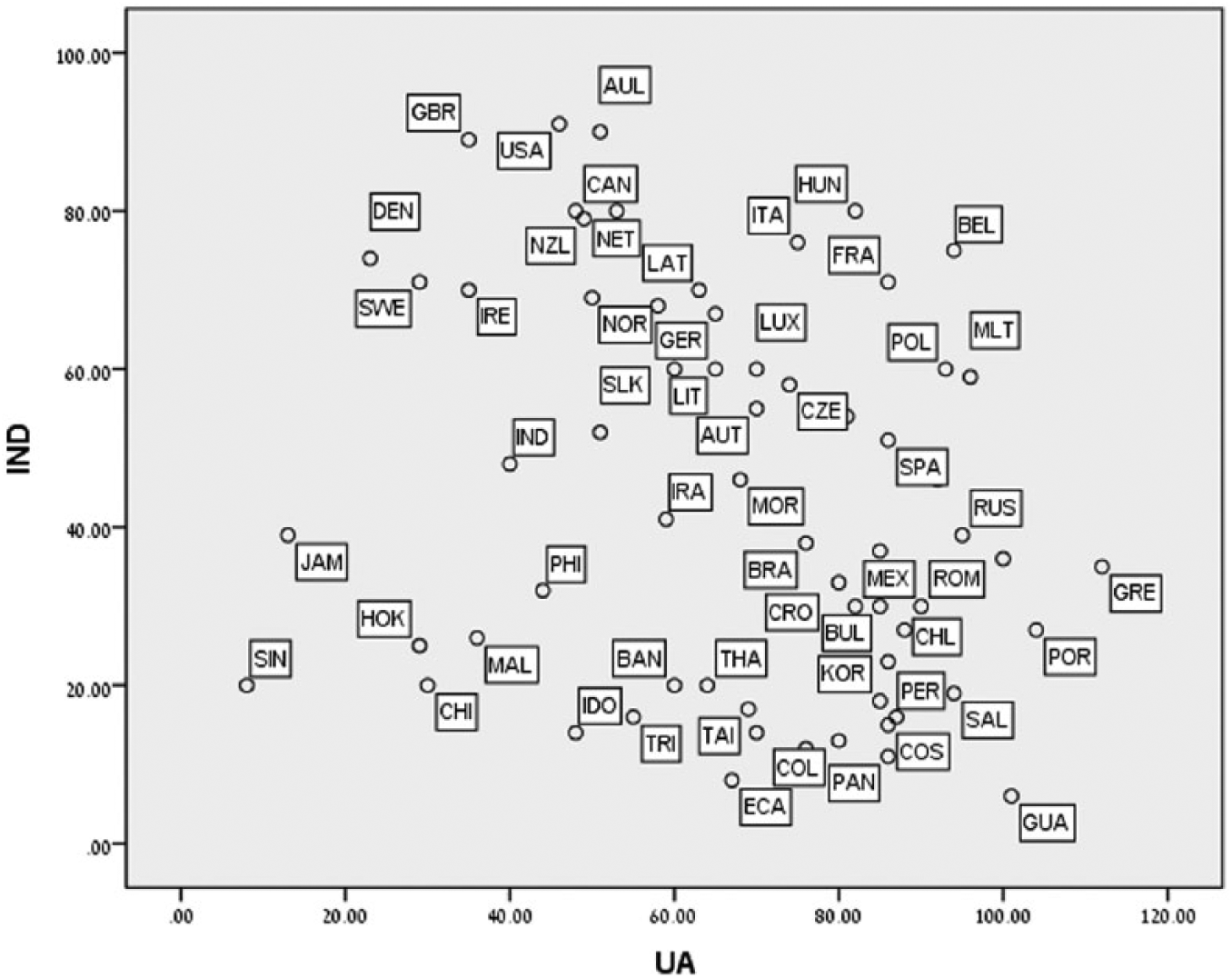
Graphical presentation of the scores of each country in individualism and uncertainty avoidance.
Footnotes
Acknowledgements
We wish to thank the anonymous reviewers for their comments and feedback during the review process, which improved our manuscript considerably.
Declaration of Conflicting Interests
The author(s) declared no potential conflicts of interest with respect to the research, authorship, and/or publication of this article.
Funding
The author(s) received no financial support for the research, authorship, and/or publication of this article.