



Abstract
The majority of studies analyzed show a positive and statistically significant impact of renewable energy consumption on economic growth. Nevertheless, some studies suggest a limited effect, while others find no statistically significant effect. Faced with this problem, we conducted a study aimed at analyzing the impact of renewable energy consumption on economic growth in the Kingdom of Saudi Arabia for the period 1990–2020. To determine the integration properties of the variables, we utilized the sharp and smooth structural breaks unit root test developed by Shahbaz, Omay and Roubaud (SOR). We also used the bootstrap approach of testing ARDL limits to examine the cointegration between variables. Using the VECM model, we studied the causal relationship between economic growth and its determinants. The results show, in the short and long run, the existence of a bidirectional causality between renewable energy consumption and economic growth (Feedback Hypothesis). Thus, there is a bidirectional relationship between GDP and capital and also between GDP and labor, in the long run. Therefore, an important policy implication resulting from this analysis is that renewable energy can be considered as an important factor for sustainable economic development in Saudi Arabia. The findings for Saudi Arabia may also be relevant for oil exporting countries to achieve efficiency and promote the renewable energy sector beyond oil.
Introduction
Before the 1973 oil crisis, countries were not interested in alternative energies. They exploited the energy sources that were readily available to them, for example coal in Great Britain and oil in France, etc. Nowadays, the phenomenon of climate change has become a problem for humanity. This result supports the assumptions of the Directive 2009/28/EC, and the Paris Agreement, 1 hence the transition to renewable energy can reduce greenhouse gas emissions on the one hand and promote the economic situation on the other. Indeed, access to energy is one of the key aspects of development and economic growth, as it provides lighting and heating. It also provides power for production machinery and equipment as well as communication equipment. However, despite the remarkable achievements in the field of energy to meet the needs of humanity, it is increasingly clear that the current energy systems are not able to provide energy to the entire population under sustainable conditions and at affordable prices. 2
Investment in renewable energy comes with potential economic benefits that vary from one country to another and from one case to another depending on the appropriateness of the choice of the renewable energy source used (solar, wind, geothermal, hydro or biomass). Nevertheless, experience shows that integrating renewable energy into a country's energy matrix can provide two key benefits.
First, at the national level, the use of renewable energy generally depends on the available resources: the need for imported fossil fuels may decrease, and the balance of payments of oil-importing countries may improve if the latter use these resources. In addition, their increased use can diversify a country's energy matrix and promote price stability when fossil fuel costs are rising. All of these factors also enhance energy security and provide a more reliable and sustainable energy base to underpin economic growth.
Second, at the local level, some studies noted that the growth of renewable energy can provide significant opportunities for job creation and income-generating activities in the production, distribution, marketing, servicing and maintenance of renewable energy technologies. Goldemberg 3 shows that renewable energy can create up to 116,229 jobs per TWh (terawatt-hour) produced, compared to 1145 for conventional energy (oil, coal and natural gas). It should also be pointed out that renewable energy technologies are not only expensive high-tech solutions as they are known in industrialized countries.
In this context, Saudi Arabia is an exception, presenting a very bold plan, comparable to the energy transition policies implemented in the European Union. It aims to produce nothing less than half of its electricity from low-carbon sources by 2030, or 54 gigawatts from renewables (solar, wind, biomass) and 17.6 gigawatts from nuclear power. 4 Saudi Arabia is the only country in the Gulf region that has already defined a clear strategy to ensure the sustainability of its economy as an energy hub. Reforms are certainly easier to carry out as this country has abundant financial resources. Indeed, Saudi Arabia's energy transition under Vision 2030 aims to preserve oil as an export product. This development plan is based on major strategic orientations in the field of energy and the environment. Three main lines of action can be identified: the implementation of public policies aimed at rationalizing energy consumption and improving energy efficiency; the diversification of the Saudi energy matrix towards renewable energies and nuclear power; and turning cities into actors in the energy transition as well as promoting the ecological and connected city of the future as a model for Saudi localities.
Our research is important, both theoretically and politically. It is important for policy makers to lead the way for progress and new technologies in the long term. Indeed, renewable energies are often seen as perfect substitutes for fossil fuels. The proponents of this vision assume that renewables are supposed to replace fossil fuels in the current technical and social system. However, renewable energies are radically different from fossil fuels and nuclear energy. They require new technical, political, economic and social systems. Indeed, renewable energies weave a new relationship with the world and with nature. They open up our scope of possibilities thanks to their great capacity for innovation.
The study makes several contributions to the literature. First, we applied the new unit root test (SOR) of Shahbaz et al. 5 to analyze the unit root properties of series containing smooth structural breaks. Second, we used the ARDL boostrap test technique proposed by McNown et al. 6 to study the cointegration relationship between economic growth and its determinants. Third, we investigated the different causal relationships between the variables via a boostrap process based on the Granger causality method of the Vector Error Correction Model (VECM).
Our paper explores the role that renewable energy could play in ensuring a more sustainable energy supply to enhance economic growth. More specifically, it intends to answer the following questions: What benefits can be expected from renewable energy to support economic growth? What policies and measures are needed to realize these benefits to support economic growth?
In order to do this and to carry out our work, we divided this work into five sections. Section ‘Literature review’ is devoted to the presentation of a literature review. Section ‘Data and methodology’ reports the data and methodology. Section ‘Empirical analysis’ presents the empirical results. Section ‘Conclusion and policy implications’ concludes and gives some policy implications.
Literature review
The relationship between energy consumption and economic growth was the subject of an extensive empirical literature based on the theoretical framework of the Cobb-Douglas production function. It proposes on the one hand the study of the effect of energy consumption on production and on the other hand the direction of causality between production and energy consumption. In this respect, four hypotheses are tested and each of them has different policy implications and recommendations.
The first hypothesis is that of growth, which assumes a unidirectional relationship between economic growth and energy consumption. Energy is considered as a factor of production in the same way as capital and labor.7–12 Production is therefore formalized as an increasing function of energy consumption. This hypothesis implies a cause-and-effect relationship from energy consumption to economic growth. An increase (reduction) in energy consumption leads to an increase (reduction) in production. The second assumption is that of conservation. It stipulates a cause-and-effect relationship from economic growth to energy consumption. In other words, a change in energy consumption will not affect economic growth.13–16 This assumption is conducive to policies aimed at reducing energy consumption insofar as the reduction in energy consumption will not affect economic growth. The third hypothesis stipulates a bidirectional causal relationship involving a feedback relationship between economic growth and energy consumption.17–19 The fourth assumption is that of neutrality. This hypothesis implies that a variation in energy consumption does not affect economic growth.20–22
Destek and Aslan 23 offer a review of the literature devoted to the relationship between total energy consumption (i.e. from renewable and fossil sources), and economic growth. They have divergent results. Chien and Hu 24 studied the effect of renewable energy on the economy's technical efficiency between 2001 and 2002 for the case of 45 OECD and non-OECD countries. Using a non-parametric technique, the authors studied the relationship between GDP, labor force, capital stock, fossil energy and renewable energy. They found that an increase in renewable energy consumption improves the economy's technical efficiency. In contrast, increasing fossil energy does not improve the economy's technical efficiency. Sari et al. 25 estimated an ARDL model on the variables of industrial production, labor, fossil energy, hydroelectric energy, solar energy, wind energy, natural gas, biomass energy and wood consumption for the case of the USA. They conducted this study over the period going from January 2001 until June 2005 and they showed that the factor of industrial production with labor has a negative and positive impact on the consumption of hydroelectric, biomass and wind energy. Apergis and Payne 26 examined the relationship between economic development, renewable and non-renewable electricity for the case of 16 emerging countries. They concluded that there is a unidirectional causality from GDP to renewable electricity consumption in the short term; but in the long term, they found that there is a bidirectional causality between these two variables. However, there is a bidirectional causality between GDP and non-renewable electricity consumption in the short and long terms.
Tugcu et al. 27 studied the causal relationship between renewable and non-renewable energy and economic development for the case of G7 countries over the period 1990–2019. They find that there is no causality (Neutrality Hypothesis) between renewable energy consumption and economic development for the case of France, Italy, Canada and the USA. However, they confirm that there is a bidirectional causality (Retroactive Hypothesis) for the case of England and Japan. Al-mulali et al. 28 studied the impact of renewable energy consumption on GDP growth for countries that are classified into three classes based on their income (high income, middle income, and low-income countries). They show that 79% of high-income countries have a positive long-term bidirectional causality. On the other hand, they do not find a causal relationship for 19% of these countries. However, for 22% of countries, there is a unidirectional relationship from GDP to renewable electricity consumption (Growth Hypothesis). Omri et al. 29 examined the relationship between nuclear energy consumption, GDP, and renewable energy consumption for the case of 17 developed and emerging countries. They employed the dynamic simultaneous equations method over the period 1990–2011. They conclude that there is a bidirectional causality between GDP and renewable energy consumption for the case of Belgium, Bulgaria, Canada, France, Pakistan and the USA. However, for the rest of the countries, they find that there is a unidirectional relationship from GDP to renewable energy consumption. Jebli and Slim 30 investigated the relationship between renewable and non-renewable electric energy and international trade for the case of 69 countries. They used the panel cointegration method and causality in the sense of Granger on the variables of GDP, total renewable and non-renewable electric energy, export and import, capital stock (gross fixed capital formation) and labor, the period of study stretched from 1980 to 2010. They observed that there is no causal relationship between GDP and renewable electricity consumption in the short term. However, there is a bidirectional causality between these two variables in the long term.
Kahia et al. 31 studied the impact of renewable and non-renewable energy on economic development for the case of two groups of MENA countries during the period 1980–2012. Using the FMOLS method and causality in the Granger sense, they argue that there is a bidirectional causality between GDP and renewable energy for the case of the second group (5 MENA countries). Amri 32 studied the relationship between economic development (GDP), renewable energy consumption, capital stock, labor, and trade for the case of 72 developed and emerging countries during the period 1990–2012. Using the two-step GMM method, the researcher finds that there is a bidirectional relationship between GDP and renewable energy consumption. Fethi 32 studied the relationship between renewable, non-renewable energy and GDP for the case of Algeria during the period 1980–2012. Using the ARDL model and causality in the sense of Granger, he finds that there is no relationship between renewable energy and economic development in Algeria. These results confirm that this country has not yet reached the threshold of renewable energy that allows it to contribute to the positive improvement of GDP.
Furthermore, Raggad 33 investigated the relationship between economic growth, energy use, and urbanization in the KSA during 1971–2014. Their estimates indicated the non-validity of the EKC hypothesis for Saudi Arabia as the relationship between GDP and pollution is positive both in the short and the long run. Moreover, energy use increases pollution both in the short and long run in the country. Tiwari et al. 34 examined the causal relationship between CO2 emissions, economic growth, energy consumption, domestic credit, exports, and money supply in Saudi Arabia using an h-horizon causality approach. They concluded that that CO2 emissions do not cause any other variables and they are only caused by economic growth at an h-horizon equal to 2. The impulse response function with Fourier frequencies provides narrower bands and reveals a smooth shock absorption for CO2 emissions, particularly after period t = 3. Kahouli et al. 35 applied a cointegration test and a VECM model to investigate the long run and causal relationship between renewable energy consumption, environmental degradation, trade, industrialization, urbanization, and economic growth for the Kingdom of Saudi Arabia from the 1971–2019 period. They found that a rise in renewable energy consumption and environmental degradation increases economic growth; however, renewable energy has a significant contribution to the deteriorating environment.
From the above literature review, it is clear that there is a case for establishing the presence of empirical links between renewable energy consumption and GDP in the Saudi context. This is particularly necessary because most studies looking for such causal relationships in different contexts faced methodological limitations, which is a gap that this study attempts to bridge.
Data and methodology
Data
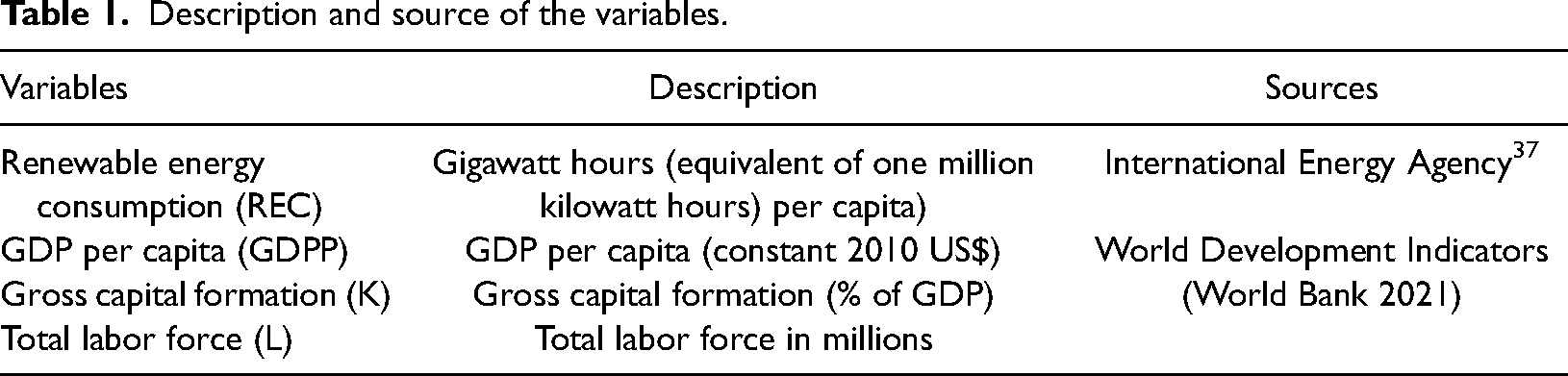
We used annual time series for Saudi Arabia during the period 1990–2020. To estimate our empirical model, we used GDP per capita (constant 2010 US$) (GDPP), Renewable energy consumption per capita (Gigawatt hours (equivalent of one million kilowatt hours)) (REC), Gross capital formation (% of GDP) (K) and total labor force in millions (L).
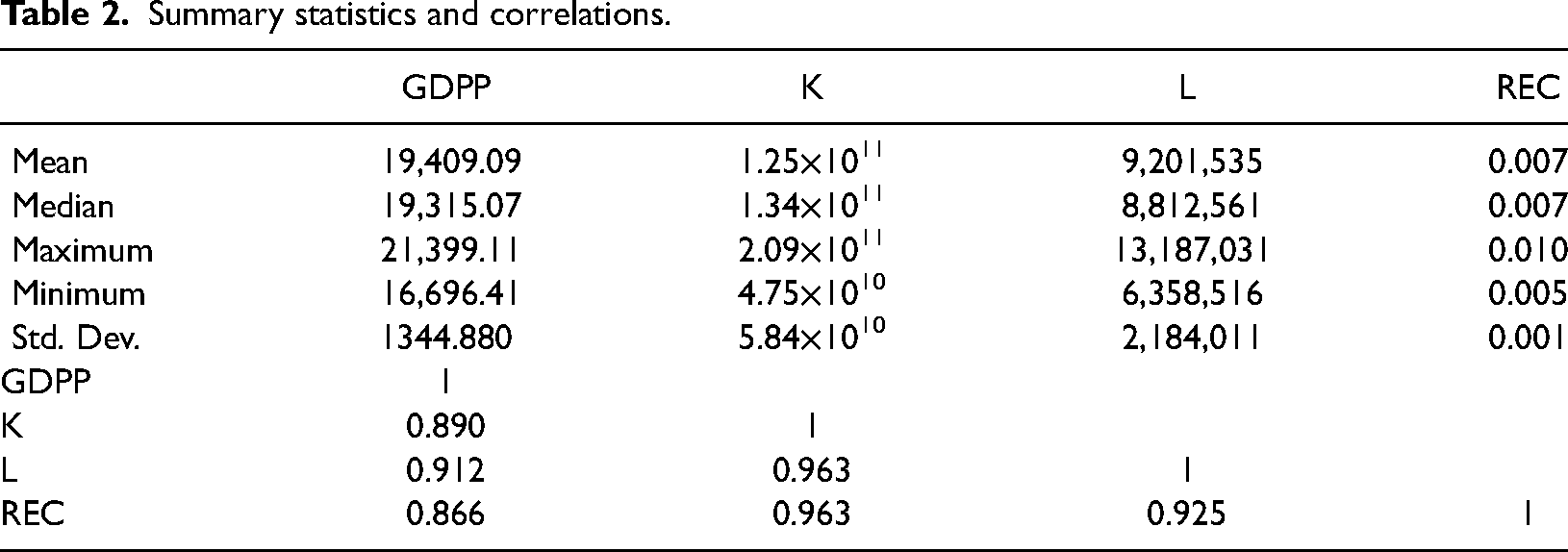
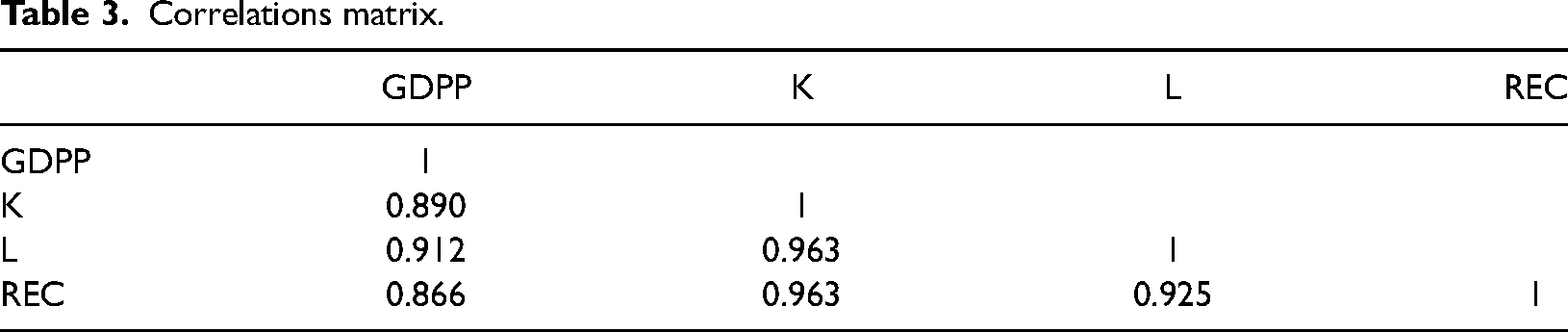
Tables 1–3 report the descriptive statistics and correlation of variables, respectively during the period 1990–2020. Table 2 shows that the GDP per capita varies from US$ 16,696.41 to US$ 21,399.11; the range for capital is from 4.75×10¹⁰ to 2.09×10¹¹ US$; the range for total labor force is from 6,358,516 to 13,187,031 million and renewable energy consumption ranges from 0.005% to 0.010% of total final energy consumption. Table 3 shows us that GDP is positively related to renewable energy consumption and that this relationship between these variables is significant, implying that economic growth has a causal impact on renewable energy consumption. This implies that renewable energy consumption is related to GDP (Sharma) 36 . Total labor force (L) and capital (K) are positive. Therefore, an increase in total labor force and capital would lead to an increase in the economic growth rate.
Description and source of the variables.
Summary statistics and correlations.
Correlations matrix.
Methodology
The SOR unit root test
To test the stationarity of the variables, we use the SOR test of Shabaz et al. (2019). Although there are several unit root tests to test the series’ stationarity, Shabaz et al. 38 argue that these tests provide biased empirical results due to their low explanatory power. The distinctiveness of the SOR unit root test lies in the nonlinearity occurring in a series, namely smooth and sharp breaks. This unit root test comprises a two-step technique proposed by Leybourne et al. 39 and Omay and Emirmahmutoglu 40 as described below:
First step: In this step, we used a nonlinear optimization algorithm with genetic constraints. The deterministic element of the selected model is then predicted. The residuals obtained from this estimation are calculated using the following models:







Finally, we will use a single frequency component Fourier approximation by (i). The amplitude and placement of the sinusoidal component of the deterministic term are given by of several multiple smooth breaks with a single frequency (i = 1). In this case, the unit root test hypotheses are:

Bootstrapping ARDL cointegration approach
We will use the ARDL bootstrap cointegration approach to study the cointegrating relationship between the series. The ARDL cointegration approach of Pesaran et al. 42 presents size and power problems. However, the ARDL bootstrapping approach addresses this shortcoming. In order to apply this approach, a new cointegration test developed by McNown et al. 6 is used. There are two conditions used by Pesaran et al. 42 to identify cointegration: (i) the coefficients of the error correction terms are significant and (ii) the coefficients of the lagged independent variables are significant.
In the first condition, if the series are stationary in first difference (I (1)), the cointegration test can be used. On the other hand, in the case of low power and small sample size, traditional unit root tests may be biased. 2 This problem can be solved by ARDL the bootstrapping approach.
One of the advantages of using ARDL bootstrap limit tests is that critical values are generated by eliminating the possibility of doubtful cases, which can be present in traditional limit tests. In addition, the limit test is useful for dynamic models with more than one independent series. The traditional procedure for testing ARDL bootstrap limits can be formulated as follows: The The The T-test which is based on the lagged dependent variable.


Empirical analysis
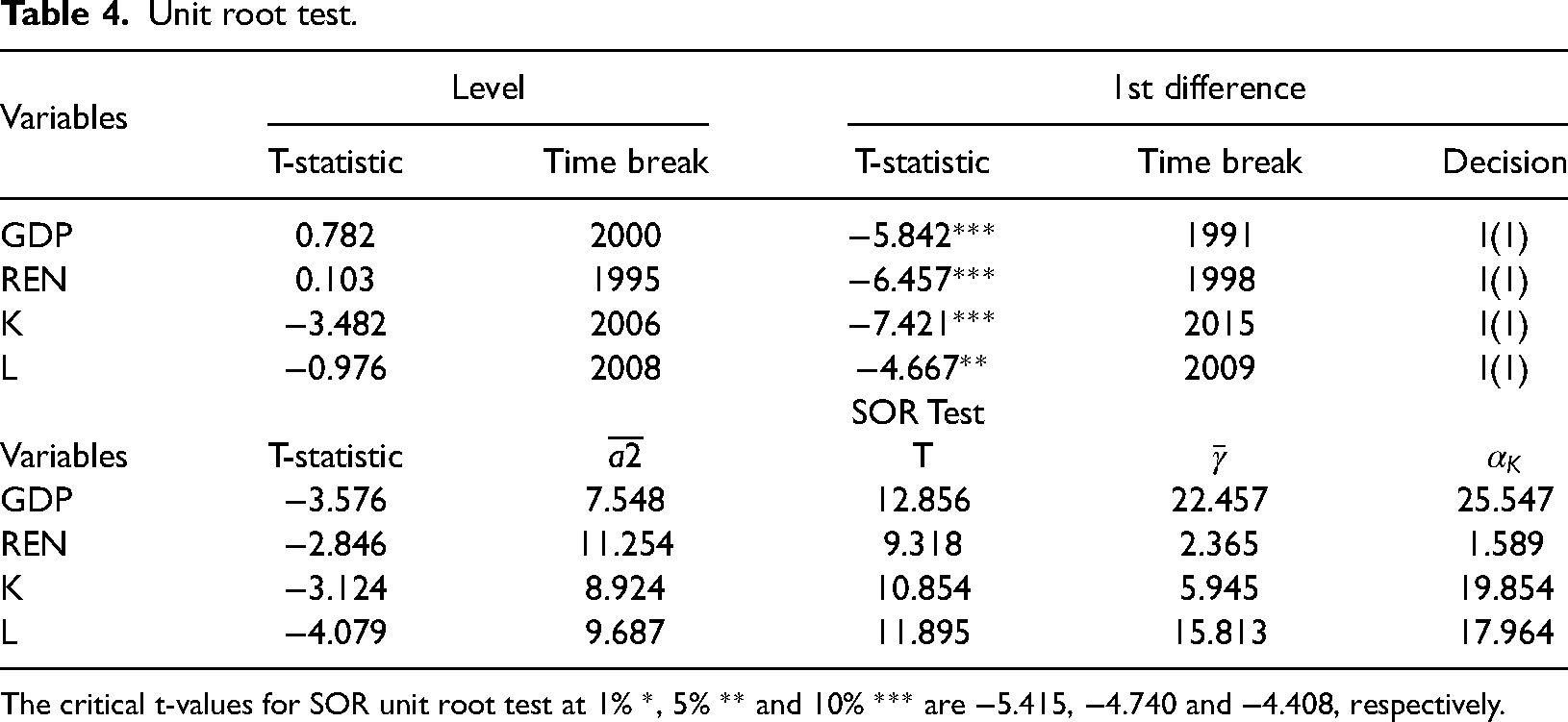
To determine the time series’ order of integration, this study uses the Augmented Dickey Fuller (ADF) stationarity tests, which present a single unknown structural break in the variable. This test is applied to examine whether the variables are stationary in I (0), I (1) or whether the series are I (0) and I (1) at the same time. It is also suitable for a small sample size. The ADF unit root test solves these problems by its explanatory power and presents empirical results without bias in the presence of structural breaks at the series level. The results of these tests are reported in Table 4. They indicate that economic growth, renewable energy consumption, capital and labor contain a unit root problem at the constant and trend level in the presence of structural breaks. These structural breaks are the result of cyclical disturbances and imbalances in the economy of the Gulf countries (Saudi Arabia in particular) in 1991. This date coincides with the Gulf War. In the presence of structural breaks in the series, Table 4 shows that all the variables are stationary in first difference I (1).
Unit root test.
The critical t-values for SOR unit root test at 1% *, 5% ** and 10% *** are −5.415, −4.740 and −4.408, respectively.
To test the robustness of the unit root analysis, we also applied the SOR unit root test. The empirical results of the SOR unit root test are reported in Table 4. The empirical results show that economic growth, renewable energy consumption, capital, and labor contain unit root processes. The information from the nonlinear parameters estimated in model 1 validates the presence of breaks in the series. The SOR unit root test was also applied to verify the robustness of the stationarity analysis. The lower portion of Table 4 gives the SOR test's empirical findings with sharp and structural breaks. The critical values generated by Shabaz et al. (2019) are greater than their calculated t-statistics, showing that GDP and their determinants have a unit root at level. The SOR test supports the existence of a unit root for all variables at level with the presence of sharp and smooth structural breaks, so we can conclude that economic growth, renewable energy consumption, capital, and labor are of order (I(1)). Since the variables are integrated of order (1), we will apply the cointegration approach to study the presence of a cointegration relationship between the variables. To do so, we used the ARDL bootstrap bounds testing approach. The ARDL bootstrap presents the F-test and the T-test. These consider lagged values for all explanatory and endogenous variables, respectively.
The empirical results of the ARDL bootstrapping bounds test for cointegration are presented in Table 5. The ARDL bootstrapping F-test and T-test results can reject the null hypothesis of no cointegration when we treated economic growth, renewable energy consumption, labor, and capital as dependent variables. This indicates that the joint F-test and T-test on lagged dependent variables and T-tests on lagged independent variables show the presence of four cointegrating vectors in the economic growth function in Saudi Arabia. We can conclude that economic growth, renewable energy consumption, capital and labor have a long-run relationship. The R2 value ranges from 0.642 to 0.889, which shows that all independent variables simultaneously explain the dependent variables. Furthermore, the J-B test confirms the normality of the residual terms for all models.
Bootstrap ARDL testing method.
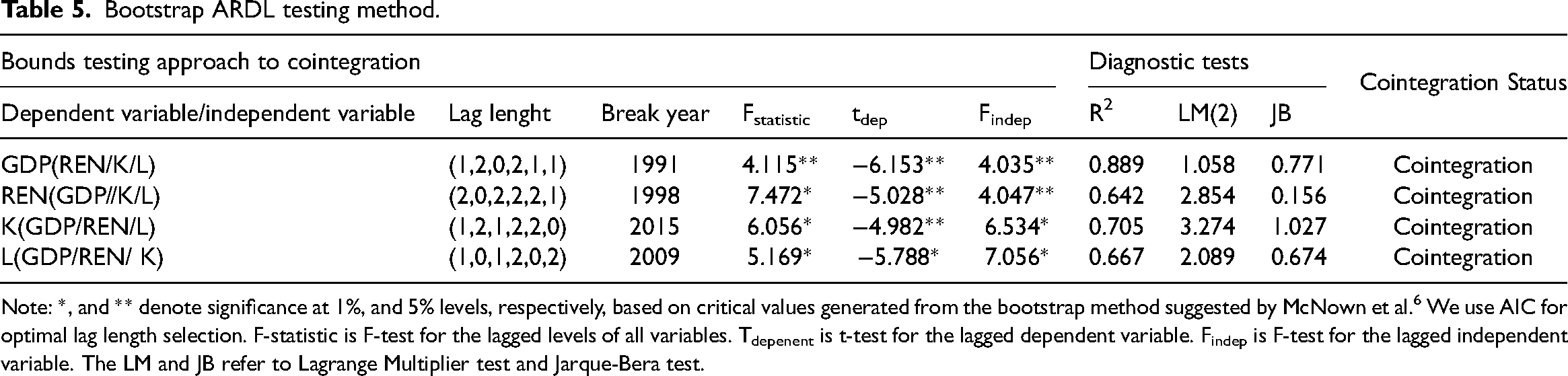
Note: *, and ** denote significance at 1%, and 5% levels, respectively, based on critical values generated from the bootstrap method suggested by McNown et al. 6 We use AIC for optimal lag length selection. F-statistic is F-test for the lagged levels of all variables. Tdepenent is t-test for the lagged dependent variable. Findep is F-test for the lagged independent variable. The LM and JB refer to Lagrange Multiplier test and Jarque-Bera test.
The short- and long-term results are presented in Table 6. In the long run, the results show that all estimated coefficients are positive and significant, and the most important one is the coefficient for renewable energy consumption. A 1% increase in renewable energy consumption is accompanied by a 0.012% improvement in economic growth at a 1% significance level. This result is in line with the findings of Cetin 43 and Azam et al., 44 who show that renewable energy consumption boosts economic growth. In addition, a 1% increase in capital increases economic growth by 0.034% and a 1% increase in labor promotes economic growth by 0.091% at 5% significance levels, respectively. This result is highly anticipated, especially that the role played by the level of education in stimulating growth is confirmed. Our results are consistent with those of Romer. 45 Indeed, the results of Romer 45 showed that the role of education is not only to improve labor productivity but also to design new manufacturing processes and improve the ability to adopt new technologies, in order to stimulate growth. The trend variable has significant and a positive impact on economic development. This proves that an increase in all the variables analyzed promotes economic growth in the long run.
Short-term and long-term results.
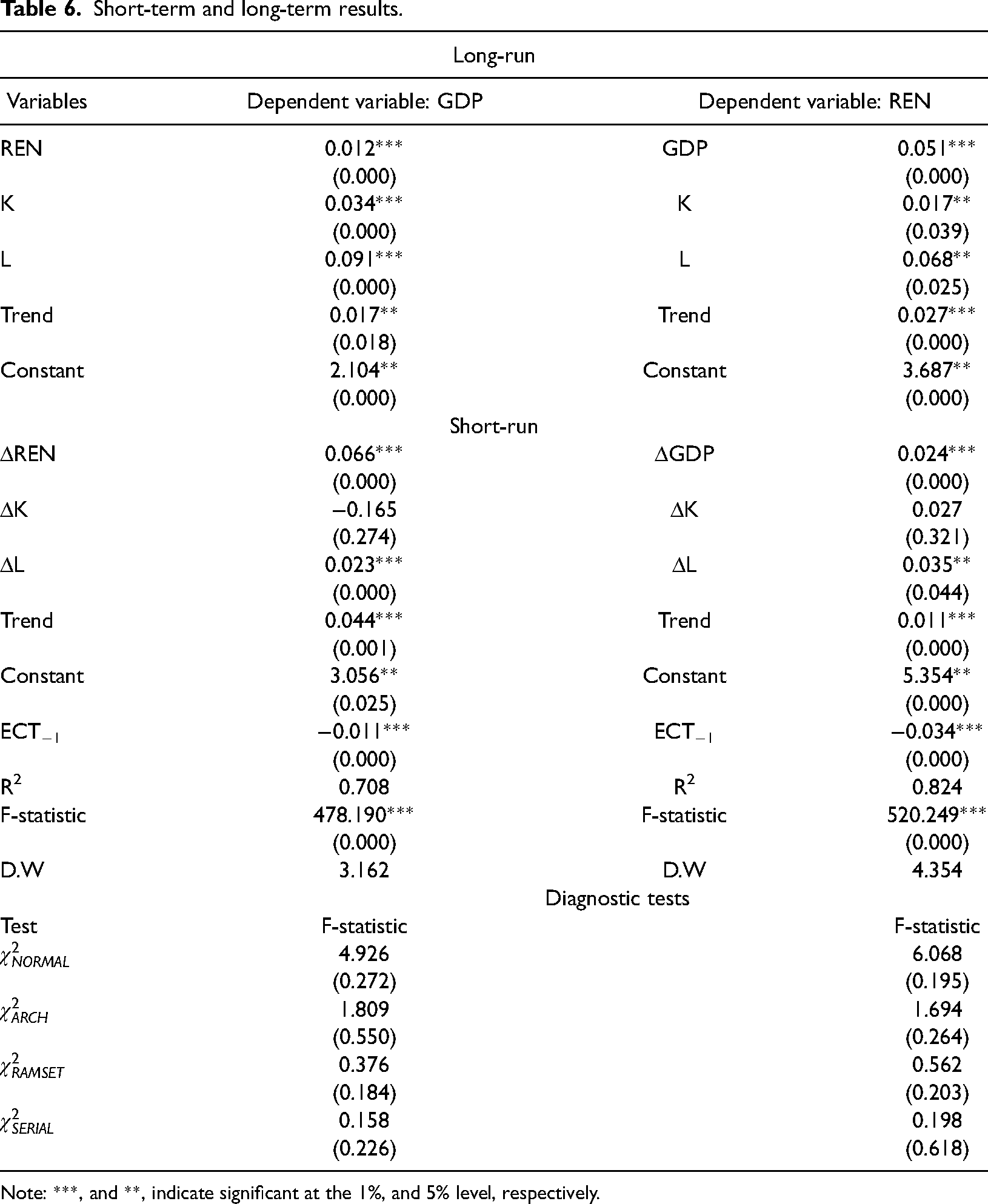
Note: ***, and **, indicate significant at the 1%, and 5% level, respectively.
However, in the short run, the coefficient on capital is not significant and does not explain economic growth. In contrast, a 1% increase in renewable energy consumption and labor stimulates economic growth by 0.066% and 0.023%, respectively, at 1% and 5% significance levels. The impact of the trend variable is positive and significant at the 1% level. The results show that the coefficient on the error-correction term ECT (−1) is significant, implying that the speed of adjustment in the short run to reach equilibrium is significant. Furthermore, this term is around −0.011, which suggests that when economic growth per capita is above or below its equilibrium value, it would adjust by 1.1% per year.
The diagnostic tests indicate that the adopted specification is globally satisfactory. The Jarque-Bera test does not reject the hypothesis of errors’ normality. The tests carried out to detect the presence of ARCH (Autoregressive Conditional Heteroscedasticity) and Breusch-Pagan-Godfrey residuals in the estimated equation do not reveal any heteroscedasticity problem at the 5% threshold. Similarly, the tests for the residuals of the CUSUM (Figure 1) and CUSUMsq (Figure 2) analysis confirm that the estimates of the parameters are stable at the 5% significance level.

CUSUM.
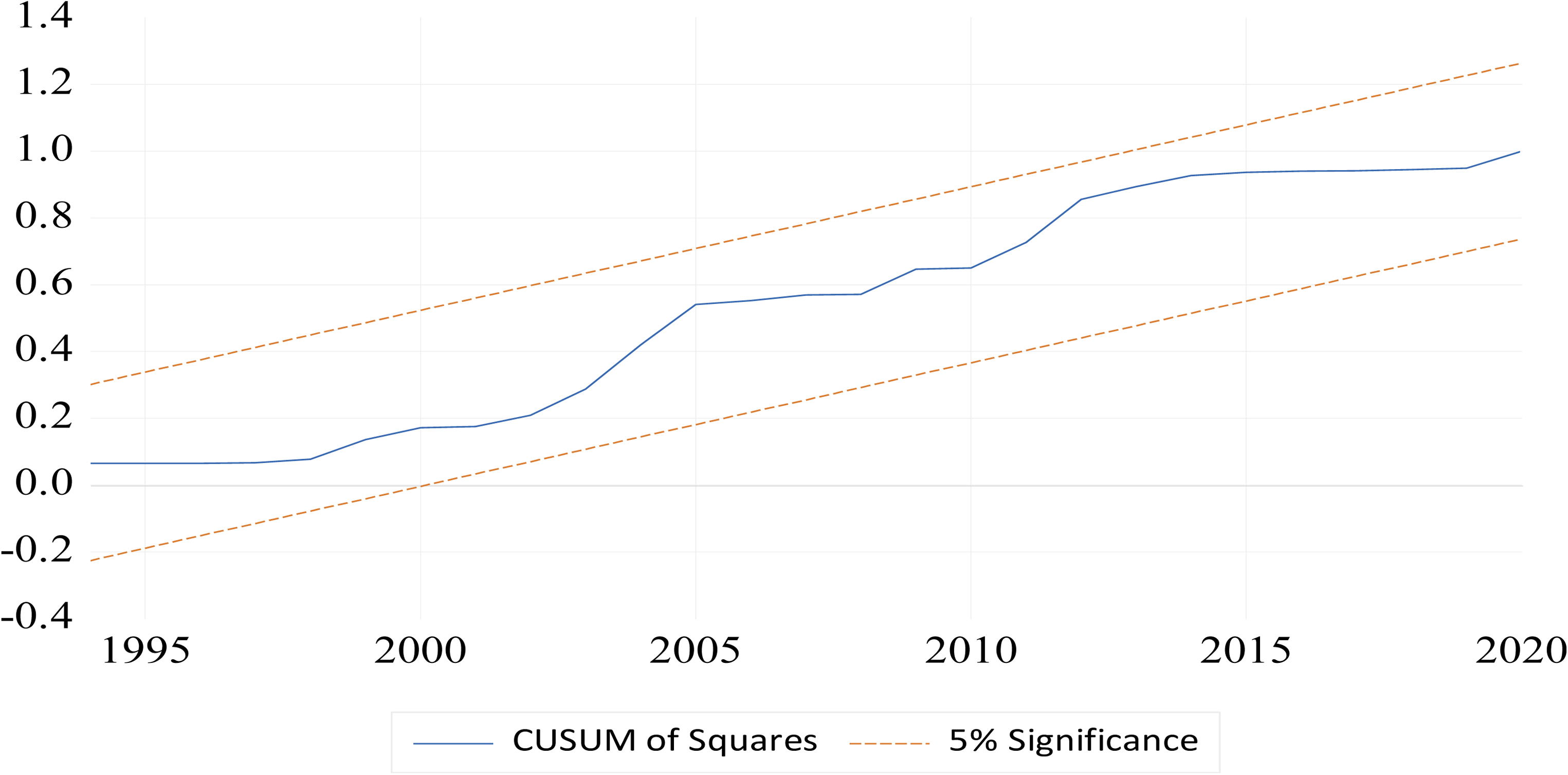
CUSUM squares.
The presence of a cointegration relation between the variables implies the existence of a causal relationship between them in at least one direction. 46 The results of the short- and long-term causalities are presented in Table 7. In the short run, renewable energy consumption has a positive and significant impact on economic growth. Additionally, capital and labor also have positive and significant impacts on economic growth. The estimation shows that economic growth increases renewable energy consumption. We can consider that there is a bidirectional relationship between renewable energy consumption and economic growth. The effect of capital is positive on renewable energy consumption but this impact is not significant. The effect of labor in this equation on renewable energy consumption is positive and significant. The results show that economic growth and renewable energy consumption increase capital, but labor does not have a significant impact on capital. Our results support the hypothesis that economic growth and capital have positive and significant effects on labor but renewable energy consumption has no impact on labor. Finally, by using a joint F-test, the results confirm the causal relationship between economic development and its short- and long-term macroeconomic determinants.
Results of the causality test.
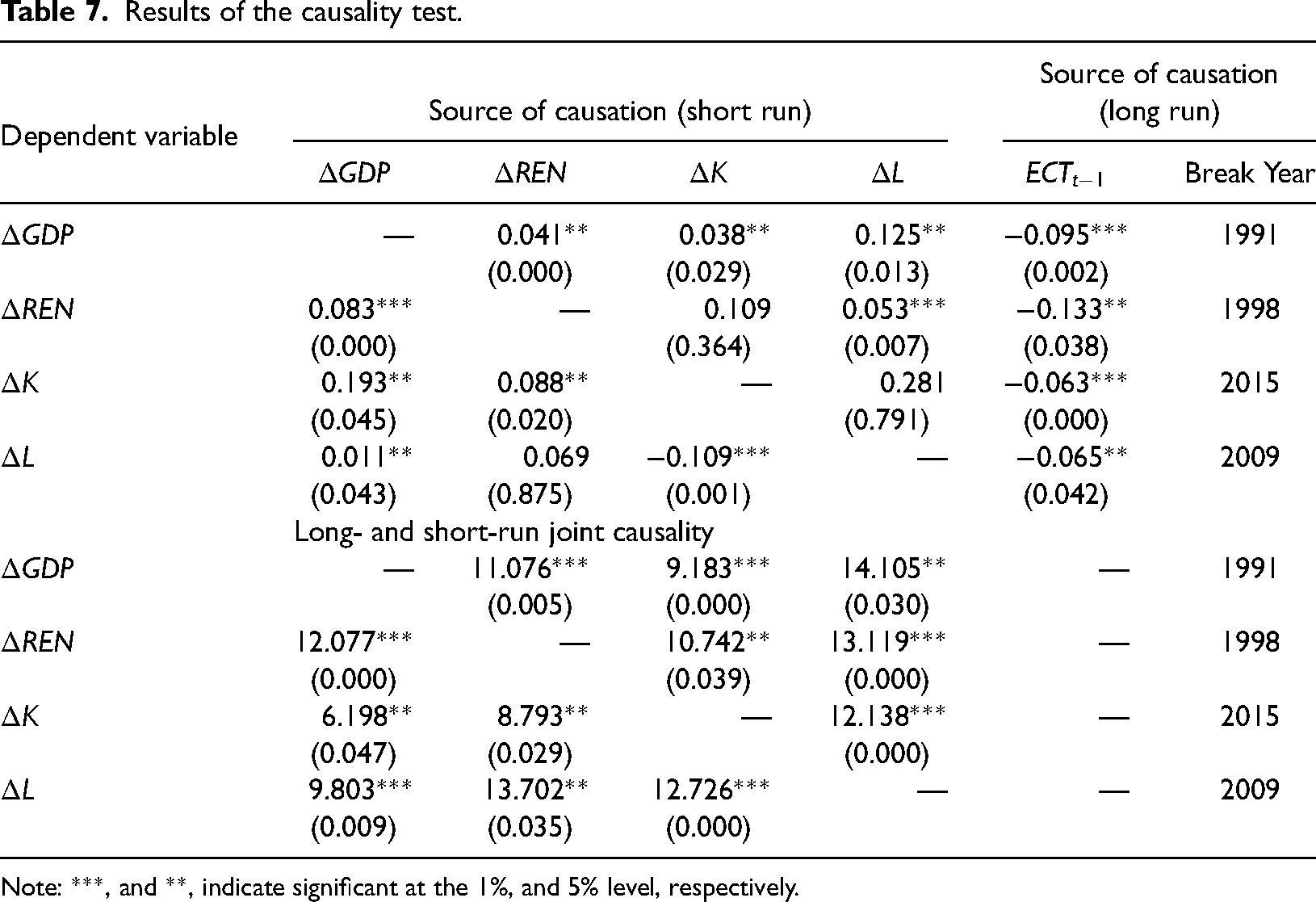
Note: ***, and **, indicate significant at the 1%, and 5% level, respectively.
The error correction term coefficients show the adjustment from short term to long term. This coefficient is significant at the 1% level, i.e., the differences between the actual values and the long-term values will be corrected with the error correction term coefficients in each period. In total, the causality test shows that in the long run there is a bidirectional relationship between renewable energy consumption and economic growth, i.e., renewable energy causes economic growth and economic growth causes renewable energy. The existence of an energy impact towards growth shows that this energy is very important in economy. Based on the result of our research, we can induce that the renewable energy consumption can stimulate economic growth in Saudi Arabia. Compared with previous works, the evidence of bidirectional causality between renewable energy consumption and GDP both in the short and long run in our empirical results seem to be consistent with the empirical result found by Pao and Tsai, 47 Magazzino, 48 Apergis and Payne, 49 Apergis and Payne, 26 Dogan, 50 Zhang et al., 51 Toumi and Toumi; 52 Kahia et al.; 53 and Agboola et al. 54 in Saudi Arabia. However, our findings contradict with those of Ozcana and Ozturk, 55 Li and Leung 56 in seven European countries, and also differ from those of EL-Karimi and El-houjjaji 57 of no cointegration between renewable energy consumption and economic growth in France, UK, Italy and Japan. The difference in the empirical results for the same country is perhaps due to the different data and models used.58–60 Our empirical results seem to have a more robust base according to the experiences with the current realities of renewable energy consumption and economic development in Saudi Arabia.
Conclusion and policy implications
The main aim of this study is to investigate the short- and long-run relationships along with the direction of causality between economic growth and renewable energy consumption in Saudi Arabia for the period 1990–2020. We incorporated labour and capital as additional determinants of economic development. The empirical results verify the presence of cointegration among renewable energy consumption, labor, capital, and economic growth. In addition, renewable energy consumption amplifies GDP. The cointegration test results highlighted the existence of a long-term relationship between capital and economic growth. Thus, the existence of a long-term relationship between labor and economic growth is confirmed. In the short run, the causality test indicates the presence of a two-way causality between renewable energy consumption and economic growth, between labour and economic growth, and between capital and economic growth. Labour causes the renewable energy consumption and capital causes labour. In addition, the renewable energy consumption causes capital. We can conclude that renewable energy consumption like any other energy influences macroeconomic variables (GDP, growth, unemployment, savings, etc.), because most of them depend on GDP. The renewable energy consumption influences economic growth in an indirect way as well, i.e. it has a positive effect on capital formation and the latter increases economic growth. The observation of the two-way relationship shows the importance of the renewable energy consumption in this country. On the other hand, the results indicate that in the long term there is a bidirectional relationship between the variables.
Based on our empirical results, it is recommended that policy makers increase renewable energy production as an important means to reduce greenhouse gas emissions, thereby contributing to mitigate the effects of climate change. However, policy makers should increase their investments in renewable energy sources, providing loans under favorable circumstances in case of electricity supply excess. In addition, policymakers need to frame innovations for the implementation and market availability of renewable energy, such as Energy Transition Tax Credits (ETTC), renewable energy portfolio standards, rebates for renewable energy installation, development of renewable energy market systems, and certificates for renewable energy sector improvement. In addition, this country should reduce the production of electricity from fossil fuels, by carrying out energy saving projects and increasing energy efficiency. These projects must be part of a broader logic of energy transition and participate to an appropriate extent to the context of the project and its environment, as well as promote the other pillars that are sobriety, efficiency and the fight against fuel precariousness.
Footnotes
Acknowledgements
This work was funded by the Deanship of Scientific Research at Jouf University under grant No (DSR-2021-04-0308).
Declaration of conflicting interests
The author(s) declared no potential conflicts of interest with respect to the research, authorship, and/or publication of this article.
Funding
The author(s) received no financial support for the research, authorship, and/or publication of this article.
