



Abstract
There are competing theoretical expectations and conflicting empirical results concerning the impact of partisanship on spending on active labour market policies (ALMPs). This paper argues that one should distinguish between different ALMPs. Employment incentives and rehabilitation programmes incentivize the unemployed to accept jobs. Direct job creation reduces the supply of labour by creating non-commercial jobs. Training schemes raise the human capital of the unemployed. Using regression analysis this paper shows that the positions of political parties towards these three types of ALMPs are different. Party preferences also depend on the welfare regime in which parties are located. In Scandinavia, left-wing parties support neither employment incentives nor direct job creation schemes. In continental and Liberal welfare regimes, left-wing parties oppose employment incentives and rehabilitation programmes to a lesser extent and they support direct job creation. There is no impact of partisanship on training. These results reconcile the previously contradictory findings concerning the impact of the Left on ALMPs.
Keywords
What drives the evolution of welfare states has been a central question in comparative political economy for at least three decades (Korpi, 1983; Wilensky, 1975). Attention has increasingly shifted to explaining more specific welfare state policies. This is best exemplified by active labour market policies (ALMPs), which aim to reduce unemployment and raise labour market participation. ALMPs include spending on public employment services, employment incentives, training and direct job creation. These programmes have been promoted by both the Organisation for Economic Co-operation and Development (OECD) in its 1994 Jobs Study and the EU in its 1997 European Employment Strategy.
In the early 1990s, Janoski and Hicks declared that ‘despite two decades of use, ALMP is still a new term … and few analyses exist on this policy’ (1994: 62). Since then, three streams of literature have studied ALMPs from different angles. First, the welfare state literature analysed how these programmes work. This literature also assessed the extent to which the introduction of these policies changed the welfare state (Clasen and Clegg, 2006; Daguerre, 2007). Second, the economics literature studied the impact of ALMPs on unemployment and employment levels across countries (Estevão, 2003; Nickell and Layard, 1999). Third, comparative political economy investigated the determinants of ALMPs (Armingeon, 2007; Boix, 1998; Bonoli, 2008; Huo et al., 2008; Rueda, 2007).
However, important debates remain concerning the role and effect of political parties on ALMPs. Two seminal studies on the impact of partisanship on ALMPs reach opposite conclusions and generate contradictory theoretical expectations. On the one hand, Boix (1998) argues that social democratic parties promote ALMPs more than conservative parties. On the other hand, Rueda (2007) argues that Social democratic parties will at best be indifferent towards ALMPs and at worst be against ALMPs. Both authors find strong empirical support for their theories. As a result, there are competing theoretical expectations concerning the effect of partisanship on ALMPs. This paper therefore asks ‘What is the impact of partisanship on ALMPs?’
The first section reviews in greater depth the existing literature. I argue that contradictory theoretical expectations are the result of two fundamental issues. As shown in the first section, the first issue is an inappropriate aggregation of ALMPs in a single conceptual category whereas different ALMPs are promoted differently by distinct political parties. The second issue concerns the omission of welfare regimes which, as the second section shows, are likely to influence the impact of partisanship on different ALMPs. The third section describes the data and presents the empirical model and estimation strategy. The results are then discussed with a focus on how the control of government by social democratic parties affects spending on three groups of ALMPs in different welfare regimes: employment incentives and rehabilitation, direct job creation and training schemes. The final section concludes and draws some implications for further research.
The impact of partisanship
Within comparative political economy of both government policies and economic outcomes, partisanship has been a particularly important focus in the literature. Previous studies have looked at the impact of partisanship on economic performance (Alvarez et al., 1991; Hibbs, 1977), inequality (Bradley et al., 2003; Pontusson et al., 2002), welfare state reform and generosity (Allan and Scruggs, 2004), and public spending more generally (Cusack, 1997).
The power resource theory posits that strong labour movements push for greater welfare state expansion. One way they do so is in the ‘electoral arena in which politicians, answerable to voters, make the key decisions’ (Pierson, 2001: 7). There is then a direct impact of political parties on public expenditures through new legislation and budgetary decisions (Janoski and Hicks, 1994). Social democratic parties are key initiators of social policies (Korpi, 2006). This implies that the control of governments by the Left results in more spending on welfare state policies (Korpi, 1983).
The earliest quantitative analysis of ALMPs was carried out by Janoski (1990). He argued that left-wing parties undertake ALMPs to address economic problems ‘important to the working class’ such as unemployment (Janoski, 1990: 263). Time series analysis of West Germany provides support for his hypothesis (Janoski, 1990: 263). In a similar vein, Huo et al. (2008), as well as Iversen and Stephens (2008), find that social democratic control of government is an important determinant of ALMPs. This is because ALMPs increase employment, which is conducive to labour’s interests. These arguments are consistent with Esping-Andersen’s (1990: 168) work on welfare regimes. He showed that ‘active labour market policy … became … the instruments through which an accommodation to full employment was pursued’.
Other authors have stressed the possibility that left-wing parties support ALMPs only under certain conditions. For instance, Bonoli (2008) has argued that left-wing parties will only support ALMPs in open economies. In relatively closed economies, left parties will favour decommodification and high employment protection for their core constituents. In open economies, however, this would hinder competitiveness. Thus, ALMPs represent a way to achieve the twin objective of promoting the interests of workers and retaining competitiveness.
Bonoli’s (2008) study echoes that of Boix (1998). He showed that left-wing parties support ALMPs because this allows them to achieve the objectives of equality and economic growth. This is because growth depends mostly on the supply side of the economy. By raising the physical and human capital of the economy, supply side policies increase the productivity of workers. Higher human capital makes it possible for the unemployed to command wages that are higher than the social wage. These higher wages make it worthwhile for them to enter employment. Thus, this strategy reduces unemployment. It also increases equality since the unemployed now earn a wage that is superior to the social wage.
On the other hand, Rueda’s seminal work (2007) shows that labour is divided between insiders and outsiders. Insiders are workers in full-time permanent employment, while outsiders encompass the unemployed and some workers in temporary or part-time contracts. Insiders represent the core constituents of social democratic parties. If they are well insulated from the risk of unemployment, they will not support ALMPs. Outsiders are relatively unimportant for both trade unions and political parties. Social democrats will therefore at best leave ALMPs unchanged and at worst reduce spending on ALMPs. There are two cases where this prediction should be qualified. If insiders have very low employment protection, their exposure to the risk of unemployment increases. In such a case, their preferences for ALMPs may change as they may benefit from these policies by becoming unemployed. Second, if many outsiders are members of unions, the latter may support ALMPs more than would otherwise be the case. Rueda finds conclusive evidence for his insider–outsider theory of ALMPs.
Thus, there are contradicting theoretical expectations and empirical evidence concerning the impact of partisanship on ALMPs spending. Note that this is obviously but one relevant dimension to investigate activation processes that have not only been applied to ALMPs but also to welfare state policies more generally (Barbier and Fargion, 2004; Dropping et al., 1999; Ludwig-Mayerhofer and Wroblewski, 2004). For instance, disability and long-term sickness or family policies have also been ‘activated’ (Etherington and Ingold, 2012; Ghysels and Van Lancker, 2011). Other processes besides activation have also characterized the evolution of welfare state policies, for instance workfare and a rebalancing of ‘rights and obligations’ (Lødemel and Trickey, 2000: 313). Similarly, reforms of unemployment benefit systems have entailed the reorganization and merger of public employment services (Champion and Bonoli, 2011) or the ‘unemployment support homogenization’ and ‘unemployment policy coordination’ (Clasen and Clegg, 2006).
Disaggregating ALMPs
A significant part of the political economy literature reviewed earlier assumes that it is appropriate to subsume these different programmes under a common heading. For instance, Huo (2009: 103) argues that ‘ALMPs do share the common characteristic of making an offer to the unemployed’. This section challenges the assumption that ALMPs can be considered as a unified category.
This is in line with literature that has emphasized that there are different types of activation (Barbier, 2001; Barbier and Ludwig-Mayerhofer, 2004). A distinction can, for example, be made between activation that is offensive or defensive (Torfing, 1999) and between liberal or universalistic (Barbier, 2004). In each case, the difference that is emphasized is between more ‘emancipating’ activation such as training and more ‘repressive’ activation (Dingledey, 2007). More recently, Bonoli (2010) also argues in favour of differentiating between different types of ALMPs. This qualitative evidence thus calls for an analysis of what ALMPs include and which political parties support different ALMPs.
Following the OECD classification one can distinguish between seven types of programmes under the heading of ALMPs. I argue that three programmes do not constitute appropriate tests for power resource theory or for the insider–outsider theory. In the remaining four programmes, one directly creates jobs for the unemployed, while two programmes incentivize unemployed people to take up jobs through various measures. The last programme in ALMPs attempts to increase the productivity of the unemployed through training schemes. The argument is that political parties support different ALMPs in distinct ways. Note that for reasons of space, the discussion of the official rationale for introducing the various reforms that underpin spending on ALMPs in each country is necessarily limited and where it occurs it is mostly for illustrative purposes (for more on this, see Bonoli, 2010; Dingledey, 2007; King, 1995).
Inappropriate inclusion of programmes
First, public employment services and administration (PES) include placement and related services and the administration of benefits. Spending on PES therefore includes the cost of employing people to administer benefits and organizing the placement services. It is entirely unclear whether this benefits the unemployed or whether PES is used to monitor benefit recipients more closely. For instance, the 2001 plan of help to return to employment made it compulsory for the unemployed in France to ‘take an ‘acceptable’ job’ (Barbier, 2009: 178). The impact of this programme on unemployment and employment is also contested. Estevão (2003: 15) finds that spending on PES is associated with lower employment rates.
Second, ALMPs include spending on job rotation and job sharing. This is the sort of programme that Germany’s Kurzarbeit schemes during the recent economic crisis involved. This is a way to prevent redundancies rather than to reduce unemployment or increase employment rates. Third, expenditures on start-up incentives entail helping the unemployed to start their own business as self-employed workers. Again, the promotion of self-employment has little to do with the interests of labour or with worker–employer relationships. Note that spending on job rotation and start-up incentives represent in any case a very small share of aggregate ALMPs.
Direct job creation
‘Direct job creation’ is a fourth type of ALMP. This sort of programme has a much longer history than ALMPs as an integrated conceptual category. Germany was implementing ‘national job creation policies’ as early as the 1920s (Janoski, 1990: 63). In the 1970s, Sweden expanded public sector employment and used ALMPs to provide an occupation for unemployed workers. This included ‘temporary jobs arranged mostly in the public sector’ (Bonoli, 2010: 18). These job creation schemes were therefore classic interventions on the demand side of the labour market. In 1979, the Danish left created a job offer scheme guaranteeing a 7-month job to the long-term unemployed (Huo, 2009: 105). The Dutch PvdA’s left party also offered government subsidized jobs in the public sector. For instance, the so-called ‘Melkert job schemes’ directly created jobs (Huo, 2009: 124, 125).
In France, the left-wing government introduced ‘collective utility work’ in 1984 (Lødemel and Trickey, 2000). Similarly, it was the socialists who in 1997 introduced the “Nouveaux Services Emplois Jeunes” providing 18–30-year-olds with 5 years of full time employment (Daguerre, 2007: 116). The impact of this initiative on spending on direct job creation in France, where the Socialists were in power from 1988 to 1992 and 1997 to 2002, can be seen in Figure 1. In France, the underlying public rationale of these schemes was both to create jobs in the context of large unemployment and to address ‘unmet needs in the public sector’ (Lødemel and Trickey, 2000: 60). Governments that initiated these schemes did so with the official objective to deal with mass unemployment through demand side programmes to ‘keep jobless people busy’ (Bonoli, 2010: 441).
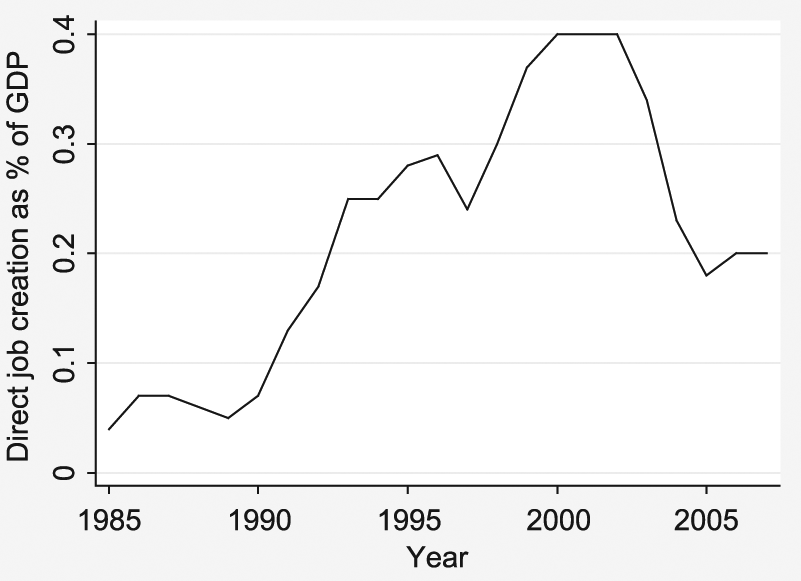
Spending on direct job creation at a percentage of GDP in France.
Thus, direct job creation involves the use of public funds to directly create employment. Most often these jobs are created in the public or non-commercial sector. This measure therefore directly reduces unemployment. There is evidence that direct job creation was effective in increasing employment in the 1990s (Estevão, 2003: 15). By reducing unemployment, direct job creation may therefore have a positive impact on wages. As a result, this measure is consistent with the interest of both the employed and unemployed workers. Social democratic parties can therefore be expected to support direct job creation.
Employment incentives and rehabilitation
Spending on ‘employment incentives’ constitutes a fifth type of ALMPs. This includes both recruitment incentives and employment maintenance incentives. This is part of a broader agenda that reinforces incentives for the unemployed to take up jobs. Economists (Phelps, 1997; Snower, 1997) have stressed the role of (targeted) employment subsidies in reducing unemployment and making low wage workers better off.
However, this type of ALMP may also put downward pressures on wages in private sector employment. This occurs through two mechanisms. First, by subsidizing low wage work in the private sector, this makes it more interesting for employers to offer low wage jobs. Such a substitution effect is consistent with some of the empirical literature (Calmfors et al., 2001). Second, this programme rewards the acceptance of any jobs by the unemployed. This makes it more likely that the unemployed would take up jobs that they would otherwise not accept.
Thus, employment incentives may promote low-wage work and make employers substitute non- subsidized labour by subsidized labour. This means that ALMPs may become ‘financial subsidies that firms exploit for hiring cheap labour’ (Huo, 2009: 111; Martin and Swank, 2004). This is not likely to be popular with core social democratic voters. This concern of a potentially detrimental effect of employment incentives on the type of employment has for instance been voiced by French trade unions (Naton, 2009). Similarly in Sweden, the social democratic position was that ‘the state should not subsidize or encourage low wage employment’ (Huo, 2009: 116).
Liberals as well as Conservatives have supported the reinforcement of incentives (Bonoli, 2010). This type of programme promotes market mechanisms and reduces unemployment by raising incentives, which is consistent with Liberal and Conservative ideology. For instance, in 1990, the Danish centre-right government introduced a scheme that promoted the young unemployed to participate in activation (Huo, 2009: 104). The impact of this initiative on spending on employment incentives in Denmark, where a Liberal Conservative coalition ruled from 1982 to 1993 and after 2001, can be seen in Figure 2. Similarly, the centre-right government in the Netherlands introduced a programme, the Loonsuppletie, which granted the unemployed a temporary wage supplement. This was only awarded where the wage of the new job was inferior to that of the previous job (Huo, 2009: 123).
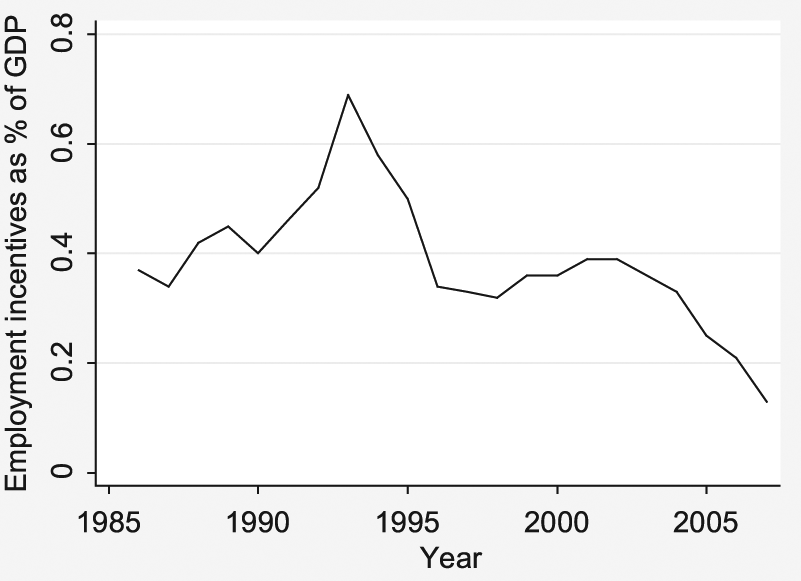
Spending on employment incentives as a percentage of GDP in Denmark.
The programme ‘supported employment and rehabilitation’ promotes mobility on the part of the unemployed to get into employment. This is done for instance by providing mobility grants to unemployed workers who accept moving region to seize an employment opportunity. It also consists of ‘subsidies for the productive employment of persons with … a long-term … reduced capacity to work’ (Organisation for Economic Co-operation and Developement, 2010). This programme makes it more likely that a job seeker in a given region would move to another region.
Thus, supported employment and rehabilitation has similar effect to employment incentives. Most often the stated aim of these programmes is to promote re-entry into the labour market (Bonoli, 2010). Both measures incentivize the unemployed to take jobs, thereby potentially putting downward pressures on wages. Rueda (2007: 74) recognized this possibility when he contends that ALMPs ‘promote entry into the labour market of outsiders who will underbid insiders’ wage demands’. I argue that this is only the case for the aforementioned programmes and not for the other types of ALMPs.
Training schemes
Training schemes in ALMPs have the aim of raising human capital. This was, for example, the main reason for the promotion of ALMPs by Swedish social democrats in the early 1950s. The Rehn Meidner model involved a solidaristic wage system that priced out low productivity industries. The resulting unemployed could then be retrained and incorporated into high productivity industries (Huo, 2009). Thus, contrary to measures that incentivizes unemployed people to take up jobs, training schemes aim to enable unemployed people to re-skill thereby increasing their chances of successfully attaining their preferred employment position.
It is precisely because training ALMPs raise human capital that Boix (1998) argues that the Left would support these programmes. By raising the productivity of unemployed people, this allows social democrats to raise both economic growth and equality. Conversely, the conservatives may see publically funded training as unnecessary. For instance, when the centre-right party took power in Sweden in 1991, they reduced spending on ‘skill and competence development’ in ALMPs (Huo, 2009: 113). And it was a left government that introduced the ‘vocational training programme’ in Norway (Huo, 2009: 120).
However, some historical evidence partly contests Boix’s argument. In 1963, the Gaullist party in France attempted to introduce training schemes in the unemployment benefit system. This was partly opposed by unions who resented additional state involvement in unemployment insurance (Bonoli, 2010; Clegg, 2005). The promotion of vocational training to address unemployment also occurred around the same time in Germany. This took the form of the 1969 employment promotion act which was proposed by the CDU–SPD coalition (Bonoli, 2010).
As Bonoli (2010: 17) concludes, training was supported by very different political parties: ‘Swedish Social democrats, the French Gaullists, Italian Christian democrats and a coalition government in Germany’. In addition, training may not be relevant for unemployment or employment levels. This echoes Estevao’s (2003: 15) conclusion that ‘training programmes for unemployed … adults seemed irrelevant’ for employment.
Partisanship and different ALMPs
This section has shown that there are important differences between ALMPs. I have identified three distinct types of ALMPs: employment incentives and rehabilitation, direct job creation and training schemes. From this discussion, my argument is that Social democratic parties, all other things being equal, support direct job creation but do not support employment incentives and rehabilitation. This is because direct job creation benefits the unemployed without putting pressure on employed workers, whereas employment incentives and rehabilitation may have adverse consequences for employed workers.
Historically, both social democratic and conservative parties may support training schemes. Theoretically, this is because training also matters to employers and hence these schemes are more likely to be driven by the coordination regime than partisanship. I therefore derive the following hypothesis and three observable implications.
H1 The control of the government by Social democratic parties is: (a) positively related to spending on direct job creation; (b) negatively related to spending on employment incentives and rehabilitation; and (c) not significantly related to spending on training.
ALMPs in different welfare regimes
This section shows that the type of welfare regime and variety of capitalism in which ALMPs are located can be expected to affect the amount that is spent on different ALMPs. The welfare state literature has shown that countries cluster in three distinct welfare regimes (Esping-Andersen, 1990). The possibility that ALMPs may cluster in different regimes is a well-supported empirical and theoretical phenomenon (Barbier and Ludwig-Mayerhofer, 2004; Dropping et al., 1999).
The potential impact of welfare regimes and varieties of capitalism
Welfare regimes may affect the preferences of political parties for different ALMPs. There are three sets of reasons why welfare regimes affect political parties’ preferences for labour market policies. First, there are enduring historical differences in the sort of problems different regimes have faced. Long-term unemployment was traditionally much higher in continental Europe than in the Nordic cluster (Esping-Andersen, 1990: 152). For example, Norway and Sweden were among the few countries to achieve unemployment rates of about 2 to 3 percent during the post-war era (Esping-Andersen, 1990: 163). More generally, Scandinavian countries have much lower poverty and inequality rates than other European countries (Häusermann and Palier, 2008).
The second reason is that the ability to undertake policies may also be regime-dependent. Political parties also choose policies in the context of existing policy tools, which may differ significantly in different regimes. Scandinavian social democratic parties can expand public sector employment more than on the continent. Their tax revenues are larger, which allows them to spend much more on all welfare state policies. Similarly, the introduction of ALMPs in the 1960s in Scandinavia was made easier by the expansion of the welfare state at that time. Today, the long history of ALMPs in Sweden makes them an easy policy tool to expand. Later retrenchment may be prevented by the popular support these programmes have created. This is what Armingeon (2007: 913) calls the ‘regime specific predisposition of expanding ALMP’. The logic of the welfare state becomes partly independent of ‘temporal political power distribution’ (Armingeon, 2007: 914).
Third, there are different coalitions and ideology behind left-wing parties in different welfare regimes. For instance, the Scandinavian left drew its strength from a coalition between labour and the peasant movement. Subsidies for farmers were granted in exchange for a ‘full employment welfare state’ (Esping-Andersen, 1990: 30). The labour movement was therefore much more encompassing in Scandinavia than in continental Europe. The labour movement may also be more divided because of religious cleavages, as in the Netherlands, or between different left-wing parties, as in France (Clegg et al., 2010). This could imply that left-wing parties may promote different types of ALMPs in continental European countries from those in Scandinavia.
The main contender to the power resource approach, the Varieties of Capitalism literature (Hall and Soskice, 2001), underscores the importance of the type of capitalism for the sort of social policy and social protection that emerges (Estevez-Abe et al., 2001). Recall that the previous section suggested that there were no clear partisan drivers of training. This does not imply that training is irrelevant in other respects. Given the importance of skills for the industry, spending on this type of ALMP is likely to be driven more by the type of capitalism than by partisanship (Estevez-Abe et al., 2001; Hall and Soskice, 2001). If employers need workers to acquire specific skills, political parties may support training schemes for the unemployed.
For instance, coordinated market economies (CMEs) have ‘high levels of vocational educational and … industry specific and firm specific skills’ (Iversen and Stephens, 2008: 31). This is consistent with historical evidence that most political parties in CMEs supported training measures for the unemployed. There is also evidence that employers in Sweden had a strong interest in the development of training schemes (Swenson, 2002). Similarly, Danish employers were heavily involved in the extension of training schemes (Martin and Thelen, 2007: 24). Indeed, the drastic expansion of training programmes in the post-Second World War period was at least partly driven by a need to address important skill shortages (Bonoli, 2010). In line with this theory, continental and Scandinavian welfare regimes may have less different preferences or needs for training because both these regimes have broadly similar coordination structures.
Mapping ALMPs in different welfare regimes
Ferrera (1996) distinguishes between four types of welfare regimes: Scandinavian, continental, Liberal and Southern. For simplicity, Liberal and Southern regimes can be put together under the label ‘minimalist labour market policies’ welfare regimes. Their welfare regimes are smaller and less decommodifying than in the rest of the continent. Thus, the Scandinavian welfare regime comprises Sweden, Denmark and Finland. The continental cluster includes France, Germany, Austria, Belgium and the Netherlands. The minimalist category includes the UK and Ireland, Spain, Portugal, Greece and Italy.
Social democratic parties in Scandinavia are stronger than in other regimes. We should therefore expect the difference between spending on employment incentives and rehabilitation under a left-wing government and under a right-wing government to be larger in Scandinavia. In addition, if left-wing parties in continental Europe are less inclusive, they may care less about the adverse effects of employment incentives and rehabilitation. Workers in precarious employment may also be less important to social democrats in continental Europe than in Scandinavia.
The ability to expand public sector employment in Scandinavia is higher than in the other two regimes. If Social democrats are able to expand standard permanent public employment, they may not promote direct job creation. This is because employment secured by direct job creation is more temporary and precarious than standard public sector employment. The more inclusive nature of the labour movement in Scandinavia means that Social democrats may want to offer standard public sector jobs to the unemployed. The recent opposition of unions and social democrats towards a work scheme introduced by the centre right government in Sweden best illustrates that the Left may be strongly opposed to certain types of ALMPs (Kullander and Bjornberg, 2011). This is ultimately an empirical matter.
As argued in the previous section, the effect of partisanship on training is historically unclear and theoretically less important than the type of capitalism in which government policy making takes place. This is because training is particularly important to employers and economic performance more generally in CMEs (Hall and Soskice, 2001; Swenson, 2002). Thus, one can expect training spending to be higher in the two welfare regimes that encompass more coordinated market economies, such as the Scandinavian and, to a lesser extent, the continental welfare regime. From this discussion, the following hypothesis is posited.
H2 (a) The negative correlation between left parties in government and employment incentives and rehabilitation will be stronger in Scandinavia; (b) the control of government by left parties is positively correlated with direct job creation in continental and minimalist welfare regimes; and (c) training spending is higher in non-minimalist welfare regimes.
Empirical analysis
One important limitation of studies focusing on welfare state spending is that ‘the existence of a social programme and the amount of money spent on it may be less important than what it does’ (Esping-Andersen, 1990: 2). 1 Relying on total social expenditures for comparing welfare states has therefore entailed a significant ‘dependent variable problem’ (Clasen and Siegel, 2007). This problem partly goes beyond the remit of this paper. While acknowledging that this is a valid limitation, this paper follows Castles’ contention (2009: 46) that ‘if the problem is the aggregation of unlike categories of spending, the … way forward is to avoid an inappropriate elision of spending categories’.
Recent literature shows that disaggregating social expenditures yields important insights into welfare state policy (Kuitto, 2011). Indeed, this is precisely the rationale for disaggregating ALMPs. Moreover, to the extent that the rights and duties as well as the extent of decommodification associated with spending levels follow Esping-Andersen’s typology, controlling for the welfare state regimes in which spending is located may also further alleviate this limitation. This section first describes the data that is used for my dependent and independent variables. It then presents the empirical model used to test the hypotheses and explains the appropriate estimation strategy.
Description of data
Throughout, I rely on panel data for 14 European countries (EU15 minus Luxembourg) over the period 1990 to 2007, though data availability varies depending on variables and countries. The lower bound results from data availability, but also from the fact that most countries outside Scandinavia did not undertake significant ALMPs prior to the 1990s. The upper bound is determined by the onset of the crisis, which may introduce a bias after 2007.
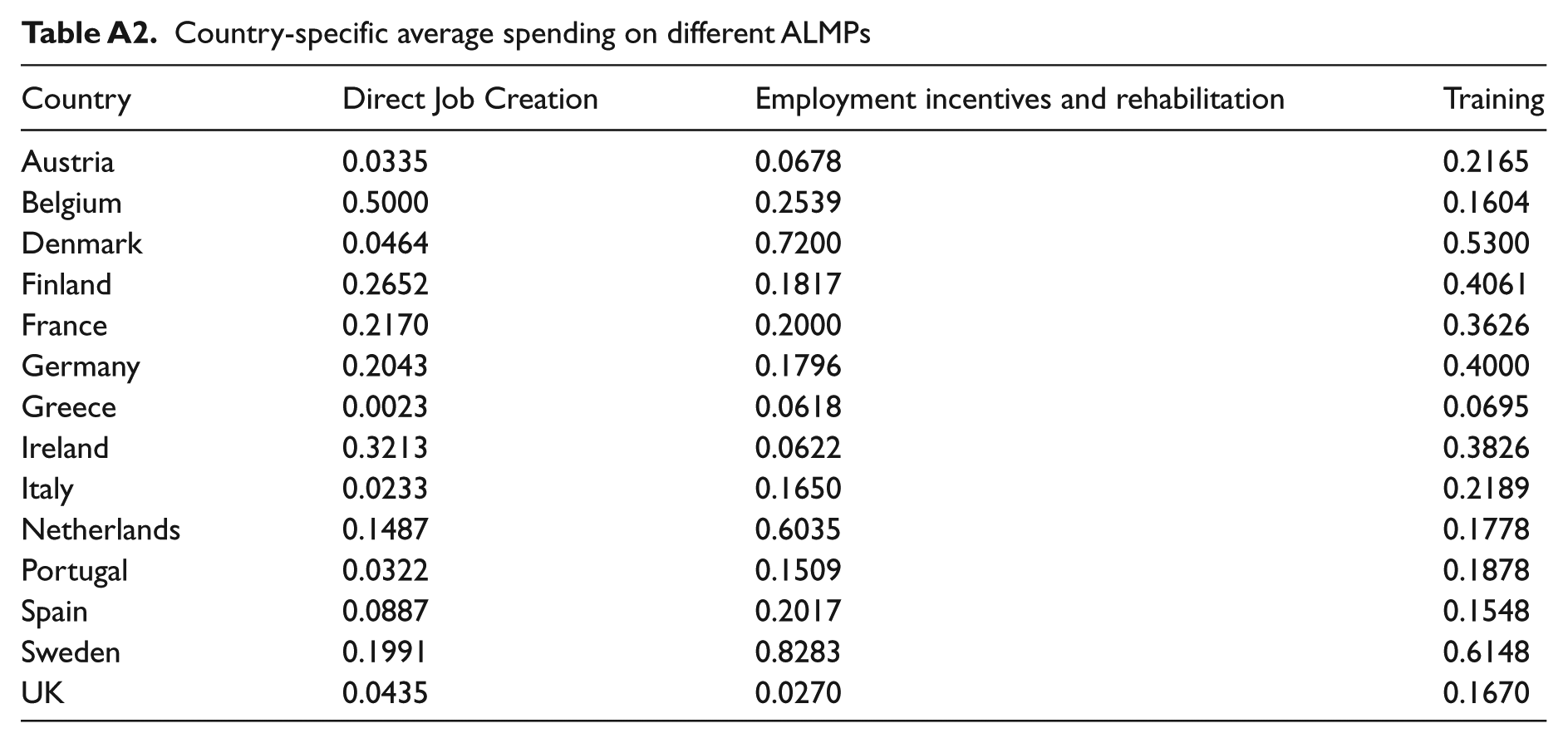
With regard to my dependent variables, I rely on the OECD statistics database. The OECD provides annual data on spending as a percentage of GDP on my three types of ALMP. My first dependent variable is constructed by summing employment incentives and supported employment and rehabilitation. The second dependent variable is training measures in the database, and the third concerns the ‘direct job creation’ category. More details on the definitions and average values for each country of the dependent variables can be found in the appendix (Tables A1 and A2).
Given that ALMPs aimed to address problems that were driven by labour market and macroeconomic developments (see Bonoli, 2010), it is particularly important to control for the performance of the labour market and the economy. To control for the former, the analysis includes annual harmonized unemployment rates defined as the number of unemployed people as a percentage of the civilian labour force. The state of the economy is controlled by including annual GDP growth in percentages because higher growth of GDP may affect both the cyclical and the discretionary component of policies. Further, controlling for the degree of deindustrialization or trade openness did not alter the results. 2
The measure of the impact of partisanship is an updated version of the Schmidt index taken from the Comparative Political Data Set III, 1990–2009 (Armingeon et al., 2011). This calculates the political composition of the Cabinet. The original coding is from (1) hegemony of right-wing (and centre) parties through to (5) hegemony of social-democratic and other left parties. I have rescaled this variable to take values from −2 to +2.
Empirical model and estimation strategy
I construct two dichotomous variables to capture the impact of welfare regimes. The dummy ‘MIN’ is equal to 1 when the country has a minimalist welfare regime, and 0 otherwise. Similarly, the dummy ‘CONT’ is equal to 1 when the country is a continental welfare regime, and 0 otherwise. When both dummy variables are zero, the intercept then captures the impact of the Scandinavian welfare regime on the dependent variables.
The mediating effect of welfare regimes on the impact of partisanship on different ALMPs is captured by introducing an interaction term between my measure of partisanship and the set of without s, i.e.: regime dichotomous variables. Panel data regression analysis of the three dependent variables is used to test my hypotheses. More specifically, the general regression model that is tested is as follows:
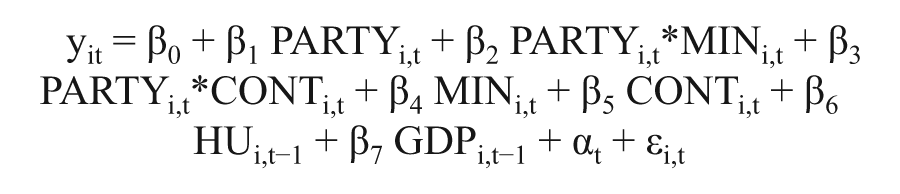
where yit is the dependent variable in country i at time t. There are three dependent variables expressed in levels: 3 spending on direct job creation; employment incentives and rehabilitation; and training as a percentage of GDP. With regard to the explanatory variables, PARTY is the index measure of partisanship that was explained earlier. MIN and CONT are dummy variables measuring the intercept effect of belonging to minimalist and continental welfare regimes, respectively. In addition, PARTY*CONT and PARTY*MIN capture how welfare regimes influence the impact of partisanship on the dependent variable. For instance, to assess the effect of left-wing power in continental Europe one should look at β1+ β3. Unemployment (HU) and GDP growth (GDP) are lagged one period. Last but not least, the αt’s are t−1 year dummies and ϵi,t is the residual. Time dummies are included to capture time effects but statistical tests suggest that country dummies are not required. 4
The various diagnosis tests 5 have identified that there is heteroskedasticity, contemporaneously cross-sectionally correlated and auto-correlated errors. The appropriate estimation method in such a case is to carry out ordinary least square (OLS) with panel-corrected standard errors and Prais–Winston transformation (Hoechle, 2007: table 1, p. 4).
The determinants of spending on employment incentives and rehabilitation (as % of GDP)
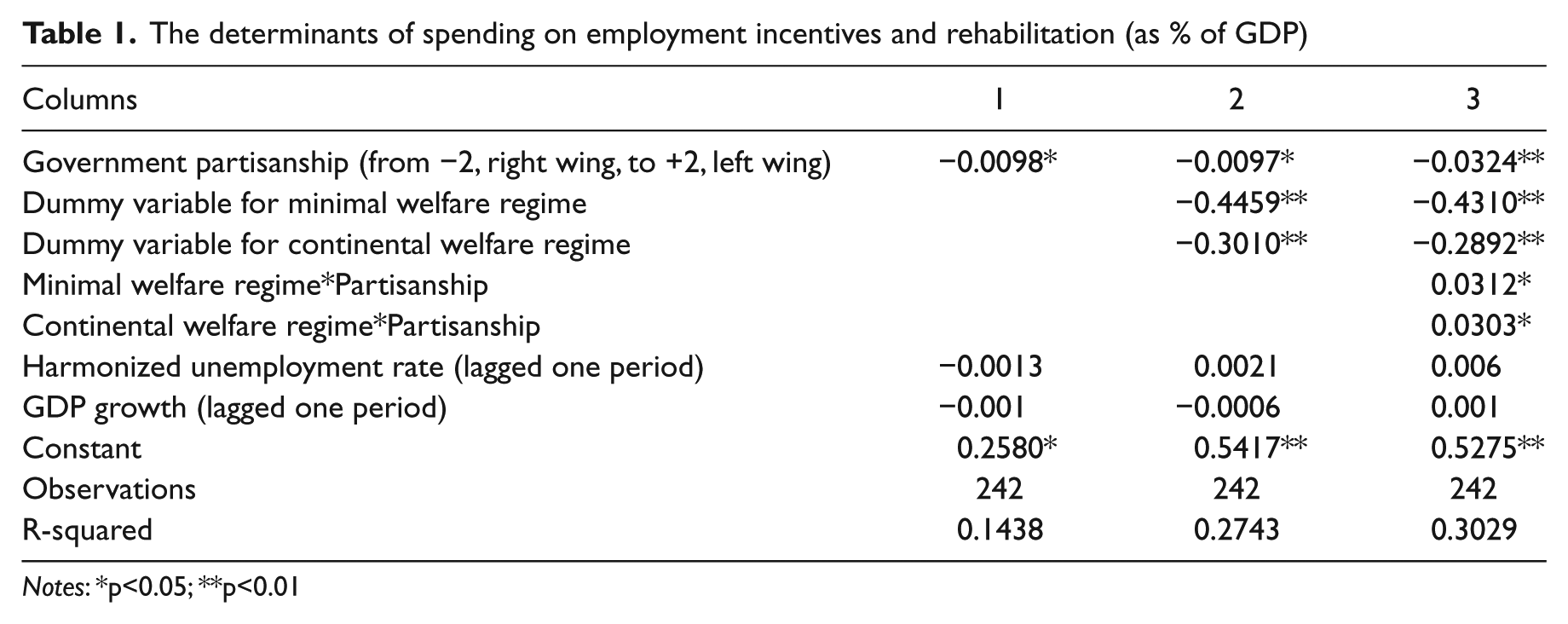
Notes: *p<0.05; **p<0.01
Results and discussion
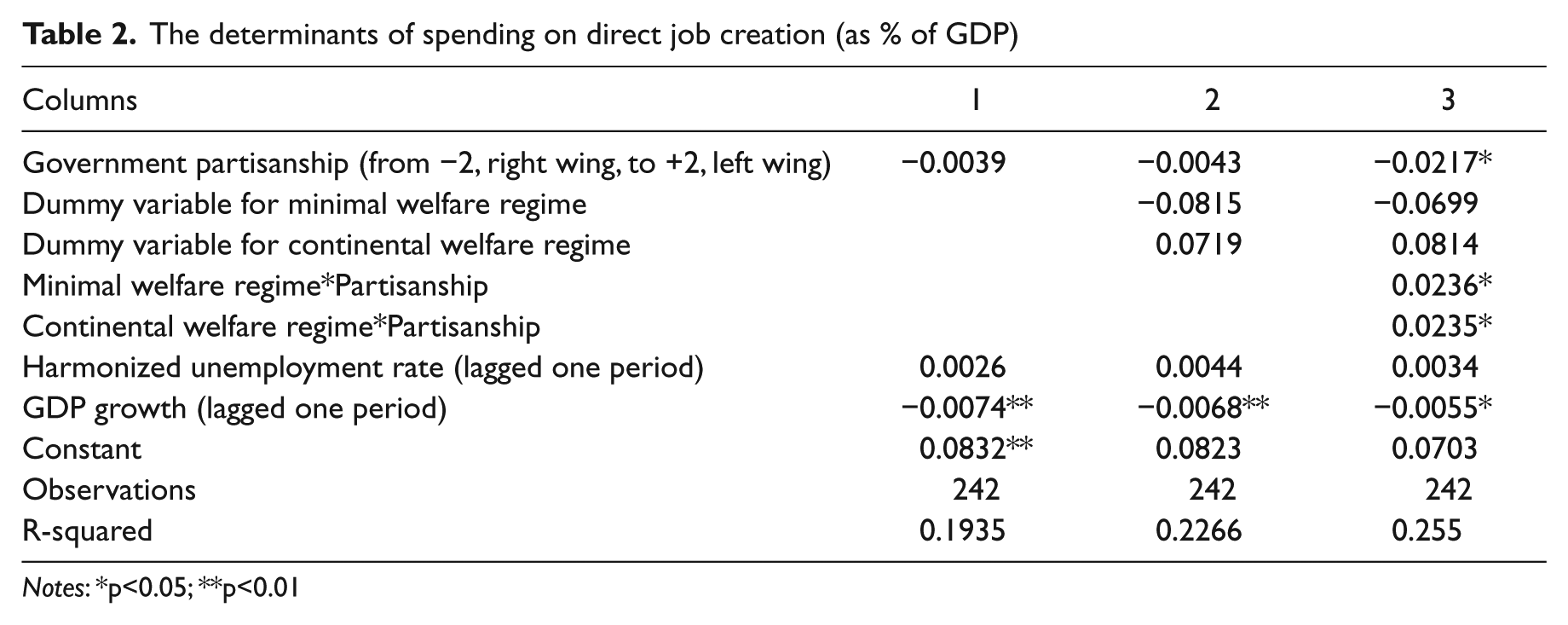
This section discusses the results of the regression analysis for each dependent variable: employment incentives and rehabilitation; direct job creation; and training. These results are broadly robust 6 and the regression was also run on total ALMPs though the results are not discussed at great length here 7 since the premise of the paper is that aggregating ALMPs is not appropriate. Note that the effect of GDP growth on the dependent variables should be interpreted with caution. Given that the dependent variables are all expressed as a percentage of GDP, there may be a spurious negative relation between GDP growth and the dependent variable. Consistent with this point, there is a significant negative relation between GDP growth and direct job creation and training (Tables 2 and 3). The effect of unemployment may provide a better proxy for this and results suggest that only training is positively related to unemployment (Table 3).
The determinants of spending on direct job creation (as % of GDP)
Notes: *p<0.05; **p<0.01
The determinants of spending on training schemes (as % of GDP)

Notes: †p<0.1; *p<0.05; **p<0.01.
The determinants of employment incentives and rehabilitation
The results for employment incentives and rehabilitation are presented in Table 1. My results suggest that the Left and spending on employment incentives and rehabilitation are negatively related. This is in line with the qualitative evidence and with the hypothesis presented earlier. This contradicts the empirical results of the power resource approach that has analysed the determinants of ALMPs. It also contradicts Boix’s (1998) contention that left-leaning governments necessarily undertake a supply side strategy, whatever its nature or the domain in which it is applied. This finding is consistent with the notion that left-wing parties will not want to spend more on employment incentives and rehabilitation because this may be neither beneficial for workers nor for the unemployed. This result is stable and significant across specification. Note that including employment protection legislation, union density, an index of wage coordination, or spending on passive labour market policies did not affect this result.
Second, the coefficients of both regimes dummies are negative and significant (columns 2 and 3). This is consistent with the notion that both Minimalist and continental welfare regimes spend less on employment incentives and rehabilitation than the Scandinavian regime. Omitting regimes might spuriously attribute the higher spending to partisanship. This is because Scandinavian countries have on average been ruled by social democrats more than in the rest of Europe.
Third, the interaction terms between partisanship and the type of welfare regime are positive and significant. This suggests that the Left in Scandinavia is indeed more negatively related to employment incentives and rehabilitation than is the case in the continental welfare regime. This finding is also consistent with Jensen’s (2010: 282) argument that ‘in countries that have a tradition of left-wing incumbency … right-wing governments compensate for the distrust of the public because of the popularity of the welfare state and strong vested interests’. As a result, there is a significant positive relation between ‘right-wing governments and social spending in traditionally left-wing countries’ (Jensen, 2010: 282). Last but not least, though significant and positive, the coefficient’s net effect of the Left in minimalist welfare regimes is not very large. This small positive coefficient is consistent with the adherence of the Left to the third way in the UK (Giddens, 1998).
The determinants of direct job creation
The results for the determinants of direct job creation are presented in Table 2. The coefficient for the minimalist welfare regime is negative but not significant, while it is positive but not significant for the continental regime (columns 2 and 3). This cannot conclusively confirm that the continental welfare regime spends more on direct job creation than the other two regimes, regardless of partisanship. However, this would be consistent with earlier qualitative evidence that shows the tendency of the continental regime to reduce labour supply. Early retirement schemes in the 1980s, for example, fulfilled such a role. The fact that the minimalist welfare regime may spend less than the other two regimes would be in line with their smaller welfare states.
Moreover, as shown in columns 1 and 2, the coefficient for partisanship is not significant. However, in the fully specified model (column 3) the power of the Left does have a significant negative coefficient in Scandinavia. This means that left-wing parties in Scandinavian countries are associated with less spending on direct job creation. By contrast, the impact of the Left in Minimalist and continental welfare regimes is significant and positive. Both results are in line with the hypothesis that in the continental welfare regime left-wing parties will favour direct job creation.
It is important to recall that ALMPs are targeting spending at the unemployed. In Scandinavia, a large and expanding public sector may have played the role of direct job creation in the continental regime. Iversen and Cusack (1998) have argued that the large public sector in Scandinavia made it possible for them to achieve the twin objective of employment and equality. Thus, while left-wing parties will not support employment incentives and rehabilitation, these results show that left-wing parties will not oppose all ALMPs in all regimes. Contrary to Rueda’s (2007) findings, the Left does support some ALMPs, provided that this does not hurt employed labour.
The determinants of training schemes
The results for spending on training schemes are presented in Table 3. First and foremost, the coefficient of partisanship is not significantly related to training schemes, regardless of the specification. Thus, spending on training schemes is not driven by the power of left-wing parties. This contradicts Boix’s (1998) argument that left-wing parties will necessarily spend more on training as part of a broad supply side strategy. It is prima facie consistent with Rueda’s (2007) findings that social democratic parties do not matter.
A second reason is that the welfare regime could itself fully determine the amount spent on training. This is partly consistent with our results. Indeed, the coefficient of the dummy variable for the continental welfare regime is negative and significant. Moreover, the coefficient of the dummy variable for the minimalist welfare regime is much more negative than that of the continental welfare regime. Thus, the Scandinavian welfare regime spends, all other things being equal, more than the continental welfare regime, which spends more than minimalist welfare regimes. This is in line with the expectation that training should be higher in CMEs than in liberal market economies.
The differences of effects between Scandinavian and continental welfare regimes require more explanation. The continental regime encompasses economies such as France that are in fact closer to being a mixed market economy (MME) than a fully coordinated market economy. Training may hence be less important in MMEs than in CMEs, which is then captured by differences in the results for Scandinavian and continental regimes. Another possibility is that differences in the way training systems are organized within CMEs has implications for the amount of spending that is channelled towards training the unemployed. While Scandinavian CMEs such as Sweden and Norway rely on vocational colleges, continental CMEs rely instead on the dual apprenticeship system (Estevez-Abe et al., 2001: 170, 171). If much more of the training in continental CMEs is provided privately by the firm, this may explain why public spending on training for the unemployed may be lower than in Scandinavia.
Conclusion
Despite significant insights, the comparative political economy literature has produced competing theoretical expectations concerning the role of partisanship in driving spending on ALMPs. While attempting to solve this puzzle, this paper has made four points. First, drawing on qualitative evidence in the welfare state literature, this paper contributes to this debate by arguing that ALMPs have distinct political determinants. The question for comparative political economy should therefore be what is driving spending on different types of ALMPs, rather than on aggregate spending on ALMPs.
Second, I argue that the importance of welfare regimes has been overlooked in existing studies of ALMPs. The findings confirm this contention: the Scandinavian welfare regime spends more on employment incentives and rehabilitation. Scandinavian and continental welfare regimes also spend more, all other things being equal, on training schemes than do minimalist welfare regimes, in line with the notion that training may be less central to their production regimes.
Third, the findings of this paper concerning employment incentives and rehabilitation contradict both the traditional power resource theory and the argument advanced by Boix (1998). Left-wing parties spend less on employment incentives and rehabilitation than other parties, because of the adverse effects these programmes may have on workers. This invalidates the implicit claim in the welfare state literature that ‘more is better’. As a result, more welfare state spending may not always be driven by the strength of labour. What is more important is that this negative relation is even stronger in Scandinavia. In other words, a shift to the left in Scandinavia is associated with a greater fall in employment incentives and rehabilitation than in continental Europe.
Fourth, Left-wing parties are positively associated with direct job creation in the Continent and negatively associated with these policies in Scandinavia. This is an important result in at least three respects. It confirms, using regression analysis, that different ALMPs have different partisanship dynamics, in line with what Bonoli (2010) argued through qualitative methods. It also suggests that parties of a similar ideology may behave in opposite ways in different welfare regimes. For instance, the ability of Scandinavian left-wing parties to expand standard public employment may explain why they do not spend more on direct job creation.
Moreover, this result shows that, contrary to what Boix (1998) argues, supply side policies are not the only arena where meaningful partisan differences remain. Direct job creation is a classic demand management policy tool. The evidence presented in this paper shows that left-wing parties do spend more on direct job creation. In addition, Rueda (2007) argued that social democratic parties do not spend more on ALMPs because these programmes do not benefit their core constituents. On the contrary, this paper demonstrates that social democrats do spend more on some ALMPs, provided that these are in line with the interests of both outsiders and insiders.
This paper suggests further research into the political economy determinants of different ALMPs may prove fruitful. It also raises the possibility that left-wing parties may have vastly different preferences for distinct welfare state policies. These preference may also be contingent on the institutional setting in which these parties operate. While this paper focused on showing that even with a simple operationalization of welfare regimes the effect of partisanship on distinct ALMPs may differ, more research would be instrumental in investigating which characteristics of welfare regimes drive this process.
In addition, a question that was not investigated here concerns the possibility of changing social democratic positions towards ALMPs over time. For instance, the emergence of the ‘Third way’ entails a greater reliance on market mechanisms to reach social objectives. Considering the case of employment incentives and rehabilitation and comparing the period 1990–1998 with that of 1999–2007 does indeed suggest this may be a worthwhile avenue for further research. 8 Similarly, this paper did not analyse systematically the relationship between disaggregated ALMPs and passive labour market policies (PLMPs) or with activation of labour market policies. The results (not reported here for reasons of space) show that there is a positive relationship between all types of ALMPs and PLMPs, suggesting that these policies seem to be complements rather than substitutes. Further research concerning the relation of different ALMP measures with more qualitative aspects of activation would prove valuable. 9
Footnotes
Appendix
Country-specific average spending on different ALMPs
| Country | Direct Job Creation | Employment incentives and rehabilitation | Training |
|---|---|---|---|
| Austria | 0.0335 | 0.0678 | 0.2165 |
| Belgium | 0.5000 | 0.2539 | 0.1604 |
| Denmark | 0.0464 | 0.7200 | 0.5300 |
| Finland | 0.2652 | 0.1817 | 0.4061 |
| France | 0.2170 | 0.2000 | 0.3626 |
| Germany | 0.2043 | 0.1796 | 0.4000 |
| Greece | 0.0023 | 0.0618 | 0.0695 |
| Ireland | 0.3213 | 0.0622 | 0.3826 |
| Italy | 0.0233 | 0.1650 | 0.2189 |
| Netherlands | 0.1487 | 0.6035 | 0.1778 |
| Portugal | 0.0322 | 0.1509 | 0.1878 |
| Spain | 0.0887 | 0.2017 | 0.1548 |
| Sweden | 0.1991 | 0.8283 | 0.6148 |
| UK | 0.0435 | 0.0270 | 0.1670 |
Acknowledgements
Useful comments on earlier versions of the paper were received at the Recwowe Workshops hosted by the IDHEAP in Lausanne and the Sciences-Po College in Menton, the European Institute Lunch Seminar and various Political Economy Workshops at the LSE. I am also grateful to Marco Simoni, Bob Hancke, Vassilis Monastiriotis, Giulano Bonoli, David Rueda, David Marsden, Moira Nelson, Lane Kenworthy, Daniel Clegg and John Stephens for comments on previous versions. Last, I would like to thank four anonymous reviewers for very constructive criticisms and helpful suggestions.