



Abstract
This study aimed to determine the level of ICT self-efficacy among librarians working in the Libraries of Aligarh Muslim University Library System (AMULS). A structured questionnaire was used to conduct a quantitative survey. One of the researchers visited the Maulana Azad Library, Faculty and College Libraries, Departmental and Seminar Libraries, and School Libraries and distributed the questionnaire to librarians. On the other hand, librarians of the AMU regional centers’ libraries were contacted through email to complete the survey form. Of the 123 questionnaires distributed to the librarians, 102 questionnaires were received with an 82.9% response rate. Librarians mostly view ICT as having a positive impact on library operations and services. The majority of librarians are skilled in using basic ICT applications. However, they lack the necessary skills to manage ICT-based library operations and services. Inadequate ICT application training and a lack of ICT infrastructure were cited as significant barriers to librarians obtaining ICT skills. This is the first study to examine ICT self-efficacy among librarians in an Indian university. Its findings could aid in the development of strategies for integrating new technologies into libraries.
Introduction
The emergence of Information and Communication Technology (ICT) in recent decades has transformed or tailored the work responsibilities of most professionals, including librarians and information managers. ICT is the convergence of electronics, computing, and telecommunications used to collect, store, process, transmit, exchange, and present information (UNESCO Institute of Statistics, 2009). ICT includes, among others, the computer, Internet, wireless networks, cell phones, and other communication media.
The convergence of different technologies demonstrates that knowledge and skills in using these diverse technologies are becoming highly significant for librarians and information professionals. Previous research identified several ICT skills and qualifications as essential for librarians and information professionals (Kamba, 2011). LIS professionals require skills in software applications (OS, Office, etc.), library automation systems, digital collections, database designing, creation and maintenance of digital libraries or institutional repositories, programing, software, hardware technology evaluation, and other aspects of ICT. As a result, librarians are expected to learn and improve their ICT skills to keep up with the current technological advancements. According to Bosque and Lampert (2009), there are two types of new librarians: (i) those who have a high level of technical competence, typically from a previous job in a technology-related area and (ii) those who struggle with technology. Those who struggle with technology wish that their library school provided more hands-on opportunities for technology learning than theoretical applications.
The Cambridge Dictionary defined “self-efficacy” as “a person’s belief that they can be successful when carrying out a particular task” (Cambridge University Press, 2021). However, perceived self-efficacy, according to Bandura (1995), refers to “the belief in one’s capabilities to organize and execute the courses of action required to manage prospective situations” (Bandura, 1995: 2). Stronger self-efficacy beliefs are linked to positive outcomes because they allow learners to view challenging tasks, resulting in a strong interest in and dedication to the activity and overcoming failures (Lee and Johnston-Wilder, 2017).
ICT self-efficacy refers to a person’s belief in their ability to use technology, and it plays an integral part in ICT adoption and usage decisions (Compeau and Higgins, 1995; Papastergiou, 2010). Meanwhile, ICT self-efficacy is an individual’s belief in their capacity to use ICT, and it plays a positive and substantial impact on ICT adoption and usage decisions (Compeau and Higgins, 1995; Papastergiou, 2010; Torkzadeh et al., 2006). While self-efficacy pertains to an individual’s competence in specific areas, ICT self-efficacy concentrates on a person’s self-perception of managing software and the Internet using specialized computer skills and knowledge (Compeau and Higgins, 1995).
The Aligarh Muslim University (AMU) is one of the most well-known educational and social institutions in contemporary India’s academic and social history, situated in Uttar Pradesh. It was founded in 1920 by a law of the Indian Legislative Council and quickly achieved the status of Central University. AMU has a world-class Central Library System, namely AMU Library System (AMULS), managed by 140 librarians (including chief librarian, deputy librarians, assistant librarians, information scientists, professional assistants, and semi-professionals assistants). AMULS consists of a Central library, that is, Maulana Azad Library (MAL), eight faculty/college libraries, 36 departmental/seminar libraries, five school libraries, and three AMU regional centers’ libraries (Murshidabad, Malappuram, and Kishanganj).
The AMULS plays a crucial role in achieving the primary goal of AMU by providing ICT-based services to its students, teachers, and researchers. AMULS has adopted various ICT-based applications for managing effective and efficient services. Significantly, all the libraries under AMUSU are maintaining their computer labs with high-speed Internet connectivity for their users. The MAL has developed a Digital Resources Centre where more than 100 computers of the latest configuration are installed to access e-resources subscribed by the university library. AMULS is fully automated with Libsys integrated library management software, which connects more than 5000 computers with its faculty/departmental/school libraries server within the university and its centers (Maulana Azad Library, 2021). Almost all the modules of Libsys software (acquisition, cataloging, circulation, serials, and OPAC interface) are being used. It also offers the facility of issuing and returning books through the latest barcode technology. Besides these, it also developed its Institutional Repository using DSpace institutional repository software to provide worldwide access to the publications produced by the university, mainly in the form of theses and dissertations. The AMU library provides remote login access to its faculty and students via OpenAthens, allowing them to access e-resources outside the campus (Maulana Azad Library, 2021).
ICT-based tools and services are being used in libraries to efficiently organize materials and fulfill users’ needs. The adoption of ICT in libraries has resulted in significant improvements in library operations and services (Kaur and Gaur, 2017; Kude, 2016). The primary ICT skills required to manage ICT-based library operations and services include handling operating systems, application software packages, databases, programing, web page design, library automation software, and technical and managerial skills. Various studies have substantiated the impact of ICT in different fields. However, a literature review shows a scarcity of research regarding ICT skills as a predictor of enhanced library services. Therefore, this study investigates the ICT self-efficacy level among librarians working in the AMULS.
Statement of the problem
Today, libraries have undergone significant transformations due to technological advancements. The functional operations and services of libraries have been revolutionized by ICT. In this context, Ahmed and Rehman (2016) stated that academic librarians should possess adequate ICT skills to overcome them and maintain control over the library services in this new environment. Against this backdrop, some questions arise: what are the basic ICT skills possessed by the academic librarians practicing in libraries of the Aligarh Muslim University Library System? (AMULS?) Do librarians have adequate skills for working on library management and institutional repository software along with their managerial skills for handling digital information? What are their attitudes toward the impact of ICT on library operations and services? However, there is a concern about measuring the degree of ICT adaptation among the librarians working in the AMULS.
Research objectives
The study aimed to assess the ICT self-efficacy level among librarians in academic libraries, particularly in AMULS. However, to achieve the aims of the study, the following research objectives have been identified:
Review of literature
ICT self-efficacy in context with librarianship
ICT skills are defined as the overall knowledge and capability required to handle various library operations and locate, manage, organize, retrieve, and disseminate technology-based digital and online information services in a library context (Selwyn, 2009; Sreenivasulu, 2000). According to Bansode and Viswe (2017), many academic libraries embrace digital technologies and resources due to rapid technological advancements. Libraries are now allocating greater space to ICT-related facilities and services based on their infrastructure. Academic libraries also use ICT in their housekeeping operations and provide automated circulation and online digital reference services (Ayoku and Okafor, 2015).
Requirements of ICT skills among librarians
Mani et al. (2019) emphasized the need for librarians to stay updated with technology changes. Furthermore, Okeji et al. (2019) stated that “the challenging work they undertake in university libraries necessitates a certain level of digital skills from library professionals to handle the changing landscape of information and information technology and services.” Fakkirappa and Naik (2013) asserted that LIS professionals and subordinate staff must acquire essential ICT skills and library management skills in line with technological advancements. To put it another way, the skills of librarians must be compatible with the technology infrastructure. According to Raju (2014), academic librarians need knowledge and skills in digital library development and software handling, technical support, quality standards, HTML coding, web mark-up languages such as SGML and XML, and, to a lesser extent, programing and scripting languages.
Mazumdar (2007) emphasized that librarians should embrace ICT applications in libraries and be acquainted with the relevant technological, administrative, communication, and preservation skills to provide online and web-based library services to distanced users. According to Gireesh (2013), librarians must be equipped with the requisite ICT skills to achieve the desired results from technology.
Assessment of librarians’ ICT skills
Several researchers have conducted studies on ICT skills among librarians and information professionals worldwide. ICT skills among librarians at Nigerian university libraries were assessed by Ayoku and Okafor (2015). According to the findings of their study, although many of the respondents had knowledge of and skills in utilizing email and word processing, still, they lacked expertise in search engines and directories, catalogs, e-resources, database management, web design, and enabling technologies. Iqbal and Khan (2017) looked into the level of ICT competence among Pakistani librarians. According to their findings, most respondents were computer literate, with a strong comprehension of library automation, digitization, and web-based services such as email, search engines, chat rooms, e-resources, and online public access catalogs. However, the majority of them were unfamiliar with programing languages. Mani et al. (2019) examined ICT knowledge and understanding among library professionals in Tirunelveli district, Tamil Nadu, India. According to their findings, librarians must focus on training in ICT-related tools due to an increasingly automated environment. It was critical to receive training on operating the library’s software. Their findings also show that training on using the library’s software, providing hardware and software, and a subscription to electronic databases is essential.
Ahmed and Sheikh (2021) evaluated the ICT skills of librarians at university libraries in Punjab, Pakistan, to predict improved library services using ICT applications. The independent variables were computer skills, information storage skills, information retrieval skills, and online utility software skills, whereas the dependent variable was a construct measuring library performance. The regression model shows that ICT skills have a slightly high explanatory power for improved library services, implying that librarians’ greater ICT competency is necessary for enhanced library services. Furthermore, the beta coefficient shows that information retrieval skills significantly improved library services compared to the other three ICT skills. The study concludes that ICT skills are necessary for enhanced library services and professional librarian growth. Dzandu and Dadzie (2012) conducted a study in Ghana at six different institutions. Their research demonstrates that researchers’ usage of ICT apparatuses, resources, and services significantly impacts their research activities and work performance. Buarki et al. (2011) discovered that ICT applications in the libraries of Kuwait have numerous flaws, although having ample resources. The leading cause of this inadequacy was identified as a lack of training for LIS professionals in computer applications. According to Ahmed and Rehman (2016), university library professionals in Khyber Pakhtunkhwa, Pakistan, should have adequate ICT infrastructure and supportive training programs. In their study, Ahmed and Yesmin (2019) illustrate that the University Grants Commission of Bangladesh’s training program improved university librarians’ IT skills by addressing their inadequacy. Ugwuanyi (2009) assessed the ICT competencies among librarians and the training methods most commonly used by academic librarians to acquire ICT competencies in Enugu state. Even though most respondents are computer literate, the survey discovered that ICT literacy among academic librarians is inadequate. Formal education, informal education, peer support, workplace training, and attendance at workshops/seminars were all beneficial in acquiring ICT skills. However, in a study of librarian training needs for digital library projects, Ugwu and Ekere (2010) discovered that competency-based training approaches are more significant than formal training in skill acquisition for digital library projects.
The ICT skills of librarians at the University of Delhi, India, were investigated by Bajpai and Madhusudhan (2019). According to their findings, most librarians possessed a basic understanding of ICT. They were, however, lacking competence in the use of operating systems and library software. Based on the findings, the study recommends that librarians acquire ICT-related skills to deliver efficient library services. Kumar (2013) looked at the existing ICT competencies of librarians in the Indian state of Andhra Pradesh. The respondents knew online services and facilities, such as email, online LIS groups, networks, and blogs. Still, they were less knowledgeable about technical skills such as OCR and imaging technology. Inadequate infrastructural facilities and a lack of management backing were the significant barriers to these librarians acquiring ICT skills. Mathew and Baby (2012) found a moderate level of ICT skills and interest in applying emerging technologies among the young library professionals to deliver ICT-based library services to users in university libraries in Kerala. Although librarians have a positive attitude toward ICT applications and their use in delivering library services, Oza and Mehta (2018) noted that most librarians do not have the opportunity to develop their skills and competencies in their allotted work. However, most librarians at Autonomous Engineering College Libraries in Karnataka had excellent knowledge of various emerging technologies (Rathna and Divyananda, 2018). Bansode and Viswe (2017) also observed good ICT skills among librarians working in university libraries in the Marathwada region to manage the ICT-based library services.
Impact of librarians’ ICT self-efficacy on ICT-based library operations and services
Arilesere et al. (2020) investigated librarians’ computer self-efficacy and barriers to efficient ICT use in service delivery in three public universities in Ogun State, Nigeria. The findings revealed that printers, photocopiers, and computer systems were operational and used to deliver services such as circulation, electronic resource access, and email. Academic librarians have a modest level of computer self-efficacy, with the main challenges being insufficient budget, irregular power supply, and inadequate bandwidth. In Nigeria, Uwaifo (2010) conducted a study investigating computer self-efficacy as a predictor of ease of use in librarians’ everyday activities. This study shows that most respondents were confident in their computer skills. There was a significant positive association between self-efficacy and the usage of computer-based libraries by library staff. Bronstein and Tzivian (2013) looked at Israeli librarians’ self-efficacy perceptions of their information retrieval skills and the correlations between self-efficacy perceptions and socio-demographic variables. According to the findings, participants reported a high level of self-efficacy in information retrieval, and all four sources of self-efficacy information influenced the construction of self-efficacy beliefs. Self-efficacy information affects men and women differently; women reported a higher score for affective emotions, while men are more prone to frustration. There was also a relation between age and years of experience and the most impacted the participants. Participants who were older and more experienced stated their mastery experiences and affective states had a more significant effect. Participants in their mid-career reported that social feedback had a higher impact on their self-perception of self-efficacy. Alahakoon and Somaratne (2020) investigated the factors influencing ICT self-efficacy among Sri Lankan HSS undergraduates. The findings revealed that students with a low ICT self-efficacy and an average level of anxiety frequented the library “infrequently.” The most significantly associated elements in the study were ICT anxiety and ICT Self-efficacy. However, the gender was largely diluted and not correlated with self-efficacy. The study proposed adopting extensive library support and ICT training to reduce higher ICT anxiety levels and promote ICT self-efficacy among students.
Mahanta (2016) noted irregular training programs on ICT applications and lack of authority support as the main reasons behind librarians’ low awareness of digital literacy, cloud library, library automation, and digital library packages in the different institutions of Assam. In a study, Seena and Pillai (2014) found that the lack of authority support and librarians’ low competencies lead to poor adaptation of ICT in the Kerala University Library System. Similar obstacles were observed by Sankari and Chinnasamy (2014) in their study while identifying the ICT skills among librarians in engineering colleges in Salem and Namakkal Districts of Tamil Nadu.
Methodology
The researchers reviewed the relevant literature on ICT self-efficacy among librarians working in various libraries. Researchers depended on the quantitative study based on the survey method to seek the answers to research questions.
Sample
The total population includes 140 librarians (including chief librarian, deputy librarians, assistant librarians, information scientists, professional assistants, and semi-professionals assistants) working in the AMULS on a regular and contractual basis. Other categories of para-professionals (library attended, bookbinder, library clerk, etc.) were excluded. During the survey, around 17 staff members were on leave. Thus, the sample for this study comprised 123 librarians (87.8% of the total population).
Data collection instrument
A questionnaire was used as the data collection instrument. Items in the questionnaire were grouped into five sections. Section A aimed to gain basic information such as the employee’s name, gender, age, qualifications, designation, and length of experience. Section B aimed at exploring the perception of the impact of ICT on library operations and services. Section C was to examine the ICT self-efficacy level among academic librarians. Section D was about how academic librarians have acquired ICT skills. Section E was about identifying the barriers to acquiring ICT skills to handle ICT-based library systems and services.
The authors developed a scale to assess the perceptions of librarians about the impact of ICT on library operations and services, as well as their ICT self-efficacy level, based on previous research and findings from qualitative studies (Ahmed and Rehman, 2016; Haneefa and Shukkoor, 2010; Musharraf et al., 2019; Okeji et al., 2019; Seena and Pillai, 2014). The ICT self-efficacy scale includes basic ICT self-efficacy, (ii) self-efficacy in ICT-based library operations, and (iii) self-efficacy in ICT-based library services. The items related to self-efficacy in ICT-based library operations were further divided into three parts: (i) self-efficacy in library automation, (ii) self-efficacy in a digital library or institutional repository, and (iii) self-efficacy in e-resource management. Perception and self-efficacy scores are measured on a 5-point Likert scale ranging from 1- “Strongly Disagree” to 5- “Strongly Agree,” and 1- “Not Confident At All” to 5- “Completely Confident” respectively.
A draft questionnaire was designed and circulated to 20 librarians from the sample population for pilot testing of the data collection instrument. It was discovered that librarians were acquainted with all of the items about various areas of ICT skills. A few of them have suggested that the scale include some more items. The data collection instrument was thus modified in response to the suggestions.
Data collection procedure
Respondents were approached at their respective workplaces. They were briefed about the objectives of the study, and verbal consent was taken. A questionnaire composed of the measures described above was administered to respondents. One of the authors visited the libraries and distributed the final questionnaire to librarians between January and February 2020. Notably, the libraries of the regional centers (Murshidabad center, in the State of West Bengal; Malappuram center, in the State of Kerala; and Kishanganj center, in the State of Bihar) were, however, sent the softcopy of the questionnaire through email. Of the 123 questionnaires distributed to the sample population (including those who had participated in pilot testing of the data collection instrument), 102 filled questionnaires were received with an 82.9% response rate. Of the 102 questionnaires, 42 were obtained from the MAL, 18 from the Faculty/College Libraries, 35 from Departmental/Seminar Libraries, and two from the libraries of the regional centers (Murshidabad and Kishanganj), four from school libraries and one from other libraries.
Measure
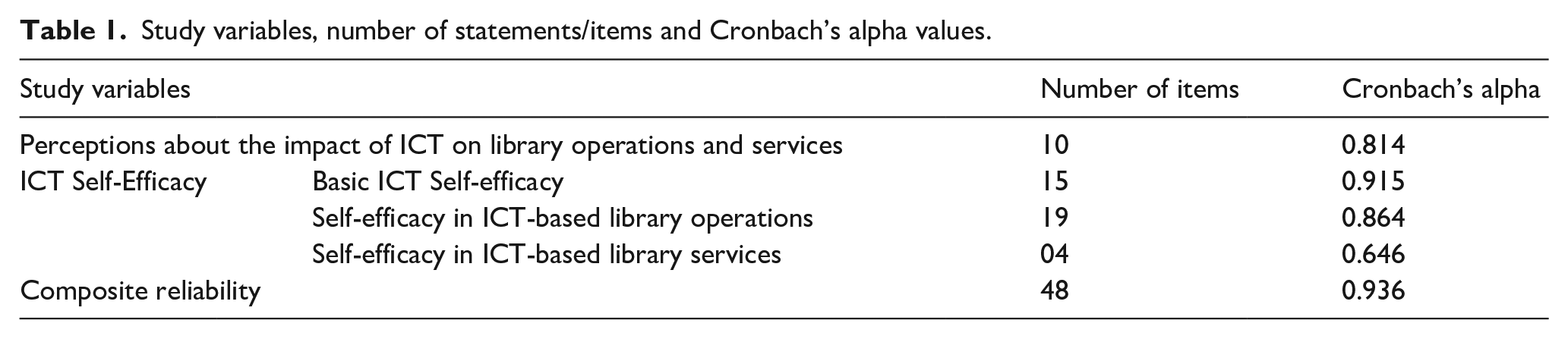
Descriptive and inferential statistics were used to analyze data and draw inferences. Pearson Correlation and Simple Linear Regression was conducted to analyze the relationship and impact of ICT Self-Efficacy on Library operations and services using statistical software package namely SPSS (Version 23). The reliability of data was verified using Cronbach’s alpha reliability analyses. Cronbach’s alpha is a measure used to assess the reliability or internal consistency of a set of scale or test items. As shown in Table 1, Cronbach’s alpha reliability coefficients for “perceptions about the impact of ICT on library operations and services” (α = 0.814), “basic ICT self-efficacy” α = 0.915), “Self-efficacy in ICT-based library operations” (α = 0.864), “Self-efficacy in ICT-based library services” (α = 0.646) were all relatively high indicating that items in each set were positively correlated. The composite reliability of the scale was α = 0.936. Cronbach’s alpha values of α = 0.7 to α = 0.10 are considered highly reasonable and acceptable.
Study variables, number of statements/items and Cronbach’s alpha values.
Demographic profile of respondents
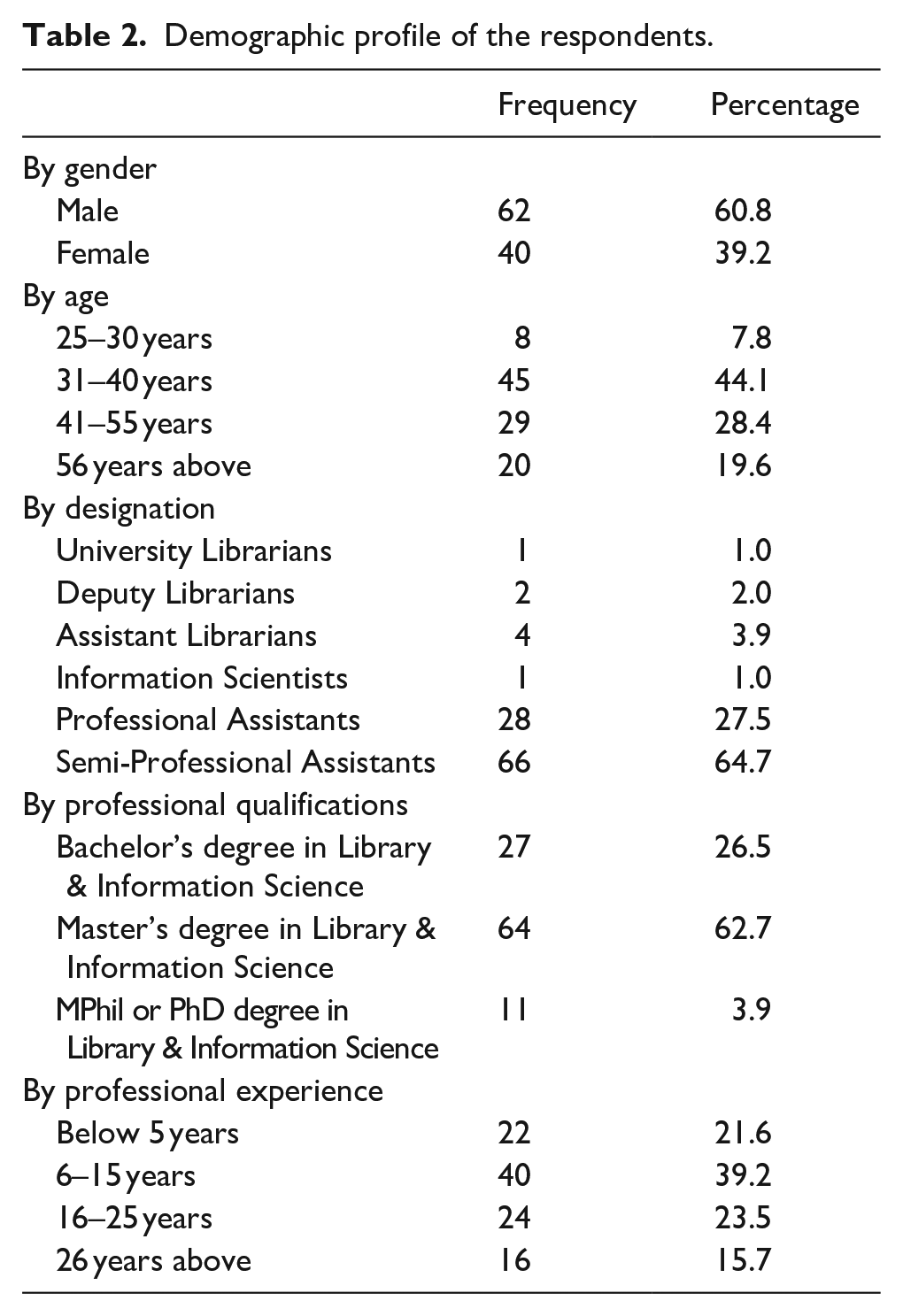
Out of the total respondents, 60.8% (n = 62) were male, and 39.2% (n = 40) were female. Out of the total of 102 respondents, 64.7% (n = 66) were Semi-Professional Assistants, 27.5% (n = 28) were Professional Assistants, 3.9% (n = 4) Assistant Librarians, 2% (2) Deputy librarians and one Information Scientist and University Librarian each. Their length of working experience was between less than 5 years to more than 26 years. However, most respondents (61.7%) had 6–25 years of working experience. In terms of the level of education, the majority of the respondents (62.7%) had a Master’s in Library and Information Science as the highest degree, 26.5% had a bachelor’s in Library and Information Science as the highest degree, and the remaining 10.8% had MPhil or PhD degree. Table 2 illustrates the demographic profile of the respondents.
Demographic profile of the respondents.
Results
Perceptions about the impact of ICT on library operations and services
Respondents were asked to indicate their opinion on a five-point Likert scale (where one represented “Strongly Disagree” and five represented “Strongly Agree”) to learn about librarians’ perceptions of the impact of ICT applications on library operations and services. As shown in Table 3, most respondents (n = 86, 84.3%) either agreed or strongly agreed that using ICT in libraries improves the speed of technical processing and makes documents available faster to the end-users. Interestingly, a huge number of respondents strongly agreed or strongly agreed with the statements that ICT improves quick access to library resources and services (n = 90, 88.2%); enhance the knowledge and skills of library professional (n = 93, 91.2%); reduces the workload of library professionals (n = 86, 84.3%); helps to offer improved resource sharing among member libraries (n = 89, 87.2%); improves the prestige and visibility of the library (n = 79, 77.4%); increases the job satisfaction of Library professional (n = 84, 82.3%); and improves the overall quality of library services and facilities (n = 84, 82.3%). However, many respondents rated neutral to the variable that using ICT in libraries reduces the number of LIS professionals/non-professional staff required. Therefore, the result sketched that librarians have positive attitudes toward the impact of ICT applications on library operations and services of the library.
Librarians’ perceptions about ICT and its impact on library operations and services.
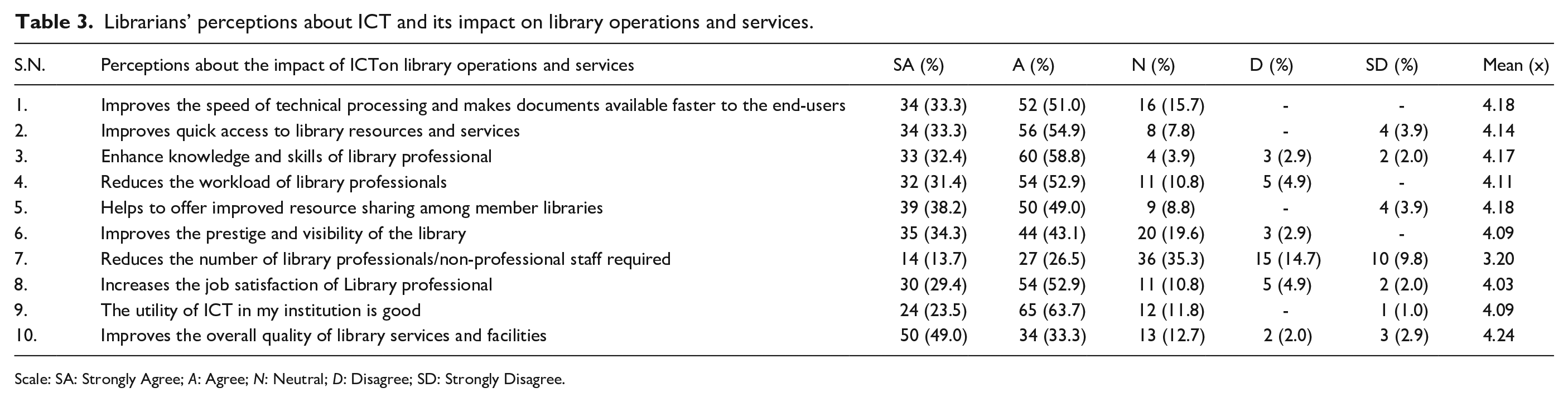
Scale: SA: Strongly Agree; A: Agree; N: Neutral; D: Disagree; SD: Strongly Disagree.
Basic ICT self-efficacy
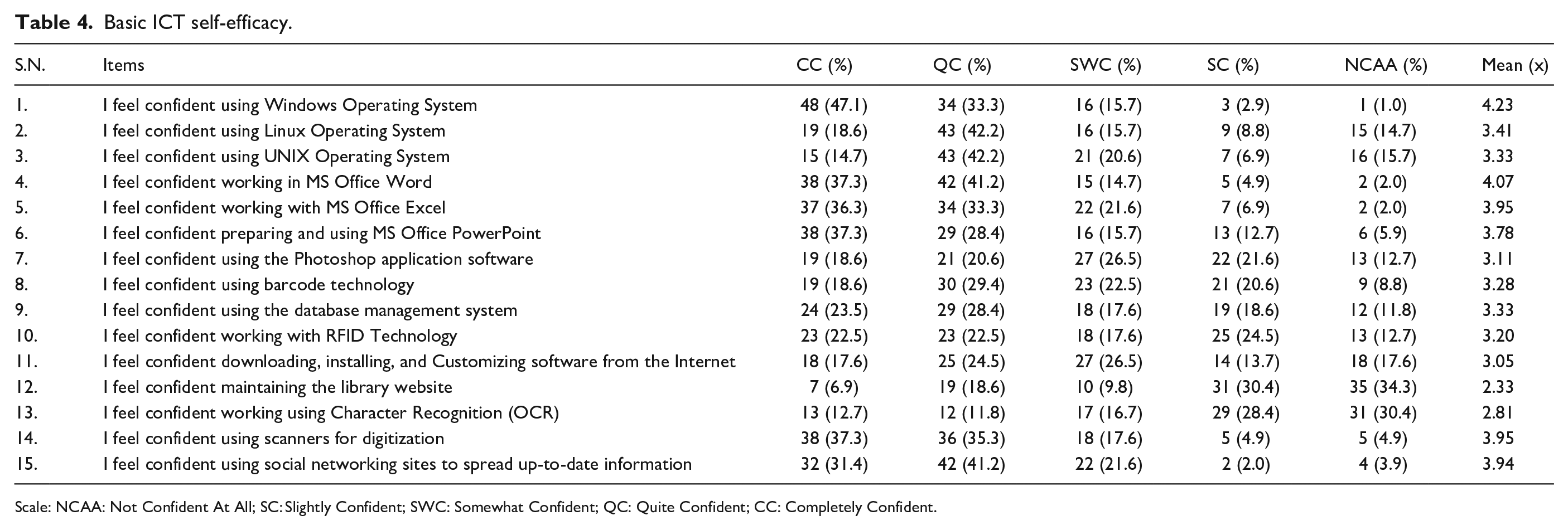
The library professionals were asked to rate their confidence level in using different ICT applications, software, and devices on a five-point Likert Scale, where one was for “Not confident at all” and 5 for “Completely confident.” Means were calculated for all items, and the average mean scores are shown in Table 4.
Basic ICT self-efficacy.
Scale: NCAA: Not Confident At All; SC: Slightly Confident; SWC: Somewhat Confident; QC: Quite Confident; CC: Completely Confident.
According to their responses, most academic librarians have quite or complete confidence in utilizing the Windows operating system (n = 82, 80.4%) while having quite a confidence and somewhat confidence in their knowledge of how to use Linux and UNIX operating systems. Majority of respondents felt quite or complete confident in using Microsoft Office applications such as Word (n = 80, 78.5%), Excel (n = 71, 69.6%), and PowerPoint (n = 67, 65.7%).
A good number of respondents felt quite confident and somewhat confident in using barcode technology (n = 53, 51.9%), photoshop (Image editing) application (n = 49, 48.1%) and installation and customization of software (n = 52, 51%). Additionally, most respondents felt completely confident and somewhat confident in the database management system (n = 53, 51.9%) and document scanning and digitization process (74, 69.6%). Respondents felt slightly confident in maintaining library websites (Mean 2.33). However, academic librarians seemed well aware of the importance of using social networking sites (SNSs) for disseminating current information to their users, educators, and peers. Many respondents had good knowledge of SNSs (n = 74, 72.6%) and their use in library services. The overall assessment of the results shows that respondents are mostly confident using and working with basic ICT applications.
Self-efficacy in ICT-based library operations
The items relevant to ICT-based library operations were classified into three subcategories to measure the level of self-efficacy: (i) self-efficacy in library automation, (ii) self-efficacy in digital library and institutional repository, and (iii) self-efficacy in e-resource management.
Self-efficacy in library automation
Respondents were asked to rate their confidence level in handling various modules of the Libsys (Integrated Library Management Software) that the library is currently using. As shown in Table 5, most respondents (n = 86, 84.3%) felt wholly confident and quite confident working on the cataloging module (including MARC21 edition, maintaining titles in the process, catalog searching, editing, and stock counting). However, a significant number of respondents (n = 62, 60.8%) felt quite confident and somewhat confident working on the circulation module (including lending operations, membership records keeping, printing bar-coded, creating ID cards, monitoring overdue items, and fine management). When asked about handling other modules like acquisition (Ordering, invoice processing, order follow-up, budgeting, and expenditure analysis), serials control (Subscription management, invoice processing, and managing e-journals), and OPAC interface (Advance Boolean operators-based search, online book reservations/renewal, etc.), more than 50% of respondents opined that they felt not confident at all and slightly confident.
Self-efficacy in library automation.
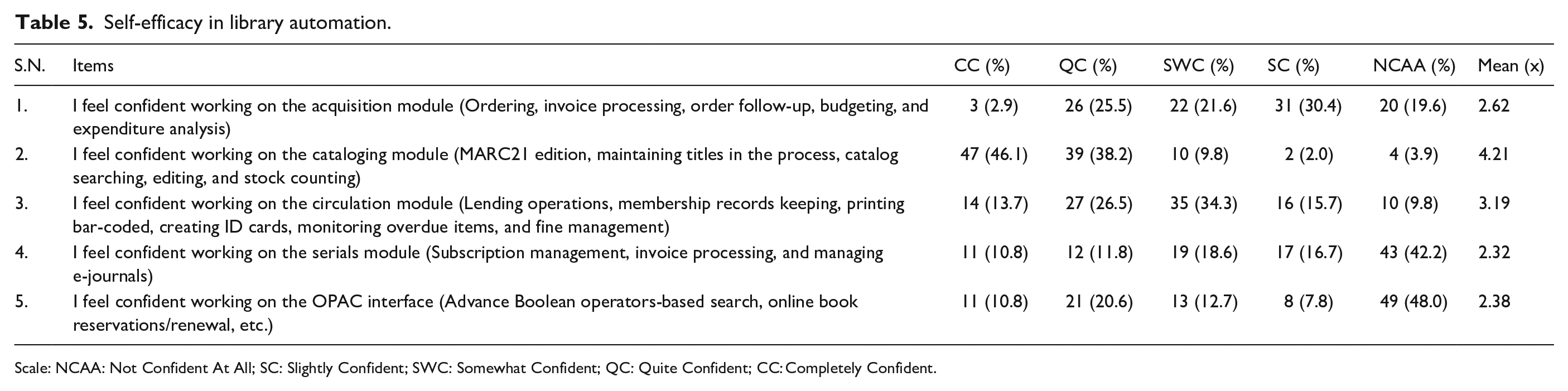
Scale: NCAA: Not Confident At All; SC: Slightly Confident; SWC: Somewhat Confident; QC: Quite Confident; CC: Completely Confident.
Self-efficacy in a digital library or institutional repository
To make library resources accessible to the users beyond the physical boundaries, libraries build digital collections by creating digital libraries or institutional repositories. However, working knowledge of digital library software is required to build digital libraries or institutional repositories. As the DSpace (digital library software) is being used in MAULS, the respondents were asked to rate their confidence level using various DSpace software functionalities. The majority of respondents (n = 74, 72.5%) reported a low level of confidence in a digital library or institutional repository software, rating themselves as not confident at all and slightly confident in downloading, installing, and customizing the DSpace institutional repository software; creating communities and sub-communities in DSpace (n = 63, 61.7%), and; uploading institutional research works using DSpace software (n = 65, 63.7%). However, some respondents (n = 52, 50.9%) seemed quite confident and somewhat confident in searching for information via DSpace software by title, subject, author, and date. The data analysis presented in Table 6 shows that academic librarians lack the knowledge and skills to work with the DSpace software to develop digital libraries or institutional repositories.
Self-efficacy in digital library and institutional repository.

Scale: NCAA: Not Confident At All; SC: Slightly Confident; SWC: Somewhat Confident; QC: Quite Confident; CC: Completely Confident.
Self-efficacy in the management of e-resources
In Table 7, respondents were asked to indicate their competencies in managing electronic resources. In response to subscribing and managing electronic books, most respondents (n = 56, 54.9%) felt quite confident and somewhat confident. The majority of respondents also rated that they felt quite confident and somewhat confident in searching the electronic catalog (OPAC) by author, title subject, keywords, etc. (n = 56, 54.9%), and subscribing to and managing online journals (n = 52, 50.7%). Most of the respondents also felt slightly confident and somewhat confident in indexing and creating metadata of e-resources (n = 55, 53.9%) and building digital collections (n = 52, 50.9%).
Self-efficacy in the management of e-resources.
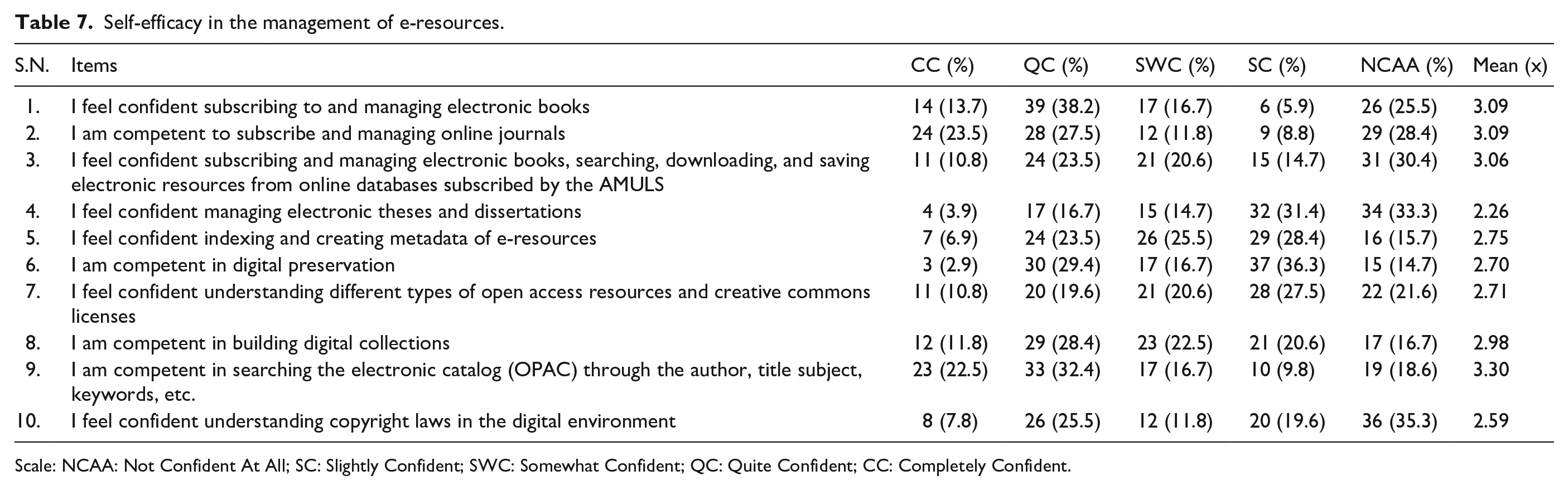
Scale: NCAA: Not Confident At All; SC: Slightly Confident; SWC: Somewhat Confident; QC: Quite Confident; CC: Completely Confident.
However, many respondents rated their knowledge and skills in managing electronic theses and dissertations (n = 66, 64.7%), digital preservation (n = 52, 51%), and copyright laws in the digital environment (n = 56, 54.9%) as not competent. Besides all these, around 50% of respondents also rated their knowledge of different types of open access resources and creative commons licenses as not competent. Thus, it can be concluded that most academic librarians had average knowledge of handling electronic resources.
Self-efficacy in ICT-based library services
AMULS offers campus-wide ICT-based services through a well-equipped ICT infrastructure, as discussed in the previous paragraph. The investigators have tried to determine the professionals’ skills for providing various ICT-based library services. Respondents were asked to rate their expertise in using ICT tools for delivering ICT-based library services. As shown in Table 8, the largest group of respondents (n = 65, 63.7%) felt quite confident and completely confident in the information retrieval process that includes information searching, selecting, and disseminating information to the right user at the right time from various electronic platforms. Furthermore, most respondents (n = 67, 65.6%) also reported that they felt Quite Confident and completely confident in understanding providing electronic document delivery services. In contrast, most academic librarians rated average knowledge of digital reference services. However, most of the respondents (n = 62, 60.8%) rated themselves as not confident and slightly confident in providing online bibliographic services (Table 8).
Self-efficacy in ICT-based library services.

Scale: NCAA: Not Confident At All; SC: Slightly Confident; SWC: Somewhat Confident; QC: Quite Confident; CC: Completely Confident.
Relationship between librarians’ ICT self-efficacy and its impact on library operations and services
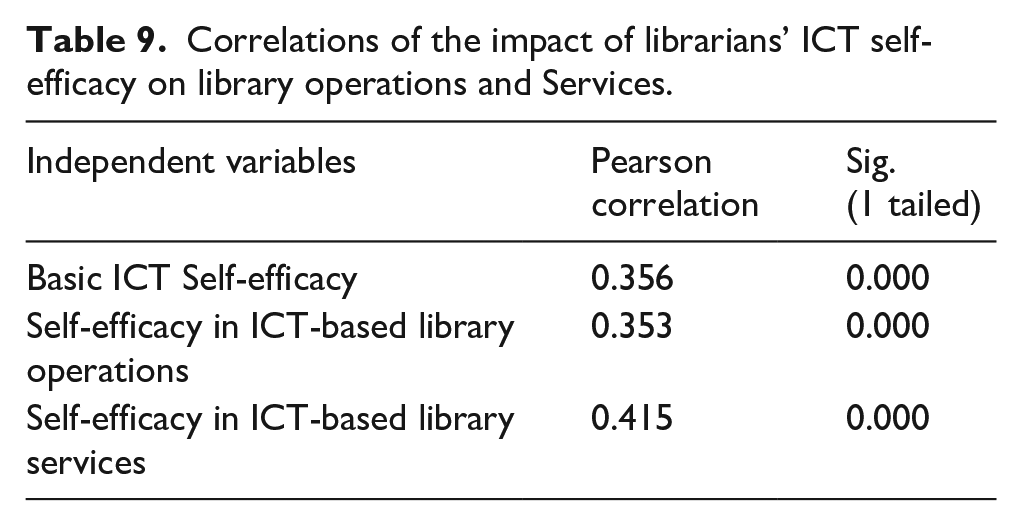
Linear Regression analysis was carried out in three rounds to test the impact of ICT Self-efficacy on ICT-based Library Operations and Services. A Pearson correlation was first conducted to investigate the strength of the correlation between each of the independent variables (Basic ICT Self-efficacy, Self-efficacy in ICT-based library operations, Self-efficacy in ICT-based library services) and the dependent variable (Impact of ICT application on library operations and services) of the study (See Table 9).
Correlations of the impact of librarians’ ICT self-efficacy on library operations and Services.
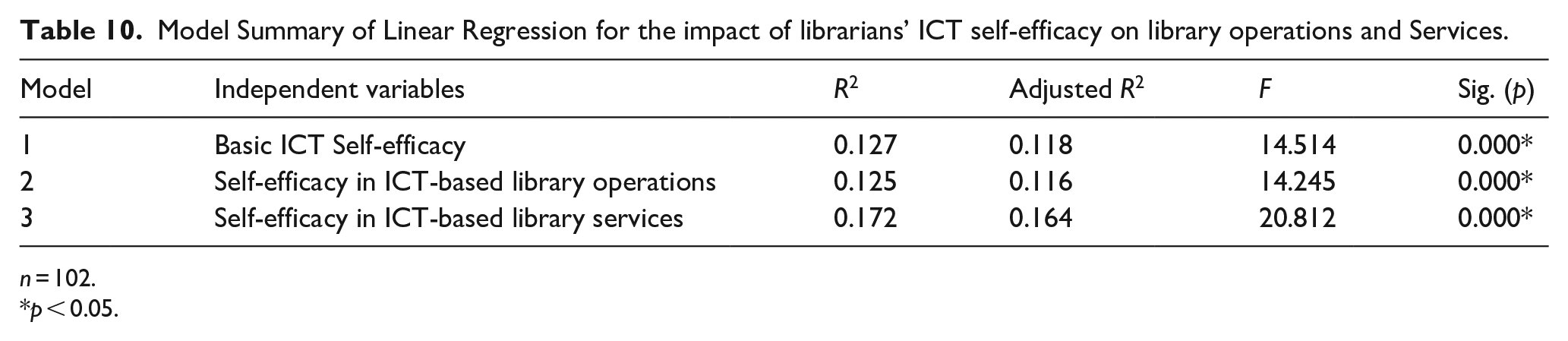
R2 is how the independent variables account for much variability in the dependent variable. It represents the combined effect of all the variables in the prediction. If we multiply R2 by 100, it gives the percentage of the variance in the dependent variable by the independent variable. The model is significant if the significance (p-value) is less than alpha α = 0.05.
In the first model, the impact of ICT on library operations and services is 12.7%, as explained by basic ICT self-efficacy with F (1, 100) = 14.514 at p = 0.000 < 0.05, R2 = 0.127. Similarly, in the second model, the Impact of ICT on Library operations and services variance is 12.5%, which can be explained by self-efficacy in ICT-based library operations with F (1, 100) = 14.245 at p = 0.000 < 0.05, R2 = 0.125. Also, in the third model, 17.2% of the variance in the Impact of ICT on Library operations and services can be explained by Self-efficacy in ICT-based library services (Table 10). So, based on Linear Regression Analysis, it may be concluded that all the three independent variables relating to ICT self-efficacy significantly impact the library operations and services.
Model Summary of Linear Regression for the impact of librarians’ ICT self-efficacy on library operations and Services.
n = 102.
p < 0.05.
Constraints in the acquisition of ICT skills
When respondents were asked whether they received training in ICT applications in libraries, most respondents (51.1%), as shown in Figure 1, indicated that they had received training for acquiring ICT skills. Respondents mostly learned ICT applications from their colleagues, as indicated by 90.2% of respondents. Self-learning by doing (74.5%), consultation of books on computers and IT (64.7%), participation in workshops/seminars (51%), and participation in training programs organized by the university (51%) were identified as other methods of acquisition of ICT skills by LIS professionals. Many respondents (41.2%) said they learned how to use ICT in libraries while pursuing LIS courses, while others (28.4%) said they learned through video conferencing.
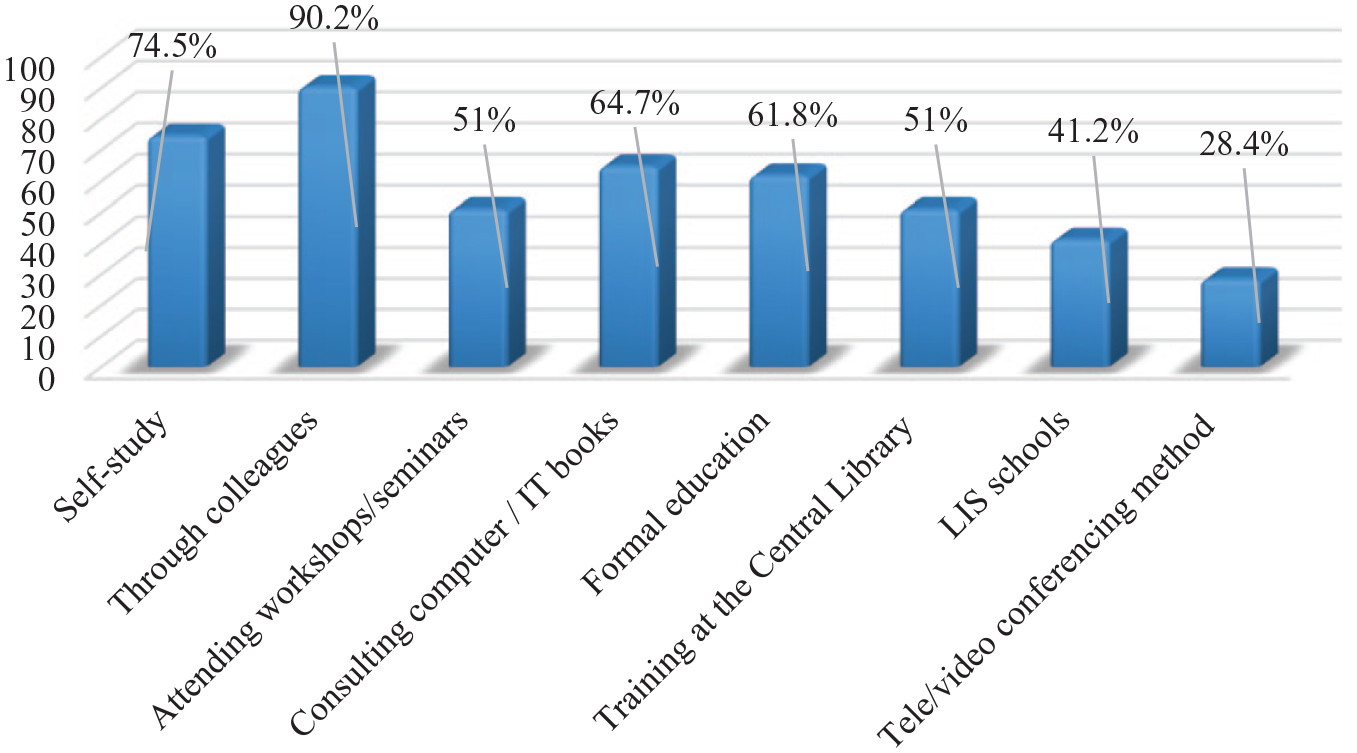
Methods of acquiring ICT skills.
Table 11 lists the problems that respondents faced in obtaining and updating their ICT skills. According to the results, the vast majority of respondents (87.3%) believe that an “inadequate training program in ICT applications” is a significant problem that impedes the acquisition of their ICT skills. Many respondents stated that gaining ICT skills is difficult for them due to “Tight working schedule” (86.2%), “lack of ICT infrastructural facilities” (80.4%), “limited scope for attending workshops on ICT applications” (74.5%), and ‘lack of support from authorities for implementing ICT applications in the libraries.” Furthermore, more than half of the respondents said that gaining ICT skills is hampered by a lack of updating ICT strategy, consultation services, and coordination among librarians.
Constraints in acquiring ICT skills.
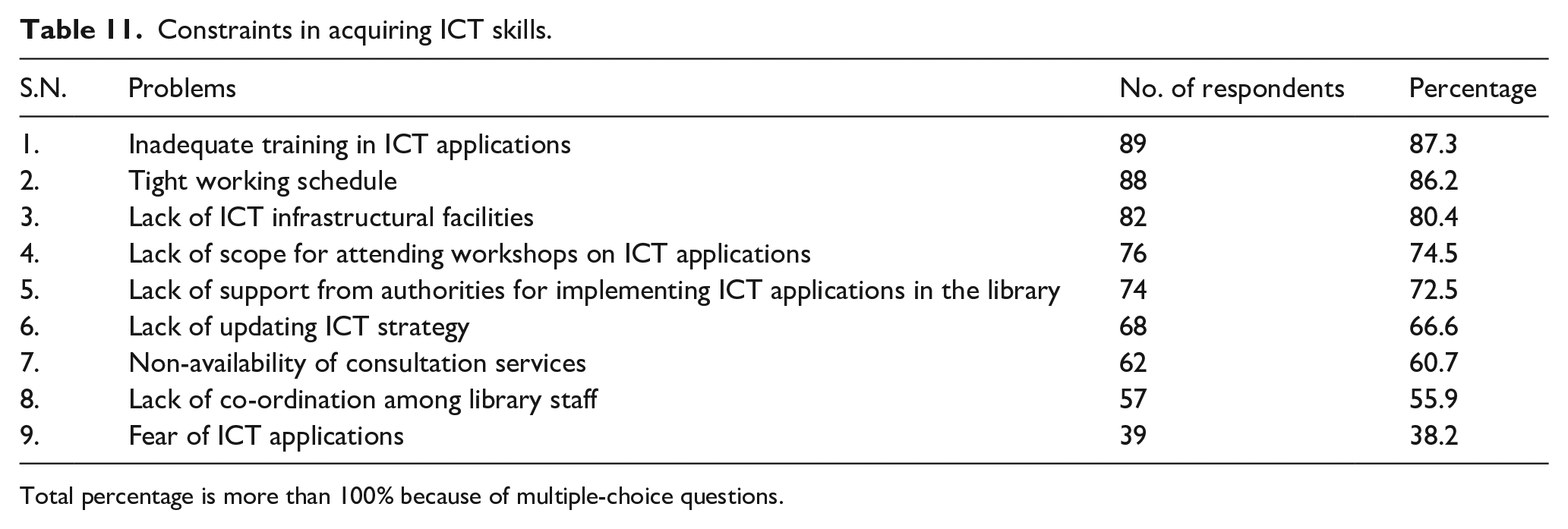
Total percentage is more than 100% because of multiple-choice questions.
Discussion of findings
Librarians’ perceptions about the impact of ICT applications on library operations and services
According to the present study’s findings, most librarians believe that ICT applications positively impact libraries, as the overall management and services improved due to numerous ICT applications. This finding is in line with Rathna and Divyananda (2018). They found that most librarians working in autonomous engineering college libraries in Karnataka strongly agreed that ICT applications improve the speed of acquisition, technical processing, organization, and faster availability of documents to users. Abdoulaye and Majid’s (2000) assertion that ICT services have revolutionized the management and use of information resources in academic libraries also supports this finding. It is important to note that more than half of librarians learned ICT skills with the support of their colleagues, self-teaching, and learning and consulting resources relevant to ICT application in libraries following closely behind. However, a few professionals stated that attending workshops/seminars helped them gain ICT skills.
Librarians’ ICT self-efficacy in handling ICT-based library operations and services
It is evident from the results that the largest group of librarians are skilled with the basic ICT applications like Windows operating system, Microsoft Office, and other essential applications software. The finding is relevant because respondents use this application software to perform routine jobs. This finding substantiates the findings of Seena and Pillai (2014), where most librarians working in the Kerala University Library System, India, had possessed average proficiency in basic ICT applications. In another study, Arilesere et al. (2020) investigated a similar finding at the public universities in Ogun State, Nigeria, where librarians relatively possessed a moderate level of ICT skills for delivering library services.
The finding of self-efficacy of ICT-based library operations and services revealed that most librarians rated themselves quite competent in working on the cataloging module of Libsys library management software. This finding is consistent with the results of Mathew and Baby (2012), where many librarians in the Universities of Kerala were familiar with some selected modules of library management software. However, they feel less skilled in using other modules like acquisition, serials control, and advanced search techniques in OPAC. Regarding developing a digital library or institutional repository, most librarians rated slightly confident in using DSpace institutional repository software. These results align with earlier studies in India (Haneefa and Shukkoor, 2010; Thanuskodi, 2011), where LIS professionals had minimal skills in using DSpace institutional repository software.
Based on the findings, Khan and Bhatti (2017) concluded that librarians should employ a variety of search engines, digital library software, server technology, e-journals searching, online bibliographic database, copyright, and other concerns to suit users’ requirements. According to the findings of this study, most professionals had an average level of skills to manage electronic resources and provide ICT-based library services. This finding is consistent with the results of Satpathy and Maharana (2011) and Sankari and Chinnasamy (2014), which revealed that librarians lacked the necessary skills to locate, manage, and exchange electronic resources.
ICT self-efficacy and its impact on library operations and services
Simple Linear Regression Analysis shows that all three independent variables (Basic ICT Self-efficacy, Self-efficacy in ICT-based library operations and Self-efficacy in ICT-based library services) have a significant impact on library operations and services. Hence, it can be considered as one of the important factor which improves the quality of library services. This finding is similar to the findings of several previous studies (Alahakoon and Somaratne, 2020; Arilesere et al., 2020; Bajpai and Madhusudhan, 2019; Bronstein and Tzivian, 2013; Gireesh, 2013; Kumar, 2013; Mathew and Baby, 2012; Mazumdar, 2007; Uwaifo, 2010;) that indicated librarians acquire ICT-related skills to deliver efficient library services. Therefore, librarians with high level of ICT self-efficacy will provide library services more efficiently and efforts should be taken to improve these skills in library staff.
How do librarians acquire ICT skills?
According to Mazumdar (2007), “since the technology revolution has given rise to various breakthroughs and inventive concepts” (p. 423), librarians need to become lifelong learners. An overwhelming majority of librarians stated that they had acquired ICT skills from various sources, including consultation with colleagues, self-learning by doing, consulting computer/IT books, and attending formal education and workshops. The finding confirmed by Babu et al. (2007) that most librarians working in Engineering Educational Institutions in Tamil Nadu have acquired ICT skills through the same sources identified in the present study. The result further substantiates the results of Kumar and Biradar (2010), Farahi and Gandhi (2011), and Ahmed and Rehman (2016) that library professionals working in different universities and colleges in India have acquired ICT skills through self-study, colleagues, workshops/seminars.
Constraints in acquiring ICT skills by librarians
Lack of adequate access to ICT application-related training programs, lack of ICT infrastructure facilities and updated ICT strategy, tight work schedules, limited flexibility for attending workshops and training on ICT applications (both inside and outside the university), and a lack of consultation services have all been identified as significant roadblocks to gaining the essential ICT skills. This finding is in line with the results of Bansode and Viswe (2017) and Ahmed and Rehman (2016), where most librarians cited a busy daily work schedule, limited opportunities to attend training programs, and insufficient support from the authorities as significant barriers to acquiring essential ICT skills.
Practical implications
Even though it is indeed a case study, librarians, information scientists, library professionals, and LIS schools can benefit from the findings. Based on the research findings, librarians may recognize the necessity of ICT skills for managing techno-based library services and infrastructure. Simultaneously, LIS schools should revise and include crucial areas in their curricula. Furthermore, we may be assured that this is the first study that assesses the ICT self-efficacy among librarians in the AMULS. Its findings may help develop strategies to implement emerging technologies in the academic library system.
Conclusion
The analysis of findings revealed that respondents perceived the positive impact of ICT on library operations and services. The study concludes that most librarians working in AMULS possess a good knowledge of basic ICT applications. However, their knowledge of ICT application in searching and managing electronic information, creating bibliographic databases, applying network and security systems, using web OPAC and digital archives, and providing electronic document delivery service is “average.” The findings also indicates that ICT self-efficacy is positively related to ICT adoption and have a significant impact on library operations and services.
Since the study is limited to assessing the ICT self-efficacy level among librarians working in AMULS, its findings may not be generalized to other libraries. For the generalization of results, an extensive study with a diverse sample of libraries is recommended. Even though it is indeed a case study, librarians, information scientists, and LIS schools can benefit from the findings. According to the study’s findings, librarians may realize the importance of ICT skills in managing ICT-based library services and infrastructure. LIS schools should also modify and incorporate essential ICT components into their course curricula.
Supplemental Material
sj-doc-1-lis-10.1177_09610006221111199 – Supplemental material for Librarians self-efficacy in ICT-based library operations and services: A survey of librarians working in libraries of Aligarh Muslim University Library System
Supplemental material, sj-doc-1-lis-10.1177_09610006221111199 for Librarians self-efficacy in ICT-based library operations and services: A survey of librarians working in libraries of Aligarh Muslim University Library System by Mohammad Nazim, Shamim Aktar Munshi and Mohammad Ashar in Journal of Librarianship and Information Science
Footnotes
Declaration of conflicting interests
The author(s) declared no potential conflicts of interest with respect to the research, authorship, and/or publication of this article.
Funding
The author(s) received no financial support for the research, authorship, and/or publication of this article.

Author biographies
References
Supplementary Material
Please find the following supplemental material available below.
For Open Access articles published under a Creative Commons License, all supplemental material carries the same license as the article it is associated with.
For non-Open Access articles published, all supplemental material carries a non-exclusive license, and permission requests for re-use of supplemental material or any part of supplemental material shall be sent directly to the copyright owner as specified in the copyright notice associated with the article.
