



Abstract
Links between role and organizational citizenship behaviour (OCB) were already signalled in early studies. However, empirical validation on the relation between the two is still unavailable. Inspired by the theory of social exchange, this study explores the relation between role clarity and OCB’s dimensions in the Indian power sector. To further the analysis, the relation was moderated with tenure levels. This study is based upon the responses gathered from 300 Indian executives. Higher statistical tools, such as Bonferroni method, path analysis and subgroup analyses, are deployed with help of multiple group confirmatory factor analysis (MGCFA) to record the validated results. A significant relationship was found between role clarity and OCB dimensions. While, OCB dimensions recorded mixed results across tenure stages, they showed a general trend of increased score on higher tenure stage with role clarity as independent variable. Also, public organizations scored better than the private organizations on role clarity–OCB dimensions relationship. Findings along with implications and future scope are discussed in this article.
Keywords
Introduction
The main focus of power sector is to establish consumer satisfaction by generation and supply of electricity at right time, quality, quantity and cost. It involves critical tasks such as planning, design, engineering, procurement, handling and storing, construction, commissioning, operation and maintenance of power plants, equipment, transmission and distribution, sale of energy and collection of revenue, management of personnel and finance, etc., and for every task to be accomplished, highly motivated and satisfied employees are required. Power sector, which is going through a rapid technological sophistication, requires specially skilled artisans, engineers, supervisors, managers, etc., to function (Ahluwalia, 2002). Things which make it difficult are the work conditions, including extreme heights, temperatures, etc., in difficult terrains. Adding to this, growing concern regarding depletion of conventional energy sources and environmental degradation has forced stringent norms which have accelerated skill obsolescence. Overall, man/MW ratio—which was at 9.4 in the ninth plan, 7 in the 10th, 5.8 in the 11th and further expected to reach 4.9 in 12th plan (Government of India, Ministry of Power, 2012)—shows the importance of every employee in power sector. Power sector is also going through reforms with state governments going with State Electricity Regulatory Commissions and restructuring State Electricity Boards and also opening the sector for private players (Rajan, 2002). Hence, the power sector, though capital intensive, needs to take care and provide support to their employees who are at centre of this transformation to fulfil the growing expectations of power-hungry India.
Organizational citizenship behaviour (OCB) has been described by Organ (1988) as ‘individual behaviour that is discretionary, not directly or explicitly recognized by the formal reward system, and in the aggregate promotes the efficient and effective functioning of the organisation’ (p. 4). This is quite a popular topic to read. Organ and Colleagues (Bateman & Organ, 1983; Smith, Organ & Near, 1983) had coined this term in 1980s for the first time, and since then not less than 700 studies have been performed on OCB and its related constructs—such as citizenship performance, extra-role behaviour, pro-social behaviour, antecedents of OCB, which include employee attitude, personality traits, leader behaviour and also the effect of OCB on organizational and individual outcomes (Organ, Podsakoff & Podsakoff, 2006)—which illustrate the level of popularity of the constructs. It has also proved to be a key criterion variable for several organizational variables, such as job attitudes and justice perceptions (Hoffman, Blair, Meriac & Woehr, 2007), and has an outstanding position in classic theories and conceptualizations of work performance (Viswesvaran & Ones, 2000). In addition, the penetration of OCB-like behaviour has extended from the field of organizational behaviour to diverse disciplines, such as leadership and economics, military psychology, health administration, human resource management, industrial relations and marketing (Podsakoff, MacKenzie, Paine & Bachrach, 2000). Incorporation of OCB by practitioners in organizations has influenced evaluation and recruitment processes.
Recently, both the industry and the academia have begun noticing the costs connected with OCB’s performance, especially role stressors, such as role overload, stress and conflict (Bolino & Turnley, 2005; Salamon & Deutsch, 2006). Role clarity plays a great part in reducing these costs. Organ (1997) has also stressed on role clarity as the antecedent of OCB. In addition, role clarity has become a significant variable for the study because of the multiple role sets that need to be performed by employees everywhere. Clarity in expectations of inter-roles and intra-roles should be the foundation of every work output. Moreover, we wish to bridge the gap between OCB as in-role behaviour and as extra-role behaviour, which is why there arises a need to do further research on this issue.
Another important construct, which may influence OCB performance is tenure. Previous studies have extensively looked into the influence of tenure on in-role performance (Wright & Bonett, 2002), and researchers have singled its influence on OCB (Ng & Feldman, 2011; Rowe, 1988; Uçanok, 2009). Moreover, most of these studies have been carried out in Northern America and Europe. Lievens and Anseel (2004) argued that ‘research on OCB measurement in contexts other than the U.S. is important because the dimensionality of an OCB measure used in different cultural contexts should not be taken for granted’ (p. 300). So, it becomes imperative to know whether the results comply with Indian sample too.
Asian countries, particularly India, have different work culture and work conditions when compared to Western countries, where most of the past studies have been conducted. This study makes an important contribution to the literature by providing the link between role clarity and OCB in the Indian power sector, and by considering demographic prospective with the help of tenure as moderator and other demographic variables as control variables. The study is conducted by using the data collected from management development programmes (MDPs) in private and public power sector organizations, which focused on enabling the employees of various organizations to gain knowledge about the management concepts. The study becomes more appealing as it analyzes the influence of role clarity and tenure on every individual dimension of OCB using a respondent sample of 300 power sector employees from 13 organizations. Distinction is also made on the basis of private and public sector employees to assess and compare the conditions in both.
Theoretical Background and Objective Building
Power Sector in India
India, which stands fifth in power generation capacity, accounts for around 4 per cent of the global energy consumption. The present installed power generation capacity in the country as on 31 January 2013 is 211,766.22 MW with almost 57 per cent of capacity coming from coal, around 19 per cent from hydro, around 12 per cent from renewable sources of energy, 2 per cent each from gas and nuclear and about 1 per cent from diesel. Share of the state government in power generation is 40.77 per cent, that of the central government is 29.73 per cent and the private sector accounts for 29.49 per cent of total power generation. Thermal power projects of 78,545 MW and hydropower projects of 15,707 MW are in the construction phase for probable commissioning during the 11th and 12th five-year plans. The prominent organizations that augmented this capacity are from both public as well as private sector, for example, Adani Power, Tata Power, National Thermal Power Corporation (NTPC) and Reliance Power. Nearly 100,000 MW (Deloitte Touche Tohmatsu India Private Limited, 2012) is aimed to be achieved in the 12th Plan. In terms of investments, US$230 billion was invested in 11th plan and a similar kind of amount will be required in the 12th plan.
The renewed interest was developed in the power sector with the introduction of National Electricity Policy 2005, and the Tariff Policy 2006. Also, standardization of bidding documents was also achieved along with competitive bidding routes. From January 2011, power procurement will be mandated through competitive bidding route. Hundred per cent foreign direct investment (FDI) has also been allowed in almost all segments of power sector (except atomic energy).
Although the growth in the Indian power sector is impressive, more efforts need to be put because of the high pressure from increasing population. The average per capita consumption of electricity in India is 814 kWh against the world average (2,300 kWh), US (~15,000 kWh) and China (~1,800 kWh) (KPMG, 2010). There is also a need to focus on the transmission capacity, which is only 13 per cent of the installed capacity. India’s transmission and distribution (T&D) losses at 33 per cent are far higher than the global benchmarks. To achieve a capacity addition of 100,000 MW in the 12th Plan, additional manpower of 407,670 MW is needed, of which 312,920 MW will be technical and 94,750 MW will be non-technical (Government of India, Ministry of Power, 2012). Power sector is striving to get committed, multitasking and self-driven employees to face the growing complexities.
Social Exchange Theory
Social exchange theory is indeed one of the most widely used theoretical bases for explaining OCB (Cropanzano, Rupp & Byrne, 2003; Konovsky & Pugh, 1994; Organ, 1990). The theory explains the exchange that occurs between two identities for mutual benefit. According to the theory, reciprocity rules and norms take a central role in motivating and governing the exchange of benefits. The principle of reciprocity ensures that there is an exchange of benefits between the parties involved. Theory of reciprocity in action can be seen in a study by Hui, Lam and Law (2000), which established high OCB level in bank employees where OCB was instrumental in the promotions.
The influence of reciprocity works at two levels: first, as a moral norm and second, as a societal norm. Within these levels, the individual is motivated to cultivate service-oriented behaviour as they ‘are motivated by the returns they (their actions) are expected to bring…from others’ (Blau, 1964, p. 91). Therefore, social exchange theory derives the individual to perform OCB even without a formal reward commitment from another party.
Yadav and Rangnekar (2013) mention that role clarity is not only related to job description but also the colleague’s expectation and individuals’ expectations for benefits in future appraisal. The clear role expectations and its implications may lead to better social exchange relationship because all the parties will have a clear view about what is expected of them and how it will benefit them in return.
Organizational Citizenship Behaviour
Bateman and Organ (1983) introduced the phrase citizenship as a behaviour that ‘lubricate the social machinery of the organisation’ (p. 654), and termed employees who show such behaviour as good citizens. Later Organ (1988) provided an extended review of OCB. We witnessed a rich literature on OCB’s role in reaching the organizational goals. In recent decades, quite a few studies have focused on this phenomenon and signified its importance in organizational studies spanning across cultures and sectors.
Apparently, these spontaneous behaviours have a greater role in fostering a positive climate and also efficiency and effectiveness in the workplace. Therefore, supervisors and managers are also expected to promote these voluntary behaviours in subordinates, on the presumption that these behaviours generate improved work setting, leading to superior work outcomes and also promote the ambitions of an organization as a whole (LePine, Erez & Johnson, 2002; Organ & Ryan, 1995). There are various concepts which are found to have similarity with OCB, such as civic citizenship (Graham, 1991), extra-role behaviour (Van Dyne, Cummings & McLean, 1995), pro-social behaviour (Baruch, Fenton, Hind & Vigoda-Gadot, 2004), contextual performance (Motowildo, Borman & Schmit, 1997) and organizational spontaneity (George & Brief, 1992). A general denominator of the above studies is that, for the most part, OCB has been considered as a self-initiated, constructive, spontaneous or voluntary behaviour intended to enhance the productivity of the workplace. Whereas, some studies (Bolino, 1999; Organ, 1997) also suggested that self-interests, impression management and other non-altruistic motives are involved in OCBs. The common theme, which can be witnessed in nearly all OCB studies is of a positive and productive behaviour worth supporting. Hence, it will not be an exaggeration to argue that till date most studies on OCB have stressed on its positive image, its beneficial implications, its involvement with individuals and organizations at multiple levels and its general corroboration of performance at the workplace.

OCB can be viewed and analyzed from two perspectives: either as an aggregate concept or by referring to its various aspects or dimensions (Tziner & Sharoni, 2014). Even in the absence of consensus on the scope of OCB, five projected dimensions of OCB by Organ (1988) are used worldwide (see Figure 1). The dimensions are:
Altruism refers to the helping behaviour aimed at a specific person, which will eventually provide profit to the organization. For example, sharing a co-worker’s workload. Courtesy can be defined as avoiding the job-related interpersonal difficulties or problems from taking place. For example, notifying other colleagues about being absent in advance. Conscientiousness is stated as undertaking actions that are advantageous to the organization, and it involves performing one’s job and roles or duties even without surveillance. For example, reaching office on time when nobody is even watching. Sportsmanship is the behaviour of tolerating some unusual situations without complaints. For example, tolerating fluctuations in office temperatures. Civic Virtue means being concerned about the efficient functioning of the company. Being alert to the goings-on in the organization. For example, attending meetings and keeping oneself updated about developments in the organization.
Role Clarity and Organizational Citizenship Behaviour
Shoemaker (1999) defined role clarity as the degree to which a person is sure about how he/she is expected to do a job. The level of clarity has also been associated with performance whereby an individual who is clear about his/her role will be more suitable in fulfilling that particular function (Braxton, 2008). According to Mukherjee and Malhotra (2006), role clarity can also be defined as the level to which an employee gathers information about the anticipated outcomes of the duties to be done by him/her in specific terms. It enhances the individual’s understanding about what proficiency is needed in their jobs as they realize what they must know about their job, what they are competent of doing and how they will do it (Baron & Armstrong, 1998). If job roles are not properly/clearly defined, there is a constant likelihood that the individuals will take up duties that are not in fact theirs while disregarding what they are expected to do. This discrepancy between what one is expected to do and what he/she performs creates role ambiguity and role conflict among the employees (Fields, 2002).
Organ (1997) while refining the construct of OCB focused on discretionary actions of the employee which is not enforceable or required for the job description or the role. He also focused on the concept of ‘role’ and ‘job’. While differentiating the two, job was considered as the description of duties given by the employer at the time of employment, which is generally clearly stated and defined while role comes with a vast discretionary power with it. Fortune magazine’s cover story titled ‘The end of the Job’ stressed that job no longer is the best way of doing work in the changing environment, downsizing and team-based organization. Smith et al. (1983) stated that OCBs are things that your supervisor would like you to do, although he cannot make you do it and cannot guarantee any reward. Therefore, this renders clarity to even those behaviours that pertain to a superior. In a study conducted by Morrison (1994), 18 out of 20 items were identified by most of the respondents as ‘in-role’. He also added that OCB varies from one employee to the other and between supervisor and employee.
Role clarity’s negative dimensions, that is, role conflict and role ambiguity were found significantly negatively related to OCB by a later study done by Podsakoff et al. (2000). Kwon (2002) also found similar results with role ambiguity and altruism.
From the above evidence, it can be hypothesized that a high level of understanding and clarity regarding what an employee does is necessary in the organization. In addition, with the growing clarity of the expectations of people around, the employee becomes more confident and exhibits a higher OCB.
Work Experience as Moderator
Work experience is defined as ‘the length of experience in a given occupation’ (McDaniel, Schmidt & Hunter, 1988, p. 327). Work experience here is not the satisfaction or the value of a specific role or job; it is the span of time an individual has spent in an occupation. The studies based upon work experience and role have been limited.
Walker, Churchill and Ford (1975) observed that job tenure might moderate role clarity regardless of the supervisory style or organizational structure. Research based on sales executives found that as sales people gain experience in a job, chances and opportunities to learn what is expected of him/her in various conditions increases. These researchers found a significant and positive relationship between work experience and role clarity (Walker et al., 1975).
A limited amount of work has been done on the relationship between tenure and OCB. However, some evidence has been found that supports this relationship. Rowe (1988) gave a hypothesis that a promising relationship does exist between OCB and tenure and have to be further explored. Tenure was found to moderate the relationship of organizational commitment and citizenship behaviour (Ng & Feldman, 2011). OCBs may change due to the work experience gained over time (Rowe, 1988). As stated by Uçanok (2009), work experience as a concept is quite important to decode and decipher the dynamics underlying extra-role behaviour and developing organizational strategies. Turnipseed and Murkison (2000) state, ‘The length of time in the organisation is directly related to positive feelings towards one’s employer (Salancik, 1977) and these feelings may result in some level of OCB’ (p. 286). Feng and Tsai (2012) while conducting research on graduate nurses stated, ‘Learning by doing was the strategy that helped new graduate nurses transition from the overwhelming chaos to being an insider’ (p. 2067).
Objectives
The above literature review revealed a gap between role clarity and OCB and it was also observed as to how employees with different tenure levels performed in this relationship. It was observed that there was a need to study both the private and public sectors on the basis of role clarity–OCB relationship in the Indian power industry. Hence, the objectives of the study are to investigate the effect of role clarity on OCB through OCB dimensions in private and public organizations and the overall power sector and to examine the moderating effect of tenure on the relationship between role clarity and various OCB dimensions in the Indian power sector.
Method
The population of the study includes full-time Indian employees from both private and public power organizations. Management development programmes (MDPs) were selected as a mode to collect responses. In total, 13 MDPs were conducted; eight in public organizations and five in private organizations across India. To ensure validity of responses, variables under study were discussed in detail before circulating the questionnaires. Out of the 340 questionnaires distributed, 40 were returned incomplete, leading to response of 300 executives with 88.24 per cent response rate.
Measure
Role ambiguity: Role clarity questionnaire by Pareek (2002) with 15 items has been used to measure the level of role clarity in executives. It is a 5-point Likert scale with responses varying from 1 for ‘very little clarity’ to 5 for ‘quite clear’. The sample items include ‘clarity regarding what your colleagues/peers expect from your role’, ‘clarity regarding rules, regulations and procedures relevant for your role’ and ‘clarity regarding appraisal system to assess how well you perform in your role’.
Organizational citizenship behaviour has been measured by considering five dimensions, that is, altruism, courtesy, conscientiousness, sportsmanship and civic virtue. A 24-item scale by Podsakoff, MacKenzie, Moorman and Fetter (1990) has been used to measure these dimensions. Responses were taken on 5-point Likert scale. Sample items are: ‘I attend meetings that are not mandatory, but are considered important’; ‘I am always ready to lend a helping hand to those around me’; and ‘I take steps to try to prevent problems with other workers’.
For tenure, 3-point scale is used with 1 for early tenure stage (0–5 years), 2 for middle tenure stage (5–10 years) and 3 for later tenure stage (above 10 years).
Control Variables
While doing the literature review, demographics appeared as an important variable in determining OCB. So, it was decided to control them for analysis. The first variable is the age of respondents. OCB literature has determined age to be positively related to OCB (Kuehn & Al-Busaidi, 2002; Siti Noor Asekin, J., 2010; Wanxian & Weiwu, 2007). These studies led us to believe that age may confound the outcomes while studying the proposed relationship. Age was measured on an ordinal scale with options ranging from 1 (21–25 years) to 8 (above 8 years).
It was also decided to control the variable position for analysis. The position represents a hierarchy of respondents, that is, respondents belonging to lower, middle or higher ranks in the organization. In the past, studies have found position to be positively related to OCB (Morrison, 1993; O’Reilly & Chatman, 1986). Position was measured on a 3-point ordinal scale with values 1 (junior level), 2 (middle level) and 3 (senior position).
The final variable to be controlled is gender. Gender was also found to be predicting OCB behaviour in past studies (Kark & Waismel-Manor, 2005; Lovell et al., 1999; Morrison, 1994). In order to understand the true explanatory powers of role clarity on OCB, it was decided to control for gender as well. A 2-point scale was used to measure gender with 1 representing female and 2 representing male respondents.
Data Analysis
Confirmatory factor analysis was performed using AMOS to test the measurement model. The discriminant validity of all the pairs of the constructs was also checked through chi-square difference test as in Bonferroni method (Simes, 1986). The influence of role clarity on OCB dimensions in proposed structural model was studied with path coefficients and t-value. The pattern of OCB dimensions on various tenure stages was analyzed with analysis of variance (ANOVA) and Tukey’s honestly significant difference (HSD) post-hoc test. Moderation powers of tenure were tested with path coefficients along with subgroup analyses using multiple group confirmatory factor analysis (MGCFA) to recognize true nature moderation on the model.
Results
Profile of Sample
Out of the sample of 300 employees, 122 employees (40.66 per cent) belonged to private sector with 73 males (59.83 per cent) and 39 females (40.6 per cent). The mean age was 35.2 years with the average tenure level of 10.4 years. Thirty-seven employees (30.32 per cent) belonged to junior level position, 45 employees (36.88 per cent) were from middle level and remaining 20 (16.39 per cent) were from higher level position.
Hundred and eighty-eight employees (59.33 per cent) were from public sector. The average age of employees was 37.9 years with the average tenure level of 11.6 years. Sixty-one employees (32.44 per cent) worked at junior level, 97 (51.59 per cent) employees were from middle position and 30 (15.95 per cent) were from senior level.
Measurement Model
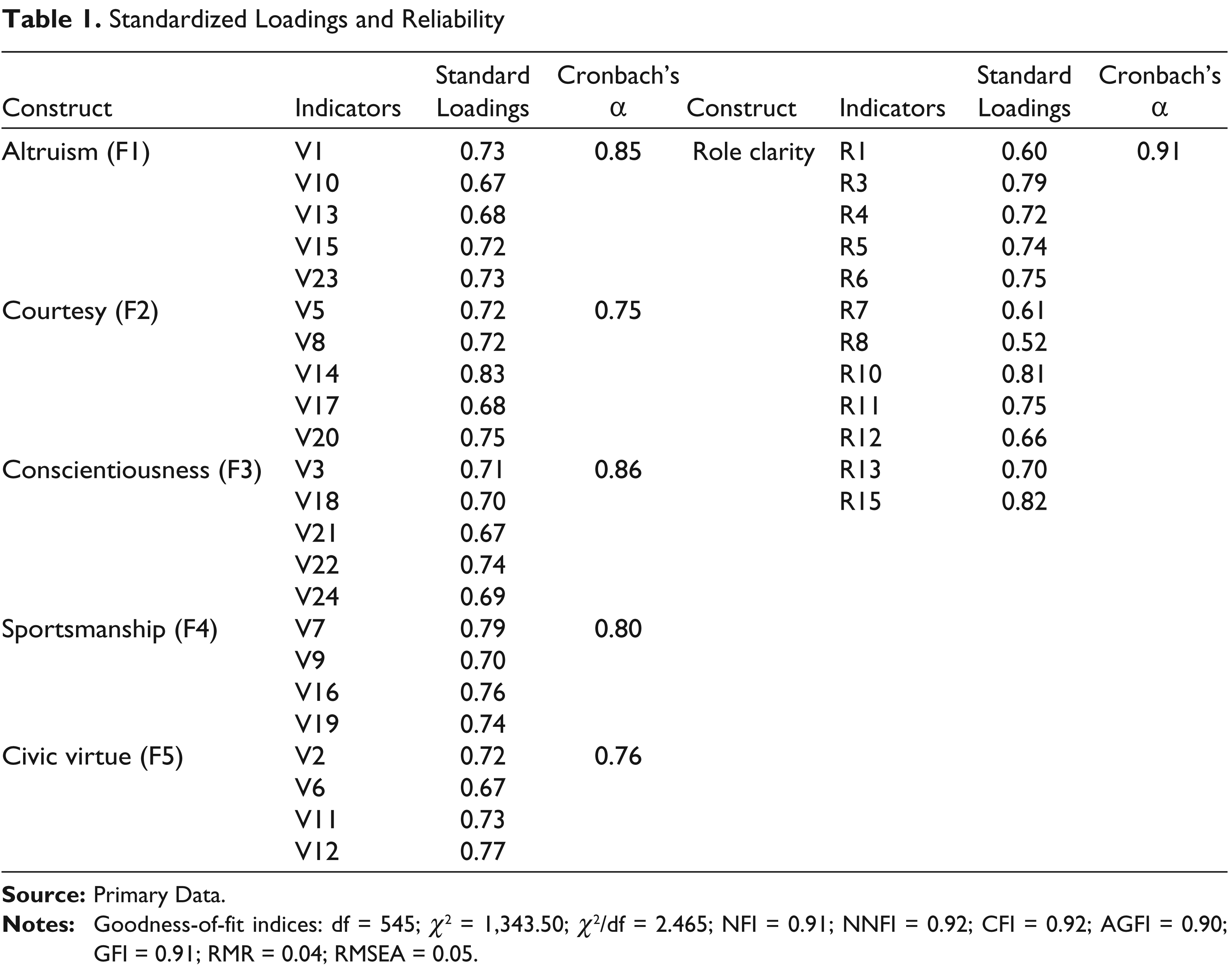
Structural equation modelling (SEM) was applied for data analysis in measurement model. Two-step approach on the guidelines of Anderson and Gerbing (1988) was used for testing the model. After continuous filtering for the variables to measure the constructs in the measurement model, two indicator variables, that is, standard loadings and Cronbach’s α were selected (Table 1). One item was dropped from sportsmanship and three items were dropped from role clarity instrument. The overall goodness-of-fit indices were also calculated to check the model fit. A good model fit includes χ2/df value less than 3; NFI (Normed Fit Index), NNFI (Non-Normed Fit Index), CFI (Comparative Fit index), AGFI (Adjusted Goodness of Fit Index) and GFI (Goodness of Fit Index) value greater than 0.9; RMR (Root-Mean-Square Residual) and RMSEA (Root Mean Square Error of Approximation) value less than 0.05.
Internal consistency of the instruments used for measuring various factors was checked using the reliability values. Reliabilities of the factor stand above 0.7 as shown in Table 1, which satisfies the general requirement for reliability of the instrument for research (Hatcher, 1994). Convergent validity can be assured with strongly correlated scores of all the indicators measuring specific construct (Hatcher, 1994). Table 1 shows statistically significant loadings of indicators measuring specific construct, supporting the convergent validity and that they effectively measure their specific constructs.
Standardized Loadings and Reliability
Chi-square difference test was used to check for discriminant validity of the study. As per Bonferroni method (Simes, 1986), every pair of the constructs under study need to be checked for discriminant validity. To minimize the type 1 error rate, the critical value of chi-square needs to be computed on the significance level/k, where k is number of pairs of constructs in the study. In total, there were 15 pairs. Hence, level of significance, that is, 0.01, was reduced to 0.01/15 = 0.000067 and critical value at this significance level came to be 15.89. Since, chi-square difference of all the paired constructs exceeded the chi-square critical value for private organization, public organization and also total sample (Table 2), and also the significance value shown by all pairs were under 0.000067. Discriminant validity is achieved.
Chi-square Difference Test for Discriminant Validity

(ii) ***Significant at 0.001 level by using the Bonferroni method.
Structural Model
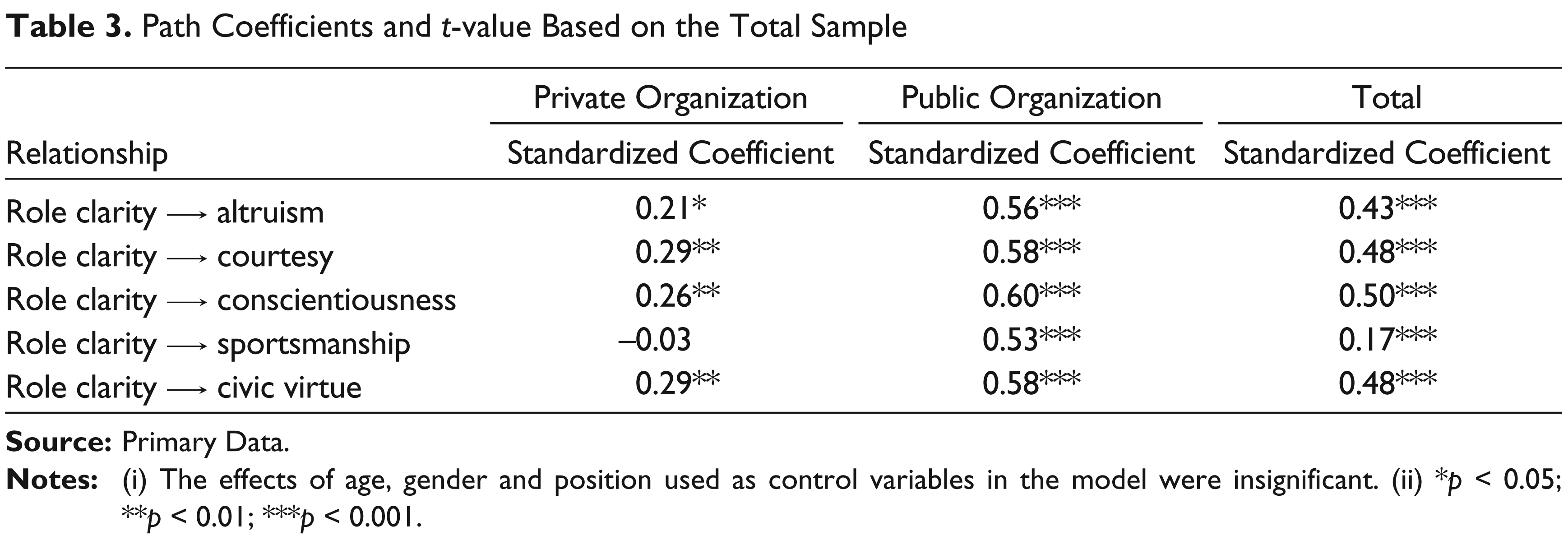
To avoid making any false inferences, age, gender and position were taken as control variables. Earlier researches have studied the influence of these variables on OCB. Chances of experimental errors were effectively reduced by controlling these variables because age, gender and position can have an unprecedented effect on OCB dimensions and role clarity. After testing a measurement model in the first step, structural model was analyzed in the second step. A comparison was drawn between public and private organization employees (Table 3). For private organization, role clarity significantly predicted all OCB dimensions except sportsmanship; and for public organizations, all the five dimensions were significantly predicted by role clarity that too at higher value on every dimension compared to private organizations. As for overall power sector, role clarity significantly predicted all the five OCB dimensions, thereby, rendering support to our objective.
Path Coefficients and t-value Based on the Total Sample
Mean, Standard Deviation and ANOVA Value for Role Clarity and OCB Dimensions
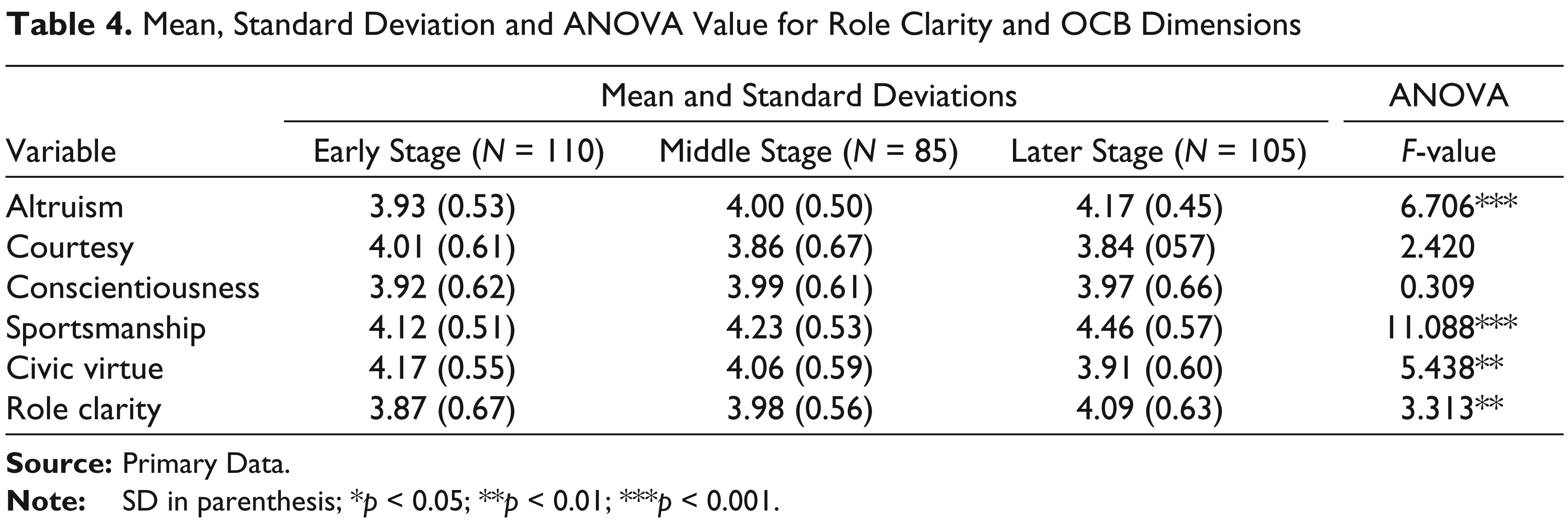
Table 4 represents the mean responses of role clarity and various OCB dimensions for employees in each of the tenure stage. Tenure was divided as: early stage—1–5 years; middle stage—5–10 years and later stage—above 10 years. Analysis of variance was conducted to ascertain whether differences in mean scores between tenure stage groups in relation to OCB dimensions and role clarity were statistically significant. Tukey’s HSD post-hoc test was used to compare means across the three tenure stages. Results indicated that altruism (p < 0.001) and sportsmanship (p < 0.001) got stronger in the later tenure stage than in early stage. Employees in the early tenure stage had the more civic virtue than employees in later tenure stage (p < 0.01). Role clarity also witnessed a rise in score with an increase in tenure stages (p < 0.01). However, courtesy and conscientiousness failed to give significant results for various tenure stages.
These results show that tenure is correlated with role clarity. Specifically, role clarity is stronger for employees with longer tenure. Three OCB dimensions gave significant, but mixed results.
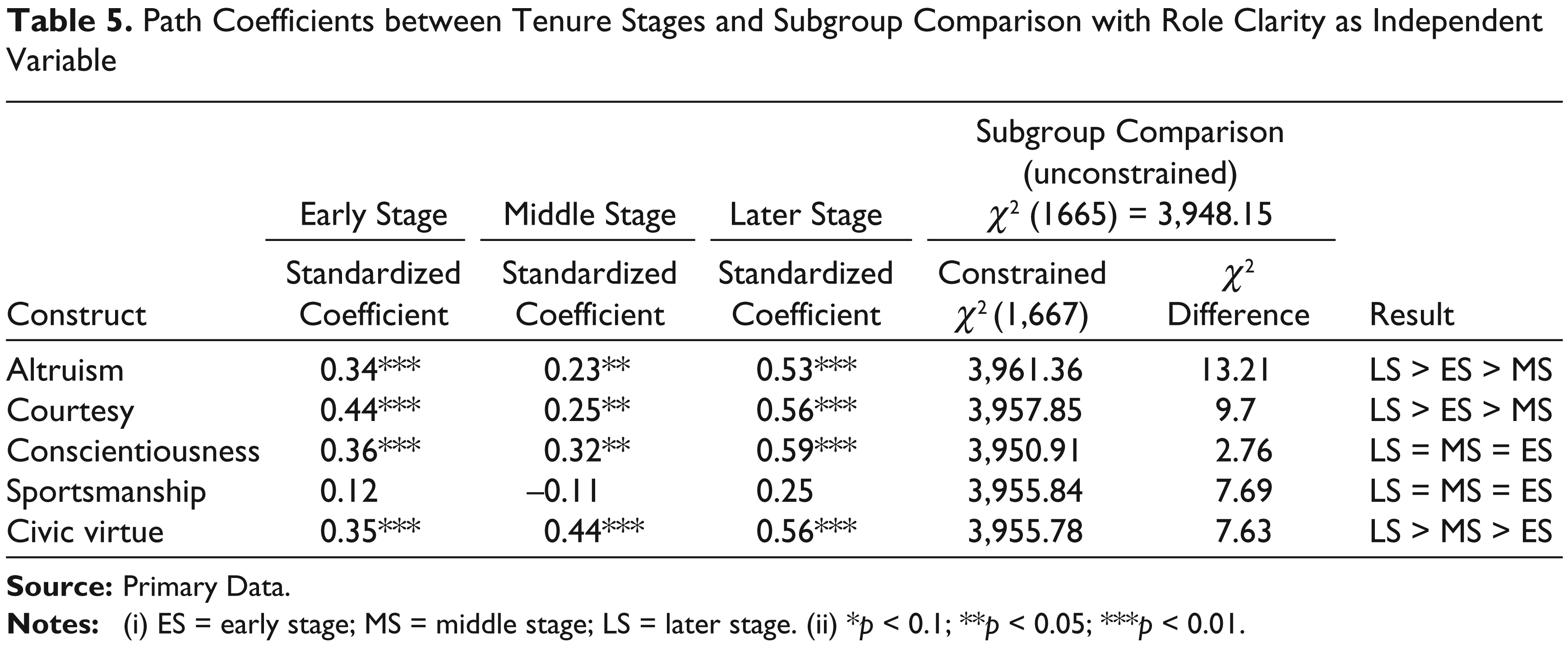
To test the moderating effect of tenure on the relationship of role clarity and OCB dimensions, subgroup analyses (Byrne, 2013; Singh, 1995) were performed with the help of MGCFA technique. The tests were run on various paths to check moderation. Table 5 shows the results of subgroup comparisons as well as path coefficients. The threshold limits on chi-square values were 3,952.76 (0.1 significance level); 3,954.15 (0.05 significance level) and 3,957.36 (0.01 significance level). The test of the moderating effect of tenure on role clarity and OCB relationship portrays that the influence of role clarity in altruism was witnessed to be the strongest at later tenure stage; early tenure stage received higher scores than middle stage. Similar results were shown by role clarity–courtesy relationship with a dip in score at middle level, but eventually reaching the highest score at later tenure stage. Although role clarity–conscientiousness relationship achieved significant results in path coefficients, it failed to pass chi-square difference test, signifying relationship to be stable at various tenure stages. Tenure failed to moderate the role clarity–sportsmanship relationship. Here, the relationship failed to give significant results at various tenure stages. Role clarity–civic virtue relationship was seen to be increasing with the increase in tenure stages, reaching at the strongest point with later tenure stage. A common pattern witnessed in the results is that all the dimensions reached highest scores with later tenure stage, proving that role clarity’s positive influence on overall OCB reaches the highest level with the increase in tenure level in employees.
Path Coefficients between Tenure Stages and Subgroup Comparison with Role Clarity as Independent Variable
Discussion
The uniqueness of the study is that it establishes the potency and course of tenure in role clarity–OCB relationship. No previous study has researched this relationship in power sector before. Research findings demonstrated a positive relationship of role clarity and OCB as hypothesized and also tenure moderating majority of the role clarity relation with OCB dimensions. Our empirical research is in sync with theories that support the significance of personal and demographic variables in OCB.
Comparison between private and public power organizations on the basis of role clarity–OCB relationship showed better results for public organization. The reason being, private sector, including foreign players, are new to Indian market and hence, are under immense pressure to perform well. Employees too, though competent, are testing the waters. Private distributors have set examples of efficiency in regions, such as Delhi and Mumbai but employees have to perform multiple roles simultaneously, leaving little time to help others. Working on the edge is confirmed by insignificant result of role clarity–sportsmanship relation. As assumed, role clarity was found to influence OCB dimensions in Indian power sector. Standardized coefficients of role clarity with all the five dimensions were significant. The explanation can be found with the help of social science theory of social exchange. Social exchange influences OCB in employees. Role clarity is said to create a holistic view of an individual’s role expectations and colleague’s expectations from him (Burke & Stets, 2009), through internal realization or re-enforced by benefits or penalty over time in the organization. High role clarity also leads to understanding individual’s expectations from other parties. So, through OCB, the individual tries to provide what organizations and colleagues want from him in exchange of favours he/she wants from them.
However, this relationship fails to materialize or maximize the benefits if one or more parties fail to have clarity of role or expectations from other parties. Therefore, individuals not only should realize their role but also communicate their expectations from others clearly.
Although, all dimensions for every tenure level showed higher results, ANOVA test gave significant results except for courtesy and conscientiousness. Role clarity, altruism and sportsmanship showed significant and positive results across tenure stages, but further increased with tenure spent. The positive results in early stage show clear role understanding and expectations, which matures with the passage of time in the organization. Power sector has become quite volatile and challenging, therefore, new employees take time to adjust and understand the process wholly. Lack of significant differences in tenure level scores of courtesy and conscientiousness shows similar level results across stages. Both of them revolve around performing role activities properly; therefore, results show commitment in employees towards their assigned role without affecting other’s work anyhow. In a highly demanding work environment as the power sector, employees have to be disciplined and at same time considerate to their colleagues (Jena & Goswami, 2014).
Path coefficients for the moderating effect of tenure in role clarity–OCB relations gave significant result for all OCB dimensions except for sportsmanship. For most of the dimensions except civic virtue, we witnessed a dip in the coefficient value. With later subgroup analysis, conscientiousness was also not found to moderate by tenure. The reason can be seen from two perspectives.
First, from various subtypes of OCB (Zhang, Liao & Zhao, 2011), individual portrays at different stages. On early tenure stage, because of intensifying competition inside and outside the organization, employees have to perform these extra-role behaviours to prove their worth to the organization (Brockner, 1988) which is known as ‘Compulsory OCB Based on Stress’ (Zhang et al., 2011). In the middle tenure stage, employees learn to show proactive behaviour in which they choose to perform because they can use it to meet certain needs or to satisfy the motives (Penner, Midili & Kegelmeyer, 1997). This behaviour is also in line with social exchange theory. The ‘Instrumental OCB Based on Self-Interest’ (Zhang et al., 2011), then shown to achieve benefits like promotion or increment is again cut back after benefits are received (Hui et al., 2000). With an increased stay in the organization, employees develop organizational commitment and consider repaying for organization’s fair treatment, respect, support and care by performing OCB at higher level (Baker, Hunt & Andrews, 2006). This ‘Responsible OCB Based on Reciprocity’ (Zhang et al., 2011) is generally not performed to gain material gain rather than out of morality and ethical viewpoint.
Second prospective is that the power sector, which procures manpower generally through industrial training institutes, polytechnics and engineering colleges is going through shortage of manpower. Government-owned institutions are not able to provide the skills matching the requirements because of many monetary and non-monetary constraints. Also, talented workforce finds power sector less attractive because of tough working environment. Therefore, workforce entering the power sector lacks skills and technical knowledge. The confidence and positivity with which new entrants come and start working soon disappears when they face the reality. They reach a state of dilemma regarding their roles, and this generally leads to low performance. In addition, they often feel unwanted and irritated at the workplace, leading to low or no interaction with colleagues and hence, a reduction in OCB level. Power sector uses on-the-job training to train employees. Therefore, burden of extra work falls on existing employees who are already overburdened. Performing multiple roles becomes stressful with limited skills, because even experienced employees soon become unfit if they are not retrained and their skills updated, although, in a later stage in their career, the employees become relaxed and mature. Then they assume the position of a trainer and also seek respect from colleagues. This craving for respect makes employees perform high on OCB.
Also, role clarity–civic virtue relationship witnessed an increase across tenure level, reaching the highest point at a later stage in the employee’s tenure. As the role clarity increases with tenure, employees get a better understanding of the organization and are eager to participate more in general matters of the organization. A need for a secure and stable workplace also increases with increase in age and tenure of the employee and the employee tries to meet these by monitoring the health of the organization.
Role clarity’s relationship with conscientiousness and sportsmanship was not found to be moderated by tenure. Sportsmanship is defined as a ‘Person’s desire not to complain when experiencing the inevitable inconveniences and abuse generated in exercising a professional activity’ (Organ, 1990, p. 96) and is not linked to role clarity by tenure, which shows clarity, resilience and loyalty in employees of all tenure levels. In this study, conscientiousness, which is related to role clarity and not moderated by tenure, is reflected in the strong feeling towards workplace in the power sector employees of all tenure levels. This is a good sign for the day-to-day functioning of the organization and reduction in overhead costs. The improvements made by the power sector are impressive, but a long path has to be covered by it to boost India’s growth aspirations.
Managerial Implications
The findings presented above have many implications important to practitioners. The theoretical implication is: we contributed towards understanding role clarity and OCB in the context of Indian power sector. By establishing role clarity and OCB scales, managers will be able to measure them as well as other individual variables as role clarity and OCB have been established as antecedents of various individuals as well as organizational outcomes. Since, role clarity leads to OCB, managers need to focus on orientation programmes and make sure that new recruits get the complete picture of the level of work expected. Since, power sector is dynamic and demanding, this becomes even more important. To reinstate the lost focus in mid-career employees, managers can try to reorganize their roles to better suit their increased expectations. Another way is to start cross-functional training for all levels, leading to a clear understanding of expectations to and from others. Adoption of training institutes such as Industrial Training Institutes (ITIs) is the step on right direction; it will provide employees with matching skills and make them readily deployable. Better packages and quality of work life, etc., can be used as incentives to attract the talent in power sector.
Private players need to create a culture of learning and sharing to make employee’s role clearer and promote OCB. With the adoption of international production technique, worldwide work norms are also needed to be adopted.
An open and transparent communication with free feedback system would help with open communication between colleagues, opening channels of helping others. In addition, there is a need to include OCB behaviours in assessing the job performance of employees. Managers are also advised to consider the tenure differences when implementing human resource (HR) techniques, such as empowerment.
Limitations and Future Research Scope
First, the scope for the causal inferences from the relationships was constrained, because of the cross-sectional nature of data collected. However, the limitation can be tackled by utilizing a longitudinal research design. Second, research assessments are based upon the respondent’s self-reported measures, which may lead to common source error because of self-perceptions. Instead, all stakeholders, such as supervisors, peer and subordinates can be included in respondents to get the complete picture. Third, data of only 300 respondents were taken, which could be increased to collect more accurate results. Fourth, the study was based on only the unidirectional relation between the variables. However, reciprocal relationships can also be focused on future studies. Other variables which together with role clarity constitute role identity, that is, challenge, autonomy and meaning were not taken in the study. Future studies could focus upon the influence of above variables on OCB. Comparative study between different functions in power sector, that is, generation, transmission and distribution, can also be conducted to find out variations in work settings in them.
To understand the overall mechanism governing OCB in the Indian power sector, more variables can be added. This model can also be studied on teams and groups to capture a macro-view on the phenomenon. Future research could try to validate this study in other countries for cross-country analysis. Our study lacks comparison on the basis of sector. So, new vistas can be explored by extending the study to other industries, for example, sugar, textile, manufacturing, etc.
Conclusion
The importance of OCB in employees in today’s unpredictable and dynamic business environment is not hidden from managers anymore. Therefore, it is not surprising that substantial amounts of dedicated researches are conducted to discover various antecedents that accounts for OCB in employees. This study adds to the existing literature on OCB by describing the impact of role clarity on a range of OCB dimensions in the Indian power sector. It also compared the private and public organizations on relationship under study. Our study differs from available researches because it tested the moderating effect of tenure stages between role clarity and various OCB dimensions. The finding of the study suggests that although private organizations are putting best foot forward, they still need to work on the employee’s understanding of his/her role. The relationship between role clarity and OCB is significant, but it tends to vary according to the length of time an employee spends in the organization.
Footnotes
Acknowledgements
The authors are grateful to the anonymous referees of the journal for their extremely useful suggestions to improve the quality of the article. Usual disclaimers apply.