



Abstract
This study uses the event study methodology to explore semi-strong form market efficiency in the context of low levels of trading activity. Covering six frontier stock markets, it investigates stock price reaction to major national news events that include natural disasters, parliamentary elections and credit rating reviews and the international events such as international terrorist incidents, major events surrounding the 2007/2008 sub-prime mortgage crisis and the United Kingdom’s referendum on membership in the European Union (Brexit). The results of the event studies, which feature a correction for low levels of trading activity, show that in sharp contrast with more actively traded markets, stock prices on markets with relatively low levels of trading activity did not react to the vast majority of major news events, and only tended to react to rare events with major consequences. Usually, where stock prices reacted to a news event, the reaction was significantly delayed, which is inconsistent with semi-strong form market efficiency. The implication is that low levels of trading activity may be associated with semi-strong form inefficiency, and stock prices in such markets may not fully reflect all relevant available information, and may be of limited value to a variety of decision-makers.
Introduction
Stock markets have become almost ubiquitous institutions across the world and by 31 December 2016, only 8 of the 206 sovereign states recognized by the United Nations did not have a stock exchange (Andorra, Brunei, Comoros, Marshall Islands, Nauru, North Korea and Angola). Decades of research by Bencivenga and Smith (1991), Atje and Jovanovic (1993), Levine (1997), Levine and Zervos (1998), Wachtel (2003) and Caporale, Howells and Soliman (2004), among others, suggests that the liquidity, informational and risk diversification benefits provided by stock markets facilitate greater investment in a variety of projects which in turn enhances economic growth and development.
The proliferation of stock markets around the world and their potential impact on economic growth and development means that the efficiency of these markets is a matter of some concern for a large and diverse number of countries. Market efficiency deals with the precision with which a market prices securities. In the case of a stock market, for example, if new information becomes known about a particular company, how quickly do market participants find out about the information and buy or sell securities on the basis of the information? How quickly do the prices of the securities adjust to reflect the new information? If prices react accurately to all relevant new information in a rapid fashion, we say the market is relatively efficient. If, instead, the information disseminates rather slowly through the market, and if investors take time in analysing the information and reacting, and possibly overreacting to it, prices may deviate from values based on a careful analysis of all available, relevant information. Such a market would be characterized as being relatively inefficient.
Number of Companies Listed on Stock Exchanges

Decades of research has produced a voluminous academic literature providing many insights into the issue of stock market efficiency. However, while stock markets across the world are a diverse bunch, and vary widely in terms of size and levels of trading activity, this voluminous body of research has focused almost exclusively on stock markets in developed countries and the larger developing countries, which tend to be markets with high levels of trading activity.
Tables 1, 2, 3 and 4 provide some insight into the diversity of stock markets around the world. For example, whilst at 31 December 2016, the average number of companies listed on a stock exchange was 949, the number ranged from two listed companies in the Seychelles to 5,280 in India (see Table 1), and over 30 per cent of stock exchanges worldwide had less than 30 listed companies. Similarly, while the average stock market capitalization to GDP (the other widely used measure of market size) stood at 71 per cent of GDP, it ranged from 0.01 per cent in Namibia to 1,072 per cent in Hong Kong (see Table 2). In terms of trading activity, whilst at 31 December 2016, the average annual turnover ratio (annual value traded/market capitalization) was 47.80, it ranged from 0.18 in Luxembourg to 1,414 in Namibia (see Table 3), and over 70 per cent of stock exchanges had a turnover ratio that was lower than the sample average. Similarly, whilst the average value of shares traded as a percentage of GDP (the other widely used measure of the level of trading activity) was 34.91 per cent, it ranged from 0.007 per cent in Armenia to 544 per cent in Hong Kong, and over 75 per cent of the stock exchanges around the world had ratios below the sample averages.
Stock Market Capitalization to GDP

The stock market turnover ratios and the value of stock traded to GDP, provided in this article, highlight a gap in the current academic literature. These ratios suggest that relatively low levels of trading activity is a feature of the vast majority of stock markets; however, the current literature tells us very little about market efficiency in the context of low levels of trading activity. If trading activity on a market is relatively low, can that market still be efficient? If low levels of trading impede market efficiency, then an economy is unlikely to be able to realize the benefits associated with stock markets and stock market proliferation may not add to economic growth and development.
This article begins to fill a gap in the literature by investigating semi-strong form market efficiency in six of the least actively traded stock markets in the world. The article does so by analysing the reaction of stock prices on these markets to major national and international news events. The events studied in the article include national natural disasters, parliamentary elections, sovereign credit rating reviews, international terrorist incidents, major events surrounding the 2007/2008 global financial and the United Kingdom’s referendum on membership in the European Union, the so-called Brexit. These events are chosen because the literature has shown that these types of events tend to generate an efficient market response on the more actively traded markets, and as such, provide a useful context for exploring semi-strong form market efficiency among the less active markets.
Stock Market Turnover Ratios Across the World

Five-year Average (from 2012 to 2017) of Annual Value of Shares Traded to GDP

The rest of the article proceeds as follows. The second section provides a brief review of prior research on stock price reactions to major news events. The third section discusses the data and methodology. The fourth section presents and discusses the results and last section provides a summary and conclusion.
Literature Review
In evaluating market efficiency, researchers generally identify three categories or levels of market efficiency. As defined by Fama (1970), these levels are weak form, semi-strong form and strong form market efficiency. Weak form efficiency focuses on the efficiency with which a market prices historical information (Robinson, 2005). Semi-strong form focuses on the efficiency with which publicly available information is priced and strong form focuses on the efficiency with which all relevant information, including private information, is priced. This study investigates stock market reaction to major news events and as such is focused on semi-strong form market efficiency.
There is a rich and varied empirical literature exploring the issue of semi-strong form market efficiency. We will not attempt an exhaustive review here, but rather focus on studies exploring stock price reaction to major news events. In terms of stock price reaction to major news events, a number of event studies focus on the stock market reaction to what may be termed negative news events such as terrorist attacks, natural disasters and other catastrophes. Studies by Barrett, Heuson, Kolb and Schropp (1987), Maloney and Mulhenrin (1998), Brooks, Patel and Su (2003), Karolyi and Martell (2010), Thompson, Zaman and Kirmani (1994), Lamb (1995, 1998), Angbazo and Narayanan (1996), Carter and Simkins (2002, p. 17), Ewing, Hein and Kruse (2006), Kalivis and Lyroudi (2006), Capelle-Blancard and Laguna (2010) and Ferreira and Karali (2015), among others, all point to an immediate and statistically significant adverse stock price reaction to the announcement of a wide range of catastrophes and disasters.
In a similar vein, there is a large body of research which suggests that investors view political elections and sovereign credit rating reviews as relevant information, and that there tends to be an immediate and statistically significant price adjustment to the announcement of the results of political elections and sovereign credit rating reviews. Seminal contributions to the literature on political elections and the stock market include Stovall (1992), Gartner and Wellershoff (1995), Henzel and Ziemba (1995), Pantzalis, Stangeland and Turtle (2000) and Booth and Booth (2003), while studies by Cantor and Packer (1996), Kaminsky and Schmukler (2002), Bissoondoyal-Bheenick (2004), Kim and Wu (2004), Norden and Weber (2004), Brooks, Faff, Hillier and Hillier (2004), Pukthuanthong-Le, Elayan and Rose (2007), Hooper, Hume and Kim (2008), Bissoondoyal-Bheenick, Brooks, Hum and Treepongkaruna (2011), Klimaviciene and Pilinkus (2011), Michaelides, Milidonis, Nishiotis and Papakyriacou (2012) and Fatnassi, Ftiti and Hasnaoui (2014) all provide evidence on stock price adjustment to the announcement of changes in sovereign credit ratings. Specifically, the above-mentioned literature finds that there is an immediate and statistically significant adverse stock price reaction to the announcement of downgrades in sovereign credit ratings, but no such adjustment to upgrades, maintenance of existing ratings or changes in the outlook.
In summary, the academic literature suggests that stock prices immediately react to major news events including catastrophes, political elections and sovereign credit rating reviews. However, these studies have focused on the United States of America and the larger markets in Europe, Asia and Latin America. These markets are among the most active in the world, and while there is a growing literature on the weak form market efficiency of the less active stock markets, there is a paucity of literature on the semi-strong form market efficiency of these markets. This article adds to the financial economics literature by exploring semi-strong form market efficiency in the context of low levels of trading activity, by exploring stock price reaction to major news events on six of the least active stock markets around the world.
Data and Methodology
Data and Events Description
This article seeks to explore the issue of semi-strong form efficiency in the context of low levels of trading activity. Beck and Levine (2004) identify two main measures of stock market activity, the annual value of stocks traded to GDP and the stock market turnover ratio (annual value of stocks traded to stock market capitalization). However, the literature does not provide a definition of an active stock market. In this article, we calculate the most recent five-year average (2012 to 2016) stock market turnover ratio and the value of stocks traded to GDP for stock markets around the world. We then define relatively inactive markets as those markets where both the annual value of stocks traded to GDP and the stock market turnover ratio are below the 95 per cent confidence interval for the global average. Markets where either the annual value of stocks traded to GDP, the stock market turnover ratio or both are at or above the 95 per cent confidence interval for the global average are classified as relatively active markets.
The six markets chosen for study in this article are the Barbados (BSE), Bahamas (BISX), Eastern Caribbean (ECSE), Guyana (GASCI), Jamaica (JSE), and Trinidad and Tobago (TTSE) stock exchanges. These six exchanges are all located in the Caribbean which is of special interest to the author. However, in addition, and more importantly, on all six of these exchanges, the five-year averages for the stock market turnover ratios and the annual value of stocks traded to GDP are well below the 95 per cent confidence interval for the global average. Indeed, according to our definition, the BSE, BISX, GASCI and ECSE are among the 20 least active exchanges in the world. As such these markets provide a useful context for exploring semi-strong form market efficiency in the context of thin trading.
The events studied are natural disasters, political elections, sovereign credit rating reviews, international terrorist events, the events surrounding the 2007/2008 international financial crisis and the referendum on the United Kingdom’s membership in the European Union. These events are chosen because the prior literature provides clear evidence that these types of events generate a semi-strong form efficient on the relatively active stock markets.
In terms of national events, the article studies stock price reaction to the 5 major hurricanes to make landfall in the Caribbean (Hurricanes Michelle, Ivan, Dean, Wilma and Sandy) over the sample period, the 39 general elections and 54 sovereign credit rating reviews that occurred in the chosen markets over the sample period.
Hurricanes are the major natural disasters to hit the Caribbean and can cause major economic dislocation and loss of life. Hurricanes Michelle, Ivan and Dean caused major damage in the Caribbean. Hurricane Michelle caused an estimated US$300 million damage in the Bahamas and an estimated US$18 million in Jamaica. Hurricane Ivan devastated Grenada causing an US$1.1 billion for Grenada, US$360 million in Jamaica, US$40 million in Saint Vincent and the Grenadines and US$20 million in Saint Lucia. Hurricane Dean caused damage estimated at US$300 million in Jamaica, US$162 million of damage in Dominica and US$6.4 million in Saint Lucia.
Sovereign credit ratings are widely used as indicators of the likelihood of sovereign debt default, and changes in these credit ratings attract major attention in the investment community. The sovereign credit rating actions over the sample period included 11 upgrades, 11 outlook changes, 9 affirmations of ratings and 23 downgrades. Similarly, general elections are among the most high profile events in these countries and command tremendous media and popular attention. The management of the economy is often a major issue in these elections and public commentary suggests that election outcomes have major implications for the economy.
In terms of international events, the article studies stock price reaction to major international terrorist events, some of the major events surrounding the sub-prime mortgage crisis of 2007/2008, and the UK referendum on its membership in The European Union (Brexit), 23 June 2016. The specific terrorist events studied are the 11 September 2001 bombings in New York, the Madrid train bombings of 2004, the London 2005 bombings and the Bali 2002 and 2005 bombings. These incidents were chosen primarily because of their international prominence of the events, the strong trade and other links between the Caribbean and the United States of America and the United Kingdom, and the fact that Bali is a world famous tourist destination like a number of Caribbean countries.
The events surrounding the 2007/2008 financial crisis studied are the announcement of major losses on mortgage backed securities at Bear Stearns 2007, the first bank run in the United Kingdom in 100 years in 2008, the acquisition of Bear Stearns by JP Morgan, Lehman Brothers filing for bankruptcy and the launch of the Troubled Assets Relief Program (TARP). The dates of these 108 events, the daily closing prices for the securities listed on the six stock exchanges and the six stock market indices constitute the basic data set for this study. In effect, 183 events studies are conducted, these being, 5 hurricanes (5 event studies are conducted for each of the six markets making for 30 event studies), 10 international events (10 event studies are conducted for each of the six markets making for 60 events studies), 39 political events (event studies are conducted only for the country holding the election) and 50 events studies related to sovereign credit ratings (event studies are conducted only for the country whose credit rating was being assessed).
Methodology
In order to investigate stock market reaction to the various events outlined in the previous paragraph, this article utilizes the widely used event study methodology (see, e.g., Al-Yahyaee, Pham, & Walter, 2011; Benartzi, Michaely, & Thaler, 1997; Gunasekarage & Power, 2002, 2006; Gurgul, Mestel, & Schleicher, 2003; Harada & Nguyen, 2005; Hillier & Marshall, 2002; Maitra & Dey, 2012; Miyamoto, 2016). Examples of studies that use the event study methodology to study the types of events studied in this article include Brooks et al. (2004), Karolyi and Martell (2010) and Celis and Shen (2015). While the event study methodology is now standard and widely utilized, due to the fact that the vast majority of studies are done on developed countries, the standard methodology overlooks the problem of low trading volumes on markets. Since this study focuses on relatively inactive stock markets, we adopt the Van Geyt, Van Cauwenberge and Bauwhede (2013) adjustment for low trading volumes.
The event study approach seeks to track the impact of an event on stock prices around the occurrence of the event. Each event is presumed to occur on date zero denoted t = 0. The first step in the process is to estimate the ‘expected normal return’ using a statistical model. In this study, we utilize the adjusted market model, initially introduced by Dimson (1979) but recently popularized by Van Geyt et al. (2013) and Buysschaert, Deloof and Jegers (2004). In the adjusted market model, stock returns depend on leads, current and lagged market returns instead of only the contemporaneous market return. In line with Van Geyt et al. (2013) and Buysschaert et al. (2004), we add one leading and three lagged market returns to the model:

where Rit represents the daily return on stock i on day t, Rm,t+ k is the adjusted return on the stock market index for day t + k and ϵi,t denotes the error term. All the firm-level daily returns and the market returns were stationary according to the Augmented Dickey–Fuller test. Hence, the specifications used are valid. Note that the error term also represents the component of returns that is abnormal or unexpected, such that the predicted expected or normal returns equation becomes:

where αi and βik are ordinary least squares parameter estimates. This normal return model provides the expected return unconditional on the event, and is normally estimated at least 120 days spanning from day t = –31 to t = –150 prior to the event’s occurrence.
The second step in the event study methodology involves calculating the stock’s abnormal returns, ARit, for each firm, per day, over the event window. The event window is the period of interest reflecting the days around the event date, and the objective is to analyse the stock return’s behaviour during the event window. In order to achieve robust results, five overlapping event windows are used with the widest window being 30 days before and 30 days after the event date. Investigating over different window ranges provides insights into short-term versus long-term effects on returns. In the case of international terrorist incidents, the event window is 30 days after the event given the likely unpredictability of such events. The daily abnormal returns, that is, the predicted error during the event window, is computed as:

where ARit is the current day abnormal return, Rit represents the current day actual return and E(Rit) is the expected normal return obtained from Equation (2). This daily abnormal return is a direct measure of the (unexpected) change in stockholder wealth associated with the event.
Aggregating Across Firms
For each individual event, abnormal return observations and relevant statistical tests are calculated for stock, for each day within the event window. Drawing statistical inferences for the reaction of the overall market to an event requires aggregating the abnormal returns across all firms. For each day, t, in the event window, the sampled average abnormal returns (AARt) are aggregated over all N firms as:

Aggregating Over Time Within the Event Window
The event study methodology also tests for the persistence of the effect over the event window (T2 – T1). This is done by examining whether the AAR for the days around the event are equal to zero. Therefore, AAR are summed to obtain the cumulative AAR (CAAR(T1, T2)) for N firms over the event window.

Sampling Distributions of T-test Statistics
The t-statistic for each day is computed as:

where σ denotes the standard deviation. While the t-statistic is estimated per event day, in order to make an inference over the entire event window, the cumulative AAR over the event window is used. To address the question of significance, we use a robust regression approach that controls for robust standard errors. In this approach, the CAAR is regressed on a constant and the estimated constant is the mean of CAAR over the event window. One hundred and eighty three event studies were undertaken, however, only the statistically significant results are reported 1 and discussed in the next section.
Results and Discussion
In a semi-strong form efficient market, stock prices adjust instantaneously and accurately to relevant information. The results of the 183 event studies conducted in this article indicate that stock prices adjusted instantaneously and accurately to 3 of the events studied, adjusted accurately but in a delayed manner to 11 of the events studied and there was no statistically significant price adjustment to 169 of the events studied.
Stock prices on the JSE adjusted instantaneously and accurately to the 11 September 2001 terrorist incidents (see Table 4), the launch of the TARP in the United States 2008 (see Table 5) and the announcement of the success of the ‘Leave’ campaign in the referendum on the United Kingdom’s membership of the European Union (Brexit) (see Table 6). Stock prices on the JSE adjusted accurately but in a delayed manner to the passage of Hurricanes Michelle and Ivan (see Tables 7 and 8), and general elections in Jamaica (see Tables 9 and 10), whilst prices on the BISX, BSE, TTSE and ECSE adjusted accurately but in a delayed manner to general elections in The Bahamas (2002 and 2012), Barbados (2008 and 2013), Trinidad and Tobago (2002 and 2010) and Grenada (2008), respectively (see Tables 11 to 19). As mentioned previously, there was no statistically significant stock price reaction to the other 169 events studied in this article.
The results point to three major findings. First, stock prices on the six exchanges did not react to the vast majority of events studied in this article. Second, stock price adjustments consistent with semi-strong form market efficiency were rare, only occurred on the JSE, and only for major global events with the potential for significant long-term economic fallout. Third, general elections were the only events to generate a statistically significant price adjustment across all exchanges, but the price adjustments were significantly delayed and hence inconsistent with semi-strong form market efficiency.
In light of the above mentioned results, a conclusion as to whether the evidence points to semi-strong form market efficiency will depend heavily on whether the absence of a statistically significant stock price adjustment to a number of the events studied in this article can be deemed an ‘accurate’ response. In a number of cases, no statistically significant price adjustment can be deemed an ‘accurate’ response and hence consistent with semi-strong form market efficiency. For example, there was no price adjustment to the Madrid train bombings of 2004, the London 2005 bombings and the Bali 2002 and 2005 bombings on any of the six exchanges. Given the relatively weak economic linkages between these countries and the Caribbean countries studied in this article, it can be argued that the information was not relevant and the stock price response was arguably accurate. Similarly, Barbados, Guyana, and Trinidad and Tobago did not suffer major damage from the passage of any hurricanes over the sample period and therefore the information may not have been relevant, and the absence of any stock price adjustment may be deemed accurate and consistent with semi-strong form market efficiency.
However, given the strong economic ties to the United States and the potential economic fallout, the 11 September 2001 terrorist incidents appear to be relevant, and the absence of any stock price adjustment to the event on the BISX, BSE, ECSE, GASCI and TTSE appears inconsistent with semi-strong form market efficiency. Similarly, the Bahamas and the countries in the Eastern Caribbean suffered major economic fallout from Hurricanes Michelle, Ivan, Dean, but there was no stock price adjustment on either the BISX or ECSE. Given the damage caused by these storms, the passage of the storms appears to be relevant information for investors and the absence of any stock price adjustment to the passage of these storms again appears inconsistent with semi-strong form market efficiency.
Descriptive Statistics for Stock Market Turnover and Value of Shares Traded to GDP

Stock Price Adjustment on JSE to World Trade Centre Bombing 11 September 2001

Stock Price Adjustment on JSE to Launch of Troubled Asset Relief Program in USA 14 October 2008

Stock Price Adjustment on JSE to BREXIT Vote

Stock Price Adjustment on JSE to Hurricane Michelle 29 October 2001

Stock Price Adjustment on JSE to Hurricane Ivan 6 September 2004
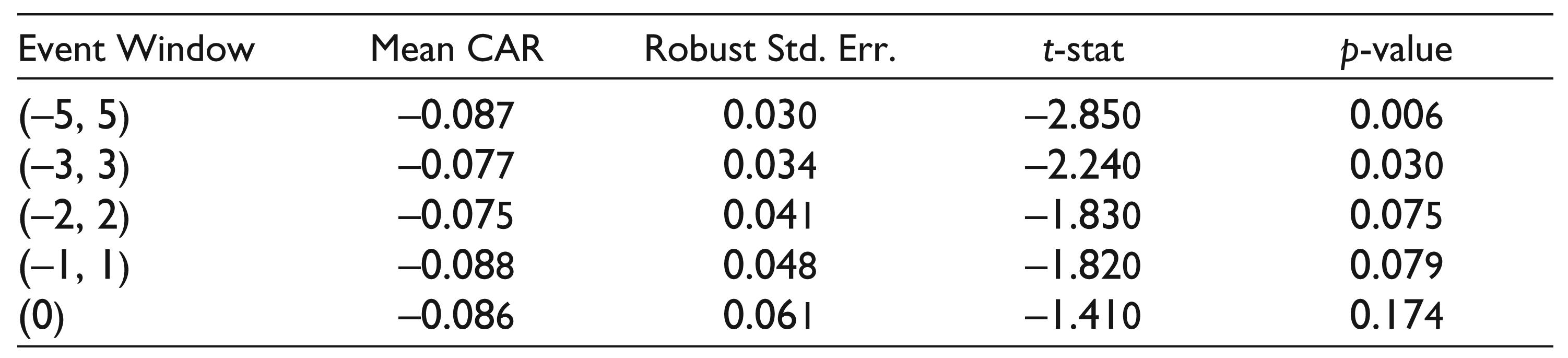
Stock Price Adjustment on JSE to Jamaican General Elections 2002

Stock Price Adjustment on JSE to Jamaican General Elections 2011

Stock Price Adjustment on BISX to Bahamas 2002 General Elections
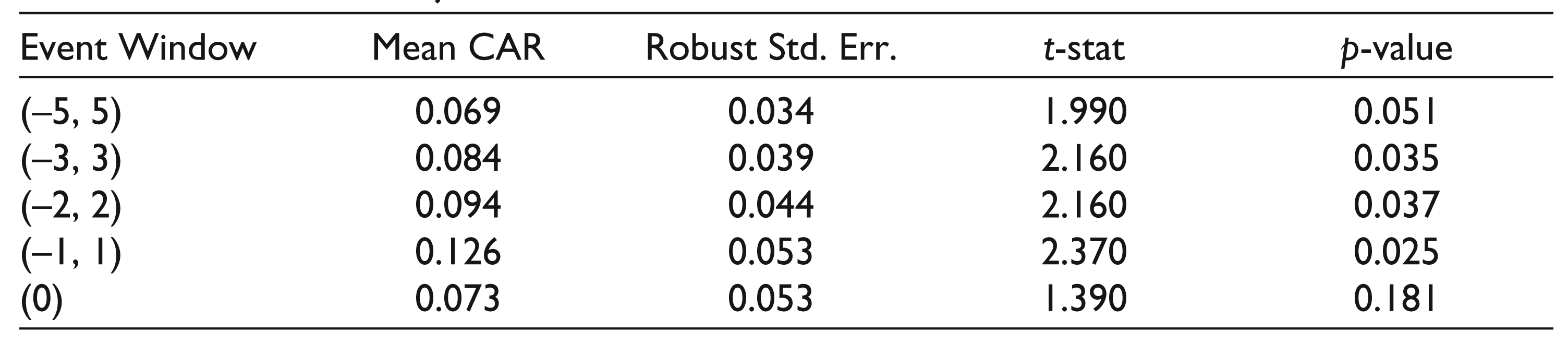
Stock Price Adjustment on BISX to Bahamas 2012 General Elections

Stock Price Adjustment on BSE to Barbados 2008 General Elections
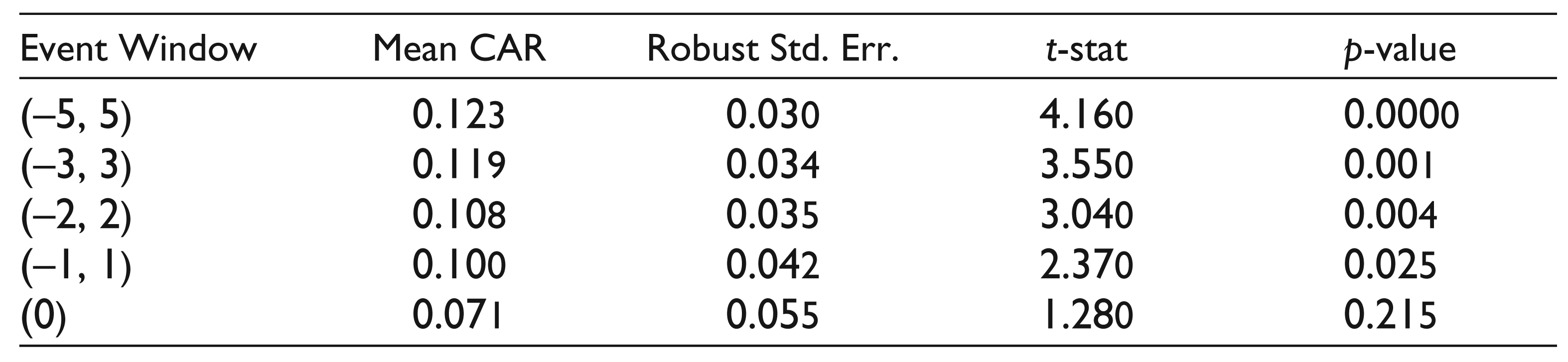
Stock Price Adjustment on BSE to Barbados 2013 General Elections
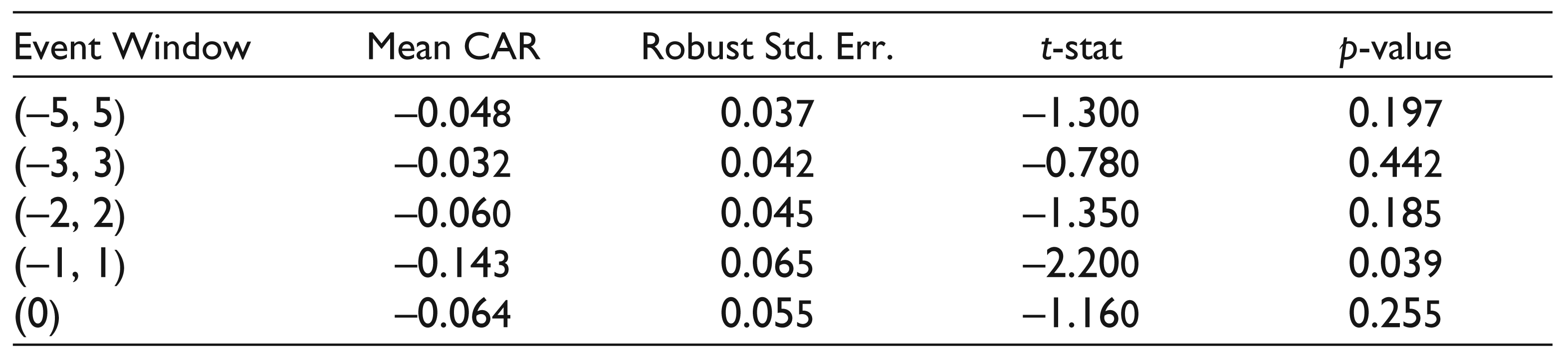
Stock Price Adjustment on TTSE to Trinidad and Tobago 2002 General Elections
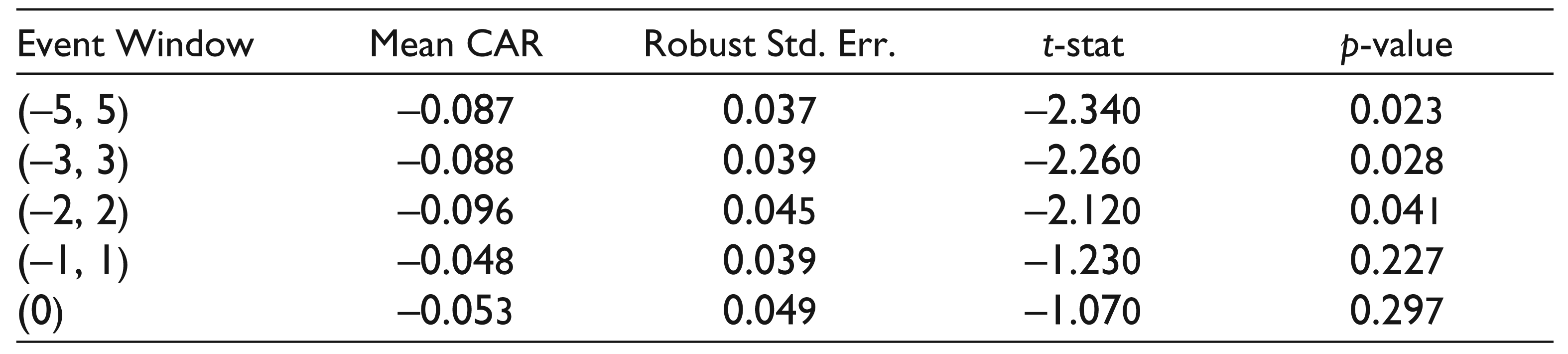
Stock Price Adjustment on TTSE to Trinidad and Tobago 2010 General Elections
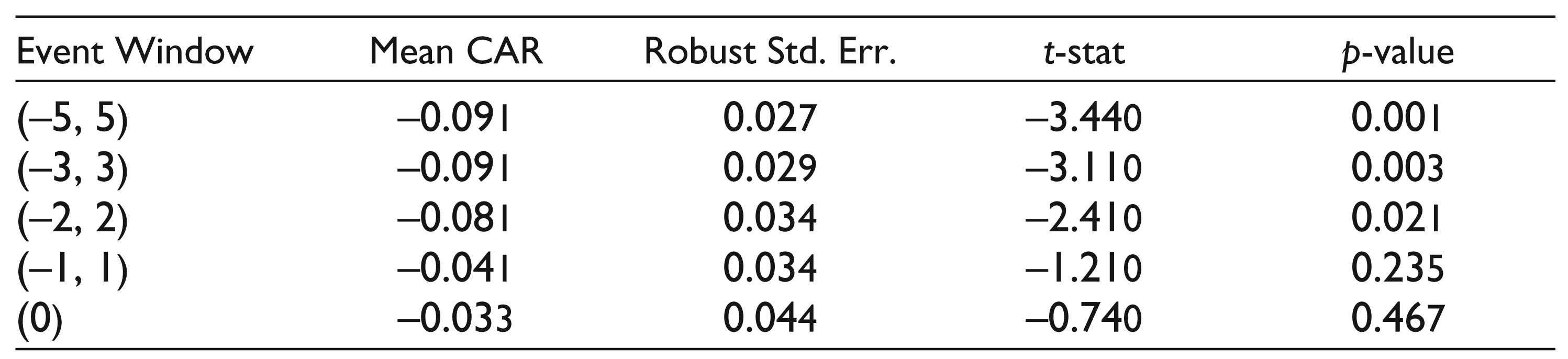
Stock Price Adjustment on ECSE to Grenada 2008 General Elections

The absence of a statistically significant stock price adjustment to any of the 23 sovereign credit rating downgrades is particularly striking in light of the findings from previous studies on stock price reaction to sovereign credit rating reviews. In the context of a semi-strong form efficient market, the absence of a stock price reaction to a credit rating action would imply that investors either do not view sovereign credit ratings and debt yields as relevant information, do not view credit ratings as credible signals for sovereign debt default and yields, investors fully anticipate ratings announcements, hence no reaction to the actual announcement of the rating, or investors have other more credible signals for changes in the likelihood of sovereign debt default or yields.
Given the well-documented negative economic consequences associated with sovereign debt defaults, debt restructurings, increases in sovereign debt yields or reduced market access, it appears difficult to argue that sovereign credit ratings are not relevant information for equity investors. Therefore, unless one can provide evidence as to why credit rating actions are not viewed as credible signals, why investors are able to fully anticipate ratings announcements, or what other more credible signals investors possess, the absence of any statistically significant price adjustment to the 23 sovereign credit rating downgrades, including a downgrade to non-investment grade status (Barbados, 2012) appears inconsistent with semi-strong form market efficiency.
In summary, the delayed stock price reaction to 11 of the 183 events studies in this article, and the absence of a statistically significant stock price reaction to a number of economically significant events and likely relevant events, especially the 23 sovereign credit rating downgrades suggests that the relatively inactive traded stock markets in the Caribbean may not be semi-strong form efficient.
Conclusion
This article uses the event study methodology adjusted for low trading volumes to investigate semi-strong form market efficiency in relatively inactive stock markets. The article studies stock price reaction on 6 of the least active stock markets in the world to 183 events ranging from disasters and catastrophes to the events surrounding the 2007/2008 international financial crisis and Brexit, as a means of shedding some light on this phenomenon.
Among the 183 events studies conducted, there were only three instances of stock price adjustments that were consistent with a semi-strong form efficient market. These were in the cases of the JSE’s reaction to the 11 September 2001 terrorist incidents, the launch of the TARP in the United States 2008 and the announcement of the success of the ‘Leave’ campaign in the referendum on the United Kingdom’s membership of the European Union 23 June 2016 (Brexit).
There was a statistically significant stock price reaction to 2 of the 5 hurricanes and 9 of the 39 general elections studied in this article. However, in all 11 cases, the stock price reaction was significantly delayed which is inconsistent with a semi-strong form efficient market. Stock prices did not adjust to 169 of the 183 events studied in this article. The absence of any stock price adjustment on the BISX, BSE, ECSE, GASCI and TTSE to the 11 September 2001 terrorist bombings or any of the events surrounding the global financial crisis of 2007/2008, the absence of any stock price adjustment on the BISX, BSE, JSE and TTSE to any of the 19 sovereign credit rating downgrades and the absence of any stock price adjustment on the BISX and ECSE to major natural disasters and catastrophes, all appear inconsistent with semi-strong form market efficiency. These findings are also inconsistent with the previous literature documenting stock price reaction to similar events on larger and more actively traded stock markets.
The evidence provided in this article suggests that the six stock markets in the Commonwealth Caribbean may not be semi-strong form market efficient. These six stock markets are among the least active in the world and the results of this study suggests that low levels of trading activity may be associated with semi-strong form market inefficiency. The implication is that stock prices on relatively inactive markets may not fully reflect all relevant publicly available information. As such, it may raise questions as to the utility of such prices in guiding investors and policymakers. If market prices are to play their expected role in guiding asset allocation and promoting economic growth and development, policymakers may do well to focus on measures to enhance the levels of trading activity on relatively inactive stock markets.
Footnotes
Acknowledgements
The authors express their gratitude to the anonymous referees of the journal for their invaluable comments that improved the article. Usual disclaimers apply.