




Abstract
The moderator role of perceived parental power and prestige in relation to perceived parental acceptance and adolescents’ psychological adjustment was analyzed in this study. The sample consisted of 306 adolescents (45% males) within the age range of 16 through 20 years (M = 17.23). Measures used were the child versions of Parental Acceptance–Rejection Questionnaire for mothers and fathers, the youth version of Parental Power–Prestige Questionnaire, and the youth version of Personality Assessment Questionnaire. Results showed that both maternal acceptance and paternal acceptance were significantly correlated with youth’s psychological adjustment, regardless of sex. Neither power nor prestige was significantly correlated with psychological adjustment. Power and prestige were, however, correlated with maternal acceptance among females, but not among males. In addition, parental prestige was negatively correlated with paternal acceptance among females. After controlling for the effects of age, hierarchical multiple regression showed that only perceived maternal acceptance made a unique contribution to the psychological adjustment of females, and only perceived paternal acceptance made a unique contribution to the adjustment of males. However, interpersonal power moderated the relationship between perceived maternal acceptance and females’ psychological adjustment.
Keywords
Introduction from the Editors
In order to avoid unnecessary redundancy across the data-oriented articles in this Special Issue, common issues relevant to all articles are discussed in Rohner’s Introduction (Rohner, 2014). These issues include an introduction to the International Father Acceptance-Rejection Project, of which this article is a part. Common issues also include description of measures used by authors, as well as data analytic procedures employed by all authors. Only information specific to this study is included here.
Method
Participants
Three hundred six adolescents (45% males) were recruited in Istanbul from a private education center designed to prepare high school students for university admission tests. Participants were mostly 11th- and 12th-grade students ranging in age from 16 through 20 years (M = 17.23, SD = 0.67). While the majority of adolescents had at least one sibling, 23.2% of them were only-children. The highest education level of 20% of the mothers and 17% of the fathers was less than high school. Approximately 40% of fathers and 34% of mothers held a 2- or 4-year college degree. The most frequently reported education levels for mothers and fathers were high school (36%) and college (35%).
Measures
Parental Acceptance–Rejection Questionnaire–Short Form (child PARQ)
The short form of the child PARQ (Rohner, 2005) was adapted in Turkish by Yılmaz and Erkman (2008). These authors reported Cronbach’s alpha of .89 for the mother version and .90 for the father version. For the current study, Cronbach’s alpha for mothers was .87, and for fathers, it was .93.
Parental Power–Prestige Questionnaire, youth version (3PQ)
The 3PQ (Rohner, 2011) was adapted in Turkish by Keskiner (2012). Keskiner reported Cronbach’s alpha of .90 for the Power scale and .75 for the Prestige scale. Factor analysis in the current data yielded two distinct factors: a power factor and a prestige factor. Cronbach’s alphas in this study were .75 and .78 for the Power and the Prestige subscales, respectively. The overall alpha was .85.
Personality Assessment Questionnaire (child PAQ)
Adaptation of the PAQ (Rohner & Khaleque, 2005) in Turkish was conducted by Varan (2003). Cronbach’s alpha for the total PAQ in that study was .81. Cronbach’s alpha in this study was .82.
Gender Inequality Scale (GIS)
The GIS (Rohner, 2012) was administered to a sample of 63 respondents (21% men; Mage = 23.38, SD = 5.69), ranging in age from 19 through 41 years. The mean gender inequality score was 17.38 (SD = 2.35). This shows that Turkey was perceived to experience substantial inequality between genders. Females’ and males’ responses to the GIS were not significantly different from each other (t = .79, p = .44). Coefficient alpha for the scale in this study was .68. A principal components factor analysis extracted a single component, which was identifiably a gender inequality factor.
Procedure
Data were collected after the Institutional Ethics Review Board of Boğaziçi University approved the research and parents’ consent was received. The research site has 20 locations around Istanbul. Therefore, participants from different socio-demographic backgrounds were able to be reached. Participation was voluntary, and all respondents experienced family life with both parents during their childhood. However, fathers of four of the adolescents were no longer alive when this research was initiated, and the mother of one adolescent was also deceased. Information about the study was given to participants both orally and in written form, along with instructions about how to fill out the questionnaires. Participants were assured of the anonymity and confidentiality of their answers. The test booklets were prepared such that the Personal Information Form was presented first, followed by the other questionnaires in random sequence.
Results
Table 1 shows that both males and females tended to perceive their mothers and fathers to be loving (accepting) parents. However, males tended to perceive their mothers to be slightly but significantly less accepting than did females. In addition, both sexes tended to report positive psychological adjustment. Beyond this, both males and females tended to agree that their mothers and fathers were approximately equal in interpersonal power and prestige, though males did see their fathers to be slightly but significantly more powerful and prestigious than did females.
Descriptive Statistics and Gender Differences in Measures of Perceived Maternal and Paternal Acceptance, Youth’s Psychological Adjustment, and Interpersonal Power and Prestige.

p < .05.
Intercorrelations displayed in Table 2 show that both maternal and paternal acceptance were significantly correlated with youth’s psychological adjustment regardless of their sex. Neither parental power nor prestige was significantly correlated with youth’s psychological adjustment, but they were significantly correlated with females’ (but not males’) perceptions of maternal acceptance. Finally, perceived parental prestige was negatively correlated with females’ perceptions of paternal acceptance. These results reveal that the more power and prestige females perceived their mothers to have relative to fathers, the more accepting mothers were perceived to be. The results also indicate that the more prestige females perceived their fathers to have relative to mothers the more accepting they were perceived to be.
Correlations Among Maternal and Paternal Acceptance, Interpersonal Power and Prestige, and Youth’s Psychological Adjustment (Nfemale = 168, Nmale = 138).

Note. Coefficients above the diagonal pertain to males; coefficients below the diagonal pertain to females.
p < .01.
To test whether power or prestige moderated the relation between maternal and paternal acceptance (predictor variables) and psychological maladjustment (criterion variable), we used hierarchical multiple regression analysis. Preliminary analyses of the data indicated that there was no multicollinearity problem, and residual distribution did not indicate any nonlinearity or interdependence among scores. However, three outliers were deleted. The basic research question was tested with a three-step hierarchical regression analysis that was run in a manner consistent with Baron and Kenny’s (1986) recommendations for testing for moderator effects. Evidence of moderation would be apparent if there was a statistically significant change in the variance accounted for in the measures of psychological adjustment after the interaction term was added to the model (Cohen & Cohen, 1983). As there were sex differences on three of the five variables shown in Table 1, regression analyses were run for both sexes separately. Before beginning the analysis, all variables were converted to standard scores to avoid a multicollinearity problem. Participants’ ages were entered at Step 1 as a control variable. Four variables (i.e., the main effect of maternal and paternal acceptance along with power and prestige) were entered simultaneously in Step 2. Four 2-way interaction terms were entered at Step 3.
Table 3 reveals that the addition of variables in all three steps of the regression produced statistically significant increments in the variance explained for females’ adjustment, but not for males’ adjustment. More importantly, after controlling for the effects of age, only perceived maternal acceptance (but not paternal acceptance) was found to make a unique contribution to variations in females’ psychological adjustment. Only perceived paternal acceptance (but not maternal acceptance) made a unique contribution to variations in males’ psychological adjustment. Collectively, the four major predictors accounted for 26% of the variance in both males’ and females’ adjustment.
Hierarchical Regression Analyses Predicting Youth’s Psychological Adjustment.

Note. Maternaccept = maternal acceptance; Paternaccept = paternal acceptance.
p < .05. **p < .01.
Finally, results of analyses in Step 3 reveal that only one interaction term (i.e., Maternal acceptance × Power) made a significant and unique contribution to the adjustment of females. There were no significant interactions between variables for males. The meaning of the interaction for females was probed by examining the relationship between females’ perceptions of maternal acceptance and psychological adjustment at high (1 SD above the mean), average (M = 12.90), and low (1 SD below the mean) levels of interpersonal power, following recommendations by Aiken and West (1991) and by Cohen, Cohen, West, and Aiken (2003). As shown in Figure 1, under the +1 SD condition, where fathers were perceived to have slightly more power than mothers, perceived maternal acceptance did not make a significant contribution to females’ psychological adjustment (βhigh = .25, p < .25). However, when females attributed equal power (mean condition) or more power (−1 SD condition) to mothers than to fathers, increases in maternal acceptance were associated with significant increases in females’ psychological adjustment (βmean = .42, p < .001; βlow = .72, p < .001). These results suggest that the magnitude of the relationship between perceived maternal acceptance and females’ psychological adjustment intensified the more power mothers were perceived to have relative to fathers. The magnitude of the relationship was not significantly affected, however, when fathers’ power was perceived to be greater than mothers’.
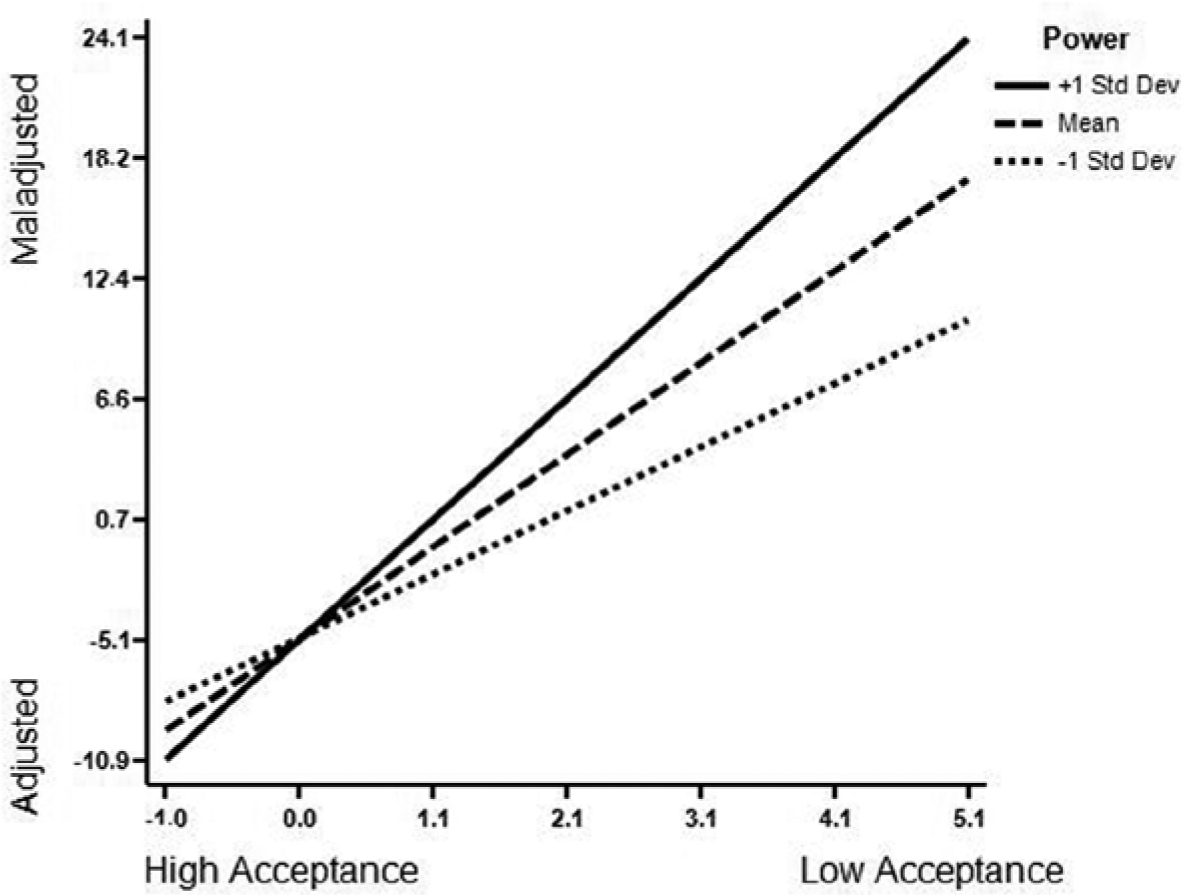
Maternal acceptance predicting females’ psychological adjustment at three levels of parental power.
Discussion
This study explores the differential contribution of perceived paternal versus maternal acceptance to the psychological adjustment of Turkish adolescents under varying conditions of perceived parental power and prestige. In particular, we ask whether the relation between perceived paternal versus maternal acceptance and the psychological adjustment of offspring is significantly moderated by the level of perceived power and/or prestige of each parent within the family.
Initial analyses show that both sexes tend to report fairly positive psychological adjustment, and both sexes tend to perceive their mothers and fathers to be quite accepting—although females report somewhat greater maternal acceptance than do males. Moreover, the psychological adjustment of both males and females is positively correlated with the youth’s perceptions of maternal and paternal acceptance. These findings are consistent with conclusions reported in prior research within Turkey (Çetin, 2005; Erkman & Rohner, 2006; Erkman & Varan, 2004; Yener, 2005). These results are also consistent with the observation that interpersonal relationships in the Turkish family tend to be marked by closeness, as well as by both generational and genderized hierarchical organization (Sunar & Fişek, 2005). Mothers tend to use more direct affection and behavioral control than fathers in their interaction with children, whereas fathers keep their superior position by maintaining a certain emotional distance from their children. In fact, fathers generally interact more with mothers than with their children. But through their interaction with mothers, fathers reach their children indirectly. These observations about Turkish families are supported in this research by the fact that both males and females tend to attribute more interpersonal power and prestige to their fathers than to their mothers. However, hierarchical multiple regression reveals in this study that only perceived maternal acceptance makes a unique or independent contribution to the psychological adjustment of females, whereas only perceived paternal acceptance makes a unique contribution to the adjustment of males. Moreover, these analyses show that the magnitude of the relationship between perceived maternal acceptance and females’ adjustment intensifies to the degree that mothers are perceived to have more power than fathers.
Footnotes
Declaration of Conflicting Interests
The author(s) declared no potential conflicts of interest with respect to the research, authorship, and/or publication of this article.
Funding
The author(s) received no financial support for the research, authorship, and/or publication of this article.