



Abstract
This article explored the effects of perceived maternal and paternal acceptance, power, and prestige on children’s psychological adjustment. The sample consisted of 254 children (59% boys) ages 9 through 12 years (M = 10.88) from Bangladesh. The measures used were the child versions of the Parental Acceptance–Rejection Questionnaire for mothers and fathers, the youth version of the Parental Power–Prestige Questionnaire, and the child version of the Personality Assessment Questionnaire. Results showed that perceived maternal and paternal acceptance were significantly correlated with children’s (both boys’ and girls’) psychological adjustment. However, neither power nor prestige was significantly correlated with either maternal or paternal acceptance, or with children’s psychological adjustment. Results of hierarchical regression analyses revealed that both perceived maternal and paternal acceptance made significant independent contributions to children’s psychological adjustment. In addition, perceived maternal (but not paternal) power significantly moderated the relation between perceived maternal acceptance and children’s psychological adjustment.
Introduction from the Editors
In order to avoid unnecessary redundancy across the data-oriented articles in this Special Issue, common issues relevant to all articles are discussed in Rohner’s Introduction (Rohner, 2014). These issues include an introduction to the International Father Acceptance-Rejection Project, of which this article is a part. Common issues also include description of measures used by authors, as well as data analytic procedures employed by all authors. Only information specific to this study is included here.
Method
Participants
The sample consisted of 254 children (59% boys). Their ages ranged from 9 through 12 years, with a mean of 10.88 years (SD = 1.04). Educational levels varied from fourth through sixth grades. Respondents were selected in convenience sampling from seven schools in Dhaka and Chittagong districts of Bangladesh. Only respondents who grew up in intact nuclear families or larger family units with their mothers and fathers in residence were included in the study. All participants were the biological offspring of their resident parents. Seventy-nine percent of the participants were from middle-class families. About 88% of the respondents’ mothers were engaged in homemaking, while about 96% of the fathers were either in service industries or in business.
Measures
All participants responded to the following self-report questionnaires along with the demographic form. In addition, the Gender Inequality Scale (GIS; Rohner, 2012) was administered to teachers in three public universities. All questionnaires except for the GIS were translated into the Bangla language. The original English version of the GIS was used.
Parental Power–Prestige Questionnaire–Youth version (3PQ: Youth)
The Bangla version (Uddin & Ahmed, 2012a) of the 3PQ (Rohner, 2011) was used in this study. Coefficient alphas in this study were .70 for both the power scale and the prestige scale. Alpha for the total 3PQ was .77. Principal component analysis with Varimax rotation calling out two independent factors was performed to determine the component structure of the measure. The results revealed that all five of the power items loaded more strongly onto Component 1, which was clearly a Power factor, and all five of the prestige items loaded more strongly on Component 2, which was identifiably a Prestige factor.
Parental Acceptance–Rejection Questionnaire for Mother and Father (Child version, short form; Child PARQ: Mother and Father)
Bangla versions (Uddin, 2011) of the Child PARQ: Mother and Father (short form; Rohner, 2005a) were used to assess children’s perceptions about parental (maternal and paternal) acceptance and rejection. Coefficient alphas in this study were .79 for both the mother and the father versions.
Personality Assessment Questionnaire–Child version (Child PAQ)
The Bangla version (Uddin & Ahmed, 2012b) of the Child PAQ (Rohner & Khaleque, 2005) was used to measure children’s overall psychological adjustment. Coefficient alpha for the questionnaire in this study was .78.
Personal Information Form (PIF)
The PIF (Rohner, 2005b) elicited demographic, personal, and social information that included respondents’ gender, age, grade in school, academic achievement, number of siblings, birth order, family size, parental education, parental occupation, family socioeconomic status, and religious affiliation.
GIS
The GIS (Rohner, 2012) was administered to a sample of 58 university teachers (66% men; mean age = 45.34; SD = 10.05), ranging in age from 30 through 64 years. The mean score on the scale was 15.33 (SD = 2.8) revealing that Bangladesh is generally perceived to be a patriarchal society. No significant gender difference in the GIS was observed. The coefficient alpha for the scale in this study was .77. A principal component factor analysis with a Varimax rotation extracted a single component, which was identifiable as a Gender Inequality factor.
Procedure
Written permission to collect data was sought from principals of all schools included in the sample. After receiving permission, all measures were administered to students in classroom settings. Respondents were asked to complete the questionnaires at their own pace. It took 1 hour on average to complete the task. On completion, every respondent was given a token gift with thanks for their participation in the study.
Results
We computed descriptive statistics for perceived maternal and paternal acceptance, perceived maternal and paternal power and prestige, and youth’s psychological adjustment. We also computed t values to test gender differences among these variables. Table 1 shows that both boys and girls perceived their fathers as well as mothers to be fairly accepting. They also perceived their mothers and fathers as having approximately equal power and prestige. In addition, both boys and girls reported themselves to be fairly well-adjusted psychologically. No significant gender difference in any major variable was found. As a result, all further analyses were pooled across the sexes.
Descriptive Statistics and Gender Differences in Measures of Perceived Maternal and Paternal Acceptance, Children’s Psychological Adjustment, and Interpersonal Power and Prestige.
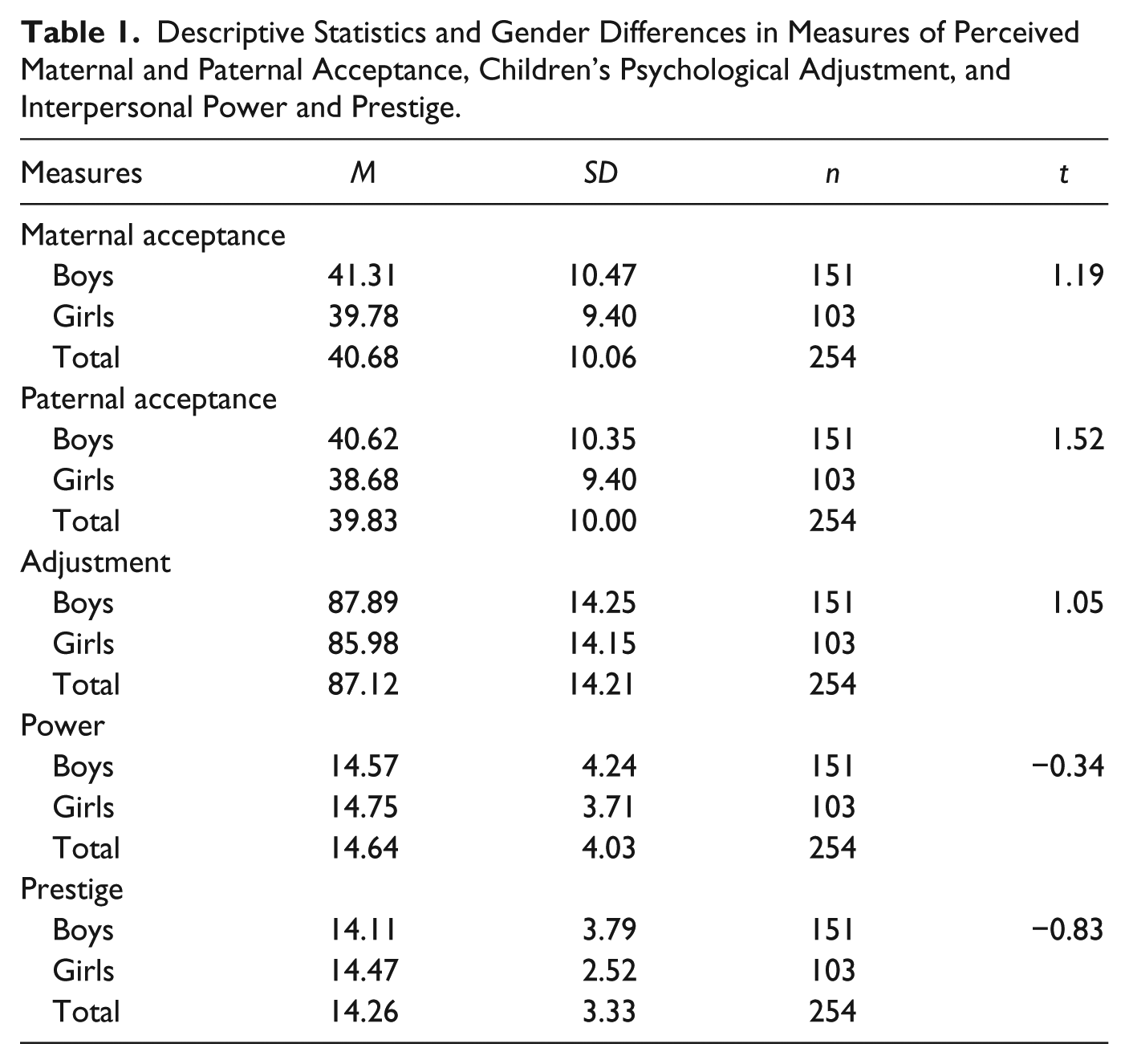
Results of correlation analyses are presented in Table 2, where one can see that neither power nor prestige was significantly associated with maternal acceptance, paternal acceptance, or psychological adjustment. Finally, paternal and maternal acceptance were significantly associated with the psychological adjustment of children.
Correlations Between Maternal and Paternal Acceptance, Power and Prestige, and Children’s Psychological Adjustment.

p < .01.
Since the correlation between power and prestige was less than .75—a common criterion for combining two separate variables into a single composite variable (Kline, 1998)—we conducted hierarchical regression analysis, with power and prestige as separate variables. The analysis was conducted with children’s age and sex entered into Step 1 to control for the possible influence of these variables. In Step 2, we entered youth’s perceptions of maternal and paternal acceptance, along with parental power and prestige to test for main effects. In Step 3, we entered product variables testing for possible interactions between perceived maternal acceptance and parental power or prestige, as well as between perceived paternal acceptance and parental power or prestige. Results are presented in Table 3, where one can see that age significantly but negatively contributed to children’s psychological adjustment in Step 1. This shows that older children tended to be slightly better adjusted than younger children. Maternal and paternal acceptance emerged as unique predictors of children’s psychological adjustment in Step 2. Together, these predictors explained an additional 21% of the variance in children’s psychological adjustment. Adding the interaction terms in Step 3 showed that perceived Maternal acceptance × Power made a small but statistically significant contribution to children’s psychological adjustment. To understand what this interaction meant, we followed recommendations by Aiken and West (1991), and Cohen and Cohen (1983) to plot the interaction between interpersonal power and perceived maternal acceptance. We also tested the statistical significance of simple slopes to probe the interactions shown in Figure 1.
Hierarchical Regression Analyses Predicting Children’s Psychological Adjustment.
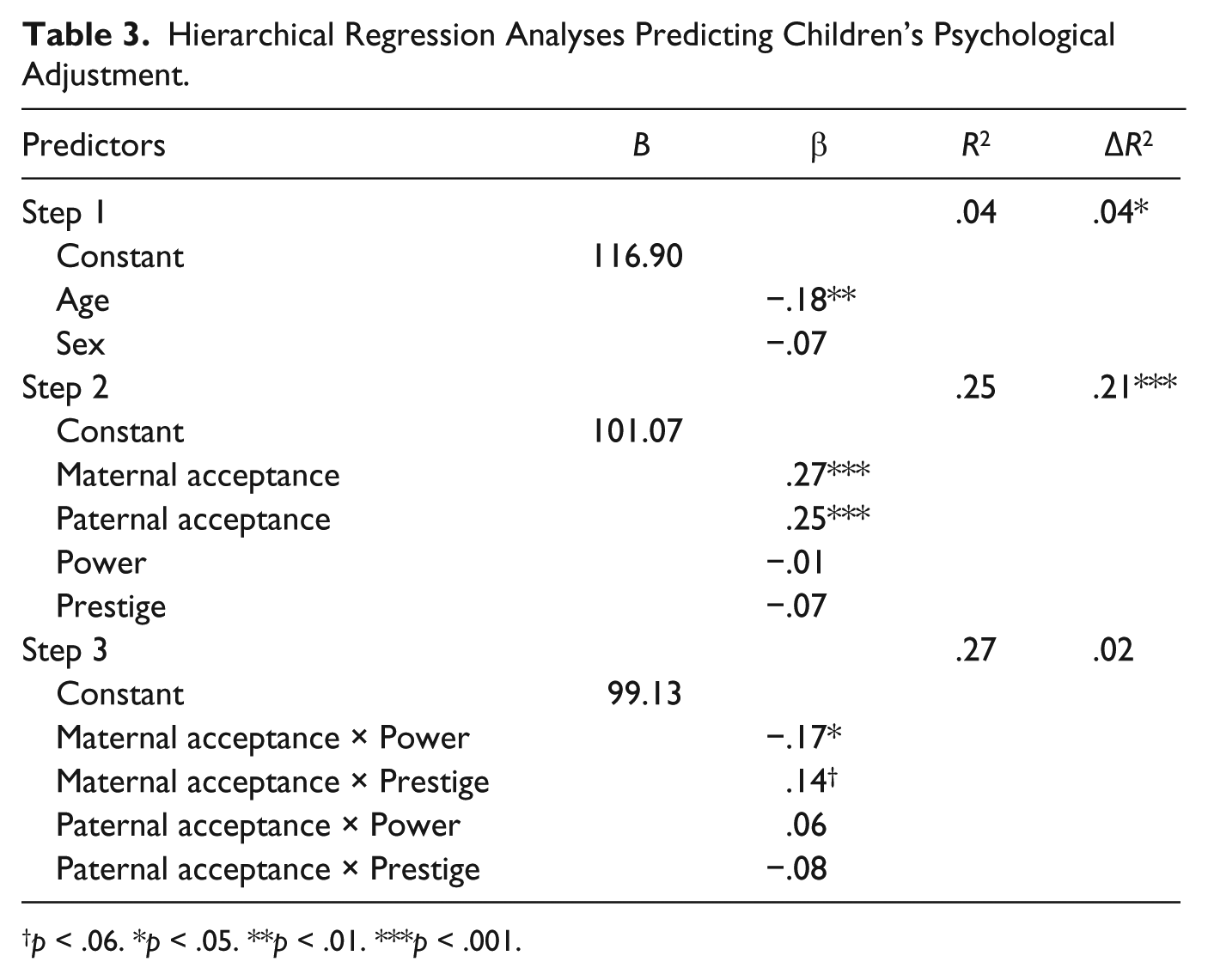
p < .06. *p < .05. **p < .01. ***p < .001.
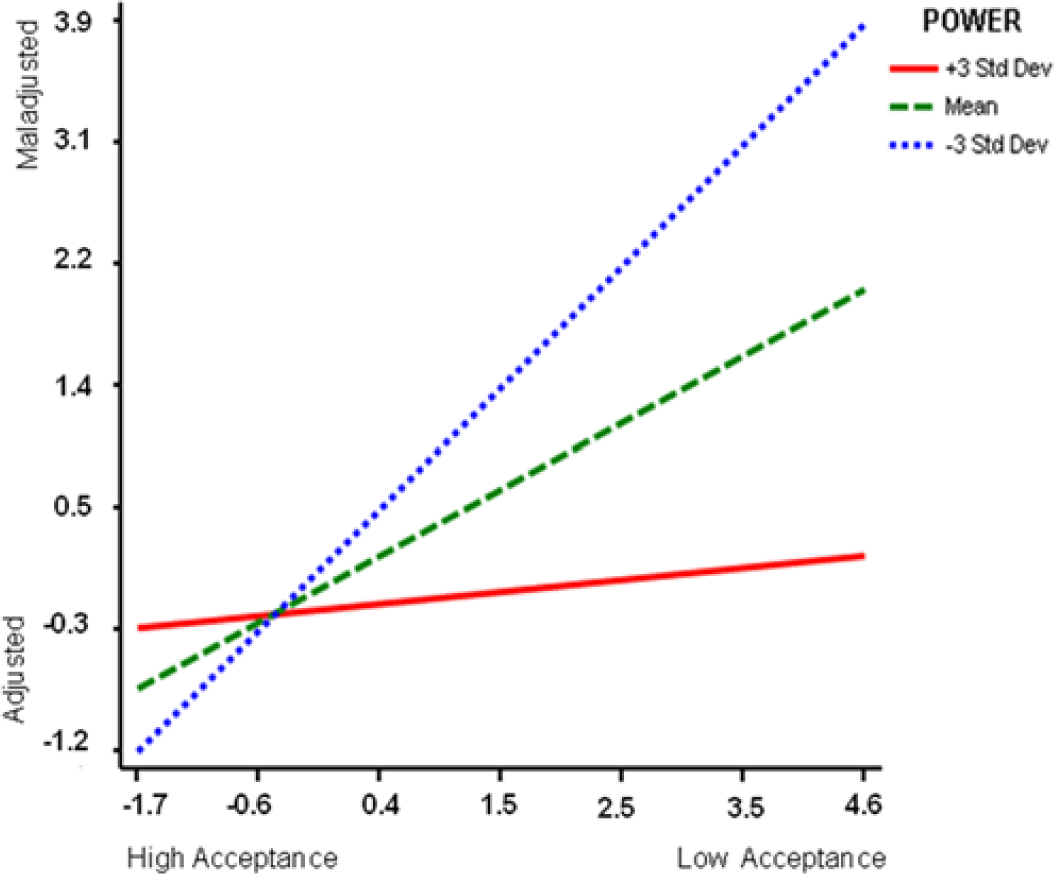
Maternal acceptance predicting children’s psychological adjustment at three levels of parental power.
Oddly, the relationship between perceived maternal acceptance and children’s psychological adjustment was not significantly affected under either the ±1 SD power condition or the ±2 SD power condition. In fact, it was not until the ±3 SD power condition that the statistically significant interaction was revealed. Three standard deviations above and below the mean of 14.64, however, place the scores well beyond the limits of possible scores on the 3PQ. Nonetheless, it appears that under the condition of −3 SD interpersonal power—where mothers were perceived to have the most power (β = .81, p < .001)—or under the condition of mean interpersonal power—where mothers and fathers were perceived to share power equally (β = .44, p < .001)—the relation between perceived maternal acceptance and children’s psychological adjustment was significant. This relationship was not significant, however, under the condition of +3 SD interpersonal power, where fathers were perceived to have the most power (β = .08, p = .65). These results suggest that the magnitude of the relationship between perceived maternal acceptance and children’s psychological adjustment intensified the more power mothers were perceived to have relative to fathers. The magnitude of the relationship was not significantly affected, however, when fathers’ power was perceived to be greater than mothers’.
Discussion
Both boys and girls tend to perceive their mothers and fathers to be quite accepting in Bangladesh. Moreover, they tend to perceive themselves to be fairly well-adjusted psychologically. Results of correlation analyses reveal that both maternal and paternal acceptance correlate significantly with the psychological adjustment of the youth. Furthermore, hierarchical multiple regression analyses indicate that both maternal and paternal acceptance make independent contributions to children’s adjustment, after controlling for the influence of children’s sex and age. In addition, regression analyses indicate that mothers’ (but not fathers’) interpersonal power (and prestige, though only marginally significant) moderate the relation between perceived maternal acceptance and children’s psychological adjustment. Specifically, the more power (and prestige) mothers were perceived to have within the family, the greater the impact of their love-related behaviors (i.e., acceptance or rejection) on the psychological adjustment of their children.
The results of the present study that both maternal and paternal acceptance have significant and independent effects on the psychological adjustment of children are consistent with several other studies (Khaleque & Rohner, 2002; Rohner, Khaleque, & Cournoyer, 2013). Results concerning the interactions partially support the hypothesis that the relation between perceived paternal versus maternal acceptance and psychological adjustment of offspring is significantly moderated by the level of perceived interpersonal power and/or prestige of each parent within the family. That is, our findings confirm the hypothesis that the relation between perceived maternal acceptance and psychological adjustment of offspring is moderated by the level of maternal power, and partially by maternal prestige (marginally significant). However, the results are not consistent with the findings of Khaleque, Rohner, and Shirin (2010) who reported that the contribution of fathers’ acceptance to Bangladeshi children’s adjustment is greater than mothers’ acceptance in families where fathers are perceived by children to have either higher interpersonal power or higher prestige than mothers. This inconsistency could be related to the fact that Khaleque et al. used a two-item measure of power and prestige. Even though that measure correlates significantly with the 3PQ, it may not have fully captured the constructs of power and prestige. Further study is required in Bangladesh to conclusively explain this inconsistency.
Footnotes
Declaration of Conflicting Interests
The author(s) declared no potential conflicts of interest with respect to the research, authorship, and/or publication of this article.
Funding
The author(s) received no financial support for the research, authorship, and/or publication of this article.